
Market Overview
| Study Period | 2021 - 2031 |
|---|---|
| Forecast Data Period | 2026 - 2031 |
| Base Year Market Size (2025) | USD 6.78 Billion |
| Market Size (2026) | USD 7.16 Billion |
| Market Size (2031) | USD 9.38 Billion |
| Growth Rate (2026 - 2031) | 5.55 % |
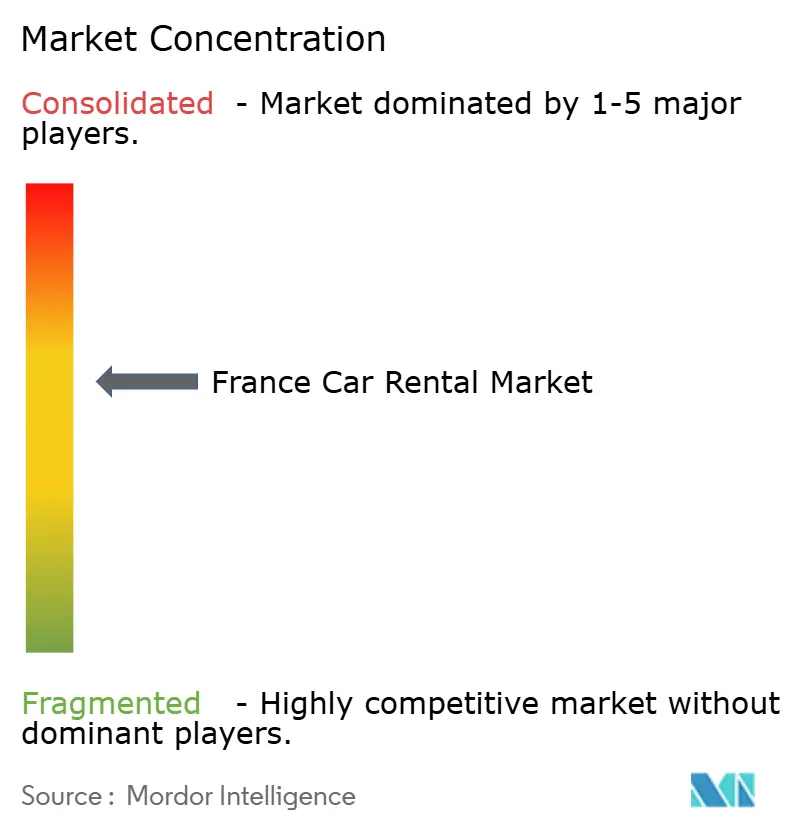
| Market Concentration | Medium |
Major Players *Disclaimer: Major Players sorted in no particular order Image © Mordor Intelligence. Reuse requires attribution under CC BY 4.0. | |
France Car Rental Market Analysis by Mordor Intelligence
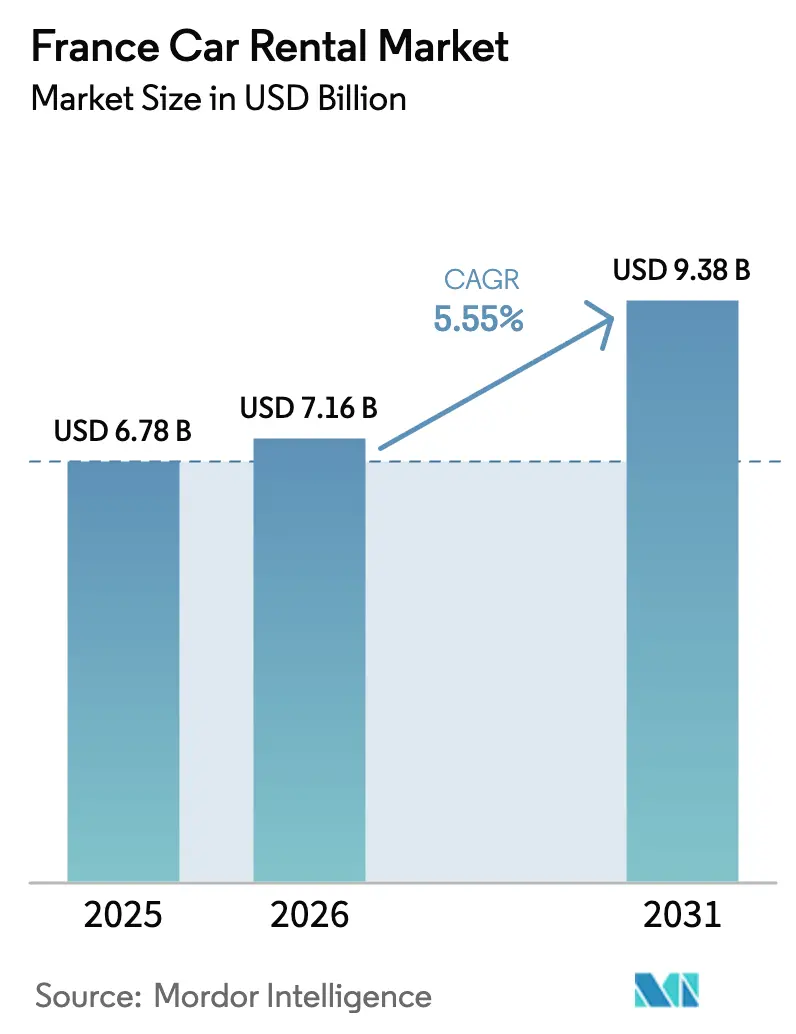
The France Car Rental Market size is expected to grow from USD 6.78 billion in 2025 to USD 7.16 billion in 2026 and is forecast to reach USD 9.38 billion by 2031 at 5.55% CAGR over 2026-2031. Robust inbound tourism, stricter low-emission zone rules, and rapid digital adoption sustain this growth path. The market benefits from the 100 million international visitors welcomed in 2024, renewed domestic travel, and the government’s EUR 1.9 billion Destination France program that upgrades tourism assets. At the same time, 25 active low-emission zones that start restricting Crit’Air 3 vehicles in 2025 accelerate fleet renewal toward cleaner powertrains.
Key Report Takeaways
- By rental duration, short-term services held 73.78% of the France car rental market share in 2025, whereas long-term contracts are poised to grow at a 9.05% CAGR through 2031.
- By booking channel, online platforms commanded 64.10% of the France car rental market share in 2025; the same channel is projected to expand at 9.76% CAGR to 2031.
- By application, leisure and tourism accounted for 58.10% of the France car rental market size in 2025, while business and corporate demand is advancing at an 8.55% CAGR.
- By vehicle class, budget and economy cars led with a 68.15% of the France car rental market share in 2025; premium and luxury rentals are forecast to climb at a 12.08% CAGR.
- By propulsion, internal combustion engines still represent 86.55% of the France car rental market share in 2025, yet battery-electric vehicles are growing fastest at a 15.30% CAGR.
- By pickup location, airports supplied 53.05% of the France car rental market share in 2025, whereas off-airport sites are set to post a 9.15% CAGR.
- By client type, individual renters controlled 70.65% of the France car rental market share in 2025, while corporate fleets are expected to rise at an 11.22% CAGR.
Note: Market size and forecast figures in this report are generated using Mordor Intelligence’s proprietary estimation framework, updated with the latest available data and insights as of 2026.
France Car Rental Market Trends and Insights
Drivers Impact Analysis*
| Driver | (~) % Impact on CAGR Forecast | Geographic Relevance | Impact Timeline |
|---|---|---|---|
| Growth in Inbound and Domestic Tourism Flows | +1.4% | National, with concentration in Paris, Nice, Lyon | Medium term (2-4 years) |
| Surge in On-demand, App-based Booking Platforms | +1.2% | Urban centers, expanding to rural areas | Short term (≤ 2 years) |
| Corporate Demand for Flexible Mobility Solutions | +0.9% | Business districts in Paris, Lyon, Marseille | Medium term (2-4 years) |
| Government Incentives for Electric-Vehicle (EV) Rentals | +0.6% | National, with higher uptake in ZFE cities | Long term (≥ 4 years) |
| ESG-Driven Fleet Electrification Targets of Corporates | +0.5% | Corporate headquarters in major cities | Long term (≥ 4 years) |
| Multi-Modal Packages with Rail and Air Operators | +0.4% | Airport hubs and SNCF stations nationwide | Medium term (2-4 years) |
| Source: Mordor Intelligence | |||
Growth in inbound & domestic tourism flows
Tourism returned to record performance as France hosted 100 million overseas visitors in 2024, generating EUR 71 billion in receipts in the same year.[1]“Où trouver des informations statistiques officielles sur le tourisme ?”, Ministère de l'Économie, economie.gouv.fr The Destination France plan channels EUR 1.9 billion into hospitality upgrades, while events such as the Rugby World Cup and the 2024-25 Olympic cycle elevate global exposure. Rural regions that lack dense public transit particularly benefit as travelers secure cars for winery, heritage, and ski itineraries. The World Travel & Tourism Council projects sector GDP contribution to rise to EUR 310.5 billion by 2034, a signal of durable demand.[2]“France’s Travel & Tourism Broke All Records Last Year,” WTTC, wttc.org This tourism momentum underpins consistent leisure rental volumes and lengthier bookings in secondary cities.
Surge in on-demand, app-based booking platforms
Free2move’s new mobility app aggregates rental, car-sharing, and subscription vehicles, accessing more than 500,000 units worldwide.[3]“Free2move Launches the New Mobility App,” Stellantis, stellantis.com Getaround’s global app overhaul, backed by USD 20 million financing, underscores the competitive edge of mobile-first design. Integrated payment, one-click insurance, and real-time vehicle tracking lower acquisition costs and improve fleet utilization. Traditional agencies lagging on user-interface upgrades risk customer churn as peer-to-peer platforms expand inventory transparency and social reviews.
Corporate demand for flexible mobility solutions
Enterprise clients are migrating from ownership to usage-based contracts. Enterprise Mobility recorded a 15% jump in corporate program membership, citing stronger sustainability alignment and lower total cost of mobility. Mobilize Financial Services expanded operational leases by 35% in H1 2024, financing 101,450 vehicles and targeting a one-million-unit fleet by 2030. Companies favor predictable monthly charges that shift fleet costs from capex to opex while meeting ESG milestones. This tilt increases average revenue per unit and encourages operators to offer bundled charging, telematics, and consolidated invoicing.
Government incentives for electric-vehicle rentals
The EUR 100-per-month social leasing scheme drew more than 90,000 applications in six weeks, forcing a temporary halt and highlighting pent-up demand for affordable EV access. An added EUR 200 million under the ADVENIR program targets 400,000 public chargers by 2030, backing fleet electrification. Battery-electric models therefore post the highest CAGR even though ICE units dominate today. Rental firms that front-load EV acquisitions gain preferential entry to ZFE cities and secure subsidies that cushion total cost of ownership.
Restraints Impact Analysis*
| Restraint | (~) % Impact on CAGR Forecast | Geographic Relevance | Impact Timeline |
|---|---|---|---|
| Intensifying Competition | -1.2% | Urban centers, particularly Paris and Lyon | Short term (≤ 2 years) |
| High Operating and Fleet Depreciation Costs | -1.1% | National, affecting all operators | Medium term (2-4 years) |
| Shifts Toward Car-Free Urban Lifestyles | -0.7% | Metropolitan areas with strong public transport | Long term (≥ 4 years) |
| Low-Emission-Zone (ZFE) Restrictions on ICE Rentals | -0.6% | 25 ZFE cities, expanding to 40+ by 2025 | Medium term (2-4 years) |
| Source: Mordor Intelligence | |||
Intensifying competition from ride-hailing & car-sharing
Ride-hailing apps and car-sharing fleets erode traditional rental share in dense urban cores. Turo’s acquisition of peer-to-peer pioneer OuiCar added thousands of privately owned cars available from EUR 20 per day, widening price points and vehicle variety. Getaround’s Europe-focused overhaul, combined with Heetch’s licensed nighttime services, raises convenience expectations among millennial users. This competitive mix compresses margins at airport counters and forces incumbents to bundle loyalty perks, valet delivery, or premium subscription tiers that justify higher daily rates.
High operating & fleet depreciation costs
Financing rates jumped from 2% to 8% between 2022 and 2024, inflating vehicle holding costs across the France car rental market. Hertz’s decision to sell 20,000 EVs and record a USD 245 million impairment underscores risk when battery models face unexpected repair bills and residual value swings. Automakers are prioritizing higher-trim production, which compels rent-a-cars to acquire costlier vehicles that may not align with economy travelers. Smaller operators unable to absorb depreciation volatility are poised to exit, tightening supply but also concentrating bargaining power among major brands.
*Our forecasts treat driver/restraint impacts as directional, not additive. The impact forecasts reflect baseline growth, mix effects, and variable interactions.
Segment Analysis
By Rental Duration: Long-Term Gains Momentum
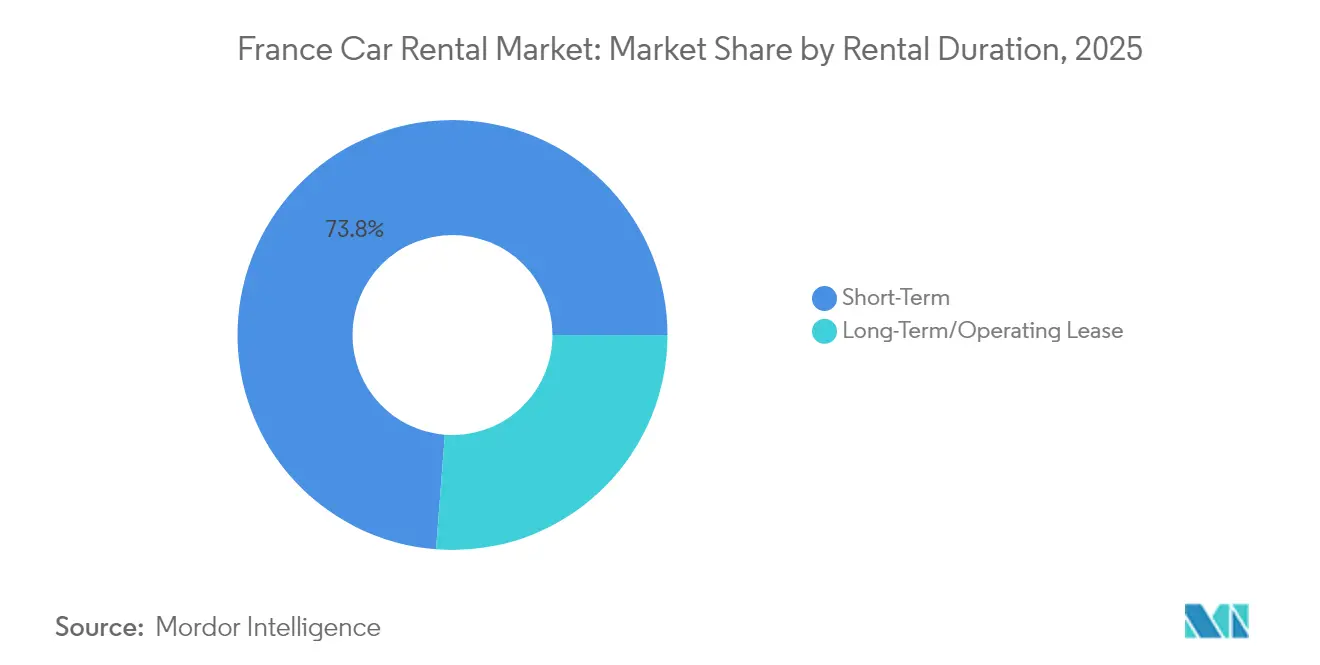
Short-term hire retained 73.78% share of the France car rental market in 2025, a reflection of tourist-heavy demand patterns. Nonetheless, long-term and operating leases are projected to expand at 9.05% CAGR and will lift the France car rental market size for contracted rentals to USD 2.28 billion by 2031. Adoption is driven by corporate fleet outsourcing and subscription programs that sidestep depreciation risk.
Long-term contracts appeal to businesses that track emissions under ESG targets and require predictable monthly charges. Mobilize Financial Services’ portfolio growth demonstrates the shift, while leisure travelers continue to favor day-based rentals for quick getaways. The France car rental market therefore balances steady tourist volume with higher-margin corporate agreements.



By Booking Channel: Digital Dominance Accelerates
Online portals delivered 64.10% of the France car rental market share in 2025 and will add another USD 1.62 billion to the France car rental market size by 2031. The channel’s 9.76% CAGR is sustained by mobile payments, biometrics, and instant damage recording that cut counter wait times.
Offline counters at airports and train stations still attract walk-in customers and travelers unfamiliar with local apps. Yet most incumbents now pursue omnichannel strategies, ensuring that the same promotion codes, loyalty points, and optional coverages align across digital and physical points of sale, preserving brand consistency.
By Application: Business Segment Emerges
Leisure travel contributed 58.10% of France car rental market revenue in 2025, anchored by resilient tourism flows. Corporate travel, however, grows faster at an 8.55% CAGR and will nudge its share to nearly one-third of the France car rental market size by 2031.
Company travel policies increasingly substitute mileage reimbursement with on-demand rental allowances or pooled subscription vehicles. Integrated expense software and centralized billing shorten administration cycles and incentivize finance departments to switch from gray-fleet arrangements.
By Vehicle Class: Premium Segment Accelerates
Budget and economy cars comprised 68.15% of the France car rental market share in 2025, yet premium and luxury models climb at a 12.08% CAGR, lifting their slice of France car rental market value by 2031. High-net-worth travelers on the French Riviera and corporate executives on tight itineraries request advanced safety tech, brand prestige, and concierge delivery.
Economy units remain indispensable for cost-sensitive backpackers and domestic road trippers, but margin compression persists as fuel prices and insurance outlays outpace daily rates. Operators offset this by upselling GPS, child seats, and zero-excess packages.
By Propulsion Type: Electric Revolution Begins
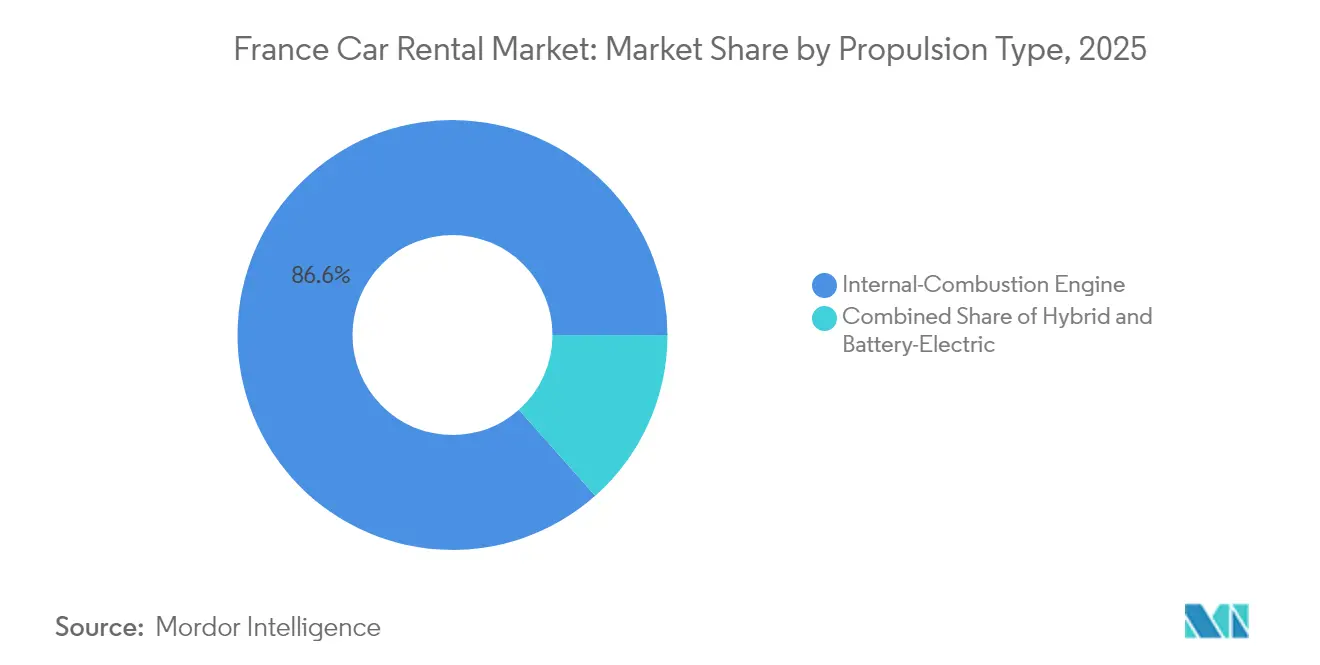
Internal combustion vehicles still hold an 86.55% France car rental market share in 2025 because of lower acquisition costs and dense refueling infrastructure; however, tightening emissions rules and corporate ESG mandates push fleets toward hybrids and full electrics. Plug-in hybrids offer a transitional option for long-distance travelers wary of charge-point queues, while connected-car data lets agencies monitor state of charge and reroute vehicles to fast chargers during idle time.
Battery-electric vehicles contributed little to overall rentals in 2025, but they delivered the segment’s fastest CAGR at 15.30%, setting the France car rental market size for EV fleets on a path to nearly triple by 2031.
By Pickup Location: Off-Airport Gains Traction
Airport counters generated 53.05% of 2025 France car rental market share and remain the entry point for most long-haul visitors due to integrated desks at Charles de Gaulle, Orly, Lyon–Saint-Exupéry, and Marseille Provence terminals. These locations benefit from established shuttle loops and airline codeshare promotions, locking in high-margin ancillary sales such as zero-excess insurance and GPS units.
Off-airport branches already post a 9.15% CAGR and are forecast to capture an additional USD 675 million of France car rental market size by 2031. Operators deploy digital key boxes in hotel lobbies, railway stations, and underground garages, trimming shuttle costs and freeing scarce airport real estate for premium upgrades.
By Client Type: Corporate Growth Accelerates
Individual renters accounted for 70.65% of total France car rental bookings in 2025, driven by France’s record 100 million tourist arrivals and a domestic culture that favors weekend road trips. Tourists typically opt for compact petrol cars to manage fuel costs and avoid unfamiliar charging etiquette, preserving volume and baseline fleet turnover. Families booking in advance through airline portals still generate the bulk of prepaid revenue and fill vehicles with high mileage during summer peaks.
Corporate fleet customers, though still smaller, are expanding at an 11.22% CAGR and will lift their slice of France car rental market share to almost one-third by 2031. Enterprise Mobility’s 15% annual jump in French corporate memberships stems from ESG-linked reporting tools that track CO₂ per kilometer and consolidate invoices for finance teams.
Geography Analysis
The French car rental market revolves around Île-de-France, with Paris airports serving as gateways for bookings. Charles de Gaulle facilitates multi-brand pick-up plazas where global loyalty members bypass counters through smartphone verification. Lyon and Marseille emerge as secondary hubs, combining robust corporate districts and expanding cruise traffic that feeds weekend rentals.
Southeast regions led by Nice, Cannes, and Monaco command premium rates, often 45% above the national daily average, due to their concentration of luxury tourism. Winter peaks in Alpine départements double fleet utilization for SUVs fitted with snow chains, while Bordeaux and Burgundy wineries drive shoulder-season demand.
ZFE rollout introduces a patchwork of compliance requirements. Paris and Lyon begin Crit’Air 3 restrictions in 2025, compelling operators to allocate newer Euro 6 or electric vehicles to these cities. Service design therefore adapts: fleets rotate older diesels toward rural branches and move EVs to urban depots equipped with fast chargers. Operators with nationwide networks gain efficiency by repositioning assets around evolving local rules.
Regulatory Landscape
France car rental operations sit under a mix of national consumer-protection oversight and mobility-decarbonization policies that increasingly influence fleet composition and contract design. The DGCCRF (General Directorate for Competition, Consumer Affairs and Fraud Control) inspects rental and leasing practices for pricing transparency and contract fairness, and its recent controls have flagged compliance issues across a significant share of inspected establishments. That has pushed operators to tighten fee disclosure, pre-authorizations, and claims processes.
On the environmental side, low-emission-zone (ZFE) enforcement in 2025, including Crit’Air 3 restrictions in key cities such as Paris and Lyon, accelerates allocation of newer Euro 6, hybrid, and battery-electric vehicles into affected urban branches. From January 1, 2026, France updated its automotive ecological penalty framework for new vehicles, using taxes linked to CO2 emissions and vehicle weight, which affects rental fleet renewal economics and residual value strategies. EV-access support also includes program controls, for example social leasing eligibility limited to new electric vehicles and registration via the Service and Payment Agency (ASP), reinforcing compliance documentation needs for operators participating in incentive-linked offers.
Value Chain Analysis
The France car rental value chain starts with fleet sourcing and financing (OEM and leasing partners), then moves into fleet preparation (registration, insurance, and telematics fitment), operations (airport and off-airport branches, and vehicle delivery or key-box logistics), and ends with remarketing and residual value management. Large operators such as Enterprise, SIXT, and Europcar run multi-site networks spanning airports and regional depots, while digital platforms enable contactless pickup and returns that reduce counter staffing pressure and improve utilization in peak tourist corridors.
Cost and compliance signals are increasingly fed into upstream procurement and midstream fleet rotation. ZFE rules and the 2026 ecological penalty on new vehicles increase incentives to prioritize lower-emission models for urban depots, while older internal-combustion inventory is shifted toward lower-constraint areas, changing inter-branch repositioning patterns. On the enabling-services layer, operational efficiency programs and IT modernization are becoming more central to the chain, reflected in Europcar Mobility Group efforts over 2025-2026 to streamline operations and upgrade systems. Public bodies such as ADEME, alongside research partners (for example 6t-Bureau de recherche), also provide market and usage datasets for shared mobility that inform how fleets are sized and placed for station-based and loop-based models.
Competitive Landscape
The France car rental market is moderately concentrated. International majors—Enterprise Holdings, Hertz, Europcar Mobility Group, and SIXT—leverage airport concessions, scale purchasing power, and recognizable brands. SIXT’s order for up to 250,000 Stellantis cars ensures connected vehicles and fuels European expansion while phasing out Teslas due to high repair bills. Enterprise Mobility posted record global revenue above USD 38 billion in FY24, achieving double-digit growth in France through technology upgrades and differentiated service tiers.
Digital challengers intensify rivalry. Free2move’s integrated app now covers rental, car-sharing, and subscription from a single login, reflecting convergence of mobility products. Peer-to-peer sharing gains legitimacy after Turo’s acquisition of OuiCar, adding community trust and nationwide insurance packages.
Rising capital requirements from fleet electrification and the need for advanced telematics likely push smaller independents toward exit or acquisition. Meanwhile, premium positioning and flexible subscriptions provide revenue resilience for brands that can sustain investment in both EV infrastructure and intuitive apps.
France Car Rental Industry Leaders
SIXT SE
Avis Budget Group
The Hertz Corporation
Europcar Mobility Group
Enterprise Holdings, Inc.
- *Disclaimer: Major Players sorted in no particular order

Market Opportunities and Future Outlook
Urban compliance and affordability programs are creating tangible openings for EV-forward rental and subscription propositions, particularly in ZFE cities where access rules are tightening. The government-backed social EV leasing program resumed from July 16, 2026, with advertised rents under EUR 200 per month for a three-year term, which supports consumer familiarity with electric driving and widens the pool of renters comfortable with EVs. At the same time, national charging support such as the ADVENIR funding add-on (EUR 200 million) and the broader push toward 400,000 public chargers by 2030 improve operational feasibility for electric rental fleets, especially when paired with depot charging and connected-vehicle monitoring.
Opportunities are also building around contactless access and multimodal nodes. Enterprise Mobility France highlights rising demand for counter-less collection using connected key boxes at transport hubs, including Lyon and Montparnasse stations, which supports off-airport growth and higher fleet turnover in dense corridors where counter capacity is constrained. Car-sharing integration is another adjacent pathway: the Loi d'Orientation des Mobilites (LOM) requires local mobility authorities (AOM) to provide alternatives that include car-sharing, and policy targets for shared-vehicle scale, including a 70,000 shared-vehicle objective by 2031, align with operator and municipality partnerships. ADEME survey indicators showing broad awareness of car-sharing among driving-license holders support product bundling across rental, subscription, and short-duration sharing, particularly for commuting and first or last-mile use cases outside traditional airport demand.
Recent Industry Developments
- April 2026: SIXT SE with Signature Aviation to provide premium mobility services at over 30 private aviation terminals in Europe, including Paris Le Bourget and Nice. The collaboration expands access to high-value international travelers and strengthens the platform ecosystem in France and Europe.
- April 2026: Europcar Mobility Group exclusive partnership with MIC Co., Ltd. to enable global booking through Europcar platform (effective from April 10, 2026). The partnership gives global cross-market fleet access and expands inventory, boosting competitiveness in premium and international segments in France.
- January 2024: SIXT SE and Stellantis enter agreement for up to 250,000 vehicles supply to SIXT rental fleet through 2026. The capacity addition supports fleet expansion and electrification readiness relevant to French market dynamics.


Research Methodology Framework and Report Scope
Market Definition and Coverage
For this study, the France car rental market covers paid, short-term access to passenger vehicles and vans that are rented without a driver, across airports and city locations, and booked through offline and online channels.
Scope exclusions: We exclude chauffeur services, taxis, ride-hailing, car sharing membership fees, and pure vehicle leasing products that are structured as long-term contracts.
Segmentation Overview
- By Rental Duration
- Short-Term (Less than or equal to 30 days)
- Long-Term / Operating Lease (More than 30 days)
- By Booking Channel
- Online
- Offline
- By Application
- Leisure / Tourism
- Business / Corporate
- By Vehicle Class
- Budget / Economy
- Premium / Luxury
- By Propulsion Type
- Internal-Combustion Engine
- Hybrid
- Battery-Electric
- By Pickup Location
- Airport
- Off-Airport (Rail-Station, Downtown, Hotel, etc.)
- By Client Type
- Individual
- Corporate Fleet
Data Sources, Market Sizing, and Validation
Desk Research
Desk work starts by setting a realistic demand and supply context for France, so the sizing does not drift away from travel and fleet reality. Public sources are used heavily, such as INSEE for macro and household travel indicators, Eurostat for tourism nights and travel flows, the French Civil Aviation Authority (DGAC) and airport operator traffic releases for passenger volumes, and the Banque de France for exchange rate series.
We also review Ministry of Ecological Transition publications and local government updates on low-emission zones to understand timing impacts on fleet renewal and availability, which then affects pricing. Company annual reports, investor presentations, and reputable press are used to cross-check fleet direction, utilization commentary, and channel mix shifts, and a few paid subscriptions support company financial intelligence, news and financials, and shipment-level import and export checks tied to vehicle replacement cycles. These desk sources are not exhaustive, and many other references are used to collect data, validate assumptions, and clarify open questions during the research.
Primary Interviews and Surveys
Primary work focuses on converting desk signals into working assumptions, especially around average day rates by season, add-on attachment (insurance and extras), and airport versus downtown mix. We speak with a mix of operator-side roles, intermediaries, fleet-related contacts, and corporate travel buyers, and then we re-check the same assumptions across different parts of France so one-city dynamics do not distort the national picture.
Distribution of primary research fieldwork respondents
| Company type | Respondent position |
|---|---|
| Top tier: 34% | CXOs: 12% |
| Mid tier: 48% | Functional/Unit leaders: 37% |
| Smaller Players: 18% | Managers: 51% |
Market-Sizing & Forecasting
Sizing is built using a top-down and bottom-up logic, where the top-down side reconstructs the addressable demand pool from travel activity and rental penetration, before totals are corrected using selective supplier and channel checks. We start from indicators like airport passenger volumes, tourism arrivals and nights, and the split between leisure and business travel, which are then translated into estimated rental days at a national level.
Revenue is modeled through ASP logic that reflects day-rate levels, length-of-rent patterns, seasonality, and the share of revenue coming from add-ons (such as protection products and one-way fees). Fleet renewal cadence and powertrain mix are used as practical checks because they influence availability, operating costs, and rate movement during peak periods. When a direct input is missing, the gap is handled by using interview-backed ranges, followed by consistency checks that keep implied utilization and revenue per vehicle within reasonable bounds.
For forecasting, we mainly use scenario analysis supported by a light multivariate regression view on demand drivers, since tourism momentum, city restrictions, and price normalization can shift faster than long-run averages suggest. The final outlook is selected after aligning the model path with primary inputs on expected day-rate progression and channel mix changes.
Data Validation & Update Cycle
Validation is done through repeated comparisons between model outputs and independent signals, such as airport traffic direction, tourism nights, and implied revenue per rental day. Large jumps are flagged and reviewed, and if the change is not explained by a known event, we revisit assumptions and re-contact relevant interviewees for confirmation.
Before sign-off, the work is reviewed in multiple steps so calculation logic, unit consistency, and FX handling are checked again. Reports are refreshed annually, with interim updates when material events occur, and just before delivery an analyst performs a fresh pass so clients receive the most current view.
Mordor Intelligence's France Car Rental Market Size Compared With Other Published Estimates
Published values for the France car rental market can differ even when everyone is talking about the same country, because FX timing, the way day rates are averaged across seasons, and what is treated as rental revenue versus mobility services are not standardized.
Because daily-rate curves and the EUR to USD conversion point are refreshed close to publication and then rechecked against travel signals like passenger traffic and tourism nights, Mordor Intelligence ends up with a 2025 value that can sit apart from estimates that rely on older rate snapshots or simpler annual averages.
Benchmark comparison
| Source | Market Size | Gaps in Research Methodology |
|---|---|---|
| Mordor Intelligence | USD 6.78 B (2025) | |
| Trade Portal A | USD 6.95 B (2024) | Presented as France car rental revenue in EUR and commonly converted using a different FX point, and the coverage is not always clear on whether ancillary mobility fees are included alongside rental charges. |
| Industry Newsletter B | USD 5.90 B (2024) | Applies a more conservative day-rate assumption with weaker seasonality lift and appears to undercount airport-led demand, which reduces implied rental days and total revenue. |
Overall, the spread is mostly explained by differences in year selection, currency conversion timing, and how seasonality and add-ons are treated inside the average day-rate build. When these drivers are made explicit and tested against simple demand and utilization checks, the market size becomes easier to trace and to repeat in future updates.


Key Questions Answered in the Report
What is the current size of the France car rental market and how fast is it growing?
The market is worth USD 7.16 billion in 2026 and is forecast to reach about USD 9.38 billion by 2031 on a 5.55% CAGR trajectory.
Which factors are driving the strongest demand for rental cars in France?
Record tourism of 100 million overseas visitors in 2024, the EUR 1.9 billion Destination France program, and 64.10% online booking uptake are the main growth engines.
How quickly are electric vehicles gaining share in French rental fleets?
Battery-electric rentals are advancing at a 15.30% CAGR and are expected to nearly triple their fleet footprint by 2031, helped by EV leasing incentives and expanding charge points.
What impact will low-emission zones (ZFE) have on rental operations?
From January 2025, 25 ZFEs will restrict Crit’Air 3 cars, compelling agencies to deploy cleaner vehicles but granting those fleets unrestricted city-center access.
Why are off-airport pickup sites becoming more popular?
Off-airport locations are growing at a 9.15% CAGR as travelers avoid congestion fees and favor digital key boxes in city centers for faster, cheaper vehicle release.
How fast is corporate demand for rental cars expanding?
Corporate fleet clients are rising at an 11.22% CAGR through 2031, driven by companies replacing owned cars with long-term rental contracts that include CO₂ tracking and consolidated billing.
Page last updated on:





