
Forensic Technology Market Size and Share
Market Overview
| Study Period | 2020 - 2031 |
|---|---|
| Market Size (2026) | USD 7.01 Billion |
| Market Size (2031) | USD 10.75 Billion |
| Growth Rate (2026 - 2031) | 8.92% CAGR |
| Fastest Growing Market | Asia-Pacific |
| Largest Market | North America |
| Market Concentration | Medium |
Major Players *Disclaimer: Major Players sorted in no particular order Image © Mordor Intelligence. Reuse requires attribution under CC BY 4.0. | |
Forensic Technology Market Analysis by Mordor Intelligence
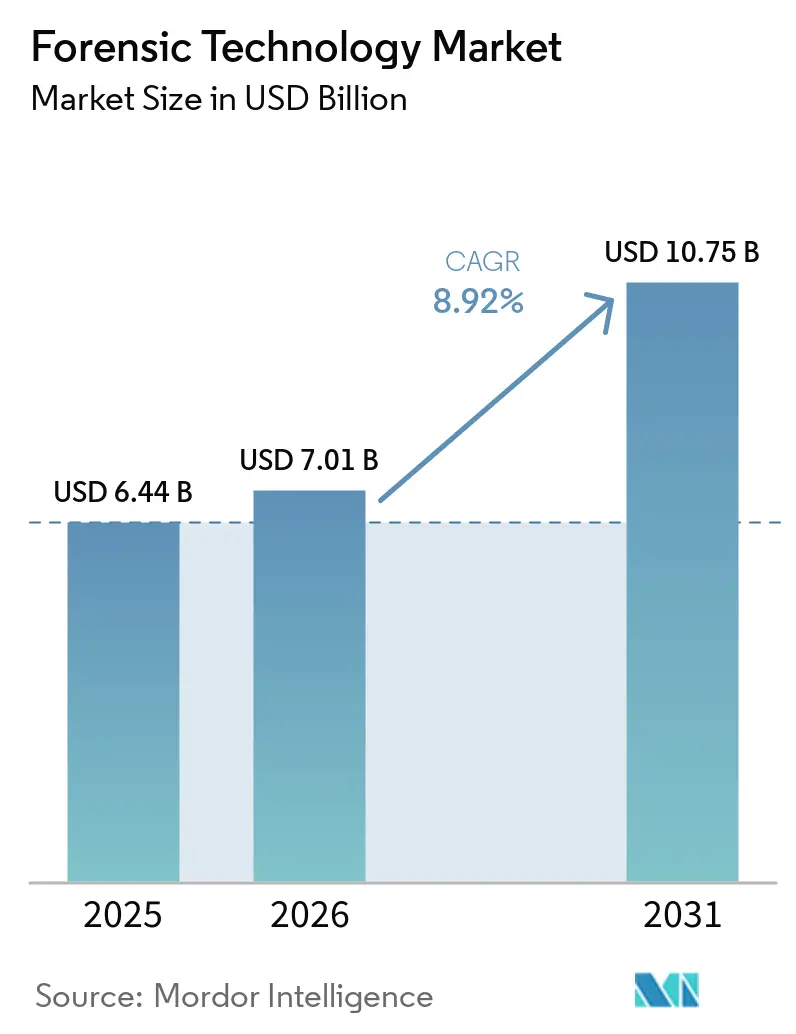
The Forensic Technology Market size is expected to grow from USD 6.44 billion in 2025 to USD 7.01 billion in 2026 and is forecast to reach USD 10.75 billion by 2031 at 8.92% CAGR over 2026-2031.
Investigators are now incorporating diverse evidence sources, including mobile data, cloud records, vehicle data, and connected-device content, into case files. DNA laboratory modernization is driving the forensic technology market as governments enhance workflows, expand searchable databases, and integrate booking-station activities with central laboratory systems. Artificial intelligence is streamlining routine reviews by reducing manual sorting of images, videos, messages, and call records, while influencing procurement decisions through advanced platform capabilities. The market is further supported by lengthy validation and accreditation cycles, which limit the ability of agencies to quickly switch platforms once methods are approved for casework. Additionally, staffing shortages and backlogs are increasing the demand for automation, secure evidence management, and AI-driven triage to accelerate case resolution timelines across the forensic technology market.
Key Report Takeaways
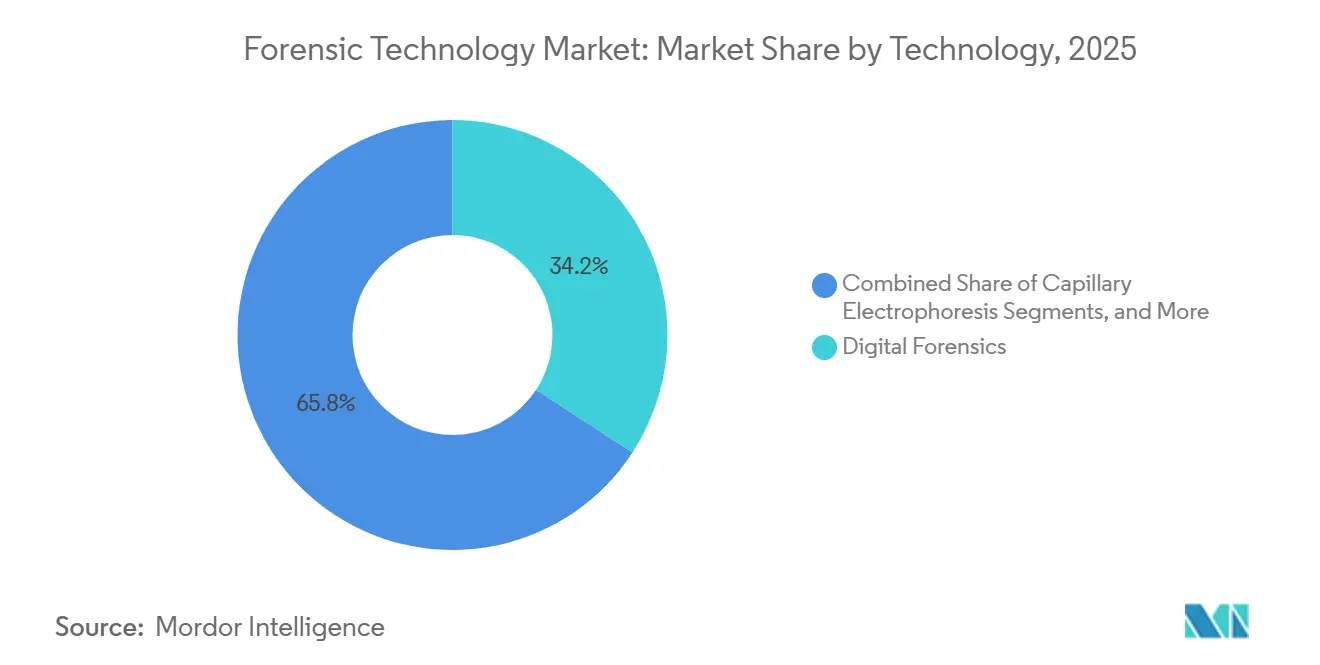
- By technology, digital forensics held 34.23% of revenue in 2025, while capillary electrophoresis is projected to grow at an 11.45% CAGR through 2031.
- By service, DNA profiling accounted for 44.23% of revenue in 2025, while Biometric analysis is expected to expand at a 12.55% CAGR through 2031.
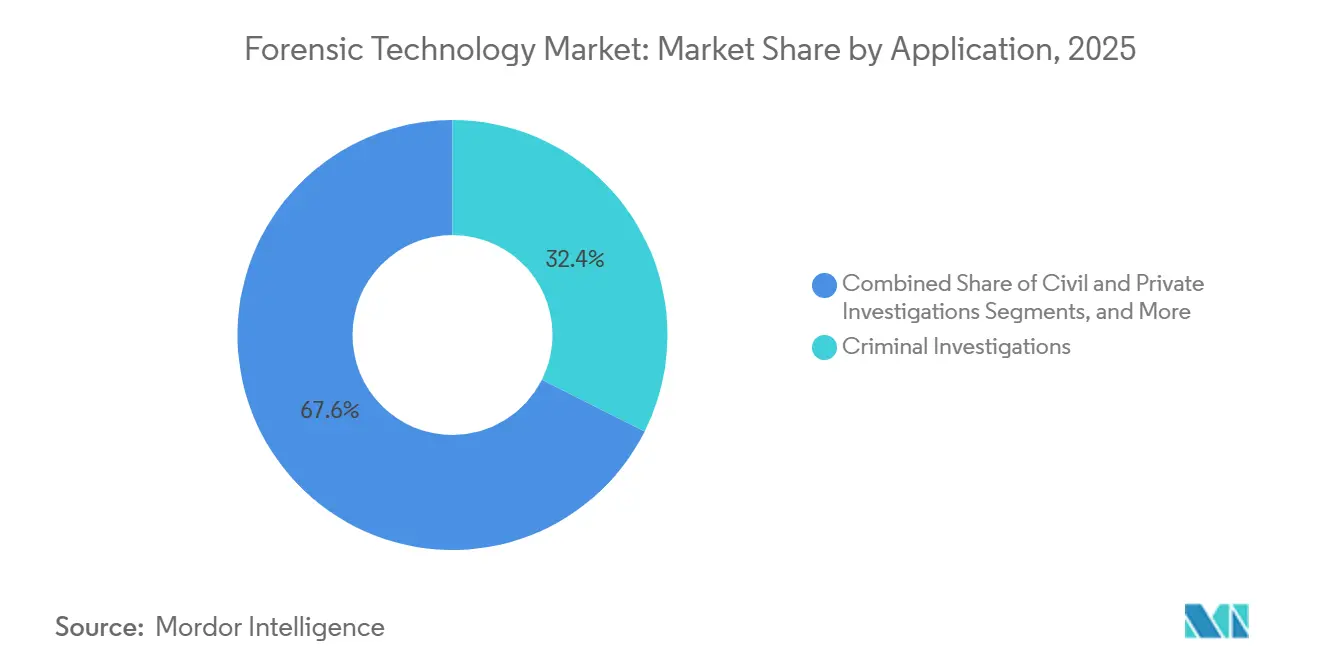
- By application, criminal investigations represented 32.44% of demand in 2025, while civil and private investigations are projected to advance at an 11.56% CAGR through 2031.
- By end user, law enforcement agencies held 33.76% of revenue in 2025, while government forensic laboratories are expected to grow at a 9.73% CAGR through 2031.
- By geography, North America captured 40.24% of the forensic technology market share in 2025, while Asia-Pacific is projected to expand at a 9.67% CAGR through 2031.
Note: Market size and forecast figures in this report are generated using Mordor Intelligence’s proprietary estimation framework, updated with the latest available data and insights as of January 2026.
Global Forensic Technology Market Trends and Insights
Drivers Impact Analysis*
| DRIVER | (~) % IMPACT ON CAGR FORECAST | GEOGRAPHIC RELEVANCE | IMPACT TIMELINE |
|---|---|---|---|
| Rising digital evidence volumes across mobile, cloud, and endpoints | +2.3% | Global, with early concentration in North America and Western Europe | Short term (≤ 2 years) |
| Expansion of DNA databases and rapid DNA workflows | +1.8% | North America, Europe, spill-over to APAC | Medium term (2-4 years) |
| Public-safety modernization and forensic lab digitization programs | +1.4% | APAC, Middle East and Africa, South America | Long term (≥ 4 years) |
| Courtroom demand for faster, more defensible chain-of-custody | +1.0% | Global, strongest in North America and EU | Medium term (2-4 years) |
| AI-assisted triage of multimedia and encrypted data repositories | +1.5% | Global, with accelerated uptake in North America | Short term (≤ 2 years) |
| Shift toward interoperable, cross-agency evidence sharing platforms | +0.8% | North America and EU core, spill-over to GCC | Long term (≥ 4 years) |
| Source: Mordor Intelligence | |||
Rising Digital Evidence Volumes Across Mobile, Cloud, and Endpoints
Forensic technology is experiencing increased demand due to the growing volume of digital evidence. Criminal investigations now involve encrypted messaging, cloud storage, vehicle telematics, and smart-home records. Smartphone data has become the largest source of evidence requests, driving demand for specialized extraction and decryption tools over traditional IT investigation software. Cloud-based evidence introduces delays as cross-border legal steps are often required before data extraction. Vendors offering integrated extraction and legal workflow solutions are reducing wait times, enhancing their competitive position. This shift emphasizes the importance of software orchestration and secure evidence transfer in the forensic technology market.
Expansion of DNA Databases and Rapid DNA Workflows
Changes in DNA workflow policies, particularly the integration of Rapid DNA results with national search systems, are driving growth in the forensic technology market. The FBI updated its Quality Assurance Standards for Forensic Laboratories in January 2025, enabling DNA profiles from Rapid DNA analyses to be searched in the national CODIS database starting July 1, 2025. Pennsylvania State Police launched a Rapid DNA program in 2025, generating an investigative lead within 2 hours during its first week of operation.[1]Federal Bureau of Investigation, “Quality Assurance Standards for Forensic DNA Testing Laboratories,” FBI, fbi.gov As Rapid DNA aligns with approved search pathways, demand is shifting toward consumables, software, and validated integrations, benefiting vendors like Thermo Fisher Scientific with its Applied Biosystems RapidHIT ID system.
AI-Assisted Triage of Multimedia and Encrypted Data Repositories
Artificial intelligence is becoming central to forensic technology as agencies seek faster analysis of multimedia and encrypted data. Cellebrite launched Genesis in March 2026, an AI system designed to analyze mobile extractions, call detail records, messages, images, and videos simultaneously. Magnet Forensics introduced Magnet AI in April 2026 and expanded its platform by acquiring V2 Forensics, adding vehicle forensics capabilities. The National Institute of Justice is supporting AI validation frameworks, indicating that courts and laboratories will increasingly require documented audit trails for automated outputs. AI fluency is becoming a critical factor in procurement decisions within the forensic technology market.
Shift Toward Interoperable, Cross-Agency Evidence Sharing Platforms
The forensic technology market is seeing rising demand for interoperable platforms to address inefficiencies caused by fragmented evidence systems across jurisdictions and agencies. India’s Union Budget 2026-27 allocated INR 550 crore (approximately USD 64.3 million) to the Inter-Operable Criminal Justice System, aimed at connecting digital data flows across institutions.[2]Pennsylvania State Police, “State Police Initiates Rapid DNA Program to Solve Cases Faster,” Commonwealth of Pennsylvania, pa.gov In the U.S., the Bureau of Justice Assistance’s FY 2025 Coverdell Enhancement for Backlog Reduction program supports DNA sample processing for CODIS entry and broader data utility. Interoperability raises certification challenges, favoring larger providers and creating barriers for smaller, specialized vendors in the market.[3]Magnet Forensics, “Magnet Forensics Unveils Magnet AI, Advancing the Next Era of Digital Investigative Intelligence,” Magnet Forensics, magnetforensics.com
Restraints Impact Analysis*
| RESTRAINT | (~) % IMPACT ON CAGR FORECAST | GEOGRAPHIC RELEVANCE | IMPACT TIMELINE |
|---|---|---|---|
| High cost of advanced instrumentation, licensing, and validation | -1.0% | Global, disproportionate in emerging markets and smaller jurisdictions | Long term (≥ 4 years) |
| Shortage of skilled examiners and accredited laboratory capacity | -0.8% | North America and Western Europe, expanding to APAC | Medium term (2-4 years) |
| Privacy, surveillance, and evidentiary admissibility constraints | -0.7% | EU, North America, growing in APAC | Medium term (2-4 years) |
| Fragmented standards across jurisdictions and evidence types | -0.5% | Global, most acute in MEA and South America | Long term (≥ 4 years) |
| Source: Mordor Intelligence | |||
High Cost of Advanced Instrumentation, Licensing, and Validation
Smaller jurisdictions face challenges in adopting advanced forensic technologies due to high costs. Platforms like next-generation sequencing and high-sensitivity mass spectrometers often exceed USD 500,000 per lab, making them inaccessible without grant support. Additionally, these systems require method validation, staff training, and documentation, delaying their integration into casework. Despite the Coverdell Program being authorized at USD 151 million, actual appropriations were limited to USD 120 million for fiscal years 2024 and 2025. This funding gap slows direct instrument procurement, even as outsourced casework temporarily increases.
Shortage of Skilled Examiners and Accredited Laboratory Capacity
The forensic technology market is constrained by a shortage of trained examiners, leading to testing backlogs of 18 months or more. For instance, Illinois State Police Forensic Services reported a need for 90 DNA scientists but had only 58 fully trained examiners as of June 2025. Similarly, Virginia’s Department of Forensic Science experienced rising Forensic Biology submissions and growing backlogs in FY 2025. Training remains a bottleneck, as forensic biology examiners require 18 to 24 months of supervised casework to work independently.
*Our forecasts treat driver/restraint impacts as directional, not additive. The impact forecasts reflect baseline growth, mix effects, and variable interactions.
Segment Analysis
By Technology: Digital Forensics Leads, Capillary Electrophoresis Gains Rapid Momentum
In 2025, Digital Forensics held a 34.23% share of the forensic technology market, leading all other technology segments. This growth was driven by the increasing reliance on smartphone evidence and the shift of criminal communications to encrypted platforms requiring specialized tools. Mobile and computer forensics remain key drivers as agencies handle significantly more data per device. Platforms integrating extraction, analytics, and secure collaboration continue to see strong demand.
Capillary Electrophoresis is the fastest-growing segment, with an 11.45% CAGR projected through 2031. Its relevance stems from its role in DNA profiling, the standard for individual identification in forensic genetics. Rapid DNA deployment and the central role of PCR in workflows further support its growth. While next-generation sequencing shows potential, its adoption is limited by cost and complexity. Advancements in biometric systems like fingerprint and facial recognition also highlight the market's technological diversity.



By Service: DNA Profiling Anchors Revenue, Biometric Analysis Accelerates
DNA Profiling accounted for 44.23% of revenue in 2025, making it the largest service in the forensic technology market. Its trusted role in criminal investigations, disaster victim identification, and civil kinship testing ensures consistent demand. Database expansion and faster workflows further strengthen its position, driving demand for instruments and software.
Biometric Analysis is the fastest-growing service, with a 12.55% CAGR projected through 2031. Growth is fueled by multimodal deployments in border control and civil identification, emphasizing unified platforms for multiple biometric checks. Chemical Analysis and Firearms Identification remain significant, especially with the rise of synthetic drugs. The market's expansion is evident in services like audio forensics and deepfake detection.
By Application: Criminal Investigations Dominate, Civil and Private Segment Fastest Growing
Criminal Investigations represented 32.44% of demand in 2025, maintaining its position as the largest application segment in the forensic technology market. Statutory requirements and advanced investigative techniques drive spending on DNA, biometrics, and digital evidence. Integrated software solutions for evidence management further anchor its significance.
Civil and Private Investigations is the fastest-growing segment, with an 11.56% CAGR projected through 2031. Growth is driven by corporate fraud, insurance disputes, and eDiscovery activities, attracting institutional buyers. Agencies increasingly seek continuous biometric matching and rapid video analysis. Expanding use cases like disaster victim identification and regulatory investigations further enrich the market.
By End User: Law Enforcement Leads, Government Labs Record Fastest Growth
Law Enforcement Agencies accounted for 33.76% of demand in 2025, making them the largest buyer group in the forensic technology market. Their dominance reflects extensive procurement of tools for DNA analysis, digital extraction, and case management. Deep integration of platforms like Cellebrite underscores law enforcement's central role in the market.
Government Forensic Laboratories are the fastest-growing segment, with a 9.73% CAGR projected through 2031. Growth is driven by digitization efforts and investments to enhance state laboratories' capacity. Public funding plays a critical role in modernizing infrastructure and workflows. The increasing relevance of private laboratories and corporates highlights the market's expanding customer base.
Geography Analysis
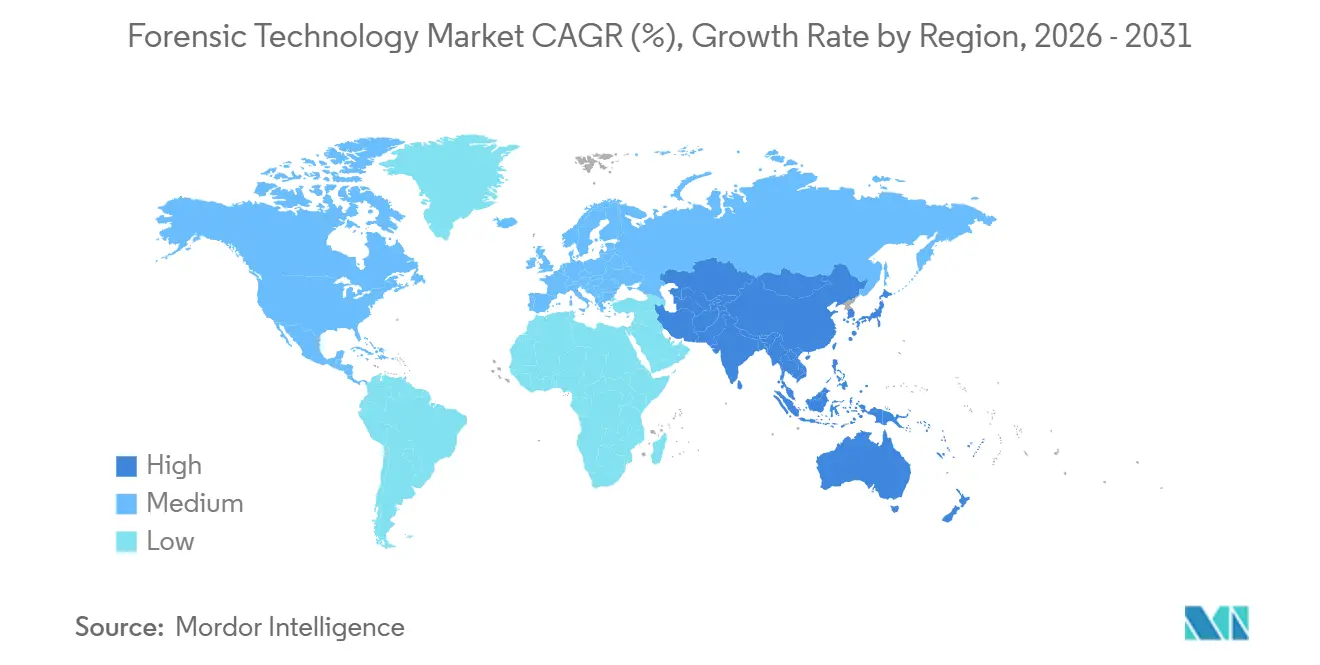
In 2025, North America secured 40.24% of the total revenue in the forensic technology market, maintaining its leadership position. The region benefits from consistent procurement cycles from federal agencies, state crime labs, and private forensic providers, ensuring steady spending. The FBI’s Quality Assurance Standards update in July 2025 enabled Rapid DNA profiles to be searched against CODIS, driving a shift from reference-lab workflows to point-of-arrest DNA processing. This transition supports demand for equipment upgrades, software integration, and consumables. North America's mature digital forensics environment prioritizes evidence extraction, multimedia analysis, and secure cloud reviews in procurement decisions.
Asia-Pacific is projected to grow at a 9.67% CAGR through 2031, making it the fastest-growing region in the forensic technology market. Growth is driven by institutional expansions rather than increased penetration of existing tools. India leads with investments in laboratory capacity, training, campus expansion, and national forensic data infrastructure. China’s public-security digitization integrates forensic capabilities with surveillance and evidence management systems. South Korea is advancing biometric capabilities at borders, while Japan focuses on high-throughput DNA systems for national programs. These developments expand laboratory networks and evidence systems, driving future demand for software, maintenance, and reagents.
The Middle East and Africa, though smaller in revenue, are experiencing rising investments in smart-city, border-security, and national security programs, particularly in the GCC. The UAE and Saudi Arabia have adopted large-scale fingerprint and facial recognition systems, aligning with NIST-style interoperability standards. South Africa leads in sub-Saharan Africa with its government-backed laboratory network. In South America, Brazil and Argentina drive demand, with Brazil investing in digital forensics for financial crime and federal prosecution. Regional growth is shaped by replacement demand, policy-driven expansion, and new institutional developments.

Competitive Landscape
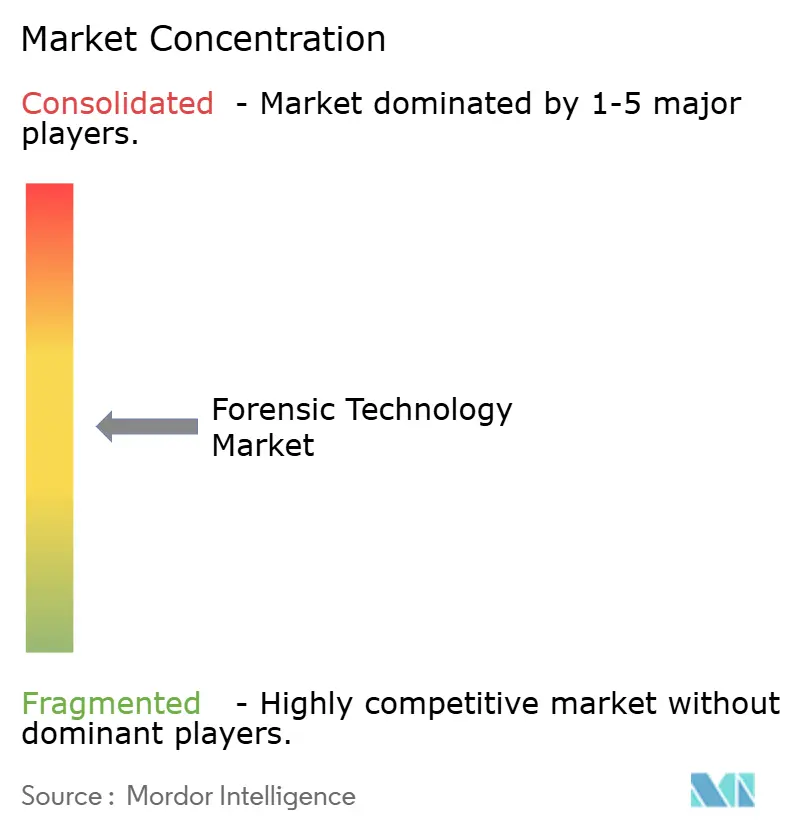
The forensic technology market exhibits moderate fragmentation, with the top five vendors collectively accounting for 40% of total revenue. Thermo Fisher Scientific, Agilent Technologies, and Promega Corporation dominate the DNA and analytical instrumentation sector. Buyers in this space often gravitate towards bundled instruments, reagents, and validated workflows, valuing their longevity. In the realm of digital forensics, Cellebrite, Magnet Forensics, and OpenText lead the pack. Here, competitive positioning increasingly hinges on AI capabilities, evidence workflow integration, and a robust cloud security posture. IDEMIA Group maintains a formidable stance in biometric identity systems.
A key trend in the forensic technology market is platform consolidation. Magnet Forensics advanced this strategy in April 2026 by acquiring V2 Forensics, integrating vehicle telematics evidence collection into its investigative intelligence workflow. Similarly, Cellebrite launched Genesis and Guardian Investigate in March 2026, expanding its offerings with AI-assisted reviews and cross-agency collaboration. Thermo Fisher Scientific strengthened its market position through conference-led relationship building and public laboratory engagement, critical in an accreditation-driven procurement environment. T
Opportunities in the forensic technology market lie in areas where demand outpaces the development of validation and interoperability standards. AI validation for legally admissible outputs remains a challenge, as agencies seek automation while courts require auditability and defensible review logic. Cross-jurisdiction evidence middleware is another gap, with agencies struggling to exchange records seamlessly across laboratories, courts, police, and corrections systems.
Forensic Technology Industry Leaders
Thermo Fisher Scientific Inc.
Agilent Technologies, Inc.
Eurofins Scientific SE
NMS Labs
Bio-Rad Laboratories, Inc.
- *Disclaimer: Major Players sorted in no particular order

Recent Industry Developments
- May 2026: Airis Labs secured USD 60 million in funding, led by PSG Equity, to expand its AI-powered video analysis solutions. These tools are designed for law enforcement agencies to analyze social media, security camera feeds, and drone footage, addressing the growing volume of digital evidence and the shortage of analysts.
- April 2026: Magnet Forensics announced the launch of Magnet AI and the acquisition of V2 Forensics during the Magnet User Summit in Nashville. Magnet AI enhances the Magnet One platform with advanced pattern recognition, while the acquisition of V2 Forensics strengthens capabilities in vehicle telematics evidence collection.
- March 2026: Cellebrite introduced Guardian Investigate on March 18, 2026, making it available globally. This AI-powered platform optimizes investigative management by enabling cross-agency collaboration, linking evidence, and constructing timelines, while ensuring compliance with chain-of-custody requirements.
- March 2026: NIST released ANSI/NIST-ITL 1-2025, which updates data format specifications for the exchange of biometric information, including fingerprints and facial recognition. This revision enhances the sharing of biometric records across agencies and international borders.


Global Forensic Technology Market Report Scope
As per the scope of the report, forensic technology is the application of scientific and engineering techniques to investigate crimes. It bridges traditional physical analysis (like DNA and ballistics) with modern digital methods (like cyber forensics and AI data recovery) to uncover actionable evidence and establish the facts of a case.
The forensic technology market is segmented by technology, service, application, end-user, and geography. By technology, the market includes polymerase chain reaction (PCR), capillary electrophoresis, next generation sequencing (NGS), rapid DNA analysis, automated liquid handling technology, microarrays, fingerprint imaging and matching, facial recognition, iris and palm vein recognition, voice biometrics, digital forensics, computer forensics, mobile device forensics, and others. By service, the market includes DNA profiling, chemical analysis, biometric analysis, firearms identification, and others. By application, the market includes criminal investigations, counterterrorism and intelligence, disaster victim identification, civil and private investigations, regulatory and compliance investigations, and cold case review and exoneration. By end-user, the market includes law enforcement agencies, government forensic laboratories, defense and intelligence organizations, private forensic laboratories, corporates and law firms, and insurance and fraud investigation firms. By geography, the market is analyzed across North America, Europe, Asia-Pacific, the Middle East and Africa, and South America. The report also covers the estimated market sizes and trends for 17 countries across major regions globally. The report offers the market sizes and forecasts in terms of value (USD) for the above segments.
| Polymerase Chain Reaction (PCR) |
| Capillary Electrophoresis |
| Next Generation Sequencing (NGS) |
| Rapid DNA Analysis |
| Automated Liquid Handling Technology |
| Microarrays |
| Fingerprint Imaging and Matching |
| Facial Recognition |
| Iris and Palm Vein Recognition |
| Voice Biometrics |
| Digital Forensics |
| Computer Forensics |
| Mobile Device Forensics |
| Others |
| DNA Profiling |
| Chemical Analysis |
| Biometric Analysis |
| Firearms Identification |
| Others |
| Criminal Investigations |
| Counterterrorism and Intelligence |
| Disaster Victim Identification |
| Civil and Private Investigations |
| Regulatory and Compliance Investigations |
| Cold Case Review and Exoneration |
| Law Enforcement Agencies |
| Government Forensic Laboratories |
| Defense and Intelligence Organizations |
| Private Forensic Laboratories |
| Corporates and Law Firms |
| Insurance and Fraud Investigation Firms |
| North America | United States |
| Canada | |
| Mexico | |
| Europe | Germany |
| United Kingdom | |
| France | |
| Italy | |
| Spain | |
| Rest of Europe | |
| Asia-Pacific | China |
| India | |
| Japan | |
| Australia | |
| South Korea | |
| Rest of Asia-Pacific | |
| Middle East and Africa | GCC |
| South Africa | |
| Rest of Middle East and Africa | |
| South America | Brazil |
| Argentina | |
| Rest of South America |
| By Technology | Polymerase Chain Reaction (PCR) | |
| Capillary Electrophoresis | ||
| Next Generation Sequencing (NGS) | ||
| Rapid DNA Analysis | ||
| Automated Liquid Handling Technology | ||
| Microarrays | ||
| Fingerprint Imaging and Matching | ||
| Facial Recognition | ||
| Iris and Palm Vein Recognition | ||
| Voice Biometrics | ||
| Digital Forensics | ||
| Computer Forensics | ||
| Mobile Device Forensics | ||
| Others | ||
| By Service | DNA Profiling | |
| Chemical Analysis | ||
| Biometric Analysis | ||
| Firearms Identification | ||
| Others | ||
| By Application | Criminal Investigations | |
| Counterterrorism and Intelligence | ||
| Disaster Victim Identification | ||
| Civil and Private Investigations | ||
| Regulatory and Compliance Investigations | ||
| Cold Case Review and Exoneration | ||
| By End User | Law Enforcement Agencies | |
| Government Forensic Laboratories | ||
| Defense and Intelligence Organizations | ||
| Private Forensic Laboratories | ||
| Corporates and Law Firms | ||
| Insurance and Fraud Investigation Firms | ||
| By Geography | North America | United States |
| Canada | ||
| Mexico | ||
| Europe | Germany | |
| United Kingdom | ||
| France | ||
| Italy | ||
| Spain | ||
| Rest of Europe | ||
| Asia-Pacific | China | |
| India | ||
| Japan | ||
| Australia | ||
| South Korea | ||
| Rest of Asia-Pacific | ||
| Middle East and Africa | GCC | |
| South Africa | ||
| Rest of Middle East and Africa | ||
| South America | Brazil | |
| Argentina | ||
| Rest of South America | ||


Key Questions Answered in the Report
What is the current size of the forensic technology market?
The forensic technology market stands at USD 7.01 billion in 2026 and is projected to reach USD 10.75 billion by 2031 at a CAGR of 8.92%.
Which technology segment leads forensic technology demand?
Digital Forensics leads with 34.23% share in 2025, supported by strong demand for mobile, cloud, and encrypted data extraction workflows.
Which service area is growing the fastest in forensic technology?
Biometric Analysis is the fastest-growing service segment, with a projected 12.55% CAGR through 2031, driven by multimodal deployments across borders, corrections, and investigations.
Which region is expanding the fastest for forensic technology vendors?
Asia-Pacific is the fastest-growing region, with a 9.67% CAGR through 2031, supported by public investment in laboratory capacity, digitization, and forensic infrastructure.
Why are staffing shortages important for forensic technology adoption?
Laboratory vacancies and backlogs are pushing agencies to buy automation, AI-assisted review tools, and secure evidence platforms that reduce manual work and improve throughput.
How concentrated is competition among forensic technology suppliers?
Competition is moderate rather than tightly concentrated, because the top 5 vendors hold 40% of revenue, leaving room for specialists in AI validation, interoperability, and cloud-native evidence workflows.
Page last updated on:






