
Food Grade Lubricants Market Size and Share
Market Overview
| Study Period | 2020 - 2031 |
|---|---|
| Market Volume (2026) | 67.51 Million liters |
| Market Volume (2031) | 86.95 Million liters |
| Growth Rate (2026 - 2031) | 5.19 % |
| Fastest Growing Market | Asia Pacific |
| Largest Market | Europe |
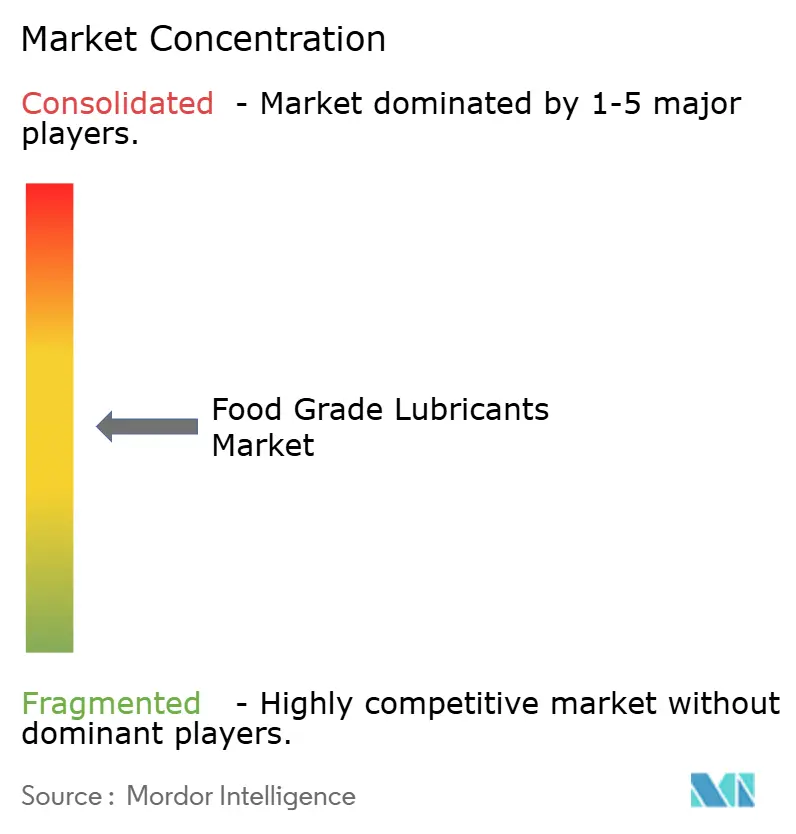
| Market Concentration | Medium |
Major Players *Disclaimer: Major Players sorted in no particular order Image © Mordor Intelligence. Reuse requires attribution under CC BY 4.0. | |
Food Grade Lubricants Market Analysis by Mordor Intelligence
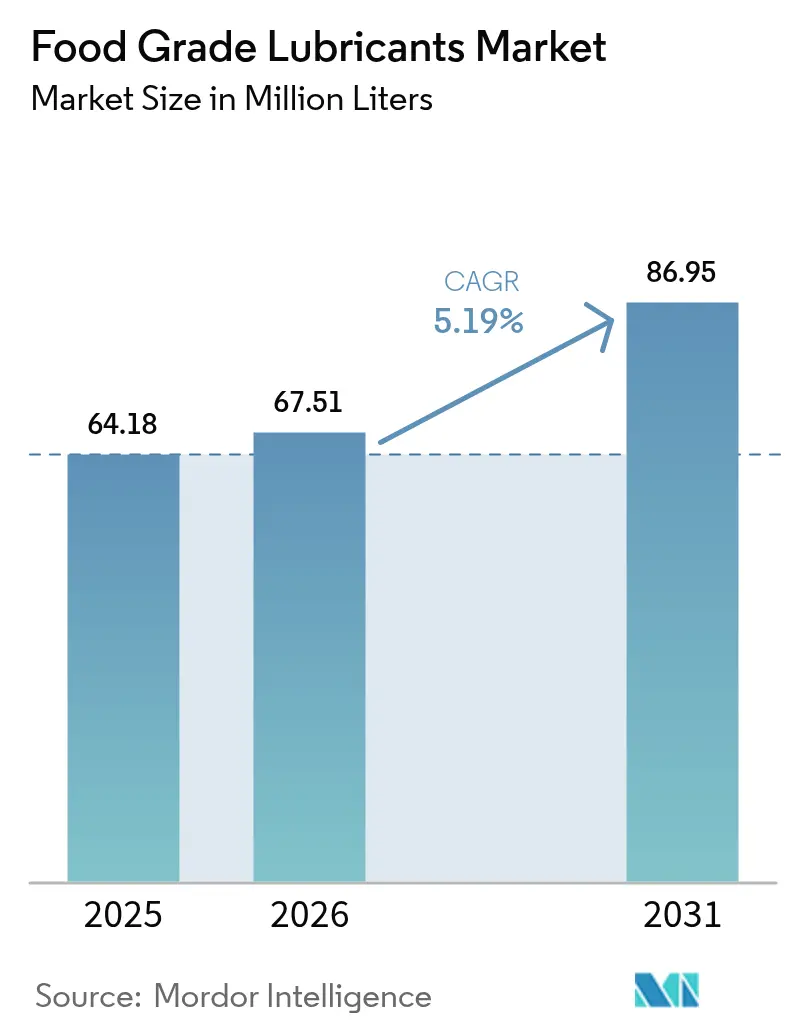
The Food Grade Lubricants Market size was valued at 64.18 Million liters in 2025 and estimated to grow from 67.51 Million liters in 2026 to reach 86.95 Million liters by 2031, at a CAGR of 5.19% during the forecast period (2026-2031). The growth path mirrors stricter global food-safety regulations, faster factory automation, and the steady shift toward processed and ready-to-eat foods that demand safe, high-performance lubricants. Regulatory bodies in North America, Europe, and Asia are aligning on the phase-out of PFAS chemistries, pushing formulators toward synthetic and bio-based alternatives that meet both safety and sustainability targets. Established producers are turning deep compliance knowledge into a competitive moat, while equipment makers are specifying certified lubricants at the design stage to minimize contamination risk. Counterfeit “H1” products remain an operational threat, yet they also amplify the value proposition of traceable, fully certified solutions that safeguard brand reputation and reduce unplanned downtime.
Key Report Takeaways
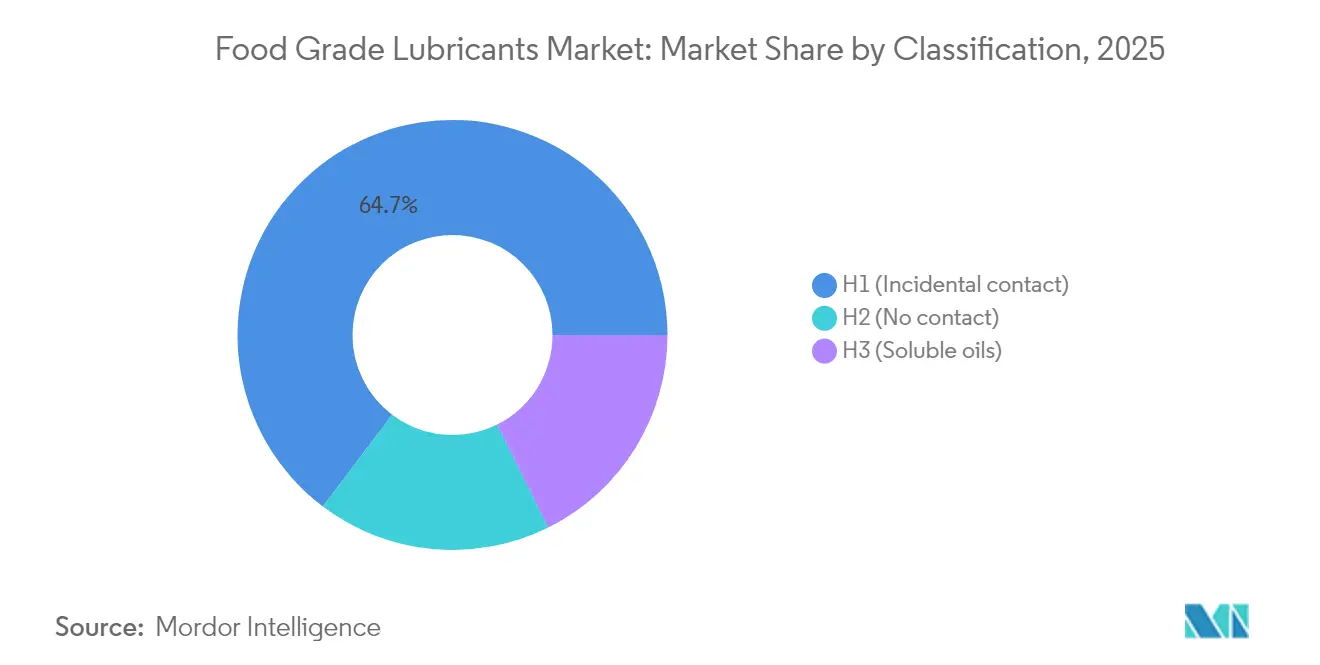
- By classification, H1 fluids held 64.70% of the food grade lubricants market share in 2025, while the same segment is forecast to post the highest growth at 5.52% CAGR through 2031.
- By base oil, mineral oil accounted for 52.08% share of the food grade lubricants market size in 2025; bio-based oils represent the fastest rising category at 5.86% CAGR through 2031.
- By product type, grease led with 39.10% revenue share in 2025; other product types together are projected to expand at a 6.01% CAGR to 2031.
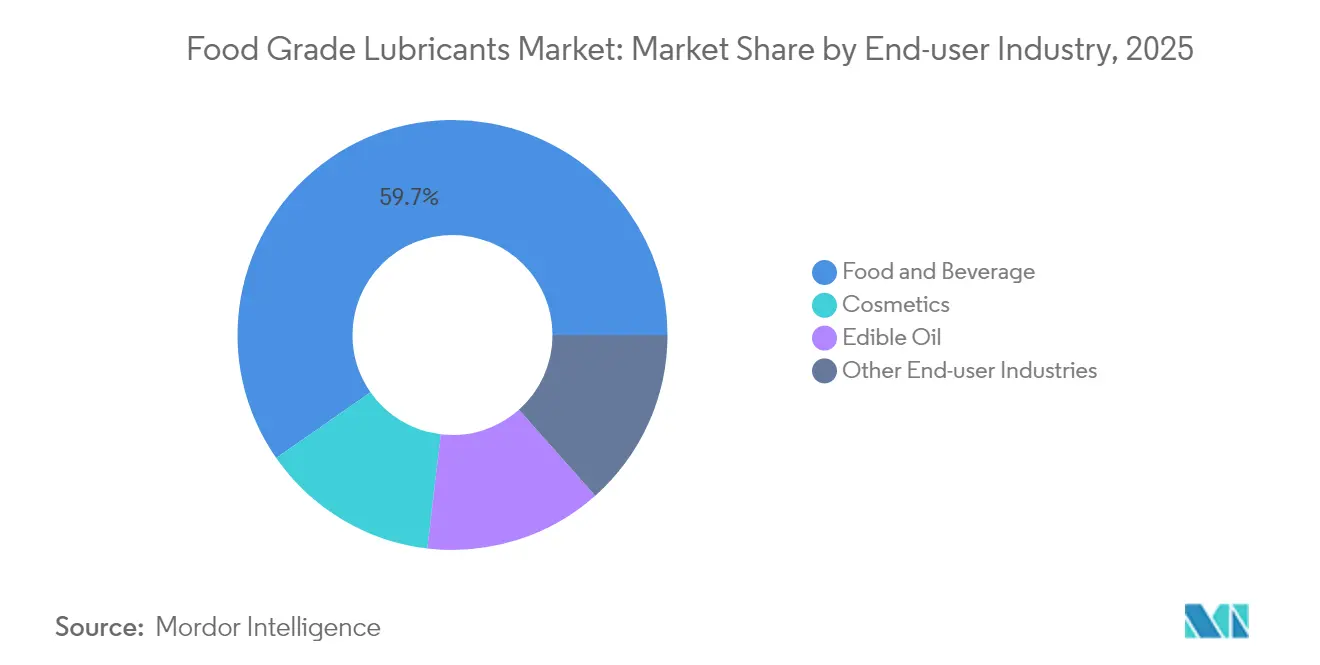
- By end-user industry, food and beverage processing commanded 59.70% of the food grade lubricants market size in 2025, whereas other end-user industries are set to grow at 6.05% CAGR over the same horizon.
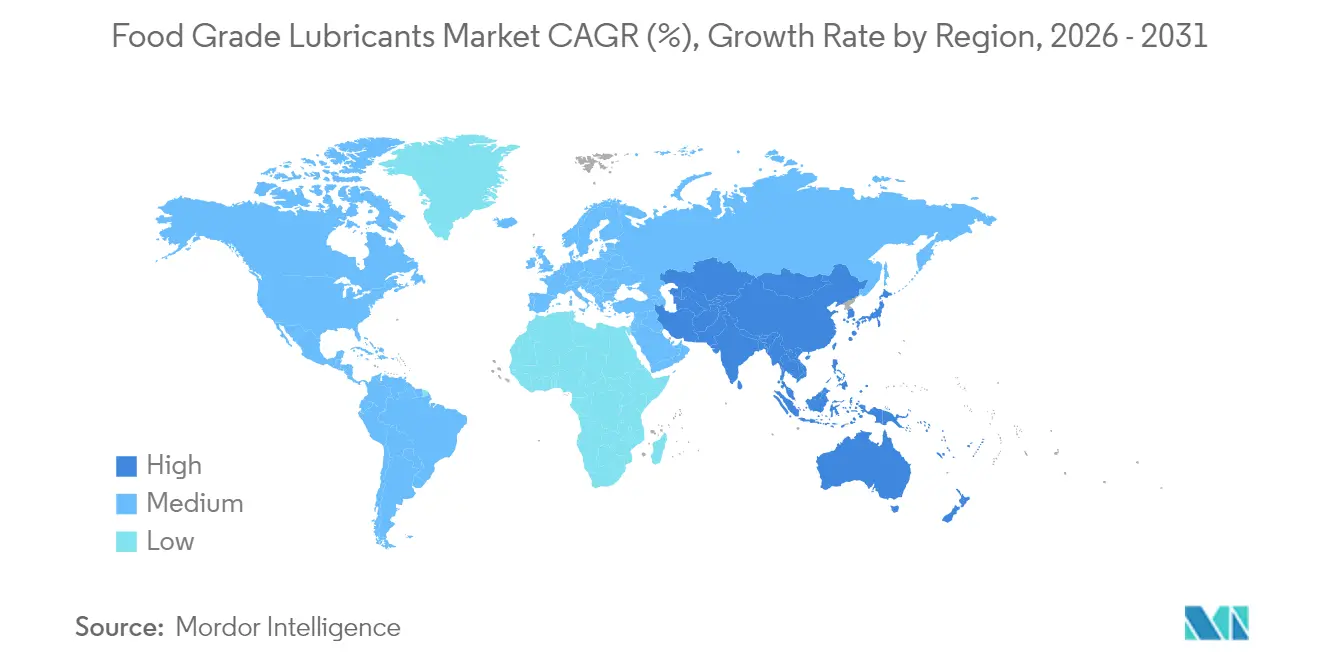
- By geography, Europe held 38.80% revenue share in 2025, and Asia-Pacific is advancing at a 5.74% CAGR through 2031.
Note: Market size and forecast figures in this report are generated using Mordor Intelligence’s proprietary estimation framework, updated with the latest available data and insights as of 2026.
Market Trends and Insights
Drivers Impact Analysis of Food Grade Lubricants Market*
| Drivers | (~) % Impact on CAGR Forecast | Geographic Relevance | Impact Timeline |
|---|---|---|---|
| Increasing food-safety regulations tightening globally | +1.2% | Global, early North America and EU | Medium term (2-4 years) |
| Surge in demand for processed and ready-to-eat foods | +1.0% | APAC core, spill-over to MEA | Long term (≥4 years) |
| Rapid automation of food and beverage plants | +0.8% | Global, developed markets | Short term (≤2 years) |
| Expanding food processing infrastructure in developing regions | +0.7% | APAC, Latin America, MEA | Long term (≥4 years) |
| Phase-out of PFAS chemicals driving reformulation demand | +0.6% | North America and EU, expanding global | Medium term (2-4 years) |
| Source: Mordor Intelligence | |||
Increasing Food-Safety Regulations Tightening Globally
Governments are converging toward more rigorous food-contact rules, forcing lubricant suppliers to upgrade formulations or risk delisting. China’s updated GB 2760-2024 extends the country’s positive list and closes loopholes around processing aids, triggering demand for fully documented H1 fluids that align with NSF and ISO 21469 audits. In Europe, the EFSA evaluation of MOSH and MOAH has led processors to favor synthetic fluids that eliminate mineral-oil traces, while ISO 21469 certification now signals a higher assurance level than basic NSF registration. The U.S. FDA continues to police 21 CFR 178.3570, and more than 30 individual states have enacted PFAS bans that indirectly shape lubricant chemistry[1]United States Government, “21 CFR 178.3570 Lubricants With Incidental Food Contact,” ecfr.gov. Suppliers with global regulatory teams convert this complexity into value-added consulting for customers who lack in-house expertise. The cumulative effect lifts entry barriers and cements long-term contracts, fueling volume expansion across the food grade lubricants market.
Surge in Demand for Processed and Ready-To-Eat Foods Requiring Food-Grade Lubricants
Dietary patterns are pivoting to convenience meals, single-serve packages, and omnichannel grocery models that rely on high-throughput machinery. Food Industry 5.0 concepts, such as AI-enabled predictive maintenance, shorten acceptable downtime windows; lubricants, therefore, must deliver longer drain intervals and contamination immunity to justify their selection. As product SKU counts rise, changeover frequency increases, pushing lubricants to tolerate variable loads and temperatures. This synergy between convenience food growth and factory automation amplifies lubricant demand volume as well as performance expectations across the food-grade lubricants market.
Rapid Automation of Food and Beverage Plants Intensifying Lubricant Duty Cycles
Manufacturers are retrofitting legacy lines with hygienic robots and autonomous conveyors. Stäubli and ABB now offer IP69k-rated robots requiring H1 greases that survive hot-water sanitation without losing viscosity. Predictive algorithms reschedule lubricant changes to avert micro-stoppages, but only premium synthetic fluids sustain film strength over extended intervals. Around-the-clock operation doubles mechanical contact events compared with semi-automated lines, accelerating lubricant consumption curves. Capital expenditures on automated kit gain board approval partly because high-grade lubricants reduce the life-cycle cost of critical bearings, chains, and actuators. Equipment makers increasingly supply start-up lubricant kits with OEM branding, ensuring the food-grade lubricants market embeds itself early in the asset life and locks in multi-year aftermarket streams.
Phase-Out of PFAS Chemicals Driving Reformulation Demand
Environmental agencies on both sides of the Atlantic have drafted sweeping PFAS bans. Lubricant makers are racing to validate replacements for PTFE-laden greases used in high-temperature ovens and vacuum sealers. FUCHS’s RHEOLUBE 460P and Interflon’s MicPol series deliver comparable load-carrying capacity without fluorinated additives. Plastics converters are adopting Baerlocher’s Baerolub AID as a PFAS-free processing aid, demonstrating cross-industry acceptance. The reformulation wave raises research and development hurdles for small private-label blenders, favoring incumbents with global labs and pilot plants. End-users that eliminate PFAS also earn sustainability credits from retailers and insurers, reinforcing the pull toward certified, fluorine-free offerings and expanding high-margin segments within the food-grade lubricants market.
Restraints Impact Analysis of Food Grade Lubricants Market*
| Restraints | (~) % Impact on CAGR Forecast | Geographic Relevance | Impact Timeline |
|---|---|---|---|
| High price premium vs. conventional industrial oils | -0.8% | Global, more pronounced in price-sensitive emerging markets | Short term (≤ 2 years) |
| Limited user awareness and training in emerging economies | -0.3% | APAC, Latin America, MEA | Medium term (2-4 years) |
| Proliferation of counterfeit/non-certified "H1" products | -0.4% | APAC, Latin America, MEA | Medium term (2-4 years) |
| Source: Mordor Intelligence | |||
High Price Premium Vs. Conventional Industrial Oils
Synthetic H1 fluids still carry a 25% surcharge relative to ordinary mineral oils, deterring small processors that operate on razor-thin margins[2]Nancy McGuire, “Bio-based Greases: Back to the Future,” stle.org. Bio-based greases, which make up only 1-5% of total volume, face steeper premiums despite biodegradability advantages. In regions with lower labor costs and longer equipment replacement cycles, management often delays lubricant upgrades until compelled by audits or large retail clients. The price hurdle is expected to erode gradually as local blending, higher base-oil yields, and competition compress margins across the food grade lubricants market.
Proliferation of Counterfeit/Non-Certified “H1” Products
Unauthorized products masquerading as H1 fluids undermine brand trust and can trigger costly recalls. The American Petroleum Institute has already flagged multiple cases of fraudulent labeling on motor oils, signaling similar risks for specialty food-contact products. Counterfeits proliferate in fragmented distribution channels where buyers lack quick tools to verify NSF listings. Legitimate suppliers are responding with QR-coded drum labels, blockchain batch tracing, and education campaigns delivered through OEM service networks. While stricter enforcement will eventually shrink illicit supply, in the interim, the practice exerts downward price pressure and complicates safety audits, limiting volume growth prospects for bona-fide producers inside the food-grade lubricants market.
*Our forecasts treat driver/restraint impacts as directional, not additive. The impact forecasts reflect baseline growth, mix effects, and variable interactions.
Food Grade Lubricants Market Segment Analysis
By Classification:
H1 Fluids Cement Market Leadership while Elevating Safety StandardsH1 lubricants captured 64.70% of 2025 volume and are projected to widen their lead at 5.52% CAGR to 2031, cementing a dual role as dominant and fastest-growing segment in the food grade lubricants market share landscape. Processors favor H1 registration even for equipment deemed non-contact to offset contamination risk during maintenance or component failure. The food grade lubricants market size attributed to H1 products will therefore advance alongside more demanding ISO 21469 audits that now scrutinize biological as well as chemical hazards.
H2 fluids, once popular for sealed systems, now occupy a defensive niche as procurement teams prioritize universal compliance over theoretical exposure assessments. H3 soluble oils remain confined to specialized areas such as hook lubrication in meat plants where water-washability is paramount. The impending PFAS ban is indirectly reinforcing H1 loyalty because reformulated synthetics offer strong load capacity at wider operating temperatures, further eroding any perceived performance gap with H2 grades. As a result the classification mix is expected to tilt more heavily toward H1 throughout the forecast horizon, making certification expertise an indispensable pillar of competition within the food grade lubricants market.



By Base Oil:
Mineral Oil Anchors Volume as Bio-Based Oils AccelerateMineral oil blends retained 52.08% share in 2025, securing their role as the volume anchor of the food grade lubricants market. The position rests on well-established supply chains, predictable additive response, and unit costs that suit high-volume bakeries and dairies. Even so, adoption of bio-based alternatives is running ahead of synthetics in percentage terms, clocking a 5.86% CAGR that outpaces the broader market. The food grade lubricants market size linked to bio-based products therefore remains small but is scaling quickly, propelled by corporate carbon targets and retailer pressure for “planet-friendly” sourcing.
Synthetic base stocks, though premium priced, attract processors running 24/7 automation where downtime risks dwarf fluid costs. Superior thermal range and resistance to aggressive cleaners extend drain intervals, slicing total lubricant-related maintenance tasks by double-digit margins in many plants.
By Product Type:
Grease Dominance Endures Amid Rising Demand for Specialty FluidsGrease held 39.10% share in 2025 owing to its indispensable role in bearings, gearboxes, and seals exposed to water, sugar dust, and frequent cleaning. Its thickening agents enable extended relubrication intervals and confer splash resistance, making it the default choice across bakeries, beverage bottlers, and confectionery lines. The food grade lubricants market size for greases will continue expanding in lockstep with conveyor installations and robotic pick-and-place stations that generate multi-directional loads.
Meanwhile compressor and chain oils form the fastest-expanding basket with a 6.01% CAGR outlook, reflecting wider adoption of spiral freezers, vacuum pumps, and high-speed ovens in automated facilities. Chain oils, in particular, must maintain film integrity under high loads while resisting carbon formation at temperatures topping 240 °C, a specification profile that favors high-tier synthetics.
By End-User Industry:
Food and Beverage Core Remains Sturdy while Supply-Chain Equipment SurgesFood and beverage manufacturing absorbed 59.70% of 2025 volume, solidifying its role as the anchor sector for the food grade lubricants market. High-frequency operations, stringent audits, and the consumer backlash risk tied to contamination events ensure sustained investment in certified lubricants. The food grade lubricants market share will therefore stay skewed toward this sector through 2031 despite relative slowdown in mature economies.
Parallel growth momentum lies in packaging and logistics assets, forecast at 6.05% CAGR, as omnichannel retailing pushes producers to accommodate mixed package formats, shorter runs, and automated warehousing. Conveyor rollers, palletizers, and pick-to-light systems integrate food-contact zones, obliging operators to substitute general industrial greases with H1 equivalents.
Geography Analysis
Europe Food Grade Lubricants Market
Europe’s 38.80% share in 2025 stems from decades-old regulatory depth, dense processing infrastructure, and continuous improvement cultures that reward premium formulations. EFSA scrutiny of MOSH and MOAH pushes processors toward fully synthetic, low-aromatic blends, driving above-average unit prices and early adoption of PFAS-free options.
APAC Food Grade Lubricants Market
Asia-Pacific, though smaller today, registers the fastest pace at 5.74% CAGR, fueled by industrialization, dietary shifts, and tightening standards. China’s revised GB 2760-2024 elevates baseline compliance and favors multinational suppliers versed in multilayer certification. ASEAN food exporters are adopting international standards to gain EU and U.S. market access, broadening the addressable base for H1 fluids.
North America Food Grade Lubricants Market
North America commands mature yet still dynamic demand, underpinned by FDA enforcement of incidental-contact rules and state-level PFAS bans that expedite formulation changeovers. Mexico’s processor base leverages NAFTA supply chains and requires dual-certified lubricants to satisfy cross-border audits.
MEA and South America Food Grade Lubricants Market
South America, and the Middle-East and Africa remain early-stage, yet infrastructure spending and supermarket expansion are catalyzing upgrades from generic industrial oils to certified products. Brazil’s distribution partnership between Univar Solutions and Arxada underscores the race to establish credible supply in jurisdictions where counterfeit risk runs high.

Regulatory Landscape
Food-grade lubricants sit between food-contact safety requirements and voluntary certification schemes that procurement teams often treat as audit requirements. In the United States, incidental food-contact lubricants are governed under FDA 21 CFR 178.3570, and NSF International H1 registration is commonly used to demonstrate conformity and support faster product verification through the NSF listing process.
Internationally, ISO 21469 goes beyond ingredient compliance into hygiene management across formulation, manufacturing, and handling, and global suppliers use it as a plant and process assurance signal. In the European Union, food-contact compliance is framed through the broader food contact materials regime under Regulation (EC) No 1935/2004, and updates to authorized substance lists and restrictions raise documentation and traceability expectations across the value chain, shaping lubricant chemistry choices, including the move away from PFAS-related chemistries.
Value Chain Analysis
The value chain starts with base-oil and additive inputs: highly refined white mineral oils and synthetic fluids alongside bio-based feedstocks (for example, vegetable oils), supported by performance additives such as antioxidants, anti-wear agents, and corrosion inhibitors. Formulators then produce application-specific lubricants (greases, hydraulic fluids, gear oils, and chain and compressor oils) and need to align production controls and documentation with food-safety benchmarks, including FDA 21 CFR 178.3570, NSF H1 registration, and increasingly ISO 21469 hygiene certification to meet multinational customer and export expectations.
Route-to-market typically combines direct sales to large food and beverage processors, MRO-focused distributors, and OEM or service networks that specify and supply certified lubricants during commissioning and maintenance. Because counterfeit H1 labeling increases audit risk, certification visibility (NSF listings and ISO 21469 plant credentials), packaging integrity, and anti-counterfeit practices influence channel choices, and suppliers tend to prioritize traceability and controlled distribution for high-risk, high-value food-contact SKUs.
Competitive Landscape
The food grade lubricants market remains moderately fragmented. Large multinationals such as ExxonMobil, FUCHS, Klüber Lubrication, TotalEnergies, and Petro-Canada capture the upper tier by virtue of proprietary additive chemistries, ISO 21469 plants, and global service footprints. These incumbents leverage vertical integration from base-oil production to on-site technical audits, delivering bundled value that offsets premium price points. Mid-tier specialists focus on regional coverage or niche applications such as high-temperature bakery chains, yet face rising CapEx needs to reformulate away from PFAS and to add NSF certification batches.
Food Grade Lubricants Industry Leaders
Condat
FUCHS
Exxon Mobil Corporation
Freudenberg SE
TotalEnergies
- *Disclaimer: Major Players sorted in no particular order
Food Grade Lubricants Market Companies Covered in this Report
- CITGO Petroleum Corporation
- Condat
- Dow
- DuPont
- Exxon Mobil Corporation
- Freudenberg SE
- FUCHS
- Interflon Belgium NV
- Lubrication Engineers
- Lubriplate Lubricants Company.
- Matrix Specialty Lubricants
- Petro-Canada Lubricants Inc.
- Renewable Lubricants, Inc.
- Schaeffer Manufacturing Co.,
- TotalEnergies
- UMW GRANTT International Sdn Bhd.

Market Opportunities and Future Outlook
A key whitespace is helping processors and OEMs move from basic H1 registration toward broader hygiene assurance, where ISO 21469 certification and auditable manufacturing controls differentiate suppliers in multi-site, export-oriented accounts. This is visible in procurement behavior, with global compliance to FDA 21 CFR 178.3570 and verifiable NSF H1 listings acting as baseline filters, and ISO 21469 serving as an additional qualifier for supplier approval when plants are assessed against stricter internal food-safety systems.
Reformulation and portfolio upgrades tied to sustainability priorities and restricted chemistries also open room, especially in high-temperature and high-washdown applications that have historically relied on fluorinated performance solutions. Investment-driven whitespace in regional supply and service coverage has been supported by recent strategic actions, including FUCHS' April 2026 completion of the full acquisition of the OPET FUCHS joint venture, which added a production plant in Aliaga, Turkey, to strengthen industrial lubrication presence and enable closer-to-customer manufacturing and technical service that can be applied to certified food-grade lines alongside broader industrial portfolios.
Recent Industry Developments in Food Grade Lubricants Market
- June 2026: FUCHS received NSF H1 registration for OMNILUBE VP FG 100 for incidental food contact applications. The registration strengthens verifiable compliance positioning and supports OEM and processor requirements for listed products that can be quickly validated during audits.
- September 2025: Lubrizol introduced HybriCal, a lithium-free grease thickener technology based on anhydrous calcium and designed to meet NLGI High-Performance Multiuse (HPM) specifications. The technology expands formulation options for grease makers, including food-grade lines that need robust performance while adapting to shifting raw-material and compliance considerations.
- July 2024: FUCHS completed the acquisition of the LUBCON Group, adding high-performance specialty lubricant capabilities that include food-grade products. The deal broadened FUCHS product depth and technical coverage for niche, high-value applications where certification, documentation, and application engineering influence supplier selection.


Food Grade Lubricants Market Report Scope and Research Methodology
Market Definition and Coverage
For this methodology, the market covers lubricants that are formulated and registered for use in areas where incidental contact with food can happen during processing, packaging, or handling. It includes common food-grade formats used to protect equipment parts, reduce friction, and support uptime in hygienic operating areas.
Scope exclusions: It excludes automotive lubricants, general industrial lubricants used only in non-food areas, and cleaning chemicals that are not used as lubricants.
Segments Covered in This Report
- By Classification
- H1 (Incidental contact)
- H2 (No contact)
- H3 (Soluble oils)
- By Base Oil
- Mineral Oil
- Synthetic Oil
- Bio-based Oil
- By Product Type
- Grease
- Hydraulic Fluid
- Gear Oil
- Other Products Types (Compressor Oil, Chain Oil, etc.)
- By End-user Industry
- Food and Beverage
- Cosmetics
- Edible Oil
- Other End-user Industries (Packaging and Logistics Equipment, etc.)
- By Geography
- Asia-Pacific
- China
- Japan
- India
- South Korea
- ASEAN Countries
- Rest of Asia-Pacific
- North America
- United States
- Canada
- Mexico
- Europe
- Germany
- United Kingdom
- France
- Italy
- Spain
- Russia
- NORDIC Countries
- Rest of Europe
- South America
- Brazil
- Argentina
- Rest of South America
- Middle-East and Africa
- Saudi Arabia
- South Africa
- Rest of Middle-East and Africa
- Asia-Pacific
Data Sources, Market Sizing, and Validation
Desk Research
Desk work starts by setting guardrails around what qualifies as food-grade lubricant use, then mapping where demand shows up in food processing and packaging operations. Public sources such as USDA and FDA resources, European Commission food safety and hygiene materials, and Codex Alimentarius references help keep definitions aligned with how food plants are regulated, inspected, and audited.
We also review non-paywalled items that describe lubrication needs in food processing, including articles in peer-reviewed tribology journals, selected patent databases for formulation trends, and trade association pages tied to food and beverage manufacturing. Company filings, investor presentations, and credible press releases are used to track capacity additions, product positioning, and regional exposure. For practical market checks, we selectively use paid subscriptions for company financials and intelligence, patent lookups, and shipment-level import-export signals where they help validate supply availability. The sources listed here are illustrative only, and additional public references were used for cross-checking, clarification, and validation.
Primary Interviews and Surveys
Primary interviews are used to turn the desk inputs into working assumptions, particularly when published numbers are missing or reported in different units. We speak with a mix of lubricant suppliers, additive and base oil participants, distributors, and end users, including food processors and plant maintenance teams. We then recheck the assumptions across APAC, EMEA, and the Americas to avoid a single-region view and to confirm how different applications are counted within food-grade coverage.
Distribution of primary research fieldwork respondents
| Company type | Respondent position | Region |
|---|---|---|
| Top tier: 38% | CXOs: 12% | APAC: 38% |
| Mid tier: 46% | Functional/Unit leaders: 31% | EMEA: 37% |
| Smaller Players: 16% | Managers: 57% | Americas: 25% |
Market-Sizing & Forecasting
Sizing is built mainly from a top-down demand reconstruction. We translate food and beverage production intensity and the installed base of processing equipment into lubricant consumption needs by application type, then roll those results up by region. To keep the totals realistic, we corroborate the output with selective bottom-up approximations, including sampled supplier volume ranges, channel checks for key product forms (greases, hydraulic fluids, gear oils), and price-per-liter sanity checks for typical food-grade specifications.
A few inputs that matter in this market include growth in packaged food output, expansion activity in dairy and meat processing lines, hygiene and audit-driven changeover frequency, the mix shift between mineral and synthetic formulations, and typical relubrication intervals for high-contact equipment. Where direct volume signals are patchy for smaller countries, we fill gaps using proxy indicators such as food manufacturing value add, equipment density assumptions shared by interviewees, and import-export movement for relevant lubricant categories.
Forecasting uses scenario analysis supported by trend smoothing. Regulation-driven adoption and plant investment cycles can shift the curve in certain years, so we test conservative and faster adoption cases around synthetic and bio-based penetration. We then settle on a central case after rechecking with industry participants so the outputs align with observed buying behavior.
Data Validation & Update Cycle
Validation is done in steps so the final number is not dependent on one dataset or one assumption. We compare the model output against independent signals such as regional food processing activity, trade movement patterns, and the implied per-plant lubricant usage. Any outliers are investigated before sign-off.
If variance is large, we re-contact sources to confirm whether the issue is scope, unit conversion, or a timing effect such as inventory stocking. Each report is refreshed annually, and interim updates are triggered when material events occur, such as major regulatory changes, sharp base oil pricing swings, or large capacity additions. Right before delivery, a final analyst pass is completed so clients receive the most current view we can support.
Mordor Intelligence's Food Grade Lubricants Market Estimate Compared With Other Published Estimates
It is normal to see different market values for food-grade lubricants because publishers do not always size the same thing in the same unit, or over the same time frame. The biggest differences usually come from whether the estimate is built from volume demand, revenue demand, or a blended approach, and from how product eligibility is interpreted.
In this market, gaps often start with scope. Some estimates fold in broader industrial lubricant volumes used in adjacent plant areas that are not exposed to incidental food contact. Differences can also come from how prices are handled, where one model uses a single average price while another adjusts by product form, base oil mix, and region-level pricing. Then, year-to-year currency timing can amplify the spread.
Benchmark comparison
| Source | Market Size | Gaps in Research Methodology |
|---|---|---|
| Mordor Intelligence | USD 0.07 B (2026) | |
| Global Consultancy A | USD 0.49 B (2025) | This figure is reported on a revenue basis, and the scope commonly leans on broader food and beverage lubricant spending, which can pull in non-incidental-contact plant usage and higher blended pricing assumptions. |
| Industry Publisher B | USD 0.34 B (2025) | This estimate appears to mix application scope across food areas and nearby industrial maintenance needs, and it also uses a different base-year structure, which shifts growth compounding and the implied price per liter. |
The table shows that unit choice and inclusion rules can move the headline number a lot, even when the story on growth looks similar. Here, the sizing is anchored in volume demand and then stress-tested with product-form price logic and regional checks, which keeps incidental-contact eligible usage separate from general industrial consumption, a choice applied by Mordor Intelligence.


Key Questions Answered in the Report
What is the projected size of the food grade lubricants market by 2031?
The market is anticipated to reach 86.95 million liters by 2031, expanding from 64.18 million liters in 2025 at a 5.19% CAGR.
Which lubricant classification holds the highest share today?
H1-certified lubricants dominate with 64.70% share in 2025, reflecting industry preference for incidental-contact safety.
Why are bio-based oils gaining traction in the food grade lubricants industry?
Bio-based oils are advancing at 5.86% CAGR because they help processors meet sustainability targets and comply with emerging PFAS and mineral-oil restrictions.
Which region is growing the fastest in the food grade lubricants market?
Asia-Pacific is the fastest-growing region, registering a 5.74% CAGR through 2031 due to rapid food factory build-outs and tightening local regulations.
How does the phase-out of PFAS chemicals affect lubricant suppliers?
Suppliers must reformulate away from fluorinated additives, creating first-mover advantages for companies that commercialize PFAS-free synthetics without performance loss.
Page last updated on:


 Your data is secure and never sold or shared.


