
Folding Furniture Market Size and Share
Market Overview
| Study Period | 2020 - 2031 |
|---|---|
| Market Size (2026) | USD 5.23 Billion |
| Market Size (2031) | USD 7.52 Billion |
| Growth Rate (2026 - 2031) | 7.55 % |
| Fastest Growing Market | Asia Pacific |
| Largest Market | Asia Pacific |
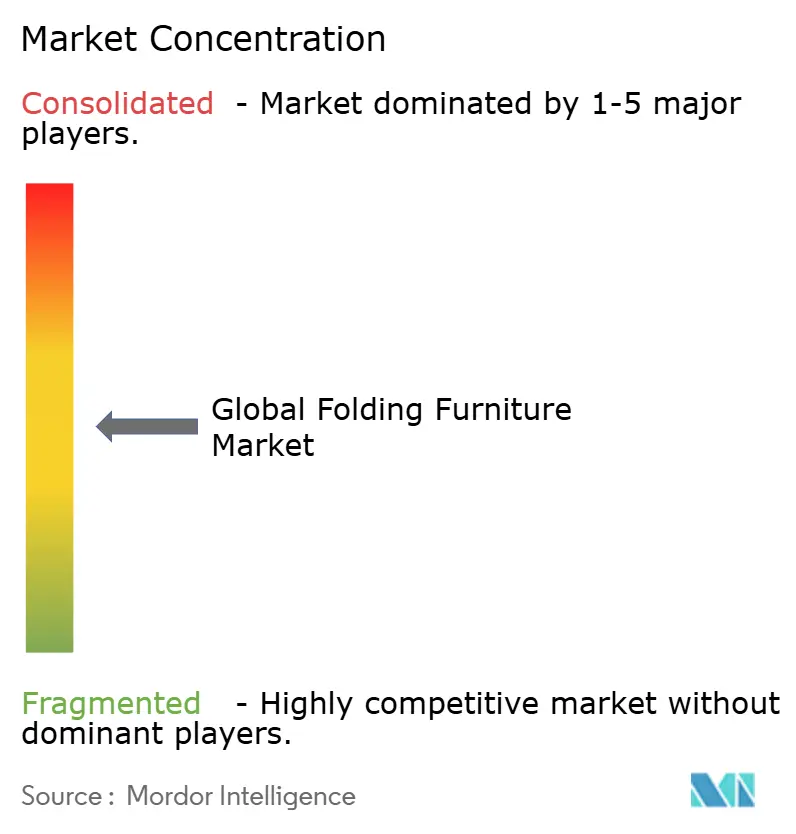
| Market Concentration | Medium |
Major Players *Disclaimer: Major Players sorted in no particular order Image © Mordor Intelligence. Reuse requires attribution under CC BY 4.0. | |
Folding Furniture Market Analysis by Mordor Intelligence
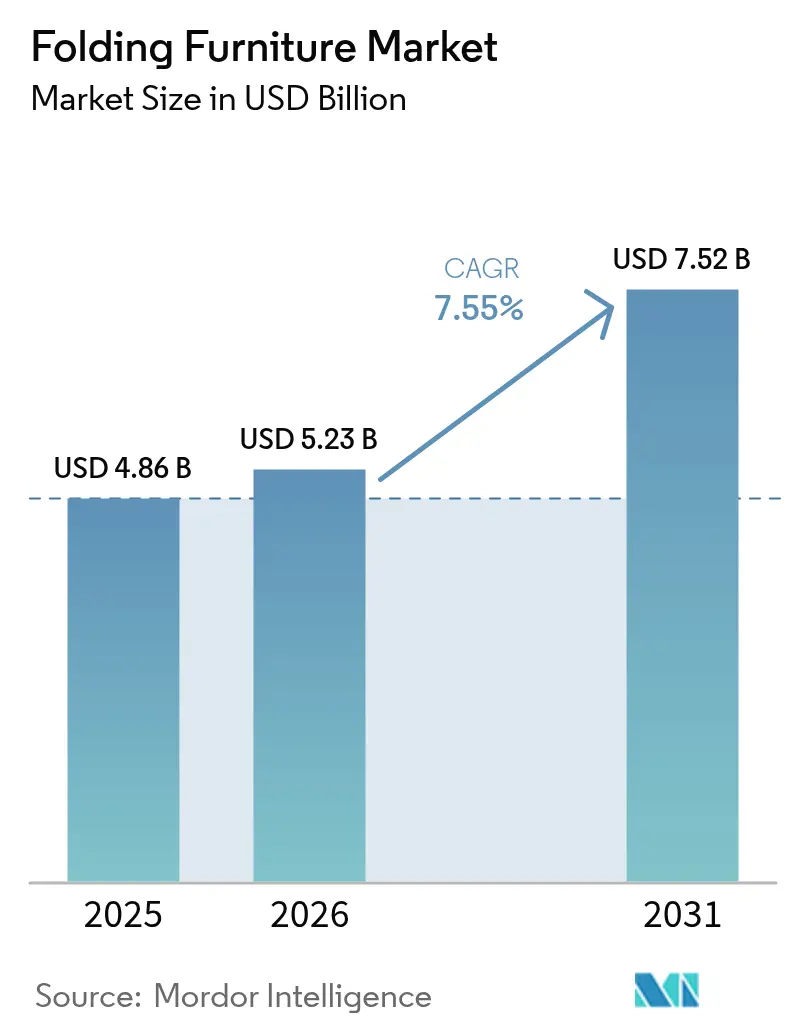
Folding Furniture Market size in 2026 is estimated at USD 5.23 billion, growing from 2025 value of USD 4.86 billion with 2031 projections showing USD 7.52 billion, growing at 7.55% CAGR over 2026-2031.
Urban dwellers are trading aesthetics for utility as floor areas shrink, and the hybrid work wave has turned spare corners into home-office zones that require desks or benches able to vanish after hours. Retailers now report that 2025 buyers list versatility as a top decision factor, catapulting devices that can shift from seating to bedding or from workstation to shelving in a single motion. Metals are displacing heavier frames—unit weights are down since 2023—while maintaining ANSI/BIFMA load ratings, encouraging consumers who relocate often. Asia Pacific is expanding on the back of micro-apartment construction, public housing grants, and cost-competitive production hubs. Residential demand still drives sales, yet commercial buyers—hotels, schools, convention centers—accelerate faster as post-pandemic refurbishments call for reconfigurable layouts. Players wrestle with steel price swings and lingering durability concerns in upscale hospitality, but patented “one-touch” transformation mechanisms, integrated charging ports, and GREENGUARD certifications are widening premium margins and drawing affluent consumers.
Key Report Takeaways
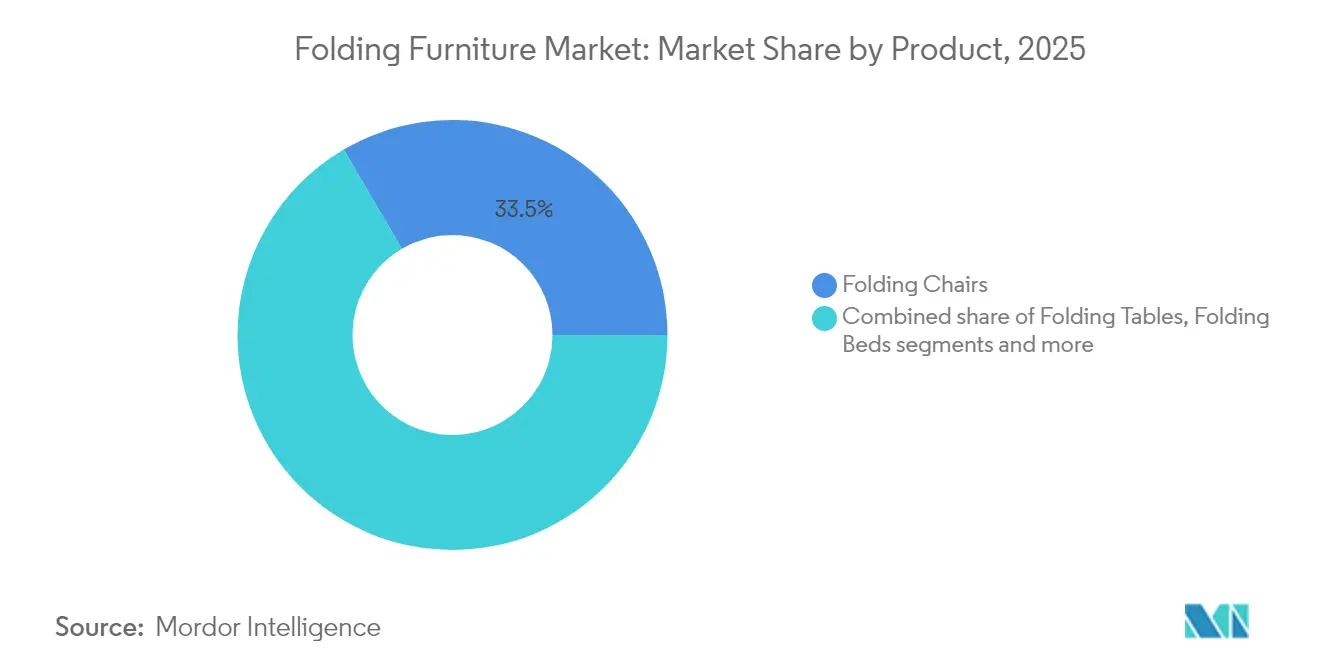
- By product category, folding chairs led with 33.45% of the folding furniture market share in 2025; folding beds are projected to record the fastest 7.6% CAGR through 2031.
- By material, wood secured a 35.60% revenue share in 2025, while metal products are forecast to expand at an 8.05% CAGR to 2031.
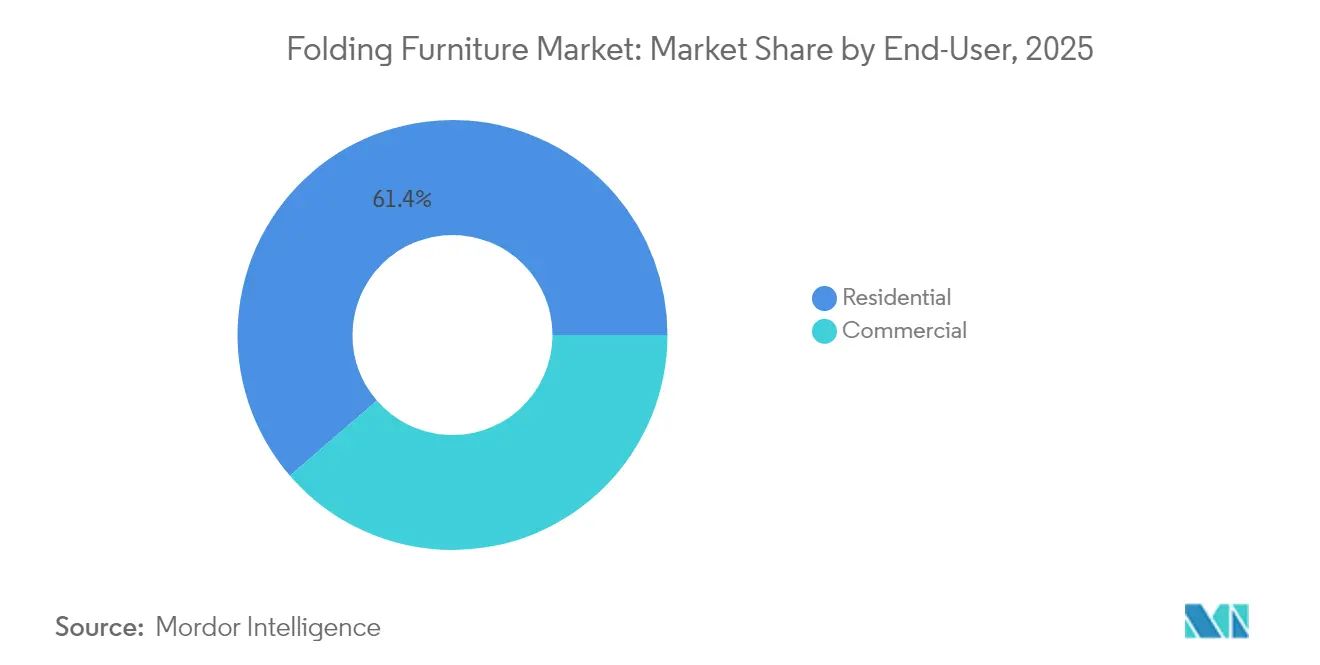
- By end user, the residential segment held 61.35% of the folding furniture market size in 2025, whereas commercial demand is advancing at a 7.9% CAGR.
- By distribution channel, B2C retail captured 78.40% sales in 2025; direct B2B procurement is growing with stronger margin resilience.
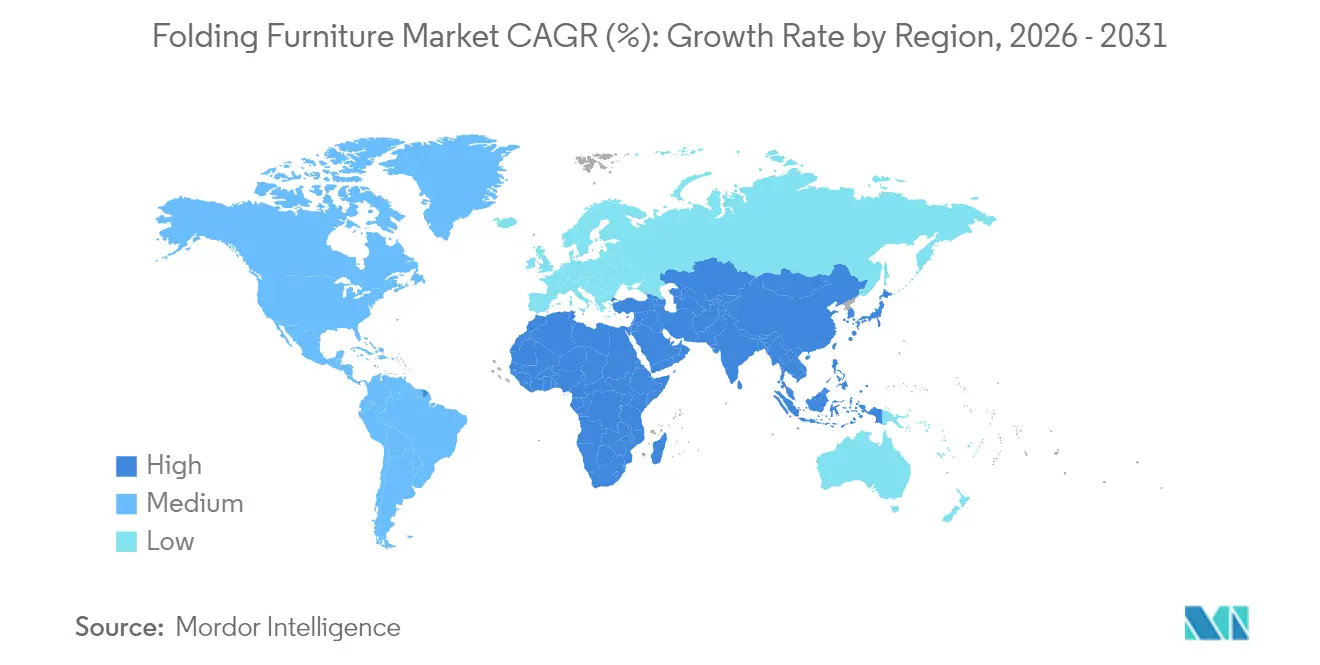
- By geography, Asia-Pacific dominated with 39.60% revenue in 2025 and is set to accelerate at a 7.7% CAGR through 2031.
Note: Market size and forecast figures in this report are generated using Mordor Intelligence’s proprietary estimation framework, updated with the latest available data and insights as of 2026.
Global Folding Furniture Market Trends and Insights
Drivers Impact Analysis*
| Driver | (~) % Impact on CAGR Forecast | Geographic Relevance | Impact Timeline |
|---|---|---|---|
| Rapid Uptake of Micro-Apartments Requiring Space-Saving Furniture | +2.1% | Asia-Pacific, Europe, North America | Medium term (2-4 years) |
| Hybrid Work Culture Boosting Home-Office Folding Furniture | +1.8% | Global, with emphasis on North America & Europe | Short term (≤ 2 years) |
| Government Housing Subsidies Accelerating Multipurpose Furniture Adoption | +1.5% | North America, Europe, and emerging Asia-Pacific markets | Medium term (2-4 years) |
| Rising Demand for Multi-functional Furniture | +1.2% | Global | Long term (≥ 4 years) |
| Growing Commercial Applications | +0.8% | Global, with emphasis on Asia-Pacific & North America | Medium term (2-4 years) |
| Source: Mordor Intelligence | |||
Rapid Uptake of Micro-Apartments Requiring Space-Saving Furniture
Penetration of folding furniture in urban dwellings under 500 ft² has increased, mirroring Asia-Pacific and European mega-cities where liveable floor plans shrink yearly. Residents prioritize transformability over décor, steering spend toward compact systems that turn kitchens into offices or bedrooms into lounges. Suppliers that engineer seamless, low-friction hinges and slimline frames now influence buying criteria more than color palettes. The folding furniture market, therefore, secures a recurring demand base that shows limited sensitivity to economic cycles and keeps replenishment sales elevated as micro-apartment turnover stays brisk.
Hybrid Work Culture Boosting Home-Office Folding Furniture
The 2024 JLL Global Future of Work survey, which captured input from 2,300 corporate real-estate leaders across 25 markets, indicates that 65% of companies intend to increase workplace flexibility by 2030 [1]. This shift is fuelling demand for fold-away desks and workstations that disappear once the workday ends. High-end models now include integrated cable channels, height-adjustable legs, and quick-lock latches that replicate the ergonomics of fixed office furniture. Manufacturers that have targeted this niche are earning stronger margins than their legacy ranges, pointing to a lasting profit pool as hybrid work solidifies.
Rising Demand for Multi-Functional Furniture
Urban residents increasingly want furniture that can change roles throughout the day, think a coffee table that rises into a dining surface or a wall unit that unfolds into a guest bed. This appetite goes beyond simple space-saving; it reflects a desire for flexible lifestyles that let the same square footage serve work, leisure, and rest without compromise. Makers that weave smart features, USB-C charging hubs, voice-activated lifts, or one-touch foldaway mechanisms into their designs are winning the affluent crowd and capturing fatter margins than standard lines. Expect the momentum to build as more people treat their homes as adaptable hubs rather than fixed layouts.
Growing Commercial Applications
Hotels, schools, and activity-based offices specify reconfigurable furniture to raise revenue per square foot and create adaptive classrooms. Corporate companies are shifting towards desk-sharing models stimulates bulk orders for durable, lightweight tables and nesting chairs. Commercial projects command larger order sizes and long-term maintenance contracts, stabilizing manufacturer capacity utilization and margin forecasts.
Restraints Impact Analysis*
| Restraint | (~) % Impact on CAGR Forecast | Geographic Relevance | Impact Timeline |
|---|---|---|---|
| Durability Concerns Limiting Premium Hospitality Procurement | -0.6% | Global, with emphasis on North America & Europe | Medium term (2-4 years) |
| Steel Price Volatility Compressing Manufacturer Margins | -0.4% | Global, with the highest impact in Asia-Pacific | Short term (≤ 2 years) |
| Price-Based Competition Eroding Brand Loyalty | -0.3% | Global | Long term (≥ 4 years) |
| Source: Mordor Intelligence | |||
Durability Concerns Limiting Premium Hospitality Procurement
High-end hotels still suspect that folding frames fatigue quicker than fixed alternatives, curbing adoption despite rigorous ANSI/BIFMA X5.1 certifications [2]. Luxury operators demand multi-year stress-test data and silent hinges that protect guest sleep quality. Manufacturers that publish third-party load validation are slowly easing the perception gap, though sales cycles remain longer than mid-tier hospitality projects.
Steel Price Volatility Compressing Manufacturer Margins
Global steel spot prices jumped erratically in 2024-2025, squeezing mid-market producers that lack hedging sophistication or premium brand positioning[3]. Many introduced aluminum-hybrid or composite frames that cut steel input by 30%, but retooling costs and learning curves temporarily trimmed EBITDA. Wider adoption of commodity futures and index-linked contracts should tame the threat over the coming years.
*Our forecasts treat driver/restraint impacts as directional, not additive. The impact forecasts reflect baseline growth, mix effects, and variable interactions.
Segment Analysis
By Product: Momentum Shifts from Chairs to Beds
Folding chairs contributed 33.45% revenue in 2025, anchoring the folding furniture market with a ubiquitous presence in homes, schools, and events. Upgraded lumbar contours, mesh backrests, and molded edges now mirror traditional task seating, enhancing perceived value. The segment’s installed base also fuels aftermarket cushion, glide, and replacement-bolt revenues. Folding beds, while smaller in volume, climb fastest at 7.6% CAGR through 2031. Demand roots in micro-apartments where wall-mounted frames reclaim daytime floor area, and in guest rooms transforming into home-office spaces overnight. Integrated strut-assist pistons shorten setup to seconds, a decisive buying hook cited by young professionals.
Manufacturers cross-pollinate design cues between these categories, spawning convertible chair-bed hybrids that slot into the premium tier. Meanwhile, folding tables hold a sizable share across conference venues and catering rentals, benefiting from powder-coated frames that resist denting during transport. Sofas, loveseats, and storage cubes represent nascent but promising subsegments that surf the same multifunctional living trend.

By Material: Wood Retains Charm While Metal Accelerates
Wood enjoys a 35.60% share of 2025 revenue, powering the fold-flat coffee tables, expandable dining sets, and bamboo laptop desks preferred by style-sensitive urbanites. Sustainably harvested rubberwood, bamboo, and reclaimed timber variants lift the eco profile without sacrificing rigidity. Metal, however, advances at an 8.05% CAGR as high-tensile steel and 6000-series aluminum alloys shave 30% off product weight yet sustain 250 lb static loads. These gains protect hinges from premature wear and enable slimmer silhouettes that fit in car trunks and apartment closets.
Composite innovations are reshaping the folding furniture market size trajectory for premium SKUs. Powder-bonded fiberboard cores wrapped in veneer deliver a wood feel while beating solid timber on warp resistance. Hybrid frames that sandwich an aluminum beam between plywood panels reinforce stress zones and pass BIFMA drop tests. The material arms race ultimately widens differentiation and lets brands command varied price ladders across channels.
By End User: Residential Dominates, Commercial Accelerates
Apartments and small homes still anchor 61.35% of the 2025 demand, making the residential tier the folding furniture market’s largest revenue pool. Penetration skews highest among units below 800 ft², where buyers juggle living, sleeping, and working zones in one open footprint. The segment’s digital-native shoppers embrace augmented-reality apps that confirm fit and demonstrate transformation animations in situ, lifting e-commerce conversion rates.
Commercial buyers fuel faster 7.9% CAGR growth through 2031. Hospitalities retrofit banquet halls into breakout rooms; classrooms add mobile desks for group activities; corporate hubs embrace huddle spaces for brainstorming, then fold tables away for yoga classes. Procurement teams weigh total-cost-of-ownership ratios, focusing on life-cycle durability, stacking efficiency, and extended warranties. Brands meeting ANSI/BIFMA and GREENGUARD standards often clinch multi-year framework deals, securing production visibility.
By Distribution Channel: Retail Commands, Direct B2B Gains
Retail outlets and pure-play e-commerce together moved 78.40% of the 2025 share, illustrating the folding furniture market’s consumer-driven DNA. Specialty marketplaces now eclipse generalist platforms for online purchases as shoppers seek niche SKUs and 3-D room-planning tools that visualize folding cycles. Home centers still move entry-level metal-frame chairs at volume, while boutique showrooms push coordinated modular systems at premium price points. Click-and-collect and rapid-ship options shorten delivery windows, an expectation codified by gig-economy tenants who relocate frequently.
Direct B2B distribution stakes a 21.60% slice of the folding furniture market size and draws higher gross margins. Manufacturers nurture vertical-specific teams for hospitality, education, and corporate fit-outs, bundling on-site training and maintenance kits. Quick-response OEM capabilities—cutting new molds within six weeks—encourage chain hotels and public-school districts to standardize specifications. Omnichannel overlap is advancing brand-run showrooms that double as trade portals, and large institutional buyers increasingly test demos in consumer pop-ups before bulk ordering.
Geography Analysis
Asia-Pacific anchors the folding furniture market with 39.60% revenue in 2025 and sustains a 7.7% CAGR to 2031 as megacities densify faster than infrastructure expansions. China leverages domestic demand and export-ready supply chains, while India’s booming middle class steers e-commerce platforms toward folding desks and beds that solve space headaches in tier-2 cities. Policy levers—Singapore’s Smart-Home Initiative and Malaysia’s MyHome rebates—explicitly reward compact furnishings, reinforcing mainstream uptake. Japan continues to debut space-efficient origami-inspired mechanisms adopted globally, and South Korea melds IoT sensors into frames that count fold cycles and flag maintenance needs.
North America ranks second by value, driven by the United States’ premium bias and Canada’s sustainability tilt. Urban lofts in New York, San Francisco, and Toronto treat folding dining sets as everyday essentials, while suburban homeowners purchase portable tables for seasonal gatherings and home gyms. The hybrid work surge sparks U.S. demand for fold-away sit-stand desks that vanish post-workday, maintaining mental boundaries in shared living spaces. Mexico's hospitality-led growth funnels government tourism incentives into flexible guest-room layouts that optimize occupancy rates.
Europe exhibits high design sophistication and stringent durability norms forged in centuries-old city footprints that demand creative use of square footage. The United Kingdom leads smart folding furniture adoption, integrating Bluetooth-linked motors and Alexa routines. Germany’s engineering culture prizes precision hinges crafted to micron tolerances, supporting premium pricing shields. France blends couture styling with functional bones, pioneering slimline wall beds disguised as art panels. Italy and Spain post above-average growth as boutique hotels refresh interiors for multipurpose events, while Eastern European capitals such as Warsaw and Bucharest open fertile ground for mass-market imports.
Value Chain Analysis
The folding furniture value chain starts with upstream inputs such as wood panels (including bamboo/rubberwood and engineered boards), metal tubing and hardware (hinges, latches, strut-assist components), plastics/composites, coatings, and packaging. Midstream manufacturing includes OEM and private-label factories as well as branded producers, where frames are cut, formed, welded, and finished, then mechanisms are assembled and durability and safety testing is carried out. Commercial buyers increasingly connect those test outcomes to ANSI/BIFMA requirements and low-emission expectations. Production is still concentrated across Asian hubs (notably China, Vietnam, and Malaysia), so freight availability and port-to-inland flows remain a recurring constraint for export-oriented programs.
Downstream, bulky-item logistics and last-mile delivery are central value drivers because folding products compete on space efficiency as well as delivered cost. Players are tightening logistics integration through long-term partnerships and dedicated capacity: A.P. Moller - Maersk and Castlery signed a 10-year ocean and integrated logistics agreement in February 2025, and IKEA-related omnichannel fulfillment has relied on dedicated warehousing and last-mile initiatives in India. This includes an Ekart electric-vehicle last-mile program in Chennai (April 2026) and a DHL Supply Chain alliance for multi-site warehousing and distribution across Pune and Bhiwandi (May 2026). Distribution splits between B2C retail (home centers, specialty stores, online marketplaces, and brand.com) and direct B2B procurement for hospitality, education, and corporate fit-outs, while packaging innovations such as vacuum compression are being used to reduce cube, lower transport costs, and improve damage performance in parcel and two-person delivery networks.
Competitive Landscape
The folding furniture market remains moderate, leaving room for agile challengers. IKEA capitalizes on vertically integrated sourcing and flat-pack logistics, reinforcing cost leadership and global reach. Resource Furniture LLC defends an upscale niche by patenting counterbalanced wall-bed mechanisms that users elevate with two fingers, carving a moat through intellectual property. Lifetime Products’ acquisition of Plastic Development Group broadens plastic-top table capacity, signaling consolidation momentum focused on scale economies.
Technology has shifted competitive battlegrounds. Zinus Inc. wins share via tool-free snap-lock connectors that cut assembly time to five minutes, delighting renters wary of landlord penalties from wall mounts. Hettich adds silent self-closing hinges into OEM collaborations, monetizing hardware expertise across desk, bed, and cabinet frames. ANSI/BIFMA certifications emerge as gating criteria in RFPs, prompting midsize factories to invest in cycle-test rigs and environmental chambers. GREENGUARD labels unlock procurement budgets in education and healthcare segments that prioritize indoor air quality.[4]
Price competition intensifies in the mid-market, where commoditized steel-tube chairs flood online channels. Yet premium and value segments see steadier margins—high end via design patents and smart integrations, low end via volume scale and austere feature sets. Direct-to-consumer newcomers deploy social-video tutorials to demystify wall-bed installation and sidestep retailer mark-ups. Incumbents respond by launching digital configurators and subscription upgrade bundles that swap worn panels for refreshed finishes.
Folding Furniture Industry Leaders
-
Leggett & Platt Inc.
-
Dorel Industries Inc.
-
IKEA
-
Lifetime Products Inc.
-
Meco Corporation
- *Disclaimer: Major Players sorted in no particular order
Market Opportunities and Future Outlook
Sustainability-led product documentation and low-emission materials are creating room for folding furniture suppliers that can operationalize traceability and back environmental claims with evidence, especially in Europe. Regulation (EU) 2024/1781 (ESPR) and Directive 2024/825 raise expectations around declared composition and transparency in sustainability messaging. This favors platforms that can standardize bills of materials across SKUs, prove repairability for folding mechanisms, and scale certified inputs (for example, FSC) alongside low-emission boards and recycled composites without sacrificing hinge performance or load ratings.
Differentiation is also moving beyond portability toward integrated performance and better-fit use cases in residential hybrid work and commercial reconfigurable spaces. The opportunity set includes premium mechanisms such as quiet hinges, counterbalanced lift systems, and quick-lock latches, as well as integrated charging and cable management for fold-away workstations. Commercial and institutional buyers continue to place weight on durability validation and indoor air quality credentials (such as GREENGUARD), which strengthens the business case for manufacturers that build cycle-test capability and publish third-party results. Innovation that links furniture to human performance is increasingly appearing in purchase decisions, including KI's Kiaura seating collection with patented Cognetic Technology in June 2026, which points to continued demand for differentiated ergonomic systems that can be adapted into space-saving and flexible-environment portfolios.
Recent Industry Developments
- May 2026: Dorel Industries reported first-quarter 2026 results for its Home segment and highlighted that Cosco branded product sales performed near plan despite broader pressure in the segment. The update reinforces Cosco's role as a key operating focus for Dorel as it refines its folding and space-saving assortment and cost structure.
- February 2026: IKEA U.S. announced plans for new store openings during 2026 as part of its omnichannel strategy to improve customer access. A larger, closer-to-consumer footprint supports faster fulfillment for bulky items such as folding tables, chairs, and beds and strengthens click-and-collect style purchasing behavior.
- July 2024: Howe, in collaboration with Jones & Partners, unveiled Folding Surfaces, a mobile double-folding bench designed for flexible environments. The launch broadened product options for commercial spaces that reconfigure layouts frequently, reinforcing demand for durable, transportable folding solutions.
Research Methodology Framework and Report Scope
Market Definition and Coverage
This market covers new, factory-made furniture that is designed to fold, stack, or nest so it can be stored and moved with less space. The market is measured in value terms at the manufacturer selling price.
Scope exclusions: Ready-to-assemble knock-down furniture that is not built for repeated folding and unfolding is excluded from the market value.
Segmentation Overview
- By Product
- Folding Chairs
- Folding Tables
- Folding Beds
- Folding Sofas & Loveseats
- Folding Desks & Workstations
- Folding Storage Units
- Other Folding Furniture
- By Material
- Wood
- Metal
- Plastic
- Other Materials
- By End-User
- Residential
- Commercial
- By Distribution Channel
- B2C/Retail
- Home Centers
- Specialty Furniture Stores
- Online
- Other Distribution Channels
- B2B/Directly from Manufacturers
- B2C/Retail
- By Geography
- North America
- Canada
- United States
- Mexico
- South America
- Brazil
- Peru
- Chile
- Argentina
- Rest of South America
- Europe
- United Kingdom
- Germany
- France
- Spain
- Italy
- BENELUX (Belgium, Netherlands, and Luxembourg)
- NORDICS (Denmark, Finland, Iceland, Norway, and Sweden)
- Rest of Europe
- Asia-Pacific
- India
- China
- Japan
- Australia
- South Korea
- South East Asia (Singapore, Malaysia, Thailand, Indonesia, Vietnam, and Philippines)
- Rest of Asia-Pacific
- Middle East And Africa
- United Arab of Emirates
- Saudi Arabia
- South Africa
- Nigeria
- Rest of Middle East And Africa
- North America
Data Sources, Market Sizing, and Validation
Desk Research
Desk research was used to set the demand context and check the direction of the model before we lock assumptions. For folding furniture, we relied on public data such as US Census Bureau retail series, Eurostat household and trade tables, UN Comtrade import and export data for relevant furniture categories, and World Bank macro indicators that help explain consumer spending cycles.
We also reviewed customs and tariff schedules, building and housing statistics, and publicly available standards and safety guidance where they affect product acceptance. Company annual reports, investor presentations, and reputable press coverage were screened to understand distribution mix shifts (offline versus online) and pricing moves by material and product type. A paid subscription used for company financials and news helped cross-check revenue exposure where disclosures were clear. These are illustrative sources only, and many other public references were used for collection, cross-verification, and clarifying open questions.
Primary Interviews and Surveys
Primary work focused on validating what counts as folding furniture in practice, then testing price and volume assumptions using product use cases (small-space residential, hospitality events, education, and light commercial). We spoke with manufacturers, distributors, retailers, and large buyers across APAC, EMEA, and the Americas, so regional differences in demand seasonality, material preference, and channel structure could be represented in the model.
Distribution of primary research fieldwork respondents
| Company type | Respondent position | Region |
|---|---|---|
| Top tier: 26% | CXOs: 17% | APAC: 41% |
| Mid tier: 55% | Functional/Unit leaders: 28% | EMEA: 32% |
| Smaller Players: 19% | Managers: 55% | Americas: 27% |
Market-Sizing & Forecasting
Market sizing starts with a top-down build where furniture demand is reconstructed from macro and trade signals, then narrowed to the foldable, stackable, and nestable product pool using category shares and usage patterns. To keep the totals realistic, we corroborate with selective bottom-up checks, such as sampled average selling price (ASP) by product type multiplied by estimated unit volumes through key channels, and then adjust when the two views disagree.
Inputs used in the model include urban housing indicators that influence small-space living, commercial fit-out activity that drives institutional purchases, material-led ASP movement (metal versus wood and plastic mixes), online penetration in furniture retail, and import dependence in markets where local manufacturing is limited. Where unit-volume visibility is weaker, gaps are handled through proxy ratios from adjacent furniture categories, then stress-tested in interviews so assumptions do not drift. For forecasting, we mainly use scenario analysis supported by a light multivariate regression on leading indicators such as housing starts and consumer spending. The final growth path is accepted only after it aligns with what channel participants expect for price progression and replacement cycles.
Data Validation & Update Cycle
Validation is done through repeated cross-checks across independent signals, and it is not treated as a single final step. Model outputs are compared with trade flows, channel-mix indicators, and implied per-capita consumption patterns. Any anomalies are reviewed so sudden jumps can be tied to a real driver rather than an input error.
Before sign-off, a second analyst reviews key assumptions such as ASP ranges, conversion factors, and regional splits. Large variances trigger re-contact with sources for clarification. The report is refreshed annually, and interim updates are made when material events occur, such as tariff changes, sharp raw material swings, or demand shifts in hospitality and housing. Right before delivery, we run a fresh pass on the latest public indicators so the view stays current for clients.
Mordor Intelligence's Folding Furniture Market Size Measured Against Other Published Estimates
Published market sizes for folding furniture can differ even when the topic name looks the same, because firms do not always count the same product set, pricing level, or timing of currency conversion. Differences also show up when one estimate relies more on shipment value and another relies more on retail value, widening the spread quickly.
The biggest gap drivers here are scope and the price point used, followed by how demand is validated across residential and institutional buyers. Some estimates fold in broader space-saving or ready-to-assemble items, or they use retail selling prices that include trade margins, which increases the number without changing unit demand. Others apply a faster ASP ramp or a more aggressive online share shift, then keep the forecast path unchanged even when trade and housing indicators soften. This is why our checks on manufacturer-level pricing and repeated-folding product eligibility are kept explicit, a choice applied by Mordor Intelligence.
Benchmark comparison
| Source | Market Size | Gaps in Research Methodology |
|---|---|---|
| Mordor Intelligence | USD 5.23 B (2026) | |
| Global Consultancy A | USD 4.42 B (2024) | Uses a different base year and often reflects a retail-level view with channel margins, which can shift the value versus a manufacturer selling price approach and can also change how online pricing is averaged. |
| Industry Publisher B | USD 4.87 B (2026) | Typically applies a wider product pool by product grouping and does not clearly separate repeatedly foldable furniture from adjacent knock-down items, which can push totals upward depending on how mixed-use furniture is classified. |
Taken together, the spread is mainly explained by what gets counted as folding furniture and whether prices are captured at retail or at the manufacturer level. By tying value to clear product eligibility, channel checks, and a repeatable set of demand indicators, we keep the estimate transparent enough to be traced back to practical assumptions.
Key Questions Answered in the Report
What is the folding furniture market’s expected growth trajectory through 2031?
The market is projected to rise from USD 4.86 billion in 2025 to USD 7.52 billion by 2031, posting an 7.55% CAGR.
Which region offers the strongest growth outlook for folding furniture?
Asia-Pacific leads with 39.60% revenue in 2025 and the fastest regional CAGR of 7.7% through 2031, supported by rapid urbanization and housing incentives.
Which product categories are expanding the fastest?
Folding beds record the highest 7.6% CAGR as urban consumers seek multifunctional pieces, while folding chairs remain the largest revenue generator at 33.45% share.
How are materials trends shifting in the industry?
Wood holds the largest 35.60% share, but metal products are scaling faster on an 8.05% CAGR due to lightweight, high-strength alloys that ease transport and assembly.
Which challenges most affect manufacturers’ profitability?
Durability perceptions in premium hospitality and steel price volatility are trimming margins, prompting investment in composite materials and expanded BIFMA-certified testing.