
Market Overview
| Study Period | 2021 - 2031 |
|---|---|
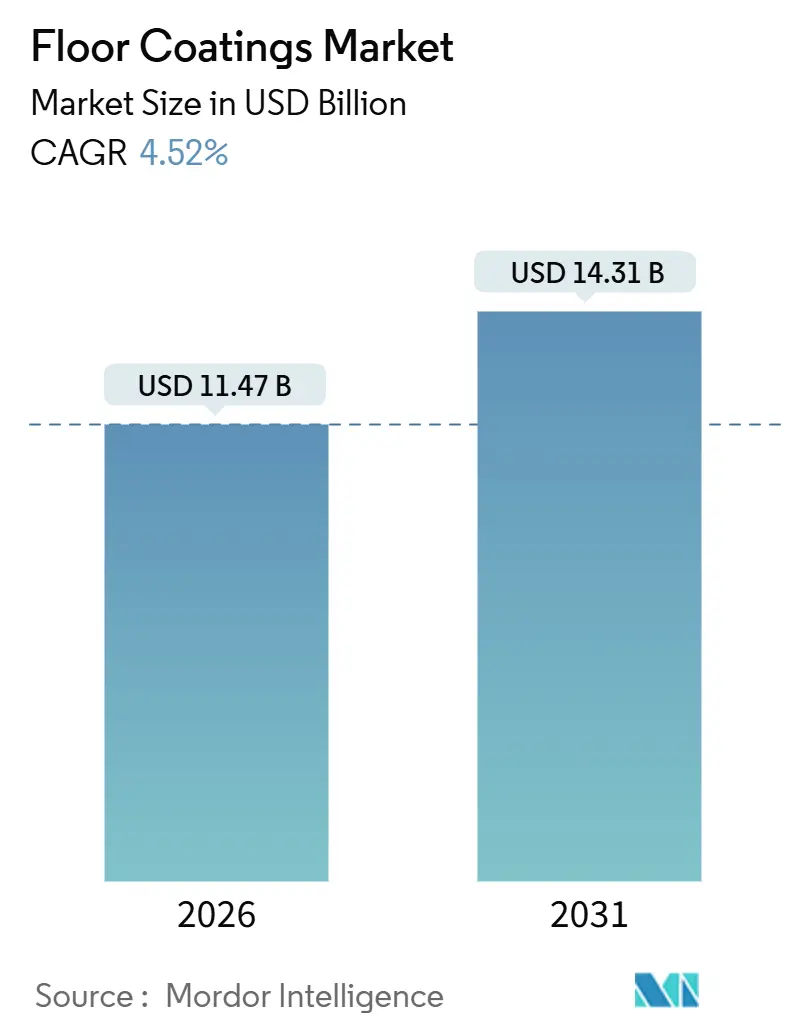
| Market Size (2026) | USD 11.47 Billion |
| Market Size (2031) | USD 14.31 Billion |
| Growth Rate (2026 - 2031) | 4.52 % |
| Fastest Growing Market | Asia Pacific |
| Largest Market | Asia Pacific |
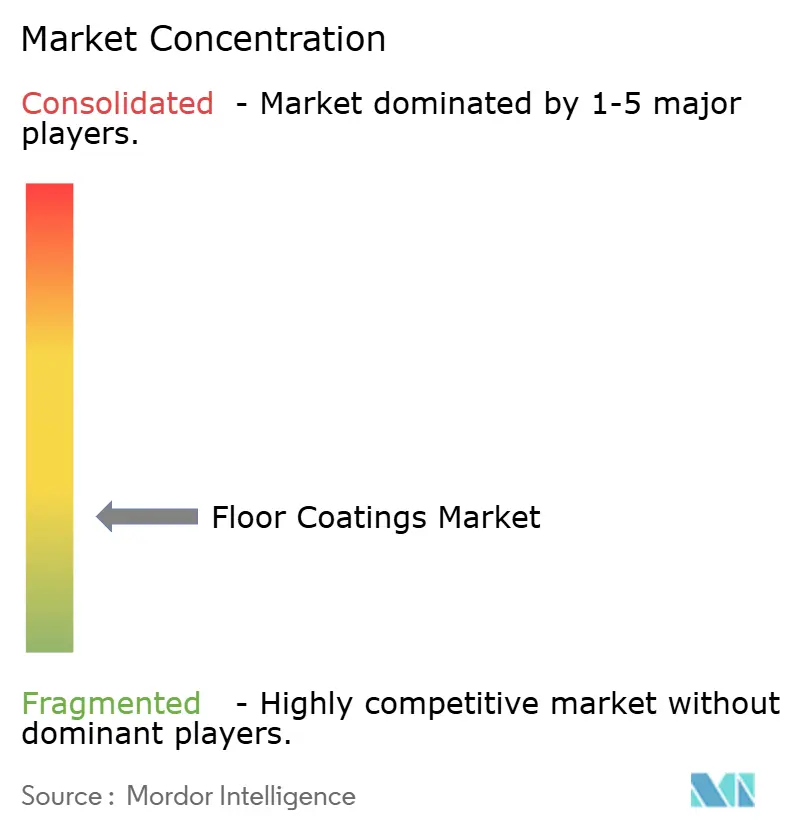
| Market Concentration | Low |
Major Players *Disclaimer: Major Players sorted in no particular order Image © Mordor Intelligence. Reuse requires attribution under CC BY 4.0. | |
Floor Coatings Market Analysis by Mordor Intelligence
The Floor Coatings Market size is estimated at USD 11.47 billion in 2026, and is expected to reach USD 14.31 billion by 2031, at a CAGR of 4.52% during the forecast period (2026-2031). Growth is fueled by rising demand for antimicrobial epoxy systems in cold-storage logistics, conductive floors in EV-battery gigafactories, and UV-cured formulations that minimize downtime in 24/7 production plants. Logistics real-estate development, aggressive clean-room standards across electronics and pharmaceuticals, and tightening VOC rules in Europe and the Nordics are steadily shifting specifications toward low-emission, high-performance chemistries. Simultaneously, raw-material cost swings and a persistent installer shortage are widening price spreads across regions, favoring suppliers with vertically integrated resin capacity and strong applicator networks. Competitive intensity remains high because regional specialists can gain share quickly by tailoring products to local regulatory and climatic conditions.
Key Report Takeaways
- By product type, epoxy commanded 50.15% revenue share of the floor coatings market in 2025, and is projected to expand at a 4.71% CAGR to 2031.
- By technology, UV-cured systems captured 35.22% share of the floor coatings market in 2025 and are projected to grow at a 4.82% CAGR through 2031.
- By floor material, concrete commanded 70.06% revenue share of the floor coatings market in 2025, and is forecast to expand at a 4.94% CAGR to 2031.
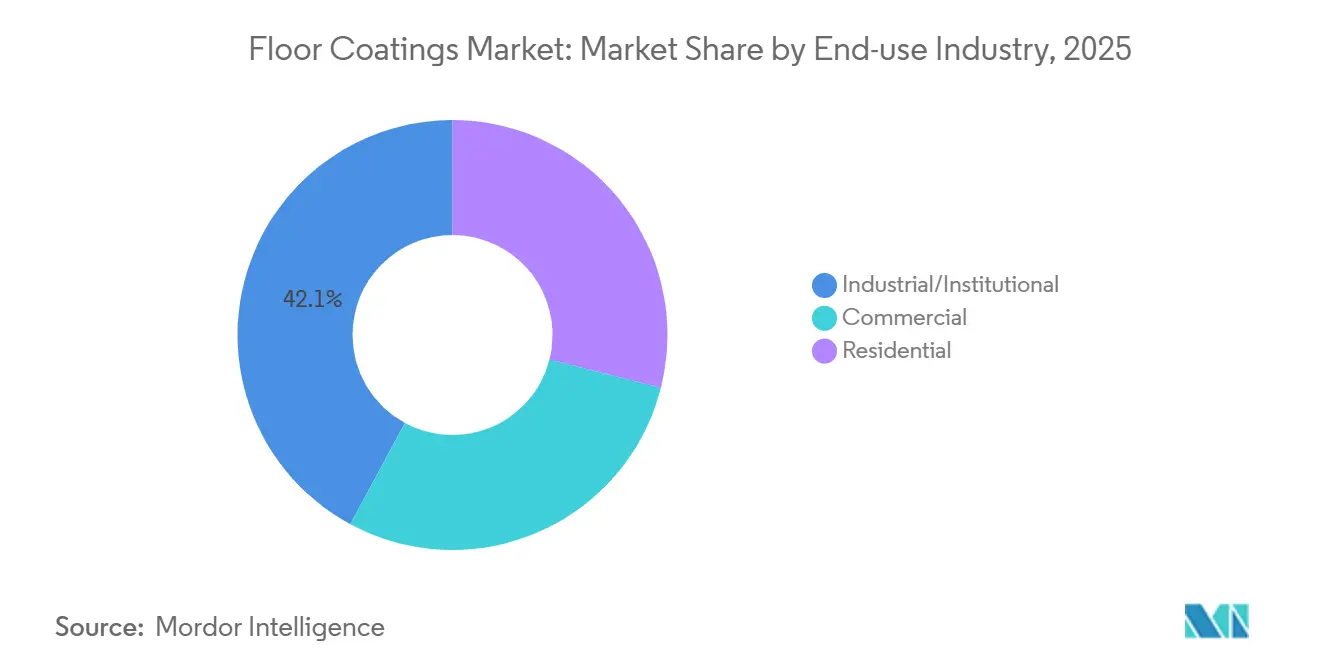
- By end-use industry, the industrial/institutional segment held 42.12% of the floor coatings market size in 2025 and is advancing at a 4.63% CAGR to 2031.
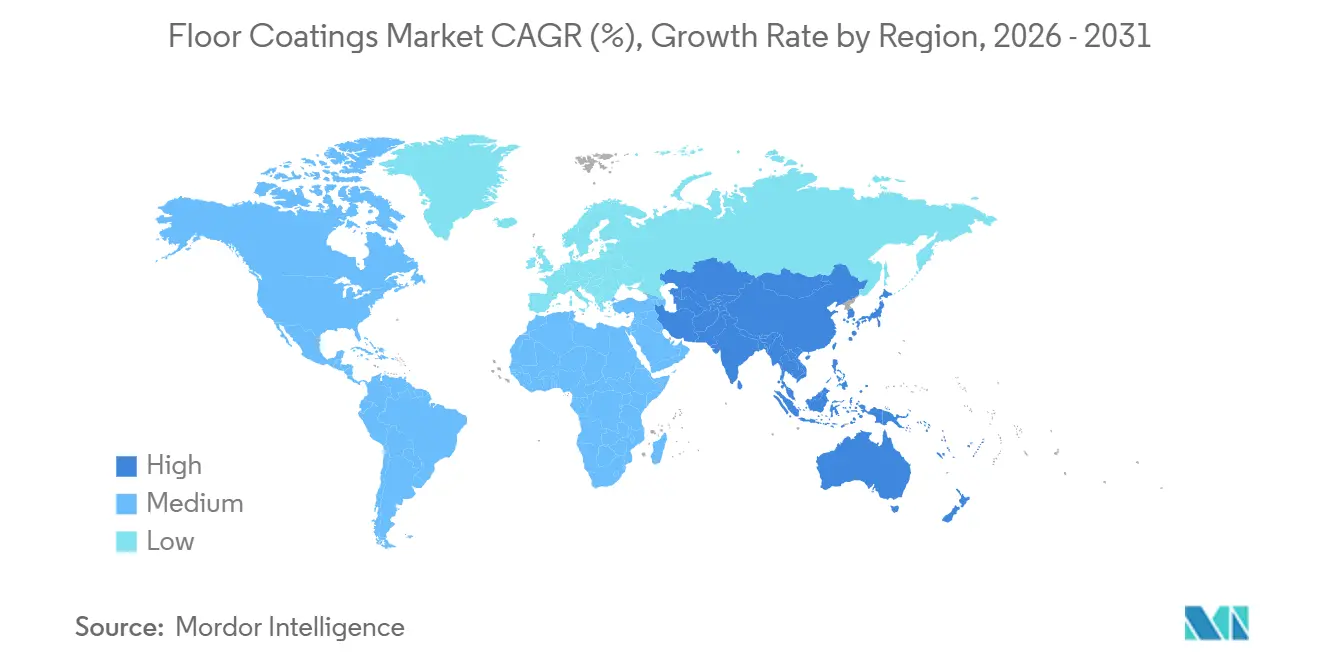
- By geography, Asia Pacific accounted for 38.27% of the floor coatings market share in 2025 and is projected to grow at a 4.78% CAGR through 2031.
Note: Market size and forecast figures in this report are generated using Mordor Intelligence’s proprietary estimation framework, updated with the latest available data and insights as of January 2026.
Market Trends and Insights
Drivers Impact Analysis of Floor Coatings Market*
| Driver | (~) % Impact on CAGR Forecast | Geographic Relevance | Impact Timeline |
|---|---|---|---|
| Rapid expansion of cold-storage warehousing needing antimicrobial coatings | +0.8% | North America, Europe, APAC cold-chain hubs | Medium term (2-4 years) |
| E-commerce fulfillment centers boosting abrasion-resistant epoxies | +1.1% | North America and APAC, spillover to MEA | Short term (≤ 2 years) |
| Renovation boom in multifamily housing driving decorative polyaspartics | +0.6% | Urban North America and Europe | Medium term (2-4 years) |
| Antistatic mandates in EV-battery gigafactories stimulating conductive floors | +0.7% | China, South Korea, Indonesia, Europe, North America | Long term (≥ 4 years) |
| Government incentives for VOC-free water-borne systems in Nordics | +0.4% | Sweden, Norway, Denmark, Finland | Short term (≤ 2 years) |
| Source: Mordor Intelligence | |||
Rapid Expansion of Cold-Storage Warehousing Needing Antimicrobial Coatings
Cold-storage operators specify antimicrobial epoxies that withstand freeze-thaw cycling and high-pressure washdowns. Jotun’s Jotafloor Hygiene achieves a 99.9% bacterial reduction within 24 hours, aligning with FDA Food Code §3-304.14 on non-porous, cleanable surfaces[1]Jotun Technical Team, “Jotafloor Hygiene Performance Data,” jotun.com. Flowcrete’s Flowfresh polyurethane embeds silver-ion biocides that remain active for the life of the floor, satisfying USDA 9 CFR Part 416 on moisture-impervious construction. Regulatory audits under the Global Food Safety Initiative have accelerated the replacement of legacy floors installed before 2020 that lack integrated antimicrobial agents, thereby shortening recoating cycles. The trend is global but most pronounced in North American and European distribution hubs where grocery retailers pledge to expand chilled capacity. As consolidation in cold-chain logistics continues, single operators increasingly award multi-site coating contracts, favoring suppliers with large geographic service networks.
E-Commerce Fulfillment Centers Boosting Abrasion-Resistant Epoxies
Fulfillment centers expose floors to forklift traffic exceeding 10,000 cycles per day, automated guided vehicles, and robotic sorters that generate concentrated loads above 5,000 psi. Epoxy systems formulated with novolac resins and aggregate hardeners deliver compressive strengths above 10,000 psi, preventing delamination under repetitive impacts. Sherwin-Williams’ Macropoxy 646 Fast Cure Epoxy reaches full cure in 16 hours at 70°F, allowing phased installations without shutting down active aisles. As online retailers regionalize inventory to cut delivery times, new warehouses and retrofits demand quick-turn coatings that minimize lost operational hours. The Asian Development Bank projects 4.9% GDP growth for developing Asia in 2025, supporting logistics infrastructure expansion. Short-cycle economic fluctuations have not altered long-range commitments to automation and high-throughput flooring standards.
Renovation Boom in Multifamily Housing Driving Decorative Polyaspartics
Polyaspartic coatings cure at temperatures as low as -20°F and exhibit superior UV stability, making them ideal for balconies, corridors, and amenity spaces in multifamily buildings. The White House allocated USD 10 billion in Community Development Block Grants for commercial-to-residential conversions, unlocking projects that require low-odor, same-day-return-to-service coatings. Flexmar Polyaspartics reach tack-free status in 30 minutes, enabling contractors to limit tenant disruption. More than 400,000 multifamily units were delivered in 2024, many specifying decorative polyaspartics that replicate terrazzo aesthetics at lower installed cost. Architects now integrate floor-finish decisions earlier in project schedules to secure installers during persistent labor shortages. The American Institute of Architects anticipates nonresidential construction spending to rise 2% in 2025, sustaining renovation momentum.
Antistatic Mandates in EV-Battery Gigafactories Stimulating Conductive Floors
Lithium-ion cell assembly requires electrostatic discharge floors with surface resistivity between 1×10⁶ and 1×10⁹ ohms per square to avoid ignition of flammable electrolytes. Sherwin-Williams’ Perma-Crete ESD Urethane meets this range while resisting N-methyl-2-pyrrolidone, a solvent common in electrode production. Sika’s Sikafloor-2530 W conductive epoxy embeds carbon nanotubes, eliminating copper grounding strips and cutting installation labor by around 20%. ASEAN countries attracted roughly USD 12 billion per year in semiconductor and electronics greenfield investment between 2021 and 2024, much of it earmarked for battery components. National industrial policies in Indonesia, Malaysia, Thailand, and Vietnam incentivize local floor-coating supply, prompting multinational formulators to build regional production capacity. These investments support steady long-term demand for conductive coatings.
Restraints Impact Analysis of Floor Coatings Market*
| Restraint | (~) % Impact on CAGR Forecast | Geographic Relevance | Impact Timeline |
|---|---|---|---|
| Raw-material price volatility | -0.9% | Europe and North America | Short term (≤ 2 years) |
| Skilled-installer shortage in emerging economies | -0.5% | APAC, MEA, Latin America | Medium term (2-4 years) |
| PFAS bans limiting high-performance fluorinated top-coats | -0.3% | Europe and North America | Long term (≥ 4 years) |
| Source: Mordor Intelligence | |||
Raw-Material Price Volatility
Epoxy resin prices in Germany rose in January 2025, and the US suppliers posted an increase in the same month, largely due to tighter bisphenol-A availability and anti-dumping investigations on Chinese imports. Concurrent refinery maintenance lifted toluene costs, squeezing polyurethane margins. The US International Trade Commission has initiated provisional duties of 15-35% on imported epoxy, pushing distributors toward regional supply despite higher base prices. BASF’s carve-out of its coatings division to the Carlyle Group underscores how integrated producers are exiting lower-margin businesses, heightening exposure of downstream formulators to spot resin markets. Price swings drive purchasing managers to extend contracts and hold higher inventories, which ties up working capital and slows specification shifts toward next-generation chemistries.
Skilled-Installer Shortage in Emerging Economies
The National Association of Home Builders estimates the US homebuilding sector faces USD 10.8 billion in annual costs from labor shortages, delaying roughly 19,000 homes and associated floor installations[2]National Association of Home Builders, “2025 Housing Market Labor Survey,” nahb.org. Finish carpenters, an occupational group that includes floor installers, rank second in shortage severity, with 56% of builders reporting hiring difficulties. Emerging markets encounter even sharper gaps because vocational programs have not kept pace with construction pipelines. Saudi Arabia’s Vision 2030 megaprojects draw international contractors who compete for limited certified resinous-floor applicators, pushing labor inflation above general construction indices. Insufficient installer capacity lengthens project timelines and raises the risk of coating failure due to improper substrate preparation.
*Our forecasts treat driver/restraint impacts as directional, not additive. The impact forecasts reflect baseline growth, mix effects, and variable interactions.
Floor Coatings Market Segment Analysis
By Product Type:
Epoxy Dominance Anchored in Concrete AdhesionEpoxy resins generated 50.15% of 2025 revenue and are forecast to expand at 4.71% to 2031. Pharmaceutical cleanrooms specify seamless epoxy to meet FDA 21 CFR §211.56 for hard, easily cleanable surfaces. Food-processing plants use similar systems to satisfy USDA FSIS 9 CFR Part 416 on moisture-impervious floors. Polyurethane earns a share in cold storage, where thermal-shock resistance prevents cracking. Decorative polyaspartic demand rises in multifamily refurbishments because same-day occupancy avoids tenant displacement penalties. Acrylic and methyl methacrylate variants remain niche for light-duty retail. The floor coatings market continues to favor epoxy because no alternative matches its cost-to-performance ratio for heavy-load environments, preserving the segment’s leadership through 2031.
Epoxy’s grip on the floor coatings market is also reinforced by extensive installer familiarity, a deep accessories ecosystem, and decades of published application guides. Innovations such as carbon-nanotube conductive fillers and antimicrobial additives extend the chemistry’s addressable end uses without raising complexity for contractors. Polyurethane formulators are responding with silver-ion antibacterial grades, but adoption is slower due to higher raw-material costs. Overall, resin competition will intensify around high-value formulations, yet the epoxy segment is well positioned to defend its 50% floor coatings market share.




By Technology:
UV-Cured Systems Redefine Installation EconomicsUV-cured coatings captured a 35.22% share in 2025 and will grow at 4.82% through 2031. Instant curing under LED lamps eliminates oven energy costs and supports ISO 14001 certification goals. Sherwin-Williams documents 99% curing efficiency, trimming energy use by up to 70% compared with thermal processes. Water-borne epoxies are accelerating in Europe as solvent taxes and VOC caps raise costs on traditional two-component systems. Teknos’ Teknofloor 7300, emitting just 25 g/L VOC, demonstrates that water-borne options can rival solvent-borne abrasion resistance. Powder coatings are limited to metal panels in data centers. The floor coatings market size tied to UV-cured and water-borne technologies will widen as public buyers require ecolabel compliance, particularly in the Nordics.
Production managers cite two factors for adopting UV-cure: elimination of extended shutdowns and predictable cure depth regardless of ambient humidity. Packaging lines, pharma fill-finish suites, and food bottling halls leverage those benefits to upgrade during weekend maintenance windows. Suppliers that bundle lamp systems with coatings capture incremental revenue. As LED prices fall, smaller job-shops can afford mobile UV units, expanding the addressable floor coatings industry customer base.
By Floor Material:
Concrete’s 70% Share Reflects Industrial Construction ScaleConcrete substrates accounted for 70.06% of 2025 revenue and are set to grow at 4.94% through 2031. Asia drives the floor coatings market size tied to concrete; Asia Pacific manufacturing FDI reached USD 226 billion in 2024, with half directed to factory construction. International Concrete Repair Institute profiles ranging from CSP 3 to CSP 5 dominate preparation specifications, ensuring mechanical interlock. ASTM F2170 moisture testing at 40% slab depth is now standard in FDA-audited facilities. Shot-blasting and diamond grinding equipment vendors report double-digit sales growth because contractors cannot risk delamination on fast-track projects.
Wood floors occupy a smaller share in commercial interiors, where UV-cured polyurethanes provide scratch resistance. Metal raised floors supporting data centers rely on powder top-coats that dissipate static while releasing zero VOCs. Maintenance cycles differ: sealed concrete in warehouses may last 7–10 years, while decorative wood finishes often require touch-up every 3–5 years. As capital allocation favors concrete superstructures, coating suppliers align R&D toward crack-bridging, conductive, and antimicrobial enhancements specifically for this substrate.
By End-Use Industry:
Industrial and Institutional Sectors Lead at 42% ShareIndustrial and institutional facilities held 42.12% revenue in 2025 and will grow at 4.63% through 2031. EV-battery gigafactories, semiconductor fabs, and pharma plants mandate specialty floors that dissipate static, withstand solvents, and resist microbial growth, pushing average coating system value higher than in commercial settings. Healthcare operators adopt epoxy with coved bases to satisfy NIH guidelines on seamless, sanitizable surfaces. Clean-room-grade flooring remains a requirement in contract-manufacturing organizations serving global drug pipelines.
Commercial retail and hospitality emphasize aesthetics and rapid re-entry, favoring polyaspartic and acrylic chemistries. Residential demand is concentrated in North American and European multifamily conversions backed by federal or municipal incentives. Labor shortages in North America may slow installation rates but also raise margins for certified applicators. Overall, industrial and institutional projects will keep anchoring the floor coatings market because compliance costs deter substitution toward lower-priced materials.
Geography Analysis
APAC Floor Coatings Market
Asia Pacific generated 38.27% of global revenue in 2025 and is forecast to grow at 4.78% through 2031. ASEAN attracted USD 226 billion of foreign direct investment in 2024, with half destined for manufacturing facilities that require industrial-grade flooring. China, India, Japan, and South Korea remain core contributors, while Indonesia, Malaysia, Thailand, and Vietnam emerge as battery-supply-chain hubs enforcing IEC 61340-5-1 standards. Data-center capacity in the sub-region climbed from 800 MW in 2019 to 1,700 MW in 2023, bolstering demand for raised-floor systems finished with powder or UV-cured coatings. Government incentives for local resin production are attracting multinational formulators who build plants in export-processing zones, ensuring proximity to end users.
North America Floor Coatings Market
North American demand is powered by new logistics facilities and high apartment renovation activity. Warehouse construction exceeded half of all commercial starts in 2023 and continues to outpace offices and retail. The White House’s USD 10 billion allocation for adaptive-reuse conversions adds a pipeline that values fast-cure, low-odor products. Skilled-labor deficits, however, stretch project timelines and increase the premium paid for unionized flooring crews. Canada mirrors US trends, with an added push toward low-carbon concrete substrates that require compatible water-borne or cementitious primers.
Europe Floor Coatings Market
Europe undergoes a technology pivot as VOC limits tighten. Sweden terminated its exemption for solvent-rich coatings, Denmark applies a solvent tax, and the EU Decopaint Directive imposes 500 g/L caps on two-component systems. Public tenders increasingly favor Nordic Swan-certified products emitting fewer than 30 g/L VOC. Germany, France, and Italy promote energy-efficient production lines; consequently, UV-cure adoption accelerates in auto plants and packaging factories. Eastern European data-center builds add conductive raised-floor opportunities, but labor migration to Western Europe constrains local installer capacity.
MEA and LATAM Floor Coatings Market
The Middle East and Africa gain momentum from sovereign infrastructure programs. Saudi Vision 2030 funnels capital into megaprojects such as NEOM, whose 20,000 m³-per-day concrete output drives large-volume epoxy consumption. The International Monetary Fund projects Saudi GDP growth of 3.5% in 2025 and 3.9% in 2026, supporting sustained construction. United Arab Emirates, Nigeria, and Egypt diversify away from oil dependence with manufacturing free-zones that demand chemically resistant floors. Latin America’s growth is steadier; Brazil and Mexico modernize agro-processing plants using antimicrobial epoxies to comply with export inspection regimes.

Value Chain Analysis
The floor coatings value chain starts with upstream petrochemical and mineral inputs, including epoxy/amine systems, polyurethane intermediates, acrylic monomers, fillers, pigments, and antimicrobial or conductive additives. These feed resin and additive producers, toll manufacturers, and integrated formulators that blend, test, and qualify full flooring systems (primers, basecoats, topcoats, and repair mortars) against performance requirements such as abrasion resistance, chemical resistance, ESD, and hygiene.
In most markets, distribution flows through specialty chemical distributors and coatings channels to flooring contractors, general contractors, and facility owners. Technical service labs and applicator training also influence specifications in segments such as cold storage, cleanrooms, and EV-battery plants, where substrate preparation and system matching affect outcomes. Recent moves reflect how suppliers are reinforcing both input access and channel reach, for example: in February 2026, Westlake Epoxy expanded its distribution relationship with Brenntag to cover South and West India for its epoxy solutions portfolio, and in March 2026 Incorez appointed Ravago Chemicals North America as exclusive distributor for the US and Canada for polyurethane, polyaspartic, and epoxy-curing technologies. Downstream, production and service footprints are being brought closer to demand centers, including VIP Coatings partnering with CIC Construction Chemicals in April 2026 to localize polyurea, polyaspartic, and hybrid coatings production in Saudi Arabia aligned with Vision 2030, and Asian Paints and PPG extending their 50:50 industrial coatings joint venture through 2041 to secure long-term industrial and automotive coatings manufacturing capacity in India.
Competitive Landscape
The Floor Coatings market is fragmented. Regional specialists win share by conforming to local VOC ceilings or by integrating antimicrobial and conductive additives tailored to niche regulatory needs. Marketing strategies stress sustainability credentials, such as EPDs (Environmental Product Declarations) and third-party ecolabels. Suppliers that can document cradle-to-gate carbon footprints below benchmark thresholds secure advantageous scoring in public tenders across Scandinavia and Western Europe.
Floor Coatings Industry Leaders
The Sherwin-Williams Company
PPG Industries Inc.
Sika AG
BASF
RPM International Inc.
- *Disclaimer: Major Players sorted in no particular order
Floor Coatings Market Companies Covered in this Report
- Akzo Nobel N.V.
- Ardex Group
- Arkema (Bostik)
- Asian Paints
- Axalta Coating Systems
- BASF
- Hempel A/S
- Henkel AG & Co. KGaA
- Jotun
- Kansai Nerolac Paints Limited
- LATICRETE International Inc.
- MAPEI S.p.A
- Nippon Paint Holdings Co., Ltd.
- PPG Industries Inc.
- RPM International Inc.
- Sika AG
- Sto SE & Co. KGaA
- Teknos Group
- Tennant Company
- The Sherwin-Williams Company
- Tikkurila

Market Opportunities and Future Outlook
Opportunity areas center on applications where buyers pay for performance assurance, faster return-to-service, and documentation for compliance rather than lowest installed cost. Cold-chain and food facilities continue to specify antimicrobial, moisture-impervious floors under audit regimes, while electronics, semiconductor, and EV-battery production supports demand for conductive/ESD systems and solvent-resistant topcoats. For 24/7 operations, UV-cured or other fast-cure chemistries reduce downtime and compress turnaround windows. In Europe and the Nordics, tightening VOC requirements and ecolabel preferences shift purchasing toward water-borne and low-emission systems, creating room for suppliers that can provide verified VOC performance, EPD-aligned documentation, and full-system compatibility (primer through topcoat) for concrete, the dominant substrate.
Supply-side investments also indicate a move toward regionalized production and locally supported application development that can shorten qualification cycles. In February 2026, BASF added a new production line for dispersions at its Mangalore, India site to increase local supply for architectural coatings and construction chemicals, and in March 2026 BASF inaugurated an expanded dispersions production facility at its Durban, South Africa site, including a modern application laboratory for technical customer support. For floor coatings suppliers and contractors, these expansions improve access to dispersion technologies used in lower-emission formulations and support faster troubleshooting and in-market application development, particularly in fragmented regions where installer capability and substrate variability can drive performance outcomes.
Recent Industry Developments in Floor Coatings Market
- July 2026: BASF expanded its biomass-balanced additives portfolio for architectural coatings with new products including Dispex AA 4145 MB, Rheovis PU 1333 MB, and Rheovis HS 1169 MB. The launch broadens the toolbox for formulators pursuing lower-footprint raw material options in coating systems used across construction and refurbishment environments. It also supports specification discussions where buyers request traceable sustainability attributes alongside conventional performance metrics.
- June 2026: Premium Service Brands acquired Wise Coatings, a floor coatings contractor network with locations across 20 US states. The deal accelerates consolidation on the application and service side of the market, where installer availability and execution quality directly affect lifecycle performance. A broader platform can standardize processes and increase marketing reach for residential and light-commercial floor coating offerings.
- April 2026: VIP Coatings and CIC Construction Chemicals announce localizing polyurea, polyaspartic, and hybrid coatings production in Saudi Arabia aligned with Vision 2030. The collaboration positions both companies to shorten qualification cycles and improve supply reliability in the Middle East market. This move underscores the shift toward regionalized production and near-market service for performance coatings.


Floor Coatings Market Report Scope and Research Methodology
Market Definition and Coverage
For this study, the floor coatings market covers factory applied or site applied coating systems used to protect and finish floors on hard substrates, where the output is measured as revenue from coating materials and related system components sold for floor use.
Scope exclusions: This sizing does not count temporary floor polishes and waxes, carpet tiles, or sheet vinyl floor finishes.
Segments Covered in This Report
- By Product Type
- Epoxy
- Polyurethane
- Polyaspartic
- Acrylic
- Others
- By Technology
- Solvent-borne
- Water-borne
- Powder
- UV cured
- By Floor Material
- Concrete
- Wood
- Others
- By End-use Industry
- Industrial/Institutional
- Commercial
- Residential
- By Geography
- Asia-Pacific
- China
- India
- Japan
- South Korea
- Malaysia
- Thailand
- Indonesia
- Vietnam
- Rest of Asia-Pacific
- North America
- United States
- Canada
- Mexico
- Europe
- Germany
- United Kingdom
- France
- Italy
- Spain
- Nordic Countries
- Turkey
- Russia
- Rest of Europe
- South America
- Brazil
- Argentina
- Colombia
- Rest of South America
- Middle East and Africa
- Saudi Arabia
- United Arab Emirates
- Nigeria
- Egypt
- South Africa
- Rest of Middle East and Africa
- Asia-Pacific
Data Sources, Market Sizing, and Validation
Desk Research
Desk work was used to build the fact base around construction activity, industrial output, and chemical and coatings supply signals that influence floor coating demand. We referred to public sources such as the US Census Bureau construction spending series, Eurostat construction and industrial statistics, UN Comtrade trade flows for relevant chemical categories, and the USGS and similar agencies for minerals and cement indicators that matter for floor buildouts.
On top of this, we reviewed company annual reports and presentations, technical papers and peer reviewed articles on resin performance and application practices, and updates from industry and building related associations that discuss flooring and maintenance cycles. In selected cases, paid subscriptions that support company financials, patent databases, and import and export shipment level data were used to cross check large supplier exposure, innovation intensity, and trade directionality. These desk sources are not exhaustive, and many additional public references were used to validate and clarify assumptions during the research process.
Primary Interviews and Surveys
Primary inputs were collected through expert interviews and structured surveys with raw material participants, formulators, applicators, distributors, and large end users across industrial, commercial, and residential demand pools. We tested what was learned in desk research, and where data was not directly visible, assumptions were corrected through pricing logic, typical project sizes, refurbishment timing, and application mix differences across regions.
Distribution of primary research fieldwork respondents
| Company type | Respondent position | Region |
|---|---|---|
| Top tier: 29% | CXOs: 13% | APAC: 42% |
| Mid tier: 53% | Functional/Unit leaders: 31% | EMEA: 31% |
| Smaller Players: 18% | Managers: 56% | Americas: 27% |
Market-Sizing & Forecasting
A top-down build was created by reconstructing the addressable floor area linked to new construction and refurbishment, and then applying coating usage rates and typical system value by end use. Once the demand pool was formed, results were corroborated through selective bottom-up checks such as sampled supplier revenue exposure to floor coatings, channel checks on product mix, and volume by average selling price estimates for common systems.
Key inputs that shaped the model included nonresidential construction spending and starts, industrial and logistics facility additions, refurbishment and maintenance cycles for concrete floors, the split between water-borne and solvent-borne technologies, and resin level shifts between epoxy, polyurethane, polyaspartic, acrylic, and cementitious systems. Price assumptions were handled using ranges by region and by system type, and then normalized into USD using the stated year conversion for consistency. For forecasting, scenario analysis was used so that near term construction cycles, industrial capex shifts, and technology substitution effects could be reflected without overfitting the history, and expert feedback was used to keep the variable trajectories realistic.
When gaps appeared in the supplier side checks, coverage ratios were applied based on channel structure and the share of organized supply versus local blends, and then reviewed again during primary calls before finalizing totals.
Data Validation & Update Cycle
Outputs were validated through triangulation across demand indicators, trade signals, and supplier exposure checks, followed by variance testing at region and product system level. Where the model produced unusual jumps, the drivers were rechecked, and follow up calls were triggered to confirm whether the change was real or caused by an input mismatch.
Before sign off, the work goes through multi step internal reviews so definitions, currency handling, and assumptions stay consistent across the time series. Reports are refreshed annually, and interim updates are made when material events occur, such as major construction slowdowns, sharp raw material price movements, or regulation led technology shifts. Right before delivery, an analyst performs a fresh pass on the key inputs to ensure clients receive the latest updated view.
Mordor Intelligence's Floor Coatings Market Size Compared Against Other Published Estimates
Published figures for floor coatings often do not line up because the included product scope, the demand proxy used, and the way prices are normalized into USD are not consistent across studies. Differences also show up when one study leans heavily on a narrow supplier set, while another assumes broader coverage without showing the bridge to end use demand.
The main gap comes from what is counted as a floor coating system, where Mordor Intelligence includes resin based and cementitious floor coating systems across industrial, commercial, and residential floors, but keeps out temporary polishes and non-coating floor finishes, which can materially change the total. Other gaps usually come from how refurbishment cycles are treated, whether technology shifts (like water-borne share gains) are priced using realistic step ups, and whether the estimate is kept current when construction conditions change quickly.
Benchmark comparison
| Source | Market Size | Gaps in Research Methodology |
|---|---|---|
| Mordor Intelligence | USD 11.47 B (2026) | |
| Global Consultancy A | USD 3.65 B (2025) | Uses a narrower value pool that appears to focus on selected resin coatings and reported manufacturer sales, which can miss cementitious systems and installed system components, and can understate demand where local blending and contractor channels are meaningful. |
| Trade Publisher B | USD 3.29 B (2024) | Relies on a different base year and a faster growth path, and it is not always clear how refurbishment timing, regional price levels, and currency conversion points are handled, which shifts the current size before the forecast even starts. |
Reading the table together, the spread is mainly explained by scope choices and the demand proxy used to translate construction activity into coating revenue. By tying the estimate to observable floor build and refurbishment drivers, and then stress testing it with pricing and supplier exposure checks, the final number stays traceable to clear steps that can be repeated year after year.


Key Questions Answered in the Report
What is the current value of the floor coatings market?
The floor coatings market size is valued at USD 11.47 billion in 2026.
How fast is demand for floor coatings expected to grow?
Revenue is projected to reach USD 14.31 billion by 2031, reflecting a 4.52% CAGR over the forecast period.
Which product type leads global sales?
Epoxy resins hold the top position, capturing 50.15% of 2025 revenue due to superior adhesion and chemical resistance.
Why are UV-cured floor coatings gaining popularity?
They cure instantly under LED lamps, cutting plant downtime and meeting strict VOC limits without ovens, enabling faster project turnaround.
Which region represents the largest opportunity?
Asia Pacific, already generating 38.27% of global revenue, benefits from heavy manufacturing FDI and is forecast to expand at 4.78% through 2031.
Page last updated on:


 Your data is secure and never sold or shared.


