
Market Overview
| Study Period | 2021 - 2031 |
|---|---|
| Market Size (2026) | USD 100.28 Billion |
| Market Size (2031) | USD 123.96 Billion |
| Growth Rate (2026 - 2031) | 4.33 % |
| Fastest Growing Market | Asia Pacific |
| Largest Market | Asia Pacific |
| Market Concentration | Medium |
Major Players *Disclaimer: Major Players sorted in no particular order Image © Mordor Intelligence. Reuse requires attribution under CC BY 4.0. | |
Architectural Coatings Market Analysis by Mordor Intelligence
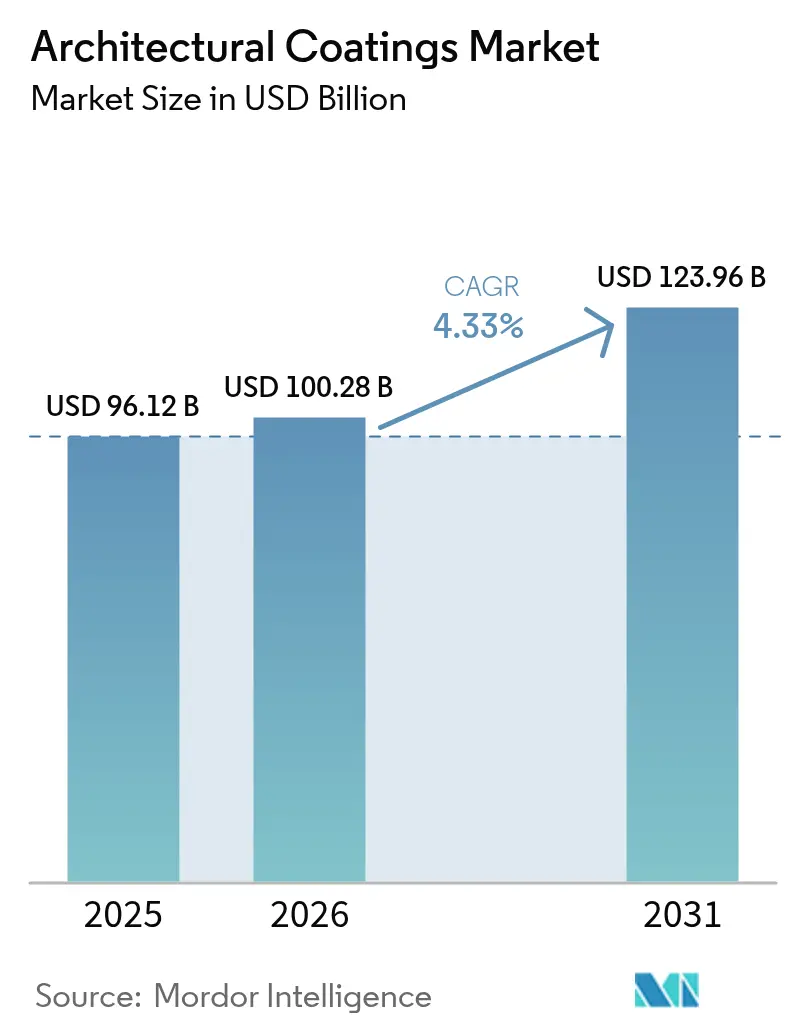
The architectural Coatings Market size is projected to be USD 96.12 billion in 2025, USD 100.28 billion in 2026, and reach USD 123.96 billion by 2031, growing at a CAGR of 4.33% from 2026 to 2031. The measured headline growth hides an accelerated shift toward low-VOC, water-borne systems that is compressing the economic life of legacy solvent-borne assets, raising capital-intensity for smaller producers that cannot fund rapid retooling. Water-borne coatings already hold just over half of global volume, yet infrastructure gaps in parts of South and Southeast Asia delay full adoption by 3-5 years, especially where tinting equipment and controlled distribution remain under-developed. Acrylic resins dominate formulation choices because they align with tightening emission rules and perform well in humid climates, while alkyd demand continues to erode as solvent limits tighten. Regionally, Asia-Pacific underpins demand expansion through rapid urbanization, whereas North America and Europe depend on renovation cycles in housing built after 1970 in an era of high borrowing costs.
Key Report Takeaways
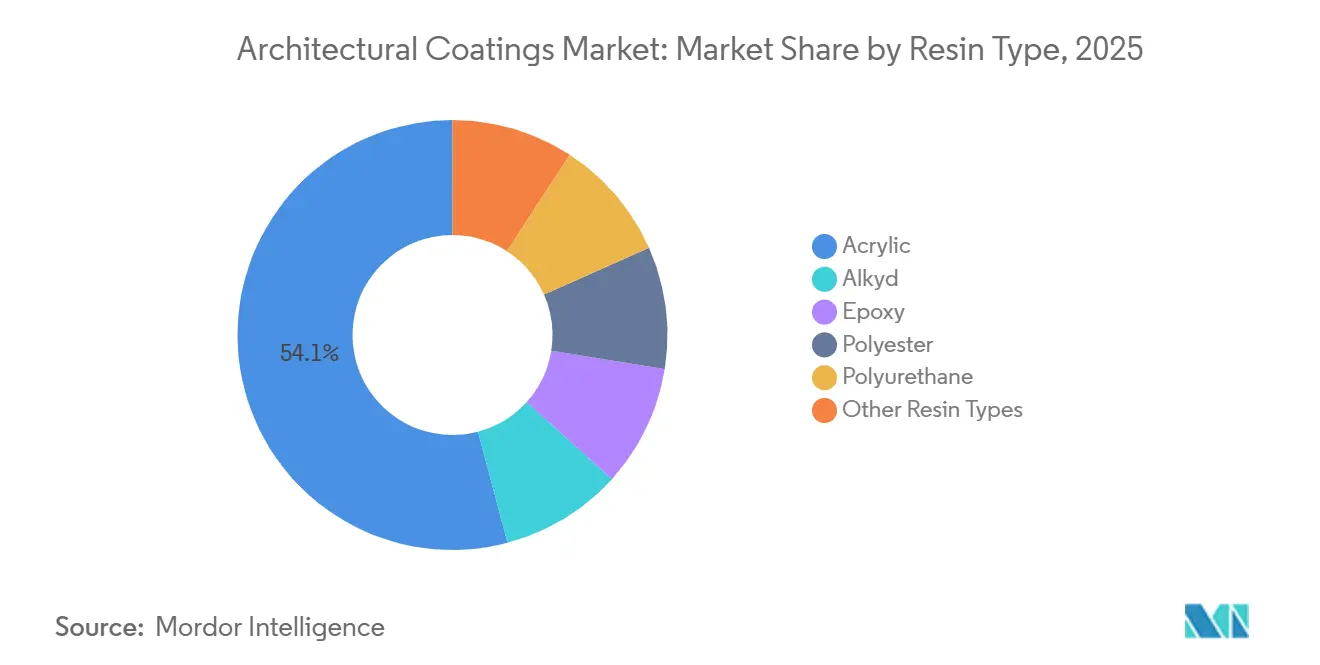
- By resin type, acrylic led with 54.13% architectural coatings market share in 2025 and is projected to advance at a 4.68% CAGR through 2031.
- By technology, water-borne captured 52.12% of the architectural coatings market size in 2025 and is expanding at a 4.78% CAGR to 2031.
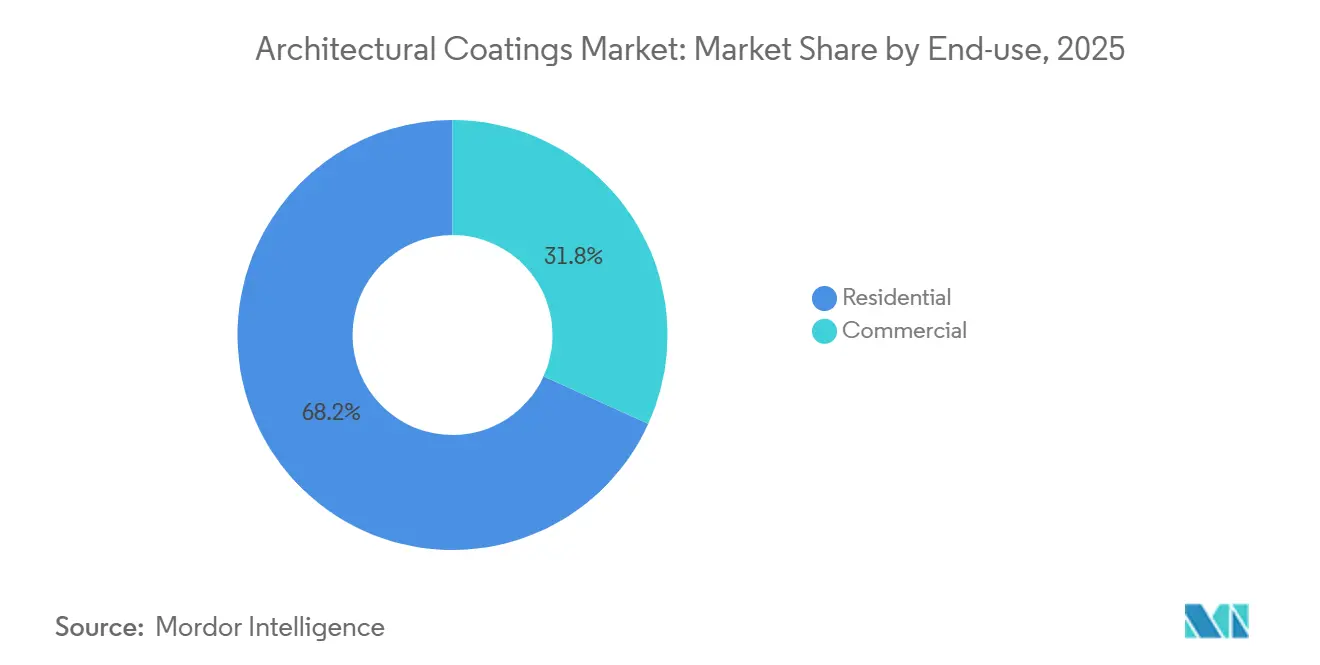
- By end use, residential accounted for 68.22% of the architectural coatings market size in 2025 and is expanding at a 4.53% CAGR to 2031.
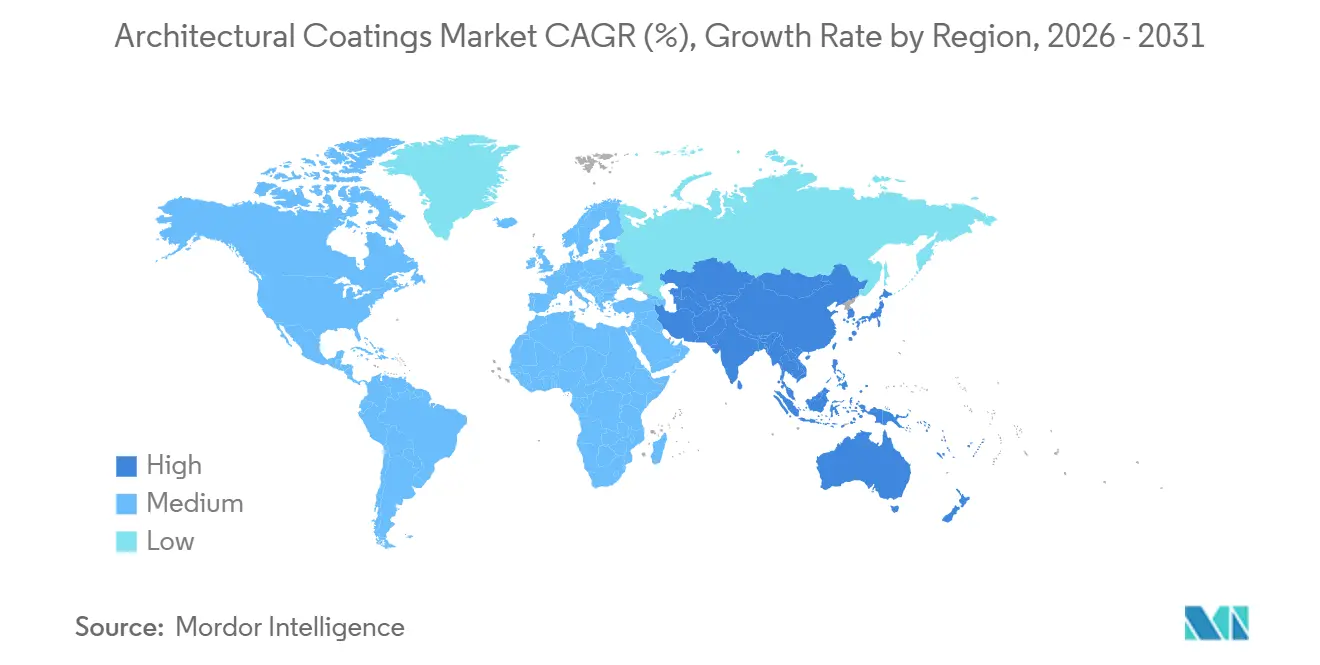
- By geography, Asia-Pacific held 46.11% of the architectural coatings market size in 2025 and is expected to grow at a 5.57% CAGR to 2031.
Note: Market size and forecast figures in this report are generated using Mordor Intelligence’s proprietary estimation framework, updated with the latest available data and insights as of 2026.
Market Trends and Insights
Drivers Impact Analysis of Architectural Coatings Market*
| Driver | (~) % Impact on CAGR Forecast | Geographic Relevance | Impact Timeline |
|---|---|---|---|
| Low-VOC regulations accelerating global switch to water-borne systems | +1.2% | Global, with strongest enforcement in EU, California, China | Medium term (2-4 years) |
| Surging renovation of post-1970 housing stock in North America and Europe | +0.9% | North America and Europe | Long term (≥ 4 years) |
| Explosive growth of organised DIFM trade-painter networks in ASEAN metros | +0.8% | ASEAN core (Indonesia, Vietnam, Thailand, Philippines) | Short term (≤ 2 years) |
| Rapid e-commerce penetration enabling direct-to-consumer paint fulfilment | +0.6% | North America, Europe, urban APAC | Medium term (2-4 years) |
| On-site robotic/3-D-printed façade modules demanding nano-filled coatings | +0.4% | Global, early adoption in Middle-East, Singapore, select EU cities | Long term (≥ 4 years) |
| Source: Mordor Intelligence | |||
Low-VOC Regulations Accelerating Global Switch to Water-Borne Systems
California lowered the VOC ceiling for interior flats to 50 g/L in 2024, forcing reformulation of 40% of products sold in the state and nudging manufacturers everywhere to harmonize recipes for scale[1]South Coast Air Quality Management District, “Rule 1113 Architectural Coatings,” aqmd.gov . The EU followed in 2025 with a 30 g/L cap, a level that effectively eliminates traditional solvent-rich alkyd primers unless costly bio-based substitutes are introduced. China’s extension of its low-VOC mandate to Tier-3 cities widened compliance coverage to another 180 million residents and accelerated the retirement of solvent lines. Global majors amortize reformulation costs across wider volumes, but small regional firms either license technology at 3%–5% of sales or cede premium segments entirely.
Surging Renovation of Post-1970 Housing Stock in North America and Europe
The United States houses built between 1970 and 1990 now require exterior refreshes, driving USD 510 billion in improvement spending projected for 2026. Canada’s Greener Homes Grant covers up to USD 3,700 for energy upgrades, propelling a 19% increase in applications during 2025. Europe’s Renovation Wave aims to double retrofit rates by 2030, and Germany alone disbursed USD 13 billion in low-interest loans for façade updates in 2025. These programs tilt demand toward acrylic and elastomeric coatings with 15-20 year lifespans that satisfy homeowners looking to minimize repeat labor. Skilled labor shortages, however, have stretched project lead times to eight-to-twelve weeks, tempering near-term volume growth.
Explosive Growth of Organized DIFM Trade-Painter Networks in ASEAN Metros
Indonesia’s painter cooperatives grew from 12,000 in 2023 to 27,000 by mid-2025, earning 15%-20% bulk discounts in exchange for brand exclusivity. Vietnam introduced mandatory licensing in 2024, lifting certified applicator share from 18% to 34% in 18 months and spurring adoption of warranty-backed premium water-borne systems. Thailand’s largest home-improvement chain launched a DIFM marketplace late 2024 that captured 9% of Bangkok’s repaint jobs within one year. Professionalization shifts preference toward brands that supply consistent batch quality, digital ordering, and next-day delivery, compressing project cycles by as much as 25%.
Rapid E-Commerce Penetration Enabling Direct-to-Consumer Paint Fulfillment
Sherwin-Williams generated USD 340 million online in 2025, with average order values 22% higher than stores after algorithm-driven upsells. Benjamin Moore’s color-visualization tool pushed return rates below 2% by letting users preview shades on their own photos. Dulux’s augmented-reality calculator has been downloaded 1.2 million times since 2024, cutting over-ordering by 30%. As online share reached 18% in cities such as Seoul and Singapore during 2025, independent dealers in North America saw their channel share slip five points to 33%.
Restraints Impact Analysis of Architectural Coatings Market*
| Restraint | (~) % Impact on CAGR Forecast | Geographic Relevance | Impact Timeline |
|---|---|---|---|
| Volatile TiO₂ and epoxy feedstock prices post-2024 supply shocks | -0.7% | Global, acute in import-dependent markets (India, Brazil, MEA) | Short term (≤ 2 years) |
| Scarcity of skilled painters in mature markets inflating installation costs | -0.5% | North America, Europe, Australia | Medium term (2-4 years) |
| EU biocide restrictions cutting allowable in-can preservative loadings | -0.3% | Europe, with spillover to export-oriented manufacturers in APAC | Long term (≥ 4 years) |
| Source: Mordor Intelligence | |||
Volatile TiO₂ and Epoxy Feedstock Prices Post-2024 Supply Shocks
TiO₂ climbed from USD 2,800/t in Q1 2024 to USD 3,300/t in Q1 2025 after Chinese environmental shutdowns, easing later when Saudi capacity came online, yet margins for Indian and Brazilian producers still fell by up to 180 basis points because of currency swings. Epoxy costs spiked 22% after force-majeure events at bisphenol-A plants, forcing formulators to shift to polyester in non-critical roles. Majors hedge via partial ownership of TiO₂ assets; PPG’s 30% stake in a Chinese supplier secures 40,000 t per year at fixed prices, insulating earnings. Smaller firms negotiate quarterly pass-throughs, limiting strategic flexibility.
Scarcity of Skilled Painters in Mature Markets Inflating Installation Costs
The United States recorded 87,000 unfilled painter roles in 2025, driving hourly wages up 14% since 2023 and lifting the cost of a typical exterior repaint to USD 7,200[2]U.S. Bureau of Labor Statistics, “Occupational Outlook for Painters,” bls.gov . Germany faces a 9,000-person gap, while Australian contractors report project backlogs of 10-14 weeks. Homeowners either delay work or downgrade product choices, softening premium demand despite manufacturer-sponsored training academies that only partly address the shortfall.
*Our forecasts treat driver/restraint impacts as directional, not additive. The impact forecasts reflect baseline growth, mix effects, and variable interactions.
Architectural Coatings Market Segment Analysis
By Resin Type:
Acrylic Dominance Rooted in Regulatory AlignmentAcrylic commanded 54.13% of 2025 demand, the largest slice of the architectural coatings market size, and is projected to outpace the overall architectural coatings market at a 4.68% CAGR to 2031. Low-VOC compliance and robust exterior durability in humid climates underpin this leadership. Alkyd demand is contracting as solvent caps render many lines non-compliant without expensive capture systems.
Epoxies are known for their high abrasion resistance but remain constrained by UV instability and elevated cost, while polyurethanes are driven by coastal gloss-retention needs. Polyester powder coatings are favoured for factory-finished metal framing, and bio-based hybrids draw fresh R&D as firms seek differentiators for circular-economy labels.



By Technology:
Water-Borne Systems Gain Despite Infrastructure GapsWater-borne comprised 52.12% of 2025 volume and are growing 4.78% annually, as regulations and indoor-air expectations rise. Solvent-borne, useful for low-temperature or high-humidity job sites, and stabilizing in India, where masonry substrates need deeper penetration.
The other technologies cover powder, high-solids, and UV-cured lines whose adoption scales with prefabrication trends. Powder finishes deliver almost 100% transfer efficiency but remain limited to factory conditions. High-solids sprays cut VOCs per liter yet demand costly gear that small painters rarely purchase, while UV-cure systems thrive in cabinetry shops but face line-of-sight limitations on complex shapes.
By End-use:
Residential Segment Anchored by Renovation CyclesResidential generated 68.22% of 2025 revenue and expanding at 4.53% thanks to steady repaint cycles and emerging-market housing starts. U.S. single-family improvements alone spent USD 34 billion on coatings in 2025, while India’s housing initiatives are lift demand regionally.
Commercial is also growing as hybrid work suppresses office repainting even as hospitality assets specify antimicrobial finishes and institutional owners pursue LEED credits that tilt choices toward premium water-borne acrylic. Retail refurbishments bifurcate: luxury stores commission bespoke finishes, whereas value chains choose cost-optimized systems.
Geography Analysis
APAC Architectural Coatings Market
Asia-Pacific contributed 46.11% of the 2025 volume and will lead the architectural coatings market growth at 5.57%. India is advancing under Smart Cities funding that raised middle-class homeownership to 58%. Southeast Asian markets grew as FDI-backed logistics hubs and social-housing programs expanded coating consumption .
North America Architectural Coatings Market
In North America, the United States accounted for most of the spending on architectural finishes as owners chose upgrades over moving in a high-rate mortgage environment. Canada added growth on the back of energy-retrofit incentives, while Mexico grew with near-shoring industrial builds.
Europe Architectural Coatings Market
In Europe, Germany, France, and the United Kingdom together represented the majority of regional value, each leveraging public loan or grant schemes to spur façade upgrades and low-emission interior paints. Central and Eastern Europe caught up with growth funded by EU structural allocations, while NORDIC markets maintained niche growth under strict environmental codes.
South America Architectural Coatings Market
In South America, Brazil’s social-housing expansion and agribusiness-led commercial builds drove growth, whereas currency pressures in Argentina redirected buyers to local brands. Chile, Peru, and Colombia benefited from mining-related infrastructure projects needing worker housing.
MEA Architectural Coatings Market
The Middle-East and Africa comprised lower demand but will post a substantial demand as Saudi Vision 2030 mega-projects require premium exterior coatings tolerant of extreme heat, and sub-Saharan urbanization lifts baseline consumption despite fragmented logistics.

Regulatory Landscape
Regulation is tightening around VOC/SVOC emissions and chemical content, accelerating the shift toward low-VOC, water-borne architectural coatings. California lowered the VOC ceiling for interior flats to 50 g/L in 2024, and the EU followed with a 30 g/L cap in 2025, limiting traditional solvent-rich alkyd primers without major reformulation.
In 2026, China implemented mandatory national standards GB 30981.1-2025 (Architectural Coatings) and GB 30981.2-2025 (Industrial Coatings), replacing GB 18582, with VOC limits for interior wall flat coatings and primers reduced to 50 g/L and introducing 5 g/L SVOC limits. This broadens compliance demands beyond top-tier cities. In the United States, 40 CFR Part 59 Subpart D continues to anchor the federal VOC framework, while states pursue SIP-strengthening actions, including the EPA proposal in February 2026 to approve Michigan Air Pollution Control Rules (MAPCR) 336.1660 and 336.1662. In Europe, the EU REACH revision process continues through 2026, with heightened focus on group-based restrictions and PFAS scrutiny.
Value Chain Analysis
The value chain starts with upstream petrochemical and bio-based feedstocks that are converted into binders (notably acrylic resins), pigments (including TiO2), solvents and coalescents, and additives (dispersants, rheology modifiers, defoamers, and in-can preservatives). Coatings manufacturers then manage formulation, tint-base production, quality control, packaging, and distribution, with downstream sales split across company-owned stores, wholesalers, independent dealers, modern home-improvement retail, and growing e-commerce fulfillment. Application is delivered through DIY consumers and professional painter and DIFM networks, which increasingly influence brand choice through bulk purchasing and warranty-backed systems.
Key friction points sit at compliance and supply continuity. Post-2024 feedstock volatility (TiO2 and epoxy-related inputs) and currency swings have pushed producers toward regional redundancy and stronger supplier verification, while regulatory changes (VOC caps, EU biocide constraints, and broader REACH-driven substance scrutiny) create repeated reformulation and documentation cycles that can delay launches. Certification and public-procurement pull-through also shape the chain, with EU Decision 2025/2607 updating Ecolabel criteria for decorative paints and related categories, reinforcing demand for traceable, lower-impact formulations and packaging practices across manufacturers and their raw-material ecosystems.
Competitive Landscape
The five largest suppliers controlled 49% of 2025 revenue, signaling moderate consolidation in the architectural coatings market. Sherwin-Williams, PPG, and AkzoNobel are leveraging vertical integration into TiO₂ and resin production, which lifted PPG's gross margin 120 basis points in fiscal 2025. Asian Paints and Nippon Paint jointly hold through dense distribution and tinting reach.
Digital engagement differentiates leaders: PPG’s “Voice of Color” app drove an 18% rise in online conversions, while AkzoNobel’s AR-based “Dulux Visualizer” cut product returns 25%. Market niches include antimicrobial interior finishes that grew in 2025 and graphene-enhanced eco-paints pitched to sustainability-minded consumers, though disruptors still own less than 1% share. Patent filings concentrate on nano-dispersion and bio-based acrylics, with BASF registering 14 new families in 2025.
Regional specialists such as Berger Paints, DAW SE, and CIN defend home-market share with localized color palettes and swift delivery yet struggle to spread R&D costs across broader geographies. Acquisition remains the preferred growth vector; Nippon Paint’s 51% stake in a Turkish producer opened direct access to Middle-Eastern and North African channels in 2025.
Architectural Coatings Industry Leaders
The Sherwin-Williams Company
AkzoNobel N.V.
Nippon Paint Holdings Co., Ltd
Asian Paints Ltd.
Pittsburgh Paints Co.
- *Disclaimer: Major Players sorted in no particular order

Architectural Coatings Market Companies Covered in this Report
- 3 TREES Group
- AkzoNobel N.V.
- Asian Paints Ltd.
- BASF
- Beckers Group
- Benjamin Moore and Company
- Berger Paints India Ltd.
- Brillux GmbH and Co. KG
- CIN S.A.
- DAW SE
- Flügger group AS
- Hempel A/S
- Jotun
- Kansai Paint Co., Ltd.
- Masco Corporation
- Nippon Paint Holdings Co., Ltd
- Pittsburgh Paints Co.
- RPM International
- Sniezka SA
- The Sherwin-Williams Company

Market Opportunities and Future Outlook
Opportunity is concentrating around compliant, low-emission products that also simplify contractor workflows, particularly where regulatory caps and indoor-air expectations are tightening faster than local infrastructure. China implementing GB 30981.1-2025 in 2026, including new SVOC limits, and the EU moving to very low VOC caps has increased the premium on water-borne acrylic systems with robust preservative strategies and stable shelf-life. This creates room for suppliers to package compliance into ready-to-tint assortments, fast-turn color logistics, and digital ordering that supports organized trade-painter networks.
Supply-side investments are also creating pockets of opportunity in high-growth geographies and in low-carbon formulation inputs. BASF expanded dispersions capacity in February 2026 at Mangalore, India, and inaugurated expanded dispersion production in March 2026 in Durban, South Africa, improving regional availability of key water-borne building blocks. In July 2026, BASF launched certified biomass-balanced additives (Dispex AA 4145 MB, Rheovis PU 1333 MB, Rheovis HS 1169 MB), which enable lower-product-carbon-footprint claims without changing downstream application equipment. In India, Nippon Paint announced in June 2026 a plan to add eight manufacturing plants by 2029, paired with near-term greenfield and brownfield investment. This reinforces the push to localize production and shorten lead times in import-dependent markets where volatility in TiO2 and other inputs can disrupt pricing and availability.
Recent Industry Developments in Architectural Coatings Market
- May 2026: Sherwin-Williams and Nippon Paint Group confirmed a joint proposal to acquire AkzoNobel, following an April 2026 offer and a formal proposal submission on April 29, 2026. The proposed split assigned Sherwin-Williams to acquire AkzoNobel's Marine and Protective, Automotive and Specialty, and Powder Coatings businesses, while Nippon Paint Group would acquire Decorative Paints and Industrial Coatings, although AkzoNobel's boards rejected the proposal. The approach highlights ongoing strategic interest in consolidating scale, portfolios, and channels across coatings, with potential read-through to procurement leverage and innovation budgets even without a completed transaction.
- March 2026: Sherwin-Williams completed a major expansion at its Bowling Green, Kentucky coil and extrusion metal coatings plant, lifting overall capacity by 60% versus 2025 levels. The site upgrade added automation and manufacturing capability that strengthens supply reliability for metal-coating demand tied to building products and construction-linked fabrication. Higher output and process control at a large US facility can also influence competitive service levels and lead times across adjacent coatings segments.
- October 2025: BASF started a new production line for dispersions used in architectural coatings at its facility in Dilovasi, Turkiye. The added capacity supports supply of low-VOC dispersion binders used in water-borne architectural paints, aligning with tightening emissions requirements. Regional production reduces logistics friction for customers reformulating away from solvent-borne systems under stricter VOC and chemical-content constraints.


Architectural Coatings Market Report Scope and Research Methodology
Market Definition and Coverage
For this study, the market covers architectural coatings used on buildings, including paints and coating products applied to interior and exterior surfaces for protection and appearance, and sized on a value basis in USD.
Scope exclusions: It excludes industrial protective coatings, automotive coatings, marine coatings, and non-coating items such as application equipment or surface-prep services.
Segments Covered in This Report
- By Resin Type
- Acrylic
- Alkyd
- Epoxy
- Polyester
- Polyurethane
- Other Resin Types
- By Technology
- Water-borne
- Solvent-borne
- Other Technologies
- By End-use
- Residential
- Commercial
- By Geography
- Asia-Pacific
- China
- India
- Japan
- South Korea
- Indonesia
- Vietnam
- Thailand
- Philippines
- Singapore
- Rest of Asia-Pacific
- North America
- United States
- Canada
- Mexico
- Europe
- Germany
- United Kingdom
- France
- Italy
- Spain
- Poland
- NORDIC Countries
- Russia
- Rest of Europe
- South America
- Brazil
- Argentina
- Rest of South America
- Middle-East and Africa
- Saudi Arabia
- South Africa
- Rest of Middle-East and Africa
- Asia-Pacific
Data Sources, Market Sizing, and Validation
Desk Research
Desk research starts with public data that helps anchor construction and renovation demand, then connects it to coatings consumption. We typically review official construction and housing indicators such as national statistics releases, building permits and completions series, and price indexes for materials that affect project timing.
To keep assumptions grounded, we also refer to sources such as US Census construction data, Eurostat construction output, UN Comtrade trade statistics for coating-related categories, and World Bank macro indicators. Patent databases are used to understand technology direction, for example water-borne and low-VOC innovation. Annual reports, investor presentations, and credible trade association publications help us track product mix shifts and channel structure, and we use paid subscription sources for company financials and news to cross-check revenue exposure and any event-driven impacts. These desk sources are not exhaustive, and we use additional public references during the work to validate and clarify specific data points.
Primary Interviews and Surveys
Primary work is used to pressure-test desk assumptions, particularly when publicly reported data does not clearly show coatings mix, pricing movement, and repaint versus new-build demand. Interviews and surveys cover manufacturers, distributors, contractors, and large end users across APAC, EMEA, and the Americas, so the model reflects on-the-ground demand signals and realistic conversion factors.
Distribution of primary research fieldwork respondents
| Company type | Respondent position | Region |
|---|---|---|
| Top tier: 25% | CXOs: 12% | APAC: 43% |
| Mid tier: 59% | Functional/Unit leaders: 32% | EMEA: 32% |
| Smaller Players: 16% | Managers: 56% | Americas: 25% |
Market-Sizing & Forecasting
Sizing is built using a top-down approach where construction activity and renovation intensity are translated into an addressable coatings demand pool, then valued using price and mix assumptions. After that, we run selective bottom-up checks through sampled supplier revenues by region, distributor channel checks, and volume times average selling price sanity tests. Where the implied consumption looks implausible, totals are adjusted.
Model inputs include indicators such as housing starts and completions, building permits, construction spending, urbanization and household formation trends, the share of water-borne versus solvent-borne products, and repaint cycle behavior for residential and commercial buildings. For pricing, we use a practical view of raw material cost direction and realized selling price movement captured through interviews, then apply region-specific currency timing rules to avoid mixing conversion periods.
For forecasting, scenario analysis is used, supported by a light multivariate regression on construction output and renovation activity where the time series depth is sufficient. Where inputs are missing for smaller countries, we use regional proxies and apply conservative penetration and mix ranges that were validated during interviews.
Data Validation & Update Cycle
Outputs are validated through triangulation across independent signals such as construction macro series, trade flow direction for coating-related categories, and implied per-capita and per-household coatings spend. Any large variance triggers a step-back review of key drivers, and we initiate follow-up calls when the mismatch is tied to mix, pricing, or channel structure rather than a simple data lag.
Before sign-off, the model and assumptions go through multiple analyst reviews. We also check the year-over-year profile for jumps that do not match observed construction and renovation conditions. Reports are refreshed annually, and interim updates are made when material events can shift pricing, demand, or regulation. A final pre-delivery pass is done to reflect the latest information.
Mordor Intelligence's Architectural Coatings Market Size Compared Against Other Published Estimates
Different sources often publish different market sizes for architectural coatings because category boundaries are not always treated the same, and because pricing and currency timing choices can change a value-based total. The headline year also varies, since some publications use a base year and others report the first forecast year.
Construction output trends and repaint-demand checks gathered during interviews are the evidence used to keep Mordor Intelligence's estimate aligned with realistic coating spend, especially by separating decorative building coatings from adjacent industrial and specialty categories. Gaps also come from how water-borne versus solvent-borne mix is valued, whether retail and contractor channels are both fully counted, and whether assumed price inflation is applied uniformly across regions.
Benchmark comparison
| Source | Market Size | Gaps in Research Methodology |
|---|---|---|
| Mordor Intelligence | USD 96.12 B (2025) | |
| Global Consultancy A | USD 69.51 B (2025) | This estimate appears to treat the market as an architectural segment under a wider paints and coatings framework, which can narrow the scope and apply different channel coverage and pricing logic, leading to a lower 2025 value. |
| Industry Publisher B | USD 93.63 B (2026) | The headline is stated for 2026, and differences can be driven by the chosen base year, the way residential versus non-residential demand is weighted, and how price and currency timing are applied for regional roll-ups. |
Overall, the spread in published values is mostly explained by scope boundaries, year selection, and how price and channel mix are treated in the model. By keeping the demand pool anchored to observable construction and renovation signals, then validating totals with targeted supply-side checks, the results remain traceable to clear inputs and repeatable steps.


Key Questions Answered in the Report
What is the projected value of the architectural coatings market in 2031?
The architectural coatings market is forecast to reach USD 123.96 billion by 2031, growing at a 4.33% CAGR from 2026-2031.
Which resin type commands the largest share in global demand?
Acrylic resins led with 54.13% share in 2025 thanks to their low-VOC compliance and exterior durability.
How fast is the Asia-Pacific region growing?
Asia-Pacific demand is advancing at 5.57%, the fastest regional CAGR, driven by urbanization and rising per-capita paint usage.
What share do water-borne technologies hold?
Water-borne coatings already represent 52.12% of global volume and are expanding faster than the overall market.
Page last updated on:


 Your data is secure and never sold or shared.


