
Flip Chip Technology Market Size and Share
Market Overview
| Study Period | 2020 - 2031 |
|---|---|
| Market Size (2026) | USD 38.14 Billion |
| Market Size (2031) | USD 54.48 Billion |
| Growth Rate (2026 - 2031) | 7.40 % |
| Fastest Growing Market | Asia-Pacific |
| Largest Market | Asia-Pacific |
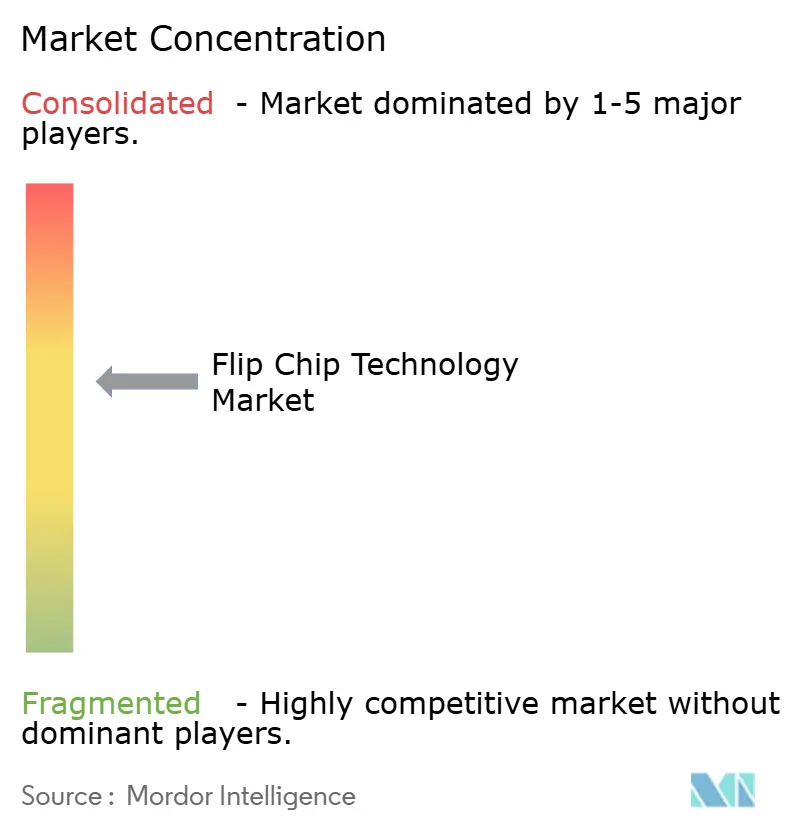
| Market Concentration | Medium |
Major Players *Disclaimer: Major Players sorted in no particular order Image © Mordor Intelligence. Reuse requires attribution under CC BY 4.0. | |
Flip Chip Technology Market Analysis by Mordor Intelligence
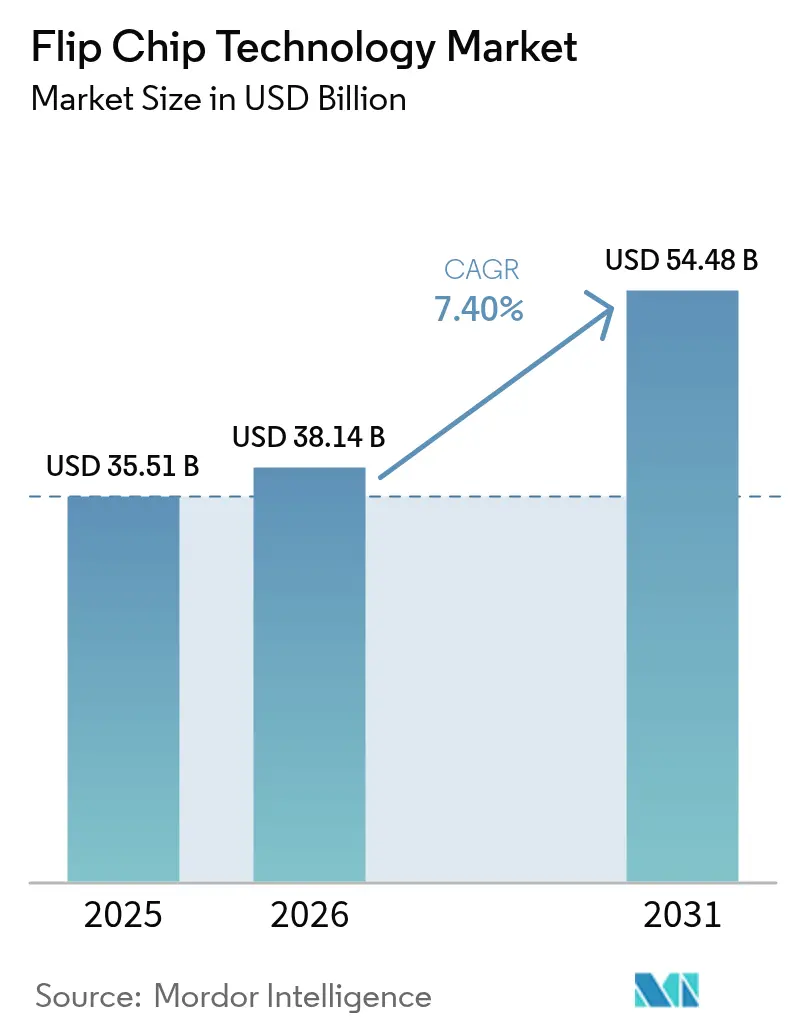
The flip chip technology market size was valued at USD 35.51 billion in 2025 and estimated to grow from USD 38.14 billion in 2026 to reach USD 54.48 billion by 2031, at a CAGR of 7.40% during the forecast period (2026-2031). Growth mirrored the semiconductor industry’s transition to chiplet-based architectures that required dense, thermally efficient interconnects. AI data-center build-outs pushed high-bandwidth memory packaging to the fore, while copper-pillar and hybrid bonding lines addressed the fine-pitch needs that traditional solder bumps could not meet. Foundries entered the packaging arena, accelerating vertical integration and bringing new competitive pressures on outsourced assembly and test providers. Asia-Pacific retained scale advantages, yet supply-chain de-risking programs in North America and Europe triggered large green-field investments in advanced packaging facilities.
Key Report Takeaways
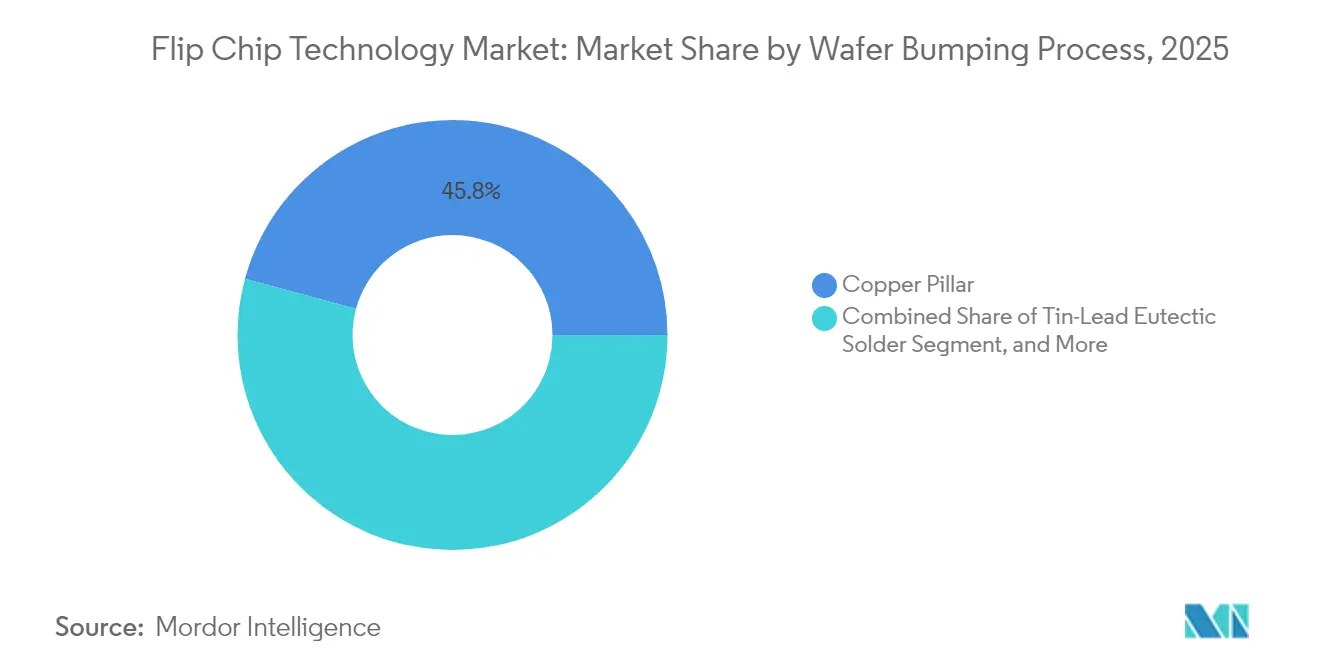
- By wafer bumping process, copper pillar held 45.78% revenue share in 2025, while Cu-to-Cu hybrid bonding is projected to expand at 9.55% CAGR through 2031.
- By packaging technology, FC-BGA led with 37.62% share in 2025, while fan-out WLP/panel-level solutions are forecast to grow at 9.88% CAGR to 2031.
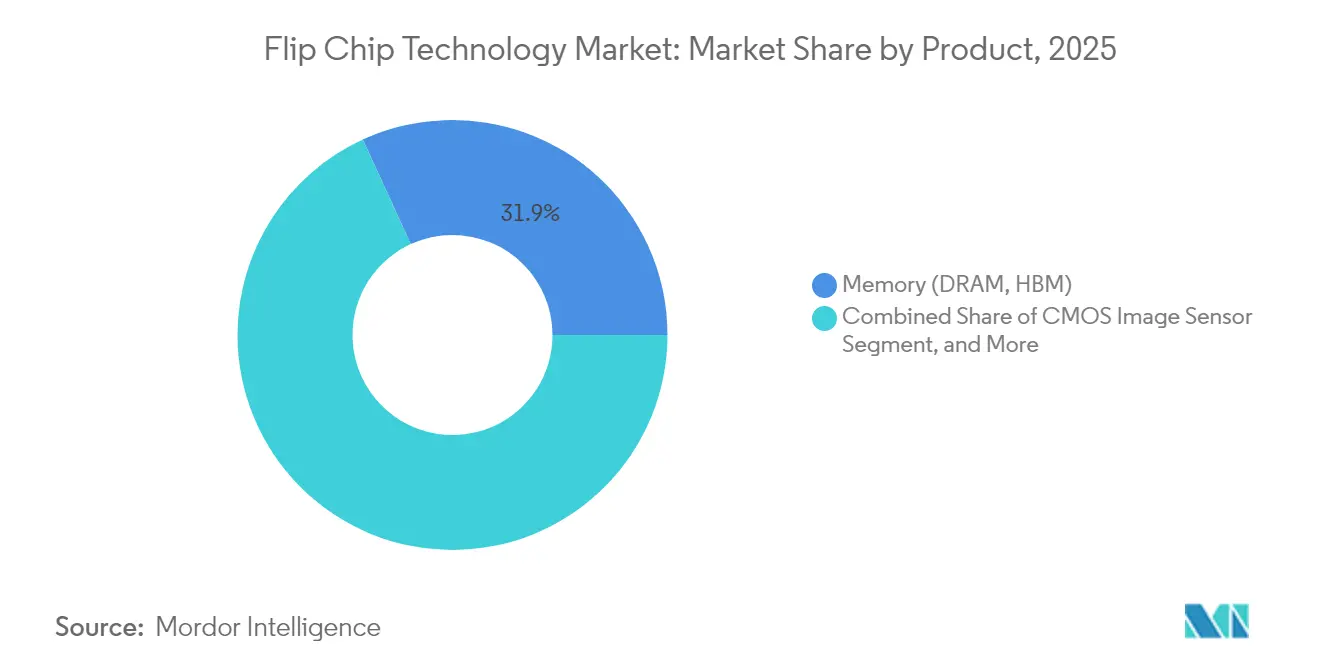
- By product, memory accounted for 31.85% of the flip chip technology market share in 2025, whereas the GPU/AI accelerator segment is set to advance at 12.45% CAGR to 2031.
- By end-use industry, consumer electronics and wearables held a 28.96% share in 2025, while data-center and cloud applications are expected to log a 8.86% CAGR through 2031.
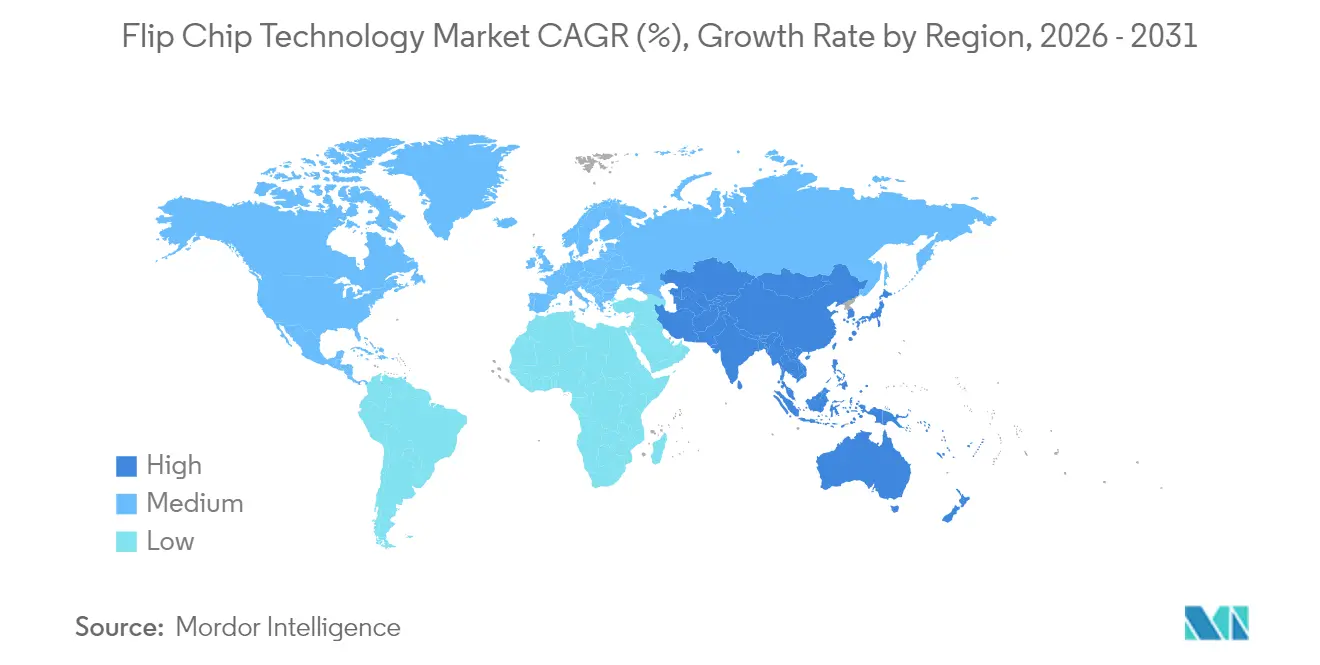
- By geography, Asia-Pacific captured 53.92% of 2025 revenue and is projected to post a 9.22% CAGR through 2031.
Note: Market size and forecast figures in this report are generated using Mordor Intelligence’s proprietary estimation framework, updated with the latest available data and insights as of 2026.
Market Trends and Insights
Drivers Impact Analysis of Flip Chip Technology Market*
| Driver | (~) % Impact on CAGR Forecast | Geographic Relevance | Impact Timeline |
|---|---|---|---|
| Surge in heterogeneous integration demand (AI/HPC) | +2.1% | Global, concentrated in North America and Asia-Pacific | Medium term (2-4 years) |
| Rising adoption of copper-pillar and micro-bump interconnects | +1.8% | Asia-Pacific core, expanding to North America and Europe | Short term (≤ 2 years) |
| Wearables and IoT miniaturization push | +1.2% | Global, with early adoption in Asia-Pacific and North America | Long term (≥ 4 years) |
| Automotive ADAS/EV reliability requirements | +1.0% | Global, led by Europe and North America | Medium term (2-4 years) |
| Glass-core substrate commercial trials | +0.9% | North America and Asia-Pacific, pilot programs in Europe | Long term (≥ 4 years) |
| Demand for chiplet-ready Cu-to-Cu hybrid bonding | +0.8% | Asia-Pacific core, expanding globally | Medium term (2-4 years) |
| Source: Mordor Intelligence | |||


Surge in Heterogeneous Integration Demand (AI/HPC)
Chipmakers pivoted from 2D scaling to heterogeneous integration that joined multiple chiplets in a single package, lifting demand for fine-pitch Cu-to-Cu interconnects.[1]Applied Materials, “Hybrid Bonding,” appliedmaterials.com TSMC’s plan to boost CoWoS capacity to 1.31 million units by 2026 illustrated how GPU vendors such as Nvidia shaped the flip chip technology market. The approach enhanced bandwidth while lowering power compared with legacy bumps, supporting the performance roadmap for AI accelerators.
Rising Adoption of Copper-Pillar and Micro-Bump Interconnects
Copper-pillar bumps delivered superior electrical resistance and reliability, explaining their 46.3% 2024 revenue share. High-speed plating chemistries from DuPont provided uniform thickness control essential for sub-40 µm pitches. The shift eroded tin-lead dominance and paved the way for 3D integration schemes that underpin the flip chip technology market.
Wearables and IoT Miniaturization Push
System-in-package and wafer-level chip-scale methods became staples for smart watches and health trackers that demanded slim profiles without sacrificing battery life. Ultra-HDI PCB advances using modified semi-additive processing and laser direct imaging offered trace widths below 40 µm, enabling compact sensor modules.
Automotive ADAS/EV Reliability Requirements
Autonomous driving and power-train electrification require packages that survive temperatures above 200 °C. Automotive-grade flip chip lines employed high-temperature underfills and copper pillar joints qualified for AEC-Q100 Grade 0. JCET’s automotive electronics revenue expanded at more than 50% CAGR between 2019 and 2023, signaling rapid adoption of these robust processes.
Restraints Impact Analysis of Flip Chip Technology Market*
| Restraint | (~) % Impact on CAGR Forecast | Geographic Relevance | Impact Timeline |
|---|---|---|---|
| High capital intensity of advanced bumping lines | -1.4% | Global, most pronounced in North America and Europe | Short term (≤ 2 years) |
| Lead-free reliability and warpage challenges | -0.9% | Global, regulatory pressure is strongest in Europe | Medium term (2-4 years) |
| Sub-10 µm alignment yield losses | -0.7% | Asia-Pacific core, expanding to global advanced fabs | Short term (≤ 2 years) |
| Supply-chain exposure to critical metal chemicals | -0.5% | Global, concentrated risk in North America and Asia-Pacific | Medium term (2-4 years) |
| Source: Mordor Intelligence | |||
High Capital Intensity of Advanced Bumping Lines
Scaling to sub-10 µm pitches required lithography steppers, advanced sputter tools, and plasma cleaners that pushed line cost above USD 250 million per module. TSMC earmarked USD 90 billion for dedicated packaging plants, underscoring the entry hurdle for smaller competitors. Collaborative R&D programs such as 3M’s participation in the US-JOINT consortium aimed to spread risk across the supply chain.
Lead-Free Reliability and Warpage Challenges
RoHS mandates accelerated SnAgCu adoption, yet differential thermal expansion introduced warpage and solder fatigue in flip chip stacks. Studies showed that eutectic Sn-Bi joints extended thermal-cycling life but suffered brittleness that limited high-stress applications. Low-temperature reflow at 175 °C reduced head-on-pillow defects but required bismuth-based alloys that complicated high-volume assembly.
*Our forecasts treat driver/restraint impacts as directional, not additive. The impact forecasts reflect baseline growth, mix effects, and variable interactions.
Flip Chip Technology Market Segment Analysis
By Wafer Bumping Process:
Copper Dominance Drives InnovationCopper pillar technology held 45.78% revenue in 2025 within the flip chip technology market. The segment benefited from reduced resistance and heightened current-carrying capability. The flip chip technology market size for Cu-to-Cu hybrid bonding is projected to expand at a 9.55% CAGR as chiplet adoption grows. The hybrid method lowered inter-chip spacing to 0.8 µm, far beyond solder’s physical limits. Tin-lead solutions still served legacy nodes, whereas gold-stud bumps remained confined to aerospace.
Advances in electroplated chemistries sustained pillar height uniformity below 2%, a prerequisite for 3D stacks. IEEE research validated solder-free Cu-Cu bonding at 260 °C as a manufacturable path for heterogeneous integration. Innovations positioned copper formats to absorb share from both lead-free and precious-metal alternatives.


By Packaging Technology:
Advanced Architectures Reshape Market DynamicsFC-BGA commanded 37.62% of 2025 revenue thanks to proven reliability in servers. Fan-out WLP and panel-level formats are expected to record a 9.88% CAGR, catalyzed by AI accelerators demanding large body sizes. ASE allocated USD 200 million to 310 mm × 310 mm panels that promise sevenfold usable area over wafers, a cost breakthrough. The flip chip technology market size for panel-level packages will climb as line yields improve.
Specialty flows such as CoWoS and EMIB enable HBM stacking essential for AI training units. IBM and Intel pursued glass-substrate roadmaps that offer lower warpage and higher line-space ratios than organic laminates. 3D IC with TSV remained a niche for extreme bandwidth-class devices due to high cost and process complexity, but set the ceiling on attainable performance.
By Product:
Memory and AI Accelerators Lead GrowthMemory held a 31.85% share in 2025 as HBM adoption soared. Applied Materials estimated sixfold growth in HBM packaging revenue, driven by 19 additional process steps versus conventional DRAM. GPU/AI accelerators will post a 12.45% CAGR to 2031. The flip chip technology market quickly adapted to combine multiple HBM stacks with logic nodes through interposers, creating package power densities exceeding 1 kW.
CMOS image sensors maintained momentum on the back of multi-camera smartphones, while micro-LED dies required sub-20 µm bumping that dovetailed with copper pillar capabilities. Silicon Box’s USD 3.5 billion Italian line targeting chiplet solutions illustrated regional investment in cross-product synergies.
By End-Use Industry:
Data Centers Drive TransformationConsumer electronics kept a 28.96% share but slowed as handset volumes plateaued. Data center and cloud demand will grow at 8.86% CAGR because AI inference nodes deploy high-bandwidth chiplets in volume. The flip chip technology market size for data-center applications is projected to widen rapidly as servers adopt four- and eight-HBM configurations.
Automotive electronics leveraged copper pillar joints molded with high-glass-transition underfills to meet Grade 0 temperature swings. Medical implants benefited from biocompatible wafer-level packages that embedded wireless telemetry while keeping envelope size minimal.Telecommunications rolled out millimeter-wave 5G radios that required low-loss interconnects compatible with Cu-pillar bumps.
Geography Analysis
APAC and North America Flip Chip Technology Market
Asia-Pacific held 53.92% of 2025 revenue. The region housed the bulk of wafer fabs and retained cost advantages, sustaining the largest slice of the flip chip technology market. Government incentives supported next-node R&D, yet export-control actions induced leading firms to build parallel capacity offshore. North America accelerated foundry and packaging startups under the CHIPS Act, adding resilience and creating a local demand pull. The flip chip technology market share for North America is expected to rise modestly as Arizona and Texas campuses come online.
EMEA Flip Chip Technology Market
Europe pursued technology sovereignty through the European Chips Act and directed capital toward panel-level and glass-core substrate lines. Silicon Box’s Novara facility is slated to process 10,000 panels weekly by 2028, anchoring a regional ecosystem. Middle East and Africa remained early-stage but benefited from electronics final-assembly hubs that feed into global supply chains.
APAC and Global Markets
Supply-chain diversification scattered future investments across at least three continents, muting single-region dominance. However, Asia-Pacific still boasted unmatched engineering depth, keeping it the reference center for high-volume manufacturing.

Regulatory Landscape
Compliance requirements for flip chip packaging are tightening around environmental disclosure and trade controls that affect advanced computing supply chains. In May 2026, SEMI E177:2026 introduced a mandatory carbon footprint declaration for 2.5D/3D chiplet packaging products exported globally, with verification tied to ISO/IEC 17025-accredited laboratory testing, adding documentation and audit workstreams for OSATs, substrate suppliers, and tool/material vendors.
Trade and industrial policy actions also affect sourcing decisions across advanced logic and related packaging flows. In January 2026, the United States implemented a 25% ad valorem tariff under Section 232 for certain advanced computing chips defined by technical performance thresholds, and U.S. Customs and Border Protection issued import entry filing guidance effective January 15, 2026. In Europe, the European Commission advanced a Chips for Europe Initiative 2.0 concept alongside a strategic mapping approach for semiconductor dependencies, linking public support to supply chain resilience and setting additional compliance and reporting expectations for participants in EU-supported pilot lines and capacity programs.
Value Chain Analysis
The flip chip value chain runs from upstream materials and components (silicon wafers, photoresists and plating chemistries, underfills and molding compounds, and high-end substrates such as Ajinomoto Build-up Film for FC-BGA), to equipment (bumping, lithography/steppers, sputter and cleaning, bonders, metrology, and singulation), to manufacturing and integration (IDMs/foundries and OSATs executing wafer bumping, flip chip attach, 2.5D/3D assembly such as CoWoS/EMIB-class flows, test, and reliability). Downstream, system OEMs and hyperscalers consume AI/HPC, networking, consumer, and automotive modules. Foundry vertical integration into advanced packaging is also compressing lead times for customers seeking front-end and back-end co-optimized chiplet architectures.
Bottlenecks are concentrated in substrates and advanced packaging capacity rather than traditional assembly labor. ABF availability remains a critical constraint for high-performance FC-BGA, and insulating materials for advanced packaging have also been cited as supply-limiting inputs in CoWoS-class ecosystems. Equipment suppliers are adapting to larger formats and tighter interconnect requirements, including 2.5D-capable bonding tools for large substrates and multi-die integration. At the same time, the industry shift from micro-bumps toward bumpless hybrid bonding is aimed at reducing parasitics and improving density. Overall, differentiation increasingly depends on access to qualified substrate supply, high-precision bonding and metrology, and the ability to scale 2.5D/3D lines for HBM-integrated compute packages.
Competitive Landscape
Foundry vertical integration re-shaped rivalry. TSMC combined wafer production with CoWoS back-end services, shortening customer cycle time. ASE responded with panel-level builds and auto-grade qualifications to safeguard the share. Intel exited internal glass substrate R&D and partnered with specialist suppliers, validating the complexity hurdle for new entrants.[4]TechPowerUp, “Intel Abandons In-House Glass Substrate R&D,” techpowerup.com
Hybrid bonding patents created defensible moats. IBM reduced inter-chip spacing to 0.8 µm, enabling dramatic bandwidth gains. Material vendors such as DuPont and 3M are advancing chemistries for pillar plating and low-warpage dielectric films, embedding themselves deeper into the value chain. Chinese OSATs expanded capacity with multi-billion-dollar plants, but technology parity with leading nodes remained a moving target.
Market leaders are increasingly differentiated by advanced node readiness rather than total bump count. The shift sharpened consolidation pressure on mid-tier players lacking capital to upgrade sub-10 µm lines, catalyzing mergers aimed at pooling R&D and customer bases.
Flip Chip Technology Industry Leaders
Amkor Technology Inc.
UTAC Holdings Ltd
Taiwan Semiconductor Manufacturing Co. (TSMC)
Chipbond Technology Corporation
TF-AMD Microlectronics Sdn Bhd.
- *Disclaimer: Major Players sorted in no particular order
Flip Chip Technology Market Companies Covered in this Report
- Amkor Technology, Inc.
- ASE Technology Holding Co., Ltd.
- Taiwan Semiconductor Manufacturing Company Limited
- Jiangsu Changjiang Electronics Technology Co., Ltd.
- Powertech Technology Inc.
- Chipbond Technology Corporation
- UTAC Holdings Ltd.
- TF-AMD Microelectronics Sdn. Bhd.
- Shinko Electric Industries Co., Ltd.
- Unisem (M) Berhad
- Hana Micron Inc.
- Nepes Corporation
- Carsem (M) Sdn. Bhd.
- Sigurd Microelectronics Corporation
- AT&S Austria Technologie & Systemtechnik AG
- Intel Corporation
- Samsung Electronics Co., Ltd.
- Advanced Micro Devices, Inc.
- Texas Instruments Incorporated
- United Microelectronics Corporation
- STATS ChipPAC Pte. Ltd.
- SFA Semicon Co., Ltd.
- Tongfu Microelectronics Co., Ltd.
- Huatian Technology Co., Ltd.
- Lingsen Precision Industries, Ltd.

Market Opportunities and Future Outlook
A key whitespace involves expanding and qualifying substrate and assembly capacity for AI-class packages that use FC-BGA, larger body sizes, and tighter warpage control, particularly beyond the traditional Asia-Pacific core. In 2026, capacity pull is visible in announced commitments: Samsung Electro-Mechanics confirmed a 1.8 trillion won investment into its Vietnam subsidiary to expand FC-BGA substrate capacity for AI-related applications, and LG Innotek disclosed large investments in Vietnam tied to RF-SiP and FC-CSP production, alongside actions to accelerate expansion across Gumi and Vietnam. Together, these moves broaden the supplier base for high-end substrates and SiP modules and create openings for underfill, dielectric film, plating chemistry, and inspection vendors that can meet automotive and data-center reliability requirements.
Technology migration also creates opportunity around hybrid bonding and 2.5D integration, as performance and thermal constraints push interconnect pitches beyond conventional solder bump scaling. Equipment and process innovation targeted at 2.5D packaging for AI system semiconductors, including newly launched bonding platforms designed for ultra-large die and multi-chip integration, supports the transition from micro-bumps to bumpless interconnect approaches across both compute and memory packaging. Glass-core and panel-level investment themes remain active as well, reinforcing demand for low-warpage materials, advanced metrology, and high-throughput singulation and test as packages scale past reticle-sized limitations.
Recent Industry Developments in Flip Chip Technology Market
- June 2026: TSMC and Amkor Technology announced a 10-year agreement to enhance advanced semiconductor packaging capabilities in Arizona. The arrangement strengthens a U.S.-based, turnkey pathway that links front-end wafer supply with back-end packaging and test for advanced packages used in AI/HPC platforms.
- October 2025: Amkor Technology broke ground on an expanded USD 7 billion advanced packaging and test campus in Arizona. The project increases long-cycle capacity commitments for flip chip and adjacent advanced packaging flows and supports customer programs seeking geographically diversified manufacturing.
- December 2024: UTAC Holdings Ltd announced it had shipped two billion copper clip-based devices. The milestone reflects scaled output in advanced interconnect manufacturing and reinforces UTACs positioning in high-reliability power and discrete packaging value chains that share process and materials linkages with broader flip chip ecosystems.


Flip Chip Technology Market Report Scope and Research Methodology
Market Definition and Coverage
This market measures the value of flip chip technology used to connect semiconductor dies to packages or substrates through bumps and direct attachment, as sold into electronics manufacturing across major end uses and regions.
Scope exclusions: We do not count final device retail prices, and we avoid double counting by not adding the same value again at the finished electronics level.
Segments Covered in This Report
- By Wafer Bumping Process
- Copper Pillar
- Tin-Lead Eutectic Solder
- Lead-Free Solder (SnAg, SAC, etc.)
- Gold-Stud Bumping
- Cu-to-Cu Hybrid / Direct Bond
- By Packaging Technology
- FC-BGA (2D/2.1D/2.5D/3D)
- FCCSP / CSP
- CoWoS / InFO / EMIB
- Fan-Out WLP / PLP
- 3D IC with TSV
- By Product
- Memory (DRAM, HBM)
- CMOS Image Sensor
- LED and Mini/Micro-LED
- SoC / Application Processor
- GPU / AI Accelerator
- CPU / Server Processor
- By End-Use Industry
- Consumer Electronics and Wearables
- Automotive and Transportation
- Industrial and Robotics
- Telecommunications and 5G Infrastructure
- Data Center and Cloud
- Military and Aerospace
- Medical and Healthcare Devices
- By Geography
- North America
- United States
- Canada
- Mexico
- South America
- Brazil
- Rest of South America
- Europe
- Germany
- France
- United Kingdom
- Russia
- Rest of Europe
- Asia-Pacific
- China
- Taiwan
- South Korea
- Japan
- Malaysia
- Singapore
- Rest of Asia-Pacific
- Middle East and Africa
- Middle East
- Turkey
- Rest of Middle East
- Africa
- South Africa
- Rest of Africa
- Middle East
- North America
Data Sources, Market Sizing, and Validation
Desk Research
We start with desk research to build the demand and supply story for flip chip, and to lock the boundaries of what gets counted as market value. Public and official sources are used to ground the model in repeatable indicators, such as semiconductor trade flows and electronics production signals, before assumptions are layered in.
Typical inputs reviewed include sources such as USITC and UN Comtrade trade tables, World Semiconductor Trade Statistics releases, the SEMI association and related standards notes, IEEE and other peer reviewed packaging papers, and patent databases that show technology direction. We then use company filings, investor presentations, and credible press to cross-check capacity expansion timelines and packaging mix commentary. Where needed, we also reference paid subscriptions for company financials and intelligence, patent analytics, and shipment level import and export signals to refine split assumptions. These examples are illustrative only, and many other sources were used for data collection, validation, and clarification during the research.
Primary Interviews and Surveys
Primary work was used to pressure-test the desk assumptions, especially around package mix shifts, pricing movement for bumping and assembly steps, and how quickly new nodes and heterogeneous integration designs are being adopted. We spoke with a balanced set of respondents across OSAT and packaging operations, materials and equipment ecosystem roles, and procurement or engineering stakeholders from end-use electronics supply chains, covering Americas, EMEA, and APAC so regional volume and ASP differences could be validated.
Distribution of primary research fieldwork respondents
| Company type | Respondent position | Region |
|---|---|---|
| Top tier: 36% | CXOs: 20% | APAC: 46% |
| Mid tier: 42% | Functional/Unit leaders: 28% | EMEA: 29% |
| Smaller Players: 22% | Managers: 52% | Americas: 25% |
Market-Sizing & Forecasting
Sizing was built using a top-down and bottom-up approach, where packaging demand is first reconstructed from semiconductor output and advanced packaging mix indicators, and then corroborated using selective roll-ups. In practice, we link the demand pool to end-use chip shipments and packaging intensity, and then translate that into market value using average selling price ranges validated in interviews.
Key inputs used in the model include unit demand for advanced logic and memory packaging, AI and data center accelerator mix, high bandwidth memory adoption, bumping technology mix (such as copper pillar versus solder), substrate availability signals, and region-wise outsourcing levels between in-house packaging and OSAT routes. These variables help explain why value can rise even when unit growth is uneven, since ASP and complexity can move faster than volumes. Forecasting uses scenario analysis supported by short-cycle indicators, with assumptions refreshed around node transitions and capacity ramp timing, followed by checks against sampled ASP times volume approximations where data is available. When bottom-up visibility is incomplete, gaps are handled through conservatively bounded ranges that are anchored to observed mix splits and revalidated through follow-up expert checks.
Data Validation & Update Cycle
Outputs are validated through multiple checks, starting with comparisons against independent signals such as semiconductor packaging capacity additions, trade movements for key inputs, and end-market shipment trends. Variances are investigated at the region and application level, and then reviewed again by another analyst before final sign-off so that outliers do not pass through without explanation.
The report is refreshed annually, and interim updates are triggered when material events occur, such as a major packaging capacity announcement or a sharp pricing swing in critical steps. Before delivery, a final pass is completed to re-check currency timing, confirm the latest year references, and ensure the assumptions still match what respondents are currently seeing.
Mordor Intelligence's Flip Chip Technology Market Size Versus Other Published Estimates
Published flip chip market numbers often spread out because each study locks a different time stamp for currency conversion, updates pricing at a different pace, and chooses its own cut of what counts as flip chip value versus adjacent advanced packaging work. Differences also show up when some estimates lean heavily on long-range capacity stories, while others anchor more tightly to near-term shipment and mix signals.
In this study, the refresh cadence matters because ASP logic is recalibrated when packaging complexity changes (for example, when HBM-linked demand lifts bumping and assembly value), and the conversion timing is kept consistent across regions, which is why Mordor Intelligence lands at a different level than sources that keep older price points or use a different year anchor for FX.
Benchmark comparison
| Source | Market Size | Gaps in Research Methodology |
|---|---|---|
| Mordor Intelligence | USD 38.14 B (2026) | |
| Global Consultancy A | USD 40.85 B (2025) | Uses a different base year and forecast window, and the scope is often broader by bundling packaging technology and bumping categories that can overlap with adjacent advanced packaging steps, which can inflate totals if double counting controls are not clearly stated. |
| Industry Publisher B | USD 29.00 B (2024) | Anchors on an earlier base year with lower observed pricing, and may apply a more conservative packaging mix progression, which can understate value during periods when complexity and ASP rise faster than unit volumes. |
Looking across the three values, the spread is mainly explained by timing and what gets counted inside the flip chip boundary, followed by how quickly pricing is updated as mix shifts. By keeping assumptions tied to visible demand signals and rechecking ASP ranges during updates, the estimate stays traceable to inputs a reader can challenge and reproduce.


Key Questions Answered in the Report
What is the current value of the flip chip technology market?
The global flip chip technology market was valued at USD 38.14 billion in 2026.
How fast is the flip chip technology market expected to grow?
Between 2026 and 2031, the market is projected to register a 7.40% CAGR.
Which wafer bumping process leads the market?
Copper pillar bumping held 45.78% revenue share in 2025, reflecting its superior electrical performance.
Why is AI driving demand for advanced packaging?
AI accelerators require high-bandwidth memory stacks and fine-pitch interconnects that only advanced flip chip packages can deliver.
Which region dominates the flip chip technology market?
Asia-Pacific captured 53.92% of 2025 revenue, supported by extensive wafer-fabrication and packaging capacity.
What is the fastest-growing end-use industry?
Data-center and cloud applications are forecast to grow at 8.86% CAGR through 2031 as AI workloads expand.
Page last updated on:


 Your data is secure and never sold or shared.


