
Finance Cloud Market Size and Share
Market Overview
| Study Period | 2020 - 2031 |
|---|---|
| Market Size (2026) | USD 43.17 Billion |
| Market Size (2031) | USD 87.86 Billion |
| Growth Rate (2026 - 2031) | 15.27 % |
| Fastest Growing Market | Asia Pacific |
| Largest Market | North America |
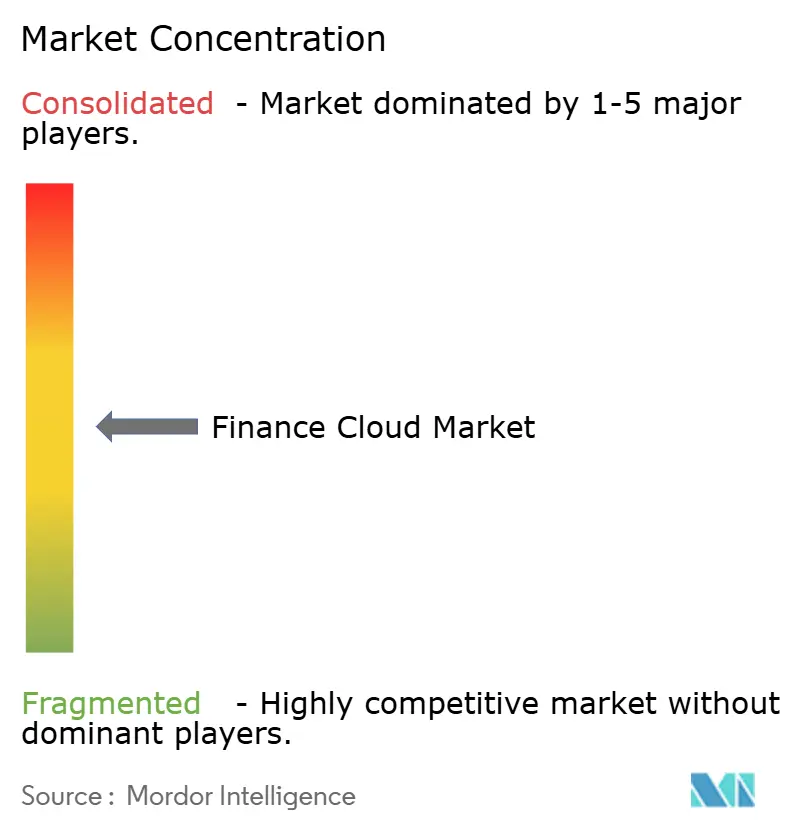
| Market Concentration | Medium |
Major Players *Disclaimer: Major Players sorted in no particular order Image © Mordor Intelligence. Reuse requires attribution under CC BY 4.0. | |
Finance Cloud Market Analysis by Mordor Intelligence
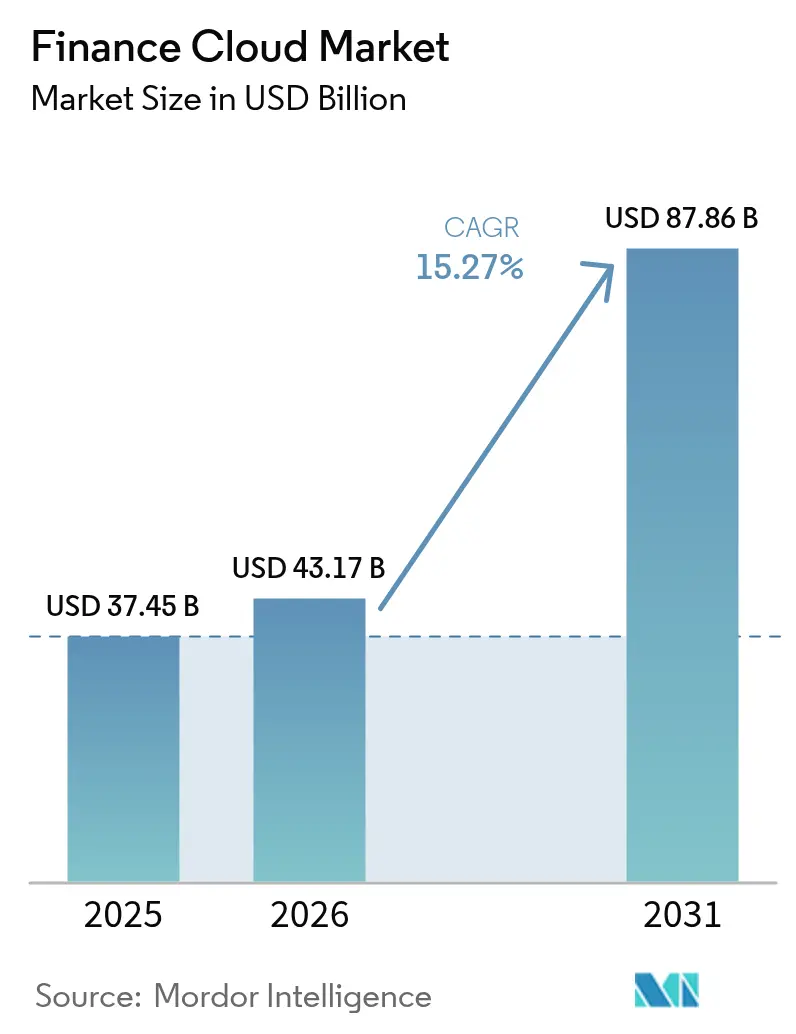
The finance cloud market size is expected to grow from USD 37.45 billion in 2025 to USD 43.17 billion in 2026 and is forecast to reach USD 87.86 billion by 2031 at 15.3% CAGR over 2026-2031. Rising digital-first consumer expectations, tighter regulatory oversight, and the maturation of cloud security frameworks are driving widespread migration of core finance workloads to public and hybrid clouds. The European Union’s Digital Operational Resilience Act (DORA) alone mandates upgraded ICT risk controls for about 22,000 financial entities and their technology partners, accelerating platform modernization across the region[1]European Banking Authority, “Digital Operational Resilience Act Portal,” eba.europa.eu. At the same time, 98% of financial institutions globally already use at least one cloud service, up from 91% in 2020, confirming that the finance cloud market has reached critical mass. Generative AI roll-outs on cloud infrastructure now underpin everything from automated reconciliation to predictive cash-flow modelling, turning cloud providers into strategic partners for competitive differentiation. North American banks fund multibillion-dollar tech budgets to migrate thousands of applications, while Asia-Pacific institutions scale cloud-native cores to serve massive digital customer bases—all of which keeps the finance cloud market on a steep growth trajectory.
Key Report Takeaways
- By solution, Financial Forecasting and Planning led with 37.70% revenue share in 2025; Risk, Compliance and RegTech is projected to expand at a 15.62% CAGR through 2031.
- By deployment model, Public Cloud held 56.90% of the finance cloud market share in 2025, while Hybrid/Multi-Cloud configurations are forecast to advance at 16.55% CAGR through 2031.
- By end-user, banking commanded 49.60% share of the finance cloud market size in 2025; FinTech and neo-banks are poised to grow at 16.12% CAGR to 2031.
- By organisation size, large enterprises accounted for 70.55% share of the finance cloud market size in 2025; SMEs exhibit the fastest growth at 16.84% CAGR.
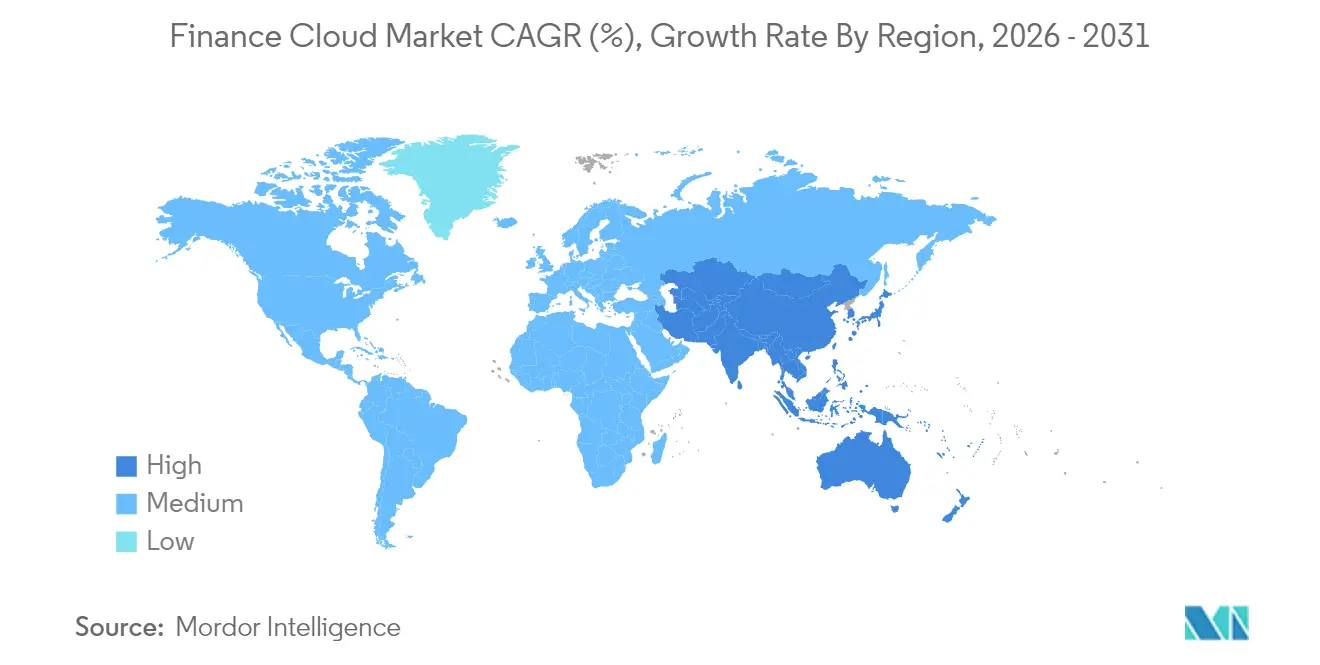
- By geography, North America contributed 40.60% of 2025 revenue, whereas Asia-Pacific is projected to record the quickest regional CAGR of 15.96% through 2031.
Note: Market size and forecast figures in this report are generated using Mordor Intelligence’s proprietary estimation framework, updated with the latest available data and insights as of 2026.
Market Trends and Insights
Drivers Impact Analysis of Finance Cloud Market*
| Driver | (~) % Impact on CAGR Forecast | Geographic Relevance | Impact Timeline |
|---|---|---|---|
| Need for improved customer relationship management | +2.8% | Global, stronger in North America and APAC | Medium term (2-4 years) |
| Demand for operational efficiency in financial sector | +3.2% | Global, pronounced in Europe and North America | Short term (≤2 years) |
| Regulatory push for real-time transparency and reporting | +4.1% | Europe leading, expanding globally | Short term (≤2 years) |
| GenAI-enabled self-service finance analytics | +2.9% | North America and APAC core, spill-over to Europe | Medium term (2-4 years) |
| FinOps adoption to optimise cloud spending | +1.8% | Global, early uptake in North America | Long term (≥4 years) |
| Industry-cloud platforms for BFSI verticals | +2.2% | Global, stronger in developed markets | Long term (≥4 years) |
| Source: Mordor Intelligence | |||
Need for Improved Customer Relationship Management
Cloud-based CRM suites give financial institutions real-time insight into behavioural patterns, enabling hyper-personalised offers that improve retention in crowded markets. Asia-Pacific banks run cloud platforms capable of supporting tens of millions of concurrent sessions, as illustrated by AIBank’s micro-services core that serves more than 100 million customers. In parallel, North American lenders integrate cloud analytics with loyalty engines to cut churn that still affects over 60% of legacy institutions. Because finance data is highly regulated, vendors differentiate through in-platform encryption, audit trails, and data-residency controls that satisfy regulators while still allowing cross-channel orchestration. As customer lifetime value becomes a pivotal KPI, the finance cloud market gains further momentum from banks’ willingness to replace ageing CRM tools with elastic, AI-ready alternatives.
Demand for Operational Efficiency in Financial Sector
Moving finance workloads to consumption-based clouds converts capital expenditure into variable operating cost, releasing cash for product innovation. Institutions that completed full cloud migrations report 20-30% reductions in month-end close cycles and similar gains in regulatory reporting speed. Automation natively embedded in cloud ERPs eliminates manual journals, while serverless compute handles unpredictable spikes in payment volumes without performance degradation. Discover Financial Services, for example, relies on a hybrid estate to flex resources during seasonal spending peaks. As margins tighten, cost-to-income ratios now appear on board dashboards alongside revenue, reinforcing the efficiency narrative that will continue to propel the finance cloud market.
Regulatory Push for Real-Time Transparency and Reporting
Since January 2025, DORA obliges European banks to log, test, and report ICT incidents in near real time. The regulation directly subjects critical third-party cloud providers to supervisory scrutiny, prompting institutions to adopt compliant platforms equipped with automated audit evidence capture, immutable logs, and cross-jurisdiction data-residency controls. Similar operational-resilience frameworks are in draft stages in North America and Asia-Pacific, creating a domino effect that favours cloud architectures offering built-in controls libraries. Vendors that embed continuous security validation, threat-intelligence feeds, and zero-trust networking stand to capture outsized wallet share within the finance cloud market.
GenAI-enabled Self-service Finance Analytics
Generative AI embedded in cloud ERP and EPM suites delivers conversational insight generation, letting business users query ledgers or generate forecasts via natural-language prompts. Workday’s Spring 2025 release introduced AI-Powered Accounts Payable and 350 other features that cut invoice processing times and speed financial closes. FIS followed with Treasury GPT, an Azure-based assistant that won industry innovation awards[2]FIS Global, “Treasury GPT Wins TMI Award,” fisglobal.com. Large-language-model deployments need scalable GPUs and high-bandwidth storage that public clouds supply on demand, securing a fresh layer of growth for the finance cloud market. Nevertheless, banks must implement rigorous model-governance and data-quality frameworks to satisfy auditors, an area where enterprise clouds again offer pre-configured services.
Restraints Impact Analysis of Finance Cloud Market*
| Restraint | (~) % Impact on CAGR Forecast | Geographic Relevance | Impact Timeline |
|---|---|---|---|
| Rise of cloud-based cyber threats | −2.1% | Global, heightened in North America and Europe | Short term (≤2 years) |
| Legacy-core integration complexity | −1.8% | Global, acute in markets with older infrastructure | Medium term (2-4 years) |
| Talent gap in cloud FinOps and data engineering | −1.3% | Global, severe in APAC and emerging regions | Long term (≥4 years) |
| Vendor lock-in and GenAI cost overruns | −0.9% | Mainly developed markets with high cloud adoption | Medium term (2-4 years) |
| Source: Mordor Intelligence | |||
Rise of Cloud-based Cyber Threats
Financial services remain the top target for sophisticated attacks, and cloud environments enlarge the threat surface. US regulators report escalating ransom incidents that disrupt critical payment infrastructures, prompting banks to double investments in zero-trust architectures and extended detection platforms. Migrating sensitive data without commensurate security uplift exposes institutions to regulatory fines that can exceed annual IT budgets. Cloud providers answer with confidential computing, hardware-rooted encryption, and sovereign-cloud blueprints, yet implementing these controls adds cost and complexity, muting short-term acceleration in the finance cloud market.
Legacy-core Integration Complexity
Roughly 90% of European banks still run parts of their ledger or payments stack on platforms older than a decade. Bridging these monoliths with cloud micro-services calls for scarce mainframe-to-Kubernetes skillsets and extended parallel-run periods that inflate project costs. Institutions therefore adopt phased coexistence strategies—lifting non-core workloads first and gradually refactoring the core—stretching realisation timelines. Emerging AI code-conversion tools promise to automate refactoring, yet are only beginning to reach production maturity. This integration overhang continues to cap upside in the finance cloud market during the medium term.
*Our forecasts treat driver/restraint impacts as directional, not additive. The impact forecasts reflect baseline growth, mix effects, and variable interactions.
Finance Cloud Market Segment Analysis
By Solution:
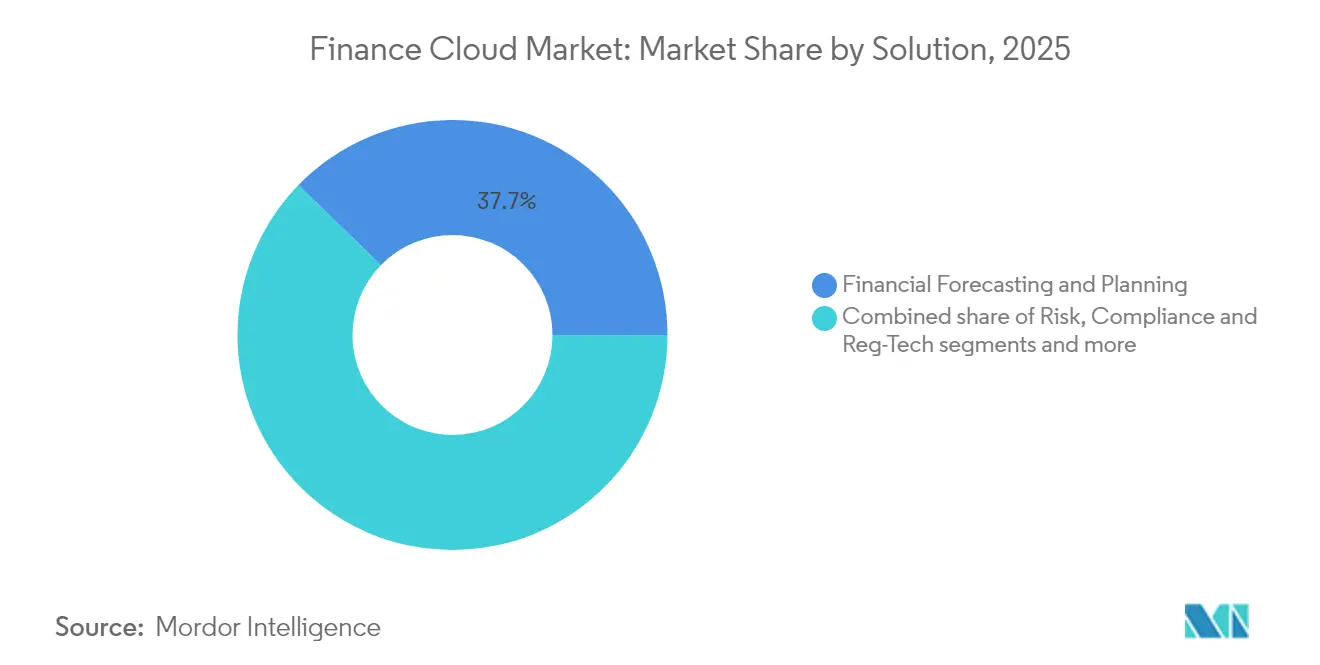
Planning Dominance Amid RegTech AccelerationThe Financial Forecasting and Planning segment retained 37.70% revenue in 2025, reflecting the universal need for scenario modelling when economic volatility remains high. Cloud-based EPM suites let finance teams generate rolling forecasts across thousands of cost centres, elevating data-driven decision-making. Integrated driver-based models update profit outlooks instantly after rate or FX shocks, reinforcing migration urgency. Concurrently, Risk, Compliance, and RegTech is the fastest-growing solution line, advancing at 15.62% CAGR through 2031 on the back of DORA and comparable regimes. Vendors embed API-ready regulatory libraries so institutions can push granular transaction data to supervisors with one-click reporting. Continuous control monitoring features lower audit-prep workloads, translating compliance budgets directly into demand for the finance cloud market.
Core Accounting and General Ledger platforms remain indispensable, acting as system-of-record anchors for all other cloud finance modules. Treasury and Cash-Management tools gain new momentum as volatile funding markets prioritise real-time liquidity insight. Citigroup, for instance, expanded its cloud treasury workspace to aggregate global cash positions minute-by-minute. Payroll and Workforce Finance applications benefit from tight finance-HR convergence; Workday’s latest release bundles headcount planning with spend analytics, underscoring how integrated suites improve enterprise alignment. As vendors package these capabilities under unified data fabrics, upsell pipelines expand, driving sustainable revenue streams within the finance cloud market.

By Deployment Model:
Public Cloud Leadership with Hybrid MomentumPublic clouds controlled 56.90% of 2025 revenue due to hyperscalers’ global footprints, advanced security certifications, and continuous innovation roadmaps. Banks routinely adopt managed PaaS databases to accelerate new product rollouts without provisioning hardware. Yet dependence on a single provider raises resilience concerns, propelling Hybrid and Multi-Cloud uptake at 16.55% CAGR. European lenders, mindful of concentration risk outlined by regulators, increasingly split workloads across at least two vendors, while retaining ultra-low-latency trading engines on private clouds. Form3’s payment platform exemplifies this strategy, abstracting routing logic so banks can toggle endpoints among clouds during outages.
Private clouds remain vital for use cases with stringent performance or data-sovereignty requirements. JPMorgan Chase is spending USD 2 billion on four new private cloud data centres that anchor latency-sensitive risk computations. Unified observability stacks and policy-as-code reduce operational friction across mixed estates, making hybrid truly seamless. Because regulatory discourse now explicitly references “exit plans,” institutions favour containerised workloads and open APIs to avoid lock-in, a development that further broadens addressable opportunity for the finance cloud market.
By End-User:
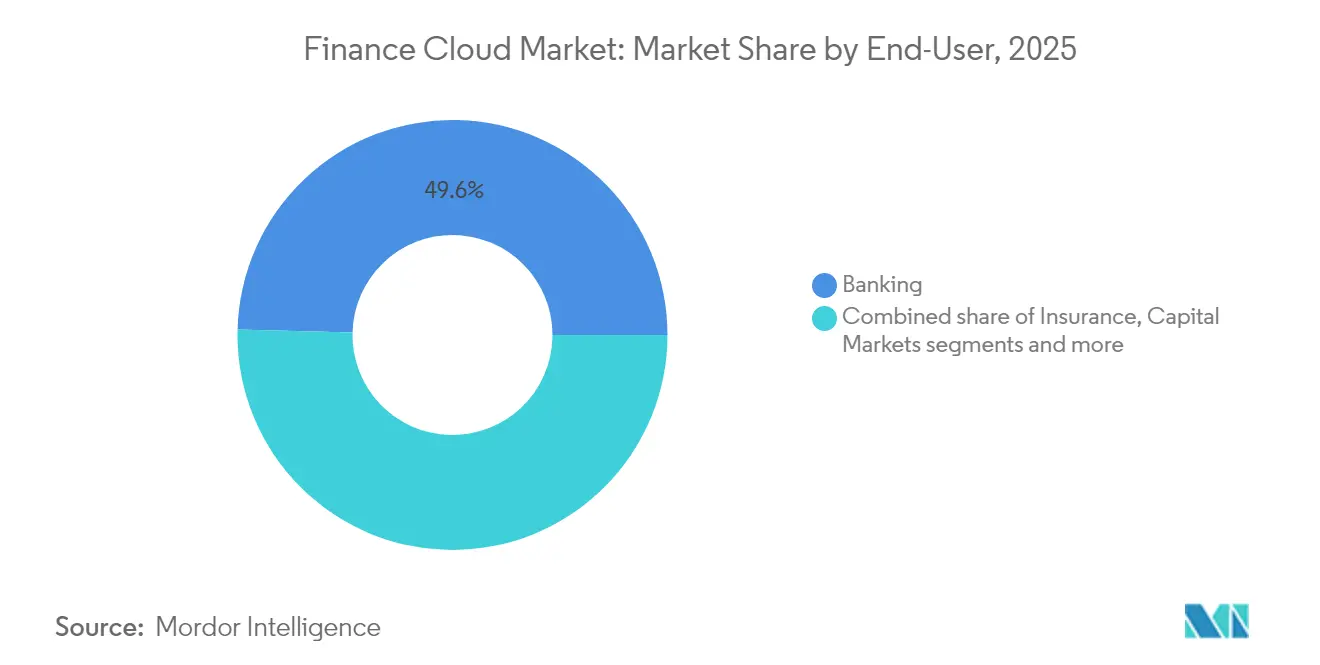
Banking Stability Contrasts FinTech DynamismTraditional banking institutions delivered 49.60% of 2025 revenue, reflecting their scale and compulsory compliance spend. Core-modernisation programmes migrate deposit systems and payment rails to elastic architectures, releasing innovation bandwidth for embedded finance partnerships. FinTech and neo-banks, however, post the highest CAGR at 16.12%, showcasing how cloud-native cores permit faster iteration cycles and lower per-account costs. A 2024 MDPI study found that digital-only lenders can launch new features 4-5 times quicker than peers. This agility forces incumbents to accelerate adoption, sustaining a virtuous circle of demand inside the finance cloud market.
Insurance carriers deploy cloud ML models to refine underwriting and automate claims triage, while capital-markets firms need low-latency data fabrics for algorithmic trading and near-real-time risk aggregation. Nasdaq and AWS launched the Eqlipse suite to modernise market infrastructure, signalling widespread buy-side and sell-side readiness for cloud execution. Collectively, these segments diversify growth sources and amplify the resilience of the finance cloud industry against cyclical slowdowns in any single vertical.
By Organisation Size:
Enterprise Scale Meets SME AgilityLarge enterprises contributed 70.55% of revenue in 2025, leveraging multi-year, multi-million-dollar transformation budgets. Complex global operations need regional data-residency, 24×7 availability, and granular segregation-of-duty controls that leading platforms now embed out of the box. Governance risk committees, therefore, green-light enterprise-wide adoption, reinforcing the size of the finance cloud market. Yet SMEs grow fastest at 16.84% CAGR as vendors introduce pay-as-you-grow tiers and pre-configured best-practice charts of account. Treasury-as-a-Service bundles combine payments, liquidity dashboards, and FX hedging into a single portal, removing the need for specialist staff.
SMEs represent 99% of OECD businesses, and surveys show over 40% still suffer from credit or cash-flow gaps. Cloud platforms that integrate bank feeds, predictive invoice-collection analytics, and embedded financing options unlock working-capital insights previously reserved for corporates. Because implementation is lightweight, SME rollouts often conclude within weeks, allowing vendors to scale via digital channels. This high-volume, low-touch model broadens the finance cloud market beyond the top tier while creating attractive recurring revenue streams for providers.
Geography Analysis
North America Finance Cloud Market
North America retained 40.60% of 2025 revenue thanks to deep technology budgets and regulatory clarity that fosters accelerated migration. The United States anchors the region, with JPMorgan Chase alone allocating USD 17 billion annually to tech and moving 6,000 applications to cloud platforms. Canada follows with open-banking guidelines that encourage secure API ecosystems, while Mexican banks adopt cloud to meet cross-border reporting standards. Public-private collaboration on cybersecurity and digital-identity frameworks further de-risks adoption, strengthening the finance cloud market in the region. Providers leverage dense data-centre footprints to meet sub-10-millisecond latency thresholds demanded by high-frequency traders.
APAC Finance Cloud Market
Asia-Pacific is the fastest-growing territory at 15.96% CAGR through 2031. Government-backed digital-economy blueprints place cloud at the centre of financial-inclusion agendas, underpinning a regional digital-economy value expected to reach USD 1 trillion by 2030. China’s AIBank demonstrates cloud scalability by serving over 100 million customers on a containerised platform. India’s public-cloud policy now allows regulated entities to host core data offshore under strict encryption keys, unlocking broader hyperscaler adoption. Japan and Australia endorse Industry-Cloud models that deliver pre-certified compliance artefacts for local supervisory bodies. Coupled with rising fee-based revenue targets—APAC banks expect digital adjacencies to supply 40% of profit pools by 2030—these trends ensure sustained upside for the finance cloud market.
EMEA and South America Finance Cloud Market
Europe accelerates cloud modernisation under DORA’s operational-resilience mandate, affecting roughly 22,000 financial organisations. Germany, France, and the United Kingdom roll out shared testing frameworks for cyber-incident simulations, incentivising the adoption of platforms that automate evidence collection. Sovereign-cloud regions operated by large providers satisfy data-sovereignty clauses, while multi-vendor strategies mitigate systemic risk. South America charts high growth, powered by Brazil’s branchless challenger banks such as Nubank, which posted USD 2 billion profit in 2024 while operating entirely on cloud infrastructure. Middle East and Africa adoption climbs swiftly; 83% of MENA financial firms now run cloud workloads and expect USD 21.14 million in annual savings within two years. Gulf Cooperation Council banks align national cloud mandates with ambitious digital transformation roadmaps, solidifying new demand pockets for the finance cloud market.
Regulatory Landscape
The finance cloud market operates under expanding operational-resilience, outsourcing, and AI governance requirements that influence how regulated workloads are architected. In the European Union, Regulation (EU) 2022/2554 (Digital Operational Resilience Act, DORA) has applied since January 2025. It requires financial entities to maintain detailed registers of ICT third-party service provider arrangements, test resilience, and report ICT-related incidents, while also bringing critical ICT third-party providers (including major cloud computing firms) under dedicated oversight frameworks.
In 2026, regulatory pressure also increases around data standardization and integrity for regulated reporting and around AI use in finance operations. In the United States, the SEC issued final rules in 2026 to implement joint data standards under the Financial Data Transparency Act (FDTA), setting an interoperability agenda for regulatory data that reinforces demand for standardized, cloud-native data management and lineage. In parallel, the EU AI Act (Regulation (EU) 2024/1689) introduces horizontal AI requirements, and EU financial authorities have been publishing sector-facing interpretations (including an ECB opinion in 2026) that push banks and their cloud vendors to strengthen model governance, controls, and auditability alongside traditional ICT-risk controls.
Value Chain Analysis
The finance cloud value chain begins with hyperscale and infrastructure providers (compute, storage, GPUs, networking, identity, encryption, and data-residency controls). It then extends through cloud platforms (databases, integration, observability, and policy-as-code) and finance application layers spanning ERP/EPM, treasury, risk and compliance tooling, and industry-cloud stacks tailored to BFSI. Implementation and operating partners (systems integrators, managed service providers, and process specialists) configure controls such as logging, immutable audit trails, and incident workflows demanded by regimes like DORA, while financial institutions and FinTechs remain the demand anchor through multi-year modernization programs.
Increasingly, the chain is shaped by ecosystem interoperability and third-party concentration management. Partnerships in 2026 highlight how AI and data capabilities are being embedded into CFO workflows through vendor marketplaces and alliances, including OneStream expanding its strategic partnership with Microsoft and Genpact expanding its alliance with Google Cloud for agentic solutions. External assurance, resilience testing, and third-party oversight requirements also intensify as authorities expand scrutiny beyond banks to key technology suppliers, increasing the value of compliance, audit evidence management, and exit-planning capabilities for both vendors and buyers.
Competitive Landscape
The finance cloud market shows moderate concentration, with a mix of hyperscale cloud vendors, enterprise-software incumbents, and cloud-native specialists contesting share. Oracle reported USD 12.5 billion in new AI-linked bookings and deepened its alliance with Microsoft to host Oracle Databases inside Azure regions, enabling customers to co-locate data and application tiers. Amazon Web Services teamed with Nasdaq to co-engineer the Eqlipse suite, signalling a vertical-platform play aimed at capital-markets clients. IBM augmented its FinOps posture by acquiring Kubernetes cost-management vendor Kubecost and rolling out sovereign-cloud blueprints tailored to DORA compliance[4]IBM, “IBM Launches Sovereign Cloud Capabilities,” ibm.com.
Specialist vendors inject competitive tension. Planful serves more than 1,300 customers with AI-enhanced planning tools that promise sub-second scenario refreshes, while Treasury-as-a-Service start-ups target SME white spaces. Private-equity activity intensifies: Vista Equity Partners will absorb Acumatica by Q3 2025 to accelerate product innovation around AI-first ERP modules. Consolidation trends continue as smaller providers struggle with escalating compliance and GPU-compute costs, pushing them into partnerships or acquisitions. Market winners increasingly differentiate by quantifying efficiency savings; several banks report 25% faster book-close cycles after implementing cloud AI automation suites. Overall, vendor success hinges on security certifications, local data centre expansion, and the ability to embed end-to-end compliance artefacts that de-risk adoption for regulated buyers.
Finance Cloud Industry Leaders
IBM Corporation
Microsoft Corporation
Salesforce.com Inc.
SAP SE
Oracle Corporation(Netsuite)
- *Disclaimer: Major Players sorted in no particular order
Finance Cloud Market Companies Covered in this Report
- Oracle Corporation(Netsuite)
- SAP
- Microsoft
- Salesforce
- IBM
- Workday
- Sage Intacct
- Unit4 / FinancialForce
- Intuit
- Anaplan
- Workiva
- BlackLine
- Coupa
- Xero
- FIS
- Fiserv
- Temenos
- Finastra
- Acumatica
- AWS
- Google Cloud
- Huawei
Market Opportunities and Future Outlook
Operational-resilience oversight is creating concrete whitespace for compliance-ready cloud design, continuous controls monitoring, and third-party risk tooling embedded into finance platforms. A major 2026 proof point is the United Kingdoms Critical Third Parties (Designation) Regulations 2026, which designate Amazon Web Services, Google Cloud, Microsoft, and Oracle entities as Critical Third Parties under joint oversight by the FCA, Bank of England, and PRA. This shifts compliance expectations toward demonstrable resilience and auditability at the shared-infrastructure layer. It expands demand for solutions that automate evidence capture, map outsourced services to critical business functions, and operationalize exit plans across public and hybrid estates.
A second opportunity cluster comes from AI-enabled finance operations that depend on scalable cloud infrastructure but require stronger governance, data quality, and model controls to satisfy auditors and supervisors. 2026 alliances and product ecosystems around agentic AI and financial intelligence (for example, hyperscaler partnerships supporting enterprise finance workflows) highlight buyer appetite for productivity gains in areas like accounts payable automation, treasury decision support, and forecasting. At the same time, they raise demand for policy-enforced data lineage, explainability tooling, and secure integration patterns across multi-vendor stacks. Vendors that package industry-specific controls libraries, sovereign and multi-region deployment options, and vendor-neutral integration layers that reduce concentration and lock-in risk stand to gain traction as these requirements move from guidance to procurement criteria.
Recent Industry Developments in Finance Cloud Market
- July 2026: The UK enacted the Critical Third Parties (Designation) Regulations 2026, designating AWS, Google Cloud, Microsoft, and Oracle entities for direct oversight by the FCA, Bank of England, and PRA. The regulation formalizes supervisory attention on the resilience of shared cloud infrastructure that underpins regulated finance workloads. Cloud and finance-platform vendors face higher expectations for audit-ready controls, incident response coordination, and credible exit planning in UK-regulated deployments.
- May 2025: IBM Cloud introduced sovereign-cloud capabilities and high-performance AI infrastructure aimed at regulated industries. The launch aligns product roadmaps with operational-resilience requirements and data-sovereignty constraints that figure prominently in finance cloud procurement decisions. It also strengthens IBM positioning for buyers seeking regulated-by-design reference architectures rather than generic cloud builds.
- September 2024: Oracle launched a sustainability application for Fusion Cloud EPM that integrates data from Fusion Cloud ERP and Oracle SCM to support enterprise reporting workflows. The release extends finance-cloud scope beyond core close and planning into compliance-adjacent disclosure processes that require governed data pipelines. For multi-module ERP/EPM buyers, this reinforces suite consolidation as a route to standardized data and auditable reporting.
Finance Cloud Market Report Scope and Research Methodology
Market Definition and Coverage
In this study, the finance cloud market covers revenues earned from cloud-delivered software, platforms, and infrastructure used to run finance and compliance workloads at financial institutions, including accounting, risk, treasury, reporting, and related core processes.
Scope exclusions: It excludes generic office productivity tools and non-finance horizontal cloud services that are not purchased for regulated finance use cases.
Segments Covered in This Report
- By Solution
- Core Accounting and GL
- Financial Forecasting and Planning
- Risk, Compliance and Reg-Tech
- Treasury and Cash-Management
- Payroll and Workforce Finance
- By Deployment Model
- Public Cloud
- Private Cloud
- Hybrid / Multi-Cloud
- By End-User
- Banking
- Insurance
- Capital Markets
- FinTech / Neo-banks
- By Organisation Size
- Large Enterprises
- Small and Medium Enterprises (SMEs)
- By Geography
- North America
- United States
- Canada
- Mexico
- Europe
- Germany
- United Kingdom
- France
- Italy
- Spain
- Rest of Europe
- Asia-Pacific
- China
- Japan
- India
- South Korea
- Australia
- Rest of Asia-Pacific
- South America
- Brazil
- Argentina
- Rest of South America
- Middle East and Africa
- Middle East
- Saudi Arabia
- United Arab Emirates
- Turkey
- Rest of Middle East
- Africa
- South Africa
- Egypt
- Nigeria
- Rest of Africa
- Middle East
- North America
Data Sources, Market Sizing, and Validation
Desk Research
Desk work started with building a demand map from public signals, since cloud spend is often disclosed in broad technology buckets. We leaned on sources such as SEC filings and annual reports, investor presentations, official regulator publications, and central bank or supervisory guidance on outsourcing and operational resilience to understand what is moved to cloud and under what controls.
To anchor the model, we also referenced materials such as NIST cloud and security publications, ISO documentation for financial messaging standards, peer-reviewed journals for cloud adoption in financial services, and trade association updates where cloud risk, data residency, and audit requirements are discussed. For company-level financial context and tracking major contracts, we additionally used subscription databases for company financial intelligence, news and financials, and patent databases. These desk sources are not exhaustive, and additional public references were used for data collection, validation, and clarification.
Primary Interviews and Surveys
Primary interviews and surveys were used to pressure-test the desk assumptions around what buyers count as finance cloud, what is bundled into multi-year contracts, and how workloads are split across public, private, and hybrid environments. We spoke with a mix of cloud program owners, finance IT leaders, security and risk stakeholders, and implementation partners to confirm adoption pace, pricing motions, and typical renewal and expansion patterns across key regions.
Distribution of primary research fieldwork respondents
| Company type | Respondent position | Region |
|---|---|---|
| Top tier: 39% | CXOs: 14% | APAC: 46% |
| Mid tier: 43% | Functional/Unit leaders: 41% | EMEA: 29% |
| Smaller Players: 18% | Managers: 45% | Americas: 25% |
Market-Sizing & Forecasting
Sizing was built using a top-down approach where financial services cloud adoption is reconstructed from enterprise IT and cloud spend pools, and then narrowed using penetration and workload-migration shares that are specific to regulated finance functions. Those totals were then checked through selective bottom-up approximations, such as sampled price ranges for common finance workloads, deal-size patterns from channel conversations, and supplier revenue splits where they are disclosed.
Key inputs used in the model include the number of regulated financial institutions by region, cloud migration intensity for core finance and risk workloads, typical contract length and ramp-up period, average revenue per workload for subscription and usage-based components, and the pace of compliance-driven modernization (for example, resilience and outsourcing controls that change the timing of migrations). For forecasting, we used scenario analysis supported by expert views on macro IT spend, regulatory timetables, and the expected speed of moving sensitive workloads, and then calibrated the final trajectory to match the adoption and pricing signals heard in interviews. Where bottom-up detail was missing, gaps were handled through conservative proxy ratios that were verified with at least two independent interview perspectives before being used in the final model.
Data Validation & Update Cycle
Outputs were triangulated across multiple checks, including cross-verifying implied cloud spend per institution, comparing growth rates against public IT spending trends, and stress-testing key assumptions like migration pace and subscription price progression. When numbers looked inconsistent, we revisited the drivers, re-checked inputs against fresh desk signals, and re-contacted selected interviewees to confirm whether a change was real or timing noise.
Before sign-off, a second analyst reviews the full model logic and key assumptions, followed by variance checks at the region and use-case level. The report is refreshed annually, and it is also updated when material events occur, such as major regulatory shifts or step-changes in cloud contracting patterns. Right before delivery, the latest public updates are reviewed again so clients receive the most current view.
Mordor Intelligence's Finance Cloud Market Size Versus Other Published Estimates
Published finance cloud market values can look far apart because each publisher draws the boundary in a different place, and then uses a different set of demand signals to scale the numbers. Differences usually show up in what is counted as finance cloud, which buyer groups are included, and how subscription versus usage revenue is timed.
Evidence such as the 2025 to 2026 step-up in reported market spend and cross-checks on regulated finance workload migration keep Mordor Intelligence tied to cloud purchases made for finance and compliance outcomes, rather than broader digital transformation budgets.
Benchmark comparison
| Source | Market Size | Gaps in Research Methodology |
|---|---|---|
| Mordor Intelligence | USD 43.17 B (2026) | |
| Global Consultancy A | USD 53.29 B (2026) | Uses a broader scope that leans into wealth and customer management platforms and can pull in adjacent engagement and embedded-finance use cases, which raises the addressable spend beyond regulated finance workloads. |
| Industry Publisher B | USD 43.78 B (2025) | Anchors the series to a different base year and may apply faster price and adoption ramp assumptions in the early years, which can shift the year-specific value even if the long-term direction is similar. |
Across the three figures, most of the spread is explained by scope boundaries and timing choices, not by a disagreement that cloud adoption is rising in financial services. By keeping the steps traceable to buyer demand signals, contract realities, and clearly stated inclusions, the final estimate stays practical to reproduce and easy to sanity-check.
Key Questions Answered in the Report
What is the current size of the finance cloud market?
The finance cloud market stands at USD 43.17 billion in 2026 and is projected to grow to USD 87.86 billion by 2031.
Which deployment model leads the finance cloud market?
Public cloud solutions currently dominate with 56.90% market share, although hybrid and multi-cloud setups are expanding the fastest at a 16.55% CAGR.
How does DORA influence finance cloud adoption in Europe?
DORA enforces stricter ICT-risk controls and real-time reporting, prompting European banks to implement compliant cloud platforms equipped with automated audit and resilience features.
Why are SMEs adopting finance cloud platforms rapidly?
Pay-as-you-grow pricing, embedded AI automation, and Treasury-as-a-Service bundles allow SMEs to access enterprise-grade financial tools without heavy upfront investment, driving a 16.84% CAGR.
What role does generative AI play in the finance cloud market?
Generative AI powers self-service analytics, intelligent payables, and conversational treasury assistants, boosting operational efficiency and strengthening the business case for cloud migration.
Who are the major players in the finance cloud market?
Leading providers include Oracle, Amazon Web Services, Microsoft, IBM, SAP, and specialist firms like Planful and Acumatica, each differentiating through AI capabilities and compliance-ready architectures.
Page last updated on: