
Field-Erected Cooling Tower Market Size and Share
Market Overview
| Study Period | 2021 - 2031 |
|---|---|
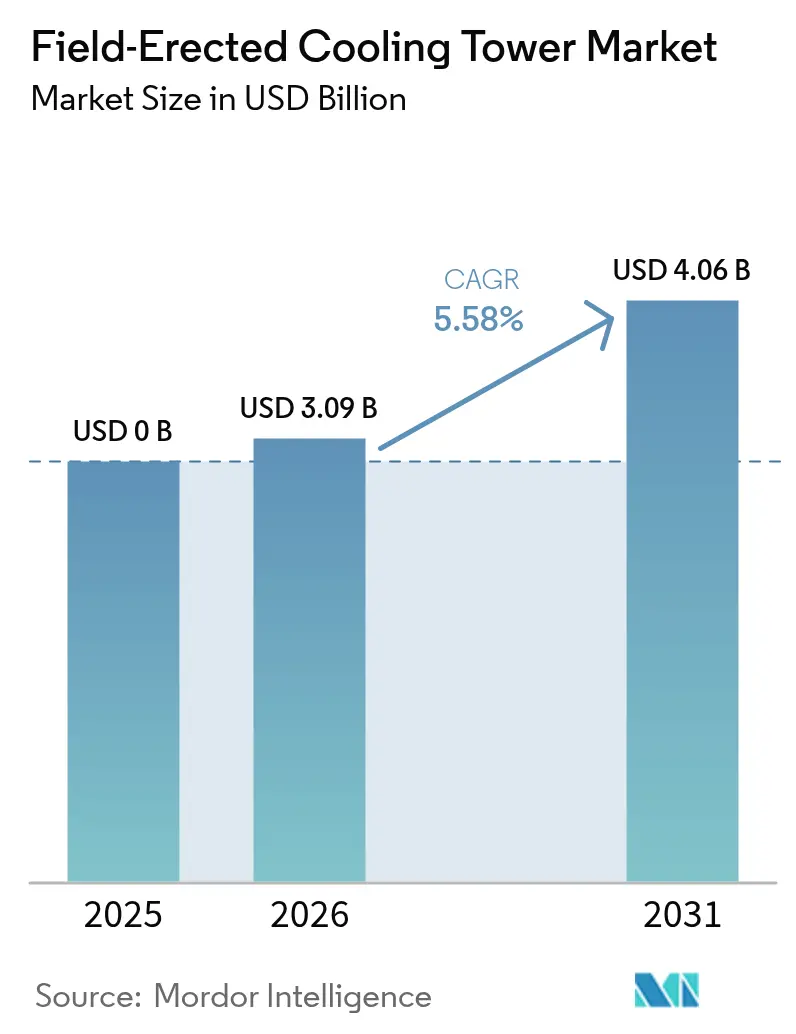
| Market Size (2026) | USD 3.09 Billion |
| Market Size (2031) | USD 4.06 Billion |
| Growth Rate (2026 - 2031) | 5.58 % |
| Fastest Growing Market | Asia Pacific |
| Largest Market | Asia Pacific |
| Market Concentration | Medium |
Major Players *Disclaimer: Major Players sorted in no particular order Image © Mordor Intelligence. Reuse requires attribution under CC BY 4.0. | |
Field-Erected Cooling Tower Market Analysis by Mordor Intelligence
The Field-Erected Cooling Tower Market size was valued at USD 2.93 billion in 2025 and estimated to grow from USD 3.09 billion in 2026 to reach USD 4.06 billion by 2031, at a CAGR of 5.58% during the forecast period (2026-2031).
Heightened investment in thermal power generation, stringent environmental rules, and a visible shift toward modular fiber-reinforced plastic (FRP) structures are the most influential growth levers. Rising electricity demand across emerging economies, rapid industrialization, and stricter plume-abatement requirements are driving end users toward hybrid and dry technologies that conserve water without compromising heat-rejection performance. At the same time, recurring refurbishment cycles in North America and Europe are converting legacy assets into steady aftermarket revenue for suppliers with advanced retrofit capabilities. Global manufacturers are pursuing localized fabrication to shorten delivery schedules and counteract raw-material price swings, while also broadening their digital service portfolios that promise predictive maintenance and lower lifetime operating expenses.
Key Report Takeaways
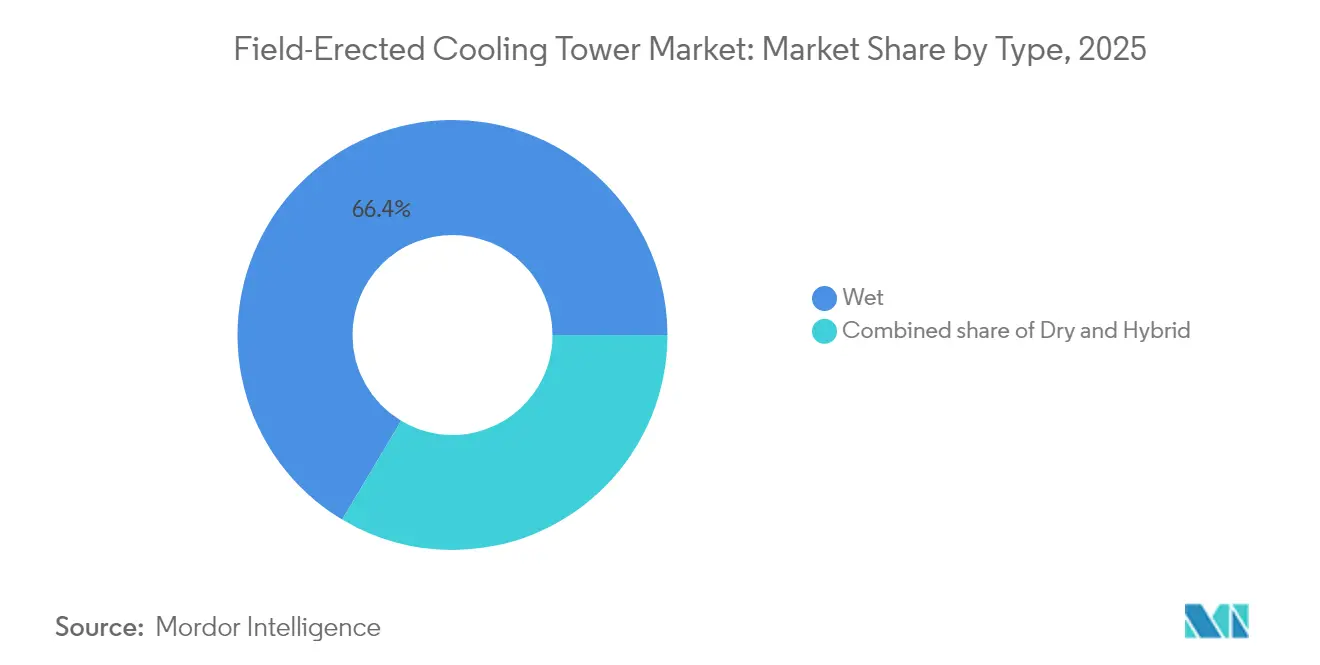
- By type, wet towers accounted for 66.42% of 2025 revenue, while hybrid towers are expected to post the fastest growth rate of 6.55% from 2026 to 2031.
- By design, induced draft systems accounted for 61.80% of the field-erected cooling tower market size in 2025 and are projected to grow at a 5.74% CAGR over 2026-2031.
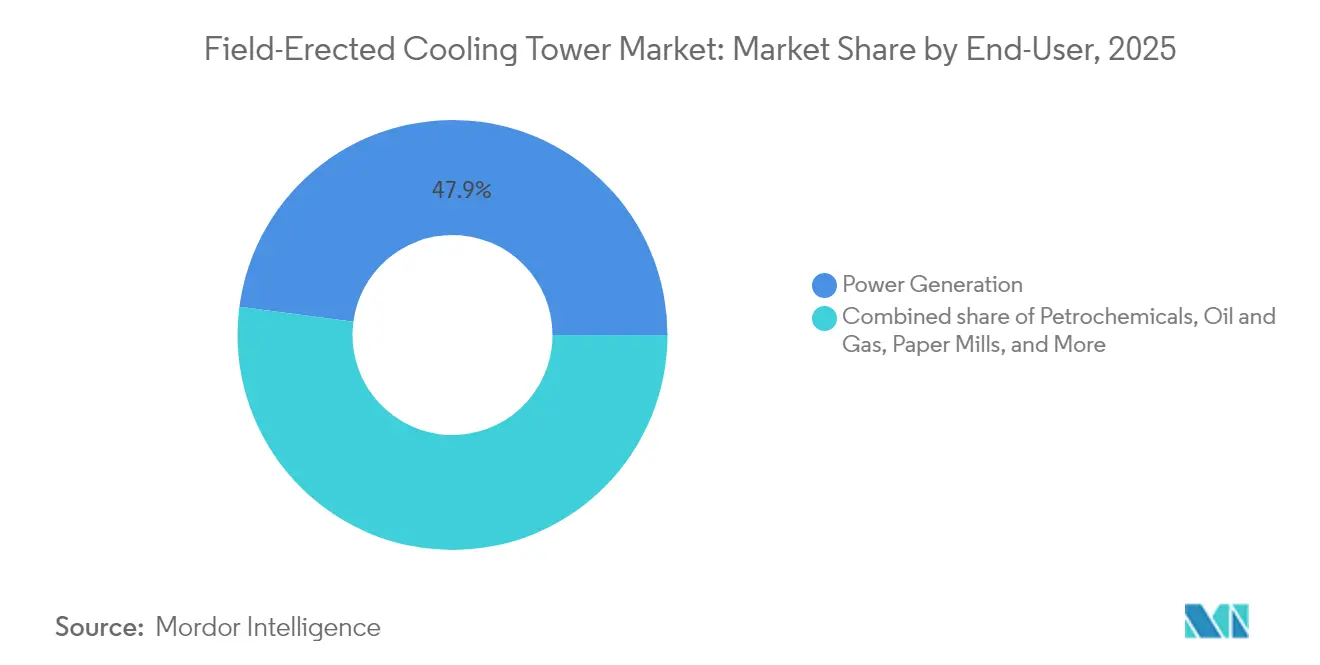
- By end user, power generation led with 47.90% of the field-erected cooling tower market share in 2025 and is forecast to expand at a 5.83% CAGR through 2031.
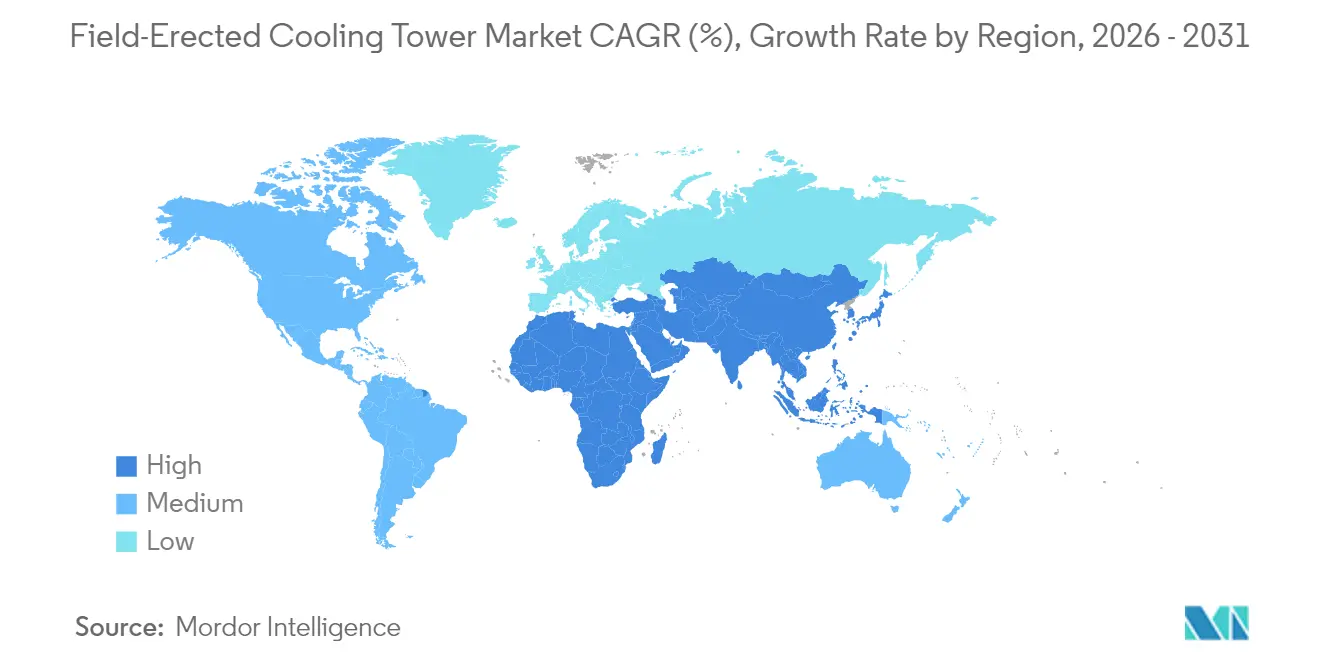
- By geography, Asia-Pacific captured 42.10% revenue in 2025 and is set to register the highest 6.92% CAGR during the forecast period.
- SPX Technologies, Babcock & Wilcox, and EVAPCO together controlled an estimated mid-double-digit share of global revenue in 2024, reflecting a moderately consolidated supplier base.
Note: Market size and forecast figures in this report are generated using Mordor Intelligence’s proprietary estimation framework, updated with the latest available data and insights as of 2026.
Global Field-Erected Cooling Tower Market Trends and Insights
Drivers Impact Analysis*
| Driver | (~) % Impact on CAGR Forecast | Geographic Relevance | Impact Timeline |
|---|---|---|---|
| Expansion of thermal-power capacity in emerging economies | 1.80% | Asia-Pacific core, spill-over to MEA | Medium term (2-4 years) |
| Mandatory refurbishment of aging plant cooling assets | 1.20% | North America & EU | Short term (≤ 2 years) |
| Tightening plume-abatement norms favouring hybrid towers | 0.90% | Global | Long term (≥ 4 years) |
| Geothermal & WtE projects seeking low-water dry towers | 0.60% | North America & EU, expanding to APAC | Medium term (2-4 years) |
| District-scale data-centre heat-reuse cooling demand | 0.40% | Global, concentrated in developed markets | Long term (≥ 4 years) |
| Modular FRP components reducing on-site labour costs | 0.70% | Global | Short term (≤ 2 years) |
| Source: Mordor Intelligence | |||
Expansion of Thermal-Power Capacity in Emerging Economies
Surging electricity demand in India, China, and Southeast Asia is driving large-scale steam-cycle investments that rely on high-capacity, field-erected cooling towers for optimal condenser performance. NTPC’s Lara Super Thermal Power Project extension in India and Nantong Tongzhou Bay ultra-supercritical units in China illustrate how mega-projects are setting new standards for tower dimensions, material durability, and water-saving capabilities. Utility engineers are increasingly mandating performance guarantees for drift loss, plume visibility, and lifecycle corrosion resistance, elevating suppliers with proven computational fluid dynamics design and in-house FRP fabrication capabilities. Local joint-venture manufacturing hubs in Gujarat, Guangxi, and Ho Chi Minh City also help reduce transport costs and expedite erection schedules, thereby strengthening regional ties between equipment vendors and engineering, procurement, and construction (EPC) contractors. With most national energy plans extending to 2030 and beyond, the driver supports a continuous, multi-year procurement pipeline in the Asia-Pacific region.
Mandatory Refurbishment of Aging Plant Cooling Assets
In North America and the European Union, the majority of fossil and nuclear generating units entered service before 1995; condenser vacuum losses, fan inefficiencies, and structural corrosion now threaten output and compliance with permit requirements.[1]World-Nuclear-News Staff, “Holtec Starts Palisades Cooling Upgrade,” world-nuclear-news.org Utilities are allocating rising capital budgets to replace fill media, upgrade gearboxes, and install high-efficiency fans that restore approach temperatures without extended outages. Holtec’s heat-exchanger replacement at the Palisades facility exemplifies how modular skid assemblies reduce tie-in windows and minimize costly civil works. Retrofit demand also benefits aftermarket divisions of global suppliers such as Baltimore Aircoil Company, which offer turnkey rebuild programs involving thermal audits, vibration monitoring, and drift-elimination upgrades.[2]Baltimore Aircoil Company, “Retrofit and Rebuild Services,” baltimoreaircoil.com Because refurbishment programs often lock in service contracts for 10 years or more, this revenue stream helps temper the cyclical swings associated with new-build projects.
Tightening Plume-Abatement Norms Favouring Hybrid Towers
Urban encroachment around industrial sites has transformed the once-benign water-vapor plume into a source of public complaints and occasionally aviation concerns. Hybrid towers blend wet and dry heat-rejection surfaces, allowing operators to toggle modes that suppress visible plume during cold, humid conditions while preserving evaporative efficiency most of the year. Nooter Eriksen’s composite NEXT series embodies the trend; its integrated plume-control module uses finned-tube add-ons that reclaim water droplets and prevent icing at roadways.[3]Nooter Eriksen, “NEXT Hybrid Cooling Solutions,” nootereriksen.com Regulatory pressure is strongest in Germany, Japan, and certain parts of the United States, where state environmental agencies incorporate plume visibility limits into air quality permits. Although hybrid systems carry a 10-15% capital premium, the payback often materializes through avoided community mitigation costs and simpler planning approvals, prompting wider adoption across combined-cycle gas and biomass plants.
Geothermal & Waste-to-Energy Projects Seeking Low-Water Dry Towers
Developers of high-enthalpy geothermal and next-generation waste-to-energy (WtE) plants operate in regions where cooling water is scarce or effluent discharge is tightly regulated. They are turning to dry or dry-assisted designs that cut water withdrawal by as much as 95% relative to wet systems. Air-cooled condenser (ACC) banks sized for 10 MW to 200 MW facilities can now be erected in compact A-frame arrays using prefabricated steel modules that reduce site crane time. Aggressive deployment incentives in Europe and North America, along with the inclusion of net-water-use metrics in green-bond reporting frameworks, position dry towers as a bankable standard for these niche but fast-growing markets. Suppliers capitalizing on this demand are integrating variable-frequency drive (VFD) fan packages and digital twins that predict seasonal performance swings, helping owners optimize dispatch economics under flexible power purchase agreements.
Restraints Impact Analysis*
| Restraint | (~) % Impact on CAGR Forecast | Geographic Relevance | Impact Timeline |
|---|---|---|---|
| High water-use penalties in arid regions | -0.80% | Arid regions globally, particularly Western US, Middle East | Short term (≤ 2 years) |
| Raw-material price volatility (steel, FRP resins) | -0.60% | Global | Short term (≤ 2 years) |
| FRP-shaft CU-deposit cracking in coastal plants | -0.30% | Coastal regions globally | Medium term (2-4 years) |
| Stricter acoustic rules driving costly fan retrofits | -0.40% | Urban and residential proximity areas globally | Medium term (2-4 years) |
| Source: Mordor Intelligence | |||
High Water-Use Penalties in Arid Regions
Utility commissions in Arizona, Nevada, and parts of the Middle East have introduced volumetric surcharges that punish evaporative losses above specified thresholds.[4]Broward County, “Cooling Tower Water Efficiency Ordinance,” broward.org For coal, gas-fired, and concentrating solar power stations located far from abundant freshwater sources, these fees erode generation margins and complicate dispatch economics. Although dry cooling offers a compliance pathway, lower heat-transfer coefficients translate into higher turbine back-pressure and reduced net output. Project sponsors, therefore, face a trade-off between water savings and fuel efficiency, which can undermine the economics of thermal projects in already challenging merchant power markets. The policy environment encourages hybridization but simultaneously raises financing hurdles for pure wet tower projects in water-stressed geographies, capping near-term field-erected cooling tower market growth potential.
Raw-Material Price Volatility (Steel, FRP Resins)
Average hot-rolled coil steel prices doubled between 2021 and 2024, before retracing, while epoxy resin costs fluctuated in line with crude oil and petrochemical supply disruptions. Since field-erected towers can require more than 1,500 tons of steel and substantial FRP content, small and medium-sized manufacturers struggle to hedge exposure during multiyear build cycles. Fixed-price EPC contracts negotiated during low-price windows become liabilities when input costs rise, eroding gross margins or forcing renegotiations that delay project execution. Larger enterprises mitigate risk through volume discounts, forward-buying programs, and vertical integration, which support consolidation trends visible across the supply chain.[5]EVAPCO, “Air-Cooled Condenser Solutions,” evapco.com Persistent volatility may deter new entrants and temper competitive intensity, yet pricing uncertainty still hinders overall market expansion.
*Our forecasts treat driver/restraint impacts as directional, not additive. The impact forecasts reflect baseline growth, mix effects, and variable interactions.
Segment Analysis
By Type: Hybrid Growth Accelerates Despite Wet Dominance
Wet systems contributed 66.42% of global revenue in 2025, underscoring their unrivalled thermodynamic efficiency wherever water is readily available. These units are the default choice for coal-, gas-, and biomass-fired plants aiming to maximize cycle efficiency because evaporative cooling lowers condenser temperatures well below dry-bulb levels. As a result, the field-erected cooling tower market continues to see sizeable procurement volumes for wet designs across Asia-Pacific and parts of Latin America. Yet, the hybrid subsegment is expanding at a 6.55% CAGR, benefiting from rule changes that cap visible plume height in metropolitan jurisdictions, as well as corporate water-stewardship targets linked to ESG reporting.
The premium for hybrid systems narrows every year thanks to modular add-on sections that retrofit onto existing basins and eliminate the need for separate dry coolers. Innovation in fill-material geometry and drift-eliminator blade profiles also enhances wet-mode efficiency, allowing plants in moderate climates to operate hybrids with minimal water penalty. Conversely, dry towers represent an essential solution for arid or drought-prone areas, although their high capital intensity limits their adoption outside government-mandated contexts. Suppliers are countering the cost hurdle through taller finned-tube bundles and enhanced tube-surface coatings that elevate heat-transfer coefficients, thereby reducing footprint. Collectively, these advances illustrate how product evolution, rather than outright technology substitution, sustains momentum in the field-erected cooling tower market.



By Design: Induced Draft Maintains Technical Leadership
Induced draft configurations represented 61.80% of 2025 revenue and will likely preserve dominance through 2031 as the design balances strong airflow with structural adaptability. Mounting the fan stack at the top of the tower creates a negative pressure zone that draws uniform air through the fill media, yielding high heat-transfer rates while minimizing recirculation. This aerodynamic advantage enables induced draft units to support variable load profiles typical of grid-balancing gas turbines, peaking boilers, and combined heat and power plants. The design’s inherent flexibility supports segmentation, for example,e multi-cell arrays that can be isolated for maintenance without derating entire power blocks.
Natural draft towers, in contrast, utilize buoyancy rise to move air and thus consume little to no auxiliary power. They remain favored for baseload nuclear installations exceeding 1 GW, but command significant civil works budgets because hyperbolic concrete shells can reach heights of up to 200 m. Forced draft designs remain relevant in space-constrained industrial facilities where a low overall height is mandatory; however, bottom-mounted fans can draw warm discharge air back into the tower, thereby degrading thermal performance. Adoption choices are therefore project-specific; yet, incremental gains in low-noise axial fans, composite gear housings, and high-efficiency drift eliminators continue to reinforce induced draft supremacy within the field-erected cooling tower market.
By End User: Power Generation Drives Market Evolution
Power producers accounted for 47.90% of global revenue in 2025, underscoring the integral relationship between condenser back-pressure and plant heat-rate performance. Every percentage point improvement in condenser vacuum can increase net thermal efficiency by several basis points, resulting in fuel savings and lower emission intensity. That economic lever, combined with continual capacity additions in coal-, gas-, and biomass-fired sectors, ensures that power generation will remain the primary demand center. The field-erected cooling tower market size for power producers is projected to grow ata 5.83% CAGR, outpacing population-weighted electricity consumption due to stringent efficiency upgrades even at existing stations.
Beyond utilities, refineries and petrochemical complexes collectively form the second-largest customer block. Their process streams require tight temperature control to protect catalysts and maximize throughput, making high-reliability cooling towers essential. Continuous casting lines in steel mills and high-vacuum digesters in pulp and paper plants also rely on robust heat-rejection infrastructure. Meanwhile, data-centre operators are emerging as a fast-rising niche. Hyperscale facilities exceeding 100 MW are evaluating district heat-reuse schemes, which often require customized tower configurations with two-stage heat-exchanger loops, redundancies, and ultra-low noise ceilings. This expanding vertical diversification contributes additional resilience to the field-erected cooling tower market over the forecast horizon.
Geography Analysis
The Asia-Pacific region retained 42.10% of global revenue in 2025 and is projected to grow at a 6.92% CAGR to 2031, driven by aggressive thermal power additions, industrial expansion, and supportive state investment in transmission infrastructure. China’s deployment of ultra-supercritical coal units and India’s pipeline of >80 GW of new capacity demonstrate the scale of ongoing demand. The rapid build-out of petrochemical clusters in Indonesia and Vietnam further amplifies the regional pull for advanced cooling technologies. Local tower fabrication yards in China’s Jiangsu province and India’s Maharashtra state reduce logistics costs and nurture domestic skill bases, reinforcing competitive cost advantages that keep Asia-Pacific at the heart of the field-erected cooling tower market.
North America ranks second by value, anchored by an entrenched fleet of coal and nuclear stations facing tightening environmental performance standards. The region’s market grows largely through retrofits, hybrid conversions, and life-extension projects rather than fresh capacity. Environmental Protection Agency (EPA) rules on water intake and hazardous air pollutants increase compliance complexity, prompting utilities to adopt high-efficiency drift eliminators, plume control modules,, advanced water chemistry systems. Parallel demand emerges from data centre clusters in Virginia’s Loudoun County and Oregon’s Columbia River corridor, where utility rebates for heat reuse strengthen the business case for field-erected installations capable of district energy integration.
Europe maintains a technology-driven profile centered on decarbonization, noise abatement, and water stewardship. Most EU member states enforce stringent pollution visibility thresholds, which accelerate the adoption of hybrid towers. Hydrogen-ready gas turbines and waste-to-energy plants also require bespoke cooling solutions, a trend exemplified by Denmark’s first WtE plant with integrated carbon capture in Aalborg. Composite fill packs engineered for low-chloride, high-alkalinity water accommodate recirculated condensate streams, underscoring the interplay between process chemistry and tower design.
Latin America and the Middle East & Africa together add a smaller yet important growth pocket. Brazil and Saudi Arabia are advancing combined-cycle plants tied to gas discoveries, while South Africa examines dry-cooling retrofits to mitigate freshwater shortages. Local engineering expertise remains uneven; therefore, global suppliers often partner with regional EPC firms for civil works and commissioning. Financial closure challenges arise when sovereign credit risk increases lending costs, yet multilateral climate funds are increasingly supporting hybrid or dry installations that conserve water, thereby gradually enhancing market viability in these regions.

Regulatory Landscape
In the United States, industrial process cooling towers are regulated under the National Emission Standards for Hazardous Air Pollutants (NESHAP), 40 CFR Part 63 Subpart Q, which sets compliance obligations for hazardous air pollutant emissions from affected towers. For performance and acceptance, field-erected systems often fall outside factory certification pathways referenced in building energy frameworks (for example, ASHRAE guidance and related CTI references used more broadly for cooling equipment), which shifts end users toward site-specific verification approaches such as CTI ATC-105 or ASME PTC-23 protocols when permits, EPC specifications, or owner standards require documented thermal or acoustic performance.
In Europe, Directive (EU) 2024/1785 (effective 4 August 2024) tightens the industrial emissions framework by reinforcing Best Available Techniques (BAT) application under the Industrial Emissions Directive, with member states required to transpose the update by 1 July 2026. Parallel public-health and operational governance requirements are also becoming more explicit at the subnational level, illustrated by Florida Senate Bill 1377 filed in the 2026 session proposing cooling-tower registration in a statewide electronic system alongside mandated water safety programs and inspections. This increases the importance of documented maintenance, water treatment, and recordkeeping for owners and service providers.
Competitive Landscape
The field-erected cooling tower market is moderately consolidated. SPX Technologies, Babcock & Wilcox, EVAPCO, Jiangsu Shuangliang, and Hamon collectively controlled slightly more than 60% of the global revenue in 2024, according to company disclosures. Scale affords these firms broad reference lists, vertical integration of key components such as gearboxes and FRP panels, and the capacity to absorb commodity price shocks. SPX Technologies recorded 32.5% year-over-year growth in 2024 cooling product sales, driven by large retrofit orders in the United States and turnkey hybrid installations in Germany.
Babcock & Wilcox displayed similar momentum, booking USD 889.6 million in new orders in Q4 2024, its largest quarterly intake on record, as utilities adopted its SolveBright™ modular carbon-capture tower retrofits, which dovetail with thermal-plant cooling upgrades. EVAPCO, in turn, expanded its dry-cooling footprint by acquiring a Dutch finned-tube specialist, reinforcing European market access and adding proprietary tube-coating technology that reduces fouling in biomass applications.
Competitive differentiation now centres on lifecycle digital services, acoustic optimisation, and ESG-linked performance guarantees. Suppliers embed IIoT sensors that feed cloud-based analytics, predicting fill fouling, fan vibration, and drift losses. They also pursue design-for-disassembly principles to meet circular economy directives and offer carbon footprint certification at the component level. New entrants gravitate toward niche segments, such as geothermal, data-center district energy, and solar tower CSP, leveraging agile engineering teams and composite expertise. However, market entry barriers remain elevated because multi-megawatt installations require proven computational modeling, global logistics capabilities, and access to dedicated erection crews.
Field-Erected Cooling Tower Industry Leaders
SPX Cooling Technologies, Inc.
Hamon & Cie International SA
Paharpur Cooling Towers Ltd
Enexio Management GmbH
Babcock & Wilcox Enterprises Inc. (SPIG)
- *Disclaimer: Major Players sorted in no particular order


Market Opportunities and Future Outlook
Hybrid and low-water designs are receiving more procurement attention where permit conditions and community constraints penalize plume visibility and water consumption. This creates room for wet-to-hybrid conversions and plume-abatement retrofit modules on existing field-erected basins. A clear indicator is John Cockerill Hamon signing a strategic cooperation agreement with HOCHTIEF CZ and REKO PRAHA (May 2026) focused on hybrid cooling-tower projects for the nuclear energy sector in the Czech Republic, underscoring that hybridization is being specified in high-scrutiny, long-life assets where planning approvals and operating constraints are stringent.
Demand is also supported by large-unit thermal build activity and by specialized deployments in harsh climates that favor advanced materials and modular construction. Examples include China Energy Engineering Group subsidiaries topping out major hyperbolic cooling-tower structures for ultra-supercritical units in China during 2026 (for example, a 195 m shell at the Anhui Anqing Phase III project), and John Cockerill commissioning a Hamon four-cell FRP cooling tower at HS Orka's Svartsengi geothermal plant in Iceland (April 2026), engineered for sub-zero and high-wind conditions. On the supplier side, product-line expansion toward mission-critical and high-density applications, plus third-party certification for noise and performance, supports opportunities in data centers, retrofit-heavy regions, and EPC packages that bundle cooling with broader plant efficiency upgrades.
Recent Industry Developments
- July 2026: John Cockerill Hamon obtained interim relief from the Bombay High Court restraining Hamon Cooling Systems Private Limited from using the HAMON trademark in India. The order clarifies brand usage in a key industrial market and can influence bidding, channel strategy, and aftermarket pull-through for projects where legacy Hamon references remain important.
- April 2026: SPX Cooling Tech unveiled the Marley OlympusMAX Fluid Cooler aimed at mission-critical and high-density industrial cooling applications. The launch broadens SPX's addressable scope in hybrid and dry-adjacent solutions that align with water and space constraints increasingly seen in data centers and industrial retrofits.
- September 2024: Babcock & Wilcox secured a FEED contract for Canada's first waste-to-energy plant with carbon capture in Alberta, covering waste-fired boilers and associated cooling infrastructure. Early-phase engineering positions the company to shape specifications for cooling systems that must integrate with carbon-capture and plant-wide balance-of-plant requirements.


Research Methodology Framework and Report Scope
Market Definition and Coverage
This market is defined as the revenue generated from field-erected cooling tower systems used to reject heat in large industrial and utility applications, covering new installations and related equipment sold for these towers across major regions.
Scope exclusions: Portable packaged towers, rental services, and general building HVAC cooling products not classified as field-erected are excluded from this sizing.
Segmentation Overview
- By Type
- Wet
- Dry
- Hybrid
- By Design
- Natural Draft
- Induced Draft
- Forced Draft
- By End User
- Power Generation
- Petrochemicals
- Oil and Gas
- Iron and Steel and Metallurgy
- Paper Mills
- Other End Users
- By Geography
- North America
- United States
- Canada
- Mexico
- Europe
- Germany
- United Kingdom
- France
- Italy
- NORDIC Countries
- Russia
- Rest of Europe
- Asia-Pacific
- China
- India
- Japan
- South Korea
- ASEAN Countries
- Rest of Asia-Pacific
- South America
- Brazil
- Argentina
- Rest of South America
- Middle East and Africa
- Saudi Arabia
- United Arab Emirates
- South Africa
- Egypt
- Rest of Middle East and Africa
- North America
Data Sources, Market Sizing, and Validation
Desk Research
To build the base data spine, we start with public and official references that help us quantify industrial activity and investment signals tied to large cooling needs. Common inputs include energy and power generation statistics from sources such as the U.S. Energy Information Administration, industrial production indicators from sources such as the World Bank and OECD, and trade and customs summaries from sources such as UN Comtrade.
We also use technical and application context from non-paywalled sources such as Cooling Technology Institute publications, standards and codes pages from bodies such as ASME and ISO, and environmental and water related guidance from agencies such as the U.S. EPA. Company filings, investor presentations, and reputed press help us cross-check demand timing across power, petrochemicals, and heavy industry. A paid subscription for company financials and news is used selectively to sanity-check scale and regional exposure. These desk research sources are illustrative, and many other public references were also used for data collection, validation, and clarifying open questions during the study.
Primary Interviews and Surveys
Primary work is used to pressure-test the desk model with people who see real project flows, including EPC professionals, plant utility teams, procurement heads, and service providers connected to large industrial cooling systems. Because this is a global market, we also make sure perspectives are captured across the Americas, EMEA, and APAC so pricing, replacement cycles, and project lead times are not assumed from a single region only.
Distribution of primary research fieldwork respondents
| Company type | Respondent position | Region |
|---|---|---|
| Top tier: 33% | CXOs: 14% | APAC: 39% |
| Mid tier: 50% | Functional/Unit leaders: 38% | EMEA: 35% |
| Smaller Players: 17% | Managers: 48% | Americas: 26% |
Market-Sizing & Forecasting
Our sizing starts with a top-down build that reconstructs the addressable demand pool from industrial capex cycles and cooling intensity in the main end-user industries, and then maps that to field-erected tower adoption in large sites. For this market, the most helpful inputs are new power generation additions and refurbishments, petrochemical and refinery capacity activity, large industrial water recirculation needs, and the share of induced draft versus natural draft designs used in typical project specifications.
After that, totals are corroborated with selective bottom-up checks so the numbers stay realistic. Examples include sampled project values by end user, average selling price movement for large tower cells and major components, and regional channel feedback on replacement versus greenfield demand. Where inputs are incomplete, we use clearly stated assumptions and re-test them in interviews. Forecasts are produced using scenario analysis that ties demand to expected power and industrial investment paths, then adjusted based on expert views on lead times, retrofit intensity, and pricing in key regions.
Data Validation & Update Cycle
We validate the model through multiple passes where outputs are compared against independent signals such as power and industrial capex trends, reported project announcements, and trade movement for tower-related components where relevant. Any sharp jumps in price, volume, or regional mix are investigated, and the assumptions are rechecked with follow-up calls when the variance cannot be explained by a known event.
Before sign-off, another analyst reviews the logic, calculations, and year-over-year movement so the final numbers remain consistent with the market story. Reports are refreshed annually, and interim updates are made when material changes occur, such as major project delays, policy shifts that impact thermal power, or sudden input cost moves. Right before delivery, a final pass is completed so clients receive the latest updated view.
Mordor Intelligence's Field Erected Cooling Tower Market Size Compared With Other Published Estimates
Published market values for field-erected cooling towers often do not match because the studies do not count the same items, and they also differ on which year they treat as the current value and how they move prices over the forecast period.
Some estimates expand the scope to include packaged cooling towers, tower rentals, or broad HVAC cooling equipment, which can inflate the total in certain years. When Mordor Intelligence sizes this market, only field-erected cooling towers are counted, and the totals are checked against end-user build and replacement signals across power generation, petrochemicals, and other heavy industries.
Benchmark comparison
| Source | Market Size | Gaps in Research Methodology |
|---|---|---|
| Mordor Intelligence | USD 3.09 B (2026) | |
| Trade Journal A | USD 1.93 B (2024) | Uses an earlier base year and leans on simplified shipment value conventions, which can undercount large-site projects and miss a portion of engineered system content priced at the project level. |
| Regional Consultancy B | USD 2.29 B (2025) | Keeps the scope closer to towers but applies narrower end-user coverage and more conservative price progression, which reduces the captured value in regions where large industrial builds and replacements carry higher installed values. |
The spread in the table is mainly explained by scope choices, base-year timing, and how project-linked pricing is treated across years. When the scope stays tight to field-erected towers and the checks tie back to observable industrial investment and replacement behavior, the number becomes easier to trace to clear demand drivers and repeatable steps.


Key Questions Answered in the Report
What is the current size of the field-erected cooling tower market?
The field-erected cooling tower market size reached USD 3.09 billion in 2026 and is projected to grow to USD 4.06 billion by 2031.
Which end-user sector dominates demand?
Power generation leads, accounting for 47.90% of 2025 revenue and expected to advance at a 5.83% CAGR through 2031.
Why are hybrid cooling towers gaining popularity?
Hybrid systems comply with stricter plume-abatement regulations while retaining the thermal efficiency of wet cooling in most operating hours.
Which region offers the highest growth potential?
Asia-Pacific is forecast to record a 6.92% CAGR to 2031 due to extensive thermal-power additions and expanding industrial capacity.
How are raw-material price swings affecting suppliers?
Volatility in steel and resin prices compresses margins for small firms, accelerating consolidation toward larger players with hedging capabilities.
What technological trends are shaping future competition?
Modular FRP construction, IoT-enabled performance monitoring and low-noise fan designs are central to differentiation among leading vendors.
Page last updated on:


 Your data is secure and never sold or shared.


