
FEVE Fluoropolymer Coatings Market Size and Share
Market Overview
| Study Period | 2020 - 2031 |
|---|---|
| Market Size (2026) | USD 211.24 Million |
| Market Size (2031) | USD 274.46 Million |
| Growth Rate (2026 - 2031) | 5.38 % |
| Fastest Growing Market | Asia Pacific |
| Largest Market | Asia Pacific |
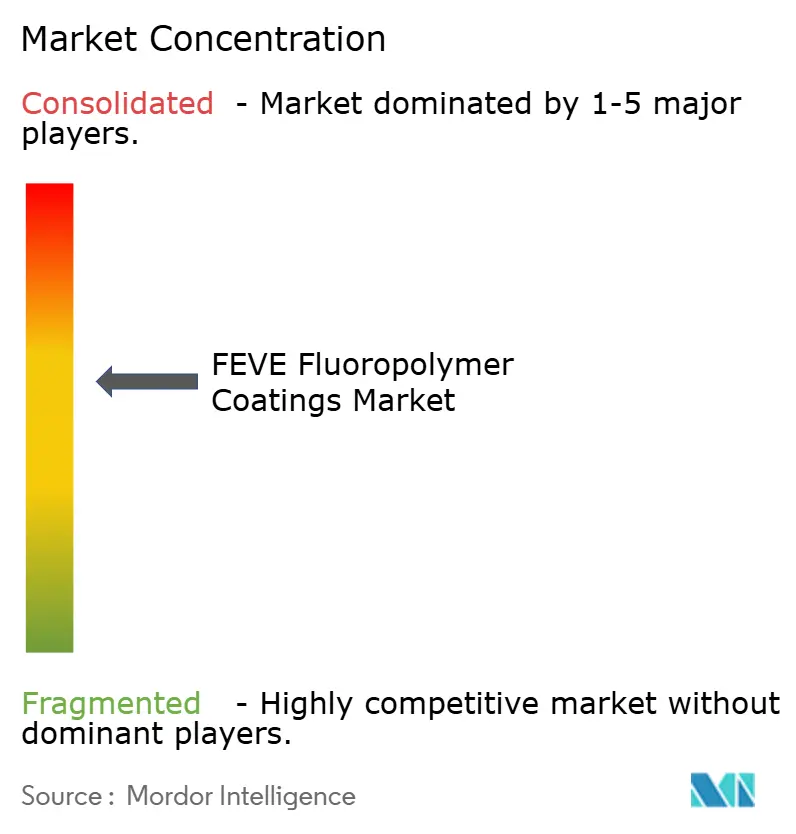
| Market Concentration | Medium |
Major Players *Disclaimer: Major Players sorted in no particular order Image © Mordor Intelligence. Reuse requires attribution under CC BY 4.0. | |
FEVE Fluoropolymer Coatings Market Analysis by Mordor Intelligence
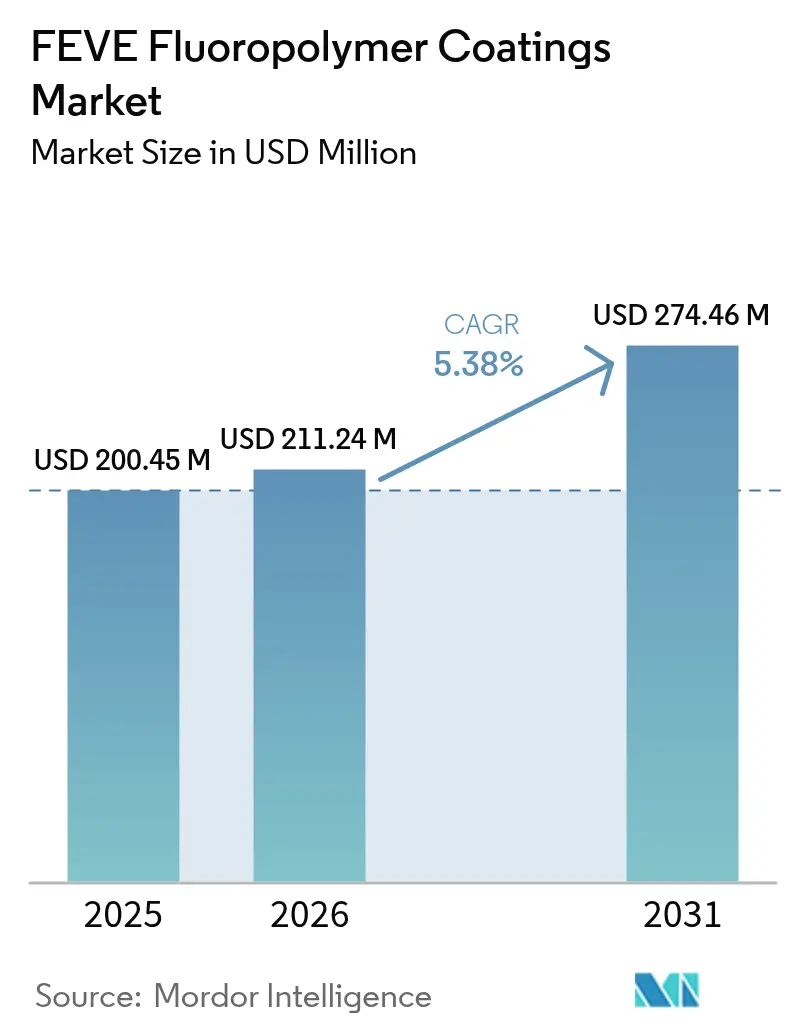
The FEVE Fluoropolymer Coatings market size is expected to grow from USD 200.45 million in 2025 to USD 211.24 million in 2026 and is forecast to reach USD 274.46 million by 2031 at 5.38% CAGR over 2026-2031. Demand rests on the resin’s ability to stretch service intervals to 30-60 years, a span that offsets its 2-4 times premium over polyurethane. Infrastructure owners are aligning with new 75-year bridge design lives, while renewable-energy manufacturers require durable powder finishes for solar and wind assets. Additionally, environmental rules favor zero-VOC chemistries. These factors mitigate the impact of headline price sensitivity and emerging polysiloxane substitutes. Moderate supplier concentration lets AGC and Daikin set resin prices, yet evolving manufacturing routes promise cost relief and lower fluorinated by-products.
Key Report Takeaways
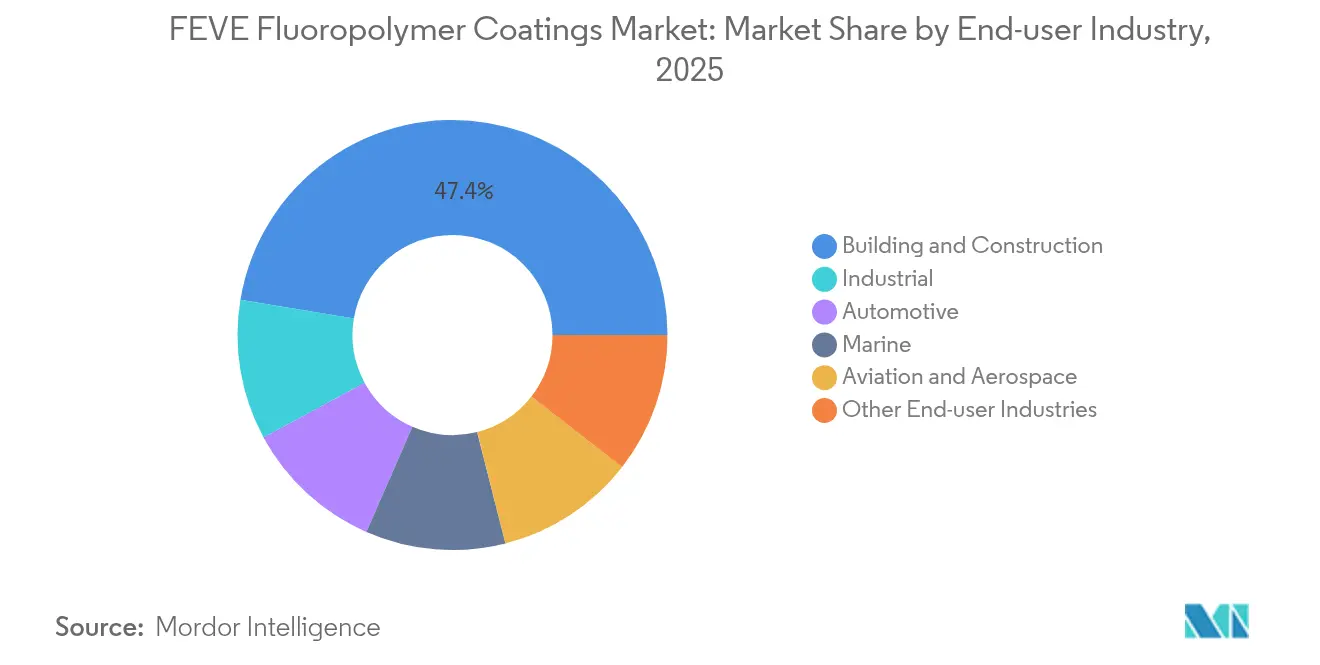
- By end-user industry, the building and construction sector accounted for the largest market share of 47.38% in 2025, and this share is expected to grow at the fastest CAGR of 6.59% during the forecast period (2026-2031).
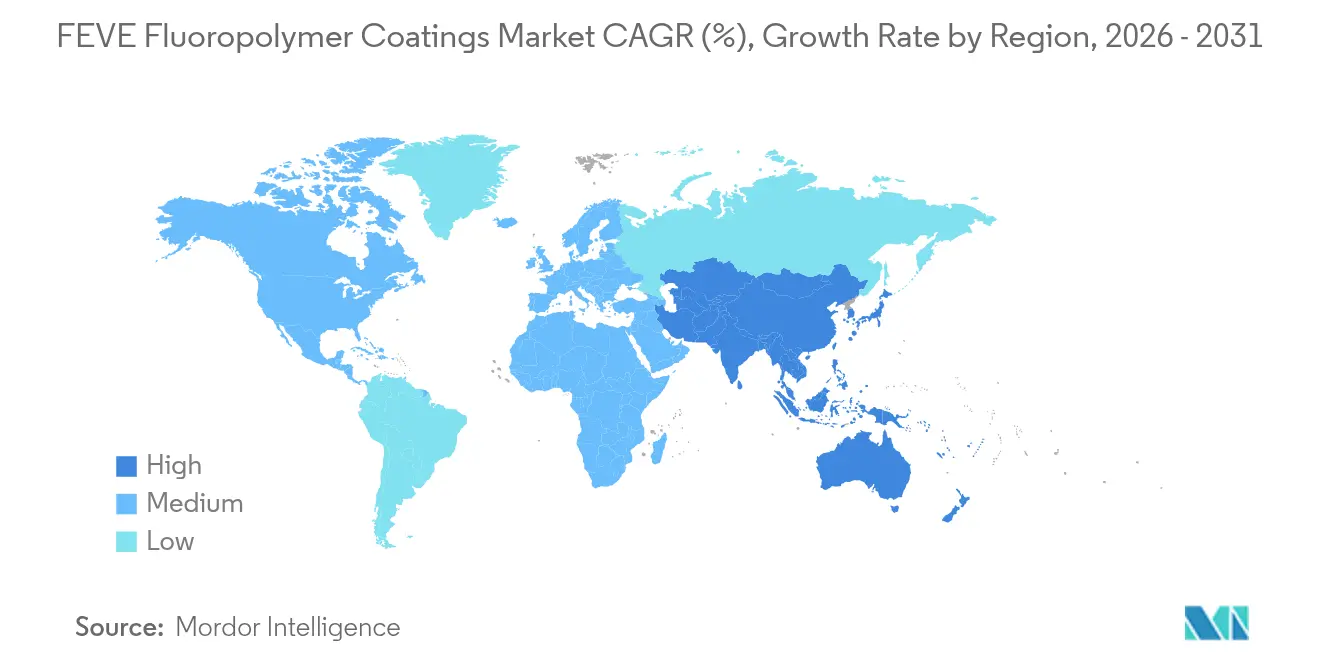
- By geography, the Asia-Pacific region held a 51.05% share in the FEVE Fluoropolymer Coatings market, and this share is expected to increase at a CAGR of 6.42% during the forecast period (2026-2031).
Note: Market size and forecast figures in this report are generated using Mordor Intelligence’s proprietary estimation framework, updated with the latest available data and insights as of 2026.
Market Trends and Insights
Drivers Impact Analysis of FEVE Fluoropolymer Coatings Market*
| Driver | (~) % Impact on CAGR Forecast | Geographic Relevance | Impact Timeline |
|---|---|---|---|
| Long-life facade demand in global construction boom | +1.8% | Global, with concentration in APAC megacities and Middle East | Medium term (2-4 years) |
| Industrial infrastructure corrosion-control programs | +1.2% | North America, Europe, coastal APAC (Japan, South Korea) | Long term (≥ 4 years) |
| Regulatory pivot to low-VOC/high-durability coatings | +1.0% | North America & EU; spillover to ASEAN via multinational specs | Short term (≤ 2 years) |
| Renewable-energy hardware (solar/wind) adoption of FEVE powders | +1.4% | Global, led by China solar capacity and offshore wind (EU, APAC) | Medium term (2-4 years) |
| Government service-life mandates for public bridges & tanks | +0.9% | United States (AASHTO), Japan (MLIT), select EU member states | Long term (≥ 4 years) |
| Source: Mordor Intelligence | |||
Long-Life Façade Demand in Global Construction Boom
Skyscraper developers select FEVE curtain-wall coatings because the annual film erosion rate stays below 0.1 µm, roughly half that of polyurethane, which limits expensive scaffold cycles. The Japan Paint Manufacturers Association values the total 30-year costs at 37% of those for chlorinated rubber systems when repainting savings are factored in. China, the Gulf states, and Southeast Asia supply the largest pipelines of high-rise projects needing American Architectural Manufacturers Association 2605 compliance. Case studies such as Ferrari World Abu Dhabi and Burj al Arab show FEVE protecting aluminum panels under UV swings exceeding 50°C[1]. Lighter cladding panels permitted by seismic codes intensify the need for low-temperature cures that FEVE powders deliver without panel distortion.
Renewable-Energy Hardware Adoption of FEVE Powders
Photovoltaic module backsheets coated with FEVE sustain more than 95% of initial power after one year of outdoor exposure, outperforming uncoated controls by 10 percentage points. Wind-turbine towers utilize single-coat FEVE powder finishes that cure at temperatures below 200 °C, recycle overspray, and resist salt-spray corrosion in offshore environments. Hybrid FEVE/polyurethane blends reinforced with graphene achieve up to 99% leading-edge erosion resistance, supporting megawatt-scale blade production targets in Europe and China. Supply chains value the resin’s zero-VOC profile as the U.S. and EU ratchet solvent regulations.
Industrial Infrastructure Corrosion-Control Programs
Oil and gas operators confirm that FEVE topcoats maintain 80% electrochemical impedance after 350 hours of combined UV and salt exposure, compared with 35% for polysiloxane. These results justify service specifications of 30-60 years for tanks and offshore platforms. North American bridge agencies, citing National Research Council Canada lifecycle models, note lower direct and social costs where long-life coatings cut traffic disruption.
Regulatory Pivot to Low-VOC/High-Durability Coatings
The US 40 CFR Part 59 caps VOC at 800 g/L for extreme-durability finishes, a ceiling FEVE powders undercut to zero. Europe’s Industrial Emissions Directive mandates substitution assessments by 2027, guiding asset owners toward durable fluoropolymer systems that eliminate the use of heavy-metal primers. Japan’s 4-star formaldehyde rating pushes growth in low-odor FEVE grades for occupied renovations[2].
Restraints Impact Analysis of FEVE Fluoropolymer Coatings Market*
| Restraint | (~) % Impact on CAGR Forecast | Geographic Relevance | Impact Timeline |
|---|---|---|---|
| Premium price versus polyurethane & acrylic systems | -1.1% | Global, most acute in price-sensitive markets (Latin America, Southeast Asia) | Short term (≤ 2 years) |
| Rising PFAS-related regulatory scrutiny in United States/European Union | -0.8% | North America & EU; indirect impact via supply-chain compliance costs globally | Medium term (2-4 years) |
| Shortage of trained applicators & specialized spray equipment | -0.5% | North America, Europe; less acute in APAC where factory coil-coating dominates | Long term (≥ 4 years) |
| Source: Mordor Intelligence | |||
Premium Price Versus Polyurethane Systems
FEVE lists at two to four times the price of polyurethane, discouraging adoption in budget-constrained regions. ChemQuest survey data show 2023 architectural volumes dipped 4.6% as remodelers delayed projects, squeezing budgets and elevating first-cost hurdles. Polysiloxane topcoats, priced at 1.5 times the cost of polyurethane, now capture mid-range demand, especially where operators calculate only five- to 15-year horizons. FEVE vendors respond with lifecycle calculators and training to spotlight 15-30% total cost savings over decades.
Rising PFAS-Related Regulatory Scrutiny
The European Chemicals Agency proposes a 50 ppm total-fluorine limit with time-bound derogations as low as 6.5 years, which will inflate testing and documentation costs. The US EPA’s new PFAS reporting rule forces manufacturers to disclose volumes dating back to 2011, exposing potential remediation liability. While no non-fluorinated topcoat currently offers equivalent 30-year gloss retention, regulatory pressure is prompting investment in hybrid chemistries and low-by-product production routes.
*Our forecasts treat driver/restraint impacts as directional, not additive. The impact forecasts reflect baseline growth, mix effects, and variable interactions.
FEVE Fluoropolymer Coatings Market Segment Analysis
By End-User Industry:
Building and Construction Maintains LeadershipBuilding and Construction commanded 47.38% of the FEVE Fluoropolymer Coatings market share in 2025, reflecting the segment’s early embrace of 30-year, single-coat façade programs. The FEVE Fluoropolymer Coatings market size for this segment is projected to expand at a 6.59% CAGR from 2026 to 2031. Curtain-wall owners credit service life extensions that defer two to three repaint cycles, cutting scaffold expenses and tenant disruption in dense urban cores. Japan’s updated bridge standards, which name FEVE as the sole approved topcoat, embed demand across public works.
Industrial equipment follows at a measured pace. Operators in oil and gas weigh FEVE’s longer intervals against polysiloxane options that cost 30-40% less. Automotive applications remain niche, covering specialty vehicles and aluminum trim that require UV and chip resistance. Marine and aviation buyers pursue FEVE for antifouling and wire-bundle protection where acceptable alternatives are scarce. Growing retrofit markets in Asia and North America lean on low-odor, waterborne FEVE grades to avoid occupant evacuation. Powder variants win share in factory-coated roof panels and aluminum extrusions because they cure below 200 °C and recycle overspray. Hybrid FEVE-ceramic blends emerge in bridge arch ribs needing color stability and barrier strength. Demand remains price-sensitive in Latin American municipal projects, yet lifecycle calculators reveal 15-30% cost savings that gradually shift procurement criteria.

Geography Analysis
APAC FEVE Fluoropolymer Coatings Market
The Asia-Pacific governs the FEVE Fluoropolymer Coatings market with a 51.05% share in 2025 and a forecasted 6.42% CAGR, driven by Chinese urbanization, Japanese bridge standards, and South Korean offshore fabrication. Chinese coil coaters offer waterborne grades that meet HG/T 4104-2019 to bypass VOC penalties while preserving a 30-year gloss. Japan’s Ministry of Land, Infrastructure, Transport, and Tourism restricts topcoats on public bridges to FEVE, securing premium prices. South Korean yards specify long-life finishes for LNG carrier topsides, reducing dry-dock frequency.
North America FEVE Fluoropolymer Coatings Market
North America accounts for approximately 24.85% of the market. AASHTO’s 75-year bridge design life shifts new construction and rehabilitation to FEVE, illustrated by the I-74 Mississippi River Bridge, where Sherwin-Williams Fluorokem shields 3,400 ft of steel. The EPA’s aerosol rule tightens VOC controls yet raises compliance efforts through PFAS reporting. Canadian lifecycle studies promote low-VOC solutions that reduce social costs, such as traffic congestion. Mexico sees a selective uptake in refinery and specialty vehicle projects, where long service life offsets capital expenditures.
Europe FEVE Fluoropolymer Coatings Market
Europe accounts for 17.80% of the value but faces the steepest regulatory tests. The proposed 50 ppm total-fluorine cap will complicate supply chains. Germany and the Nordics lean on FEVE powder grades for offshore wind towers under QUALICOAT Class 3 standards. Southern Europe’s public budgets lag, though airport and retail façades still specify FEVE. Russia’s Arctic pipeline opportunities remain limited amid trade sanctions.
Regulatory Landscape
Regulation affecting FEVE fluoropolymer coatings is tightening around two axes: VOC emissions and PFAS oversight. In the United States, VOC compliance continues to steer specifications toward powder and other low-emission systems, while EPA implementation steps under TSCA are adding reporting and recordkeeping load for PFAS-containing chemistries. The EPA finalized an update (effective April 13, 2026) that sets the TSCA PFAS Reporting Rule submission window to begin no later than January 31, 2027, raising the compliance bar for manufacturers and importers across the FEVE value chain.
In Europe, the proposed REACH restriction on PFAS explicitly captures polymeric PFAS in scope and is moving through formal scientific review. ECHA's Risk Assessment Committee adopted its final opinion in March 2026, and the restriction pathway is shaping procurement for long-life architectural and infrastructure coatings through testing, documentation, and the use of time-bound derogations tied to site-specific emission management plans for certain fluoropolymer applications.
Value Chain Analysis
The FEVE fluoropolymer coatings value chain begins with fluorinated and vinyl ether building blocks, moves through resin polymerization, and then into formulation (liquid, waterborne, and powder systems). It is followed by application on metal (coil, extrusion, panels) and field-applied protective coatings, with asset-owner maintenance cycles monetizing long service life. Upstream resin supply is relatively concentrated, with AGC and Daikin positioned as key base-resin providers and technology licensors, while downstream formulators (for example, PPG, Sherwin-Williams, Akzo Nobel, Axalta, Kansai Paint, and Tnemec) compete on application engineering, warranties, and spec-writing support rather than polymer design.
Manufacturing and finishing capacity clusters shape lead times and economics: resin synthesis and coating production are concentrated in Asia (notably Japan, China, and South Korea), and significant formulation and compounding activity in Chinese industrial provinces supports architectural aluminum and coil-coating ecosystems. Bottlenecks center on access to high-purity fluorochemical feedstocks and the availability of qualified applicators and approved lines, especially electrostatic powder lines and certified architectural applicator networks. These networks function as both distribution channels and performance-assurance gates for premium specifications such as AAMA 2605.
Competitive Landscape
The FEVE Fluoropolymer Coatings market is moderately concentrated. AGC and Daikin supply most base resins, licensing technology to global formulators including PPG, Sherwin-Williams, Axalta, Akzo Nobel, Kansai Paint, and Tnemec. AGC’s 2024 surfactant-free emulsion route aims for commercialization by 2030 and may reduce upstream fluorinated by-products and feedstock costs. Formulators differentiate through application engineering rather than polymer design. Powder lines now deliver single-coat coverage, waterborne systems extend pot life, and hybrid blends marry FEVE’s weatherability with polysiloxane’s lower cost. Chinese newcomers, such as Futant Uliao, offer certified waterborne options for domestic high-rise projects, although AAMA 2605 accreditation and brand recognition limit their export share.
FEVE Fluoropolymer Coatings Industry Leaders
-
PPG Industries, Inc.
-
Akzo Nobel N.V.
-
The Sherwin-Williams Company
-
AGC Inc.
-
DAIKIN INDUSTRIES, Ltd.
- *Disclaimer: Major Players sorted in no particular order
FEVE Fluoropolymer Coatings Market Companies Covered in this Report
- A&I Coatings
- AGC Inc.
- Akzo Nobel N.V.
- Axalta Coating Systems Ltd.
- DAIKIN INDUSTRIES, Ltd.
- IFS Coatings
- Innocoat Systems
- Kansai Paint Co., Ltd.
- KCC CORPORATION
- PPG Industries Inc.
- The Sherwin-Williams Company
- Tnemec
Market Opportunities and Future Outlook
Standardization and proof of durability are expanding whitespace for FEVE in premium protective and architectural specifications. ISO/TR 20470-1:2026 (published March 2026) provides a common framework for weathering performance data for FEVE type fluoropolymer topcoats within associated protective coating systems, which supports 30-year durability claims and long-term warranties for infrastructure and façade programs where owners are actively extending maintenance intervals.
VOC enforcement and decarbonization programs are also driving formulation shifts that open product and process opportunities, particularly where factory coating dominates in Asia-Pacific. China is pushing conversions toward lower-emission chemistries under VOC standards such as GB 30981 and broader dual-carbon policy targets, reinforcing demand for waterborne and powder FEVE systems in aluminum extrusion, curtain wall, and metal building product supply chains. Alongside this, technical development in UV-curable and other advanced FEVE resin routes (reported in 2026 technical literature) supports pathways for faster cure and reduced solvent reliance in refurbishment and industrial corrosion-control uses where field downtime and solvent controls affect total installed cost.
Recent Industry Developments in FEVE Fluoropolymer Coatings Market
- July 2026: PPG Industries announced a major FEVE coatings capacity expansion in North America, enabling higher-volume production for architectural and industrial protective applications. The expansion is designed to support higher-volume fulfillment for premium coatings programs in infrastructure and facade markets.
- May 2025: Elevate introduced Mountain Black across its metal roofing, edge metal, and wall panel portfolios using FEVE resin-based coating technology. The product broadened FEVE visibility in prefinished metal building products, supporting higher-end color and weathering performance positioning in architectural envelopes.
- April 2024: Mitsubishi Chemical Americas ALPOLIC Division expanded FEVE finishes across its metal composite materials line, aligning with a collaboration with Sherwin-Williams Coil Coatings to extend service life of facade finishes. The expansion indicates continued integration of FEVE into facade assemblies for high-end building envelopes.
FEVE Fluoropolymer Coatings Market Report Scope and Research Methodology
Market Definition and Coverage
This market covers revenue generated from FEVE (fluoroethylene vinyl ether) fluoropolymer based coating products sold for protective and decorative use across major end markets, sized on a value basis in USD at a global level.
Scope exclusions: We exclude non-FEVE fluoropolymer coatings (such as PVDF and PTFE based coatings), along with upstream FEVE resin sales that are not sold as coating products.
Segments Covered in This Report
- By End-user Industry
- Industrial
- Building & Construction
- Automotive
- Marine
- Aviation & Aerospace
- Other End-user Industries
- By Geography
- Asia-Pacific
- China
- India
- Japan
- South Korea
- ASEAN Countries
- Rest of APAC
- North America
- United States
- Canada
- Mexico
- Europe
- Germany
- United Kingdom
- France
- Italy
- Spain
- Russia
- NORDIC Countries
- Rest of Europe
- South America
- Brazil
- Argentina
- Colombia
- Rest of South America
- Middle-East and Africa
- Saudi Arabia
- South Africa
- Rest of Middle-East and Africa
- Asia-Pacific
Data Sources, Market Sizing, and Validation
Desk Research
Desk work started by building a consistent fact base on where FEVE coatings are specified and how demand typically tracks construction and industrial activity. We referred to public sources such as USGS materials statistics, US Census Bureau construction spending series, Eurostat production and construction indicators, UN Comtrade trade flows for relevant chemical and coating categories, and EPA and ECHA regulatory updates that can influence formulation choices.
We also reviewed annual reports, investor presentations, product technical datasheets, and reputable industry press to understand repaint cycles, service life expectations, and where FEVE is chosen versus adjacent durable coatings. For cross-checking company presence and technical direction, we used paid subscriptions focused on company financials and intelligence and patent databases to track formulation activity over time. These desk sources are illustrative and not exhaustive, and other public references were used to collect, validate, and clarify the final assumptions.
Primary Interviews and Surveys
Primary work was used to pressure-test desk assumptions on where FEVE is preferred, what drives acceptance in building facades and long life infrastructure, and how pricing typically shifts between solvent based and water based offers. We spoke with a mix of coating formulators, raw material participants, applicators, and downstream specifiers across APAC, EMEA, and the Americas, so adoption patterns and replacement behavior could be checked across climates, codes, and project types.
Distribution of primary research fieldwork respondents
| Company type | Respondent position | Region |
|---|---|---|
| Top tier: 26% | CXOs: 12% | APAC: 47% |
| Mid tier: 57% | Functional/Unit leaders: 29% | EMEA: 30% |
| Smaller Players: 17% | Managers: 59% | Americas: 23% |
Market-Sizing & Forecasting
Sizing was built using top-down logic where construction output and industrial activity indicators help reconstruct the addressable demand pool for long durability coatings, which is then filtered by the typical share of projects and assets that specify FEVE systems. To keep totals realistic, we corroborated results with selective bottom-up approximations. This included sampled price per kilogram assumptions multiplied by indicative volumes in key applications, followed by channel checks to confirm the implied mix.
Inputs used in the model included (illustratively) construction output and refurbishment intensity, repaint intervals for exterior long life coatings, solvent based versus water based mix movement linked to VOC policy direction, project starts and industrial capex signals by region, and typical FEVE price premium versus polyurethane for durability driven uses. Where direct volume signals were weak, gaps were handled by applying conservative adoption bands validated in interviews, and then the implied consumption levels were reviewed for outliers.
For forecasting, scenario analysis was used around construction cycles and specification uptake, and the scenarios were aligned to what industry participants expect for adoption in architectural and industrial protective uses. The final forecast path was kept smooth unless a leading indicator supported a step-change, which helps clients trace each movement back to a practical driver.
Data Validation & Update Cycle
Outputs were validated through triangulation across multiple signals so the final market number stays consistent with macro demand conditions and procurement feedback. Variance checks were run by region and by end-use exposure, and anomalies were escalated for a second analyst review before sign-off.
When interview feedback showed disagreement on an input like repaint interval or pricing progression, respondents were re-contacted and assumptions were tightened until the implied demand looked explainable. Reports are refreshed annually, with interim updates when a material event changes supply availability, regulation, or demand outlook. Before delivery, an analyst performs a fresh pass so clients receive the latest updated view matched to the most recent public indicators.
Mordor Intelligence's Feve Fluoropolymer Coatings Market Size Compared With Other Published Estimates
Published market sizes for FEVE fluoropolymer coatings can differ widely, even when they appear to cover the same topic, because chemistry coverage, counted sales level, and year conventions are often not consistent. Differences also come from how firms treat pricing and mix shifts, especially when premium coatings are projected to gain share.
The main gap comes from whether non-FEVE fluoropolymer coatings and upstream FEVE resin revenues are included in the total. Mordor Intelligence counts only FEVE coating product sales to end-use applications, then cross-checks the implied pricing bands and adoption rates through interviews and regional demand signals.
Benchmark comparison
| Source | Market Size | Gaps in Research Methodology |
|---|---|---|
| Mordor Intelligence | USD 211.24 M (2026) | |
| Trade Publisher A | USD 456.00 M (2024) | Uses a broader product bucket that appears to include more than FEVE coatings, and it may also mix in resin or adjacent fluoropolymer coating revenues, which lifts the total versus a coatings-only scope. |
| Industry Research Group B | USD 600.00 M (2024) | Likely applies a wider inclusion set and a more aggressive price and adoption pathway, with limited transparency on how regional volumes and coating type splits were validated against project demand indicators. |
The spread in the table is mainly explained by what is counted inside FEVE coatings versus nearby categories, and by how pricing and mix are carried across years. By tying the steps to observable construction and industrial indicators and then rechecking assumptions with practitioners, the final number stays easier to replicate and audit when users update scenarios.
Key Questions Answered in the Report
What is the projected value of the FEVE Fluoropolymer Coatings market in 2031?
The market is forecast to reach USD 274.46 million by 2031, growing at a 5.38% CAGR.
Which end-user segment leads current demand for FEVE coatings?
Building and Construction dominates with 47.38% market share in 2025 and the fastest 6.59% CAGR through 2031.
Why are FEVE powders gaining traction in renewable energy?
They cure below 200°C, carry zero VOC, and extend solar panel and wind tower lifetimes beyond 25 years.
How does upcoming PFAS regulation affect FEVE suppliers?
Proposed 50 ppm total-fluorine limits in the EU and new US reporting rules will raise testing and traceability costs.
Which region shows the fastest growth?
Asia-Pacific combines a 51.05% share with a 6.42% CAGR, supported by infrastructure spending and long-life bridge standards.