
Feed Additive Nosiheptide Premix Market Size and Share
Market Overview
| Study Period | 2021 - 2031 |
|---|---|
| Market Size (2026) | USD 1.42 Billion |
| Market Size (2031) | USD 1.93 Billion |
| Growth Rate (2026 - 2031) | 6.33 % |
| Fastest Growing Market | Asia-Pacific |
| Largest Market | North America |
| Market Concentration | Medium |
Major Players *Disclaimer: Major Players sorted in no particular order Image © Mordor Intelligence. Reuse requires attribution under CC BY 4.0. | |
Feed Additive Nosiheptide Premix Market Analysis by Mordor Intelligence
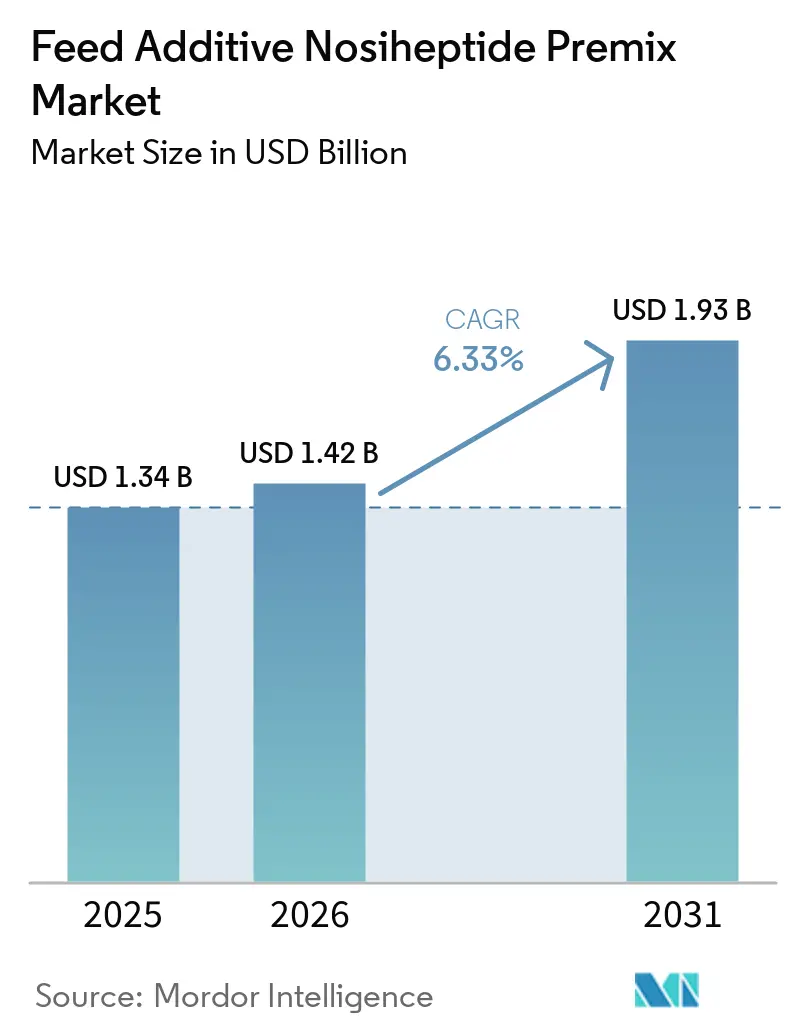
The feed additive nosiheptide premix market size is projected to grow from USD 1.34 billion in 2025 to USD 1.42 billion in 2026, reaching USD 1.93 billion by 2031, with a CAGR of 6.33% over 2026-2031. Regulatory measures issued by the United States Food and Drug Administration that restrict the prophylactic use of medically important antibiotics are driving the adoption of narrow-spectrum thiopeptides. These thiopeptides help maintain gut microbiome diversity while managing Gram-positive pathogens. In the Asia-Pacific region, integrators are enhancing export-compliant production systems to meet Middle Eastern and African poultry demand, utilizing nosiheptide to comply with residue-testing standards. Bio-fermentation platforms are reducing production costs and aligning with sustainability requirements preferred by European retailers. Additionally, venture capital investments highlight growing investor confidence in advanced feed-health solutions.
Key Report Takeaways
- By livestock, poultry accounted for the largest 54% of the feed additive nosiheptide premix market share in 2025, and the feed additive nosiheptide premix market size for poultry is projected to grow at the fastest 7.8% CAGR from 2026 to 2031.
- By formulation, conventional premixes held the largest 67% of the feed additive nosiheptide premix market share in 2025, whereas the organic/non-GMO premix market size is projected to grow at the fastest 9.4% CAGR from 2026 to 2031.
- By source, synthetic nosiheptide accounted for the largest 72% of the feed additive nosiheptide premix market size in 2025, while bio-fermented nosiheptide is projected to grow at the fastest 10.1% CAGR from 2026 to 2031.
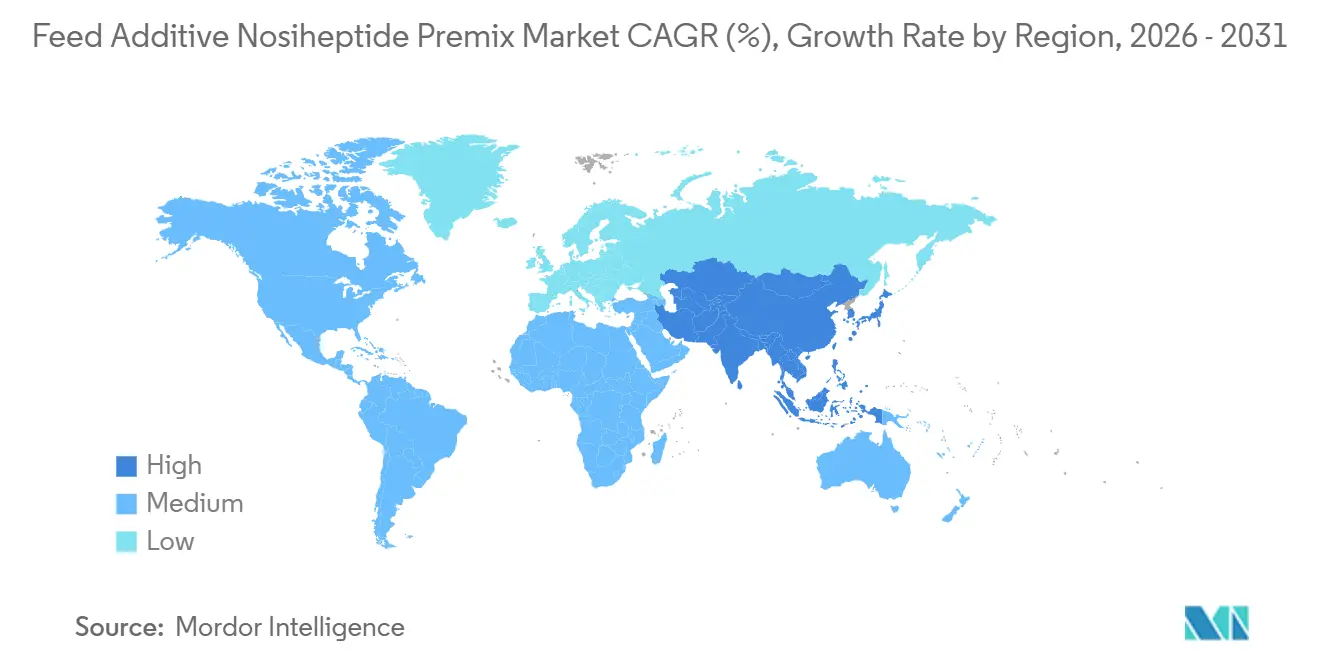
- By geography, North America accounted for the largest 36% of the feed additive nosiheptide premix market share in 2025, whereas the Asia-Pacific market is projected to grow at the fastest 7.9% CAGR from 2026 to 2031.
Note: Market size and forecast figures in this report are generated using Mordor Intelligence’s proprietary estimation framework, updated with the latest available data and insights as of January 2026.
Market Trends and Insights
Drivers Impact Analysis of Feed Additive Nosiheptide Premix Market*
| Driver | (~) % Impact on CAGR Forecast | Geographic Relevance | Impact Timeline |
|---|---|---|---|
| Regulatory push for antibiotic replacement | +1.2% | Global | Medium term (2-4 years) |
| Growth of poultry meat exports from Asia-Pacific | +0.9% | Asia-Pacific core, spill-over to Middle East | Medium term (2-4 years) |
| Emergence of antibiotic-free labeling premiums | +0.8% | North America and Europe | Short term (≤ 2 years) |
| Scale-up of precision-fermentation manufacturing | +0.7% | Global, concentrated in China and North America | Medium term (2-4 years) |
| Integration of premix dosing automation at feed mills | +0.5% | Global, early gains in Asia-Pacific and North America | Short term (≤ 2 years) |
| Rising venture funding for narrow-spectrum antimicrobials | +0.4% | Global, concentrated in North America and Europe | Medium term (2-4 years) |
| Source: Mordor Intelligence | |||
Regulatory Push for Antibiotic Replacement
Stringent antimicrobial stewardship regulations in the United States are driving the adoption of alternatives such as nosiheptide premixes in animal feed. In 2024, the United States Food and Drug Administration (FDA) strengthened its antimicrobial resistance strategy through Guidance for Industry (GFI) 263 and related stewardship initiatives. These measures mandate that medically important antimicrobial drugs for animals remain under veterinary oversight and promote their judicious use in livestock production [1]Source: United States Food and Drug Administration, “List of Approved New Animal Drug Applications Affected by GFI 263,” FDA.gov.. As a result, feed manufacturers and producers are increasingly turning to non-medically important alternatives, such as nosiheptide, to sustain feed efficiency and productivity while complying with evolving antimicrobial resistance policies.
Growth of Poultry Meat Exports from Asia-Pacific
Increasing poultry meat exports from Asia are driving demand for specialized feed additives, including nosiheptide premixes. According to the Rabobank Global Poultry Quarterly (2025), global processed chicken trade reached approximately 400,000 metric tons in Q4 2024, marking a 15% year-on-year growth [2]Source: Rabobank, “Rabobank Global Poultry Quarterly Report (Q2 2025),” rabobankna.com. This growth was supported by significant export contributions from Asian producers such as Thailand and China. The expansion in exports is prompting producers to adopt feed solutions that comply with strict residue and traceability standards, leading to greater use of nosiheptide to ensure compliance while maintaining productivity and efficiency.
Emergence of Antibiotic-Free Labeling Premiums
According to researchers from the University of Waikato and City University of Hong Kong in 2026, over 60% of consumers are willing to pay a premium for antibiotic-free meat products, highlighting strong demand for such labeling. This growing consumer preference is encouraging poultry producers and retailers to expand antibiotic-free offerings and reformulate feed strategies. As a result, producers are increasingly adopting non-medically important feed additives such as nosiheptide, which help maintain feed efficiency and growth performance while complying with antibiotic-free standards, thereby supporting premium product positioning.
Scale-Up of Precision-Fermentation Manufacturing
Advancements in precision fermentation technologies are facilitating more efficient and sustainable production of feed additives, including nosiheptide. Enhanced bioprocessing methods, such as in-situ product recovery and strain optimization, are improving yield consistency while minimizing reliance on solvent-intensive chemical synthesis. With increasing regulatory emphasis on environmental compliance, feed manufacturers are progressively adopting bio-based production methods. Fermentation platforms initially developed for antibiotics such as virginiamycin are being repurposed for thiopeptides, demonstrating scalability potential. This shift promotes cost efficiency, reduces carbon footprints, and aligns with sustainability objectives, driving the adoption of bio-fermented nosiheptide in commercial feed applications.
Restraints Impact Analysis of Feed Additive Nosiheptide Premix Market*
| Restraint | (~) % Impact on CAGR Forecast | Geographic Relevance | Impact Timeline |
|---|---|---|---|
| Stringent residue-testing regimes in the European Union | -0.6% | Europe, with compliance spill-over to export-oriented Asia-Pacific producers | Short term (≤ 2 years) |
| Volatility of nosiheptide API supply from China | -0.5% | Global, most acute in North America and Europe | Short term (≤ 2 years) |
| Slower adoption in ruminant rations | -0.4% | Global, centered in North America, Europe, and South America | Medium term (2-4 years) |
| Price competition from bacitracin and tylosin premixes | -0.7% | Global, especially cost-sensitive Asia-Pacific and South America markets | Short term (≤ 2 years) |
| Source: Mordor Intelligence | |||
Stringent Residue-Testing Regimes in the European Union
Stringent residue-testing regulations in the European Union are driving up compliance costs for feed additive manufacturers. Commission Regulation (EU) 2024/1229 sets maximum cross-contamination limits for 24 antimicrobial substances in non-target feed [3]Source: European Commission, “Commission Delegated Regulation (EU) 2024/1229 Establishing Maximum Levels for Cross-Contamination of Antimicrobial Substances in Feed,” eur-lex.europa.eu. This regulation requires the use of highly sensitive analytical methods for detection. The strict thresholds necessitate advanced technologies, such as high-resolution chromatography, which increase testing complexity and operational expenses. Smaller premix manufacturers, particularly those lacking dedicated production lines or accredited laboratories, face significant challenges in meeting these requirements. This situation limits their market participation and benefits larger, vertically integrated companies with established quality-control systems.
Volatility of Nosiheptide API Supply from China
The supply of nosiheptide active pharmaceutical ingredient (API) from China continues to be volatile due to regulatory and operational challenges in key production areas. Strict environmental inspections and emission-control policies often result in temporary shutdowns or reduced operating capacities at fermentation-based manufacturing facilities. As nosiheptide production relies on these bioprocesses, such disruptions directly affect output stability. For example, periodic enforcement of air-quality regulations in major industrial provinces has led to halted or delayed fermentation cycles, thereby constraining supply availability. This situation contributes to procurement uncertainties, price variability, and supply chain risks for global feed additive manufacturers reliant on Chinese sources.
*Our forecasts treat driver/restraint impacts as directional, not additive. The impact forecasts reflect baseline growth, mix effects, and variable interactions.
Feed Additive Nosiheptide Premix Market Segment Analysis
By Livestock:
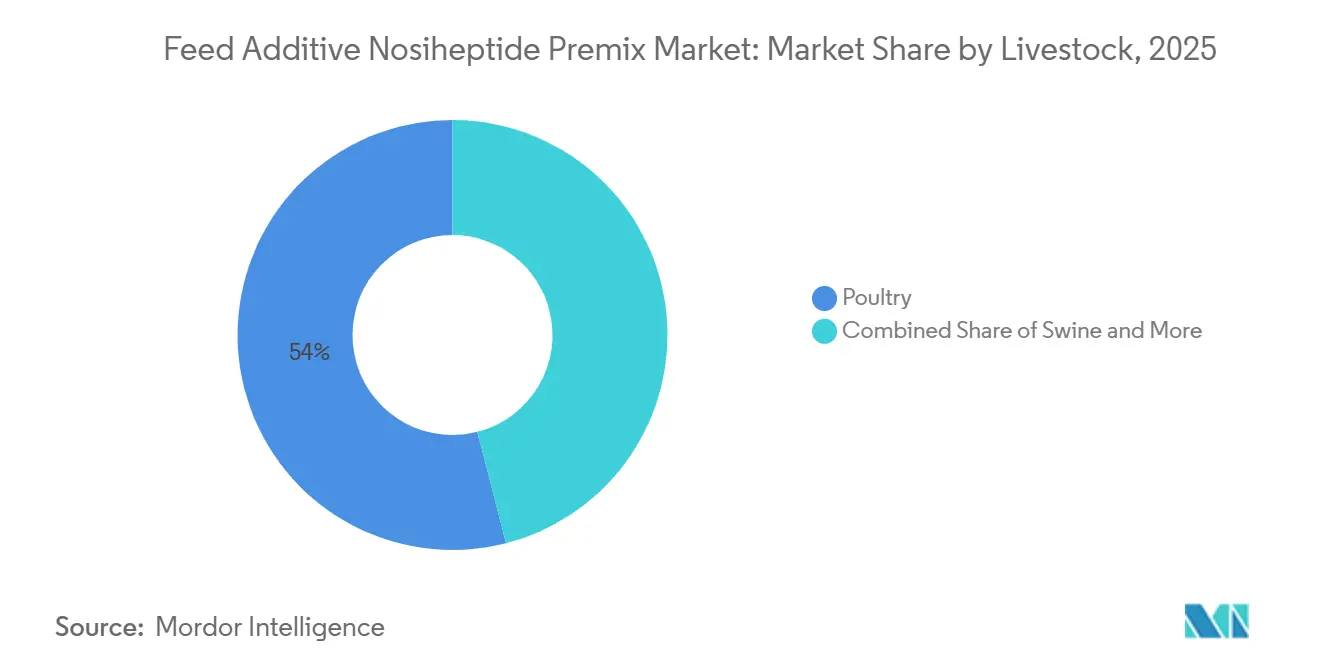
Poultry Dominance Anchored by Export GrowthPoultry accounted for the largest 54% share of the feed additive nosiheptide premix market in 2025. This dominance was driven by intensive broiler production systems and strong export-oriented demand. Short production cycles enable quicker adjustments to feed formulations, leading to greater additive utilization in commercial operations. Export markets demand low-residue feed solutions to comply with stringent import standards, further solidifying poultry's leading position. Swine represents a secondary segment, supported by gut health management needs, while aquaculture adoption is gradually increasing due to stricter biosecurity and disease-prevention measures.
The poultry segment market size is projected to grow at the fastest CAGR of 7.8% from 2026 to 2031. This growth is attributed to increasing global poultry consumption and the expansion of intensive farming systems. The growing preference for antibiotic-free meat production is driving the adoption of non-medically important feed additives that ensure performance and feed efficiency. Poultry producers benefit from shorter production cycles, enabling faster integration of new feed technologies. This adaptability, combined with strong export demand and regulatory compliance, positions poultry as the fastest-growing segment in the market.



By Formulation Type:
Organic Premixes Capture Niche GrowthConventional premixes are projected to account for the largest 67% of the feed additive nosiheptide premix market share in 2025, driven by their cost efficiency and scalability in large-scale feed manufacturing systems. These premixes ensure consistent dosing and compatibility with standardized feed processes, making them well-suited for high-volume production. Feed mills in the Asia-Pacific region predominantly use conventional formulations to enhance operational efficiency and minimize costs. In contrast, organic and non-GMO premixes remain limited due to higher production complexities and the need for segregated processing systems, which pose operational challenges for manufacturers.
The organic/non-GMO premix segment is projected to grow at the fastest CAGR of 9.4% from 2026 to 2031, driven by rising demand for clean-label, antibiotic-free livestock production systems. Retailers and food producers are increasingly focusing on traceability and certification, driving the adoption of specialized feed formulations. Producers are investing in segregated production lines and compliance measures to meet certification requirements. Despite higher production costs, premium pricing opportunities, and shifting consumer preferences, the growth of organic and non-GMO premixes is projected in both developed and emerging livestock markets.
By Source:
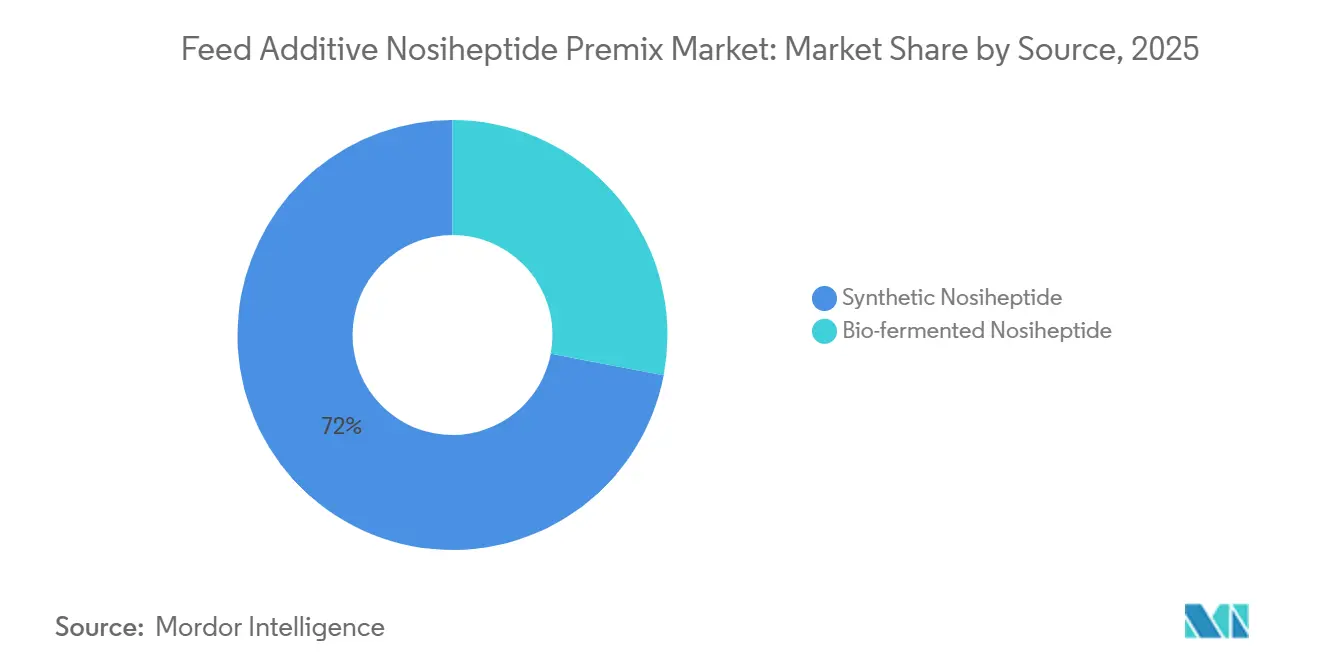
Bio-Fermentation Gains on Sustainability NarrativeSynthetic nosiheptide accounted for the largest 72% of the feed additive nosiheptide premix market share in 2025, driven by established production infrastructure and cost advantages. Large-scale chemical manufacturing ensures consistent output and reliable supply, making synthetic variants the preferred choice for commercial feed operations. Existing supply chains and technical expertise further reinforce their dominance, particularly in regions with high-volume feed production. These factors continue to make synthetic sources the preferred option for manufacturers seeking cost-effective and scalable solutions.
Bio-fermented nosiheptide is projected to grow at the fastest CAGR of 10.1% from 2026 to 2031, supported by an increasing focus on sustainability and environmentally compliant production methods. Advances in fermentation technology are enhancing production efficiency and minimizing environmental impact. Feed manufacturers are gradually adopting bio-based alternatives to meet regulatory requirements and carbon reduction targets. The growing emphasis on sustainable sourcing and cleaner production processes is projected to drive the adoption of bio-fermented nosiheptide, particularly among producers catering to premium and environmentally conscious market segments.
Geography Analysis
North America Feed Additive Nosiheptide Premix Market
North America is accounted for the largest 36% of the feed additive nosiheptide premix market share in 2025. This dominance is attributed to strict regulatory frameworks and the widespread adoption of antibiotic-free livestock production systems. The United States Food and Drug Administration mandates veterinary oversight for medically important antimicrobials, driving the transition toward non-medically important alternatives. Additionally, vertically integrated poultry producers in the region leverage advanced feed management systems and quickly adopt new formulations, thereby ensuring steady demand for specialized feed additives such as nosiheptide in commercial livestock production.
APAC Feed Additive Nosiheptide Premix Market
The Asia-Pacific region is projected to register the fastest CAGR of 7.9% from 2026 to 2031, driven by the growth of livestock production and export-oriented supply chains. Rising meat consumption and the intensification of farming systems are promoting the adoption of performance-enhancing feed additives. Regional producers are investing in feed manufacturing infrastructure and modern production practices to serve both domestic and international markets. Countries like China, Thailand, and Vietnam are enhancing their roles in global poultry exports, which is driving the demand for specialized additives that comply with stringent residue and quality standards.
Europe Feed Additive Nosiheptide Premix Market
Europe represents a mature but value-driven market, supported by stringent regulatory frameworks and increasing demand for certified livestock production systems. Strict policies on antimicrobial usage and residue compliance are encouraging producers to shift toward non-medically important feed additives. Livestock producers are adopting advanced traceability systems and certified feed inputs to meet regulatory and retailer requirements. This transition increases operational complexity and production costs, particularly for smaller manufacturers. At the same time, strong demand for antibiotic-free and organic animal products supports premium pricing, enabling suppliers to offset compliance costs while maintaining profitability across the region.

Competitive Landscape
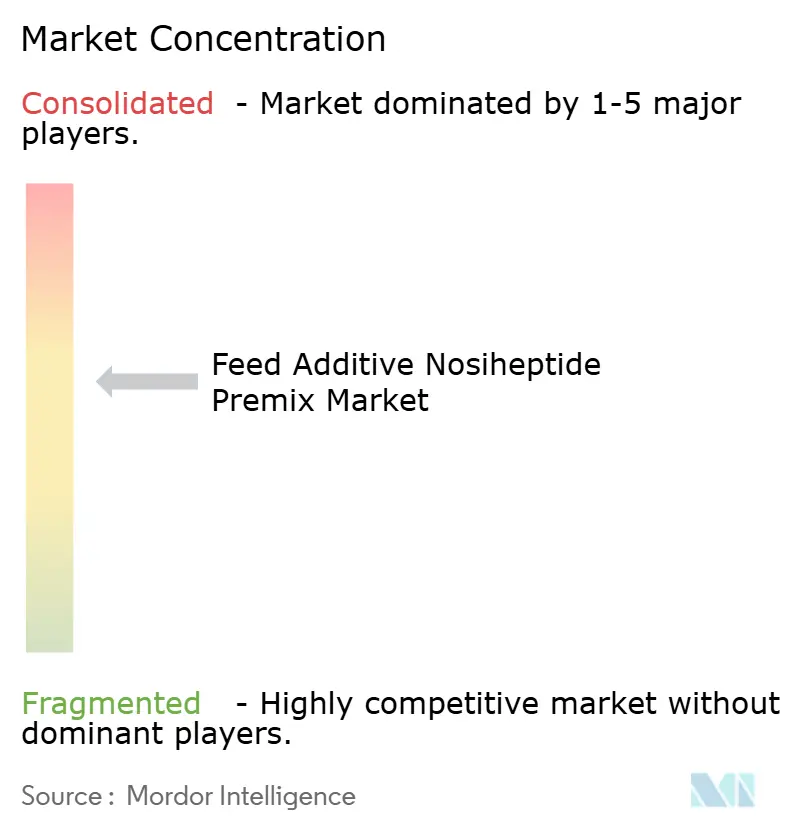
The feed additive nosiheptide premix market is moderately fragmented, with significant shares by Chinese top companies such as Guangdong Haid Group Co., Ltd., Tianjin Ringpu Bio-Pharmacy Co., Ltd., Zhejiang Shenghua Biok Biology Co., Ltd., Shandong Sinder Technology Co., Ltd., and Anyou Biotechnology Group Co., Ltd. Major feed integrators are enhancing their market position through vertical integration and the expansion of production facilities. Companies are increasingly focusing on capacity expansion and establishing international manufacturing bases to strengthen supply chains and reduce reliance on single-region sourcing. This strategic approach aims to mitigate risks related to regulatory disruptions and supply chain volatility, particularly in fermentation-based production systems.
Competition in the market is increasingly influenced by technological advancements and product quality rather than solely by pricing. Companies are allocating resources to advanced fermentation techniques, quality control systems, and traceability solutions to address changing regulatory standards and customer expectations. Organizations like Zhejiang Esigma Animal Health Co., Ltd. and Shandong Sinder Technology Co., Ltd. are emphasizing innovation in animal health and integrated feed solutions. The capability to provide customized formulations and products that meet regulatory compliance is emerging as a critical competitive advantage, as livestock producers focus on performance, safety, and adherence to regulations when selecting feed additives.
In 2026, Guangdong Haid Group Co., Ltd. expanded its presence in the feed additive value chain by establishing a new production and R&D facility in Singapore. This facility aims to support livestock and aquaculture nutrition across Southeast Asia. It emphasizes technology transfer, full traceability systems, and the development of advanced feed formulations that comply with international quality standards. This initiative underscores the investments by key players in regional manufacturing and innovation to improve product consistency, enhance supply reliability, and meet the rising demand for specialized feed additives.
Feed Additive Nosiheptide Premix Industry Leaders
Guangdong Haid Group Co., Ltd.
Tianjin Ringpu Bio-Pharmacy Co., Ltd.
Zhejiang Shenghua Biok Biology Co., Ltd.
Shandong Sinder Technology Co., Ltd.
Anyou Biotechnology Group Co., Ltd.
- *Disclaimer: Major Players sorted in no particular order
Feed Additive Nosiheptide Premix Market Companies Covered in this Report
- Zhejiang Shenghua Biok Biology Co., Ltd.
- Tianjin Ringpu Bio-Pharmacy Co., Ltd.
- Anyou Biotechnology Group Co., Ltd.
- Guangdong Haid Group Co., Ltd.
- Shandong Shengli Bioengineering Co., Ltd.
- Zhejiang Esigma Animal Health Co., Ltd.
- Shandong Sinder Technology Co., Ltd.
- Hainan Zhongxin Chemical Co., Ltd.
- Anyou Biotechnology Group Co., Ltd.
- Fengchen Group Co., Ltd.
- Anhui Wanbei Pharmaceutical Co., Ltd.
- Zhejiang University Sunny Nutrition Technology Co., Ltd.
- Chattha Group

Recent Industry Developments in Feed Additive Nosiheptide Premix Market
- April 2026: Guangdong Haid Group Co., Ltd. expanded its feed additive and premix value chain by initiating new feed production projects in Vietnam and Laos, thereby enhancing its presence in Southeast Asia's livestock and aquaculture markets.
- January 2026: Guangdong Haid Group Co., Ltd. enhanced its feed and additive capabilities by establishing a new production and R&D facility in Singapore. The facility focuses on livestock and aquaculture nutrition as well as advanced feed formulations.


Global Feed Additive Nosiheptide Premix Market Report Scope
Nosiheptide premix is a feed additive blend containing nosiheptide, an antimicrobial agent used to enhance growth performance and feed efficiency in livestock. It helps control harmful gut bacteria and supports nutrient absorption. The premix format ensures uniform distribution in feed, facilitating consistent dosing and adherence to antibiotic-use regulations. The feed additive nosiheptide premix market report is segmented by livestock (poultry, swine, ruminants, aquaculture, and other livestock), by formulation type (conventional premix and organic/non-GMO premix), by source (synthetic nosiheptide and bio-fermented nosiheptide), and by geography (North America, South America, Europe, Asia-Pacific, the Middle East, and Africa). The market forecasts are provided in terms of value (USD).
| Poultry |
| Swine |
| Ruminants |
| Aquaculture |
| Other Livestock |
| Conventional Premix |
| Organic/Non-GMO Premix |
| Synthetic Nosiheptide |
| Bio-fermented Nosiheptide |
| North America | United States |
| Canada | |
| Mexico | |
| Rest of North America | |
| South America | Brazil |
| Argentina | |
| Rest of South America | |
| Europe | Germany |
| France | |
| United Kingdom | |
| Italy | |
| Spain | |
| Rest of Europe | |
| Asia-Pacific | China |
| India | |
| Japan | |
| South Korea | |
| Australia | |
| Rest of Asia-Pacific | |
| Middle East | Saudi Arabia |
| United Arab Emirates | |
| Rest of Middle East | |
| Africa | South Africa |
| Egypt | |
| Rest of Africa |
| By Livestock | Poultry | |
| Swine | ||
| Ruminants | ||
| Aquaculture | ||
| Other Livestock | ||
| By Formulation Type | Conventional Premix | |
| Organic/Non-GMO Premix | ||
| By Source | Synthetic Nosiheptide | |
| Bio-fermented Nosiheptide | ||
| By Geography | North America | United States |
| Canada | ||
| Mexico | ||
| Rest of North America | ||
| South America | Brazil | |
| Argentina | ||
| Rest of South America | ||
| Europe | Germany | |
| France | ||
| United Kingdom | ||
| Italy | ||
| Spain | ||
| Rest of Europe | ||
| Asia-Pacific | China | |
| India | ||
| Japan | ||
| South Korea | ||
| Australia | ||
| Rest of Asia-Pacific | ||
| Middle East | Saudi Arabia | |
| United Arab Emirates | ||
| Rest of Middle East | ||
| Africa | South Africa | |
| Egypt | ||
| Rest of Africa | ||


Key Questions Answered in the Report
What is the current global value of the feed additive nosiheptide premix market?
The feed additive nosiheptide premix market size was valued at USD 1.34 billion in 2025.
How fast is the market projected to grow over the next five years?
Between 2026 and 2031, the sector is projected to register a 6.33% CAGR, reflecting regulatory pressure on medically important antibiotics and rising demand for narrow-spectrum alternatives.
Which livestock segment dominates demand for nosiheptide premixes?
Poultry leads, holding largest 54% of market share and forecast to expand at the fastest 7.8% CAGR from 2026 to 2031.
What region will post the fastest revenue growth?
Asia-Pacific market size is set for the fastest 7.9% CAGR from 2026 to 2031.
Page last updated on:





