
Fabry Disease Treatment Market Size and Share
Market Overview
| Study Period | 2020 - 2031 |
|---|---|
| Market Size (2026) | USD 2.83 Billion |
| Market Size (2031) | USD 4.09 Billion |
| Growth Rate (2026 - 2031) | 7.63 % |
| Fastest Growing Market | Asia-Pacific |
| Largest Market | North America |
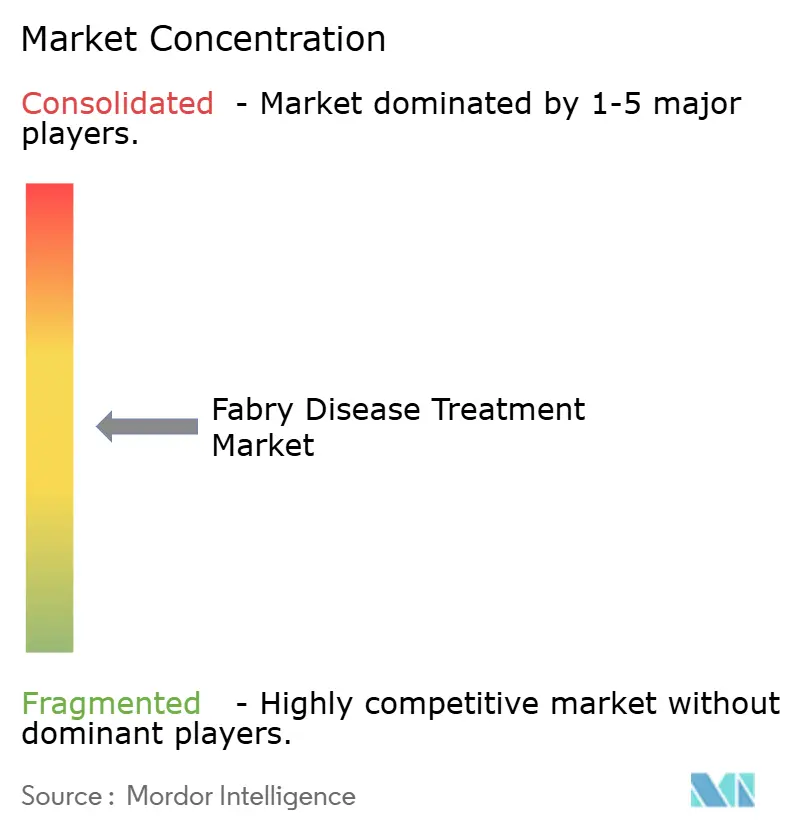
| Market Concentration | Medium |
Major Players *Disclaimer: Major Players sorted in no particular order Image © Mordor Intelligence. Reuse requires attribution under CC BY 4.0. | |
Fabry Disease Treatment Market Analysis by Mordor Intelligence
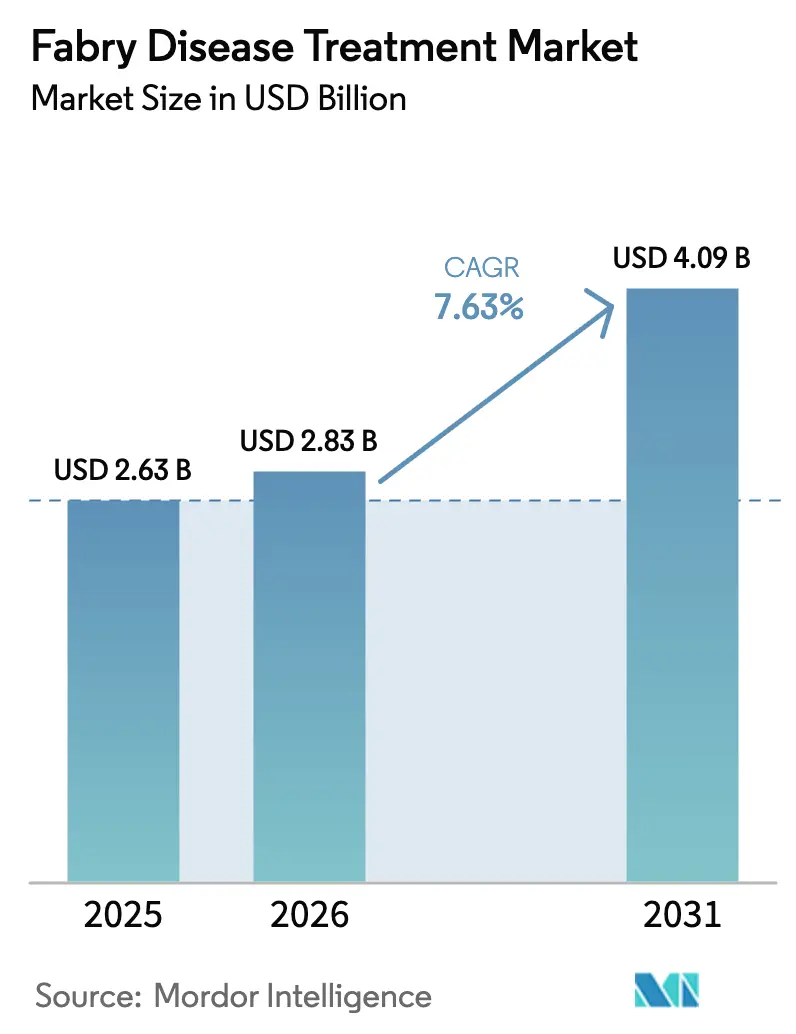
The fabry disease treatment market size is expected to grow from USD 2.63 billion in 2025 to USD 2.83 billion in 2026 and is forecast to reach USD 4.09 billion by 2031 at 7.63% CAGR over 2026-2031. The Fabry disease treatment market is progressing from conventional bi-weekly enzyme replacement infusions toward once-only gene therapies and oral substrate reduction regimens. Growing clinical recognition of late-onset variants, broadened newborn screening, and favorable orphan-drug regulations are expanding the Fabry disease treatment market addressable population. Continued investment in home-infusion services and telemedicine reduces administration burdens and supports adherence. Manufacturing innovations and biosimilar pressure are simultaneously lowering entry barriers, amplifying competitive intensity in the Fabry disease treatment market[1]Matthias Lenders, Eva-Renee Menke, and Eva Brand, “Progress and Challenges in the Treatment of Fabry Disease,” BioDrugs, springer.com.
Key Report Takeaways
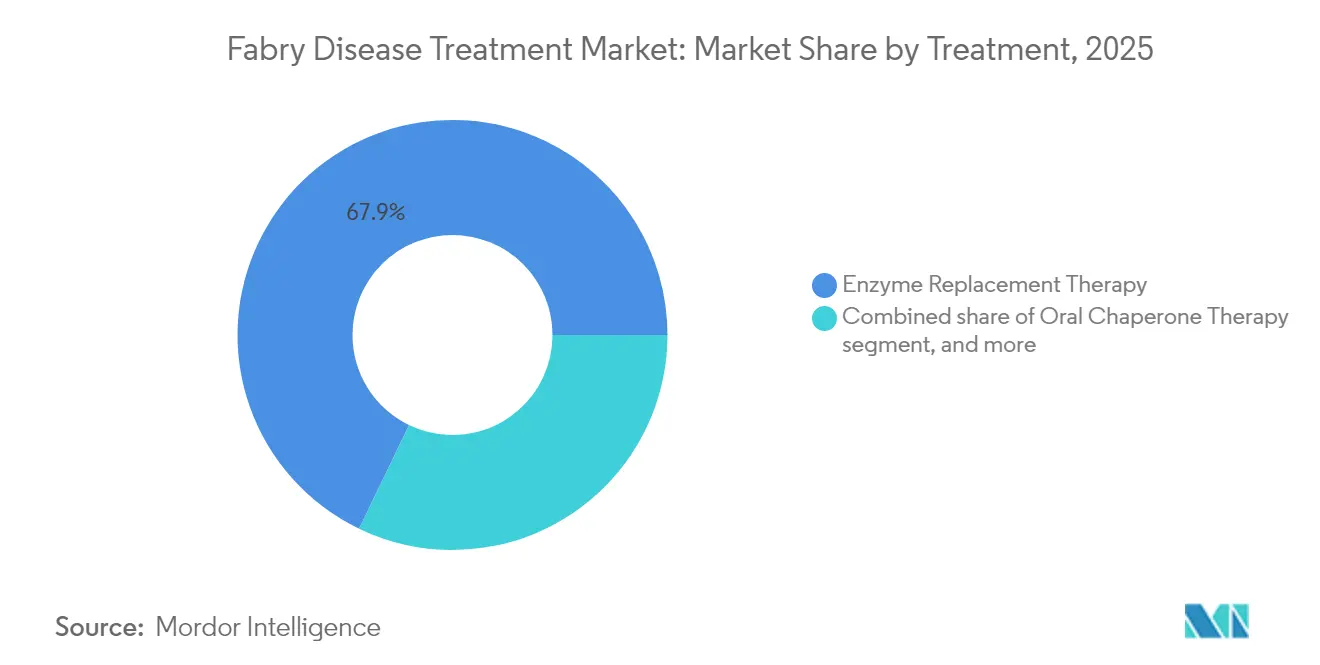
- By treatment, enzyme replacement therapy held 67.85% of the Fabry disease treatment market share in 2025 while gene therapy is projected to advance at a 9.18% CAGR through 2031.
- By route of administration, intravenous delivery commanded 72.60% of the Fabry disease treatment market size in 2025, whereas subcutaneous delivery is expected to expand at a 9.21% CAGR to 2031.
- By distribution channel, hospital pharmacies accounted for 55.70% of the Fabry disease treatment market size in 2025 and specialty pharmacies post the highest projected CAGR of 10.05% during 2026-2031.
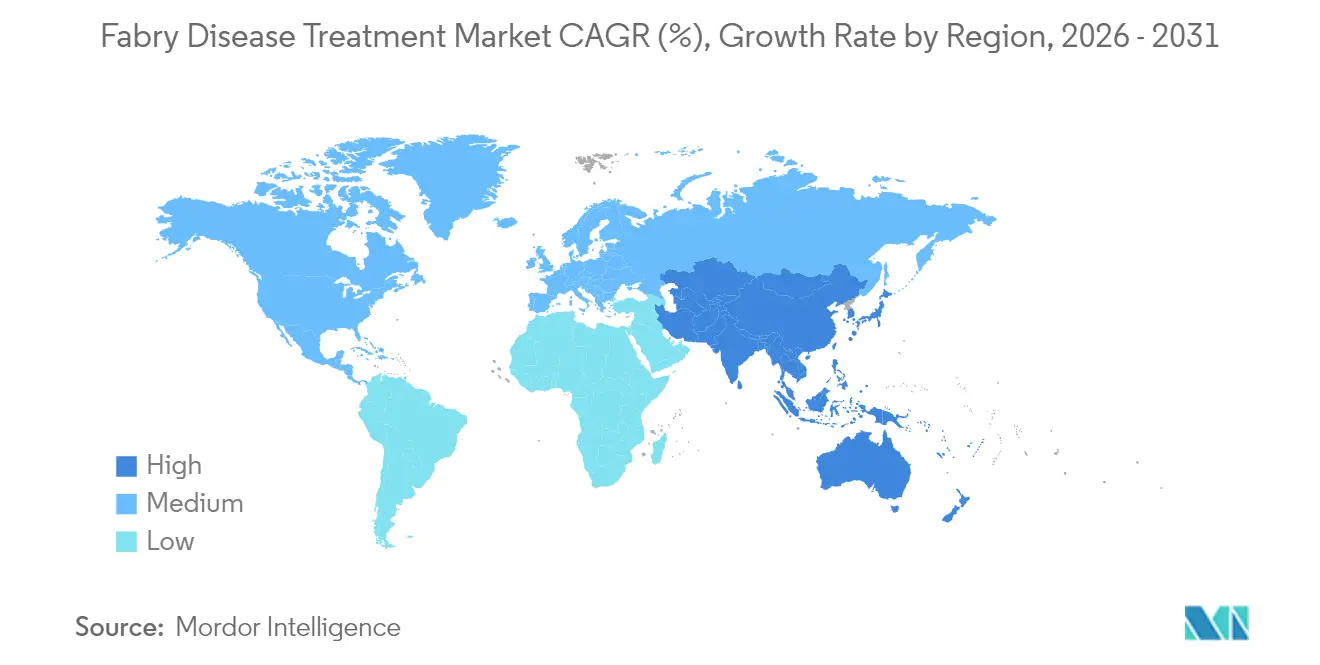
- By geography, North America led with 42.85% revenue share of the Fabry disease treatment market in 2025; Asia-Pacific is forecast to post the fastest 8.28% CAGR to 2031.
Note: Market size and forecast figures in this report are generated using Mordor Intelligence’s proprietary estimation framework, updated with the latest available data and insights as of 2026.
Global Fabry Disease Treatment Market Trends and Insights
Drivers Impact Analysis*
| Driver | % Impact on CAGR Forecast | Geographic Relevance | Impact Timeline |
|---|---|---|---|
| Growing prevalence of Fabry disease | +1.5% | Global, strongest in North America & Europe | Medium term (2-4 years) |
| Advancements in gene- and mRNA-based therapies | +1.2% | North America & EU leading, APAC following | Long term (≥4 years) |
| Favorable orphan-drug incentives and fast-track designations | +0.8% | Global, highest impact in US & EU | Short term (≤2 years) |
| Increasing global healthcare expenditure on rare diseases | +1.0% | Global, with regional variations | Medium term (2-4 years) |
| Strategic collaborations and licensing agreements | +0.9% | Primarily developed markets worldwide | Medium term (2-4 years) |
| Expansion of telemedicine and home-infusion services | +0.6% | North America & Europe | Short term (≤2 years) |
| Source: Mordor Intelligence | |||
Growing Prevalence of Fabry Disease
Re-evaluation of screening programs indicates Fabry disease affects nearly 1 in 10,000 individuals, a four-fold increase on earlier estimates. Late-onset forms account for most symptomatic cases and often escape detection until organ damage progresses, which creates a significant latent pool of untreated adults[2]James Cook et al., “Estimating the Prevalence of Late-Onset Fabry Disease in the US in 2024,” medRxiv, medrxiv.org. Broader renal and cardiology screening plus newborn testing in several countries funnels higher numbers of presymptomatic carriers into specialty clinics. This expanding patient funnel underpins sustained demand in the Fabry disease treatment market.
Advances in Gene and mRNA Therapies
Multiple AAV-based vectors now show persistent α-galactosidase A expression for at least two years, minimizing immunogenicity and infusion burden. FDA agreement on an accelerated approval path for Sangamo’s ST-920 underscores rising regulatory confidence in biomarker-driven endpoints. uniQure’s AMT-191 and Exegenesis Bio’s EXG110 hold orphan designations and early safety data support single-dose curative potential. Each milestone heightens investor interest and propels the Fabry disease treatment market toward transformative modalities.
Favorable Orphan-Drug Incentives and Fast-Track Designations
Seven-year exclusivity, tax credits, and priority review vouchers shorten time-to-market and protect pricing flexibility. The Inflation Reduction Act’s orphan exemption preserves revenue potential by shielding rare-disease therapies from mandatory Medicare negotiations. Collectively these policy levers de-risk pipeline investment and accelerate availability of novel agents in the Fabry disease treatment market.
Increasing Global Healthcare Expenditure on Rare Diseases
Orphan drugs are projected to represent 20% of total prescription outlays by 2026. Average annual therapy cost for a rare-disease patient has risen to USD 147,000, with Fabry drugs exceeding USD 400,000 per year in some markets. China’s Hainan Province recorded an 88.99% annual growth in rare-disease spend between 2019-2023, illustrating escalating resource commitments that underpin the Fabry disease treatment market.
Restraints Impact Analysis*
| Restraints Impact Analysis | (~) % Impact on CAGR Forecast | Geographic Relevance | Impact Timeline |
|---|---|---|---|
| High treatment costs and payer budget constraints | -0.7% | Global, most severe in emerging markets | Medium term (2-4 years) |
| Limited diagnostic infrastructure in emerging markets | -0.5% | APAC, MEA, Latin America | Long term (≥4 years) |
| Manufacturing capacity constraints for advanced therapies | -0.4% | Global, heightened in regions with limited biomanufacturing | Short term (≤2 years) |
| Stringent reimbursement criteria and access barriers | -0.6% | Global, pronounced in cost-constrained health systems | Medium term (2-4 years) |
| Source: Mordor Intelligence | |||
High Treatment Costs and Payer Budget Constraints
Elfabrio’s annual price surpasses USD 430,000, placing Fabry therapy among the costliest prescriptions worldwide. Insurers often restrict reimbursement until organ pathology is documented, delaying initiation and potentially worsening prognosis[3]Morgan Loh and Julia Settler, “Clinical Overview: Elfabrio for Fabry Disease in Adults,” Pharmacy Times, pharmacytimes.com. Variable public financing leaves emerging-market patients exposed to catastrophic out-of-pocket fees, muting penetration rates in the Fabry disease treatment market despite rising clinical need.
Limited Diagnostic Infrastructure in Emerging Markets
Sophisticated enzymatic assays and gene sequencing remain scarce outside major urban centers. Misdiagnosis is common because neuropathic pain, proteinuria, and hypertrophic cardiomyopathy mimic more prevalent disorders. Absence of newborn screening in many low- and middle-income nations delays identification for years, shrinking the treated cohort and restraining Fabry disease treatment market expansion.
*Our forecasts treat driver/restraint impacts as directional, not additive. The impact forecasts reflect baseline growth, mix effects, and variable interactions.
Segment Analysis
By Treatment: Gene Therapy Drives Innovation Despite ERT Dominance
Enzyme replacement therapy generated 67.85% of Fabry disease treatment market revenue in 2025 and continues to anchor clinical practice due to decades of safety data. However, gene therapy is forecast to post a 9.18% CAGR, reflecting patient demand for single-dose, potentially curative solutions. Oral chaperone migalastat addresses amenable mutations, and substrate reduction agent venglustat is in Phase III for neuropathic pain management. The diversified pipeline signals that the Fabry disease treatment market will transition toward modality pluralism rather than a single therapeutic hegemon.
Gene therapy sponsors improve vector tropism and dosing efficiency, reducing manufacturing cost and immunogenic risk. Pegunigalsidase alfa’s monthly infusion option demonstrates legacy ERT innovation while biosimilar entries loom as patents expire. Collectively, these shifts promise a more competitive and patient-centric Fabry disease treatment market over the next decade.



By Route of Administration: Subcutaneous Delivery Gains Momentum
Intravenous infusions accounted for 72.60% of the Fabry disease treatment market size in 2025 given that all approved ERTs require vein access. Patients increasingly favor subcutaneous formulations under development that permit self-administration at home, driving a 9.21% CAGR for this route. Oral migalastat offers unmatched convenience for mutation-amenable patients but serves a narrow niche. Gene therapy could ultimately bypass chronic administration entirely, redefining expectations within the Fabry disease treatment market.
Home-infusion services now cover most urban areas in North America and Europe, cutting administration costs and hospital time. Subcutaneous development programs aim to replicate efficacy while shrinking infusion duration, an advance particularly valuable in regions with sparse infusion centers. These delivery innovations reinforce adherence and expand reach, bolstering long-term growth of the Fabry disease treatment market.

By Distribution Channel: Specialty Pharmacies Capitalize on Complexity
Hospital pharmacies captured 55.70% share of the Fabry disease treatment market in 2025 driven by in-hospital infusion dominance. Specialty pharmacies are projected to deliver a 10.05% CAGR by supplying complex dispensing, nursing coordination, and insurance navigation that high-touch rare diseases demand. Retail chains remain minor participants because of cold-chain requirements and payer mandates, though they distribute oral agents. The widening role of specialty pharmacies improves logistic resilience and patient experience, supporting wider adoption across the Fabry disease treatment market.
Payers increasingly channel high-cost biologics through limited distribution networks that couple dispensing with adherence programs and outcome reporting. This model aligns stakeholder incentives by improving real-world effectiveness and justifying budget impact, reinforcing specialty pharmacy ascendance. Hospital pharmacies retain relevance for initiation and high-risk monitoring, yet even these functions are migrating to ambulatory or home settings as the Fabry disease treatment market seeks efficiency.
Geography Analysis
North America led with 42.85% Fabry disease treatment market revenue in 2025 underpinned by broad newborn screening, specialist centers, and comprehensive reimbursement. The FDA routinely applies priority and breakthrough designations, enabling swift adoption of novel modalities. Despite payer scrutiny, commercial plans typically cover enzyme replacement and migalastat, while multiple gene therapy trials recruit aggressively across the United States and Canada.
Europe ranks second, benefiting from cross-border regulatory harmonization via the EMA and robust academic registries tracking long-term outcomes. National health technology assessments can delay uptake but ultimately assure broad coverage. Recent Scottish approval for pegunigalsidase alfa highlights continued regional expansion of the Fabry disease treatment market. EU research consortia and patient groups provide an integrated ecosystem that supports evidence generation and guideline refinement.
Asia-Pacific is the fastest growing zone at an 8.28% CAGR. Japan’s conditional early-access framework and South Korea’s national insurance adoption of ERT illustrate mature system capacity. China’s rare-disease catalog, expanded reimbursement, and domestic biotech investment collectively accelerate penetration. Rising clinical trial activity and infrastructure upgrades in India and Southeast Asia suggest further upside for the Fabry disease treatment market over the horizon.

Regulatory Landscape
The regulatory environment for Fabry disease therapies is shaped by orphan-drug frameworks and expedited pathways in major markets. In the United States, approved options include Fabrazyme (agalsidase beta) and Elfabrio (pegunigalsidase alfa-iwxj), with Fabrazyme carrying a boxed warning for hypersensitivity reactions including anaphylaxis, which reinforces requirements for infusion monitoring and risk management in clinical practice.
Pipeline development is closely tied to FDA and EMA rare-disease programs. ST-920 (isaralgagene civaparvovec) holds FDA Orphan Drug, Fast Track, and RMAT designations, and also has EMA orphan status with PRIME eligibility, supporting biomarker-driven and accelerated review approaches. In Europe, the EMA Committee for Orphan Medicinal Products (COMP) anchors designation oversight (including the prevalence threshold of fewer than 5 per 10,000 people in the EU), while additional regional access decisions, such as Scotland approvals, influence near-term uptake dynamics for newer ERTs.
Competitive Landscape
The fabry disease treatment market remains moderately concentrated yet increasingly contested. Sanofi, Takeda, and Chiesi defend entrenched ERT franchises while scaling manufacturing to counter biosimilar threats. Amicus Therapeutics leverages oral migalastat differentiation and recorded USD 528.3 million revenue in 2024, implying 33% annual growth and confirming strong physician adoption.
Gene therapy challengers pursue curative positioning. Sangamo’s ST-920 secured an FDA alignment for accelerated approval based on eGFR slope, aiming to launch by 2027. uniQure’s AMT-191 and Exegenesis EXG110 add competitive diversity, enhancing patient choice and price discipline. Pegylated PRX-102 from Protalix and Chiesi demonstrates incremental innovation within ERT class, extending infusion intervals to four weeks and offering improved pharmacokinetics.
Supply chain reliability and patient-support programs emerge as decisive differentiators. Past shortages of Fabrazyme triggered legal scrutiny and underscore the premium on robust manufacturing and logistics. Specialty pharmacies and home-infusion providers integrate digital adherence tools and nurse coaching, creating service layers that competitors must match as the Fabry disease treatment market evolves.
Fabry Disease Treatment Industry Leaders
Sanofi (Genzyme Corporation)
Takeda Pharmaceutical Company Limited
Amicus Therapeutics, Inc
ISU ABXIS
JCR Pharmaceuticals Co., Ltd.
- *Disclaimer: Major Players sorted in no particular order

Market Opportunities and Future Outlook
A key whitespace area sits at the intersection of durable efficacy and reduced treatment burden, where regulators are engaging on novel endpoints and companion diagnostics. In March 2026, Sangamo advanced the rolling BLA submission to the US FDA for ST-920, and its antibody assay companion diagnostic entered FDA CDRH review for PMA, signaling an emerging commercialization pathway that combines therapeutics with enabling testing. This can broaden demand for specialized lab services and integrated care pathways.
Opportunities also come from regimen optimization and geographic expansion for established modalities. In October 2025, JCR Pharmaceuticals signed a licensing agreement with Menagen Pharmaceutical Industries to commercialize an agalsidase beta biosimilar across nine MENAT markets, illustrating market entry routes where local marketing authorizations and partner-led commercialization can broaden access to treated patients. On the product-development side, programs such as Sanofi's venglustat (with Fast Track and orphan designations for Fabry disease) and early-stage platforms like Glafabra Therapeutics (reporting pilot trial completion and targeting an IND filing for Q1 2027) point to continued diversification beyond biweekly infusions into oral and gene-based approaches, alongside differentiated service models such as home infusion and specialty-pharmacy coordination.
Recent Industry Developments
- May 2026: Chiesi Limited reports MHRA approves additional 2mg/kg every-four-week dosing for pegunigalsidase alfa (Elfabrio) in adults stable with ERT. The dosing interval expansion for Elfabrio broadens treatment flexibility and may improve adherence among Fabry patients.
- March 2026: Chiesi Global Rare Diseases and Protalix BioTherapeutics receive European Commission approval for 2mg/kg every-4-weeks dosing for pegunigalsidase alfa (Elfabrio) for adults with Fabry disease on ERT. The regulatory expansion broadens market access and may lead to higher utilization of Elfabrio.
- March 2026: Sangamo Therapeutics advances rolling submission of BLA to FDA for ST-920 (isaralgagene civaparvovec) for Fabry disease. The move positions a potential gene therapy option for regulatory review and adds a curative modality trajectory to Fabry market dynamics.


Research Methodology Framework and Report Scope
Market Definition and Coverage
This market covers revenues generated from therapies used to manage Fabry disease, including drug treatment and related administration in the care pathway, counted at ex-manufacturer or equivalent realized pricing across major healthcare systems.
Scope exclusions: We exclude diagnostic testing, genetic counseling, and non-therapeutic supportive care that does not involve Fabry-specific drug treatment.
Segmentation Overview
- By Treatment
- Enzyme Replacement Therapy
- Oral Chaperone Therapy
- Gene Therapy
- Substrate Reduction Therapy
- Other Treatments
- By Route of Administration
- Intravenous
- Oral
- Subcutaneous
- By Distribution Channel
- Hospital Pharmacies
- Retail Pharmacies
- Specialty Pharmacies
- Online Pharmacies
- Geography
- North America
- United States
- Canada
- Mexico
- Europe
- Germany
- United Kingdom
- France
- Italy
- Spain
- Rest of Europe
- Asia-Pacific
- China
- Japan
- India
- Australia
- South Korea
- Rest of Asia-Pacific
- Middle East & Africa
- GCC
- South Africa
- Rest of Middle East & Africa
- GCC
- South America
- Brazil
- Argentina
- Rest of South America
- North America
Data Sources, Market Sizing, and Validation
Desk Research
Desk research was used to set the disease and treatment boundaries and to gather the starting inputs that can be checked across countries. Public sources such as the US FDA drug labels and approvals database, the NIH Genetic and Rare Diseases Information Center, CDC newborn screening references, and the World Health Organization and OECD health spending indicators helped us keep assumptions realistic.
To make the model usable in revenue terms, we also reviewed sources such as national reimbursement and HTA publications, peer-reviewed journals on Fabry prevalence and diagnosis rates, and government health ministry price lists where available. Company filings, investor presentations, and reputable press releases were used to understand therapy rollout timing and typical dosing schedules, and then paid subscriptions for company financials and patent databases were used selectively to confirm timelines and cross-check commercial scale signals. These sources are illustrative, and many other public documents were also reviewed for data collection, validation, and clarification.
Primary Interviews and Surveys
Primary work focused on validating treated patient pools, therapy switching behavior, and real-world access differences across major regions. We spoke with a mix of clinicians, payer or reimbursement experts, specialty pharmacy stakeholders, and industry participants so that gaps from desk findings could be closed and assumptions could be stress-tested before finalizing the model.
Distribution of primary research fieldwork respondents
| Company type | Respondent position | Region |
|---|---|---|
| Top tier: 35% | CXOs: 20% | APAC: 44% |
| Mid tier: 45% | Functional/Unit leaders: 28% | EMEA: 29% |
| Smaller Players: 20% | Managers: 52% | Americas: 27% |
Market-Sizing & Forecasting
Sizing was built using a top-down approach that starts from the diagnosed and treated Fabry patient pool by country, and then converts that demand pool into revenues using treatment mix, dosing patterns, and annual therapy cost assumptions. To keep the totals grounded, results were corroborated through selective bottom-up approximations, such as sampled price per patient checks, channel feedback on treated volumes, and supplier revenue sanity checks where disclosures are available.
Key model inputs included prevalence and diagnosis rates, newborn screening expansion signals, share of patients eligible for oral chaperone therapy, enzyme replacement therapy dosing frequency and persistence, and regional access factors such as reimbursement breadth and infusion setting shifts (hospital versus home). Where direct country inputs were thin, we applied conservative proxy logic using comparable markets with similar screening and reimbursement maturity, and then adjusted through expert feedback.
Forecasting relied mainly on scenario analysis, because the market is shaped by pipeline maturation, label expansions, and access decisions that can change the treated population and therapy mix quickly. The scenario paths were anchored to consensus views from interviews on adoption timing, price progression, and switching rates, and then translated into annual revenue curves.
Data Validation & Update Cycle
Validation was done through triangulation across patient-based demand estimates, published clinical and policy signals, and observed commercial indicators, and then checked for outliers at the country and regional levels. When a variance looked too wide, the assumptions were revisited, and targeted re-contacts were triggered to confirm whether the gap came from access limits, therapy mix, or pricing.
Before sign-off, the model goes through multi-step analyst reviews that re-check units, currency conversion timing, and year alignment, followed by a final consistency review against independent healthcare spend and rare-disease treatment trends. Reports are refreshed annually, and interim updates are made when material events occur, and we do a fresh pre-delivery pass so clients receive the latest updated view.
Mordor Intelligence's Fabry Disease Treatment Market Sizing Compared With Other Published Estimates
Published market values for Fabry disease treatment can look far apart because each publisher chooses a different geography set, therapy boundary, and timing for currency and pricing. Differences also show up when one study relies more on epidemiology-driven demand build-ups, and another leans on broad rare-disease spend benchmarks.
Newborn screening expansion references, diagnosis and treated-pool checks, and therapy dosing validation are the evidence points that keep Mordor Intelligence aligned to the addressable treated population instead of counting undifferentiated rare-disease drug spend. In addition, some estimates blend adjacent lysosomal storage disease revenues or use a narrower country basket, which can move the total even when the same therapies are discussed.
Benchmark comparison
| Source | Market Size | Gaps in Research Methodology |
|---|---|---|
| Mordor Intelligence | USD 2.63 B (2025) | |
| Industry Publisher A | USD 2.42 B (2024) | Uses a different base year and may apply broader therapy grouping assumptions, where treated-pool and persistence logic by country is less transparent, which can pull the starting point down. |
| Healthcare Analytics Note B | USD 1.70 B (2024) | Limits the scope to a 7-market basket and is framed at the disease market level, which can omit smaller geographies and undercount treated patients outside the included countries. |
The spread mainly comes from geography coverage, base year selection, and how tightly the treated patient pool is tied to dosing and access reality. By keeping the steps traceable from patients to treatment mix to annual cost, the approach offers a practical number that can be reproduced and updated as screening, pricing, and uptake signals change.


Key Questions Answered in the Report
What is the current Fabry disease treatment market size and projected growth?
The market is valued at USD 2.83 billion in 2026 and is expected to reach USD 4.09 billion by 2031, delivering a 7.63% CAGR.
Which therapy type dominates the Fabry disease treatment market?
Enzyme replacement therapy leads with 67.85% revenue share in 2025, although gene therapy shows the fastest 9.18% CAGR outlook.
Which region grows fastest in the Fabry disease treatment market?
Asia-Pacific posts the highest 8.28% CAGR through 2031 due to rising diagnosis rates, expanding reimbursement, and local clinical trial activity.
How are high treatment costs influencing market access?
Annual therapy prices above USD 400,000 drive stringent reimbursement criteria, particularly in emerging markets, tempering uptake despite clinical benefits.
What role do specialty pharmacies play in this market?
Specialty pharmacies offer tailored patient support and complex reimbursement services, fueling a 10.05% CAGR and increasing their share of drug dispensing.
Page last updated on:


 Your data is secure and never sold or shared.


