
Executive Coaching And Leadership Development Market Size and Share
Market Overview
| Study Period | 2020 - 2031 |
|---|---|
| Market Size (2026) | USD 112.98 Billion |
| Market Size (2031) | USD 174.53 Billion |
| Growth Rate (2026 - 2031) | 9.11 % |
| Fastest Growing Market | Asia Pacific |
| Largest Market | North America |
| Market Concentration | Medium |
Major Players *Disclaimer: Major Players sorted in no particular order Image © Mordor Intelligence. Reuse requires attribution under CC BY 4.0. | |
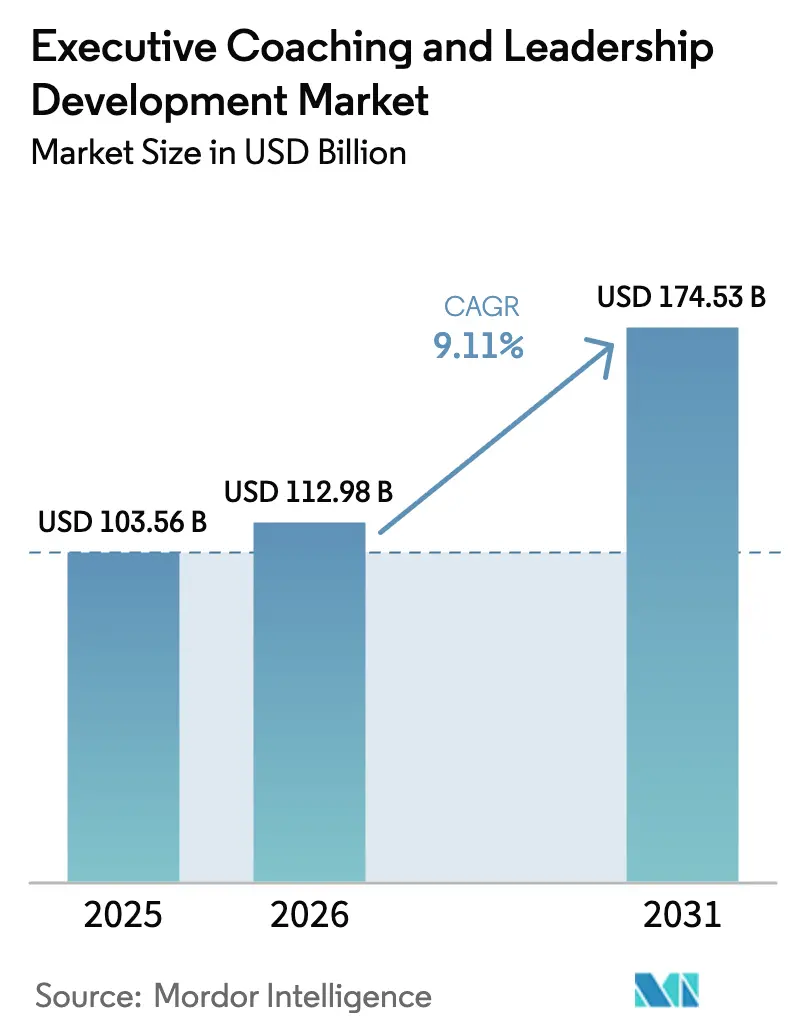
Executive Coaching And Leadership Development Market Analysis by Mordor Intelligence
Executive Coaching and Leadership Development market size in 2026 is estimated at USD 112.98 billion, growing from 2025 value of USD 103.56 billion with 2031 projections showing USD 174.53 billion, growing at 9.11% CAGR over 2026-2031. Escalating C-suite succession gaps, compressed corporate-strategy cycles, and generative-AI tools that hyper-personalize coaching are stimulating sustained budget growth across the Executive Coaching and Leadership Development market. Corporate spending on leadership development already exceeds USD 366 billion, and 88% of firms intend to upgrade programs to restore trust in senior management after the pandemic[1]: Sean Linehan, “29 Eye-Opening Leadership Development Statistics 2025,” Exec, exec.com . CoachHub's Series C funding round highlights the increasing integration of technology within the Executive Coaching and Leadership Development market. Large enterprises remain the dominant buyers, yet subscription platforms are enabling SMEs to join the Executive Coaching and Leadership Development market at a lower entry price. Fragmented certification frameworks and data-privacy anxieties restrain adoption in some regions even as updated industry ethics codes start to raise confidence.
Key Report Takeaways
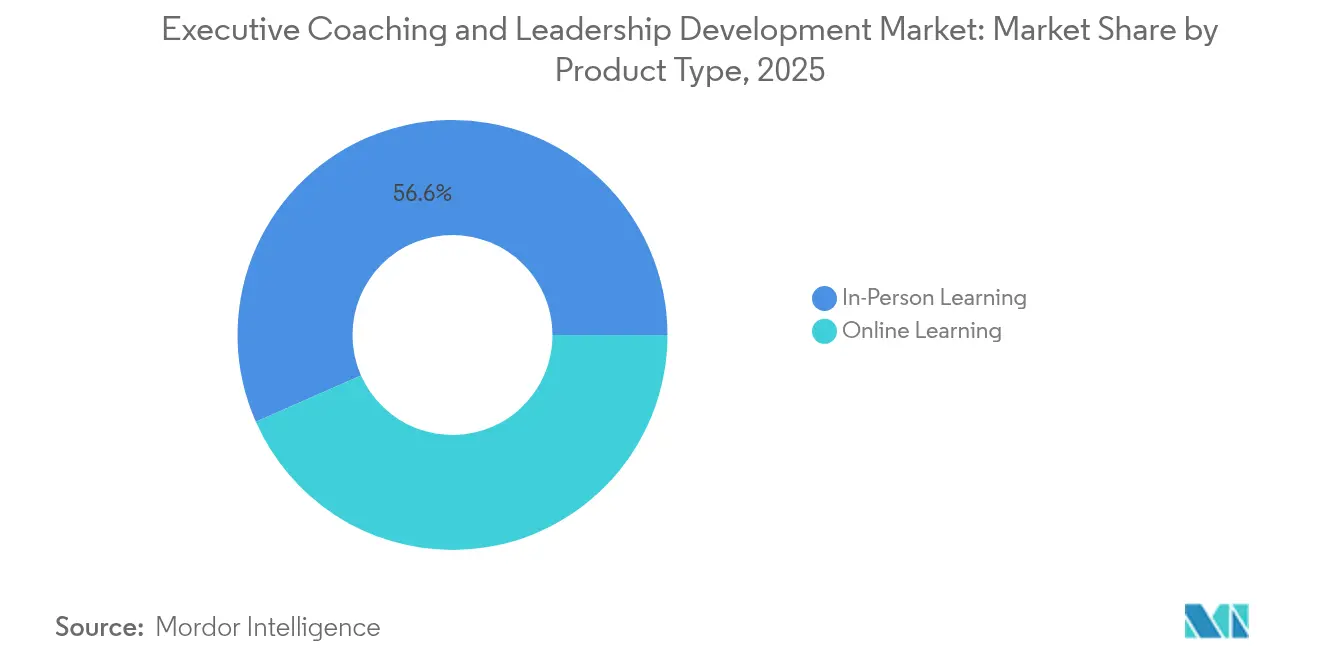
- By product type, in-person learning held 56.62% Executive Coaching and Leadership Development market share in 2025, while online learning is advancing at an 11.64% CAGR through 2031.
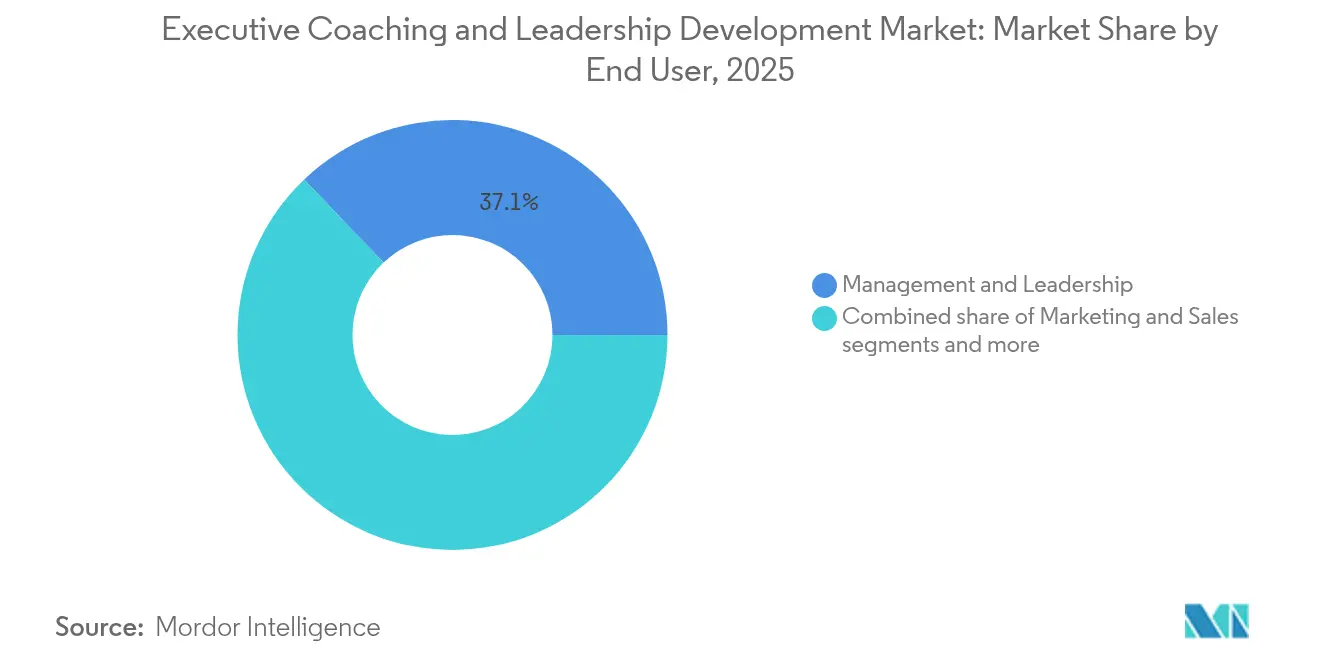
- By end user, management and leadership commanded 37.12% of the Executive Coaching and Leadership Development market size in 2025, whereas strategic leadership and innovation are forecast to expand at a 9.55% CAGR between 2026-2031.
- By organization size, large enterprises controlled 57.61% Executive Coaching and Leadership Development market share in 2025, but small and medium-sized enterprises are growing at an 11.17% CAGR to 2031.
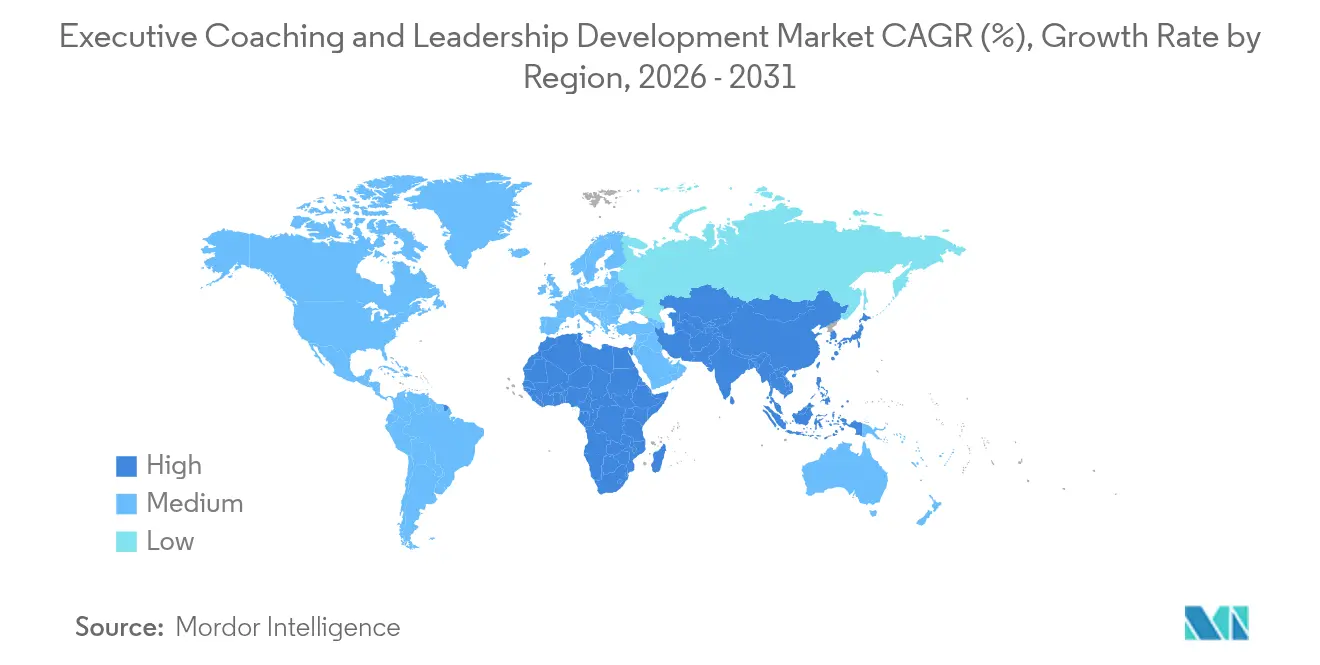
- By geography, North America accounted for 40.88% of the Executive Coaching and Leadership Development market size in 2025, and Asia-Pacific is registering the fastest 11.12% CAGR through 2031.
Note: Market size and forecast figures in this report are generated using Mordor Intelligence’s proprietary estimation framework, updated with the latest available data and insights as of 2026.
Market Trends and Insights
Drivers Impact Analysis of Executive Coaching And Leadership Development Market*
| Driver | (~) % Impact on CAGR Forecast | Geographic Relevance | Impact Timeline |
|---|---|---|---|
| Rapid digitisation of professional learning ecosystems | +1.8% | Global, with early adoption in North America & Europe | Medium term (2-4 years) |
| Growing demand for measurable ROI in leadership programs | +2.1% | Global, strongest in North America & Asia-Pacific | Short term (≤ 2 years) |
| Shortened corporate-strategy cycles driving continuous upskilling | +1.5% | Global, particularly in technology-intensive markets | Long term (≥ 4 years) |
| Escalating C-suite succession gaps in ageing economies | +1.2% | North America, Europe, Japan, Australia | Medium term (2-4 years) |
| AI-assisted coaching analytics unlocking hyper-personalised content | +0.9% | North America, Europe, with expansion to the Asia-Pacific | Short term (≤ 2 years) |
| Venture capital funnels into coaching marketplaces | +0.7% | Global, concentrated in venture capital hubs | Medium term (2-4 years) |
| Source: Mordor Intelligence | |||
Rapid Digitization of Professional Learning Ecosystems
Corporate learning is migrating from one-off classroom events to cloud-based platforms that blend AI personalization with human expertise. FranklinCovey introduced its AI Coach in March 2025, utilizing proprietary content and sophisticated language models to enhance skill-acquisition efficiency among early adopters[2]FranklinCovey Co., “FranklinCovey Launches FranklinCovey AI Coach,” franklincovey.com . Annual AI adoption in professional learning is climbing 40%, creating a network effect that accelerates digital-first demand across the Executive Coaching and Leadership Development market. Integrated analytics now correlate coaching inputs with revenue, innovation, and retention KPIs, providing proof of impact that traditional workshops lacked. These advances reduce travel costs and scheduling friction yet require investment in change management to weave new tools into everyday workflows. Vendors able to integrate seamlessly with HRIS platforms gain procurement preference over point solutions.
Growing Demand for Measurable ROI in Leadership Programs
Chief financial officers now insist that leadership budgets deliver quantifiable returns. Organizations that embed systematic coaching record 25% stronger business outcomes than peers, according to 2025 benchmarking research. Platforms have responded by embedding dashboards that link coaching moments to productivity, engagement, and project-cycle metrics, increasing transparency for sponsors[3]Azure Gilman & Brit Morse, “How a New Generation of AI Coaches Could Transform Management Training,” Fortune, fortune.com. North American and Asia-Pacific clients adopt these analytics fastest, reflecting tight budget oversight and tech readiness. Outcome evidence supports larger multiyear contracts, expanding the Executive Coaching and Leadership Development market for providers able to deliver data-rich insights. Traditional consultancies without digital proof points risk renewal erosion as buyers migrate to analytics-enabled platforms.
Shortened Corporate-Strategy Cycles Driving Continuous Upskilling
Strategy refresh rates have compressed from three-year plans to 12-18-month horizons, forcing leaders to upskill continuously. Seventy percent of executives surveyed by Harvard Business Review view lifelong learning as critical for agility. Just-in-time micro-learning paired with executive coaching meets this need, enabling leaders to pivot quickly when market signals shift. Technology-intensive industries adopt these continuous models earliest, fueling long-term expansion of the Executive Coaching and Leadership Development market. Platforms capable of instant content re-configuration gain share because static curricula cannot keep pace. Sustained demand boosts subscription revenue, smoothing cash-flow predictability for vendors.
Escalating C-Suite Succession Gaps in Ageing Economies
Organizations across North America, Europe, and Japan are increasingly identifying insufficient leadership bench strength as a critical challenge, compelling boards to focus on accelerating leadership development pipelines. Internal promotions are recognized as a more efficient and cost-effective strategy compared to external recruitment; however, many companies lack robust and structured frameworks for grooming internal talent. This gap in leadership development processes underscores the need for organizations to invest in systematic approaches to identify, nurture, and prepare high-potential employees for leadership roles, ensuring long-term organizational resilience and competitiveness. Coaching frameworks that pair assessments with individualized roadmaps directly address this vulnerability, propelling new bookings across the Executive Coaching and Leadership Development market. Providers offering succession analytics alongside coaching now win multiyear enterprise licenses. Aging-workforce demographics ensure medium-term demand momentum as retirements accelerate through 2030.
Restraints Impact Analysis of Executive Coaching And Leadership Development Market*
| Restraint | (~) % Impact on CAGR Forecast | Geographic Relevance | Impact Timeline |
|---|---|---|---|
| Fragmented certification & quality-assurance standards | -1.1% | Global, particularly acute in emerging markets | Long term (≥ 4 years) |
| High average cost per coach limits SMB adoption | -0.8% | Global, with the strongest impact in price-sensitive markets | Medium term (2-4 years) |
| Data-privacy anxieties around session recordings | -0.6% | Europe, North America, with expansion to the Asia-Pacific | Short term (≤ 2 years) |
| Cultural stigma toward coaching in certain emerging markets | -0.4% | Asia-Pacific, Middle East, Latin America | Long term (≥ 4 years) |
| Source: Mordor Intelligence | |||
Fragmented Certification & Quality-Assurance Standards
More than a dozen accreditation bodies overlap without a unified benchmark, sowing confusion for procurement teams. The International Coach Federation’s April 2025 ethics update expands coverage to AI platforms yet stops short of creating one global gold standard. Multinational corporations are required to conduct a thorough evaluation of coach credentials on a case-by-case basis. This meticulous vetting process contributes to prolonged deal cycles and marginally impacts the projected CAGR of the Executive Coaching and Leadership Development market. Such detailed assessments are becoming increasingly critical as organizations prioritize quality and alignment with strategic objectives in their leadership development initiatives. Large vendors accumulating multi-credentialed coach pools gain credibility, while smaller players face higher compliance costs. Until outcome-based metrics supplant hours-based certification, fragmentation is likely to persist.
Cultural Stigma Toward Coaching in Certain Emerging Markets
In hierarchical cultures, coaching is often perceived as a remedial measure, which can be seen as a challenge to leadership authority. This perception is particularly prevalent in family-owned conglomerates across regions such as Asia and Latin America, where informal mentorship practices are traditionally preferred. These cultural preferences have hindered the widespread adoption of formal executive coaching programs. While younger executives and multinational corporations demonstrate a higher level of receptiveness to such initiatives, the overall adoption remains inconsistent. This uneven adoption has resulted in a 0.4 percentage point decline in the projected growth rate of the Executive Coaching and Leadership Development market within these regions. To address these challenges, businesses are increasingly adopting localization strategies that align with culturally respected norms and incorporate bilingual content. These tailored approaches are gradually mitigating the stigma associated with formal coaching practices, fostering a more favorable environment for market growth.
*Our forecasts treat driver/restraint impacts as directional, not additive. The impact forecasts reflect baseline growth, mix effects, and variable interactions.
Executive Coaching And Leadership Development Market Segment Analysis
By Product Type:
Digital Platforms Converge with Face-to-Face DepthOnline learning is expected to log an 11.64% CAGR, narrowing the gap with in-person formats that accounted for 56.62 of % Executive Coaching and Leadership Development market share in 2025. Cloud delivery slashes travel and scheduling costs, while AI-driven matchmaking pairs leaders with best-fit coaches. Embedded VR simulations replicate nuanced scenarios, and dashboards provide transparent ROI evidence, reinforcing budget allocation. Yet board-level coaching still leans on face-to-face interaction where trust is paramount. Providers successively blend virtual diagnostics with periodic executive retreats, illustrating hybrid convergence that defines the segment’s future trajectory.
In-person programs remain indispensable for immersive experiences, non-verbal communication, and relationship depth. Executive offsites combine strategic planning with leadership coaching, supporting behaviour change at pivotal organizational moments. Sustainability mandates and budget scrutiny, however, encourage companies to shorten onsite durations and replace pre-work and follow-up with digital tools. This hybridization keeps the in-person share substantial while enabling online channels to capture incremental growth across the Executive Coaching and Leadership Development market.



By End User:
Innovation Leadership Surges AheadManagement and leadership programs represented 37.12% of spending in 2025, demonstrating their foundational role across industries. Strategic leadership and innovation now enjoy the fastest 9.55% CAGR. Boards require leaders fluent in design thinking, agile ways of working, and ESG strategy to navigate disruption. Coaches with innovation credentials command premium rates, while cross-functional cohorts blend perspectives from R&D, operations, and marketing. Finance and accounting leaders seek coaching on stakeholder communication amid increasing disclosure complexities, and business operations executives focus on hybrid-work optimization.
The executive coaching and leadership development market is increasingly adopting modular curricula designed to address the unique requirements of various functional archetypes. Innovation-driven programs integrate advanced methodologies, such as rapid-prototyping labs and simulations that encourage a failure-tolerant approach, to foster creativity and adaptability. In contrast, finance-focused programs concentrate on critical areas like risk management and scenario planning to enhance decision-making capabilities. Service providers that strategically integrate diverse content offerings and facilitate cross-functional peer learning are positioned to expand their contract portfolios and improve client retention rates.
By Organization Size:
Democratization Gains MomentumLarge enterprises generate 57.61% of 2025 revenue thanks to established succession pipelines and broader L&D budgets. However, SMEs exhibit the fastest 11.17% CAGR, reflecting democratization trends in the Executive Coaching and Leadership Development market. Integrating leadership nudges into collaboration suites allows organizations to embed professional development into routine workflows, thereby reducing barriers to adoption. Vendors that focus on tailoring performance metrics, such as minimizing founder burnout or shortening sales cycle durations, enhance the overall value proposition. This strategic approach not only improves user satisfaction but also strengthens customer retention and renewal rates.
Coaching has become an integral component of talent-management systems within large enterprises, strategically embedded to enhance organizational performance. These long-term agreements, which encompass leadership development from director-level professionals to the C-suite, are designed to leverage advanced analytics that establish a direct correlation between leadership effectiveness and EBITDA growth. Service providers capable of integrating with global HRIS platforms and ensuring compliance with rigorous data-sovereignty regulations are positioned to secure higher premium seat allocations. This capability strengthens their competitive position and market share within the Executive Coaching and Leadership Development market.
Geography Analysis
APAC Executive Coaching and Leadership Development Market
The Asia-Pacific region is witnessing the fastest growth in the Executive Coaching and Leadership Development market, advancing at a strong CAGR of 11.12% through 2031. This rapid expansion is primarily fueled by the region’s booming digital economy and a generational transition in corporate leadership structures. Younger executives across emerging and developed markets are increasingly embracing continuous feedback cultures that prioritize adaptability and soft-skill enhancement. At the same time, multinational corporations are cascading global coaching frameworks and standards into their regional operations, further professionalizing the industry. Domestic technology giants and conglomerates are also investing heavily in leadership development as a critical driver of innovation, resilience, and long-term competitiveness.
APAC Localization Executive Coaching and Leadership Development Market
Localization has emerged as a defining success factor across Asia-Pacific’s executive coaching ecosystem, influencing both adoption and retention rates among clients. Bilingual coaches who can bridge cultural nuances are increasingly in demand, as organizations seek more relevant and relatable leadership insights. Market players are customizing casework and simulations that reflect region-specific business environments, enhancing the authenticity of coaching outcomes. Additionally, the use of local data hosting and regionally compliant platforms has become essential to maintaining trust and meeting data privacy expectations. These adaptive strategies collectively ensure that executive coaching programs resonate deeply with regional management cultures while maintaining global standards of excellence.
North America and EMEA Executive Coaching and Leadership Development Market
North America continues to hold the largest revenue share, commanding 40.88% of the global Executive Coaching and Leadership Development market in 2025. The region benefits from mature corporate governance systems, robust venture capital inflows, and a widespread commitment to measurable, data-driven coaching outcomes. Europe follows closely, where stringent privacy regulations such as GDPR elevate procurement barriers but reward firms offering transparent, algorithm-driven coaching platforms. Meanwhile, the Middle East is aligning its growing coaching demand with national diversification and human capital development agendas. In Africa, early-stage market traction is emerging within rapidly urbanizing hubs, particularly driven by growth in telecommunications and fintech sectors, sustaining overall global market momentum.

Regulatory Landscape
Executive coaching and leadership development faces limited direct statutory regulation, so buyers typically use industry-led governance, credentialing, and privacy compliance as de facto controls. The International Coaching Federation (ICF) is a key reference point, with its Code of Ethics effective April 1, 2025 expanding expectations for AI-enabled coaching, disclosure, and data safeguards. ICF also runs an Ethical Conduct Review (ECR) process managed by an Independent Review Board to adjudicate ethics complaints.
Even with ICF leadership, the landscape is fragmented globally, with multiple overlapping accreditation bodies and differing enterprise procurement requirements. Organizations generally layer ICF-aligned standards with broader data protection and workplace policies, including GDPR-driven requirements in Europe, plus vendor security and data-handling commitments. This is especially relevant when session recordings, coaching notes, and analytics dashboards are used to evidence ROI.
Value Chain Analysis
The value chain starts with IP creation and program design, including leadership frameworks, assessments, role-based curricula, and digital content libraries. Coach sourcing and credential verification follow, supported by ecosystems such as ICF. Talent supply is built through training and accreditation pathways, where ICF updates competency models through evidence-based job analysis cycles (last completed in 2025) and ties standards to credentials and ethics requirements.
Delivery then moves through consultancies and platform providers that match leaders to coaches, run cohort programs, and embed analytics into enterprise HR and talent systems. Large professional services players such as Korn Ferry connect executive coaching and leadership development with adjacent offerings (executive search, talent management, and organizational consulting), while marketplace and subscription platforms extend reach to new buyer segments by standardizing onboarding, quality assurance, and measurement across distributed coach networks.
Competitive Landscape
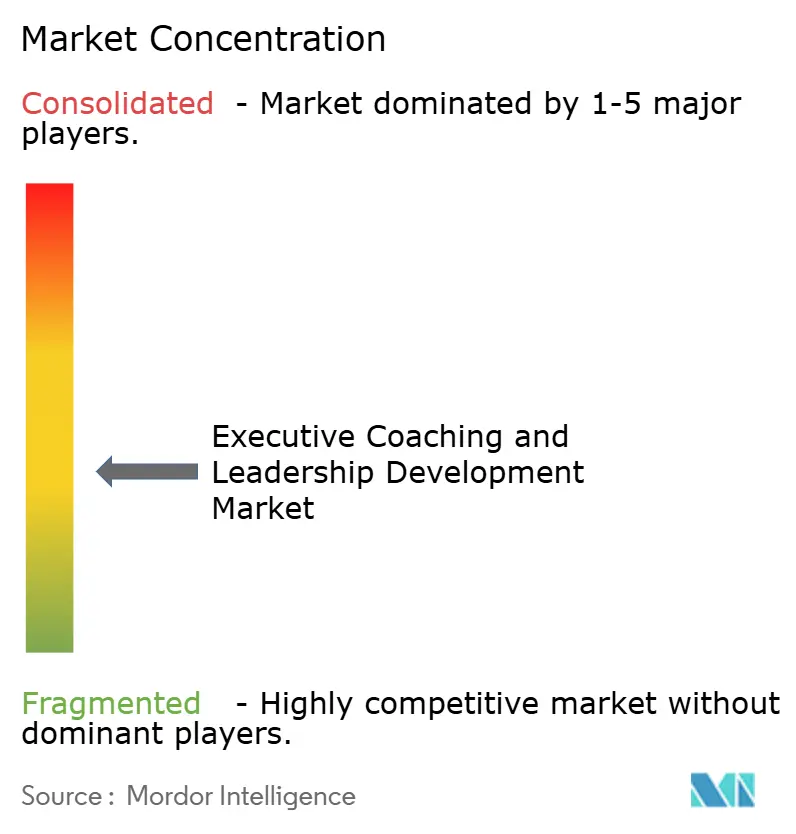
The Executive Coaching and Leadership Development market is characterized by a concentrated competitive landscape, with leading vendors accounting for approximately half of the market share. This scenario creates substantial opportunities for new and emerging players to establish their presence and capture a portion of the remaining market share. FranklinCovey, BetterUp, CoachHub, Korn Ferry, and DDI anchor global portfolios with proprietary IP, large coach networks, and outcome analytics. FranklinCovey’s AI Coach now delivers generative content for thousands of learners within days of launch. BetterUp’s hybrid model blends human experts with algorithmic insights that provide micro-nudges between sessions. CoachHub operates on a marketplace-driven model, efficiently aligning client needs with a global network of 3,500 certified coaches spanning 90 countries. This approach leverages marketplace dynamics to optimize the matching process, ensuring tailored coaching solutions for diverse client requirements [4]CoachHub, “CoachHub Raises USD 200 Million in Series C,” coachhub.com .
Traditional consultancies integrate coaching into leadership-advisory bundles. Korn Ferry and Heidrick & Struggles cross-sell coaching to executive-search clients, unlocking synergies from shared assessment data. TalentoHC’s 2025 acquisition of The PeterSan Group underscores the trend toward niche capability consolidation. Compliance competence differentiates winners under the 2025 ICF ethics code, which mandates AI-usage disclosure and data safeguards. Vendors lacking certified security frameworks face longer sales cycles, particularly in finance and healthcare.
Demonstrable outcomes increasingly drive the renewal process in the Executive Coaching and Leadership Development market. Leading platforms are incorporating advanced ROI dashboards that systematically measure leadership behaviors against KPIs for revenue generation and innovation. This trend reflects a growing preference among buyers for performance-based contracts, which is pressuring providers with limited analytical capabilities toward commoditization. Consequently, market players are striving to integrate human-centric empathy with data-driven, machine-grade measurement systems. This strategic combination is redefining competitive dynamics and reshaping the overall market landscape.
Executive Coaching And Leadership Development Industry Leaders
Korn Ferry
FranklinCovey
BetterUp
Center for Creative Leadership
CoachHub
- *Disclaimer: Major Players sorted in no particular order
Executive Coaching And Leadership Development Market Companies Covered in this Report
- Korn Ferry
- FranklinCovey
- BetterUp
- CoachHub
- Center for Creative Leadership (CCL)
- DDI (Development Dimensions International)
- BTS Group AB
- Gallup Inc.
- PwC (Strategy&)
- Heidrick & Struggles
- Right Management
- Vistage Worldwide Inc.
- Dale Carnegie & Associates
- SHL
- Randstad RiseSmart
- Lee Hecht Harrison (LHH)
- Blanchard
- NeuroLeadership Institute
- GiANT
Read Analysis of Executive Coaching And Leadership Development Companies

Market Opportunities and Future Outlook
AI-enabled, measurable coaching at scale is widening the solution set for enterprise buyers seeking auditability and consistency across geographies and leadership levels. Technology investment is visible in product moves like FranklinCovey launching its AI Coach (March 2025) and BetterUp strengthening analytics and AI capabilities through acquisitions (April 2026), which connect coaching interventions with dashboards and HR workflows and reduce reliance on purely episodic, in-person sessions.
Standardization and trust infrastructure also create room for providers that pair credential rigor with defensible data practices. ICFs roadmap for enhanced mentor coaching requirements for ACC and PCC credentials effective April 1, 2027, alongside formal specialization such as the Mentor Coach Specialization (MCS), increases demand for scalable mentor-coaching supply, quality assurance, and program operations. Consolidation continues to reshape routes to market, including Korn Ferry entering a definitive agreement to acquire AMS for approximately USD 1.1 billion (June 2026), which strengthens end-to-end talent and leadership offerings that can be bundled into longer-term enterprise contracts.
Recent Industry Developments in Executive Coaching And Leadership Development Market
- June 2026: Korn Ferry entered into a definitive agreement to acquire AMS for approximately $1.1 billion, subject to regulatory clearance. Adds long-term revenue visibility and expands Korn Ferry's global consulting footprint. The agreement strengthens cross-border service capabilities within the Korn Ferry portfolio.
- April 2026: BetterUp acquired HR tech companies Motive and Impraise to enhance data analytics and AI capabilities. Strengthens BetterUp's AI-enabled coaching platform with ML and NLP tooling. Fortifies BetterUp's data-driven coaching and analytics capability, broadening solutions for enterprise clients.
- February 2026: BetterUp expanded partnership with Mercedes-AMG PETRONAS F1 Team to include the F1 Academy programme. Deepens enterprise-scale coaching deployment in high performance sports and brands. Demonstrates integration of BetterUp within elite teams, signaling scalable paid platform adoption.


Executive Coaching And Leadership Development Market Report Scope and Research Methodology
Market Definition and Coverage
This market covers paid services and programs that improve leadership capability through executive coaching and structured leadership development, delivered through in-person sessions and online learning modules. We size the market based on provider revenues linked to corporate and professional leadership development use cases.
Scope exclusions: This estimate excludes informal mentoring, free internal training content with no external revenue, and academic degree programs that are not sold as leadership development services.
Segments Covered in This Report
- By Product Type
- Online Learning
- In-Person Learning
- By End User
- Management and Leadership
- Finance and Accounting
- Strategic Leadership and Innovation
- Marketing and Sales
- Business Operations and Entrepreneurship
- By Organization Size
- Large Enterprises
- Small & Medium-sized Enterprises (SMEs)
- By Geography
- North America
- Canada
- United States
- Mexico
- South America
- Brazil
- Peru
- Chile
- Argentina
- Rest of South America
- Europe
- United Kingdom
- Germany
- France
- Spain
- Italy
- BENELUX
- NORDICS
- Rest of Europe
- Asia-Pacific
- India
- China
- Japan
- Australia
- South Korea
- South-East Asia
- Rest of Asia-Pacific
- Middle East and Africa
- United Arab Emirates
- Saudi Arabia
- South Africa
- Nigeria
- Rest of Middle East and Africa
- North America
Data Sources, Market Sizing, and Validation
Desk Research
Desk research sets the structure of the model and helps anchor the demand pool. We rely on public sources that show training activity and labor market signals, such as OECD education and skills statistics, US Bureau of Labor Statistics releases on management occupations, Eurostat labor and enterprise data, World Bank macro indicators, and selected national statistics offices.
We also review provider annual reports and investor presentations when available, plus reputable press coverage and association publications that discuss coaching adoption and learning trends. Where relevant, we use paid subscriptions for company financials and intelligence, patent databases (for digital coaching features), and global contracts and tenders to verify company footprints and large program awards. The desk sources listed here are illustrative, and we used additional references for data collection, validation, and clarification during the study.
Primary Interviews and Surveys
Primary interviews and surveys were used to test what buyers actually purchase, how budgets shift between coaching and broader leadership programs, and how delivery formats change by region and organization size. We spoke with service providers, enterprise L&D and HR leaders, and independent experts to tighten assumptions on utilization, program duration, and pricing before finalizing the model.
Distribution of primary research fieldwork respondents
| Company type | Respondent position | Region |
|---|---|---|
| Top tier: 30% | CXOs: 14% | APAC: 44% |
| Mid tier: 56% | Functional/Unit leaders: 39% | EMEA: 36% |
| Smaller Players: 14% | Managers: 47% | Americas: 20% |
Market-Sizing & Forecasting
Sizing starts with a top-down build where corporate learning spend and workforce leadership demand indicators are translated into an addressable pool for coaching and leadership development services, then allocated by format and region. To keep totals realistic, we corroborate outcomes using selective bottom-up checks such as sampled provider revenue ranges, channel discussions on typical seat volumes, and price band validation for online versus in-person delivery.
Inputs that matter in this market include enterprise L&D budget direction, the share of roles in management and leadership pipelines, adoption of online learning platforms for leadership content, program intensity (hours and duration), and typical pricing patterns by cohort and delivery mode. Where company disclosures are limited, gaps are handled by applying conservative utilization and pricing bands that are validated through interviews, with adjustments when multiple sources point to the same direction.
For forecasting, scenario analysis is used, supported by short-run smoothing of key demand indicators and primary feedback on expected budget cycles. Growth assumptions are then checked against macro conditions that affect discretionary training spend, and applied consistently across regions, followed by a final sanity check on implied spend per employee in target cohorts.
Data Validation & Update Cycle
Outputs are validated through multiple checks so final totals stay aligned with real market signals. We compare modeled revenues with independent indicators such as reported corporate training spend trends, hiring and promotion patterns for management roles, and the observed split between online and in-person delivery in enterprise learning.
Variance checks are run at each step, and any unusual jumps trigger a re-check of inputs. If needed, we re-contact interviewees to confirm whether a shift is structural or temporary. Before sign-off, the model and narrative go through an internal review so assumptions remain consistent across regions and time periods. Reports are refreshed annually, with interim updates when material changes affect pricing, delivery formats, or large buyer behavior, and a final pre-delivery pass is completed so clients receive the latest view.
Mordor Intelligence's Executive Coaching and Leadership Development Market Size Compared With Other Published Estimates
Published market sizes for executive coaching and leadership development can look far apart even when the topic sounds the same. In practice, differences come from what gets counted as revenue, how online learning is treated, and whether the estimate is built around corporate spend or only direct coaching fees.
By tracking delivery-mode splits and corporate L&D budget signals, then refreshing scope checks each update, Mordor Intelligence keeps the market total focused on paid leadership development and coaching services rather than mixing in adjacent training categories or informal internal activity. Another frequent gap driver is the pricing curve used for multi-year forecasts, where some estimates assume fast ASP inflation without validating program duration and utilization changes with buyers.
Benchmark comparison
| Source | Market Size | Gaps in Research Methodology |
|---|---|---|
| Mordor Intelligence | USD 112.98 B (2026) | |
| Trade Journal A | USD 103.56 B (2025) | Uses a broader corporate spend framing for the prior year, which can bundle leadership development platforms and related consulting without consistently separating coaching-led program revenue by delivery mode. |
| Industry Association B | USD 5.34 B (2025) | Tracks the coaching profession through practitioner revenue, which is much narrower than enterprise leadership development spend and typically excludes platform subscriptions, content libraries, and structured corporate programs. |
The spread in the table is mainly explained by scope boundaries, not math errors. When the market is defined around full paid leadership development programs, values naturally sit much higher than practitioner-only revenue studies, and year timing can add another layer of difference. Our approach makes each driver traceable to simple inputs like delivery mode mix, buyer budgets, and realistic pricing bands, which helps users reuse the logic when planning or validating assumptions.


Key Questions Answered in the Report
What is the revenue size of the Executive Coaching and Leadership Development market in 2026?
It totals USD 112.98 billion and is on a 9.11% CAGR trajectory toward 2031.
Which delivery format is expanding the quickest?
Online learning is the fastest-growing format, advancing at an 11.64% CAGR through 2031.
Why is Asia-Pacific recording the highest growth rate?
Rapid economic expansion, younger leadership cohorts, and AI-enabled platforms are driving an 11.12% CAGR in the region.
What affordability hurdle do small businesses face?
Traditional coaching services often face challenges with high fees surpassing hourly thresholds; however, the emergence of subscription-based SaaS models is reducing barriers to entry by offering cost-effective alternatives.
How is artificial intelligence reshaping executive coaching?
AI personalizes content, provides always-on support between human sessions, and supplies analytics that link behaviour change to business KPIs.
Which metric best proves return on coaching investment?
Companies track post-program gains in productivity, employee engagement, and revenue growth to verify ROI and justify future budgets.
Page last updated on:


 Your data is secure and never sold or shared.


