
Market Overview
| Study Period | 2021 - 2031 |
|---|---|
| Forecast Data Period | 2026 - 2031 |
| Base Year Market Size (2025) | 304.01 gigawatt |
| Market Volume (2026) | 328.08 gigawatt |
| Market Volume (2031) | 490.78 gigawatt |
| Growth Rate (2026 - 2031) | 8.39 % |
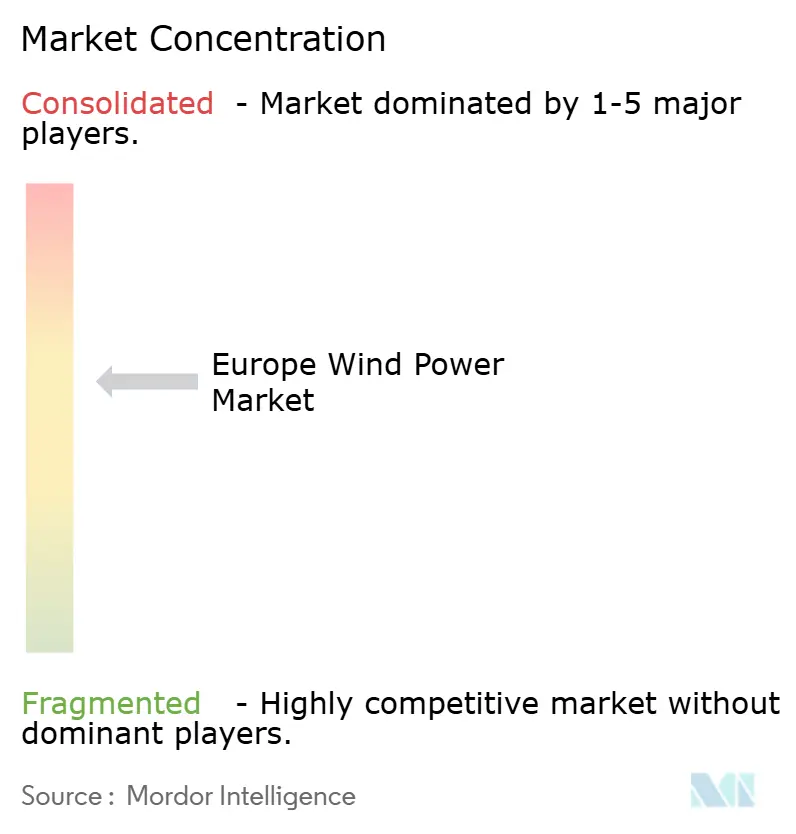
| Market Concentration | Medium |
Major Players *Disclaimer: Major Players sorted in no particular order Image © Mordor Intelligence. Reuse requires attribution under CC BY 4.0. | |
Europe Wind Power Market Analysis by Mordor Intelligence
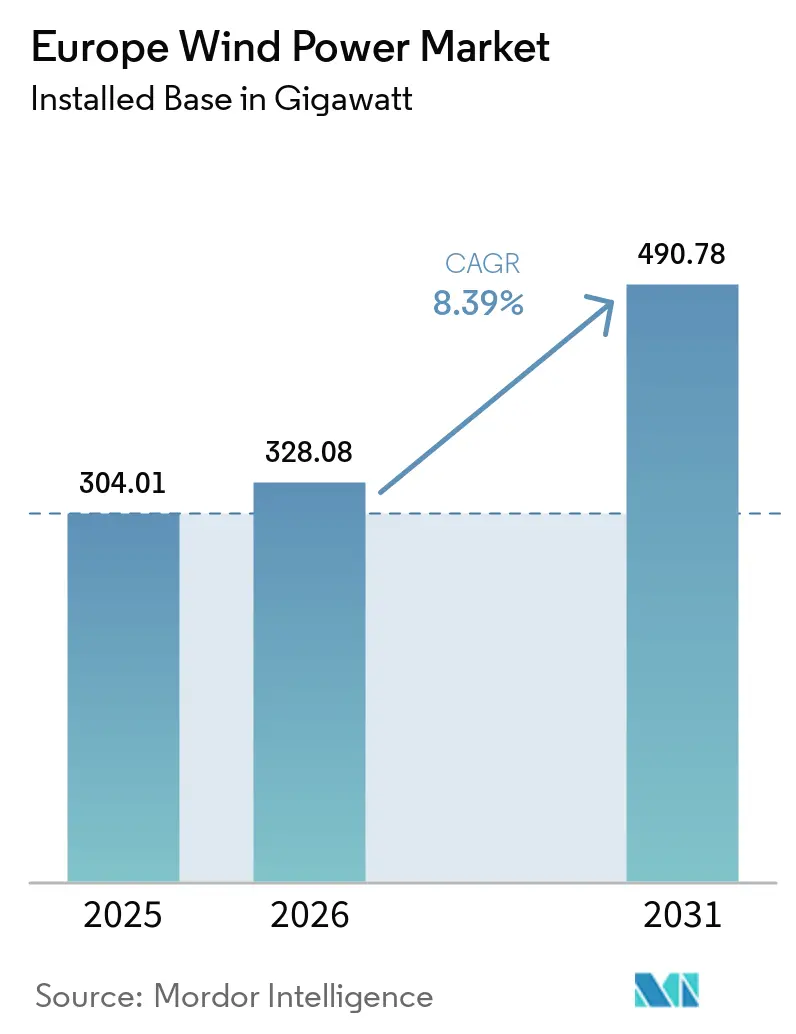
The Europe Wind Power Market size in terms of installed base is expected to grow from 304.01 gigawatt in 2025 to 328.08 gigawatt in 2026 and is forecast to reach 490.78 gigawatt by 2031 at 8.39% CAGR over 2026-2031. Energy security, renewable-energy policy, and industrial demand are supporting the buildout across the region. REPowerEU has made wind procurement more central to national energy planning, while corporate buyers are increasingly using long-term contracts to secure electricity supply. Grid limits, project financing, and auction terms still affect the pace at which approved projects reach construction. The largest opportunities extend beyond new sites to repowering older fleets, building offshore transmission links, and developing floating wind in deeper waters.
Key Report Takeaways
- By location, onshore wind held 87.3% of the Europe wind power market share in 2025, while offshore wind is forecast to grow at a 12.8% CAGR through 2031.
- By turbine capacity, the 3 to 6 MW category accounted for 51.1% of the Europe wind power market size in 2025, while turbines above 6 MW are projected to expand at a 15.8% CAGR through 2031.
- By application, utility-scale projects held 87.7% of the Europe wind power market share in 2025, while commercial and industrial installations are forecast to grow at a 15.4% CAGR through 2031.
- By geography, Germany accounted for 24.9% of installed capacity in 2025, while Poland is projected to record the fastest growth at a 17.5% CAGR through 2031.
Note: Market size and forecast figures in this report are generated using Mordor Intelligence’s proprietary estimation framework, updated with the latest available data and insights as of January 2026.
Europe Wind Power Market Trends and Insights
Drivers Impact Analysis*
| Driver | (~) % Impact on CAGR Forecast | Geographic Relevance | Impact Timeline |
|---|---|---|---|
| EU Renewable-Energy Targets and Energy-Security Procurement | +2.10% | EU-wide; concentrated near-term gains in Germany, Poland, France, and Spain | Short term (≤ 2 years) |
| Faster Permitting and Renewables Acceleration Areas | +1.60% | EU-wide; early implementation gains in Germany and the Nordics | Short term (≤ 2 years) |
| Corporate PPAs and Industrial Decarbonization Demand | +1.30% | North-West Europe core, spill-over to Poland and Spain | Medium term (2–4 years) |
| Repowering of Aging Onshore Fleets | +1.10% | Germany, France, Spain, Sweden — countries with early-2000s fleet build-outs | Medium term (2–4 years) |
| Cross-Border Offshore Grid and Hybrid Interconnector Buildout | +0.90% | North Sea and Baltic Sea nations; spill-over to the Baltic States | Long term (≥ 4 years) |
| Standardized Floating-Wind Platforms and Deepwater Access | +0.70% | France (Atlantic, Mediterranean), Spain, UK (West of Shetland) | Long term (≥ 4 years) |
| Source: Mordor Intelligence | |||
EU Renewable-Energy Targets and Energy-Security Procurement Drive Capacity Build
The Renewable Energy Directive III sets an EU-wide renewable-energy target of 42.5% by 2030, with a 45% ambition[1]. REPowerEU has linked wind deployment to energy security as well as climate policy. The European Commission reported that renewable sources generated nearly half of EU electricity by May 2025. It also reported that wind and solar capacity increased by 58% between 2021 and 2024, reducing gas demand by an estimated 38 billion cubic meters. The European Investment Bank has approved a EUR 5 billion package for wind manufacturing and installation, with the potential to support EUR 80 billion of wider investment. These measures provide a durable policy base for the Europe wind power market, even when individual national projects face delays.
Faster Permitting and Renewables Acceleration Areas Lower Lead Times
RED III requires member states to identify Renewable Acceleration Areas and simplify approvals for renewable-energy projects. The directive also calls for a digital single-point contact for permitting. These measures are important in Germany and Spain, where new wind projects have historically faced long development timelines. Existing sites can benefit most because their grid links and operating history are already established. VSB Group connected the 105.6 MW Elster repowering project in Germany to the grid in August 2025, using 16 Siemens Gamesa SG 6.6-155 turbines to replace 50 older turbines[2]. The repowered site is expected to generate 235 GWh annually, around 6 times the previous output, demonstrating the potential of modern turbine technology to significantly increase electricity generation at established wind sites.
Corporate PPAs and Industrial Decarbonization Demand Strengthen Bankability
Corporate power purchase agreements are becoming a more important source of project revenue in the European wind power market. In February 2026, TotalEnergies signed 2 clean firm power contracts with Airbus to supply 3.3 TWh of electricity to its major sites in Germany and the United Kingdom, with supply from new renewable assets beginning in 2027[3]. Vattenfall opened the 139 MW Bruzaholm wind farm in Sweden in May 2026, with AB Volvo contracting for part of its output. The agreement supports electricity supply for Volvo's planned Mariestad battery factory. Long-term contracts from industrial buyers can reduce reliance on state-backed auction support and strengthen financing cases. This model gives the Europe wind power market another route to construction when auction schedules or bid terms do not fit project costs.
Repowering of Aging Onshore Fleets Doubles Output on Existing Sites
Europe has a substantial stock of onshore wind projects approaching the end of their original operating life. WindEurope expects 49 GW of projects to reach 20 years of age or more by 2030, while a total of 75 GW will reach at least 20 years of age and require decisions on repowering, lifetime extension, or decommissioning. Repowering can use existing sites, connections, and local operating records, which lowers several development barriers. Statkraft completed the first phase of its Montes de Cierzo repowering in Spain in April 2026 by replacing 44 turbines with 10 newer units. The project achieved 98% waste recovery for decommissioned components. ACCIONA Energía replaced 98 turbines with 13 units at Tahivilla in Spain, increasing annual output by 72%[4].
Restraints Impact Analysis*
| Restraint | (~) % Impact on CAGR Forecast | Geographic Relevance | Impact Timeline |
|---|---|---|---|
| Grid Congestion and Curtailment | -0.80% | UK (Scotland), Germany, Spain, France; progressively affecting Poland and the Nordics | Short term (≤ 2 years) |
| Inflation, Interest Rates, and Auction-Design Risk | -0.70% | EU-wide; most acute in Germany, Denmark, and the Netherlands where auctions underperformed | Medium term (2–4 years) |
| Lengthy Permitting and Local Opposition | -0.50% | Germany, France, Italy — administrative and judicial delays persist for greenfield sites | Medium term (2–4 years) |
| Offshore Component and Port-Capacity Mismatch | -0.40% | North Sea heavy-lift and monopile supply chain; concentrated at German and UK ports | Long term (≥ 4 years) |
| Source: Mordor Intelligence | |||
Grid Congestion and Curtailment Erode Revenue Certainty
Grid congestion is limiting the volume of renewable electricity, including wind power, that can be delivered to consumers. Aurora Energy Research estimates that European grid congestion-management measures affected 72 TWh of generation in 2024 and cost EUR 8.9 billion, with most of the affected generation coming from renewables. EU analysis also indicates that delays and shortfalls in grid investment are contributing to transmission bottlenecks and restricting renewable integration in several markets. In Scotland, more than 10 TWh of renewable electricity was reportedly curtailed in 2025, according to Montel data reported by Energy Voice. In Germany, compensation paid to renewable generators for curtailed electricity was EUR 435 million in 2025, according to government figures. Curtailment can reduce project output and revenue, although the financial impact depends on compensation mechanisms and project contracting arrangements. Persistent grid constraints can also increase uncertainty in project production and revenue forecasts.
Inflation, Interest Rates, and Auction-Design Risk Trigger Bid Failures
Germany's August 2025 offshore wind auction received no bids, highlighting the effect of cost and financing pressure on project economics. Germany's Federal Cabinet approved an amendment to the WindSeeG in September 2026 that allows offshore projects to overbuild grid connections by 20% and extends standard operating life from 25 to 35 years. The revised rules are intended to improve the use of scarce grid capacity. The United Kingdom's Allocation Round 7 cleared at GBP 91.2/MWh in January 2026, with RWE securing contracts for 6.9 GW across 5 projects. These contrasting outcomes show that project pipelines depend on workable auction terms as well as demand for renewable power. Developers in the Europe wind power market are therefore placing greater weight on revenue design, indexation, and operating-life assumptions.
*Our forecasts treat driver/restraint impacts as directional, not additive. The impact forecasts reflect baseline growth, mix effects, and variable interactions.
Segment Analysis
By Location: Offshore Additions Accelerate as Onshore Consolidates
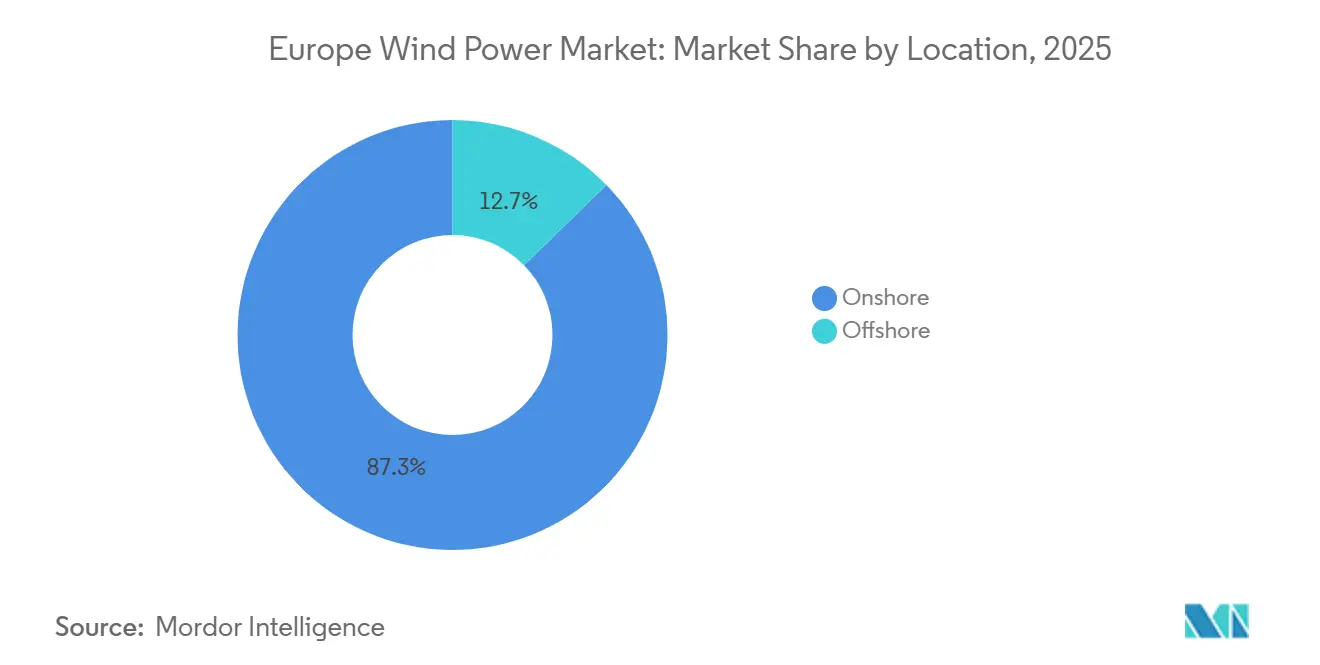
Onshore wind held 87.3% of the Europe wind power market size in 2025. Its installed base reflects decades of development in Germany, Spain, France, and the Nordic countries. Many assets are entering mid-life and create a practical pool for repowering. Poland, Italy, and the Baltic countries retain room for new projects because land-use saturation is lower. These factors keep onshore capacity central despite faster offshore growth.
Offshore wind is projected to grow at a 12.8% CAGR through 2031. Europe had 40.9 GW of installed offshore wind at the end of June 2026 after adding 2.3 GW during the first half of the year. Six projects with a combined capacity of 5.6 GW reached final investment decisions in 2025. Offshore development depends heavily on timely grid connections and workable auction terms. The EU Offshore Renewable Energy Strategy provides a long-term regional direction for this buildout.

By Turbine Capacity: Above 6 MW Platforms Reshape Project Economics
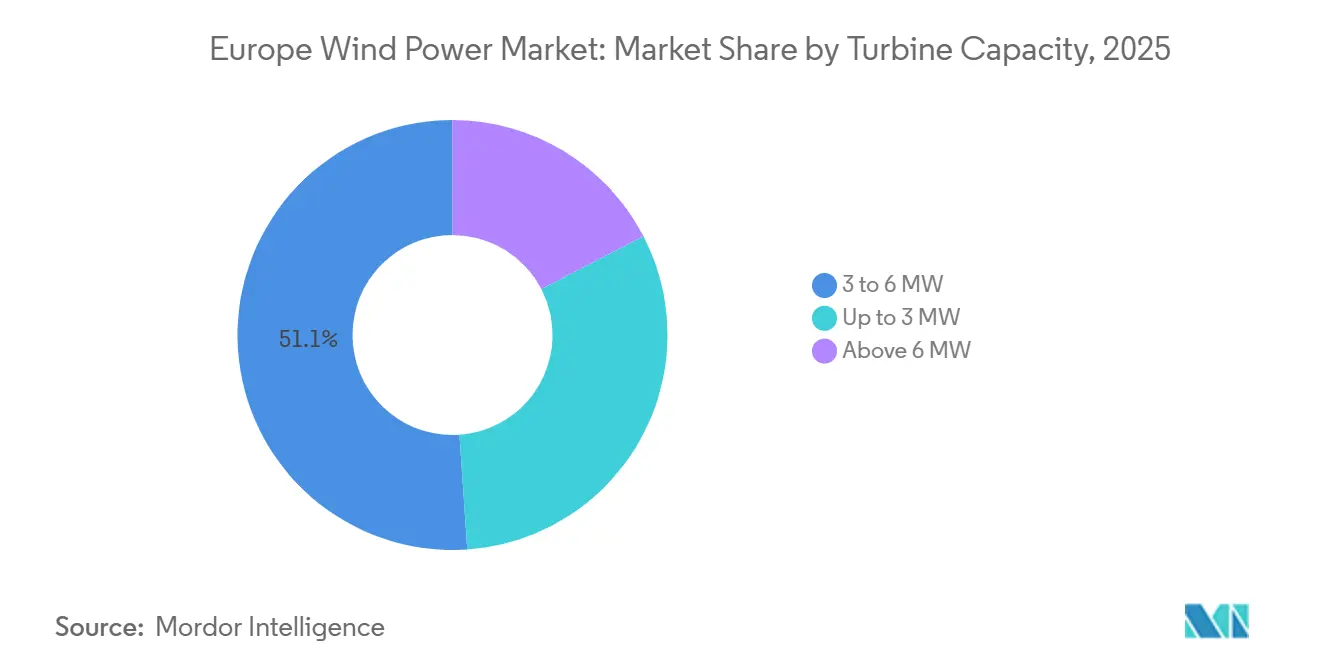
The 3 to 6 MW class accounted for 51.1% of the Europe wind power market share in 2025. It has been widely used in projects across Germany, Spain, Italy, and the United Kingdom. Smaller turbines are losing relevance as older farms reach end of life. Larger models produce more electricity per site and reduce the number of units requiring foundations and maintenance. This supports more productive repowering at established wind sites.
Turbines above 6 MW are forecast to grow at a 15.8% CAGR through 2031. Offshore developers use 15 MW-class machines to increase output per vessel visit. RWE selected 72 Siemens Gamesa SG 14-236 DD turbines, each with an operating capacity of up to 15 MW, for its 1.1 GW Thor project in Denmark. Larger onshore models are also moving into commercial use in Germany. The shift raises manufacturing and transport requirements but improves economics where balance-of-plant costs are high.
By Application: Utility-Scale Throughput Supports C&I Market Formation
Utility-scale projects held 87.7% of the Europe wind power market size in 2025. Their position reflects the efficiency of shared substations, dedicated grid links, and established revenue contracts. Offshore projects are usually utility-scale because export infrastructure and construction vessels require large capacity. Utility projects remain the main source of new installed volume across national programs. Their delivery remains exposed to grid availability and auction schedules.
Commercial and industrial installations are projected to grow at a 15.4% CAGR through 2031 as industrial buyers use power purchase agreements to manage electricity costs and support emissions commitments. Prologis and ENGIE agreed on a wind power purchase agreement for Polish logistics operations that began in January 2026 and covers 335 GWh over 5 years, or 67% of the sites' electricity demand. Community-led projects are generally smaller than utility-scale developments. In September 2026, Denmark removed its onshore wind turbine cap, eliminating a regulatory constraint on onshore wind development. The country also maintains schemes designed to support local participation and community benefits.
By Component (Qualitative Analysis): Supply Chain Strain Across the Value Chain
The turbine and nacelle segment is a critical supply constraint because major offshore orders require long manufacturing lead times. Lead times can extend 3 to 4 years before planned installation windows. Vestas, Siemens Gamesa, Nordex, GE Vernova, and ENERCON are central suppliers. Blade materials are changing as developers request designs that support recycling. In April 2026, RWE installed the world's first offshore wind turbine featuring a CO₂-reduced steel tower and recyclable rotor blades at its 1.1 GW Thor offshore wind farm in Denmark.
Towers for higher hub heights require heavy-steel capacity and specialized transport. Generator, gearbox, and high-voltage component availability can affect completion schedules. Offshore balance-of-system costs remain high for foundations, inter-array cables, and cable trenching. Port capacity is important because large components require heavy-lift handling and storage space. These requirements give equipment and service suppliers a stronger role in the Europe wind power industry.
Geography Analysis
Germany accounted for 24.9% of the Europe wind power market share in 2025. It connected 1,077 MW of offshore capacity in the first half of 2026, taking its operating offshore fleet to 10.8 GW. The 976.5 MW Gennaker offshore wind project in Germany's Baltic Sea is on track to enter commercial operation by the end of 2028. Germany's target of at least 70 GW of offshore wind capacity by 2045 remains unchanged in the September 2026 WindSeeG amendment proposal.
The United Kingdom is a leading offshore contract market during the forecast period. RWE secured 6.9 GW of contracts in Allocation Round 7 at GBP 91.2/MWh in January 2026. Scotland's curtailment challenge continues to affect project revenue and supports the case for grid reform. France published the AO10 offshore wind tender specifications in June 2026, covering 11 projects with a combined capacity of 10 GW, comprising 5 GW of fixed-bottom and 5 GW of floating offshore wind. Spain continued to support X1 Wind's floating wind technology in 2025, while the PLEMCAT site in Catalonia received environmental approval in 2026 for the installation of X1 Wind's pre-commercial platform under the NextFloat project.
Poland is forecast to grow at a 17.5% CAGR through 2031. Its December 2025 auction awarded 3.4 GW of offshore contracts to Baltic East, Baltica 9, and Bałtyk 1. First power is targeted for December 2032. Denmark's Thor project had 36 of 72 turbines installed by July 2026. Lithuania, Latvia, and Germany signed a declaration of intent in February 2026 to advance the 2 GW Baltic-German PowerLink, a proposed hybrid offshore interconnector designed to enable electricity exports and support the integration of up to 2 GW of offshore wind capacity in Lithuania and Latvia.
Competitive Landscape
The Europe wind power market is moderately concentrated among large developers and turbine suppliers. RWE, Iberdrola, Ørsted, Vattenfall, and Equinor hold important offshore pipelines. Vestas, Siemens Gamesa, Nordex, GE Vernova, and ENERCON supply much of the equipment base. Developers balance contracts for difference-backed assets with projects supported by corporate power purchase agreements.
Manufacturers compete through larger turbine platforms, service contracts, and delivery capacity. RWE installed the first Thor turbine with a carbon dioxide-reduced steel tower and recyclable blades in April 2026. RWE secured 6.9 GW of UK offshore wind Contracts for Difference in Allocation Round 7 in January 2026 and agreed a long-term partnership with KKR to jointly develop, construct, and operate the 3.1 GW Norfolk Vanguard East and Norfolk Vanguard West projects. GE Vernova has expanded its role through German turbine orders and offshore grid technology. These actions combine equipment, financing, and infrastructure capabilities.
Floating platforms, life-extension services, and community ownership offer room for new suppliers. The aging fleet supports demand for maintenance and repowering specialists. Large developers use procurement scale, while regional firms can compete through local development knowledge and service capacity. Competition remains active across equipment supply, project development, and long-term operations. The competitive position of each firm depends on access to projects, grid capacity, contracts, and manufacturing slots.
Europe Wind Power Industry Leaders
-
Vestas Wind Systems A/S
-
Nordex SE
-
Siemens Gamesa Renewable Energy, S.A.U.
-
ENERCON GmbH
-
GE Vernova Inc.
- *Disclaimer: Major Players sorted in no particular order
Recent Industry Developments
- September 2026: RWE installed the first monopile for the 795 MW OranjeWind offshore wind farm in the Dutch North Sea, a 50-50 joint venture with TotalEnergies, with full commissioning expected in 2028.
- July 2026: RWE confirmed that 36 of the 72 Siemens Gamesa 15 MW turbines were installed at the 1.1 GW Thor offshore wind farm off Denmark's west coast, with full installation expected by end-2026 and commissioning in spring 2027.
- June 2026: France published AO10 tender specifications for 10 GW of offshore wind across 11 projects, including 5 GW of fixed-bottom and 5 GW of floating capacity, with award decisions targeted for February 2027.
- May 2026: Vattenfall inaugurated the 139 MW Bruzaholm onshore wind farm in Sweden, comprising 21 Siemens Gamesa turbines and a 38 MW Fluence battery storage system, with AB Volvo contracting part of the output.
Research Methodology Framework and Report Scope
Market Definition and Coverage
This market is defined as the wind power installed base across Europe, measured in gigawatts (GW) of operational wind capacity. It covers the capacity in service across onshore and offshore wind projects within the covered European countries.
Scope exclusions: We exclude non-wind renewable capacity, electricity transmission and distribution assets, and the broader revenue pools of wind equipment manufacturing or O&M services unless they directly change installed wind capacity.
Segmentation Overview
- By Location
- Onshore
- Offshore
- By Turbine Capacity
- Up to 3 MW
- 3 to 6 MW
- Above 6 MW
- By Application
- Utility-scale
- Commercial and Industrial
- Community Projects
- By Component (Qualitative Analysis)
- Nacelle/Turbine
- Blade
- Tower
- Generator and Gearbox
- Balance-of-System
- By Geography
- Germany
- United Kingdom
- France
- Spain
- Italy
- Poland
- Sweden
- Denmark
- Rest of Europe
Data Sources, Market Sizing, and Validation
Desk Research
Desk research starts by building a clean view of Europe wind additions, cumulative installed capacity, and the policy pipeline that influences commissioning. For these inputs, we lean on public and official sources such as Eurostat energy statistics, ENTSO-E power system data, European Commission updates on renewables implementation and permitting, and national energy agency publications where country totals are clarified.
We also review trade association releases and datasets such as WindEurope statistics, plus regulatory and auction documents that indicate award volumes and expected commissioning windows. To keep the project and company context grounded, we use annual reports, investor presentations, and reputable press coverage of commissioning, repowering, and grid connection milestones. In a few places, paid subscriptions are used only for company financials and news screening, and for patent databases when technology shifts need to be checked. The desk sources listed here are illustrative, and additional references are used during data collection, cross-checking, and assumption clean-up.
Primary Interviews and Surveys
Primary interviews are used to validate how quickly capacity moves from awarded auctions into grid-connected assets, and where delays are most common (permitting, grid, supply constraints). We spoke with developers, EPC and service-side experts, component-side leaders, and advisors across major European wind markets, so the commissioning schedule assumptions and repowering rates stayed aligned with what is being executed on the ground.
Distribution of primary research fieldwork respondents
| Company type | Respondent position |
|---|---|
| Top tier: 33% | CXOs: 16% |
| Mid tier: 51% | Functional/Unit leaders: 33% |
| Smaller Players: 16% | Managers: 51% |
Market-Sizing & Forecasting
The core model is built using a top-down capacity stack, where country installed bases are reconstructed from historical additions, retirements, and expected commissioning from awarded pipelines. Those country totals are then rolled up to Europe, and split across onshore and offshore based on project commissioning and grid-connection timing.
To keep the numbers practical, we corroborate results with selective bottom-up approximations such as sampled project-by-project rollups for large offshore parks, and channel checks on annual additions versus turbine class mix (up to 3 MW, 3 to 6 MW, and above 6 MW). Key inputs used in the model include annual new installations (GW), decommissioning and repowering volumes, auction award volumes and expected delivery years, offshore grid-connection milestones, and country-level permitting and grid lead times. Where bottom-up detail is incomplete for smaller projects, gaps are handled using country historical shares and validated build-rate ranges from interviews.
For forecasting, scenario analysis is used around commissioning slippage and repowering acceleration, and the final path is chosen based on the most repeated expert consensus by country. This approach keeps the forecast tied to what can realistically be connected to the grid, not only announced capacity.
Data Validation & Update Cycle
Validation is done through several checks before numbers are finalized. Outputs are compared against independent signals such as Europe-wide installed capacity totals, annual installation run-rates, and publicly stated national targets, and then large variances are reviewed country by country.
When an anomaly appears, assumptions are revisited and we re-contact sources if the driver is a material change such as a policy shift, a grid constraint, or a major offshore commissioning delay. A multi-step analyst review is followed so that definitions, math, and unit consistency (GW vs additions) stay clean. Reports are refreshed annually, with interim updates when major events change the expected commissioning curve, and a final freshness pass is completed right before delivery.
Mordor Intelligence's Europe Wind Power Market Size Measured Against Other Published Estimates
Published estimates for Europe wind power do not always line up because the unit of measurement is not consistent, and the boundary between capacity and revenue is often mixed. Timing also matters because some sources use grid-connected capacity, while others track awarded pipelines or equipment spending, which can shift totals by year.
By tracking grid-connected installed base by country and refresh timing across auction and commissioning calendars, Mordor Intelligence is kept aligned to GW capacity in service, which differs from revenue-based views and from outlooks that emphasize only new annual additions.
Benchmark comparison
| Source | Market Size | Gaps in Research Methodology |
|---|---|---|
| Mordor Intelligence | USD 336.90 B (2026) | |
| Industry Association B | USD 285.00 B (2024) | Uses total installed capacity and annual additions reporting, with Europe and EU-27 definitions that can differ, and it does not present a market value series that maps cleanly into the 2026 to 2031 forecast window. |
| Regional Consultancy A | USD 30.36 B (2025) | Sized as a revenue market for the wind energy ecosystem (installation, integration, O&M), so the value reflects spending flows, not the installed capacity stock that grows each year. |
The spread in the table is mainly explained by what is being counted and in which year it is counted. When the scope is held to installed capacity versus spending, and when grid-connection timing is treated consistently across countries, the estimate becomes easier to reconcile with public capacity statistics and with the real commissioning pipeline.
Key Questions Answered in the Report
What is the forecast for Europe wind power capacity?
Capacity is projected to increase from 328.08 GW in 2026 to 490.78 GW by 2031, at an 8.39% CAGR.
Which location is growing fastest in European wind power?
Offshore wind is forecast to grow at a 12.8% CAGR through 2031, although onshore held 87.3% of installed capacity in 2025.
Why is offshore wind important in Europe?
Offshore projects can be built at large scale and are supported by national tenders, corporate contracts, and regional grid plans.
Which country is expected to grow fastest through 2031?
Poland is projected to record a 17.5% CAGR, supported by its 3.4 GW offshore auction in December 2025.
What are the main constraints on wind project delivery?
Grid congestion, curtailment, financing costs, auction terms, permitting delays, and supply-chain capacity can slow delivery.
How is repowering changing European wind development?
Repowering replaces older turbines with fewer, larger units, allowing higher output from sites with existing grid links and operating history.