
Market Overview
| Study Period | 2020 - 2031 |
|---|---|
| Forecast Data Period | 2026 - 2031 |
| Base Year Market Size (2025) | USD 180.95 Billion |
| Market Size (2026) | USD 193.12 Billion |
| Market Size (2031) | USD 271.49 Billion |
| Growth Rate (2026 - 2031) | 7.05 % |
| Market Concentration | Low |
Major Players
*Disclaimer: Major Players sorted in no particular order Image © Mordor Intelligence. Reuse requires attribution under CC BY 4.0. |
|
Europe Textile Market Analysis by Mordor Intelligence
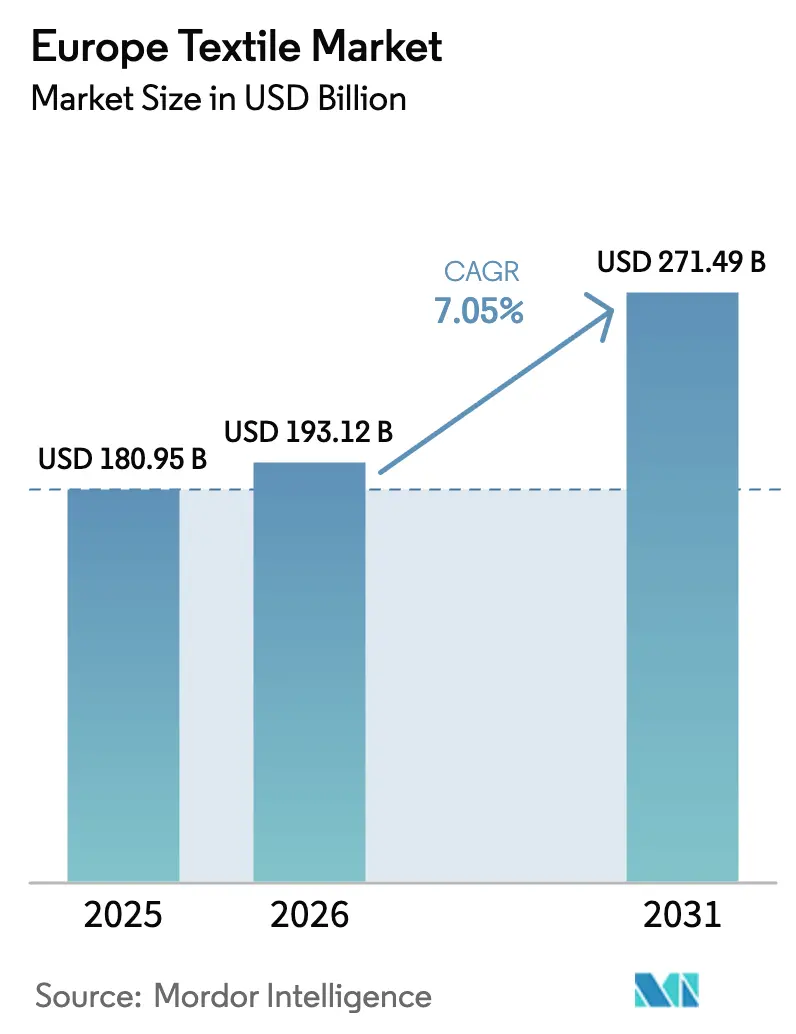
The Europe Textile Market size is projected to expand from USD 180.95 billion in 2025 and USD 193.12 billion in 2026 to USD 271.49 billion by 2031, registering a CAGR of 7.05% between 2026 to 2031.
Circular-economy legislation, quicker fashion cycles, and surging demand for technical fabrics are the pivotal forces shaping the European textile market. Mandatory separate textile-waste collection across the EU-27, together with the phased launch of the Digital Product Passport, is channeling capital toward recycling plants and traceability tools. E-commerce platforms have cut design-to-shelf lead times to under four weeks, prompting mills to adopt digital knitting, automated dye kitchens, and near-infrared sorting. Investment is also shifting to high-margin applications such as flame-retardant fabrics for electric-vehicle battery enclosures and geotextiles for rail and road upgrades. At the same time, demand for locally cultivated flax, hemp, and wool is rising as brands highlight reduced transport footprints and “made-in-Europe” fiber stories.
Key Report Takeaways
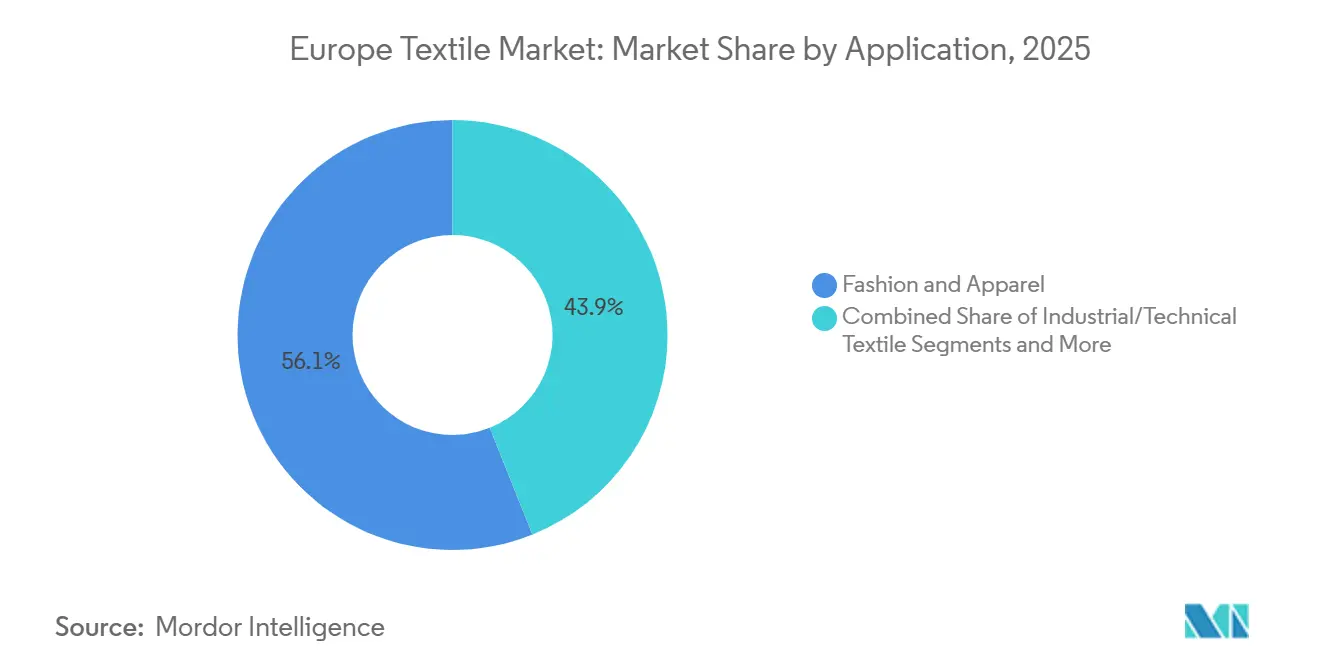
- By application, fashion and apparel held 56.06% of the European textile market share in 2025, while industrial and technical textiles are forecast to expand at a 6.15% CAGR through 2031.
- By raw material, synthetic fibers accounted for 53.96% of the European textile market size in 2025, with polyester alone projected to register a 6.56% CAGR between 2026 and 2031.
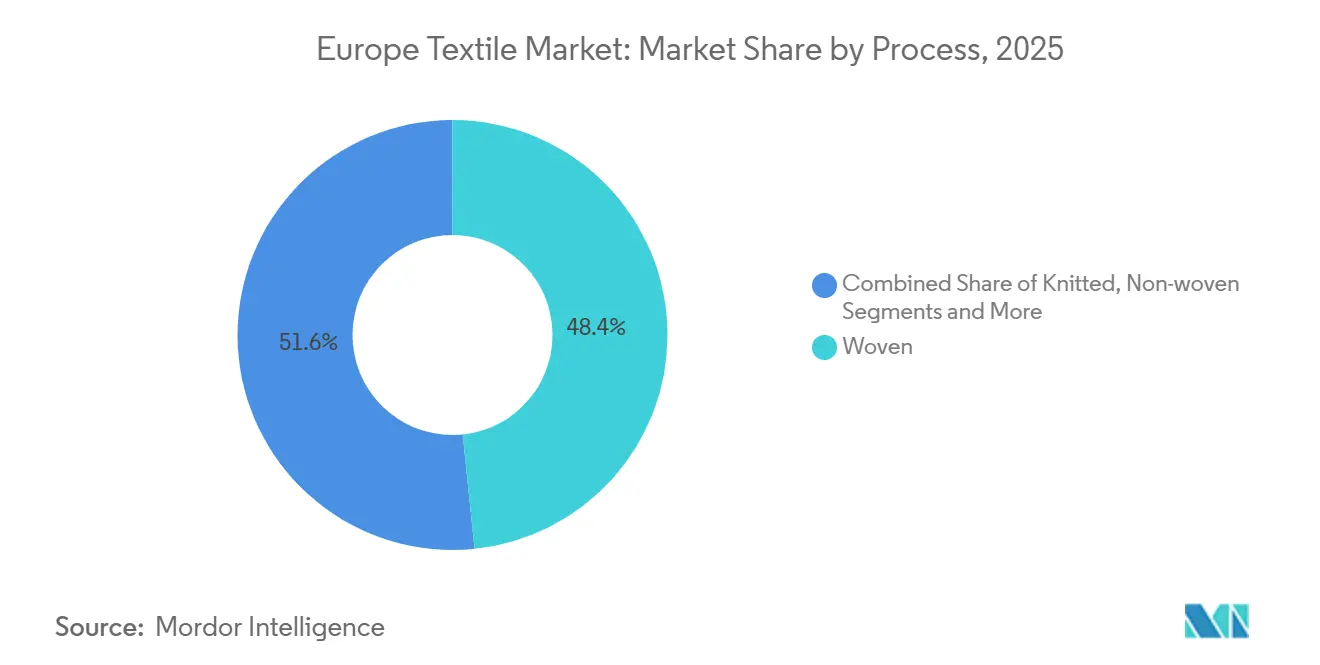
- By process, woven fabrics contributed 48.36% revenue in 2025, whereas non-woven technologies are anticipated to post a 6.05% CAGR to 2031.
- By geography, Germany captured 25.45% of the European textile market share in 2025, and Spain is set to record the fastest growth at 5.8% CAGR through 2031.
Note: Market size and forecast figures in this report are generated using Mordor Intelligence’s proprietary estimation framework, updated with the latest available data and insights as of January 2026.
Market Trends and Insights
Drivers Impact Analysis of Europe Textile Market*
| Drivers | (~) % IMPACT ON CAGR FORECAST | Geographic Relevance | Impact Timeline |
|---|---|---|---|
| Mandatory Separate Collection of Textile Waste Across EU-27 from 2025 | +1.5% | EU-27 | Medium term (2–4 years) |
| Growth of High-Performance Technical Textiles for Mobility and Infrastructure | +1.3% | Germany, France, Nordics | Long term (≥ 4 years) |
| Rapid Changes in Fashion Cycles and Rise of Fast Fashion | +1.2% | Spain, Italy, Portugal | Short term (≤ 2 years) |
| EU Digital Product Passport Enabling Data-Rich Circular Business Models | +1.0% | EU-27 | Medium term (2–4 years) |
| E-Commerce and Social-Commerce Platforms Shortening Design-to-Shelf Lead Times | +0.9% | Germany, France, UK | Short term (≤ 2 years) |
| Demand Surge for Europe-Grown Flax, Hemp, and Wool as Low-Carbon Local Fibers | +0.8% | France, Belgium, Netherlands | Medium term (2–4 years) |
| Source: Mordor Intelligence | |||
Mandatory Separate Collection of Textile Waste Across EU-27 from 2025
From January 2025, all municipalities were required to install dedicated textile-collection points, redirecting roughly 5 million tonnes of garments per year into European sorting hubs[1]European Commission, “Waste Framework Directive,” environment.ec.europa.eu. Early movers such as France and the Netherlands achieved collection rates above 60% by pairing curbside bins with social-enterprise partners. The regulation exposed a shortfall: Europe had fewer than 50 automated sorting lines in mid-2025, so investors committed USD 870 million to new plants in Poland, Spain, and Portugal. Producers now face eco-modulation fees, pushing them to design mono-material garments with detachable trims. Over the medium term, the collection mandate is expected to lift recycled-fiber availability and underpin circular supply contracts.
Growth of High-Performance Technical Textiles for Mobility and Infrastructure
Electric-vehicle makers increased technical-textile content to more than 12 kg per car in 2025, replacing steel in battery enclosures with carbon-fiber composites for weight savings. EU states earmarked USD 130 billion for rail and highway upgrades, lifting demand for geotextiles that stabilize soil and reduce asphalt thickness. Hospitals mandated washable barrier fabrics that meet ISO 16604, driving purchases of flame-retardant and antimicrobial materials. Patent filings for hybrid spacer-composite architectures rose 18% in 2024, signaling fresh R&D spend[2]European Patent Office, “Patent Statistics 2024,” epo.org. The long-term driver pulls investment toward ultra-high-molecular-weight polyethylene and aramid filaments that earn margins three to five times those of commodity polyester.
Rapid Changes in Fashion Cycles and Rise of Fast Fashion
Ultra-fast fashion platforms now post new styles every 48 hours, forcing European mills to switch from six-month production runs to micro-batches of 500–1,000 meters. Digital printing, automated cutting, and in-house dyeing allow vertically integrated groups to meet next-day orders, while contract weavers risk cancellation if they miss narrow delivery windows. Between 2023 and 2025, European apparel brands raised SKU counts by 35%, yet overall unit sales stayed flat, showing a pivot to variety over volume. A consumer backlash is emerging at the premium end, where “slow fashion” labels that offer repair services and fiber disclosure are gaining traction. The driver raises velocity expectations but also enlarges niches for traceable, durable fabrics.
EU Digital Product Passport Enabling Data-Rich Circular Business Models
The Ecodesign for Sustainable Products Regulation introduces a phased Digital Product Passport, requiring every textile to carry embedded traceability data by 2030[3]European Commission, "Ecodesign for Sustainable Products Regulation," commission.europa.eu. Pilot projects already link QR codes to supply-chain records, enabling resale marketplaces, rental platforms, and repair networks to verify fiber content and care history. Early adopters gain brand trust and premium pricing, while laggards risk exclusion from regulated markets. The passport also underpins producer-responsibility fees, rewarding mono-material construction that simplifies end-of-life recycling. Over the medium term, data-rich garments are expected to unlock secondary revenue streams and tighten material loops.
Restraints Impact Analysis of Europe Textile Market*
| Restraints | (~) % IMPACT ON CAGR FORECAST | Geographic Relevance | Impact Timeline |
|---|---|---|---|
| Volatile energy and raw-material prices squeezing low-margin producers | -0.8% | EU-27 | Short term (≤ 2 years) |
| High capex requirement for state-of-the-art recycling and sorting capacity | -0.6% | Western Europe | Medium term (2–4 years) |
| Skilled-labor shortages in dyeing, finishing, and advanced weaving | -0.5% | Germany, Italy, France | Long term (≥ 4 years) |
| Fragmented SME base complicating compliance with new EU due-diligence rules | -0.4% | Italy, Spain, Portugal | Medium term (2–4 years) |
| Source: Mordor Intelligence | |||
Volatile Energy and Raw-Material Prices Squeezing Low-Margin Producers
Natural-gas costs peaked at USD 130 per MWh in early 2024 before sliding to USD 43 in late 2025, unsettling dyehouses where energy can reach 70% of operating costs. Crude swings of USD 10 per barrel drove 8% moves in polymer prices, while cotton futures oscillated between USD 75 and USD 95 per pound. SMEs without hedging tools saw margins evaporate, prompting asset sales in Poland and Romania. Cost-plus contracts that share risk remain rare outside deep partnerships. Price instability, therefore, threatens capacity and fuels consolidation.
High Capex Requirement for State-of-the-Art Recycling and Sorting Capacity
A 20,000-tonne fiber-to-fiber plant demands up to USD 87 million, including near-infrared sorting and chemical-depolymerization reactors. Banks insist on offtake deals and government co-investment, slowing project finance. Public grants worth USD 1.3 billion have been pledged but move slowly through permitting channels. SME operators cannot absorb USD 5 million AI-sorting lines, widening the technology gap. The funding hurdle will constrain recycled-fiber supply until at least 2027.
*Our forecasts treat driver/restraint impacts as directional, not additive. The impact forecasts reflect baseline growth, mix effects, and variable interactions.
Europe Textile Market Segment Analysis
By Application:
Industrial Textiles Outpace Fashion’s Volume BaseIn 2025, the fashion and apparel segment represented a significant majority of the overall Europe textile market, accounting for 56.06% of the total market size. The fastest-growing technical segment is forecast to clock a 6.15% CAGR through 2031, buoyed by electric-vehicle interiors, medical barrier fabrics, and geotextile reinforcement. German automakers used more than 12 kg of technical textiles per vehicle in 2025, up from 9 kg in 2020, to lighten battery platforms. Hospitals mandated ISO 16604-compliant drapes, expanding medical-textile contracts. Protective workwear profits from stricter flame-retardant rules, and sportswear integrates conductive yarns that capture biometric data, backed by 18% growth in smart-textile patents in 2024.
Premium fashion labels pivot to direct-to-consumer sites and store events, yet mid-market apparel grapples with ultra-fast competitors that post styles every two days. This bifurcation encourages mills to balance staple apparel orders with high-margin technical contracts. Regional production also realigns: Italy continues to anchor luxury shirting, while Germany and France lead technical-fabric R&D for automotive and aerospace partners. Over the forecast horizon, the Europe textile market will rely on industrial demand to offset slower apparel volumes.



By Raw Material:
Polyester Leads Synthetic ResurgenceSynthetic fibers dominated with 53.96% of the Europe textile market share in 2025, and polyester alone is predicted to post a 6.56% CAGR to 2031. Glycolysis and methanolysis plants backed by Lenzing and Indorama plan to add 200,000 tonnes of recycled-polyester output by 2028, elevating circular content without sacrificing yarn strength. Nylon and acrylic hold niche positions in airbags and outdoor upholstery. Natural fibers remain stable in volume but shift toward certified premium grades; European mills pay 15–25% premiums for organic cotton to satisfy brand pledges. Locally grown flax and hemp supply chain security and lower emissions, aligning with the EU Green Deal. Specialty fibers such as aramid and ultra-high-molecular-weight polyethylene deliver margins up to five times higher than commodity polyester, attracting R&D and venture funding.
Pre-consumer cutting waste and post-consumer garments represent a small but fast-rising recycled-fiber pool. The EU waste-collection mandate could channel 5 million tonnes yearly into sorting hubs, yet blend complexity means only 20% can be recycled at scale today. Chemical-recycling investments aim to lift that rate over the decade, supporting recycled-content targets embedded in brand scorecards.
By Process:
Non-Woven Innovation Challenges Woven MaturityWoven fabrics still generated 48.36% of process-based revenue in 2025, but non-woven technologies are forecast to accelerate at a 6.05% CAGR between 2026 and 2031. Spunbond and meltblown lines added since 2024 serve HVAC filters and EN 14683 medical-barrier fabrics, riding sustained public-health awareness. Hydroentangled webs enjoy demand in household wipes for softness and absorbency, while needle-punched mats secure automotive carpeting contracts. Woven mills face Asian price pressure, pushing them to differentiate through jacquard designs and traceable yarns.
Digital warp-knit machines, capable of mass customization with near-zero waste, support on-demand fashion factories in Portugal and Spain. Three-dimensional weaving for spacer fabrics grew on the back of German and Swiss equipment breakthroughs that cut labor costs by 40%. Wet-laid non-wovens cater to battery separators and high-performance filters, commanding high unit value despite modest tonnage. Automation, robotic material handling, and AI vision inspection raise capex but reduce variable costs, advantaging vertically integrated groups.
Geography Analysis
Germany Textile Market
Germany captured 25.45% of the Europe textile market size in 2025, driven by automotive and industrial-textile clusters in Baden-Württemberg and North Rhine-Westphalia. Close links to OEMs speed sample approval for seat covers, airbags, and battery housing fabrics. Federal apprenticeship programs combine craft skills with digital process control to ease labor shortages. Energy-efficiency grants help mills cut gas consumption in dyehouses.
Spain Textile Market
Spain is the fastest-growing market with a 5.8% CAGR expected through 2031. Government incentives encourage the reshoring of cut-and-sew from North Africa, while EU recovery funds subsidize machinery upgrades. Proximity to Morocco and Tunisia allows flexible sourcing, and Spanish e-commerce brands rely on local mills to replenish micro-collections within days. Textile clusters in Catalonia and Valencia also pilot near-infrared sorting lines for post-consumer waste.
Broader European Markets
Italy retains a commanding position in luxury and technical fabrics. Lombardy mills supply premium shirting and merino knits, whereas Veneto focuses on carbon-fiber prepregs for aerospace. Patent filings surpassed 200 in 2024, the highest in Europe. France combines heritage fashion with non-woven innovation and dominates flax cultivation, exporting to mills across Belgium and the Netherlands. BENELUX countries excel in spunbond and circular-business pilots, while Nordic firms trial wood-based fibers. Central and Eastern European nations offer low-cost weaving capacity but face skilled-labor constraints and energy volatility.
Regulatory Landscape
EU textile regulation is tightening around circularity and transparency, with the European Commission using the Ecodesign for Sustainable Products Regulation (ESPR), in force since 18 July 2024, as the framework for product-level sustainability requirements. This includes a phased rollout of Digital Product Passports supported by CEN-CENELEC standardization work (JTC24). A near-term trigger is the targeted revision of the Waste Framework Directive, which entered into force on 16 October 2025 and introduces mandatory Extended Producer Responsibility (EPR) schemes for textiles and footwear, with Member States working through transposition and operational setup timelines.
Implementation milestones extend into 2026: the ESPR ban on the destruction of unsold clothing, clothing accessories, and shoes applies from 18 July 2026, and requirements under the Directive on common rules promoting the repair of goods apply from 27 September 2026. Together with eco-modulation mechanisms linked to design-for-recyclability and data disclosure, these measures are pushing brands and mills to shift assortment design toward mono-material construction, expand repair and take-back channels, and invest in traceability systems that can populate product passports and support EPR reporting.
Value Chain Analysis
The European textile value chain spans raw material supply (natural fibers such as flax, hemp, wool, and imported cotton; synthetics and specialty high-performance fibers), upstream fiber and yarn producers, fabric manufacturing (woven, knitted, and non-woven), wet processing (dyeing and finishing), garment making and technical converting, and downstream distribution through brands, wholesalers, and e-commerce. Circularity creates parallel flows across collection and sorting operators, reuse channels, mechanical and chemical recyclers, technology providers (near-infrared sorting, digital knitting, AI inspection, traceability platforms), and Producer Responsibility Organisations (PROs) that coordinate EPR funding and reporting. The EU textile and clothing sector is highly fragmented, with about 197,000 companies employing around 1.3 million people and generating EUR 170 billion turnover in 2023, which affects how quickly firms can adopt capex-heavy upgrades.
Bottlenecks cluster around cost and capability gaps. Energy- and labor-intensive wet processing remains sensitive to utility price swings, while recycled-fiber economics are constrained by a persistent price gap versus virgin inputs and limited automated sorting and fiber-to-fiber recycling capacity. The regulatory push (EPR under the revised Waste Framework Directive and ESPR-linked Digital Product Passport obligations with staged implementation starting in 2026) is reweighting value creation toward verified data at source, auditable chain-of-custody, and end-of-life solutions. Mapping work published by the TexMat consortium (May 2026) highlights dependencies among nine stakeholder groups in the circular textile ecosystem, reinforcing that material and financial flows increasingly hinge on interoperable data and long-term offtake agreements that de-risk recycling investments.
Competitive Landscape
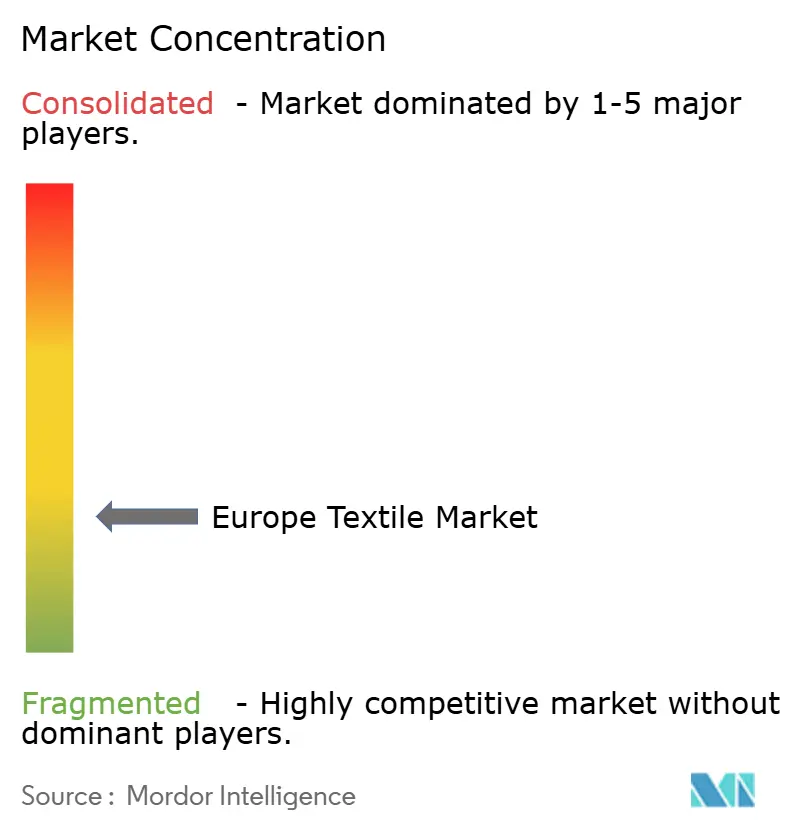
Competition remains fragmented; the ten largest producers hold under 30% combined share, giving the European textile market a low concentration profile. Commodity segments, basic apparel fabrics, and standard non-wovens battle shrinking margins due to Asian imports and energy swings. High-performance technical textiles and luxury fabrics, however, command premiums owing to proprietary know-how and brand partnerships.
Strategic moves center on vertical integration and circular scale-ups. Lenzing’s 2025 buyout of a chemical-recycling startup secures mono-ethylene glycol feedstock for lyocell lines. Indorama Ventures acquired a Spanish depolymerization plant capable of turning 30,000 tonnes of polyester waste into virgin-grade pellets, locking in recycled content for European yarns. Freudenberg teamed with a German OEM to co-develop aramid non-woven battery enclosures, targeting a 25% weight cut over steel.
Disruptors attack niches. Enzymatic-recycling startups promise lower-temperature depolymerization. Digital-knitting platforms accept orders as small as 100 meters, reducing inventory risk for fashion labels. Swiss research tie-ups produce conductive yarns that embed biometric sensors into garments, opening medical and sportswear channels. Compliance readiness is also a competitive lever: mills that implement Digital Product Passport data layers and AI-sorting ahead of 2025 waste rules will win supply contracts, while laggards risk disqualification.
Europe Textile Industry Leaders
-
Lenzing AG
-
Freudenberg Performance Materials
-
Indorama Ventures (M&G Fibras Europe)
-
Albini Group
-
Marzotto Group
- *Disclaimer: Major Players sorted in no particular order
Europe Textile Market Companies Covered in this Report
- Lenzing AG
- Freudenberg Performance Materials
- Indorama Ventures (M&G Fibras Europe)
- Albini Group
- Marzotto Group
- Klopman International
- Schoeller Textil AG
- Borgers SE & Co. KG
- Ahlstrom-Munksjö
- Beaulieu Technical Textiles
- Don & Low Ltd
- ITV Denkendorf Produktservice
- Holland & Sherry
- Gebrüder Otto
- TWE Group
- PFNonwovens Czech s.r.o
- HUESKER Synthetic GmbH
- Tirotex Textile Company
- Baltex
- Statex Produktions GmbH

Market Opportunities and Future Outlook
Compliance-driven circularity creates whitespace for infrastructure and services that connect collection, sorting, reuse, and recycling into bankable supply contracts. The revised Waste Framework Directive, in force from 16 October 2025, mandates EPR schemes for textiles and footwear, while ESPR, in force since 18 July 2024, tightens product-level sustainability and introduces the 18 July 2026 ban on destroying unsold apparel. This raises the value of repair, recommerce, and take-back channels that can document outcomes. With the Digital Product Passport workstream moving through phased implementation supported by CEN-CENELEC JTC24 standardization activity, demand is building for interoperable traceability stacks, supplier verification tools, and data integration that can serve both passport disclosure and EPR reporting across fragmented SME supply bases.
Manufacturing modernization is also pulling investment toward nearshoring-enabling technologies and higher-margin end uses. In 2026, Durst Group backed the Durst Como industrial hub for digital textile printing with a EUR 20 million investment (June 2026), and Alchemie Technology announced Project Wave in Portugal to deploy digital jet precision dyeing and finishing systems (EUR 15 million, May 2026). These projects target shorter lead times, lower resource use, and batch flexibility for fast fashion and on-demand production. On the demand side, technical textiles keep widening the addressable mix for European mills, from EV and infrastructure applications to medical textiles, where URGO Group announced a EUR 60 million investment to build a 35,000 sq m factory for medical textiles in Frances Loire region (January 2026), supporting capacity build-out in regulated, specification-driven segments.
Recent Industry Developments in Europe Textile Market
- June 2026: Durst Group launched the Durst Como project in Italy, positioning it as an industrial hub for digital textile printing backed by a EUR 20 million investment. The move strengthens regional capability for short runs and high-mix production, supporting faster replenishment models used by European fashion and specialty fabric converters.
- May 2026: Alchemie Technology announced Project Wave, a EUR 15 million investment in Portugal to deploy digital jet precision dyeing and finishing systems. By targeting water, chemical, and energy-intensive wet processing steps, the project supports on-shored production economics and compliance-focused process modernization for European mills and finishers.
- September 2024: Freudenberg Performance Materials acquired major parts of the Heytex Group, adding coated technical textile capabilities and broadening its portfolio in industrial applications. The transaction increased scale in engineered performance materials used across mobility, architecture, and protective end markets, strengthening a higher-value segment of the European textile ecosystem.


Europe Textile Market Report Scope and Research Methodology
Market Definition and Coverage
For this report, the Europe textile market is defined as the value of textiles produced and consumed across European countries, covering major fiber inputs and fabric formation routes, and the downstream textile output used in apparel, home, and technical end uses.
Scope exclusions: This sizing excludes finished apparel retailing value and focuses on textiles and textile products rather than full fashion brand revenues.
Segments Covered in This Report
-
By Application
- Fashion & Apparel
- Industrial/Technical Textiles
- Household & Home Textiles
- Medical & Healthcare Textiles
- Automotive & Transport Textiles
- Others (Protective, Sports Textiles, etc.)
-
By Raw Material
-
Natural Fibers
- Cotton
- Wool
- Silk
-
Synthetic Fibers
- Polyester
- Nylon
- Rayon / Viscose
- Acrylic
- Polypropylene
- Recycled Fibers
- Others (Speciality High-Performance Fibers (Aramid, Carbon, UHMWPE))
-
Natural Fibers
-
By Process / Technology
- Woven
- Knitted
-
Non-woven
- Spunlaid (Spunbond / Melt-blown)
- Dry-laid Hydro-entangled
- Wet-Laid
- Needle-punched
- 3-D Weaving & Spacer Fabrics
-
By Geography
- United Kingdom
- Germany
- France
- Italy
- Spain
- BENELUX (Belgium, Netherlands, and Luxembourg)
- NORDICS (Denmark, Finland, Iceland, Norway, and Sweden)
- Rest of Europe
Data Sources, Market Sizing, and Validation
Desk Research
Desk research was used to set the base market structure and to sanity check the direction of change in demand and trade across Europe. The sources included public statistics and industry publications such as Eurostat industrial production and trade series, UN Comtrade trade data, OECD indicators, European Commission policy notes on textiles and circularity, and association releases such as EURATEX facts and key figures.
To connect these data points to market value, we also reviewed company annual reports, investor presentations, and credible press coverage to understand capacity additions, closures, and material shifts. Where useful, paid subscriptions for company financials and news intelligence supported quick cross-checks on revenue mixes and geography exposure. The desk sources cited above are illustrative, and additional public and paid references were also used for data collection, validation, and clarification.
Primary Interviews and Surveys
Primary work was carried out through expert interviews and structured surveys with manufacturers, converters, distributors, and large buying organizations that source textiles for apparel, home, automotive, and technical uses. The respondent input was used to validate pricing logic, utilization trends, and the practical split between woven, knitted, and non-woven demand. Where responses showed large variance across Western Europe and emerging manufacturing pockets, we rechecked assumptions and adjusted the ranges used in the model.
Distribution of primary research fieldwork respondents
| Company type | Respondent position |
|---|---|
| Top tier: 30% | CXOs: 14% |
| Mid tier: 53% | Functional/Unit leaders: 41% |
| Smaller Players: 17% | Managers: 45% |
Market-Sizing & Forecasting
The market model starts from a top-down build where production, trade flows, and apparent consumption signals are reconstructed for Europe, then translated into value using blended pricing benchmarks by fiber and fabric type. Those totals are corroborated with selective bottom-up approximations, including sampling supplier revenue exposure, checking typical output per facility type, and using volume by fabric route times average selling price to adjust totals where needed.
Key inputs used in the model include textile output trends by country, import and export balances for textile categories, shifts in fiber mix (cotton, wool, polyester, viscose, recycled fibers), changes in non-woven penetration in hygiene and medical uses, and energy and input cost pass-through patterns that influence pricing. When a specific subcategory had weak public visibility, we handled the gap using conservative volume proxies and interview-led ranges, then aligned it back to the parent totals.
For forecasting, scenario analysis was used with a central case guided by expert consensus on demand recovery, capacity utilization, and sustainability related material shifts, followed by sensitivity tests around trade intensity and pricing progression. Results were kept traceable so another analyst can reproduce the output with the same data series and assumption set.
Data Validation & Update Cycle
Validation is done through stepwise cross-checks so the final numbers remain consistent with real economy signals across Europe. We compare outputs with independent indicators such as industrial production direction, trade balance movements, and stated capacity changes, then investigate any spikes that do not match supporting evidence.
Before sign-off, the model is reviewed across multiple analyst checks, and follow-up calls are triggered when interview feedback materially contradicts desk signals. Reports are refreshed annually, and interim updates are made when major events occur, such as policy shifts, trade disruptions, or large capacity moves. Right before delivery, a fresh pass is completed so clients receive the latest updated view.
Mordor Intelligence's Europe Textile Market Sizing Compared With Other Published Estimates
Published market sizes for Europe textiles can differ even when they sound like they measure the same thing, because each publisher draws the line around scope and timing in its own way. Differences also come from how prices are built into the model and whether trade and production data are used as hard constraints.
The benchmark table shows a tighter 2025 value than some wider figures, and in Mordor Intelligence's model the count stays at textiles and textile products across Europe, with value built from fiber and fabric formation level pricing rather than adding finished apparel retail markups.
Benchmark comparison
| Source | Market Size | Gaps in Research Methodology |
|---|---|---|
| Mordor Intelligence | USD 180.95 B (2025) | |
| Regional Consultancy A | USD 187.59 B (2025) | Uses a broader country list and category mapping that can fold adjacent clothing value into textiles, and it applies a lower-growth, longer horizon that can compress near-term pricing adjustments. |
| Industry Publisher B | USD 261.70 B (2024) | Reports an earlier base year and appears to include a wider basket of textile-related products with higher average pricing assumptions, which can lift the total when converted into USD and rolled forward. |
Across the three figures, the spread is mainly explained by what is counted as textile value versus downstream clothing value, plus year selection and how price progression is handled. By keeping the inputs tied to observable production and trade signals, then pressure-testing them with interview ranges, our estimate stays easier to reconcile with the demand pool that buyers in the region actually manage.


Key Questions Answered in the Report
How big is the Europe textile market in 2026?
The Europe textile market size reached USD 193.12 billion in 2026.
What is the expected CAGR for European textiles to 2031?
The overall market is forecast to grow at a 7.05% CAGR between 2026 and 2031.
Which segment is growing fastest within European textiles?
Industrial and technical textiles are projected to rise at a 6.15% CAGR, outpacing apparel.
Which raw material leads in market share?
Synthetic fibers dominate with 53.96% share, led by polyester.
Which EU country is the largest contributor by revenue?
Germany contributed 25.45% of regional revenue in 2025 thanks to its automotive cluster.
What regulatory change most affects circularity goals?
The mandatory separate collection of textile waste across the EU-27 starting in January 2025 drives investment in recycling infrastructure.
Page last updated on:


 Your data is secure and never sold or shared.


