
Market Overview
| Study Period | 2021 - 2031 |
|---|---|
| Forecast Data Period | 2026 - 2031 |
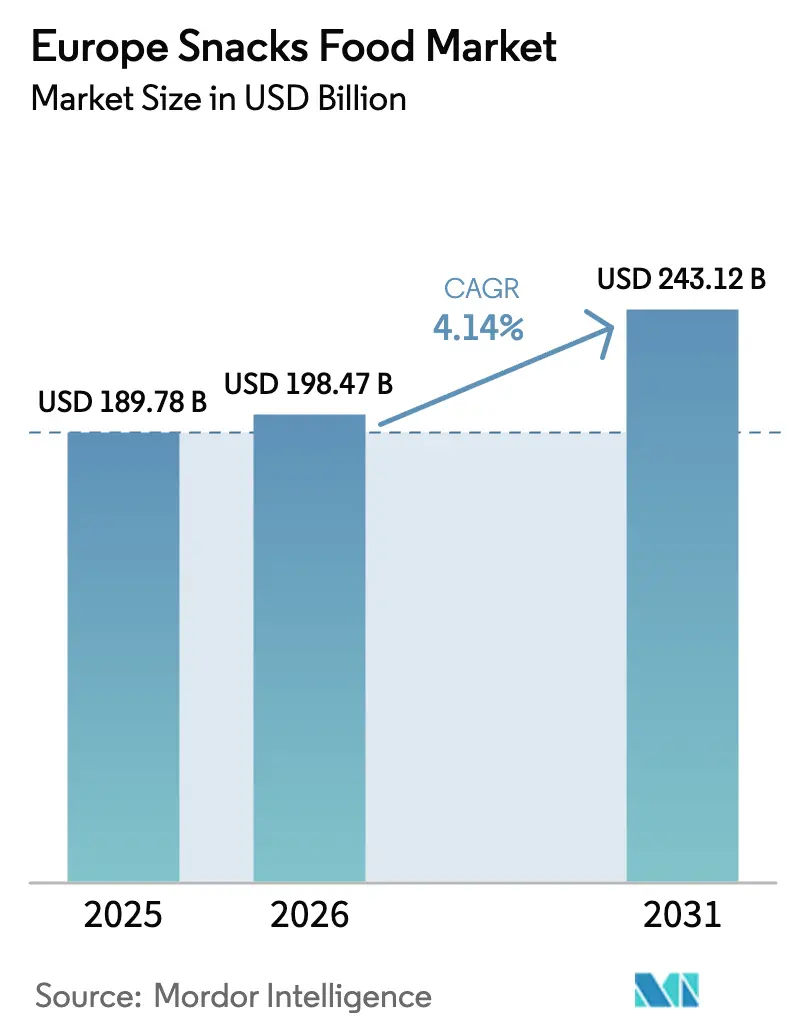
| Base Year Market Size (2025) | USD 189.78 Billion |
| Market Size (2026) | USD 198.47 Billion |
| Market Size (2031) | USD 243.12 Billion |
| Growth Rate (2026 - 2031) | 4.14 % |
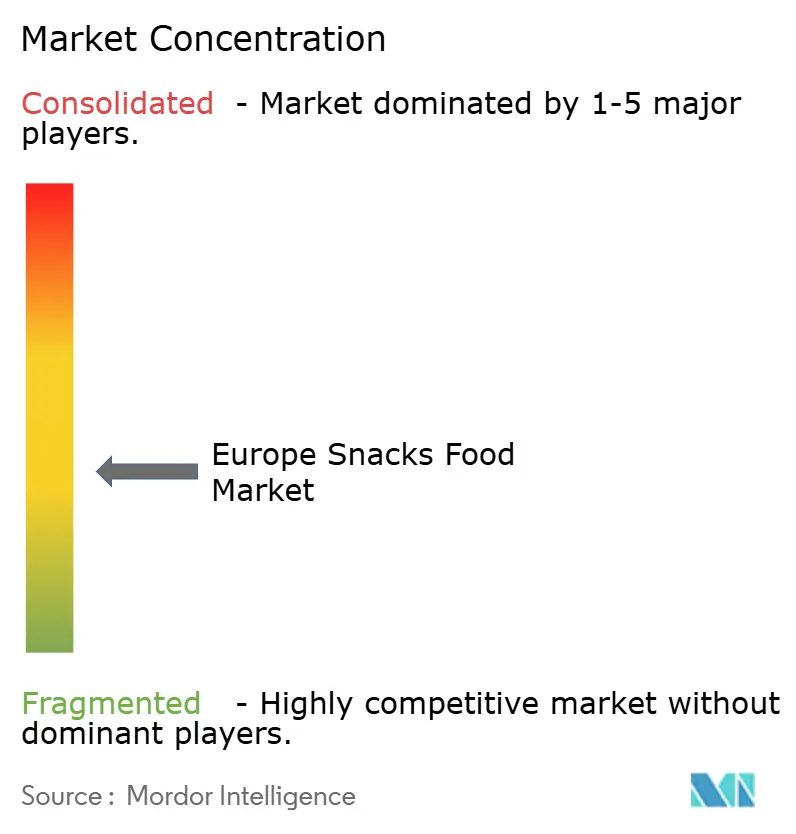
| Market Concentration | Medium |
Major Players *Disclaimer: Major Players sorted in no particular order Image © Mordor Intelligence. Reuse requires attribution under CC BY 4.0. | |
Europe Snacks Food Market Analysis by Mordor Intelligence
The Europe Snacks Food market size is projected to be USD 189.78 billion in 2025, USD 198.47 billion in 2026, and reach USD 243.12 billion by 2031, growing at a CAGR of 4.14% from 2026 to 2031. Convenience snacking now replaces meals for roughly half of daily eating occasions among consumers under 35, which is accelerating demand for portable, single-serve formats. Regulatory pressure around Nutri-Score labeling and the EU Packaging and Packaging Waste Directive is prompting wide-scale reformulation and packaging redesign, favoring companies able to fund compliance investments. Retailer consolidation has lifted private-label penetration to 39.1% of packaged food sales, squeezing branded margins while encouraging faster innovation cycles. At the same time, plant-based, organic, and frozen innovations are expanding assortment breadth, giving the European Snacks Food market fresh avenues for growth.
Key Report Takeaways
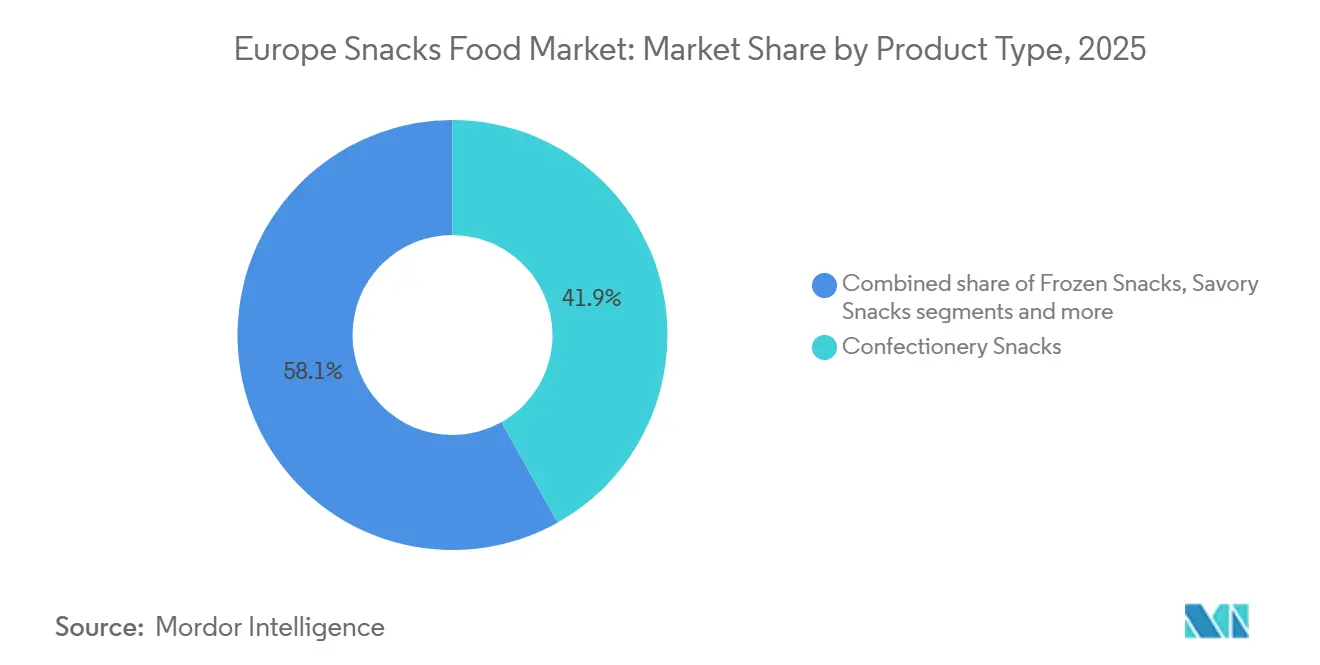
- By product type, confectionery snacks held 41.86% of the Europe Snacks Food market share in 2025, while frozen snacks are advancing at a 5.41% CAGR to 2031.
- By category, conventional products accounted for 63.12% of the Europe Snacks Food market size in 2025, yet organic and clean-label variants are growing at a 6.53% CAGR over 2026-2031.
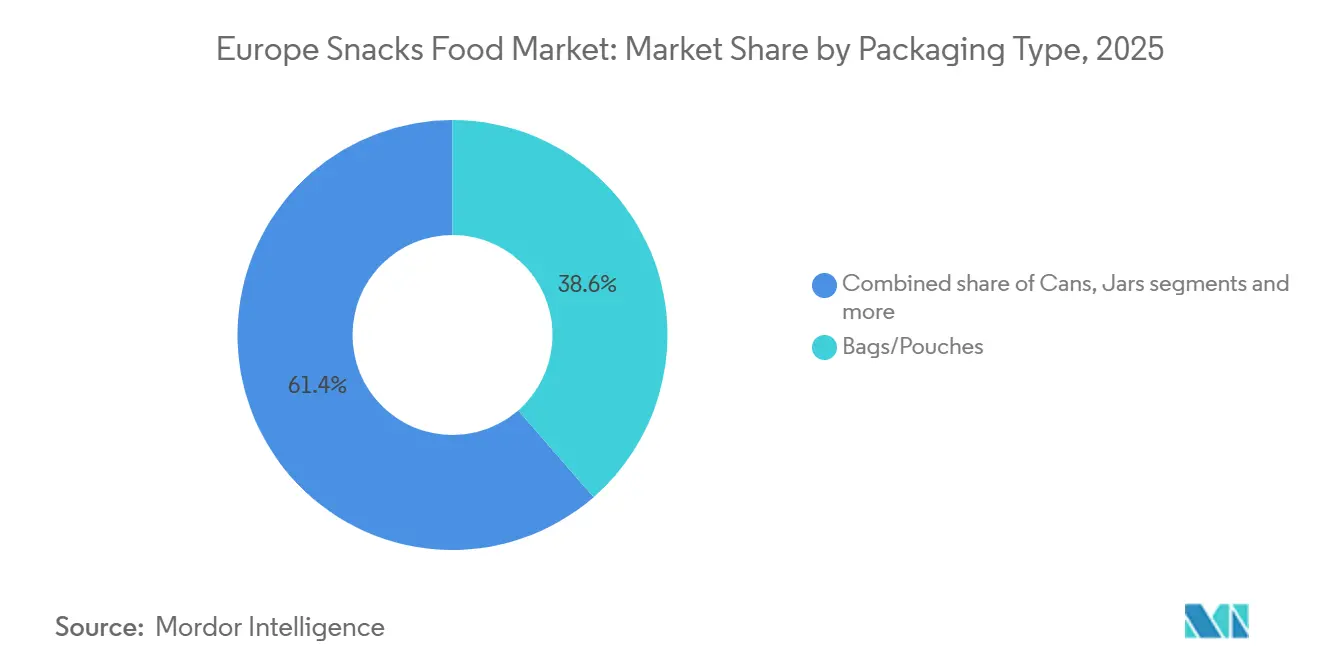
- By packaging, bags and pouches captured 38.55% of sales in 2025, whereas cans are expanding at a 4.73% CAGR through 2031 on the back of premiumization and recyclability advantages.
- By distribution, supermarkets and hypermarkets accounted for 54.62% of revenue in 2025, while online retail is growing at a 6.85% CAGR, supported by double-digit e-commerce growth expectations.
- By geography, the United Kingdom led with a 25.41% share in 2025, yet Germany is the fastest-growing country, with a 4.92% CAGR, driven by high per-capita organic spending.
Note: Market size and forecast figures in this report are generated using Mordor Intelligence’s proprietary estimation framework, updated with the latest available data and insights as of 2026.
Europe Snacks Food Market Trends and Insights
Drivers Impact Analysis*
| Driver | (~) % Impact on CAGR Forecast | Geographic Relevance | Impact Timeline |
|---|---|---|---|
| Demand for convenient on-the-go formats | +0.8% | Global, with highest penetration in UK, Germany, France | Medium term (2-4 years) |
| Growing consumer focus on health-oriented snacking | +0.7% | Western Europe core (UK, Germany, Netherlands, Sweden), expanding to Southern Europe | Long term (≥ 4 years) |
| Expansion of plant-based and vegan snacks | +0.6% | UK, Germany, Netherlands lead; spillover to France, Spain, Italy | Medium term (2-4 years) |
| Flavor innovation and gourmet premiumization | +0.5% | France, Italy, Spain Mediterranean corridor; UK premium retail | Short term (≤ 2 years) |
| Growth for premium organic, gluten-free, and clean-label snacks | +0.6% | Germany, Netherlands, Sweden, Switzerland; urban centers across Western Europe | Long term (≥ 4 years) |
| Popularity of Mediterranean and regional flavors | +0.4% | Southern Europe (Spain, Italy, France); export to Northern markets | Medium term (2-4 years) |
| Source: Mordor Intelligence | |||
Demand for convenient on-the-go formats
Snacking now constitutes half of daily eating occasions among European consumers under 35, fundamentally redefining meal architecture and driving demand for portable, single-serve formats that fit commuter lifestyles and hybrid work patterns. Mondelez International's 2025 State of Snacking report revealed that 59% of global consumers, rising to 64% in Western Europe, snack 2 to 3 times daily, with on-the-go consumption peaking during morning and afternoon dayparts[1]Source: Mondelez International, “The State of Snacking 2025,” mondelezinternational.com. This behavioral shift is propelling investment in resealable pouches, portion-controlled multipacks, and ambient-stable formats that eliminate refrigeration dependency. PepsiCo's July 2025 launch of "That's Nuts" coated peanuts in the UK, targeting a projected GBP 200 million (USD 255 million) segment by 2030, exemplifies how incumbents are engineering snacks for dashboard consumption and desk-drawer storage.
Growing consumer focus on health-oriented snacking
Health-conscious reformulation is no longer a niche differentiator but a baseline expectation, as 73% of European consumers actively seek snacks with reduced sugar, salt, or artificial additives, according to EIT Food's 2025 consumer trust survey. Glanbia's 2025 Better Nutrition report documented that 52% of global consumers, rising to 58% in Northern Europe, prioritize protein content when selecting snacks, driving the proliferation of high-protein bars, Greek yogurt-based bites, and legume-derived crisps[2]Source: Glanbia, “Better Nutrition Report 2025,” glanbia.com. This demand is reshaping product portfolios: Walkers reformulated its core range in August 2025 to comply with UK restrictions on high-fat, salt, and sugar (HFSS) products in prominent retail placements, cutting sodium by 15% without sacrificing taste perception. Mondelez's December 2025 introduction of sugar-free Oreos in select European markets signals a strategic pivot toward better-for-you indulgence, targeting consumers with diabetes and those managing their weight. The shift is quantifiable: UK organic snack sales reached GBP 3.7 billion (USD 4.7 billion) in 2024, growing 6% year-on-year, while Germany's organic food market hit EUR 16.1 billion, with snacks capturing an estimated 12% share, according to the Soil Association.
Expansion of plant-based and vegan snacks
Plant-based snacks are transitioning from specialty-store novelty to mainstream fixture, propelled by the European plant-based food market's expansion to EUR 5.4 billion in 2024, up 5.5% from the prior year, according to Good Food Institute Europe. Vegan and vegetarian consumers now represent 10% to 12% of the UK and German populations, yet flexitarians, those reducing animal product intake without full elimination, drive 60% of plant-based snack purchases, creating a TAM far exceeding strict dietary adherents, according to Good Food Institute Europe. This demographic breadth is attracting legacy players: Nestlé invested EUR 44.2 million in its Bulgarian KitKat factory in February 2025 to expand tablet production, including plant-based variants targeting the CHF 7.5 billion European tablet segment. The Centre for the Promotion of Imports from developing countries (CBI) documented that European imports of plant-based snacks from Asia and Latin America surged 18% in 2024, reflecting supply-chain diversification and cost arbitrage. Regulatory tailwinds include the EU's Farm to Fork strategy, which incentivizes plant-protein innovation through research and development grants and sustainability certifications, lowering barriers for startups and co-manufacturers.
Growth for premium organic, gluten-free, and clean-label snacks
Clean-label positioning, defined by short ingredient lists, recognizable components, and absence of artificial additives, has evolved from a marketing claim to table stakes, as 68% of European shoppers actively read ingredient panels before purchase, per EIT Food's 2025 trust index. Western European organic food sales reached EUR 22 billion in 2024, with the Organic Trade Association reporting sustained double-digit growth in snack subcategories such as organic nuts, seeds, and fruit bars[3]Source: Organic Trade Association, “Western European Organic Food Sales Reach EUR 22 Billion in 2024,” ota.com . Germany anchors this trend, with EUR 16.1 billion in organic food sales and per-capita organic expenditure exceeding EUR 190, the highest globally, according to the Federal Statistical Office of Germany. Gluten-free snacks are capturing incremental share beyond celiac sufferers, appealing to consumers who associate gluten avoidance with digestive wellness and weight management, despite limited clinical evidence for non-celiac populations. The UK's Soil Association certified over 8,500 organic products in 2024, including 1,200 snack SKUs, reflecting supply-side responsiveness to retailer mandates for clean-label assortments. Regulatory influence is indirect but material: the EU Organic Regulation (2018/848) standardizes certification criteria, reducing compliance friction for cross-border trade and enabling smaller producers to access pan-European distribution networks.
Restraints Impact Analysis*
| Restraint | (~) % Impact on CAGR Forecast | Geographic Relevance | Impact Timeline |
|---|---|---|---|
| Health concerns over salt, sugar, and ultra-processed foods | -0.5% | EU-wide, with strictest enforcement in France, Netherlands, Belgium, Germany | Long term (≥ 4 years) |
| Competition from fresh and whole-food alternatives | -0.3% | Western Europe urban centers; Nordic countries | Medium term (2-4 years) |
| Stringent EU regulations and labeling requirements | -0.4% | EU-27, with national variations in enforcement (France, Spain, Belgium lead) | Long term (≥ 4 years) |
| Environmental scrutiny on packaging waste | -0.3% | Germany, Netherlands, Sweden, France; EU-wide Extended Producer Responsibility | Medium term (2-4 years) |
| Source: Mordor Intelligence | |||
Health concerns over salt, sugar, and ultra-processed foods
Public-health campaigns targeting sodium, added sugars, and consumption of ultra-processed foods are constraining formulation latitude and eroding category appeal among health-conscious segments. The World Health Organization's 2025 guidance recommends limiting ultra-processed foods to less than 10% of daily caloric intake, citing epidemiological links to obesity, cardiovascular disease, and metabolic syndrome. France's mandatory Nutri-Score labeling, effective from 2026 onward, assigns color-coded grades (A through E) based on nutrient profiles, with many traditional snacks scoring D or E, triggering consumer avoidance and retailer de-listing, according to the European Commission. Seven EU member states have adopted Nutri-Score or equivalent front-of-pack schemes, creating compliance fragmentation that raises labeling costs for pan-European brands. The European Commission's salt-reduction initiative targets 16% cuts across processed foods by 2030, forcing reformulation investments that can exceed EUR 50 million per major portfolio. Walkers' August 2025 reformulation to meet UK HFSS restrictions illustrates the operational complexity: the brand reduced sodium by 15% while maintaining taste through umami enhancers and flavor encapsulation, a process requiring 18 months of research and development.
Competition from fresh and whole-food alternatives
Fresh produce, nuts, and minimally processed whole foods are capturing snack occasions previously dominated by packaged goods, particularly among millennials and Gen Z consumers who prioritize ingredient transparency and sustainability. European shoppers increased their purchases of fresh food, with snacking occasions shifting toward fruit, vegetable sticks, and bulk nuts purchased from supermarket perimeter sections. This trend is structural rather than cyclical: urbanization and proximity to fresh-food retailers reduce the convenience premium of ambient snacks, while social-media influencers amplify whole-food narratives through platforms such as Instagram and TikTok. The British Retail Consortium reported that UK fresh produce sales reached GBP 12.8 billion (USD 16.3 billion) in 2024, growing 4.2% year-on-year, outpacing packaged snacks' 3.1% growth[4]Source: British Retail Consortium, “UK Retail Sales Data 2024,” brc.org.uk . Retailers are responding by expanding fresh-cut fruit and vegetable offerings in convenience formats, directly competing with packaged snacks for impulse purchases. The substitution effect is most pronounced in Northern Europe, where organic whole-food penetration exceeds 15% of grocery spend, and in Mediterranean markets, where cultural preferences for fresh ingredients remain entrenched.
*Our forecasts treat driver/restraint impacts as directional, not additive. The impact forecasts reflect baseline growth, mix effects, and variable interactions.
Segment Analysis
By Product Type: Frozen Snacks Lead Innovation Velocity
Frozen Snacks are expanding at a 5.41% CAGR through 2031, the fastest pace among product types, as manufacturers leverage cold-chain infrastructure to deliver high-protein, portion-controlled formats that straddle indulgence and nutrition. Nomad Foods' 2024 consumer research revealed that 36% of European households prefer snacking from the freezer, driven by extended shelf life, reduced food waste, and the ability to stock a diverse range of options without daily shopping trips. Unilever's January 2026 launch of Carte D'Or Sundaes with dual-compartment packaging, separating ice cream from toppings until consumption, exemplifies the category's innovation trajectory, targeting premiumization through experiential eating. FRO ZEN Power's March 2025 introduction of high-protein ice cream bars in Austria and Germany, delivering 8.4 grams of protein per 60-gram serving, illustrates how frozen formats are absorbing health-and-wellness trends from ambient categories. Tesco's September 2025 relaunch of 270 frozen products, its largest refresh since 2018, signals retailer confidence in category momentum.
Confectionery Snacks commanded 41.86% market share in 2025, anchored by chocolate tablets, sugar confectionery, and gum, yet face headwinds from Nutri-Score labeling and sugar-reduction mandates. Nestlé's EUR 44.2 million investment in its Bulgarian KitKat factory in February 2025, targeting the CHF 7.5 billion (USD 8.4 billion) European tablet segment, underscores incumbents' commitment to defending share through capacity expansion and SKU proliferation. Savory Snacks, crisps, extruded snacks, nuts, benefit from on-the-go portability and flavor innovation, with PepsiCo's July 2025 "That's Nuts" launch projecting a GBP 200 million (USD 255 million) UK segment by 2030. Fruit Snacks and Bakery Snacks are capturing health-conscious consumers through clean-label positioning and whole-grain formulations, while Meat Snacks remain niche but are growing through protein-forward messaging. Other Product Types, including dairy-based and hybrid formats, are fragmenting the category into micro-segments that defy traditional classification.



By Category: Organic/Clean-Label Outpaces Conventional
Organic/Clean-Label snacks are advancing at a 6.53% CAGR through 2031, nearly double the overall market rate, as Western European consumers prioritize ingredient transparency and sustainability certifications. Western European organic food sales reached EUR 22 billion in 2024, with Germany contributing EUR 16.1 billion, and per-capita organic expenditure exceeding EUR 190, the highest globally, according to the Organic Trade Association. The UK's Soil Association certified over 8,500 organic products in 2024, including 1,200 snack SKUs, reflecting supply-side responsiveness to retailer mandates. Clean-label positioning, short ingredient lists, recognizable components, and the absence of artificial additives have evolved from niche differentiators to baseline expectations, with EIT Food's 2025 survey finding that 68% of European shoppers actively read ingredient panels before purchase. The EU Organic Regulation (2018/848) standardizes certification criteria, reducing compliance friction for cross-border trade and enabling smaller producers to access pan-European distribution networks.
Conventional snacks retained 63.12% market share in 2025, anchored by legacy brands, price-sensitive consumers, and impulse-purchase occasions where ingredient scrutiny is minimal. Conventional manufacturers are responding through reformulation and hybrid positioning, reducing sodium and sugar while maintaining mass-market pricing, as evidenced by Walkers' August 2025 HFSS-compliant reformulation. The category's resilience stems from its breadth: it encompasses value-tier products serving cost-conscious households, mid-tier brands balancing quality and affordability, and premium conventional SKUs that eschew organic certification while emphasizing provenance and craftsmanship.
By Packaging Type: Cans Gain Ground Through Premiumization
Bags/Pouches held 38.55% of packaging share in 2025, dominating crisps, extruded snacks, and confectionery through cost efficiency, lightweight logistics, and resealable convenience. However, Cans are expanding at a 4.73% CAGR through 2031, driven by premiumization in ready-to-eat segments, superior shelf-life performance, and recyclability credentials that resonate with sustainability-conscious consumers. Aluminum cans achieve 75% recycling rates in Europe, exceeding flexible plastics' 40% rates, and are exempt from many single-use plastic taxes, creating a cost-of-compliance advantage, according to the European Commission. The format is migrating beyond beverages into nuts, protein snacks, and portion-controlled confectionery, with brands leveraging the tactile premium cues of cans and billboard-sized labeling real estate. Jars capture niche segments such as olives, pickled vegetables, and nut butters, where glass conveys quality and enables pantry display, while Others, including rigid trays, cartons, and hybrid formats, serve specialized applications such as bakery snacks and frozen novelties.
The EU Packaging and Packaging Waste Directive's 65% recycling target by 2025 and proposed reuse mandates for 2030 are accelerating innovation in mono-material films, compostable substrates, and refillable pouches, each commanding 15% to 25% cost premiums over conventional polyethylene, according to the European Commission[5]Source: European Commission, “Packaging and Packaging Waste Directive,” europa.eu. Germany's VerpackG imposes EPR fees that escalate for non-recyclable materials, incentivizing paper-based pouches despite inferior moisture barriers. Mars' EUR 1 billion European investment includes commitments to 100% recyclable packaging by 2025 and 30% recycled content by 2030, targets that require supplier audits and material science research and development. Consumer sentiment is amplifying regulatory pressure: EIT Food's 2025 survey found that 62% of European shoppers consider packaging sustainability when selecting snacks, with 41% willing to pay premiums for eco-friendly alternatives.
By Distribution Channel: Online Retail Disrupts Traditional Footprints
Online Retail is surging at a 6.85% CAGR through 2031, the fastest-growing distribution channel, propelled by high internet penetration and annual expansion in European online food and beverage sales. TikTok's emergence as an online food and beverage retailer in Europe is compressing discovery-to-trial cycles, as viral snack content drives impulse purchases and enables niche brands to bypass traditional retail gatekeepers. Supermarkets/Hypermarkets captured 54.62% of the distribution share in 2025, leveraging scale economies, one-stop shopping convenience, and promotional firepower to defend incumbency. However, the channel faces margin pressure from private-label proliferation, driven by footfall declines in suburban big-box formats as urbanization concentrates populations near smaller-format stores.
Convenience Stores serve top-up missions and impulse purchases, capturing commuter traffic and late-night occasions, yet face competition from online rapid-delivery services that promise 15-minute fulfillment. Other Distribution Channels, including vending machines, petrol stations, and foodservice outlets, are fragmenting into micro-channels that require SKU-specific strategies and packaging formats. The British Retail Consortium reported that UK snack sales through convenience formats grew 5.2% in 2024, outpacing supermarkets' 3.1% growth, illustrating channel-mix shifts.
Geography Analysis
The United Kingdom accounted for 25.41% of Europe Snack Food market share in 2025, anchored by GBP 4.2 billion (USD 5.4 billion) in snack sales documented by the British Retail Consortium, yet faces structural headwinds from post-Brexit trade friction and HFSS regulations that restrict prominent placement of high-fat, salt, and sugar products. PepsiCo's July 2025 launch of "That's Nuts" coated peanuts, targeting a projected GBP 200 million (USD 255 million) segment by 2030, illustrates how incumbents are engineering products for regulatory compliance while capturing premiumization upside. The UK's Soil Association certified over 8,500 organic products in 2024, including 1,200 snack SKUs, reflecting supply-side responsiveness to clean-label mandates. Germany is expanding at 4.92% CAGR through 2031, the fastest geographic growth, driven by EUR 16.1 billion in organic food sales and per-capita snack expenditure exceeding EUR 200 annually, according to the Federal Statistical Office of Germany. German consumers prioritize sustainability certifications and ingredient transparency, with 72% actively seeking organic or clean-label snacks, per EIT Food's 2025 survey. France mandates Nutri-Score labeling from 2026 onward, forcing portfolio rationalization and reformulation investments that can exceed EUR 100 million per major manufacturer.
Italy and Spain anchor Mediterranean snack consumption, leveraging Protected Designation of Origin (PDO) and Protected Geographical Indication (PGI) certifications to command premium pricing and export to Northern markets. Spanish olive-oil crisp exports to Germany rose 22% in 2024, capitalizing on the Mediterranean diet's health halo and culinary tourism exposure Journal of Ethnic Foods. Ferrero's October 2025 launch of five new products in Italy, including Nutella Crêpe frozen snacks and Kinder extensions, illustrates how Southern European manufacturers are leveraging brand equity to enter adjacent premium categories. The Netherlands and Sweden lead Northern European sustainability trends, with Dutch and Swedish consumers exhibiting the highest willingness to pay premiums for eco-friendly packaging and organic certifications. The Netherlands' plastic tax of EUR 0.80 to EUR 1.20 per kilogram is incentivizing paper-based pouches and aluminum cans, despite inferior moisture barriers. Sweden's organic food penetration exceeds 15% of grocery spend, the highest in Europe, driven by government subsidies for organic agriculture and retailer commitments to sustainable sourcing.
Poland represents Eastern Europe's fastest-growing market, propelled by rising disposable incomes, urbanization, and Western-format retail expansion. Swiss consumers exhibit the highest per-capita snack expenditure in Europe, exceeding EUR 250 annually, driven by premium positioning and tourism-related consumption. Russia's market trajectory remains uncertain due to geopolitical sanctions and supply-chain disruptions, yet domestic manufacturers are capturing share previously held by Western multinationals. Rest of Europe, encompassing Belgium, Austria, Portugal, and smaller markets, collectively contributes approximately 15% of regional revenue, with Belgium's adoption of Nutri-Score in 2025 signaling regulatory convergence across smaller member states.
Regulatory Landscape
The Europe snacks food market operates under EU food law and national public-health rules that increasingly shape formulation and claims. Food-safety oversight is coordinated at EU level through the European Commission and EFSA, with ongoing updates to authorizations and limits affecting ingredients and residues used across snack supply chains, including 2026 regulatory actions such as Commission Regulation (EU) 2026/840 on maximum residue limit (MRL) updates and Commission Implementing Regulation (EU) 2026/1219 authorizing a novel food (inulin-propionate ester). At the same time, front-of-pack and nutrition policies are tightening at country level, with France moving to mandatory Nutri-Score from 2026 onward and the UK maintaining HFSS placement restrictions that have already driven reformulation activity among large snack brands.
Packaging and marketing compliance is a second pressure point, anchored by EU-wide work on packaging waste and consumer-facing claims. Implementation discussions around the Packaging and Packaging Waste Regulation (PPWR), along with the proposed Green Claims Directive and the Empowering Consumers for the Green Transition Directive, are raising the bar for recyclability, substantiation of environmental claims, and label or pack redesign programs. Industry bodies such as the European Snacks Association (ESA) have been active in advocacy and regulatory simplification dialogues in 2025-2026, which highlights how compliance costs and evidence requirements are becoming a competitive filter between scaled manufacturers and smaller brands.
Competitive Landscape
The Europe Snacks Food market exhibits moderate fragmentation, signaling that the top 5 players, General Mills, PepsiCo, Nestlé, Intersnack, and Mondelez, collectively command approximately 35% to 40% share, leaving substantial white space for regional specialists and private-label programs. Mars Inc.'s USD 36 billion acquisition of Kellanova, approved in December 2025, consolidates Pringles, Cheez-It, and Mars' existing portfolio into a unified USD 36 billion snacking entity, reshaping competitive dynamics by creating a vertically integrated platform spanning savory, confectionery, and frozen segments. This mega-merger follows Ferrero's USD 3.1 billion purchase of WK Kellogg in late 2025, illustrating how incumbents are leveraging mergers and acquisitions to capture scale economies, cross-category synergies, and geographic footprint expansion. The European Commission's antitrust scrutiny throughout 2025 delayed several transactions, signaling heightened regulatory vigilance around market concentration and potential anti-competitive effects.
Strategy patterns cluster around three vectors: reformulation to comply with Nutri-Score and HFSS mandates, capacity investments in high-growth segments such as frozen and organic, and omni-channel distribution that integrates brick-and-mortar with direct-to-consumer e-commerce. Mars' EUR 1 billion European investment commitment through end-2026 includes EUR 300 million for regulatory compliance, EUR 400 million for capacity expansion, and EUR 300 million for sustainability initiatives, exemplifying the capital intensity of defending incumbency. White-space opportunities are emerging in plant-based frozen snacks, high-protein ambient formats, and hyper-local provenance narratives that smaller players can exploit without competing on scale. Fairfields Farm Crisps and Tayto Group are carving defensible niches through single-origin sourcing, heritage branding, and retail partnerships that emphasize traceability over volume.
TikTok's emergence as the online food and beverage retailer in Europe is democratizing access to consumers, enabling niche brands to bypass traditional retail gatekeepers and achieve viral distribution through influencer partnerships. Technology deployment is bifurcating: multinationals are investing in AI-driven demand forecasting, dynamic pricing algorithms, and blockchain-enabled traceability to optimize supply chains and substantiate sustainability claims, while smaller players leverage social commerce and subscription models to build direct relationships with consumers. The Good Food Institute Europe documented that the EUR 5.4 billion European plant-based food market, growing 5.5% in 2024, is attracting venture capital and corporate venture arms, signaling that disruptors are accessing capital to scale production and distribution. Regulatory compliance is emerging as a competitive moat: brands that proactively reformulate for Nutri-Score and invest in recyclable packaging gain first-mover advantages in retailer assortment decisions and consumer preference.
Europe Snacks Food Industry Leaders
General Mills, Inc.
PepsiCo Inc.
Nestlé S.A.
Intersnack Group GmbH
Mondelez International Inc.
- *Disclaimer: Major Players sorted in no particular order

Market Opportunities and Future Outlook
Reformulation, functional positioning, and simplification are creating clearer openings in better-for-you snacks that still deliver convenience and indulgence. Company actions in 2026 reinforce this direction: PepsiCo reported a portfolio reset with SKU rationalization and a stronger emphasis on protein-based and functional snacks, indicating that scale players are reallocating capacity and innovation budgets toward nutrition-forward propositions designed to work within HFSS and Nutri-Score constraints. Nestle’s move to acquire full ownership of Germany-based yfood in June 2026 also supports the opportunity around protein-forward snack-meal hybrids sold through modern retail and online.
Operational and packaging compliance requirements are also creating opportunities for suppliers and co-manufacturers that can help brands meet evolving EU and national rules on labeling and sustainability claims. Intersnack investing EUR 85 million in its Alsbach, Germany plant (construction beginning in summer 2026) to expand capacity and modernize energy systems, including a transition to renewable electricity, shows how energy efficiency and lower-footprint production are being funded alongside output growth. ESA activity around PPWR implementation and green-claims rules further points to packaging redesign opportunities, including mono-material structures, improved recyclability, and compliant on-pack messaging that can be scaled across high-velocity snack SKUs and private-label programs.
Recent Industry Developments
- July 2026: Intersnack Group announced a definitive agreement to acquire Utz Brands, Inc. in a deal valued at about USD 2.9 billion, with closing targeted for Q4 2026 subject to approvals. The transaction expands Intersnack into the US market while reinforcing its scale and sourcing leverage in core savory-snack platforms. With a larger multinational footprint, the deal raises competitive intensity for European snack leaders through cross-market portfolio and procurement synergies.
- June 2026: Nestle moved to acquire full ownership of Germany-based yfood after taking a minority stake in 2023. Bringing yfood fully in-house strengthens Nestle's nutrition-positioned, ready-to-drink and meal-replacement adjacency that competes for snack occasions and supports premium, protein-forward innovation. The acquisition also adds a European brand with multi-market reach, supporting faster rollout of health-oriented formats across the region.
- March 2026: PepsiCo initiated a strategy reset for its snacks business that included SKU reductions, manufacturing footprint actions, and a pivot toward protein-based and functional snack offerings. The program signals a tighter focus on higher-velocity, higher-margin platforms amid retailer consolidation and mounting nutrition and packaging compliance demands. It also increases pressure on competitors and private label to match faster innovation cycles in better-for-you and permissible-indulgence segments.


Research Methodology Framework and Report Scope
Market Definition and Coverage
For this report, the Europe snacks food market is the total value of packaged snack products sold for at-home and on-the-go consumption across European countries, covering branded and private label sales through retail and foodservice-linked retail formats.
Scope exclusions: We exclude fresh unpackaged foods sold by weight, home-prepared snacks, and in-store made-to-order items that are not sold as packaged snack products.
Segmentation Overview
- By Product Type
- Frozen Snacks
- Savory Snacks
- Fruit Snacks
- Confectionery Snacks
- Bakery Snacks
- Meat Snacks
- Other Product Types
- By Category
- Conventional
- Organic/Clean-Label
- By Packaging Type
- Bags/Pouches
- Jars
- Cans
- Others
- By Distribution Channel
- Supermarkets/Hypermarkets
- Convenience Stores
- Online Retail Stores
- Other Distribution Channels
- By Country
- United Kingdom
- Germany
- France
- Italy
- Spain
- Netherlands
- Sweden
- Poland
- Switzerland
- Russia
- Rest of Europe
Data Sources, Market Sizing, and Validation
Desk Research
Desk research starts with building a consistent fact base for Europe, and it is then used to anchor assumptions that cannot be observed directly from one single dataset. We rely on public and official sources such as Eurostat (household consumption and price indices), FAOSTAT (commodity supply indicators), UN Comtrade (trade flows for relevant food categories), and national statistics offices in major European markets.
To make the model practical at a country level, we also review trade association publications (such as category bodies for savory snacks and confectionery), regulatory updates from EU institutions on labeling and packaging, and company annual reports and investor presentations to understand pricing actions and mix shifts. In some cases, paid subscriptions are used for company financials and intelligence, patent lookups for product claims, and shipment-level import and export checks. The sources listed here are illustrative, and many other public and paid references were also used to collect, validate, and clarify the data points.
Primary Interviews and Surveys
Primary work focuses on validating what the numbers imply in the real market, especially where promotion intensity and pack-size changes can distort reported value growth. We speak with category managers, distributors, ingredient and packaging stakeholders, and selected retailers across Europe, so assumptions on price ladders, private label share direction, and channel mix can be confirmed.
Where desk sources leave gaps, interviews help us set realistic ranges for average selling prices by category, typical premiumization rates, and how quickly reformulation and labeling changes are flowing into mainstream shelves, which then tightens the final model.
Distribution of primary research fieldwork respondents
| Company type | Respondent position |
|---|---|
| Top tier: 33% | CXOs: 12% |
| Mid tier: 46% | Functional/Unit leaders: 41% |
| Smaller Players: 21% | Managers: 47% |
Market-Sizing & Forecasting
The sizing starts with a top-down build that reconstructs country demand pools using food consumption signals, price indices, and category penetration patterns, which are then converted into value using observed price ladders. Once the country totals are shaped, selective bottom-up checks are used to keep the total grounded, including supplier and brand roll-ups where disclosures exist, and sampled volume times ASP checks across key snack categories.
Inputs used in the model include category-level inflation and packaged food CPI movement, private label share direction in modern retail, promotional depth and frequency (to avoid overstating list price impacts), pack-size changes and shrinkflation effects, and shifts in channel mix between grocery, convenience, and e-commerce. Because cocoa, edible oils, and potatoes can move costs quickly, the pricing logic is kept explicit so it is easy to see what is driving value growth.
For forecasting, scenario analysis is applied and guided by expert views on cost pass-through timing, expected normalization of promotion, and regulatory-led reformulation cycles. When country data is thin, proxy indicators from similar markets are used, and then adjusted through interviews before totals are finalized.
Data Validation & Update Cycle
Model outputs are checked against independent signals like packaged food price trends, trade flow direction for key snack inputs and finished categories, and publicly discussed volume softness or recovery in major markets. If a country shows an unusual spike, the drivers are re-tested, and assumptions on pricing, mix, or channel split are revisited before sign-off.
A multi-step analyst review is followed, and re-contacts are triggered when variables move outside agreed ranges or when a major event changes costs, regulation, or consumer demand. Reports are refreshed annually, with interim updates for material events, and a final pre-delivery pass is completed so clients receive the most current view.
Mordor Intelligence's Europe Snacks Food Market Size Compared With Other Published Estimates
Published values for Europe snacks often differ because the underlying scope, currency timing, and price logic are not handled the same way, and these choices can swing results during periods of high input-cost volatility. Another driver is how each publisher treats category boundaries, like whether chilled or frozen snacks, in-store bakery items, or meal-replacement formats are included.
A refresh-led gap shows up when the pricing layer is updated using the most recent country-level inflation and promotion normalization, and then stress-tested with interview feedback on real shelf prices and pack-size changes. This is the approach applied by Mordor Intelligence to keep the 2025 value aligned with what buyers actually paid, using a discipline that is applied consistently across countries.
Benchmark comparison
| Source | Market Size | Gaps in Research Methodology |
|---|---|---|
| Mordor Intelligence | USD 189.78 B (2025) | |
| Industry Data Provider A | USD 252.72 B (2024) | Uses a large POS-based snapshot across selected big markets and many snack segments, which can inflate Europe-wide totals when uncovered countries are imputed and when foodservice-adjacent items are counted as snacks. |
| Trade Association B | USD 54.33 B (2024) | Tracks mainly savory snacks and snack nuts in retail value terms, so confectionery, sweet biscuits, and several snack formats are outside scope, which makes the reported number much smaller than an all-snacks definition. |
The comparison mainly reflects boundary and timing choices, not simple arithmetic differences. When scope is clearly stated and pricing is updated with current currency and promotion effects, the resulting market size is easier to trace back to repeatable inputs and to validate country by country.


Key Questions Answered in the Report
How large is the Europe snacks food market in 2026?
The market is valued at USD 197.53 billion in 2026.
What CAGR is projected for European snack sales through 2031?
A 4.08% CAGR is forecast for the period 2026-2031.
Which category is growing fastest within European snacks?
Frozen snacks are expected to post the highest CAGR at 6.92%
Which country leads regional snack revenues?
The United Kingdom holds the largest share at 25.41% of 2025 sales.
Page last updated on:





