
Market Overview
| Study Period | 2021 - 2031 |
|---|---|
| Forecast Data Period | 2026 - 2031 |
| Base Year Market Size (2025) | USD 29.89 Billion |
| Market Size (2026) | USD 31.56 Billion |
| Market Size (2031) | USD 41.44 Billion |
| Growth Rate (2026 - 2031) | 5.60 % |
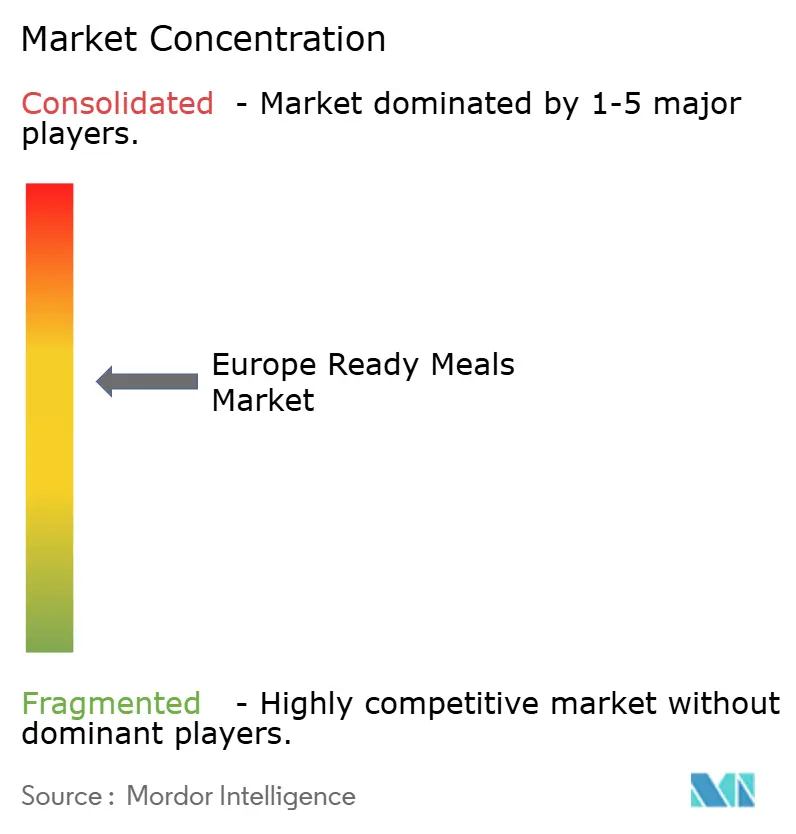
| Market Concentration | Medium |
Major Players *Disclaimer: Major Players sorted in no particular order Image © Mordor Intelligence. Reuse requires attribution under CC BY 4.0. | |
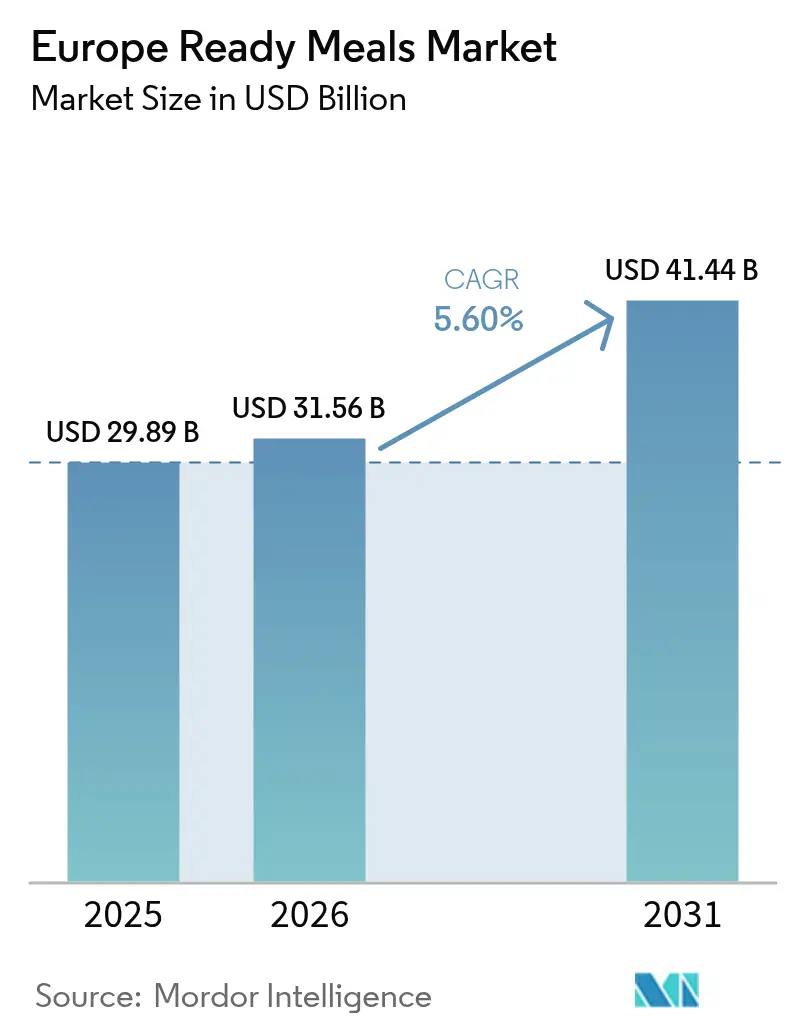
Europe Ready Meals Market Analysis by Mordor Intelligence
The Europe ready meals market size is expected to grow from USD 29.89 billion in 2025 to USD 31.56 billion in 2026 and is forecast to reach USD 41.44 billion by 2031 at 5.6% CAGR over 2026-2031. The market's expansion reflects fundamental changes in European consumer behavior, with busy professionals and families increasingly seeking convenient meal solutions. The implementation of Europe Regulation 2025/40 on recyclable packaging is reshaping manufacturers' operational costs, while the moderation in food inflation to 2.4-4.9% enables companies to maintain more stable pricing strategies. The market benefits from several demographic shifts, including the continued trend of urbanization, the ongoing reduction in average household sizes, and the sustained increase in female workforce participation - factors that collectively strengthen the demand for quality, pre-portioned meals. The competitive environment continues to evolve as established food manufacturers leverage their extensive supply chain networks and distribution capabilities, while innovative start-ups address emerging consumer preferences for plant-based options, personalized nutrition, and sustainable products. The growth of digital platforms, especially quick-commerce applications, has created new distribution channels, particularly resonating with millennial and Gen Z consumers who prioritize convenience and immediate delivery options.
Key Report Takeaways
- By type, frozen ready meals led with 39.78% of Europe ready meals market share in 2025; freeze-dried ready meals are forecast to advance at a 5.78% CAGR through 2031.
- By ingredient, conventional formulations accounted for 82.05% of the 2025 Europe ready meals market; free-form lines are projected to grow at a 6.05% CAGR between 2026-2031.
- By category, non-vegetarian SKUs captured 65.74% of 2025 sales while vegetarian lines are set for a 6.45% CAGR to 2031.
- By distribution channel, supermarkets/hypermarkets controlled 53.10% of 2025 sales, yet online retail stores are expected to post a 9.28% CAGR through 2031.
- By geography, the United Kingdom held 19.72% of 2025 value, whereas Italy is on track for the fastest 6.95% CAGR during 2026-2031.
Note: Market size and forecast figures in this report are generated using Mordor Intelligence’s proprietary estimation framework, updated with the latest available data and insights as of 2026.
Market Trends and Insights
Drivers Impact Analysis of Europe Ready Meals Market*
| Driver | (~) % Impact on CAGR Forecast | Geographic Relevance | Impact Timeline |
|---|---|---|---|
| Rising trend of on-the-go consumption demanding convenience and portability | +1.2% | Global, with stronger impact in United Kingdom, Germany, Netherlands | Medium term (2-4 years) |
| Innovations in product formats, flavors, and nutritional profiles | +0.9% | Europe-wide, particularly Italy, France, Spain | Long term (≥ 4 years) |
| Expansion of personalized meal options | +0.7% | Northern Europe, urban centers across Europe | Long term (≥ 4 years) |
| Advances in packaging technology enhancing shelf life and sustainability | +0.8% | Europe-wide due to Regulation 2025/40 compliance | Medium term (2-4 years) |
| Growing consumer acceptance of free-from and functional food claims | +0.6% | Germany, Netherlands, Sweden, Belgium | Medium term (2-4 years) |
| Increasing penetration of online grocery shopping and e-commerce platforms | +1.1% | Europe-wide, accelerated in Italy, Spain, Poland | Short term (≤ 2 years) |
| Source: Mordor Intelligence | |||
Rising Trend of On-the-Go Consumption Demanding Convenience and Portability
Changes in European consumer mobility patterns are fundamentally reshaping how individuals structure their daily meal consumption, creating a robust and growing market for portable ready meal solutions. According to the Agriculture and Horticulture Development Board's comprehensive research, ready meals now represent 41% of red meat convenience products, demonstrating resilient market performance despite volume decreases in traditional food categories [1]. This transformation reflects a significant evolution in consumer behavior, where conventional fixed mealtimes are transitioning to flexible eating patterns that accommodate modern professional schedules and daily commuting requirements. The ongoing urbanization and increasing population density across major European cities further amplify this market dynamic, as residents adapt to smaller living spaces that limit cooking capabilities while managing extended commuting hours between residential and workplace locations. The concurrent demographic shifts of an aging population combined with high workforce participation rates have elevated convenience foods from an occasional choice to an essential component of daily life for many European consumers.
Innovations in Product Formats, Flavors, and Nutritional Profiles
Product innovation cycles are accelerating as manufacturers work to meet stringent regulatory requirements while adapting to sophisticated consumer preferences. The establishment of Nomad Foods' Future Foods Lab in June 2025 exemplifies how traditional food companies are building strategic partnerships with startups to harness innovative technologies and gain deeper consumer behavior insights. Recent developments in freeze-dried technology have enabled manufacturers to produce shelf-stable products that deliver fresh, authentic taste experiences, effectively addressing consumer concerns about processed food quality without compromising on convenience. Ready meal manufacturers are diversifying their product portfolios by integrating authentic regional flavors and diverse ethnic cuisines, helping them expand their market presence beyond conventional European taste preferences. Through the strategic incorporation of functional ingredients, manufacturers are transforming ready meals into nutritionally beneficial options, positioning them as wholesome dietary choices rather than mere convenience alternatives.
Expansion of Personalized Meal Options
The ready meals market is evolving as consumers increasingly seek personalized nutrition options that match their specific dietary needs and health goals. According to the EIT Food Nutrition Trend Report 2025, 69% of nutrition experts identified personalized nutrition as a key priority, reflecting the growing consumer demand for individualized food solutions [2]. Manufacturers are leveraging technology to enable mass customization, producing variants that address specific dietary requirements, allergen restrictions, and nutritional targets. The subscription box model has gained significant traction across European markets, particularly in Italy, where food e-commerce growth accelerated during COVID-19 and continued through 2024 [3]. Personalization now encompasses multiple aspects including portion sizes, meal timing, and nutritional density, allowing companies to implement premium pricing strategies for customized offerings.
Advances in Packaging Technology Enhancing Shelf Life and Sustainability
The European Union's regulatory framework is reshaping packaging requirements through strict recyclability standards, responding to increasing consumer demands for products with longer shelf life and minimal environmental footprint. The regulation establishes a tiered grading system for recyclability, fundamentally altering how companies approach material selection and design. These requirements for recycled content in plastic packaging are creating immediate supply chain pressures, though they also present strategic advantages for businesses that proactively invest in compliant materials and manufacturing processes. Companies are implementing active packaging technologies that preserve food quality and safety while extending product longevity, enabling broader market reach and addressing food waste reduction goals. The incorporation of smart packaging elements, such as digital tracking codes and monitoring sensors, enhances consumer interaction while providing comprehensive supply chain visibility and product traceability.
Restraints Impact Analysis of Europe Ready Meals Market*
| Driver | (~) % Impact on CAGR Forecast | Geographic Relevance | Imapact Timeline |
|---|---|---|---|
| Increased consumer demand for freshly prepared meals | -0.8% | France, Italy, Spain - traditional food cultures | Medium term (2-4 years) |
| Regulatory challenges related to food labeling, health claims, and safety standards | -0.6% | Europe-wide, particularly complex in multi-country operations | Long term (≥ 4 years) |
| Environmental concerns over plastic and non-biodegradable packaging | -0.4% | Northern Europe, environmentally conscious markets | Short term (≤ 2 years) |
| Challenges in maintaining consistent taste and quality across product lines | -0.3% | Europe-wide, quality-sensitive markets like Germany, France | Medium term (2-4 years) |
| Source: Mordor Intelligence | |||
Increased Consumer Demand for Freshly Prepared Meals
European consumers demonstrate a strong inclination toward fresh food options over ready meals, primarily driven by their emphasis on nutritional benefits and superior taste experiences. The growing trend of home cooking has become deeply ingrained in consumer behavior, with many households developing and maintaining regular meal preparation routines. Markets with rich culinary heritage, particularly France, Italy, and Spain, exhibit notable resistance to ready meal adoption, as their deeply rooted food traditions and communal dining practices create natural barriers to convenience food acceptance. The gradual stabilization of food prices has enabled consumers to redirect their spending toward fresh ingredients, moving away from processed alternatives. This shift in consumer preference particularly impacts the premium ready meal segment, as improved household purchasing power makes fresh food alternatives increasingly accessible and appealing.
Regulatory Challenges Related to Food Labeling, Health Claims, and Safety Standards
The complex regulatory environment across Europe member states presents significant operational challenges that particularly burden small food manufacturers, while giving larger companies with well-established regulatory departments a competitive edge. The European Parliament's 2024 implementation report on Regulation 1924/2006 revealed an important trend: while 18% of new food products feature nutrition and health claims, many of these products marketed under the 'healthy' umbrella contain concerning levels of fat, sugar, or salt [4]. The fragmented regulatory harmonization between member states forces manufacturers to navigate through a maze of different labeling requirements, health claim approvals, and safety standards when distributing products across multiple countries. Adding to these challenges, the proposed front-of-pack nutrition labeling system creates substantial uncertainty in product development cycles, requiring manufacturers to simultaneously maintain current compliance while preparing for upcoming regulatory changes. The implementation of Bisphenol A restrictions in food contact materials, set to take effect from December 2024, illustrates how evolving safety requirements continue to demand substantial investments in packaging compliance from food manufacturers [5].
*Our forecasts treat driver/restraint impacts as directional, not additive. The impact forecasts reflect baseline growth, mix effects, and variable interactions.
Europe Ready Meals Market Segment Analysis
Segment 1
The freeze-dried segment demonstrates significant market potential, growing at a 5.78% CAGR through 2031. This growth trajectory positions freeze-dried products as a notable challenger to the well-established Frozen Ready Meals segment, which currently commands a substantial 39.78% market share in 2025. The freeze-dried preservation method delivers extended shelf stability without the need for refrigeration, enabling companies to expand their distribution networks and reduce cold chain expenses while maintaining the nutritional content and taste quality of their products.
Frozen Ready Meals continue to maintain their market leadership position through strong consumer acceptance and an optimized retail infrastructure. Their competitive pricing structure makes these products accessible to consumers across various income levels. In contrast, Chilled Ready Meals occupy the premium market segment, offering products with shorter shelf life but perceived higher quality. This premium positioning attracts consumers who prioritize fresh-like characteristics and are willing to pay higher prices for such attributes.
By Ingredient:
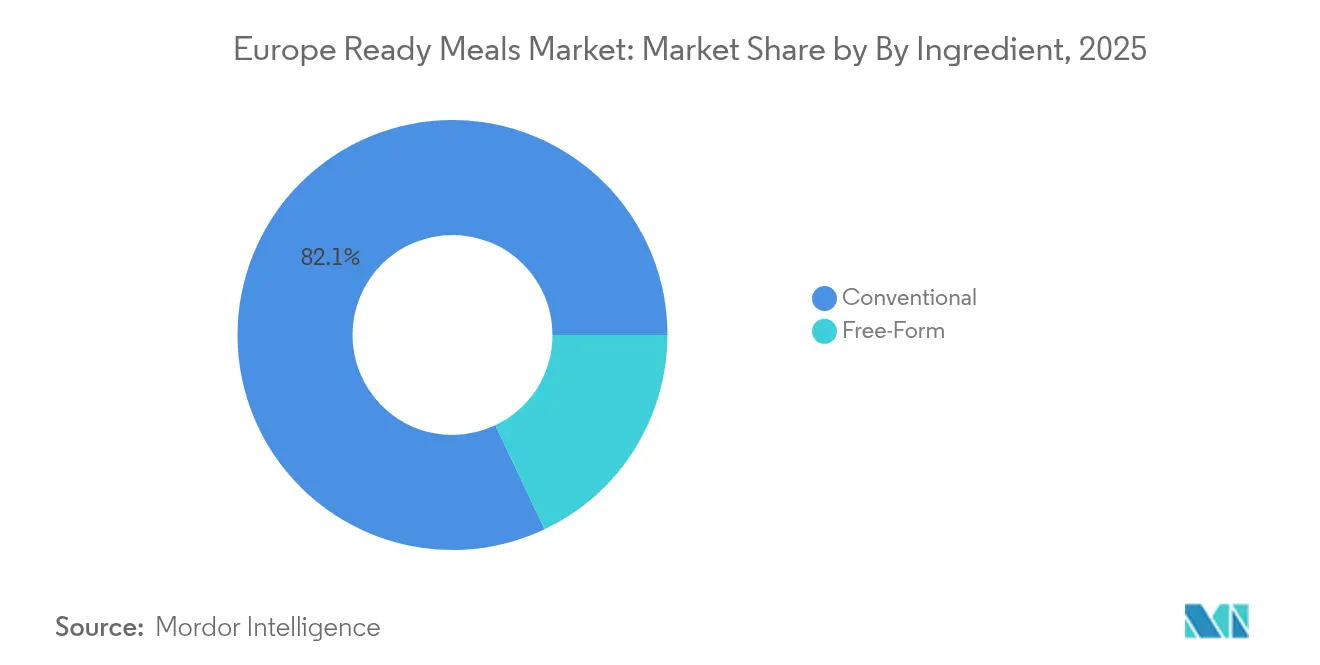
Conventional Strength Versus Free-Form AccelerationThe free-form ingredients market continues to demonstrate robust growth, advancing at a 6.05% CAGR through 2031. This expansion is primarily fueled by increasing consumer awareness and demand for products with clean labels and allergen-free formulations. In contrast, conventional ingredients maintain their strong market position with an 82.05% share in 2025, supported by their inherent cost advantages and well-established supply chain networks. The BMEL Food Report 2024 highlights a significant shift in consumer preferences, with more than half of consumers actively seeking processed foods containing reduced sugar and fat content.
This evolving consumer behavior has prompted manufacturers to undertake extensive reformulation efforts across both conventional and free-form categories. Free-form products successfully maintain premium pricing strategies, justified by their health-focused positioning and specialized manufacturing processes that eliminate common allergens and artificial additives. Meanwhile, conventional ingredients continue to dominate the market through their ability to leverage economies of scale, long-standing supplier relationships, and broad consumer familiarity that minimizes the need for extensive market education.

By Category:
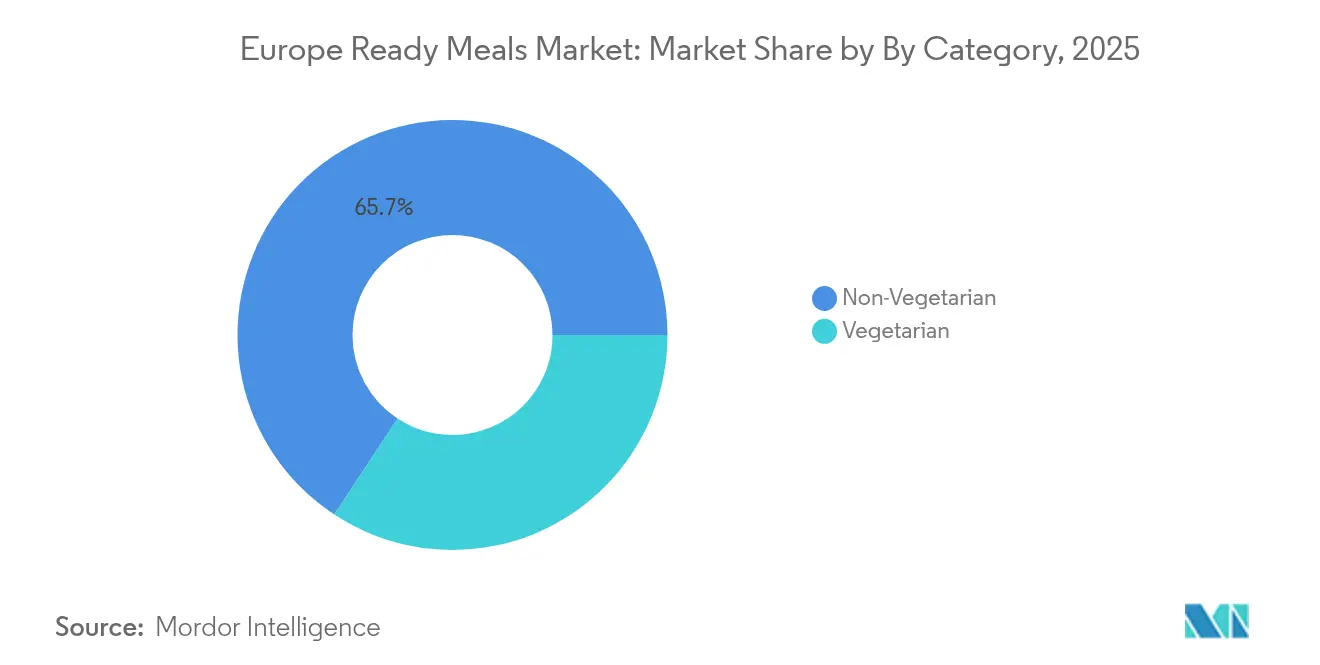
Plant-Based Momentum Challenges Meat DominanceThe vegetarian ready meals segment demonstrates strong growth potential, with projections indicating a CAGR of 6.45% through 2031. This growth trajectory aligns with the broader consumer shift toward plant-based food options. Meanwhile, non-vegetarian ready meals continue to hold a substantial market position, maintaining a 65.74% share in 2025. This dominance stems from deeply rooted consumer preferences and the segment's ability to meet protein requirements effectively.
Industry validation comes from the EIT Food Nutrition Trend Report 2025, where an overwhelming 82% of nutrition experts highlighted plant-based diets as the primary trend. This professional consensus is reflected in strategic market movements, exemplified by Migros-Molkerei Elsa's acquisition of Sofine Foods, a specialist in vegan schnitzels and ready meals. The vegetarian segment's appeal extends beyond dietary preferences, encompassing sustainability benefits, growing health consciousness among consumers, and particular resonance with younger demographics. These factors enable companies to implement premium pricing strategies while establishing distinct brand identities in the market.
By Distribution Channel:
Digital Transformation Accelerates Retail EvolutionThe online retail segment of the ready meals market continues to demonstrate robust growth, with projections indicating a CAGR of 9.28% through 2031. Traditional brick-and-mortar establishments, specifically supermarkets and hypermarkets, remain the primary distribution channel, commanding a substantial 53.10% market share in 2025. The expansion of e-commerce platforms reflects the broader digital transformation in consumer behavior, which was initially accelerated by pandemic-related restrictions but has since become a permanent shift in shopping preferences.
Consumer preference for the convenience and extensive product selection offered by online platforms has sustained growth beyond the pandemic period. The Italian food segment demonstrates this shift through the adoption of e-commerce and subscription-based services, enabling direct-to-consumer delivery of personalized meal options. Online channels have been particularly effective for freeze-dried and shelf-stable products, as these items bypass the complexities of cold chain logistics and reach a broader geographic audience.
Geography Analysis
United Kingdom Ready Meals Market
The United Kingdom stands as the powerhouse in the European ready meals market, commanding a significant 19.72% market share in 2025. This market leadership reflects the nation's deeply ingrained convenience food culture and highly developed retail infrastructure. British consumers have embraced ready meals as part of their daily lives, supported by major retail chains that understand and cater to this demand through extensive shelf space allocation and robust cold chain management. The market's maturity has opened doors for manufacturers to introduce premium offerings and innovative products, as consumers show increasing willingness to experiment with new meal formats, international flavors, and health-focused options. While Brexit initially presented supply chain challenges, it ultimately strengthened the United Kingdom's domestic food production capabilities and reduced its reliance on European suppliers. The country's continued adherence to EU food safety standards maintains valuable export opportunities while allowing manufacturers to develop products that resonate with local tastes and dietary preferences.
Italy Ready Meals Market
Italy has emerged as the market's rising star, achieving an impressive 6.95% CAGR through 2031. This growth story marks a significant evolution in Italian consumer behavior, particularly noteworthy in a country known for its traditional approach to home cooking. Modern Italian consumers, especially in urban areas, are increasingly balancing their love for authentic cuisine with the demands of contemporary lifestyles. The market has naturally segmented into three distinct consumer groups: tradition-focused buyers who prioritize local sourcing and sustainability, price-conscious consumers seeking value in their meal choices, and environmentally aware shoppers who gravitate toward organic and ethically produced options. This transformation reflects a broader shift in Italian society, where convenience no longer carries the stigma it once did.
Broader European Markets
The broader European landscape, encompassing markets such as Germany, France, and Spain, presents a diverse tapestry of growth patterns shaped by unique local characteristics. France, in particular, demonstrates how traditional culinary heritage can coexist with modern convenience, as urban professionals seek high-quality ready meals that honor traditional cooking methods and ingredient quality. Each market requires a nuanced approach that respects local food cultures while addressing the evolving needs of busy consumers. Success in these markets depends on understanding regional preferences, navigating specific regulatory requirements, and developing products that bridge the gap between convenience and culinary tradition.
Regulatory Landscape
The European ready meals market operates under EU-wide food information and safety rules, with Regulation (EU) No 1169/2011 setting mandatory consumer information requirements, including allergen emphasis, nutrition declarations, and date marking for ready-to-eat and ready-to-heat meals sold across member states. In parallel, manufacturers are redesigning packaging and adjusting sourcing decisions in line with Europe Regulation 2025/40 on recyclable packaging, which brings increased scrutiny on material selection, recycled-content availability, and labeling consistency for multi-country distribution.
Food safety requirements tighten for chilled and other ready-to-eat products capable of supporting Listeria growth as Regulation (EU) 2024/2895 becomes applicable from July 2026, amending microbiological criteria under Regulation (EC) No 2073/2005. The change increases the burden of proof on operators to demonstrate compliance through shelf life via shelf-life studies, challenge testing, and environmental monitoring, and national competent authorities have supplemented the rollout with guidance, including updates from the Food Safety Authority of Ireland in July 2026.
Value Chain Analysis
The value chain includes upstream agricultural and ingredient suppliers (meat, vegetables, grains, oils, dairy), processors and component manufacturers, ready meal producers, and specialist co-packers and contract manufacturers (supported by trade bodies such as the European Co-Packers Association, ECPA). Packaging suppliers form a key enabling layer, especially for chilled and frozen formats, where barrier performance, sealing integrity, and recyclability requirements influence product shelf life, food safety validation, and retail acceptance.
On the downstream side, supermarkets and hypermarkets lead distribution, with convenience retail and online grocery and quick-commerce routes adding additional capabilities such as picking, last-mile delivery, and cold-chain execution as differentiators. Cost and continuity risks cluster around energy, transport, and input volatility, alongside dependencies tied to fertilizers and imported commodities, while EU-level coordination mechanisms such as the European Food Security Crisis Preparedness and Response Mechanism (EFSCM) support efforts to identify and address supply-chain threats. Structural consolidation among convenience and prepared food players has also emerged as a value-chain feature, improving scale in procurement, optimizing manufacturing footprint, and expanding customer coverage.
Competitive Landscape
The United Kingdom has established itself as the cornerstone of the European ready meals market, holding a commanding 20.04% market share in 2024. This leadership position stems from years of cultivating a convenience food culture that resonates deeply with British consumers. Major retail chains across the country have responded to this consumer behavior by creating dedicated spaces for ready meals and investing in sophisticated cold chain networks. The market's maturity has created an environment where manufacturers confidently introduce premium products and innovative meal solutions, knowing that consumers are receptive to new dining experiences, global flavors, and nutritionally balanced options. While the initial Brexit transition posed distribution challenges, it ultimately strengthened the United Kingdom's food production capabilities and reduced European supply dependencies. By maintaining alignment with Europe food safety standards, the country preserves crucial export opportunities while developing products that cater specifically to local preferences.
Italy represents the market's most dynamic growth story, recording a remarkable 7.23% CAGR through 2030. This growth trajectory signals a profound shift in Italian consumer attitudes, particularly significant in a nation traditionally devoted to home-cooked meals. Today's Italian consumers, especially in urban centers, are actively seeking convenient meal solutions that complement their modern lifestyles. The market has naturally evolved into three distinct consumer segments: traditional buyers who value local sourcing and sustainability, value-seeking consumers who prioritize affordability, and environmentally conscious shoppers who prefer organic and ethically produced meals. This transformation reflects a broader cultural shift where convenience aligns with, rather than opposes, Italy's rich culinary heritage.
The wider European market, including Germany, France, and Spain, showcases diverse growth patterns influenced by unique regional characteristics. France exemplifies how traditional food culture can successfully blend with modern convenience, as urban consumers embrace high-quality ready meals that respect classical cooking methods and ingredient integrity. Each regional market demands a carefully crafted approach that honors local food traditions while addressing contemporary lifestyle needs. Success in these markets requires deep understanding of regional preferences, careful navigation of regulatory frameworks, and development of products that seamlessly combine convenience with cultural authenticity.
Europe Ready Meals Industry Leaders
-
Nomad Foods Ltd.
-
Nestlé S.A.
-
Dr. Oetker GmbH
-
Unilever PLC
-
Orkla ASA
- *Disclaimer: Major Players sorted in no particular order
Europe Ready Meals Market Companies Covered in this Report
- Nomad Foods Ltd.
- Nestlé S.A.
- Dr. Oetker GmbH
- Unilever PLC
- Orkla ASA
- Kerry Group plc
- Fjordland AS
- Saarioinen Oy
- VegMe AB
- Bell Food Group AG
- Greencore Group plc
- Bakkavor Group plc
- 2 Sisters Food Group
- Fresh Food Group (Di Luca)
- Delhaize Ready Meals
- Pladis Foods Ready Meals
- Frosta AG
- Iceland Foods Ltd
- Schäfer’s Fertiggerichte
- Apetito AG
Market Opportunities and Future Outlook
Compliance-driven reformulation and process upgrades create space for manufacturers that can demonstrate shelf-life safety performance while maintaining sensory quality, particularly for chilled ready meals that can support Listeria growth. With Regulation (EU) 2024/2895 becoming applicable in July 2026, demand increases for validated product design, stronger plant hygiene programs, and packaging performance that protects shelf life, which supports opportunities for challenge-testing services, predictive microbiology tools, and higher-integrity packaging formats aligned with ready-to-eat requirements.
The packaging transition and related capacity additions are an execution priority as brand owners respond to recyclable-packaging obligations referenced in the report context and look for materials that also protect product quality across frozen, chilled, and shelf-stable ready meals. Recent investments reflect this direction, including Mondi completing a EUR 1.2 billion packaging investment program (with assets in the Czech Republic and Poland) and Tetra Pak announcing a EUR 60 million paper-based barrier pilot plant investment at Lund, Sweden. At the same time, the growth of online grocery and quick-commerce distribution supports formats that travel well and reduce cold-chain complexity, including shelf-stable and freeze-dried ready meals, while widening the potential for assortment expansion and targeted free-from and personalized propositions through digital merchandising.
Recent Industry Developments in Europe Ready Meals Market
- June 2026: Nomad Foods announced a GBP 2.2 million investment in a new potato waffle production line at its Lowestoft factory in the United Kingdom, taking annual waffle capacity to around 18,250 tonnes. The upgrade supports manufacturing efficiency and supply-chain resilience for a high-volume frozen category, reinforcing scale advantages in serving major retail channels.
- August 2025: Nomad Foods launched Birds Eye's Europe-wide masterbrand campaign, "That's a Recipe for a Life Well Fed," backed by a multi-million-pound media investment. The campaign worked to reposition frozen food as nutritious and emotionally relevant, supporting category premiumization and brand differentiation in a competitive ready meals landscape.
- June 2025: Nomad Foods unveiled the Future Foods Lab to accelerate collaboration with startups through a venture-clienting model. The platform strengthens product and process innovation capabilities for frozen and adjacent prepared meal formats, improving speed-to-market for new concepts aligned with evolving consumer preferences.
Europe Ready Meals Market Report Scope and Research Methodology
Market Definition and Coverage
For this study, the market covers packaged, commercially sold ready meals in Europe that are pre-cooked or fully prepared and are mainly consumed after reheating or minimal final preparation.
Scope exclusions: We exclude home-prepared meal kits, restaurant made meals sold for immediate consumption, and unpackaged deli or fresh counter foods that are not sold as ready meals.
Segments Covered in This Report
- By Type
- Frozen Ready Meals
- Chilled Ready Meals
- Shelf-Stable Ready Meals
- Freeze-Dried Ready Meals
- By Ingredient
- Conventional
- Free-Form
- By Category
- Vegetarian
- Non-Vegetarian
- By Distribution Channel
- Supermarkets/Hypermarkets
- Convenience/Grocery Stores
- Online Retail Stores
- Other Distribution Channel
- By Geography
- Germany
- United Kingdom
- Italy
- France
- Spain
- Netherlands
- Poland
- Belgium
- Sweden
- Rest of Europe
Data Sources, Market Sizing, and Validation
Desk Research
Desk work starts with building a clear definition of ready meals and mapping where value is created from manufacturing to retail. We anchor the Europe view using public statistics and industry reference material such as Eurostat, the UK Office for National Statistics, FAOSTAT, and OECD indicators (income, labor, and consumption patterns). These sources help explain demand direction and cross-country differences.
To keep assumptions realistic, we also review EFSA publications for food safety context, customs and trade releases where relevant, and peer-reviewed nutrition and food science journals that discuss shelf-life, chilled versus frozen dynamics, and packaging trends. Company annual reports, investor decks, and credible press are used to confirm product mix shifts and channel expansion. Where needed, paid subscriptions covering company financials and intelligence, patent databases, and shipment-level import and export data are used to fill gaps in revenue proxies and packaging or ingredient signals. These sources are illustrative, and many other public and paid references were also used to collect data, validate numbers, and clarify open questions.
Primary Interviews and Surveys
Primary work focuses on checking how ready meal value is recorded across chilled, frozen, and shelf-stable products, and how pricing changes flow through to retail value. We speak with a mix of manufacturers, ingredient and packaging participants, distributors, and retail or category experts across Europe so assumptions on volumes, private label mix, and channel weighting can be corrected before finalizing the model.
Distribution of primary research fieldwork respondents
| Company type | Respondent position |
|---|---|
| Top tier: 35% | CXOs: 13% |
| Mid tier: 50% | Functional/Unit leaders: 40% |
| Smaller Players: 15% | Managers: 47% |
Market-Sizing & Forecasting
Market sizing is built using a top-down approach where food category spending and packaged food value pools are reconstructed by country, then filtered into ready meals using category shares and channel splits that match how these products are sold in Europe. Once the country totals are built, they are rolled up to a regional total after currency normalization and timing alignment.
The model is then checked using selective bottom-up approximations so totals stay realistic. This includes sampled price per pack times estimated volumes for key meal formats, supplier and retailer channel checks, and revenue sanity checks from a limited set of disclosed financials where reporting lines allow it. Because company reporting is not always clean, gaps are handled through mix-based allocation rules, then re-tested with interview feedback.
Key inputs that move the numbers include chilled versus frozen mix, retail price inflation and promotional intensity, private label penetration, modern grocery versus convenience and online shares, and household structure signals that influence at-home convenience meal demand. For forecasting, we use scenario analysis with a base case informed by expert views on pricing normalization and volume recovery patterns, followed by sensitivity checks on inflation, channel shift speed, and product premiumization.
Data Validation & Update Cycle
Validation happens in steps so errors do not travel into the final market number. We compare outputs against independent signals such as country-level food spending trends, price index direction, and observed retail category momentum, then investigate any large variances before sign-off.
Assumptions that show unusual jumps are reviewed by another analyst, and follow-up calls are triggered when a key input changes or a respondent flags a mismatch with market reality. Reports are refreshed annually, with interim updates when material events affect pricing, demand, or supply conditions. Before delivery, a final review pass is completed so clients receive the most current view available at the time of publication.
Mordor Intelligence's Europe Ready Meals Market Size Measured Against Other Published Estimates
Published market values for Europe ready meals can differ even when the topic sounds identical, since the boundary between ready meals, broader convenience foods, and ready-to-eat items is not always applied the same way. Differences also show up when pricing is treated differently across chilled and frozen formats, and when country coverage inside Europe is not handled consistently.
By tracking pricing normalization timing, inflation pass-through, and country-level category splits, Mordor Intelligence keeps the Europe ready meals total tied to packaged ready meal consumption, instead of blending in adjacent convenience categories. The gaps usually come from scope choices (for example, including deli prepared foods or wider ready-to-eat baskets), plus the base-year selection and currency conversion timing that can inflate or compress the same underlying demand.
Benchmark comparison
| Source | Market Size | Gaps in Research Methodology |
|---|---|---|
| Mordor Intelligence | USD 29.89 B (2025) | |
| Industry Publisher A | USD 29.31 B (2026) | Uses a different base year and a longer forecast window, and the ready meals boundary appears to be influenced by broader consumer cohorts, which can shift what is counted as a ready meal. |
| Sector Tracker B | USD 27.40 B (2025) | Often reflects a narrower definition focused on manufacturer revenue for prepared meals, which can undercount retail value uplift, private label sales, and some chilled meal formats. |
The spread across the three numbers is mainly explained by how the ready meal boundary is set, and whether values represent retail sales versus producer-side revenue, followed by the year and currency timing used. When scope and pricing logic are written down clearly and then checked with real channel and mix signals, the final estimate becomes easier to reproduce and easier to use in planning.
Key Questions Answered in the Report
How large is the Europe ready meals market in 2026?
The Europe ready meals market size reached USD 31.56 billion in 2026.
What is the expected growth rate for ready meals in Europe through 2031?
The market is projected to post a 5.6% CAGR from 2026 to 2031.
Which product type leads sales across Europe?
Frozen Ready Meals held 39.78% of the Europe ready meals market share in 2025.
Which distribution channel is growing the fastest?
Online Retail Stores are forecast to expand at a 9.28% CAGR through 2031.
Why is Italy considered the fastest-growing European market?
Italy combines urbanization, rising dual-income households, and strong e-commerce uptake, driving a 6.95% CAGR forecast.