
Market Overview
| Study Period | 2020 - 2031 |
|---|---|
| Forecast Data Period | 2026 - 2031 |
| Historical Data Period | 2020 - 2024 |
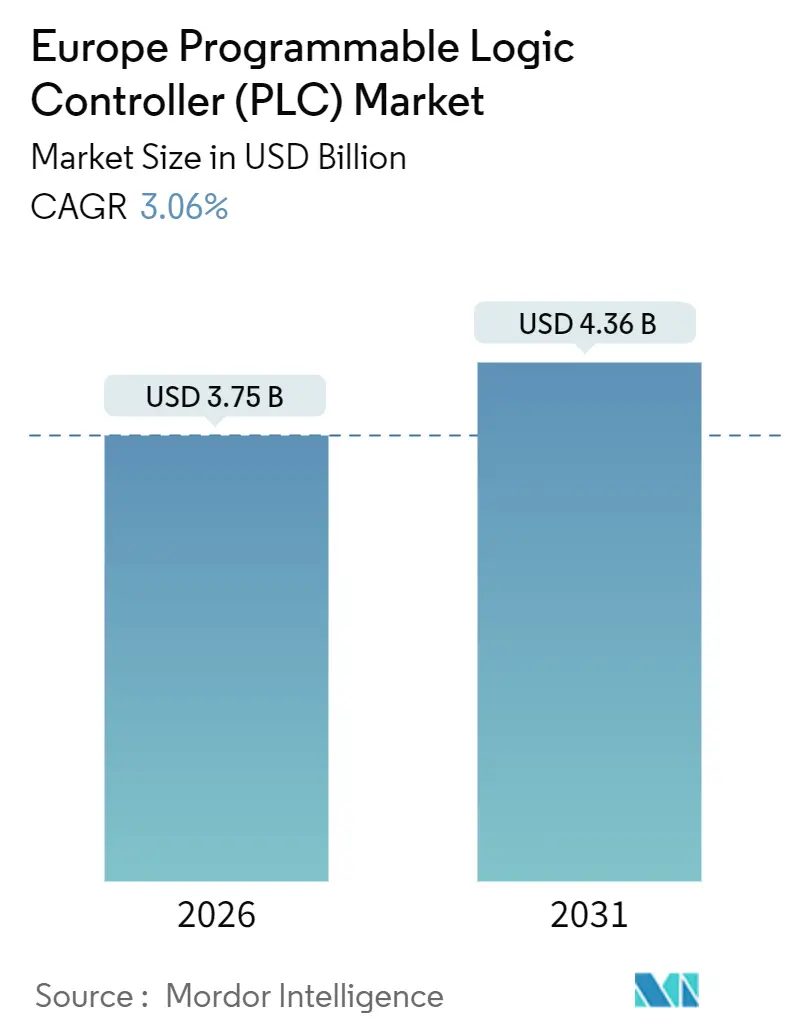
| Market Size (2026) | USD 3.75 Billion |
| Market Size (2031) | USD 4.36 Billion |
| Growth Rate (2026 - 2031) | 3.06 % |
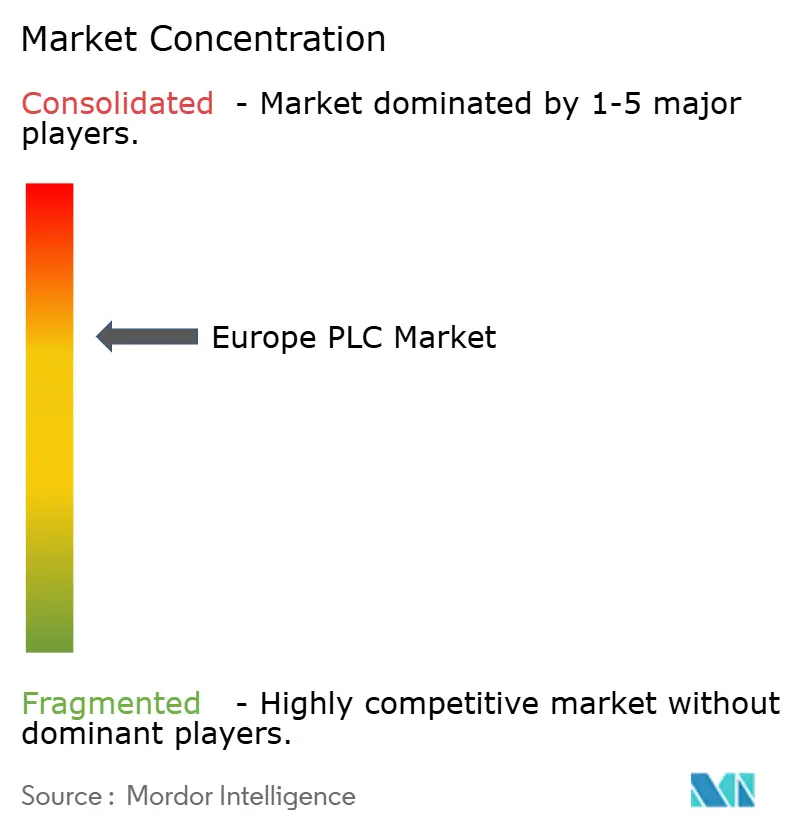
| Market Concentration | Medium |
Major Players *Disclaimer: Major Players sorted in no particular order Image © Mordor Intelligence. Reuse requires attribution under CC BY 4.0. | |
Europe Programmable Logic Controller (PLC) Market Analysis by Mordor Intelligence
The Europe Programmable Logic Controller (PLC) Market size reached USD 3.75 billion in 2026 and is projected to climb to USD 4.36 billion by 2031, translating to a 3.06% CAGR over the forecast period. Solid demand comes from brownfield retrofits in Germany, France and Italy, where legacy relay logic is being replaced with connected controllers that expose real-time data to enterprise systems. Edge-ready PLCs that combine deterministic control with on-device analytics are gaining traction as factories adopt Industry 4.0 reference architectures. Safety-rated variants certified to IEC 61508 and ISO 26262 are the fastest adopters because the EU Machinery Regulation 2023/1230 requires higher performance-level credentials for collaborative robot cells introduced after January 2027. Component lead-time volatility, evident during the 2021-2022 chip shortage, is softening thanks to capacity expansions triggered by the European Chips Act, while structured-text programming talent remains a bottleneck in Eastern Europe. Across all trends, the Europe PLC market is steadily pivoting from pure motion control toward tightly integrated safety, data handling, and energy-management workloads.
Key Report Takeaways
- By type, Medium PLCs held 34.83% of Europe PLC market share in 2025, while Nano PLCs are advancing at a 4.46% CAGR through 2031.
- By architecture, Modular platforms accounted for 41.27% of the Europe PLC market size in 2025, whereas Soft PLCs are forecast to expand at a 4.51% CAGR.
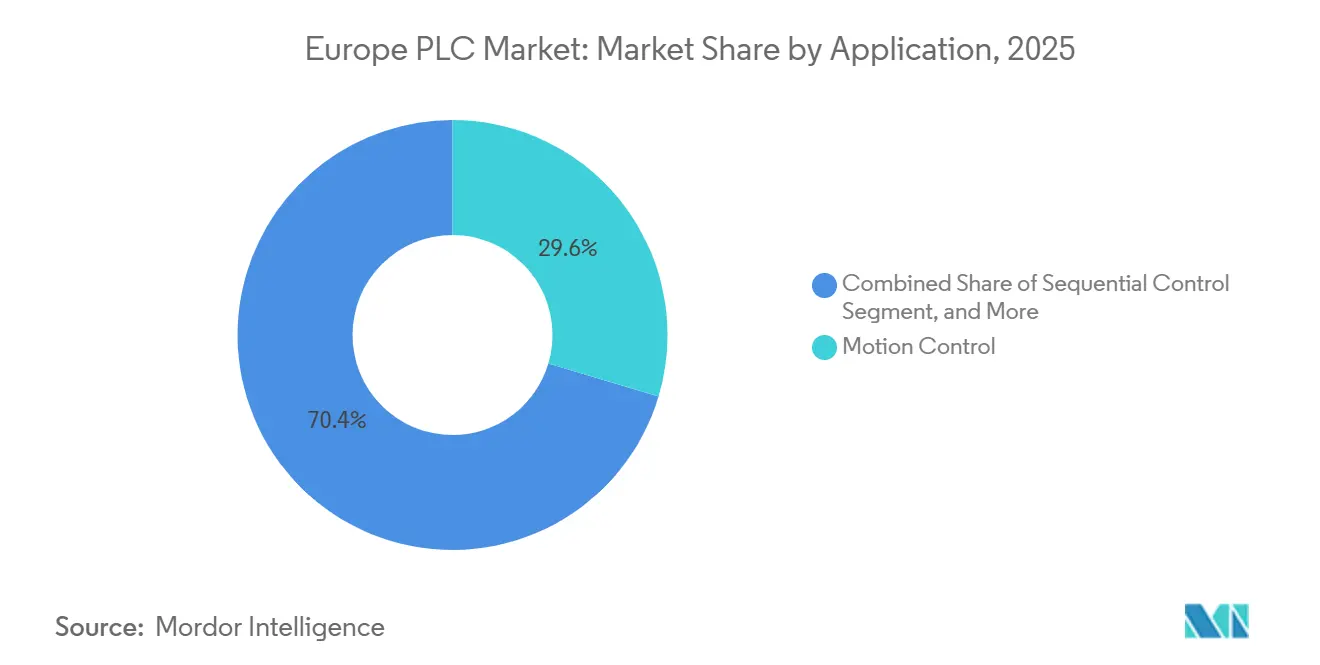
- By application, Motion control dominated with 29.62% revenue share in 2025; Safety logic is projected to rise at a 4.96% CAGR between 2026 and 2031.
- By end-user, the Automotive Sector led with 27.14% of demand in 2025, but Pharmaceutical production is set to post the quickest growth at a 4.71% CAGR through 2031.
Note: Market size and forecast figures in this report are generated using Mordor Intelligence’s proprietary estimation framework, updated with the latest available data and insights as of January 2026.
Market Trends and Insights
Drivers Impact Analysis of Europe Programmable Logic Controller (PLC) Market*
| Driver | (~) % Impact on CAGR Forecast | Geographic Relevance | Impact Timeline |
|---|---|---|---|
| Accelerating Industry 4.0 Adoption and Smart Factory Initiatives | +0.80% | Germany, France, Italy, Netherlands, with spillover to Visegrád Group | Medium term (2-4 years) |
| Increased Adoption of Automation Systems in Manufacturing | +0.70% | Pan-European, concentrated in automotive and pharmaceutical clusters | Short term (≤ 2 years) |
| Growing Demand for Energy-Efficient Production Lines | +0.50% | Germany, Nordic countries, Belgium, driven by carbon pricing under EU ETS | Medium term (2-4 years) |
| Rising Investments in Automotive Electric Vehicle Production Lines | +0.60% | Germany, France, Spain, Hungary, Poland | Short term (≤ 2 years) |
| EU-Funded Digital Innovation Hubs Driving PLC Integration in SMEs | +0.40% | Southern and Eastern Europe, rural manufacturing regions | Long term (≥ 4 years) |
| Post-2024 European Chips Act Incentives Catalysing On-Shoring of PLC Chip Manufacturing | +0.30% | Germany, France, Italy, Ireland (semiconductor fab locations) | Long term (≥ 4 years) |
| Source: Mordor Intelligence | |||
Accelerating Industry 4.0 Adoption and Smart Factory Initiatives
Large manufacturers across Germany, France and Italy moved from pilot projects to scaled rollouts in 2025, with 68% of German plants above 250 employees reporting at least one retrofit that connects legacy PLCs to cloud MES platforms.[1]Plattform Industrie 4.0, “Annual Report 2025,” plattform-i40.de National incentive schemes such as France’s Industrie du Futur and Italy’s Transizione 4.0 provide tax credits or hyper-depreciation on connected machinery, but only if PLCs expose OPC UA servers for interoperability.[2]French Ministry of Economy and Finance, “Industrie du Futur,” economie.gouv.fr Funding from Horizon Europe directs EUR 95 million (USD 111.2 million) to AI-driven predictive maintenance pilots in 2024-2025, accelerating edge-analytics modules on controller backplanes. Spain’s automotive PERTE program earmarks automation subsidies for EV battery lines that need SIL 3 safety PLCs. Collectively, these actions deepen digitalization and cement PLCs as master data nodes on the plant floor.
Increased Adoption of Automation Systems in Manufacturing
EU vehicle output hit 12.8 million units in 2025 with EV and PHEV models accounting for 28%; each electrified variant needs 15-20% more PLC-controlled stations than an internal-combustion build-out. Pharmaceutical capacity expanded 11% as Novo Nordisk and peers ramped biologics production, installing controller-level electronic-record functionality that satisfies FDA 21 CFR Part 11 and EU GMP Annex 11. Food processors upgraded relay logic to PLCs that log HACCP parameters every second, meeting EFSA hygiene mandates effective January 2025.[3]European Federation of National Maintenance Societies, “Maintenance Survey 2025,” efnms.eu Chemical firms in the Rhine-Ruhr invested EUR 890 million in 2025 to replace DCS islands with modular PLCs aligned to NAMUR NE 148 for faster engineering reuse. Water utilities in the Netherlands and Belgium installed 2,300 controllers for real-time CSO monitoring, addressing new wastewater directives.
Growing Demand for Energy-Efficient Production Lines
Carbon prices under the EU ETS touched EUR 85 per metric-ton in Q3 2025, pushing manufacturers to retrofit compressors, chillers and VFDs under PLC supervision. German industrial power costs reached EUR 0.21 per kilowatt-hour in 2025, prompting automotive suppliers to deploy S7-1500 energy-management blocks that curtail non-critical loads during peak tariffs. The Ecodesign for Sustainable Products Regulation obliges machinery above 50 kW to report power per actuator, forcing controller vendors to integrate granular energy counters. Schneider Electric captured a EUR 78 million chemicals retrofit by bundling IEC 61499 control with energy analytics, targeting a 12% reduction in specific consumption. Nordic pulp mills use ABB PLCs to shift digester loads into negative-price hours when wind output peaks.
Rising Investments in Automotive Electric-Vehicle Production Lines
BMW’s Debrecen plant will start volume production in 2026 with 96 safety PLCs and 340 standard units across battery and body shops. Mercedes-Benz budgeted EUR 1.3 billion in 2025 to convert Rastatt, installing GuardLogix PLCs for cobot cells. Renault’s ElectriCity hub deployed 520 Modicon M580s with OPC UA links into SAP MES, ensuring ISO 22163 traceability. Northvolt’s Skellefteå gigafactory relies on 280 ABB controllers for ±2 µm electrode coating tolerances. Public-private tracking by the European Battery Alliance tallies EUR 38 billion (USD 44.46 billion) of announced cell investments through 2025, equating to EUR 8-12 million in PLC hardware per GWh.
Restraints Impact Analysis of Europe Programmable Logic Controller (PLC) Market*
| Restraint | (~) % Impact on CAGR Forecast | Geographic Relevance | Impact Timeline |
|---|---|---|---|
| Intensifying Competition from Industrial PCs and Edge Controllers | -0.40% | Germany, Benelux, Nordics (high-tech manufacturing clusters) | Medium term (2-4 years) |
| High Initial Capital Expenditure for Upgrading Legacy Systems | -0.50% | Southern and Eastern Europe, SME-dominated regions | Short term (≤ 2 years) |
| Cybersecurity Compliance Burden under EU NIS2 Directive | -0.30% | Pan-European, critical infrastructure sectors | Short term (≤ 2 years) |
| Skilled Labour Shortage in IEC 61131-3 Programming in Eastern Europe | -0.40% | Poland, Czech Republic, Romania, Hungary | Long term (≥ 4 years) |
| Source: Mordor Intelligence | |||
Intensifying Competition from Industrial PCs and Edge Controllers
Shipments of industrial PCs into European factories grew 18% in 2025 as Advantech, Beckhoff and Kontron pitched x86 hardware that collapses PLC logic, HMI and analytics onto one box. Time-sensitive networking under IEEE 802.1Qbv now delivers sub-millisecond determinism on commercial switches, eroding the cycle-time advantage of traditional racks. Beckhoff’s TwinCAT software PLC reached 9% share in discrete automation, buoyed by engineers who prefer C++ over ladder logic. Yet Windows or Linux patches every quarter complicate validation in pharma sites governed by Annex 11, giving hardware PLCs security-through-simplicity leverage.
High Initial Capital Expenditure for Upgrading Legacy Systems
A 2025 EFNMS survey found 43% of plants in Italy, Spain and Portugal running controllers averaging 17 years old, with replacements costing EUR 1,200-2,800 (USD 1,404–3,280) per axis, an outlay many SMEs cannot self-fund. Migrating Siemens S5 or Allen-Bradley PLC-5 code to IEC 61131-3 can run EUR 450-650 per engineer hour, deterring updates. The 2027 cybersecurity clause in the EU Machinery Regulation obliges encrypted protocols yet offers no subsidies, forcing cash-constrained integrators to choose compliance over productivity. Spain’s tier-2 auto suppliers carry an automation debt of EUR 3.2 million (USD 3.74 million) per facility and risk delisting if they lack OPC UA connectivity by 2027. Eastern European contract manufacturers operate on 4-7% gross margins, delaying PLC modernization until they secure EIB loans that demand ISO 50001 certification, creating a circular funding hurdle.
*Our forecasts treat driver/restraint impacts as directional, not additive. The impact forecasts reflect baseline growth, mix effects, and variable interactions.
Europe Programmable Logic Controller (PLC) Market Segment Analysis
By Type:
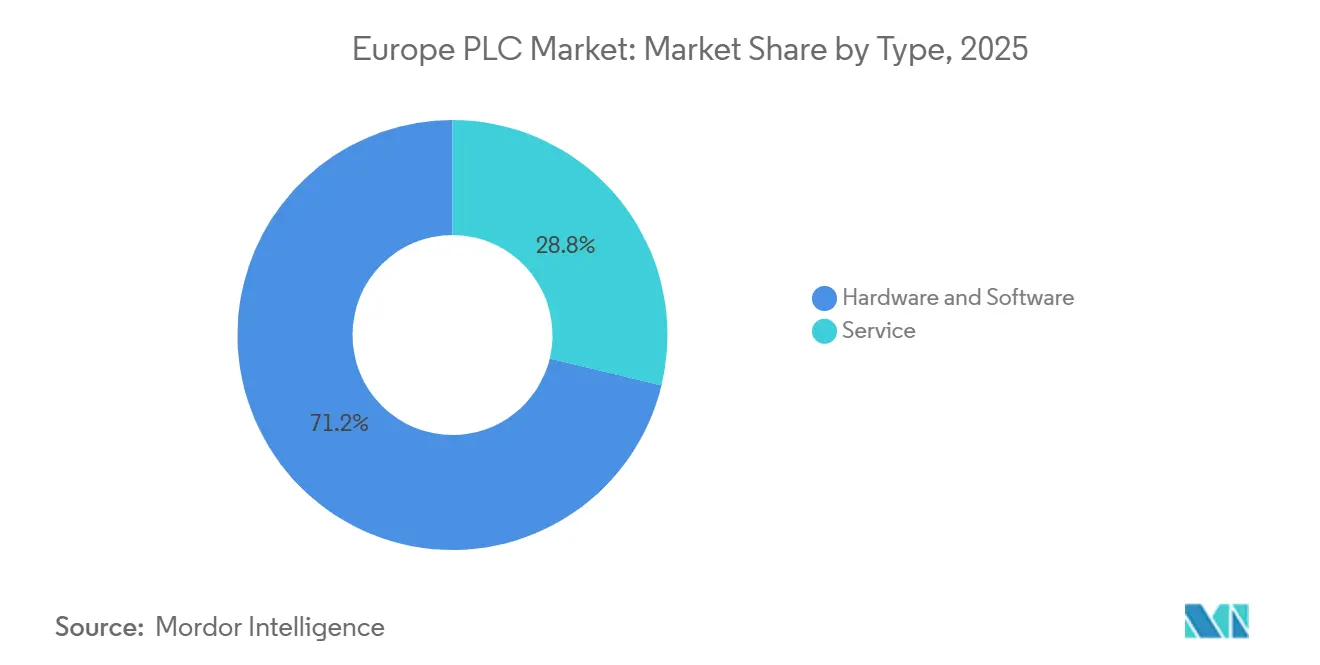
Nano PLCs Empower Modular Machine ConceptsMedium controllers dominated Europe Programmable Logic Controller (PLC) Market share with 34.83% in 2025, anchoring production lines that handle 50-500 I/O points. The Europe Programmable Logic Controller (PLC) Market size for nano variants is expanding fastest at a 4.46% CAGR, driven by machine builders embedding postage-stamp controllers inside plug-and-produce cells. Manufacturers appreciate nano devices for their 3-8 watt draw during energy-label audits and for DIN-rail widths under 25 millimetres that cut cabinet depth. Large PLCs remain staples in refining and pulp but slowly cede ground to distributed architectures that split logic across smaller nodes.
Siemens’ S7-1200 Nano, launched in 2025, bolts directly to DIN rail without a separate power supply, appealing to export OEMs squeezed by container tariffs. Rockwell’s Micro800 line merges a 2.4-inch HMI into the housing, shaving bill-of-materials costs on carwash and laundry equipment. ABB’s AC500-S integrates SIL 3 safety in 90 mm width and slashes control-cabinet wiring 35%. Expect nano growth to keep outpacing the overall Europe Programmable Logic Controller (PLC) Market beyond 2028 as PackML-aligned modules proliferate in pharma and consumer-goods plants.


By Architecture:
Modular Racks Hold the Lead While Soft PLCs AccelerateModular configurations accounted for 41.27% of the Europe Programmable Logic Controller (PLC) Market in 2025 because chemical and pharmaceutical users must hot-swap I/O under Annex 11 audit scrutiny. Compact all-in-one boxes stay popular for lift stations and HVAC air handlers but lose share where future expansion is likely. Rack-mount variants persist in brownfield refineries where 19-inch cabinets can be reused, saving 40% mechanical redesign time.
Soft PLC deployments, meanwhile, are rising at a 4.51% CAGR as firms run control logic on industrial PCs to unify SCADA and deterministic tasks in one chassis. CODESYS runtime licenses cost EUR 350-650 (USD 410–760) versus EUR 2,800-4,200 (USD 3,280–4,914) for hardware equivalents, a compelling difference when cycle times can be maintained through TSN. Schneider’s Modicon M580 ePAC, combining standard and safety logic, secured 18% of the European safety PLC segment in 2025. The newest IEC 61508 revision now mandates secure boot and encrypted firmware, adding EUR 800-1,400 per controller but offering long-term cyber resilience.
By Application:
Safety Logic Surges Ahead of Motion ControlMotion control retained 29.62% of deployments in 2025, underpinning body-in-white welding lines and high-speed palletizers that demand ±0.05 mm accuracy. Still, safety logic is the breakout segment, projected to grow 4.96% annually through 2031 as collaborative robots multiply under Machinery Regulation performance level “d” and “e” mandates. Process and sequential control remain staples for batch reactors and conveyor interlocks but face incremental growth, while data-handling workloads rise quickly as the EU Data Act grants machinery owners real-time access rights.
Rockwell’s FactoryTalk Edge Gateway allows ControlLogix units to stream JSON payloads into AWS or Azure every second, cutting integration labour 60%. Siemens added OPC UA PubSub over TSN to S7-1500 firmware in 2025, enabling synchronized data feeds without sacrificing sub-millisecond loops. As plants blend quality analytics with deterministic control, PLCs able to juggle both domains will capture incremental Europe Programmable Logic Controller (PLC) Market share.

By End-User Industry:
Pharmaceuticals Overtake Automotive in Growth PaceAutomotive claimed 27.14% of 2025 demand, bolstered by battery-module assembly that needs 200-300 safety PLCs per line. Yet pharmaceutical capacity is advancing fastest at a 4.71% CAGR because the EU Falsified Medicines Directive enforces blister-pack serialization down to each vial. Food, tobacco and beverage lines demand IP69K-rated enclosures for washdown environments, while chemicals in the Rhine-Ruhr swap DCS islands for modular PLCs that shrink engineering hours 30%.
Energy utilities outfit wind-farm substations with redundant S7-1500R controllers to guarantee 50 ms failover. Metals and mining operators favour conformal-coated AC500-XC units for dust-laden quarries. Water-treatment authorities in the Low Countries have rolled out 2,300 PLCs since 2024 for CSO alerts mandated by new wastewater rules. Across these domains, serialization, functional safety and energy-optimization each fuel fresh Europe Programmable Logic Controller (PLC) Market opportunities.
Geography Analysis
Germany Programmable Logic Controller (PLC) Market
Germany remained the anchor of the Europe Programmable Logic Controller (PLC) Market in 2025, underpinned by EUR 52 billion (USD 60.84 billion) in announced EV investments from Volkswagen, BMW and Mercedes-Benz that each specify 200-300 safety controllers per gigafactory. Plattform Industrie 4.0 issued digital-twin reference shells that require OPC UA at the controller layer, accelerating retrofits of Simatic S7-1500 and Beckhoff CX5000 units. The “Digital Now” grant covers half of automation spend for SMEs and funnelled 38% of approvals to PLC projects in 2024-2025. High power prices, averaging EUR 0.21 per kWh, further hasten controller swaps that manage dynamic load shedding at BASF and Covestro.
United Kingdom and France Programmable Logic Controller (PLC) Market
The United Kingdom is pivoting from a softer auto sector toward expanding biologics plants; AstraZeneca and GSK upgrades drove 14% capacity gains and heavy PLC demand in 2025. The Made Smarter adoption program co-funded 420 SME controller retrofits, with each project mandating real-time ERP connectivity. France preserved momentum via Industrie du Futur tax credits that oblige built-in OPC UA servers, standardizing multi-vendor lines, while Stellantis’ Hordain battery plant deployed Modicon M580 safety PLCs with encrypted boot loaders to satisfy NIS2 cybersecurity audits.
Broader European Markets
Italy leveraged 270% hyper-depreciation to lift PLC shipments 34% year-on-year in 2025, with Bologna’s packaging OEMs embedding Omron NJ controllers for export. Spain’s PERTE initiative funnelled EUR 2.98 billion (USD 3.49 billion) into battery lines at Martorell and Vigo, each fitted with GuardLogix safety PLCs for ASIL-D compliance. Elsewhere, Poland and Czechia lure tier-1 EV suppliers, the Nordics stress energy-optimized automation in pulp mills, and the Netherlands and Belgium automate port cranes with S7-1500 controllers to attain 99.7% uptime under ISO 55001. Collectively, this geographic mosaic ensures the Europe Programmable Logic Controller (PLC) Market continues to display balanced growth across diverse industrial clusters.
Regulatory Landscape
The European regulatory environment for PLCs is tightening around functional safety and product cybersecurity, which in turn affects controller architecture, documentation, and validation. Regulation (EU) 2023/1230 (Machinery Regulation) raises compliance expectations for machinery placed on the EU market and adds requirements such as retaining technical documentation and EU declarations of conformity for extended periods. It also gives authorities the ability to request access to software or programming logic when needed to assess safety compliance, aligning with the faster uptake of safety-rated PLCs ahead of the January 2027 inflection referenced for collaborative robot cell deployments.
On the standards side, IEC 61508 remains the core functional-safety lifecycle framework for programmable electronic systems, while IEC 61131-6:2012 specifies functional safety requirements for safety PLCs used in safety-related control systems. Regulation (EU) 2024/2847 (Cyber Resilience Act) shifts market access toward secure-by-design requirements for products with digital elements, pushing PLC vendors to formalize lifecycle cybersecurity risk assessments, secure update processes, and compliance-ready technical files as part of CE marking and customer audits, particularly in regulated end users such as automotive, energy, and pharmaceuticals.
Competitive Landscape
The Europe Programmable Logic Controller (PLC) Market is moderately concentrated: Siemens, Schneider Electric and Rockwell Automation together commanded 52% in 2025. Siemens capitalizes on its TIA Portal and MindSphere ecosystem, raising customer switching costs above USD 500,000 for mid-sized lines. Schneider Electric differentiates with EcoStruxure Automation Expert, the first IEC 61499 mainstream offer; a EUR 78 million (USD 91.26 million) chemicals deal in 2025 validates vendor-agnostic portability. Rockwell leverages GuardLogix pre-certified safety blocks, trimming automotive validation cycles 40%.
Mid-tier challengers Beckhoff and WAGO advance via EtherCAT distributed I/O that cuts wiring 40% and aligns with PackML modularity, giving them 9% share in discrete manufacturing. ABB, Mitsubishi Electric and Phoenix Contact invest in safety PLC miniaturization with secure-boot firmware to comply with IEC 61508 edition 3, while CODESYS runtime maintains a near-universal foothold across 400 OEMs. Patent filings rose to 340 during 2024-2025, 28% centered on cybersecurity such as ABB’s over-the-air encrypted firmware method EP4012345A1. Semiconductor availability is improving. Infineon is adding EUR 5 billion (USD 5.85 billion) of microcontroller capacity in Dresden, shrinking lead times that peaked at 52 weeks during COVID-19.
Software ecosystems now shape vendor stickiness more than raw scan-time specs. The rise of time-sensitive networking blurs hardware advantages, prompting PLC players to embed analytics toolkits and automated code-generation wizards. Services revenue around validation, cybersecurity hardening and energy-optimization is projected to eclipse hardware growth through 2031, intensifying the scramble for domain-specialist talent across Europe PLC industry engagements.
Europe Programmable Logic Controller (PLC) Industry Leaders
ABB Ltd
Mitsubishi Electric Corporation
Schneider Electric SE
Rockwell Automation
Siemens AG
- *Disclaimer: Major Players sorted in no particular order
Europe Programmable Logic Controller (PLC) Market Companies Covered in this Report
- Siemens AG
- Schneider Electric SE
- Rockwell Automation Inc.
- Mitsubishi Electric Corporation
- ABB Ltd.
- Honeywell International Inc.
- Omron Corporation
- Emerson Electric Co.
- Panasonic Corporation
- Robert Bosch GmbH (Bosch Rexroth)
- Hitachi Ltd
- General Electric Co.
- Beckhoff Automation GmbH
- B and R Industrial Automation GmbH
- Phoenix Contact GmbH
- Festo SE and Co. KG
- WAGO Kontakttechnik GmbH
- Eaton Corporation plc
- IDEC Corporation
- Advantech Co. Ltd
Read Analysis of Europe Programmable Logic Controller (PLC) Companies

Market Opportunities and Future Outlook
The clearest opportunity sits at the intersection of functional safety upgrades and cybersecurity-by-design, as end users standardize control platforms to reduce revalidation and compliance workload. The EU Machinery Regulation 2023/1230 increases the emphasis on performance-level requirements and safety documentation for new machine deployments, while the Cyber Resilience Act (Regulation (EU) 2024/2847) adds lifecycle cybersecurity obligations for connected controllers. Together, these requirements support PLC platforms that package safety, secure boot, signed firmware, and documented risk management into solutions that are easier to audit. In current market conditions, that whitespace is most visible in safety logic and data-handling workloads as plants consolidate controllers, gateways, and edge functions to meet both safety and cyber audit expectations with fewer devices and fewer interfaces.
Industrial digitalization programs and large-scale capex pipelines also create upgrade headroom tied to interoperability and energy management. In Europe, national schemes such as France’s Industrie du Futur and Italy’s Transizione 4.0 link incentives to interoperable connectivity, including requirements for OPC UA exposure at the controller layer. This supports demand for modular and edge-ready PLCs that can act as data nodes for MES/ERP integration. On the supply side, semiconductor localization efforts under the European Chips Act, alongside vendor capacity expansions such as Infineon’s Dresden investments cited in the report context, reduce the operational risk from long lead times that constrained project rollouts in 2021-2022, enabling OEMs and integrators to plan multi-site retrofit waves across Germany, France, Italy, and fast-automating clusters in Eastern Europe.
Recent Industry Developments in Europe Programmable Logic Controller (PLC) Market
- July 2026: Siemens introduced a new generation of the Sinumerik One CNC control system positioned as AI-ready and aligned with upcoming EU Cyber Resilience Act requirements. The update tightens the linkage between machine control, data capabilities, and compliance-driven security features, shaping controller selection in high-volume automated production lines where CNC and PLC ecosystems are procured together.
- December 2025: Schneider Electric won a EUR 92 million contract to supply Modicon M580 safety PLCs across 18 aseptic filling lines in Italy. The win highlights how validated safety functions and faster qualification cycles are becoming decisive in regulated manufacturing, reinforcing safety PLC momentum alongside pharma capacity expansion in Europe.
- October 2024: ABB launched the AC500-S Compact Safety PLC and reported EUR 28 million in initial orders tied to collaborative robot cell deployments. Early commercial traction shows the continued shift from conventional motion control toward integrated functional safety at the controller layer as OEMs redesign cells to meet higher safety performance requirements.


Europe Programmable Logic Controller (PLC) Market Report Scope and Research Methodology
Market Definition and Coverage
This market covers revenues generated from programmable logic controllers sold and used across Europe for industrial control and automation, including hardware units and the closely linked controller software/firmware that ships with the PLC.
Scope exclusions: Excludes adjacent automation layers like SCADA/HMI software, industrial networking gear, and plant-wide engineering services that can be purchased alongside PLC deployments.
Segments Covered in This Report
- By Type
- Hardware and Software
- Large PLC
- Medium PLC
- Small PLC
- Nano PLC
- Other Hardware Types
- Service
- Hardware and Software
- By Architecture
- Modular PLC
- Rack PLC
- Compact PLC
- Soft PLC
- Safety PLC
- By Application
- Motion Control
- Process Control
- Sequential Control
- Safety
- Data Handling and Communications
- By End-User Industry
- Automotive
- Food, Tobacco and Beverage
- Chemical and Petrochemical
- Energy and Utilities
- Pharmaceutical
- Oil and Gas
- Metals and Mining
- Water and Wastewater
- Other End-User Industries
- By Geography
- Germany
- United Kingdom
- France
- Italy
- Spain
- Rest of Europe
Data Sources, Market Sizing, and Validation
Desk Research
Desk work started with mapping PLC demand signals and supply constraints across Europe, then cross-checking them with country and industry activity indicators. Public sources included materials from bodies such as Eurostat (manufacturing output and industrial production indices), the European Commission (industrial and digital policy updates), and customs and trade statistics portals for import and export checks. Where relevant, we also referenced international standards and safety documentation such as IEC materials. We then reviewed peer-reviewed industrial automation journals for adoption patterns, and used patent databases to understand where controller capabilities are moving.
To anchor the company landscape, we reviewed annual reports, investor presentations, and product documentation from major automation suppliers, followed by trusted business press for lead time and semiconductor availability notes. Where needed, we used paid subscriptions for company financials and news intelligence, and a patent database for faster screening of filings by controller type and function. These sources are illustrative, and other public and paid references were used for data collection, validation, and clarification.
Primary Interviews and Surveys
Primary inputs were gathered through expert calls and structured questionnaires with PLC suppliers, system integrators, distributors, and end users in process and discrete industries across Europe. The interviews helped us validate typical PLC replacement cycles, price movement by PLC class, and how safety and regulatory requirements influence controller selection. We then refined assumptions when desk signals moved in different directions.
Distribution of primary research fieldwork respondents
| Company type | Respondent position |
|---|---|
| Top tier: 37% | CXOs: 12% |
| Mid tier: 47% | Functional/Unit leaders: 28% |
| Smaller Players: 16% | Managers: 60% |
Market-Sizing & Forecasting
Sizing was built using a top-down model where manufacturing output, automation capex intent, and installed base refresh needs are converted into an addressable PLC spend pool for Europe, and then split by the most common buying patterns observed in the field. In parallel, totals were checked with selective bottom-up approximations using sampled average selling prices by PLC class (nano, small, medium, large where applicable) multiplied by estimated unit volumes from channel discussions. This cross-check helped correct overcounting in years with inventory digestion.
Key inputs used in the model included industrial production trends by country, machine and equipment investment indicators, the pace of brownfield retrofits versus greenfield projects, semiconductor lead time normalization, and the share of safety-rated deployments that typically carry a higher controller price. Forecasts were developed using scenario analysis supported by simple multivariate regression on industrial output and capital formation signals, then adjusted based on expert consensus about automation backlogs and replacement timing. When unit signals were patchy for smaller countries, gaps were handled using proxy intensity factors tied to manufacturing value add and sector mix, before being rechecked with interview feedback.
Data Validation & Update Cycle
Outputs were validated through step-by-step triangulation across independent signals, so the final totals aligned with what was seen in industrial activity, trade flows, and pricing direction. Outliers were flagged at the country level, reviewed by another analyst, and then reworked only after assumptions were traced back to a clear input or a confirmed interview point. If a large variance appeared after a major event such as a regulatory change, a supply disruption, or a sharp currency move, respondents were re-contacted to confirm what changed and whether it was temporary.
The report is refreshed annually, with interim updates when material market events occur. Before publication, we run a final update pass to ensure the latest public data releases and validated field notes are reflected in the market size and forecast path.
Mordor Intelligence's Europe Programmable Logic Controller Plc Market Sizing Compared With Other Published Estimates
Published numbers for Europe PLCs can look different because not everyone uses the same product boundary, and the base year and currency timing can also vary. Differences also show up when one study relies on shipment proxies while another relies on spending proxies, since channel inventory swings can temporarily distort apparent demand.
SCADA and HMI software value is bundled in some estimates, and that bundle sits outside Mordor Intelligence's scope for this PLC market, which keeps the value tied to controller hardware and its directly attached controller software. Other gaps come from whether refurbishments are counted like new sales, how safety-rated PLC price uplift is applied, and whether the 2021 to 2022 lead time and stocking effects are normalized or carried straight into the base.
Benchmark comparison
| Source | Market Size | Gaps in Research Methodology |
|---|---|---|
| Mordor Intelligence | USD 3.75 B (2026) | |
| Global Consultancy A | USD 2.53 B (2025) | Uses a factory automation PLC lens that can undercount process-industry demand, and it anchors sizing on a different base year, which shifts currency and inflation timing versus a 2026 reference. |
| Industry Publisher B | USD 3.38 B (2022) | Older base year and growth projection window can miss later retrofit waves and post-shortage normalization, and the page-level method detail is limited on how pricing is updated into later years. |
Across the table, the spread is mainly explained by what is bundled into PLC value, the year being quoted, and how pricing and inventory effects are treated. By keeping inputs tied to observable industrial activity and checked with real purchase behavior shared in interviews, we arrive at a market total that can be repeated and stress-tested when assumptions change.


Key Questions Answered in the Report
What was the Europe PLC market size in 2026?
It reached USD 3.75 billion.
How fast will the Europe PLC market grow by 2031?
The market is forecast to expand at a 3.06% CAGR to USD 4.36 billion.
Which PLC type is expanding quickest?
Nano PLCs are growing at a 4.46% CAGR as OEMs embed compact controllers into modular machines.
Why are safety PLCs gaining importance?
The EU Machinery Regulation 2023/1230 mandates higher performance levels for collaborative robot cells introduced after January 2027, spurring a 4.96% CAGR in safety logic deployments.
Which country leads PLC adoption in Europe?
Germany commands the largest share due to extensive EV-battery and chemical investments.
What is the main restraint for SMEs modernizing PLCs?
High up-front capital expenditure, often EUR 1,200-2,800 per axis, delays upgrades without external financing.
Page last updated on:





