Market Overview
| Study Period | 2019 - 2031 |
|---|---|
| Base Year Market Size (2025) | USD 2.23 Billion |
| Market Size (2026) | USD 2.28 Billion |
| Market Size (2031) | USD 2.62 Billion |
| Growth Rate (2026 - 2031) | 2.82 % |
| Fastest Growing Market | Multi-Mission Helicopter |
| Largest Market | France |
Major Players *Disclaimer: Major Players sorted in no particular order Image © Mordor Intelligence. Reuse requires attribution under CC BY 4.0. | |
Europe Military Helicopters Market Analysis by Mordor Intelligence
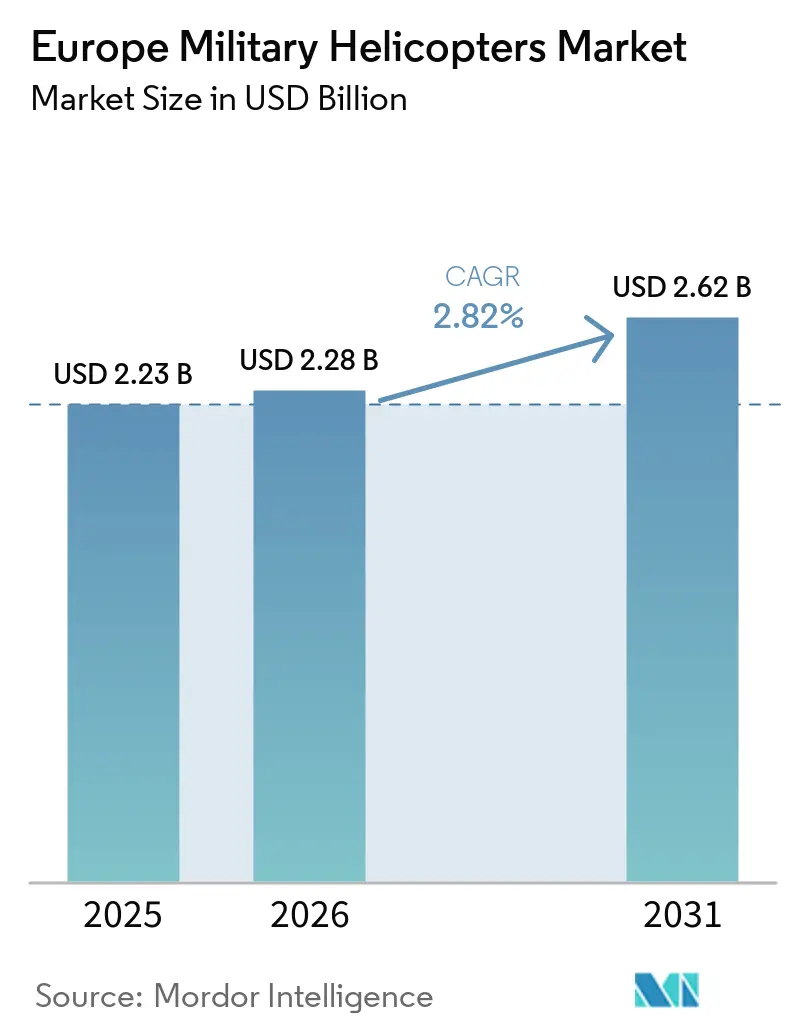
The Europe military helicopters market size was valued at USD 2.23 billion in 2025 and is forecast to grow from USD 2.28 billion in 2026 to USD 2.62 billion by 2031, registering a 2.82% CAGR between 2026 and 2031. Rising defense budgets are moving helicopter programs from planning to funded procurement and contracted delivery, enabling ministries to align aircraft replacement with training, spare parts, infrastructure, and personnel requirements. NATO members are expected to meet the 2% of GDP defense spending guideline in 2025, while European allies and Canada are projected to increase combined defense expenditure by nearly 20% in real terms to more than USD 571 billion. This creates a more stable funding environment for previously delayed or fragmented procurement programs.
European procurement is becoming more coordinated through the SAFE mechanism, which can provide up to EUR 150 billion (USD 173.98 billion) in joint-procurement loans. EU equipment procurement is expected to exceed EUR 100 billion (USD 115.98 billion) in 2025, allowing governments to coordinate purchases while retaining responsibility for operational requirements. Fleet replacement needs, cross-service standardization, and operational demands along Europe’s eastern and southern borders are supporting the procurement of utility, transport, and combat helicopters. As established fleets age, aircraft availability, maintenance capacity, and access to spare parts remain critical during fleet transitions.
Suppliers that combine aircraft delivery with training, support, mission systems, and local industrial participation are better positioned to secure long-term programs in the Europe military helicopters market. Governments increasingly assess operational readiness, domestic workshare, and sustainment as part of a single acquisition decision. This favors established suppliers that can ensure reliable delivery schedules, availability of spare parts, trained technical personnel, and local participation. Programs that standardize aircraft across compatible services also benefit from shared equipment and common training, reducing the burden of operating several separate fleets.
Key Report Takeaways
- By helicopter type, multi-mission helicopters accounted for 39.94% of the Europe military helicopters market in 2025, while transport helicopters are forecast to grow at a 3.99% CAGR through 2031.
- By end-user service, Army Aviation accounted for 41.97% of the Europe military helicopters market in 2025, while Paramilitary and Coast Guard services are forecast to grow at a 3.58% CAGR through 2031.
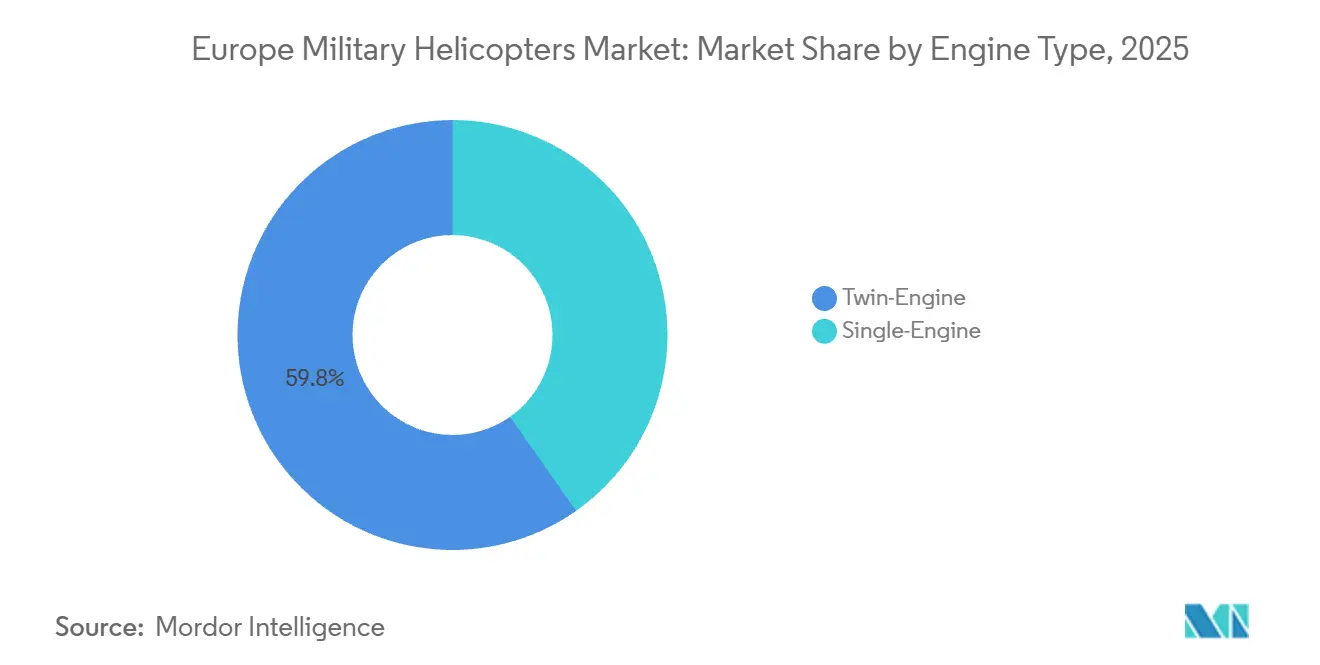
- By engine type, twin-engine platforms accounted for 59.75% of Europe military helicopters market in 2025 and are forecast to grow at a 3.97% CAGR through 2031.
- By application, Combat and close air support accounted for 41.92% of the Europe military helicopters market in 2025, while humanitarian and disaster relief is forecast to grow at a 3.15% CAGR through 2031.
- By country, France accounted for 21.89% of the Europe military helicopters market in 2025, while Germany is forecast to grow at a 4.01% CAGR through 2031.
Note: Market size and forecast figures in this report are generated using Mordor Intelligence’s proprietary estimation framework, updated with the latest available data and insights as of January 2026.
Europe Military Helicopters Market Trends and Insights
Drivers Impact Analysis*
| Driver | (%) Impact on CAGR Forecast | Geographic Relevance | Impact Timeline |
|---|---|---|---|
| NATO and European defense-spending commitments | +0.60% | Global, led by Germany, Poland, and Baltic states | Short term (≤ 2 years) |
| Fleet modernization and replacement of aging platforms | +0.60% | Germany, France, UK, Italy | Medium term (2-4 years) |
| Multi-mission standardization and interoperability requirements | +0.30% | EU and NATO core nations | Medium term (2-4 years) |
| Rising regional security threats and border-protection requirements | +0.40% | Eastern and Central EU, Baltic states, Mediterranean flank | Short term (≤ 2 years) |
| Open-architecture, crewed-uncrewed teaming, and digital avionics | +0.20% | UK, France, Germany | Long term (≥ 4 years) |
| Multinational procurement and sovereign industrial-base localization | +0.20% | EU-wide, with early gains in Spain, Romania, Poland | Medium term (2-4 years) |
| Source: Mordor Intelligence | |||
NATO And European Defense-Spending Commitments
Defense commitments in NATO Europe have entered multi-year spending frameworks rather than remaining political targets. All 32 NATO allies met the 2% of GDP threshold in 2025, and the June 2025 Hague Summit set a 5% target for 2035, with annual national spending plans.[1]Source: Airbus, “Airbus Delivers First NH90 Standard 2 to France,” Airbus, airbus.com This reporting structure makes prolonged underinvestment more visible and gives ministries a clearer basis for sequencing helicopter purchases. EU equipment procurement reached EUR 100 billion (USD 115.98 billion) in 2025, up 26% from 2024.[2]Source: NATO, “Defence Expenditures and NATO’s 5% Commitment,” NATO, nato.in The Europe military helicopters market, therefore, benefits from budgets that can support aircraft, spare parts, training equipment, and infrastructure. Spain’s 100-aircraft package helped Airbus Helicopters expand its Albacete customization and training capacity, linking procurement to a more durable local delivery base.
Fleet Modernization And Replacement Of Aging Platforms
Europe has an aging rotary-wing fleet, including 1,800 transport helicopters and 600 combat helicopters, with an average service life of more than 20 years. Without replacement, many heavy aircraft could remain in operation for more than 50 years by the 2040s. Replacement programs are becoming more concrete as countries define retirement dates for legacy fleets and commit funding for new platforms. Germany’s 60 CH-47F Block II helicopters will replace the CH-53G Sea Stallions, which are scheduled to retire by 2030. Its H145M program includes training, simulators, spare parts, and maintenance support from contract signature, placing lifecycle services inside the initial purchasing decision. This approach expands the Europe military helicopters market beyond airframe deliveries and makes reliable support capacity central to supplier selection.
Rising Regional Security Threats And Border-Protection Requirements
The security environment since Russia’s 2022 invasion of Ukraine has changed national requirements for transport, attack, surveillance, and utility aircraft. Poland’s Apache and Black Hawk acquisitions reflect stronger demand for attack and utility capabilities among countries along NATO’s eastern flank. Border protection also combines surveillance, mobility, medical evacuation, and humanitarian tasks in ways that require adaptable helicopters. Paramilitary and Coast Guard use is forecast to grow at a 3.58% CAGR through 2031 as these missions become more closely linked. Romania’s 2026 program combined 12 H225M military transports with H175M and H145 civil-security helicopters, demonstrating a national approach that connects defense and internal security requirements.[3]Source: Airbus, “Airbus Delivers First NH90 Standard 2 to France,” Airbus, airbus.com This overlap broadens the opportunity base for the Europe military helicopters market, although requirements and funding channels remain different across users.
Open Architecture, Crewed-Uncrewed Teaming, And Digital Avionics
Crewed-uncrewed teaming is moving from demonstrations toward defined military requirements in European programs. The UK MoD selected 4 industry partners for Project NYX in 2026 to develop autonomous systems that support the British Army’s AH-64 Apache fleet. A prototype phase is scheduled for autumn 2026, with an operational system targeted for 2030. Airbus Helicopters also conducted a maritime trial with the Spanish Navy that transferred drone imagery in real time through HTeaming into the NAIAD naval combat-management system. NATO’s Next Generation Rotorcraft Capability (NGRC) requirements call for a 220-knot cruise speed, open modular architecture, and native interoperability with uncrewed systems. These requirements place mission-system flexibility and integration capability alongside flight performance in the Europe military helicopters market.
Restraints Impact Analysis*
| Restraint | (%) Impact on CAGR Forecast | Geographic Relevance | Impact Timeline |
|---|---|---|---|
| High lifecycle cost and sustainment burden | -0.40% | Germany, France, Italy, Nordic states | Medium term (2-4 years) |
| Procurement lead times and skilled-labor bottlenecks | -0.20% | Germany, France, Italy | Medium term (2-4 years) |
| Export controls, technology-transfer limits, and political risk | -0.10% | Transatlantic procurement programs with EU-US avionics chains | Short term (≤ 2 years) |
| Fragmented requirements and low fleet availability during transition | -0.10% | Multinational programs, including NH90 nations | Medium term (2-4 years) |
| Source: Mordor Intelligence | |||
High Lifecycle Cost And Sustainment Burden
Lifecycle spending can exceed the acquisition price over a 30-year helicopter service life, placing significant pressure on defense budgets after delivery. Norway’s 2025 settlement with NHIndustries followed persistent problems with NH90 spare-parts availability and showed that support issues can become program-level disputes. NATO’s EUR 1.3 billion (USD 1.51 billion) NH90 support contract covers Belgium, France, Germany, Italy, and the Netherlands from 2025 to 2030. The pooled arrangement is expected to save 22% compared with separate bilateral contracts. Even with pooled support, availability constraints during fleet transition can limit training and operational readiness. The NGRC program’s EUR 35 million (USD 40.61 million) flyaway cost target and lifecycle cost requirement show that affordability now influences aircraft design and buying decisions.
Procurement Lead Times And Skilled-Labor Bottlenecks
Long procurement cycles can delay the readiness gains expected from higher defense budgets. The UK’s New Medium Helicopter program was announced in 2021 and contracted in March 2026, demonstrating the time required for competition, oversight, and industrial assessment. Manufacturers must also compete for avionics engineers, composite-structure specialists, and flight-test staff. These skills are needed by civil aerospace and other technology-intensive employers, which adds pressure to program schedules. Germany used the US Foreign Military Sales (FMS) route for its CH-47F purchase because domestic heavy-lift production capacity does not exist at the needed scale. The SHARP and NGRC initiatives seek to develop European propulsion and systems expertise, but training qualified personnel will take well into the 2030s.
*Our forecasts treat driver/restraint impacts as directional, not additive. The impact forecasts reflect baseline growth, mix effects, and variable interactions.
Segment Analysis
By Helicopter Type: Multi-Mission Platforms Support Cross-Service Fleet Renewal
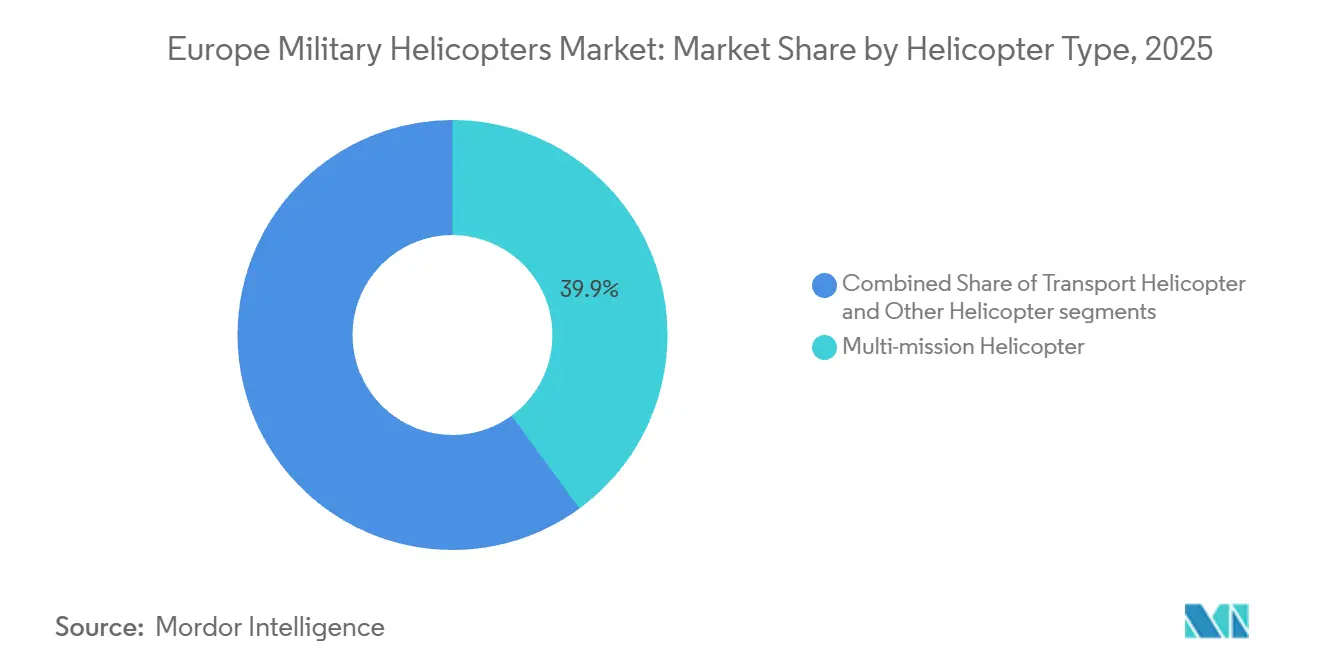
Multi-mission helicopters accounted for 39.94% of the Europe military helicopters market in 2025, making them the largest helicopter-type category. Operators use these aircraft for combat support, troop transport, and search and rescue, which reduces the need to maintain separate fleets for each task. Spain ordered 31 additional NH90 tactical transport helicopters in December 2025, after already operating or ordering 45 aircraft, underscoring the scale of its commitment once a platform is established across service branches. The order formed part of a wider 100-helicopter package for the Army, Air Force, and Navy. Common platforms can simplify crew training, maintenance planning, and mission-system support. They can also help armed services coordinate procurement when missions overlap. This is important where force structures require aircraft to move quickly between domestic support and military operations. The market consequently places a high value on adaptable airframes that can be configured for multiple roles.
Transport helicopters are forecast to grow at a 3.99% CAGR through 2031. NATO’s reinforced force model increases the need to move troops, equipment, and supplies over long distances. Heavy-lift aircraft, therefore, remain necessary even as ministries seek common utility fleets. Germany’s planned CH-47F Block II acquisition provides a clear example of this need because it is tied to the retirement of the CH-53G fleet by 2030. Other types, including light liaison and observation aircraft, face lower procurement volumes as countries consolidate platforms. They remain relevant for pilot training and territorial surveillance. The NH90 Standard 2, delivered first to the French special forces in July 2026, demonstrates how mission-specific avionics can extend the capabilities of a baseline platform. NAHEMA and NHIndustries began a Block 2 architecture study in April 2026 for operations after 2040, extending the platform’s relevance. France’s planned 169 H160M Guépard aircraft will further support multi-mission fleet renewal, with the first Army delivery expected in 2028.



By End-User Service: Army Aviation Retains Volume While Paramilitary Users Expand
Army Aviation accounted for 41.97% of the Europe military helicopters market in 2025, supported by land-focused force structures and requirements along NATO’s eastern flank. Army users need helicopters for reconnaissance, tactical transport, medical support, command mobility, and combat missions. Their demand remains linked to the availability of deployable ground forces and the need to sustain those forces. Air Force, Naval, and Marine Corps Aviation, as well as Joint and Special Operations users, account for the remainder of procurement. Naval demand remains firm because anti-submarine warfare and maritime patrol require specialized rotary-wing capability. Joint and special operations units also seek aircraft with advanced communications and mission equipment. These requirements keep the Europe military helicopters market diverse, even as ministries pursue fewer core airframes.
Paramilitary and Coast Guard services are forecast to grow at a 3.58% CAGR through 2031, the highest rate among end-user services. Border management, maritime surveillance, and emergency-response duties increasingly require military-grade aircraft and support systems. Romania ordered H175M and H145 helicopters for its Ministry of Internal Affairs in June 2026 alongside a separate H225M military transport acquisition. This structure shows how internal-security users can use procurement mechanisms that also support armed-force modernization. The UK selected 23 AW149 helicopters in March 2026 to replace 3 legacy types across Army and Strategic Command missions. France’s NH90 Standard 2 deliveries and Spain’s orders also reinforce standardization for special operations missions. NATO aircrew-training requirements and allied interoperability agreements favor approved and supportable platforms. This narrows the number of viable choices for users who need to operate with allied forces.
By Engine Type: Twin-Engine Aircraft Remain the Standard for Demanding Missions
Twin-engine helicopters held 59.75% of the Europe military helicopters market share in 2025, the largest share among engine configurations. They are also forecast to grow at a 3.97% CAGR through 2031, preserving their lead in the active procurement pipeline. European military operators use twin-engine designs for over-water, mountain, and high-threat missions where redundancy is important. Safety requirements often favor these aircraft when a mission cannot tolerate a single point of failure. The H225M, NH90, AW149, and CH-47F are all twin-engine aircraft within major confirmed procurement programs. Their presence in French, German, Romanian, Spanish, and UK programs directly links engine preference to current spending. This alignment supports continued demand for twin-engine capability across utility, transport, and combat-related tasks.
Single-engine aircraft remain relevant in training, liaison, and light-utility missions. Spain’s 13-unit H135 order was intended for pilot training and observation roles within the National Helicopter Plan. These roles have a distinct operating profile and do not always require the range or redundancy of larger aircraft. Germany’s H145M is a light twin-engine aircraft, and 18 of its 82 units are assigned to the Army Aviation Helicopter Training Centre at Bückeburg. This deployment illustrates how twin-engine aircraft can also take over roles once filled by lighter designs. The SHARP consortium is developing the ENGHE propulsion architecture for future twin-engine helicopters across weight classes. The program is aimed at service entry around 2040 and supports the longer-term position of twin-engine configurations. Engine selection will remain tied to mission risk, training needs, and total support requirements.
By Application: Combat Support Leads While Humanitarian Missions Grow Faster
Combat and close air support accounted for 41.92% of the Europe military helicopters market in 2025. The category is supported by Poland’s AH-64E Apache procurement and Airbus Helicopters’ Tiger mid-life upgrade work in Albacete. These programs reflect the continuing need for armed reconnaissance and close support in land operations. Combat platforms must operate with ground forces and integrate sensors, communications, weapons, and digital mission systems. They remain important for countries seeking to strengthen deterrence and rapid-response capacity. Troop transport is the second-largest application by volume. NH90 NATO Transport Helicopter variants in 14 nations and Germany’s future CH-47F fleet support this demand. Together, these applications link the market to both combat effectiveness and mobility.
Humanitarian and disaster relief is forecast to expand at a 3.15% CAGR through 2031, making it the fastest-growing application. Climate events and formal military disaster-response responsibilities have increased the value of helicopters capable of supporting civil authorities. Romania’s H145 procurement for SMURD emergency rescue and mountain-rescue operations shows how these needs can create demand for aircraft also suited to security missions. Pilot training also grows as fleets expand because new aircraft require more crews, instructors, simulators, and maintenance personnel. Spain’s H135 allocation and Germany’s Bückeburg cluster show that training capacity is being developed alongside combat fleets. The NGRC program requires modular mission systems capable of transitioning between combat support and transport tasks. This capability may make application boundaries less distinct in future fleets. Procurement decisions will increasingly consider whether a single aircraft can meet both military and civil-response roles without major reconfiguration.
Geography Analysis
France held 21.89% of the Europe military helicopters market share in 2025 and remained the largest national procurement market. It's 2024-2030 Military Programming Law supports renewal across NH90 TTH, NH90 Standard 2, and H160M Guépard fleets. The first NH90 Standard 2 delivered in July 2026 can carry up to 20 soldiers at 320 km/h and includes an electro-optical designator and a special-forces radio suite.
Germany is forecast to grow at a 4.01% CAGR through 2031, supported by 82 H145M helicopters and a EUR 7 billion (USD 8.12 billion) CH-47F program. The first H145M special-forces aircraft was delivered to Laupheim in June 2026. Germany's contracts show that the Zeitenwende agenda is producing aircraft deliveries, not just budget allocations. The UK's AW149 agreement preserves Yeovil as the country's only sovereign military-helicopter manufacturing site and creates a platform for future export work.
Spain and Italy are established mid-tier markets where procurement is closely connected to domestic industrial workshare. Spain's December 2025 package included NH90, H145M, H135, and H175M helicopters for 3 military services. Airbus is committed to a new customization center, an H145M training center, and more than 300 skilled jobs in Albacete. This arrangement places industrial capacity alongside operational needs in Spain's procurement decisions. The Albacete Tiger mid-life upgrade program follows the same pattern of linking fleet capability with local work. Italy's demand is closely tied to Leonardo's role in aircraft manufacturing and mission-system integration. AW139, AW101, and AW149 variants support Italian Army, Air Force, and Naval Aviation requirements. Greece signed a EUR 50 million (USD 57.98 million) NH90 support agreement in December 2025 covering spare parts and maintenance for 5 years, highlighting the ongoing aftermarket need following initial deliveries.
Romania's purchase of 12 H225M military transport helicopters for EUR 757 million (USD 877.87 million), together with a follow-on option for 30 aircraft, signals a significant entry into regional procurement. The deal includes logistics, training, technology transfer, and local assembly-line development at IAR Ghimbav. Poland is also increasing its capabilities through investments in Apache and Black Hawk helicopters, though this approach favors US-origin platforms over European alternatives. Belgium received its first H145M in 2025 after signing its initial contract through the NATO Support and Procurement Agency in 2024. Its program supports interoperability of light helicopters within the Benelux pooling agenda. The Netherlands and Belgium also participate in the 2025-2030 NH90 support agreement with 3 other European operators. Russia's Mi-8/17, Mi-24/35, Mi-28, and Ka-52 fleets remain outside Western procurement structures. Its import-substitution approach focuses on avionics and components previously sourced from EU and US suppliers.

Competitive Landscape
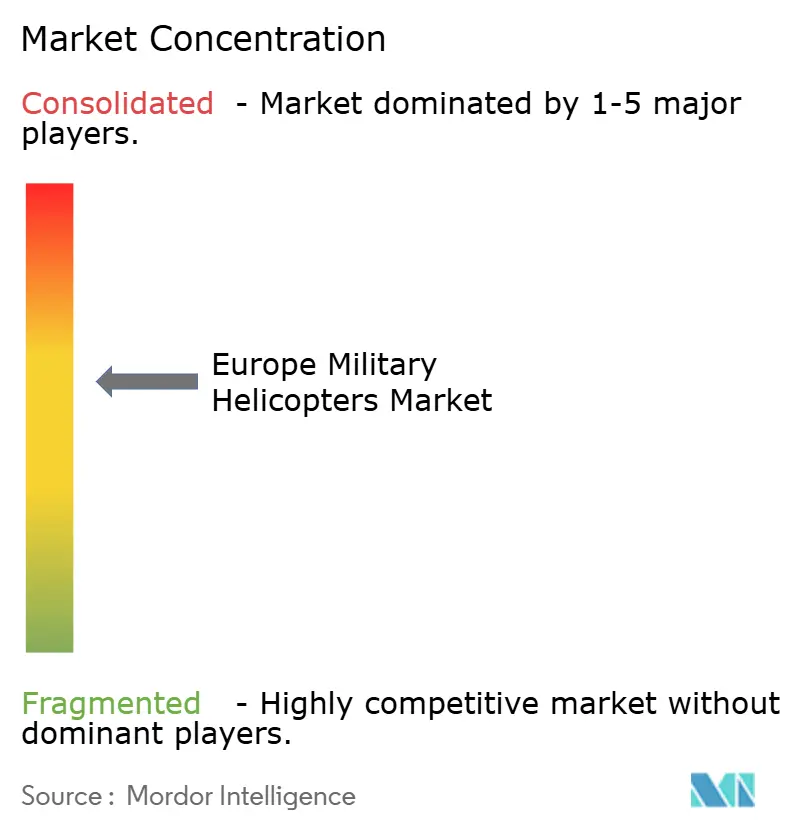
The Europe military helicopters market is moderately concentrated, led by Airbus Helicopters and Leonardo across major platform categories. Airbus Helicopters supplies the NH90, H145M, H225M, and planned H160M Guépard. Leonardo participates through the AW149 and AW101, and in the NH90 consortium. NHIndustries connects the leading European suppliers in a program that has delivered more than 600 aircraft to 14 nations. This relationship increases commonality across operators but can limit price competition in sustainment. It also creates high barriers for new platform suppliers because existing fleets require established maintenance, training, and parts networks. The industry, therefore, remains shaped by long program cycles and the cost of changing aircraft families.
US suppliers remain competitive in heavy-lift and selected utility programs. Boeing secured Germany’s 60-unit CH-47F order, while Sikorsky Black Hawks are replacing some Soviet-era Mil helicopters in Central and Eastern Europe. These wins demonstrate that national requirements can outweigh the preference for European production. The NSPA awarded NGRC concept-study contracts to Airbus, Leonardo, Lockheed Martin, and Sikorsky in 2025. The program is intended to support replacement needs for more than 900 aircraft across NATO after 2035. Leonardo has put forward a Bell V-280 Valor tiltrotor concept, which could alter the competition between conventional helicopter designs and faster rotorcraft approaches. The program will test whether common NATO requirements can translate into a shared platform choice.
Digital integration is becoming an important basis for competition. Leonardo’s Proteus autonomous rotary-wing system completed its first flight in 2026 and is being positioned for anti-submarine warfare and intelligence, surveillance, and reconnaissance missions. Safran Helicopter Engines, MTU Aero Engines, and Avio Aero expanded the EURA joint venture in 2025 to support ENGHE propulsion under the SHARP program. The EUR 25 million (USD 28.99 million) EDF grant supports a European engine development effort that addresses supply chain dependence. Open-architecture mission systems remain important for countries seeking to integrate software sovereignty without US ITAR restrictions. Hensoldt, MBDA, and Rheinmetall provide sensors, munitions, and systems integration that can reduce platform manufacturers’ control over future upgrades.
Europe Military Helicopters Industry Leaders
Airbus SE
Leonardo S.p.A.
The Boeing Company
Lockheed Martin Corporation
Russian Helicopters (Rostec)
- *Disclaimer: Major Players sorted in no particular order

Recent Industry Developments
- July 2026: Airbus Helicopters delivered the first NH90 Standard 2 to the French Armament General Directorate for the 4e Régiment d'Hélicoptères des Forces Spéciales at Pau. The variant features an EO designator system and a special-forces radio suite. All 18 ordered units are scheduled for delivery by mid-2029.
- July 2026: The European Commission allocated EUR 25 million (USD 28.99 million) through the European Defence Fund to the SHARP consortium, which has 25 partners in 12 European countries. The consortium is developing propulsion architecture for ENGHE, an engine targeted at future European military helicopters entering service around 2040
- June 2026: Romania’s Ministry of Internal Affairs ordered 7 Airbus H160 and 5 H145 helicopters under the EU SAFE civil-protection initiative. The H160 aircraft will support civil protection and tactical security, while the H145 aircraft will support the SMURD emergency rescue service.


Europe Military Helicopters Market Report Scope
Military helicopters are rotary-wing aircraft designed for defense and security missions across land and maritime domains. Equipped with mission-specific avionics, weapon systems, survivability features, and advanced propulsion systems, they support tactical, strategic, and humanitarian operations, including combat support, troop transport, reconnaissance, search and rescue, logistics, and disaster relief in diverse and contested environments.
The Europe military helicopters market is segmented by helicopter type, end-user service, engine type, application, and geography. By helicopter type, the market is segmented into multi-mission, transport, and other helicopters. By end-user service, the market is segmented into air force, army aviation, naval/marine corps aviation, joint/special operations, and paramilitary and coast guard. By engine type, the market is segmented into single-engine and twin-engine helicopters. By application, the market is segmented into combat and close air support, troop transport, humanitarian and disaster relief, and pilot training. The report also covers the market sizes and forecasts for the Europe military helicopters market in six countries across the region. For each segment, the market size is provided in terms of value (USD).
By Helicopter Type
| Multi-mission Helicopter |
| Transport Helicopter |
| Other Helicopter |
By End-User Service
| Air Force |
| Army Aviation |
| Naval/Marine Corps Aviation |
| Joint/Special Operations |
| Paramilitary and Coast Guard |
By Engine Type
| Single-Engine |
| Twin-Engine |
By Application
| Combat and Close Air Support |
| Troop Transport |
| Humanitarian and Disaster Relief |
| Pilot Training |
By Geography
| United Kingdom |
| France |
| Germany |
| Spain |
| Italy |
| Russia |
| Rest of Europe |
| By Helicopter Type | Multi-mission Helicopter |
| Transport Helicopter | |
| Other Helicopter | |
| By End-User Service | Air Force |
| Army Aviation | |
| Naval/Marine Corps Aviation | |
| Joint/Special Operations | |
| Paramilitary and Coast Guard | |
| By Engine Type | Single-Engine |
| Twin-Engine | |
| By Application | Combat and Close Air Support |
| Troop Transport | |
| Humanitarian and Disaster Relief | |
| Pilot Training | |
| By Geography | United Kingdom |
| France | |
| Germany | |
| Spain | |
| Italy | |
| Russia | |
| Rest of Europe |


Market Definition
- Aircraft Type - All the military rotorcraft which are used for various applications are included in this study.
- Sub-Aircraft Type - For this study, all the military helicopters based on their application are considered.
- Body Type - Multi-Mission Helicopters, Transport Helicopters, Training Helicopters and various other rotorcraft are considered in this study.
| Keyword | Definition |
|---|---|
| IATA | IATA stands for the International Air Transport Association, a trade organization composed of airlines around the world that has an influence over the commercial aspects of flight. |
| ICAO | ICAO stands for International Civil Aviation Organization, a specialized agency of the United Nations that supports aviation and navigation around the globe. |
| Air Operator Certificate (AOC) | A certificate granted by a National Aviation Authority permitting the conduct of commercial flying activities. |
| Certificate Of Airworthiness (CoA) | A Certificate Of Airworthiness (CoA) is issued for an aircraft by the civil aviation authority in the state in which the aircraft is registered. |
| Gross Domestic Product (GDP) | Gross domestic product (GDP) is a monetary measure of the market value of all the final goods and services produced in a specific time period by countries. |
| RPK (Revenue Passenger Kilometres) | The RPK of an airline is the sum of the products obtained by multiplying the number of revenue passengers carried on each flight stage by the stage distance - it is the total number of kilometers traveled by all revenue passengers. |
| Load Factor | The load factor is a metric used in the airline industry that measures the percentage of available seating capacity that has been filled with passengers. |
| Original Equipment Manufacturer (OEM) | An original equipment manufacturer (OEM) traditionally is defined as a company whose goods are used as components in the products of another company, which then sells the finished item to users. |
| International Transportation Safety Association (ITSA) | International Transportation Safety Association (ITSA) is an international network of heads of independent safety investigation authorities (SIA). |
| Available Seats Kilometre (ASK) | This metric is calculated by multiplying Available Seats (AS) in one flight, defined above, multiplied by the distance flown. |
| Gross Weight | The fully-loaded weight of an aircraft, also known as “takeoff weight,” which includes the combined weight of passengers, cargo, and fuel. |
| Airworthiness | The ability of an aircraft, or other airborne equipment or system, to operate in flight and on the ground without significant hazard to aircrew, ground crew, passengers or to other third parties. |
| Airworthiness Standards | Detailed and comprehensive design and safety criteria applicable to the category of aeronautical product (aircraft, engine or propeller). |
| Fixed Base Operator (FBO) | A business or organization that operates at an airport. An FBO provides aircraft operating services like maintenance, fueling, flight training, charter services, hangaring, and parking. |
| High Net worth Individuals (HNWIs) | High Net worth Individuals (HNWIs) are individuals with over USD 1 million in liquid financial assets. |
| Ultra High Net worth Individuals (UHNWIs) | Ultra High Net worth Individuals (UHNWIs) are individuals with over USD 30 million in liquid financial assets. |
| Federal Aviation Administration (FAA) | The division of the Department of Transportation is concerned with aviation. It operates Air Traffic Control and regulates everything from aircraft manufacturing to pilot training to airport operations in the United States. |
| EASA (European Aviation Safety Agency) | The European Aviation Safety Agency is a European Union agency established in 2002 with the task of overseeing civil aviation safety and regulation. |
| Airborne Warning and Control System (AW&C) aircraft | Airborne Warning and Control System (AEW&C) aircraft is equipped with a powerful radar and on-board command and control center to direct the armed forces. |
| The North Atlantic Treaty Organization (NATO) | The North Atlantic Treaty Organization (NATO), also called the North Atlantic Alliance, is an intergovernmental military alliance between 30 member states – 28 European and two North American. |
| Joint Strike Fighter (JSF) | Joint Strike Fighter (JSF) is a development and acquisition program intended to replace a wide range of existing fighter, strike, and ground attack aircraft for the United States, the United Kingdom, Italy, Canada, Australia, the Netherlands, Denmark, Norway, and formerly Turkey. |
| Light Combat Aircraft (LCA) | A light combat aircraft (LCA) is a light, multirole jet/turboprop military aircraft, commonly derived from advanced trainer designs, designed for engaging in light combat. |
| Stockholm International Peace Research Institute (SIPRI) | Stockholm International Peace Research Institute (SIPRI) is an international institute that provides data, analysis, and recommendations for armed conflict, military expenditure, and arms trade as well as disarmament and arms control. |
| Maritime Patrol Aircraft (MPA) | A maritime patrol aircraft (MPA), also known as maritime reconnaissance aircraft is a fixed-wing aircraft designed to operate for long durations over water in maritime patrol roles, in particular, anti-submarine warfare (ASW), anti-ship warfare (AShW), and search and rescue (SAR). |
| Mach Number | The Mach number is defined as the ratio of true airspeed to the speed of sound at the altitude of a given aircraft. |
| Stealth Aircraft | Stealth is a Common term applied to low observable (LO) technology and doctrine, that makes an aircraft near invisible to radar, infrared or visual detection. |


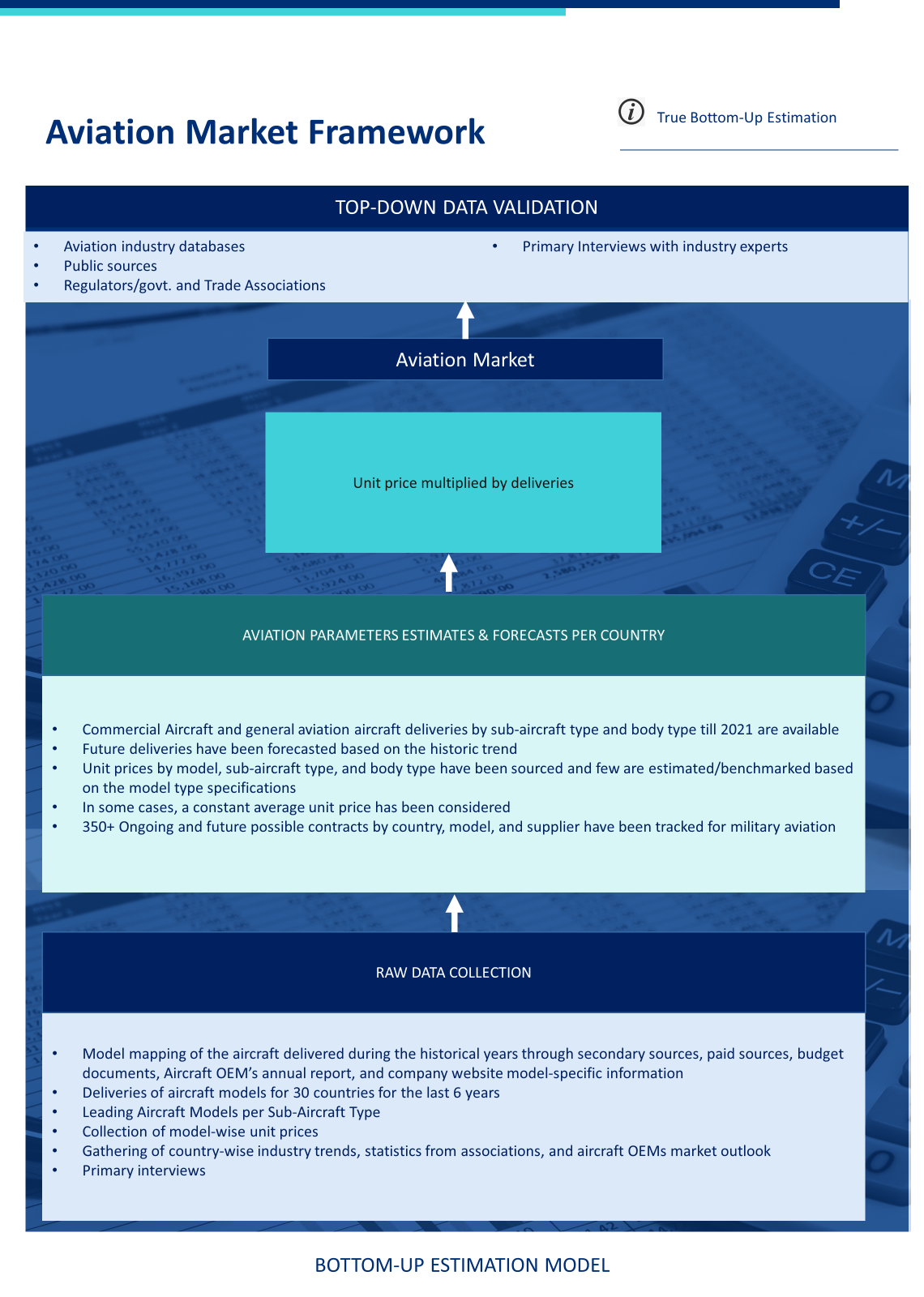
Research Methodology
Mordor Intelligence follows a four-step methodology in all our reports.
- Step-1: Identify Key Variables: In order to build a robust forecasting methodology, the variables and factors identified in Step-1 are tested against available historical market numbers. Through an iterative process, the variables required for market forecast are set and the model is built on the basis of these variables.
- Step-2: Build a Market Model: Market-size estimations for the historical and forecast years have been provided in revenue and volume terms. For sales conversion to volume, the average selling price (ASP) is kept constant throughout the forecast period for each country, and inflation is not a part of the pricing.
- Step-3: Validate and Finalize: In this important step, all market numbers, variables and analyst calls are validated through an extensive network of primary research experts from the market studied. The respondents are selected across levels and functions to generate a holistic picture of the market studied.
- Step-4: Research Outputs: Syndicated Reports, Custom Consulting Assignments, Databases & Subscription Platforms