
Market Overview
| Study Period | 2021 - 2031 |
|---|---|
| Forecast Data Period | 2026 - 2031 |
| Base Year Market Size (2025) | USD 7.93 Billion |
| Market Size (2026) | USD 8.41 Billion |
| Market Size (2031) | USD 11.29 Billion |
| Growth Rate (2026 - 2031) | 6.05 % |
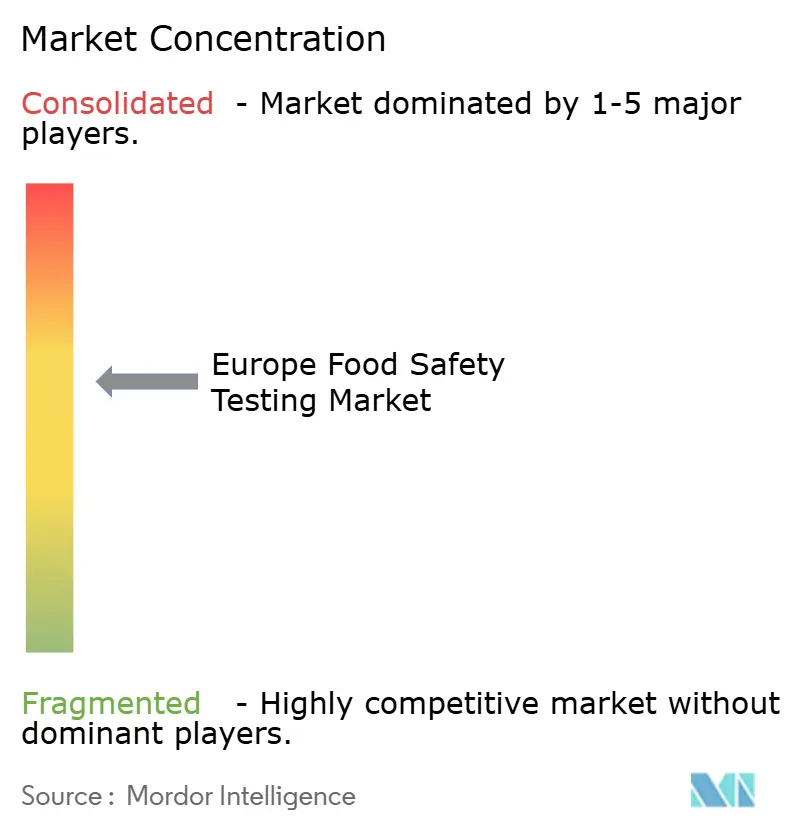
| Market Concentration | Medium |
Major Players *Disclaimer: Major Players sorted in no particular order Image © Mordor Intelligence. Reuse requires attribution under CC BY 4.0. | |
Europe Food Safety Testing Market Analysis by Mordor Intelligence
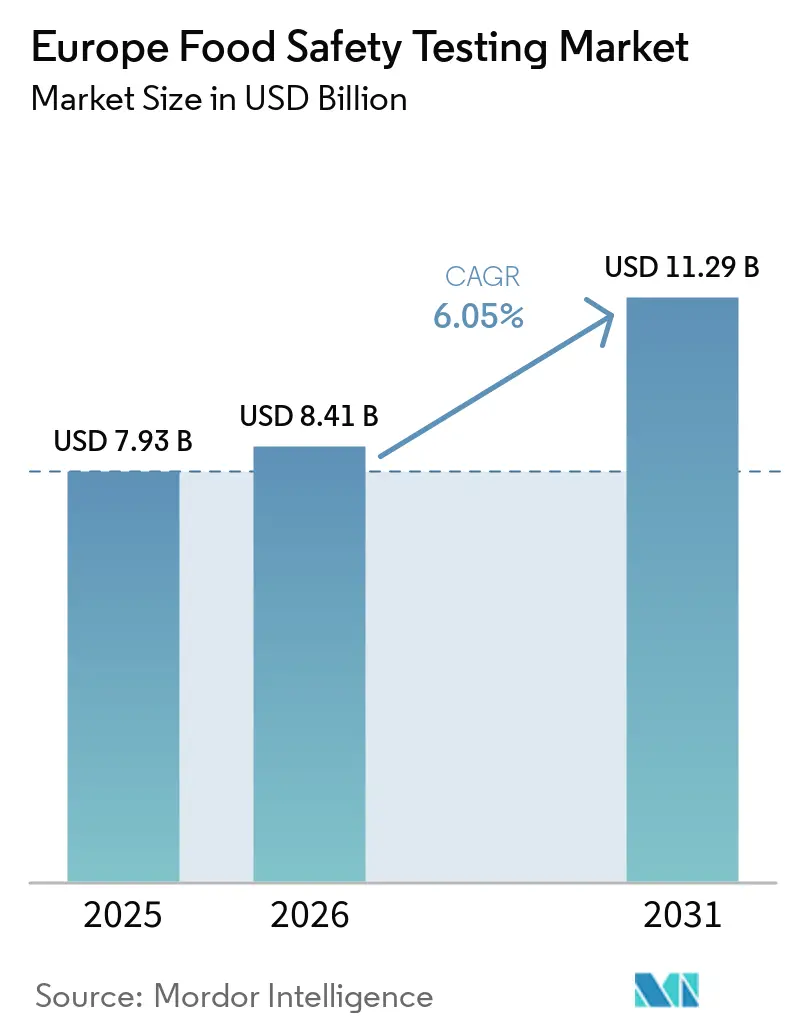
Europe food safety testing market size in 2026 is estimated at USD 8.41 billion, growing from 2025 value of USD 7.93 billion with 2031 projections showing USD 11.29 billion, growing at 6.05% CAGR over 2026-2031. This growth trajectory reflects the region's heightened focus on food safety compliance amid escalating foodborne illness incidents and evolving regulatory frameworks. The market's expansion is underpinned by technological advancements in rapid testing methods and increasing consumer demand for transparency in food labeling and authenticity verification. Momentum is powered by stricter enforcement of food‐safety rules, continued innovation in rapid methods, and rising public demand for transparent labeling and authenticity checks. Heightened surveillance programs, high‐profile pathogen outbreaks, and the spread of premium organic and allergen-free foods further expand analytical workloads across the region. Laboratories that deploy high-throughput automation and molecular diagnostics capture share as manufacturers seek quicker turnaround times. Consolidation among independent players and strategic technology alliances signal sustained investment in specialized capabilities and geographic coverage.
Key Report Takeaways
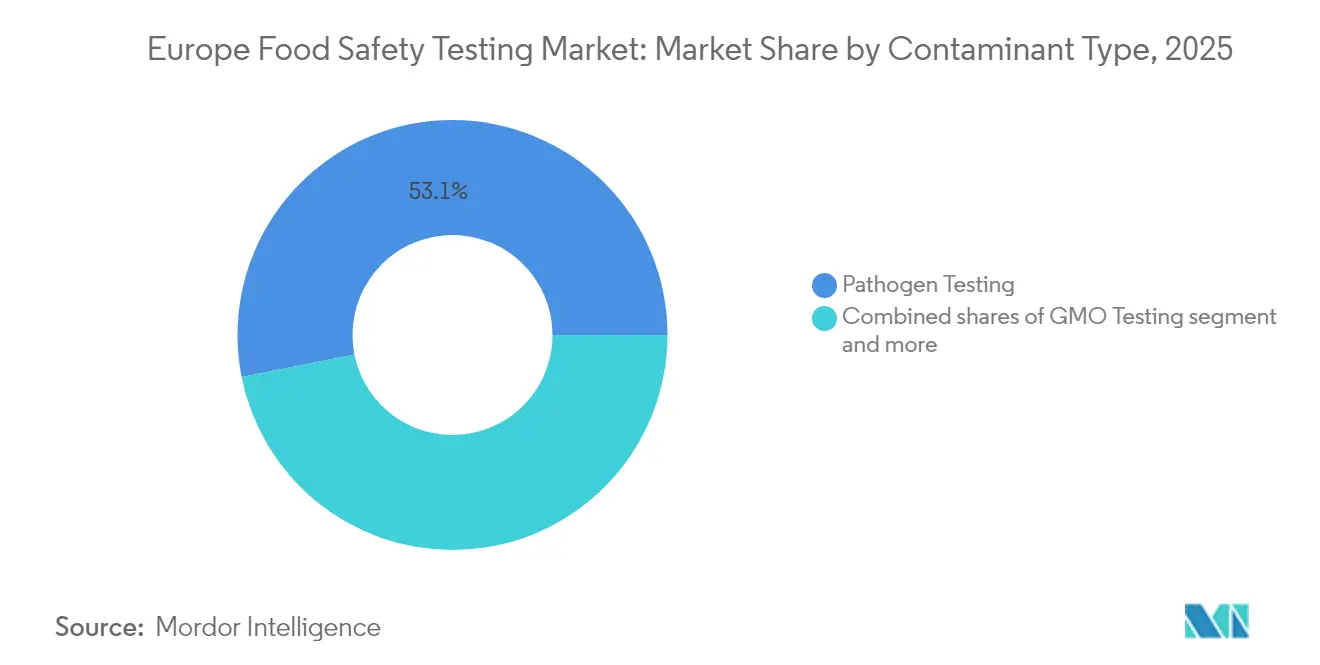
- By contaminant type, pathogen testing held 53.12% of the Europe food testing market share in 2025, while GMO testing is projected to post the fastest 6.56% CAGR to 2031.
- By technology, PCR commanded 48.85% share of the Europe food testing market size in 2025; chromatography and spectrometry are expected to register the highest 7.01% CAGR through 2031.
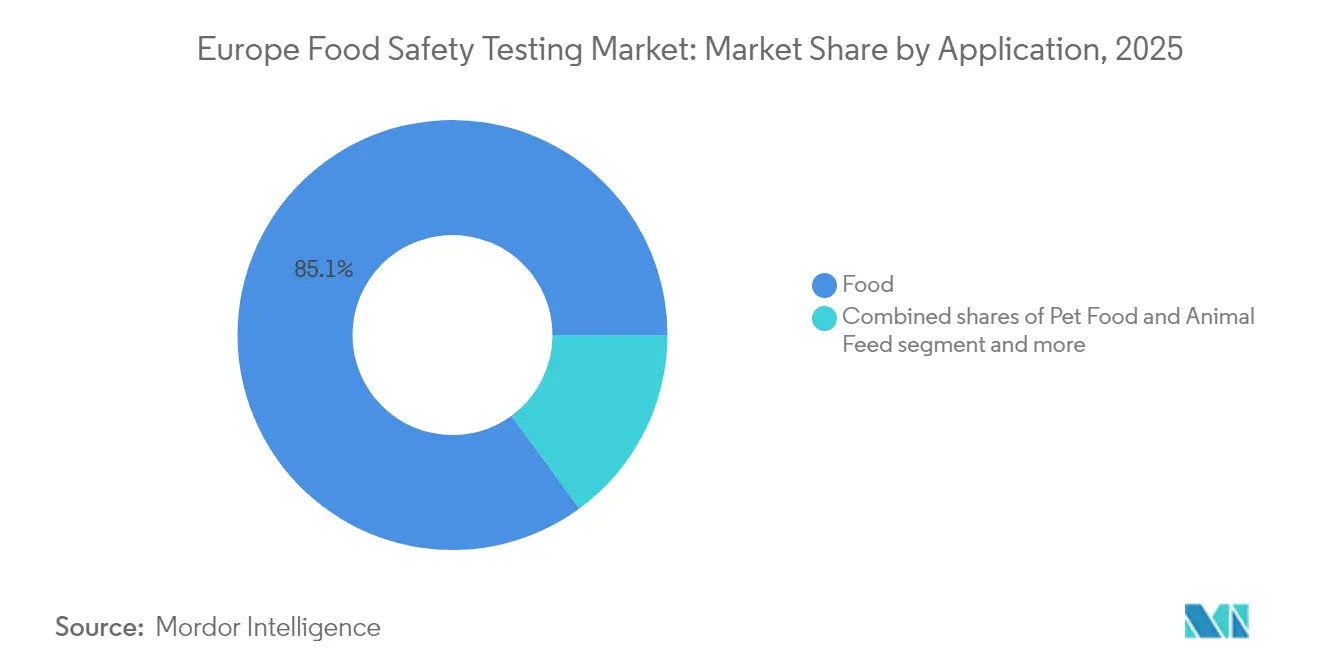
- By application, food accounted for 85.05% of the Europe food testing market size in 2025, whereas pet food and animal feed are forecast to expand at an 7.92% CAGR between 2026-2031.
- By geography, Germany led with 22.40% revenue share of the Europe food testing market in 2025 and is set to grow at a 7.18% CAGR to 2031.
Note: Market size and forecast figures in this report are generated using Mordor Intelligence’s proprietary estimation framework, updated with the latest available data and insights as of 2026.
Market Trends and Insights
Drivers Impact Analysis of Europe Food Safety Testing Market*
| Driver | (~) % Impact on CAGR Forecast | Geographic Relevance | Impact Timeline |
|---|---|---|---|
| Rising Foodborne Illness Incidence and Outbreaks | +1.2% | Germany, United Kingdom, France core markets | Short term (≤ 2 years) |
| Advancements in Testing Technologies and Rapid Methods | +0.8% | Global, with early adoption in Germany, Netherlands | Medium term (2-4 years) |
| Growing Consumer Awareness and Demand for Transparency and Label Accuracy | +0.6% | Western Europe, spillover to Eastern Europe | Medium term (2-4 years) |
| Demand for Organic, Pesticide-free, Allergen-free Products | +0.5% | Germany, France, Netherlands, Nordic countries | Long term (≥ 4 years) |
| Focus on Allergen and Mycotoxin Testing Needs | +0.3% | EU-wide, with concentration in food manufacturing hubs | Medium term (2-4 years) |
| Food Adulteration and Authenticity Concerns | +0.2% | Southern Europe, cross-border trade corridors | Long term (≥ 4 years) |
| Source: Mordor Intelligence | |||
Rising Foodborne Illness Incidence and Outbreaks
The surge in foodborne illness cases across Europe has created unprecedented demand for comprehensive pathogen testing services. UK Health Security Agency data reveals Salmonella cases reached a decade high of 10,388 cases in 2024, representing a 17.1% increase from 2023 levels. The multi-country Salmonella Mbandaka outbreak linked to pre-cooked frozen chicken demonstrated the critical role of whole-genome sequencing in cross-border outbreak investigation, driving adoption of molecular diagnostic capabilities across European testing laboratories. This trend particularly benefits laboratories with advanced WGS infrastructure and rapid turnaround capabilities, as regulatory authorities increasingly rely on molecular epidemiology for source attribution and control measures. The emphasis on ready-to-eat product testing has intensified following multiple contamination events, creating sustained demand for specialized microbiological testing protocols.
Advancements In Testing Technologies and Rapid Methods
Laboratory automation and rapid analytical methods are transforming European food testing operations, driven by workforce shortages and demand for faster turnaround times. The integration of robotics-based solutions, NMR automation, and AI-enabled data analysis is enabling laboratories to increase throughput while reducing manual handling errors. Near-infrared spectroscopy (NIR) and laser-induced breakdown spectroscopy (LIBS) are gaining regulatory acceptance as sustainable alternatives to traditional wet chemistry methods, eliminating solvent usage and reducing environmental footprint. However, regulatory acceptance remains constrained, particularly in Germany, where normative methods still dominate official controls. The development of portable mass spectrometry and handheld spectroscopy devices is creating new market opportunities for on-site testing, though validation and standardization challenges persist. These technological advances are particularly relevant for ISO 17025 accredited laboratories seeking to maintain competitive advantage through operational efficiency.
Growing Consumer Awareness and Demand for Transparency and Label Accuracy
European consumers increasingly demand verifiable information about food origin, processing methods, and ingredient authenticity, driving growth in analytical testing services beyond basic safety parameters. The implementation of blockchain-based traceability solutions, such as Intertek's HoneyTrace system for honey authentication, reflects the market's evolution toward comprehensive supply chain transparency. This trend is particularly pronounced in premium and organic food segments, where consumers pay significant price premiums for verified authenticity claims. The convergence of analytical testing with digital verification technologies creates opportunities for integrated service offerings that combine laboratory analysis with tamper-proof documentation systems. Regulatory frameworks supporting this trend include EU requirements for origin labeling and the growing emphasis on sustainability claims verification, which require sophisticated analytical capabilities to substantiate marketing assertions.
Demand For Organic, Pesticide-free, Allergen-free Products
The European organic food market's continued expansion drives specialized testing requirements for pesticide residue analysis, mycotoxin screening, and authenticity verification. EFSA's 2023 pesticide residue monitoring report documented comprehensive testing across 88,141 food samples, revealing the scale of analytical requirements for regulatory compliance [1]. Climate change impacts on mycotoxin prevalence, particularly in grain crops, necessitate enhanced monitoring capabilities and more frequent testing protocols. The development of optimized ELISA methods and co-occurrence studies for multiple mycotoxin detection reflects the industry's adaptation to emerging contamination patterns. Allergen testing requirements continue expanding as food manufacturers reformulate products to address diverse dietary restrictions, creating sustained demand for cross-contamination monitoring and label verification services. These trends particularly benefit laboratories with specialized capabilities in trace-level detection and method validation for novel food matrices.
Restraints Impact Analysis of Europe Food Safety Testing Market*
| Restraint | (~) % Impact on CAGR Forecast | Geographic Relevance | Impact Timeline |
|---|---|---|---|
| High Costs of Advanced Testing Equipment and Methods | -0.7% | Smaller laboratories across Europe, Eastern Europe focus | Short term (≤ 2 years) |
| Complex Regulatory Heterogeneity Across Countries | -0.4% | Cross-border operations, multi-country suppliers | Medium term (2-4 years) |
| Sample Contamination and Handling Issues in Testing Chain | -0.3% | All European markets, supply chain dependent | Short term (≤ 2 years) |
| Data Security, Privacy, and Traceability Infrastructure Gaps | -0.2% | Digital transformation laggards, smaller operations | Long term (≥ 4 years) |
| Source: Mordor Intelligence | |||
High Costs of Advanced Testing Equipment and Methods
The substantial capital requirements for state-of-the-art analytical instrumentation create barriers for smaller testing laboratories seeking to expand service capabilities. Advanced mass spectrometry systems, automated sample preparation equipment, and molecular diagnostic platforms require investments often exceeding USD 500,000 per instrument, constraining market entry for regional players. This cost structure favors larger, established laboratories with sufficient scale to justify equipment investments and maintain utilization rates. The ongoing shift toward more sophisticated testing methods, including untargeted screening approaches and multi-residue analysis, further escalates operational costs through specialized consumables and highly trained personnel requirements. Smaller laboratories increasingly rely on outsourcing arrangements or consolidation strategies to access advanced analytical capabilities, contributing to market concentration trends.
Complex Regulatory Heterogeneity Across Countries
Despite EU harmonization efforts, significant regulatory variations persist across European markets, creating compliance complexity for multinational food companies and testing service providers. Differences in sampling protocols, analytical methods, and reporting requirements necessitate jurisdiction-specific expertise and multiple accreditations. The challenge is particularly acute for emerging contaminants and novel testing technologies, where regulatory acceptance timelines vary significantly between member states. Brexit has further complicated regulatory alignment, requiring separate validation and approval processes for UK market access. These regulatory inconsistencies increase operational costs for testing laboratories serving multiple European markets and create barriers for smaller players lacking resources to navigate diverse compliance requirements across jurisdictions.
*Our forecasts treat driver/restraint impacts as directional, not additive. The impact forecasts reflect baseline growth, mix effects, and variable interactions.
Europe Food Safety Testing Market Segment Analysis
By Contaminant Type:
Pathogen Testing Dominates Safety PrioritiesAdvanced molecular diagnostic methods are revolutionizing pathogen detection capabilities across European food testing laboratories, with Pathogen Testing commanding 53.12% market share in 2025. The segment's dominance reflects the critical importance of microbiological safety in preventing foodborne illness outbreaks, particularly following high-profile incidents like the multi-country Salmonella Mbandaka outbreak that highlighted the need for rapid, accurate pathogen identification European Centre for Disease Prevention and Control. GMO Testing emerges as the fastest-growing segment at 6.56% CAGR (2026-2031), driven by evolving EU regulations on New Genomic Techniques and increasing consumer scrutiny of bioengineered ingredients.
Pesticide and Residue Testing maintains significant market presence, supported by EFSA's comprehensive monitoring programs that analyzed 88,141 food samples in 2023, demonstrating the scale of regulatory requirements. Mycotoxin Testing gains importance due to climate change impacts on crop contamination patterns, while Allergen Testing expands alongside growing dietary restriction awareness and cross-contamination prevention requirements. Other Contaminant Testing, including heavy metals and process contaminants, addresses emerging regulatory concerns such as PFAS limits and acrylamide monitoring. The segment's evolution toward multi-analyte screening platforms reflects laboratories' efforts to improve efficiency while meeting diverse analytical requirements across food categories.

By Technology:
PCR Leadership Challenged by Chromatography AdvancesPolymerase Chain Reaction technology maintains market leadership with 48.85% share in 2025, reflecting its versatility in pathogen detection, GMO identification, and species authentication applications. However, Chromatography and Spectrometry demonstrates the highest growth potential at 7.01% CAGR (2026-2031), driven by advances in ultra-high-performance liquid chromatography coupled with high-resolution mass spectrometry for contaminant screening. The technology's ability to perform untargeted analysis and identify unknown compounds positions it as essential for emerging contaminant detection and food fraud investigation.
Immunoassay-based methods retain importance for rapid screening applications, particularly in field testing scenarios where immediate results are required. The technology benefits from continuous improvements in antibody specificity and assay sensitivity, enabling detection of trace-level contaminants in complex food matrices. Other technologies, including biosensors and spectroscopic methods, are gaining traction through portable device development and on-site testing capabilities. The integration of artificial intelligence and machine learning algorithms across all technology platforms enhances data interpretation capabilities and enables predictive analytics for food safety risk assessment. Regulatory frameworks such as ISO 17025 continue influencing technology adoption patterns by establishing validation requirements for analytical methods.
By Application:
Food Segment Dominance with Pet Food GrowthThe Food application segment's commanding 85.05% market share in 2025 reflects the vast scale of human food production and consumption across Europe, encompassing diverse categories from fresh produce to processed foods. Within this segment, Meat and Poultry testing drives significant demand due to pathogen risks and regulatory requirements, while Dairy testing focuses on adulterant detection and quality parameters. Fruits and Vegetables testing emphasizes pesticide residue analysis and pathogen screening, particularly for ready-to-eat products that have been implicated in recent outbreak investigations.
Pet Food and Animal Feed emerges as the fastest-growing application at 7.92% CAGR (2026-2031), driven by premiumization trends and regulatory alignment with human food safety standards. The segment benefits from increasing pet ownership rates and consumer willingness to pay premium prices for verified nutrition and safety claims. Processed Food testing addresses complex analytical challenges related to multi-ingredient formulations and novel processing technologies. Crops testing supports agricultural supply chain integrity through mycotoxin monitoring and authenticity verification. The application diversity creates opportunities for specialized testing laboratories to develop niche expertise while larger players benefit from comprehensive service portfolios across all food categories.
Geography Analysis
Germany Food Safety Testing Market
Germany leads the European food testing market with 22.40% share in 2025 and demonstrates the strongest growth trajectory at 7.18% CAGR (2026-2031), reflecting the country's robust food manufacturing sector and stringent regulatory enforcement. The German Federal Office of Consumer Protection and Food Safety (BVL) reported comprehensive surveillance activities, including extensive Salmonella testing in livestock that revealed significant contamination rates requiring enhanced monitoring protocols. The country's leadership in analytical instrumentation manufacturing and research creates synergies between technology development and testing service capabilities. Major testing companies maintain significant operations in Germany, with SGS Institut Fresenius operating multiple accredited laboratories across Berlin, Hamburg, Taunusstein, and other key locations. The market benefits from strong automotive and chemical industries that drive demand for specialized analytical capabilities applicable to food testing applications.
France and the United Kingdom Food Safety Testing Market
France represents a significant market driven by its extensive agricultural production and food processing industries, with regulatory oversight from ANSES (French Agency for Food, Environmental and Occupational Health and Safety). Recent regulatory developments include new plant protein labeling requirements and livestock sovereignty initiatives that create additional testing requirements for authenticity verification and nutritional analysis . The United Kingdom maintains substantial testing demand despite Brexit-related regulatory changes, with the Food Standards Agency continuing to drive safety requirements while developing independent regulatory frameworks. The UK's focus on environmental health officer capacity building reflects ongoing challenges in maintaining adequate inspection and testing capabilities.
Broader European Markets
Italy, Spain, Netherlands, Poland, Belgium, and Sweden collectively represent significant market opportunities, each with distinct regulatory requirements and industry focus areas. The Netherlands demonstrates strength in agricultural innovation and sustainable food production, creating demand for specialized testing services related to organic certification and environmental impact assessment. Poland's growing food processing sector and EU integration drive increasing testing requirements, while Nordic countries emphasize sustainability and quality parameters. The Rest of Europe category encompasses emerging markets in Eastern Europe where EU accession processes and harmonization requirements create growth opportunities for testing service providers. Regional variations in regulatory enforcement and industry development create diverse market dynamics, with opportunities for both specialized niche players and comprehensive service providers across the European landscape.
Regulatory Landscape
The Europe food safety testing market operates under the EU official controls framework (Regulation (EU) 2017/625), implemented by Member State competent authorities and supported by EFSA for science and data coordination. For 2026, the European Commission set an annual programme of official controls using risk-based priorities informed by EFSA data. EFSA also reinforced the technical backbone for compliance by opening its 2026 call for continuous collection of chemical contaminant occurrence data, with the DCF opening on 1 April 2026 and a transmission deadline of 30 June 2026.
Regulatory updates in 2026 increased the need for method updates and structured reporting. Commission Implementing Regulation (EU) 2026/748 created a coordinated multiannual control programme for 2027-2029 focused on pesticide MRL compliance, and Implementing Regulation (EU) 2026/765 updated sampling and analysis methods for pesticide residues with application from 1 January 2027. In parallel, Implementing Regulation (EU) 2026/731 extended the deadline for national laboratories to revalidate methods for pharmacologically active residues in food-producing animals to 31 December 2027, reflecting technical transition constraints. EFSA also expanded access to its requirements through a new online catalogue and EU Library of Food Safety Guidance Documents (April 2026).
Value Chain Analysis
Demand is initiated by food and feed operators (including meat, dairy, processed foods, and pet food and feed producers), importers, and retailers that must demonstrate compliance with EU and national control plans and respond to rapid alert and outbreak signals. Samples then move through a chain covering collection (in-plant QC, border control posts, and official control sampling), logistics and chain-of-custody, accredited laboratory testing (ISO/IEC 17025), and reporting into customer QA systems and public risk-management infrastructures. Testing covers microbiology (pathogens and toxins), residues and contaminants (pesticides, veterinary drugs, mycotoxins, metals), and authenticity and speciation, with increasing use of PCR, LC-MS/MS, and high-resolution platforms to meet sensitivity and turnaround requirements.
Regulatory and surveillance changes are also shifting where value accrues across the chain, with more emphasis on ingredient-level and risk-based controls rather than finished-product checks. EU updates to laboratory methods and documentation flow into upstream lab work, including new pesticide sampling and analysis methods introduced through Commission Implementing Regulation (EU) 2026/765 (applicable from 1 January 2027), which increases the need for method transfer, validation, and proficiency testing. Outbreak investigations such as the June 2026 multi-country Salmonella Stanley event linked to flavoured noodle products increase the need for faster escalation pathways between manufacturers, contract labs, and authorities. Meanwhile, tightened import controls for selected high-risk foods add testing and documentation steps at the border that can lengthen lead times, raising the value of laboratories with multi-country coverage and harmonized reporting capabilities.
Competitive Landscape
The European food testing market exhibits moderate concentration with established global players competing alongside specialized regional laboratories and emerging technology providers. Market leaders leverage comprehensive service portfolios, extensive geographic coverage, and advanced analytical capabilities to serve multinational food companies requiring standardized testing protocols across multiple jurisdictions. Major players include TÜV SÜD, Eurofins Scientific, SGS Société Générale de Surveillance SA, Mérieux NutriSciences, and Intertek Group plc, among others.
Strategic consolidation continues reshaping competitive dynamics, exemplified by Mérieux NutriSciences' EUR 360 million acquisition of Bureau Veritas' food testing operations, which demonstrates the premium valuations commanded by specialized testing capabilities and established client relationships. Technology differentiation increasingly drives competitive positioning, with leaders investing in automation, rapid testing methods, and digital integration capabilities to improve turnaround times and operational efficiency. Intertek's development of blockchain-based traceability solutions and SGS's expansion of molecular diagnostic capabilities reflect the industry's evolution toward comprehensive quality assurance services beyond traditional analytical testing.
Emerging opportunities exist in portable testing technologies, AI-enabled data analysis, and integrated supply chain monitoring solutions that address growing demand for real-time quality assurance and transparency. Regulatory compliance requirements, particularly ISO 17025 accreditation and method validation protocols, create barriers to entry while favoring established players with proven quality management systems and technical expertise [3]. The market's fragmented nature in specialized testing niches allows smaller players to compete effectively through technical expertise and customer service excellence in specific geographic regions or analytical domains.
Europe Food Safety Testing Industry Leaders
-
TÜV SÜD
-
Eurofins Scientific
-
SGS Société Générale de Surveillance SA
-
Mérieux NutriSciences
-
Intertek Group plc
- *Disclaimer: Major Players sorted in no particular order
Europe Food Safety Testing Market Companies Covered in this Report
- SGS Société Générale de Surveillance SA
- Eurofins Scientific SE
- Bureau Veritas SA
- Intertek Group plc
- ALS Limited
- TÜV SÜD AG
- TÜV Rheinland AG
- TÜV NORD GROUP
- Merieux NutriSciences Corporation
- Synlab AG
- Neogen Corporation
- Microbac Laboratories, Inc.
- AsureQuality Limited
- Bio-Rad Laboratories, Inc.
- 3M Company
- Thermo Fisher Scientific Inc.
- Agilent Technologies, Inc.
- Romer Labs Division Holding GmbH
- LGC Limited
- Fera Science Limited
Market Opportunities and Future Outlook
Regulatory programmes and method updates create specific demand for laboratories that can operationalize new sampling, analytical, and reporting requirements across multiple countries. Commission Implementing Regulation (EU) 2026/765 establishes updated pesticide residue sampling and analysis methods with application from 1 January 2027, supporting near-term work in method development, revalidation, and expanded multi-residue capability in chromatography and spectrometry. EFSA’s 2026 continuous chemical contaminant occurrence data collection, with DCF submission timelines (opening 1 April 2026 and deadline 30 June 2026), also rewards providers that can produce structured, audit-ready datasets alongside test results.
Opportunities extend where controls move from general monitoring to hazard-specific validation and higher-frequency surveillance. The EU annual programme of official controls for 2026 prioritizes risk-based monitoring using EFSA inputs. Separately, regulatory adjustments to minimum control frequencies for contaminants that took effect from 1 January 2026 require manufacturers and importers to refine testing plans by product and origin. For ready-to-eat meat producers, evidence-based validation of Listeria monocytogenes control over shelf life is increasing demand for microbiological challenge studies, environmental monitoring, and faster methods that shorten decision cycles under Regulation (EU) 2024/2895 (implementation in 2026). EFSA market monitoring results published in 2026, covering around 125,000 food samples with 98.2% MRL compliance, indicate the scale of routine residues work while still supporting targeted testing for higher-risk non-compliant niches, including certain import streams.
Recent Industry Developments in Europe Food Safety Testing Market
- March 2026: Eurofins and trinamiX GmbH (BASF) expanded their mobile forage analysis solution across additional European countries, extending coverage to France, Italy, Portugal, and Spain. The rollout broadens on-site analytical capability supporting dairy and cattle farming, strengthening upstream quality control that feeds into broader food and feed safety testing workflows.
- June 2025: SGS launched advanced radiological testing services for food and feed safety in Bulgaria. Adding this capability supports compliance needs for contaminants beyond routine microbiology and residues, and it strengthens regional coverage in Eastern Europe where accredited specialty testing capacity can be more limited.
- October 2024: SGS introduced meat and fish speciation testing using next-generation sequencing. The method upgrade expands the toolbox for authenticity and fraud investigations, complementing PCR-based approaches and supporting customers needing defensible species identification across complex and processed matrices.
Europe Food Safety Testing Market Report Scope and Research Methodology
Market Definition and Coverage
For this methodology, the Europe food safety testing market covers laboratory and rapid tests used to detect microbiological and chemical risks in food and feed so that products meet safety and labeling rules and can be released to market.
Scope exclusions: This sizing excludes in-house QA process controls that are not reported as paid testing activity, and it also excludes food packaging migration testing unless it is contracted under food safety testing.
Segments Covered in This Report
- By Contaminant Type
- Pathogen Testing
- Pesticide and Residue Testing
- Mycotoxin Testing
- GMO Testing
- Allergen Testing
- Other Contaminant Testing
- By Technology
- Polymerase Chain Reaction
- Immunoassay-based
- Chromatography and Spectrometry
- Others
- By Application
- Pet Food and Animal Feed
- Food
- Meat and Poultry
- Dairy
- Fruits and Vegetables
- Processed Food
- Crops
- Other Foods
- By Geography
- Germany
- United Kingdom
- Italy
- France
- Spain
- Netherlands
- Poland
- Belgium
- Sweden
- Rest of Europe
Data Sources, Market Sizing, and Validation
Desk Research
Desk research was used to set the boundaries for what counts as food safety testing in Europe, and then to build the first view of demand drivers and testing intensity by food category. We relied on public regulatory and surveillance references such as the European Food Safety Authority (EFSA), the Rapid Alert System for Food and Feed (RASFF), and European Commission food safety and labeling rules, which help clarify why testing volumes move year to year.
To anchor the demand pool, we also reviewed public statistics and science outputs such as Eurostat production and trade tables, national food safety agency releases, and peer reviewed journal articles on detection methods and incidence trends. Company filings, annual reports, and investor presentations were used to understand service mix and lab network expansion, and then a paid subscription for company financials, patents, and shipment-level trade signals was used selectively to cross-check scale assumptions. These desk sources are illustrative only, and many other public and paid references were consulted to collect data, validate assumptions, and clarify open questions.
Primary Interviews and Surveys
Primary work focused on lab operators, quality leaders at food and feed producers, and procurement teams that regularly contract testing, so our assumptions on test mix and pricing did not stay purely theoretical. Inputs were also checked with subject experts who track regulatory enforcement and method adoption across major European markets, which helped us confirm which demand indicators are most sensitive each year.
Distribution of primary research fieldwork respondents
| Company type | Respondent position |
|---|---|
| Top tier: 37% | CXOs: 13% |
| Mid tier: 44% | Functional/Unit leaders: 39% |
| Smaller Players: 19% | Managers: 48% |
Market-Sizing & Forecasting
Sizing started from a top-down reconstruction of the testing demand pool, where food production and import patterns were converted into expected testing needs using compliance intensity and risk-based surveillance signals. In practice, the model used inputs such as notified non-compliances and recalls, testing frequency norms by food type, the split between pathogen and chemical residue panels, method migration toward PCR and chromatography or spectrometry, and typical retest rates after a failed lot.
Once that structure was in place, we used selective bottom-up approximations to keep totals realistic, such as rolling up sampled lab revenue disclosures, applying average price per test to estimated volumes in high-activity categories, and validating capacity expansion through lab footprint checks. When bottom-up information was missing for smaller countries or niche panels, gaps were filled through proportional allocation using production and trade weights and then adjusted based on interview feedback. Forecasting was run with scenario analysis, where baseline, tighter enforcement, and softer demand conditions were expressed through changes in compliance intensity, test mix, and expected price progression, followed by a reasonableness check against expert expectations.
Data Validation & Update Cycle
Model outputs were checked against independent signals, including public alert volumes, food trade direction, and observed technology adoption, and then outliers were investigated before any estimate was finalized. When a country or test type showed an unusual jump, we revisited the assumptions, re-checked the desk evidence, and re-contacted selected respondents to confirm whether a real market change had occurred.
Each estimate goes through multi-step analyst review where scope, unit logic, currency handling, and growth drivers are rechecked. The report is refreshed annually, and interim updates are made when material events occur such as major regulation shifts or sustained changes in testing demand. Before delivery, a final pass is performed so clients receive the most current view available at that time.
Mordor Intelligence's Europe Food Safety Testing Market Size Compared With Other Published Estimates
Published market numbers for Europe food safety testing often do not match because the service boundary is not identical, the year used as the base can be different, and the way prices are carried forward is handled in different ways. Some studies also mix testing for food with adjacent services that sit close to compliance work, which can shift totals even if growth direction looks similar.
RASFF notifications and country-level coverage checks are the evidence that ties Mordor Intelligence's estimate to the active compliance testing demand pool in Europe, instead of counting broader quality services that do not always translate into paid test volumes. Differences also come from whether animal feed is counted alongside food, whether rapid kits are valued as testing revenue or as separate product sales, and whether currency conversion uses an average annual rate or a point-in-time rate for the stated year.
Benchmark comparison
| Source | Market Size | Gaps in Research Methodology |
|---|---|---|
| Mordor Intelligence | USD 8.41 B (2026) | |
| Industry Publisher A | USD 8.63 B (2024) | Uses a 2024 base and a longer horizon, and its scope appears to include a wider set of technology and food-tested buckets, which can pull in adjacent testing activities and inflate totals versus a tighter compliance-testing boundary. |
| Research Publisher B | USD 4.61 B (2024) | Reports a lower 2024 value, which can happen when the scope leans more toward core food-only testing and a narrower view of service revenue, and when pricing progression and retest assumptions are kept conservative. |
The spread in the table is mostly explained by year alignment and what each publisher counts as testing revenue, and not by a disagreement that testing demand is rising. By keeping scope tied to measurable compliance signals and then checking outputs with practical bottom-up cross-checks, the estimate stays transparent and repeatable even when input data is uneven across countries.
Key Questions Answered in the Report
How big is the European food testing segment today and how fast is it growing?
The segment is valued at USD 8.41 billion in 2026 and is forecast to advance at a 6.05% CAGR to USD 11.29 billion by 2031.
Which contaminant category sees the highest testing demand across Europe?
Pathogen testing commands 53.12% share, reflecting regulators’ priority on preventing Salmonella, Listeria, and Campylobacter outbreaks.
What technology platforms are laboratories adopting most for food safety analysis?
PCR retains 48.85% share for its versatility, while chromatography and spectrometry are the fastest‐growing at a 7.01% CAGR thanks to ultra-high-performance LC-HRMS upgrades.
Why is Germany the key geography for food testing service providers?
Germany controls 22.40% of regional revenue and is projected to grow at a 7.18% CAGR, supported by stringent enforcement and a dense network of accredited labs.