
Market Overview
| Study Period | 2021 - 2031 |
|---|---|
| Forecast Data Period | 2026 - 2031 |
| Base Year Market Size (2025) | USD 41.62 Billion |
| Market Size (2026) | USD 42.77 Billion |
| Market Size (2031) | USD 49.13 Billion |
| Growth Rate (2026 - 2031) | 2.81 % |
| Market Concentration | Medium |
Major Players *Disclaimer: Major Players sorted in no particular order Image © Mordor Intelligence. Reuse requires attribution under CC BY 4.0. | |
Europe Food Additives Market Analysis by Mordor Intelligence
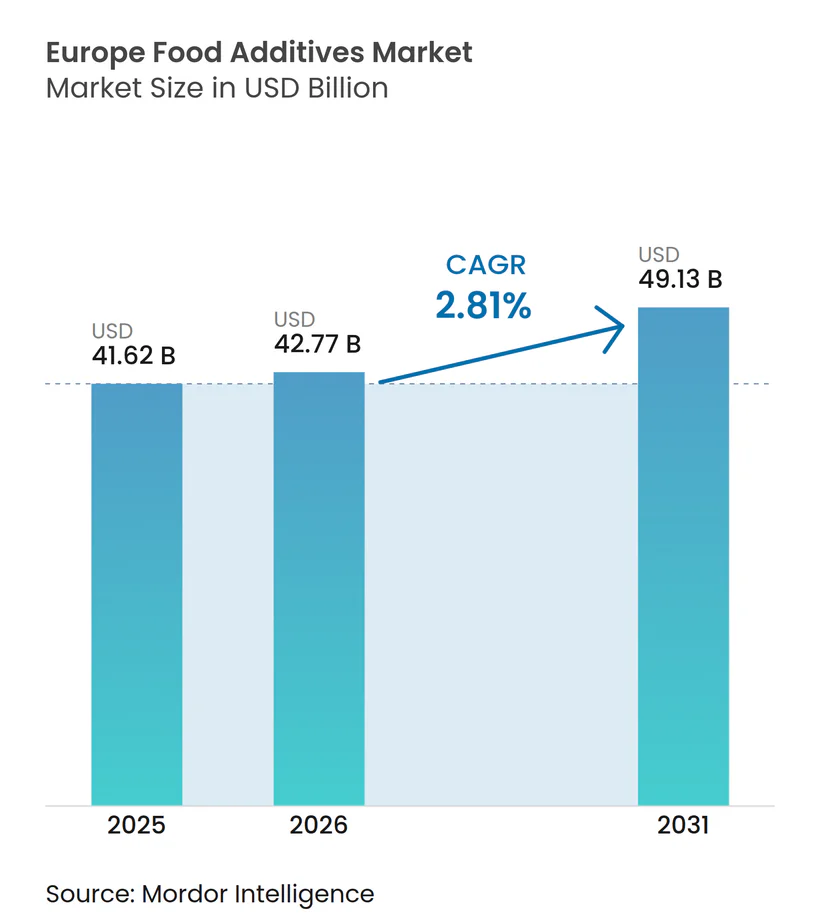
The Europe Food Additives Market is expected to grow from USD 41.62 billion in 2025 to USD 42.77 billion in 2026 and reach USD 49.13 billion by 2031, registering a CAGR of 2.81% over 2026–2031. Market growth is driven by the increasing need to maintain food safety, extend shelf life, and ensure consistent product quality across modern food manufacturing operations. The growing preference for processed and convenience foods, alongside rising demand for clean-label formulations and naturally derived ingredients, is encouraging continuous innovation in additive development. Advances in food processing, fermentation, enzyme technology, and ingredient stabilization are improving the functionality and performance of additives, enabling manufacturers to address evolving formulation requirements.
Key Report Takeaways
- By product type, Bulk Sweeteners held 55.54% of the Europe food additives market share in 2025, while Food Colorants are projected to grow at a 3.45% CAGR through 2031.
- By form, Dry additives accounted for 65.67% of the Europe food additives market share in 2025, while Liquid additives are forecast to expand at a 3.67% CAGR through 2031.
- By source, Synthetic additives represented 69.87% of the Europe food additives market share in 2025, while Natural additives are expected to register a 4.74% CAGR through 2031.
- By application, Bakery and Confectionery captured 27.12% of the Europe food additives market share in 2025, while Dairy and Desserts are projected to grow at a 3.53% CAGR through 2031.
- By geography, Germany held 21.34% of the Europe food additives market share in 2025, while Italy is forecast to expand at a 4.52% CAGR through 2031.
Note: Market size and forecast figures in this report are generated using Mordor Intelligence’s proprietary estimation framework, updated with the latest available data and insights as of 2026.
Market Trends and Insights
Drivers Impact Analysis of Europe Food Additives Market*
| Driver | (~) % Impact on CAGR Forecast | Geographic Relevance | Impact Timeline |
|---|---|---|---|
| Expansion of plant-based food products | +0.4% | Germany, Netherlands, United Kingdom, France, spill-over to Italy and Spain | Medium term (2–4 years) |
| Growing demand for processed and convenience food | +0.5% | Pan-European; highest uplift in Poland, Germany | Short term (≤ 2 years) |
| Rising preference for clean-label food ingredients | +0.6% | Western Europe core, Germany, France, United Kingdom, Netherlands, Scandinavia | Medium term (2–4 years) |
| Technological advancements in food processing | +0.3% | R&D corridors in Germany, France, and Benelux | Long term (≥ 4 years) |
| Increasing demand for extended shelf life | +0.3% | Pan-European; acute in e-commerce, chilled logistics, and export food manufacturing | Short term (≤ 2 years) |
| Growth in functional foods and beverages | +0.4% | Germany, United Kingdom, Netherlands, Sweden, France | Medium term (2–4 years) |
| Source: Mordor Intelligence | |||
Expansion of Plant-Based Food Products
Growing consumer acceptance of plant-based foods is encouraging food manufacturers to invest in ingredient innovation, reformulation, and specialized additive solutions. According to the Good Food Institute Europe (GFI Europe), in 2024, 60% of consumers in Germany and 56% in the United Kingdom consumed plant-based foods at least monthly[1]. This recurring consumption is encouraging manufacturers to strengthen their plant-based product portfolios and improve product quality to meet evolving consumer expectations. The shift is increasing demand for food additives that provide consistent functional performance, support formulation stability, and help manufacturers overcome technical challenges associated with plant-derived ingredients. As competition intensifies in the plant-based food industry, investment in improved additive formulations is becoming increasingly important for product differentiation, quality consistency, and commercial scalability, supporting the overall growth of the European food additives market.
Growing Demand for Processed and Convenience Food
Growing consumer preference for convenient, ready-to-eat, and easy-to-prepare food products is driving demand in the Europe Food Additives Market. Manufacturers are responding by improving product stability, maintaining consistent quality, and optimizing production efficiency. Changing lifestyles and the demand for time-saving meal options are prompting food producers to expand their packaged food portfolios, increasing the importance of additives that deliver predictable performance throughout manufacturing, distribution, and storage. This trend is also driving investment in advanced additive formulations that help manufacturers maintain product characteristics over longer storage periods. As competition in the packaged food market intensifies, manufacturers are increasingly focusing on ingredient innovation and formulation optimization, supporting sustained demand for food additives across Europe.
Rising Preference for Clean-Label Food Ingredients
Growing consumer preference for natural products and transparent ingredient lists is driving reformulation efforts across the Europe Food Additives Market. Manufacturers are increasingly adopting ingredients that align with clean-label expectations, prompting additive producers to develop solutions that deliver reliable functionality while meeting demand for recognizable ingredient sources and simpler formulations. According to Safe Food Advocacy Europe (SAFE), 86% of European consumers reported purchasing products they believed to be natural in 2024. This preference is encouraging food manufacturers to reassess ingredient choices and invest in clean-label alternatives, creating opportunities for suppliers of naturally derived colors, preservatives, stabilizers, and other functional additives.
Technological Advancements in Food Processing
Advancements in food processing technologies are driving manufacturers to adopt specialized ingredients that deliver consistent performance under increasingly precise and automated production conditions. Improvements in enzyme engineering, fermentation, encapsulation, and ingredient stabilization are enabling additive producers to develop solutions with greater functional efficiency, improved stability, and more predictable performance. These innovations support the development of new additive formulations and help manufacturers address technical challenges associated with product reformulation, ingredient compatibility, and quality consistency. As food processors increasingly prioritize process optimization, reproducibility, and ingredient functionality, continued technological progress is expected to stimulate innovation in food additives and strengthen demand for advanced ingredient solutions across Europe.
Restraints Impact Analysis of Europe Food Additives Market*
| Restraint | (~) % Impact on CAGR Forecast | Geographic Relevance | Impact Timeline |
|---|---|---|---|
| Stringent regulatory approval requirements | -0.5% | EU-wide; heightened complexity in United Kingdom (post-Brexit FSA divergence) | Medium term (2–4 years) |
| High costs of natural additive production | -0.4% | Western Europe core, Germany, France, Netherlands | Long term (≥ 4 years) |
| Limited availability of certain natural raw materials | -0.3% | Mediterranean sourcing regions; global botanical inputs | Short to medium term |
| Fluctuations in raw material and energy costs | -0.4% | Pan-European; energy-intensive processing in France, Germany, Netherlands | Short term (≤ 2 years) |
| Source: Mordor Intelligence | |||
Stringent Regulatory Approval Requirements
Strict regulatory requirements governing the safety assessment, authorization, and permitted use of food additives restrain the growth of the Europe Food Additives Market by increasing compliance costs and extending product development timelines. Under the European Union framework, food additives require authorization following a safety evaluation by the European Food Safety Authority (EFSA), with permitted uses and conditions established under applicable EU legislation. Manufacturers must provide scientific evidence supporting the safety of new additives or proposed changes to existing authorizations, creating additional demands for toxicological studies, technical documentation, and regulatory expertise. These requirements can delay commercialization, increase research and development expenditure, and create barriers for smaller ingredient manufacturers seeking to introduce new additives.
High Costs of Natural Additive Production
The high costs associated with producing natural food additives restrain the growth of the European Food Additives Market by making it more challenging for manufacturers to replace conventional synthetic ingredients with naturally derived alternatives. Natural additives often require specialized extraction, purification, concentration, and stabilization processes to achieve the required purity, functionality, and consistency. Dependence on agricultural raw materials and botanical sources also exposes production to seasonal availability, variations in crop quality, and fluctuations in raw material supply. Additionally, maintaining color stability, flavor consistency, and functional performance in natural ingredients may require additional processing and quality-control measures. These factors increase manufacturing complexity and the cost of finished ingredients, potentially discouraging adoption among food producers seeking to maintain formulation performance within existing cost constraints.
*Our forecasts treat driver/restraint impacts as directional, not additive. The impact forecasts reflect baseline growth, mix effects, and variable interactions.
Europe Food Additives Market Segment Analysis
By Product Type:
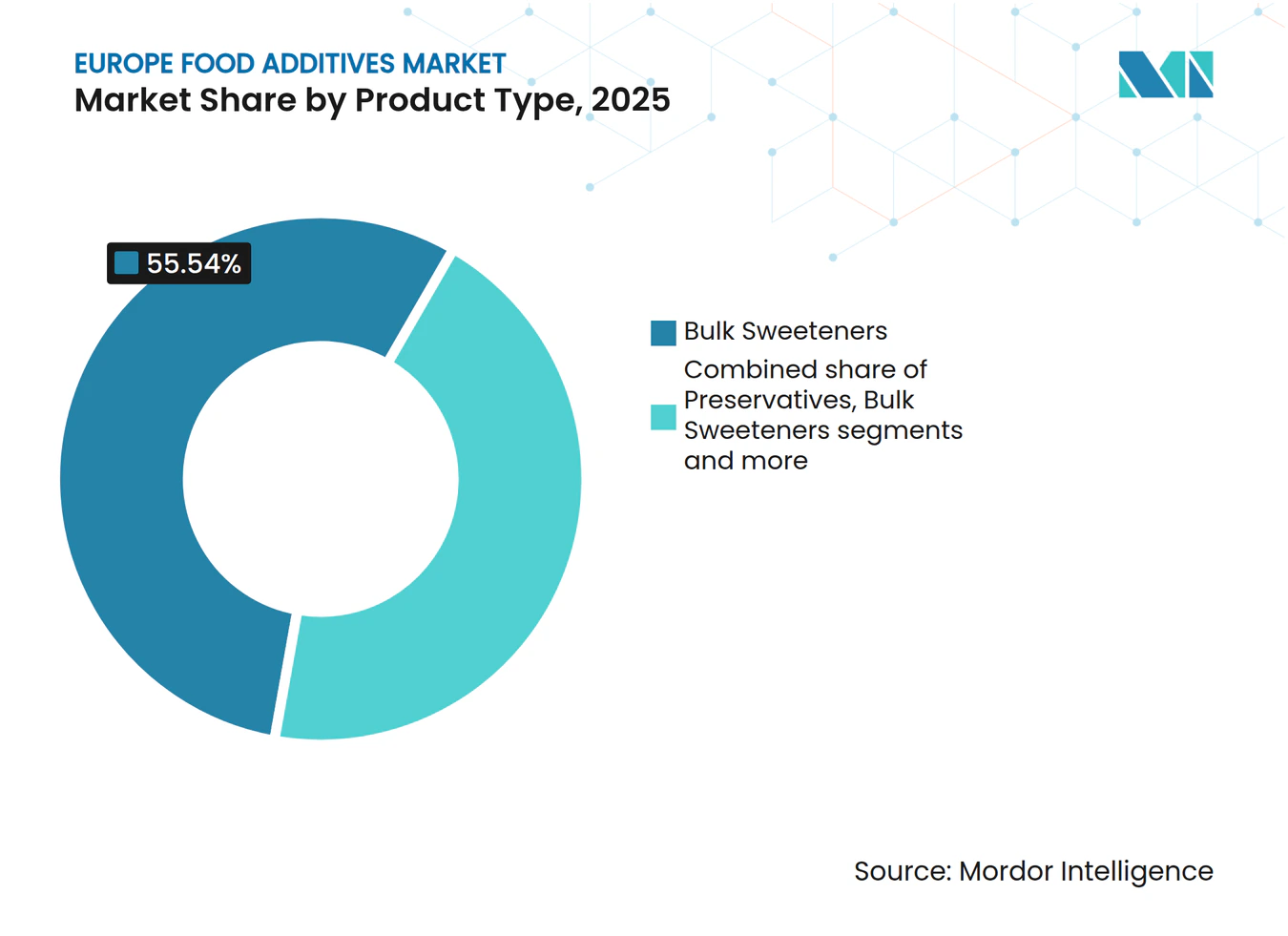
Bulk Sweeteners Hold Ground, Colorants AccelerateBulk sweeteners accounted for 55.54% of the Europe Food Additives Market in 2025, driven by their cost-effectiveness, functional versatility, and importance in maintaining sweetness and formulation characteristics of food products. Their widespread use in industrial food manufacturing is supported by their ability to deliver consistent sweetness, contribute to product bulk, and influence texture, moisture retention, mouthfeel, and overall product structure. Unlike high-intensity sweeteners, which provide sweetness at very low concentrations, bulk sweeteners contribute to the physical composition of formulations, making them important for maintaining product characteristics during processing and storage. The growing emphasis on sugar reformulation and the development of reduced-sugar products is encouraging food manufacturers to optimize sweetener blends and explore alternatives such as polyols, while retaining the required sensory and functional properties.
Food colorants are projected to be the fastest-growing product type in the Europe Food Additives Market, registering a CAGR of 3.45% over 2026–2031. This growth is driven by increasing demand for visually appealing food products, rising consumer preference for natural and clean-label ingredients, and ongoing reformulation efforts to reduce reliance on certain synthetic colorants. Food manufacturers are increasingly focusing on ingredient transparency and recognizable sources, encouraging the development and adoption of color solutions derived from fruits, vegetables, plants, algae, and other natural materials. Growing innovation in extraction, stabilization, and processing technologies is improving the color intensity, consistency, and performance of these ingredients, helping address formulation challenges associated with natural alternatives. At the same time, changing consumer perceptions of artificial ingredients and regulatory scrutiny of certain colorants are encouraging manufacturers to evaluate alternative coloring systems.



By Form:
Dry Form Dominant, Liquid Gains from Processing EfficienciesDry-form additives dominated the Europe Food Additives Market in 2025, accounting for 65.67% of the market. Their dominance is driven by their suitability for standardized ingredient blending and efficient industrial processing. The powdered or granular structure of dry-form additives enables manufacturers to combine multiple ingredients with greater control over formulation ratios, supporting consistent product characteristics across production batches. Dry formulations also offer advantages in inventory management, as many can be stored and transported without the specialized handling required by moisture-sensitive liquid ingredients. Improvements in powder processing, particle-size control, and dispersion technology are strengthening their performance in complex formulations, while their compatibility with automated weighing and batching systems supports production efficiency.
Liquid additives are projected to register a CAGR of 3.67% during 2026–2031, supported by their ability to simplify ingredient incorporation and improve dosing precision in automated production environments. Their fluid consistency enables controlled pumping and metering, helping manufacturers regulate ingredient quantities and maintain uniformity between batches. Liquid formulations can also facilitate the distribution of soluble or dispersed functional ingredients, reducing mixing requirements and helping achieve consistent formulation characteristics. Technological improvements in liquid concentrate development, emulsion stability, and ingredient delivery systems are expanding formulation possibilities while addressing challenges related to separation and degradation during storage.
By Source:
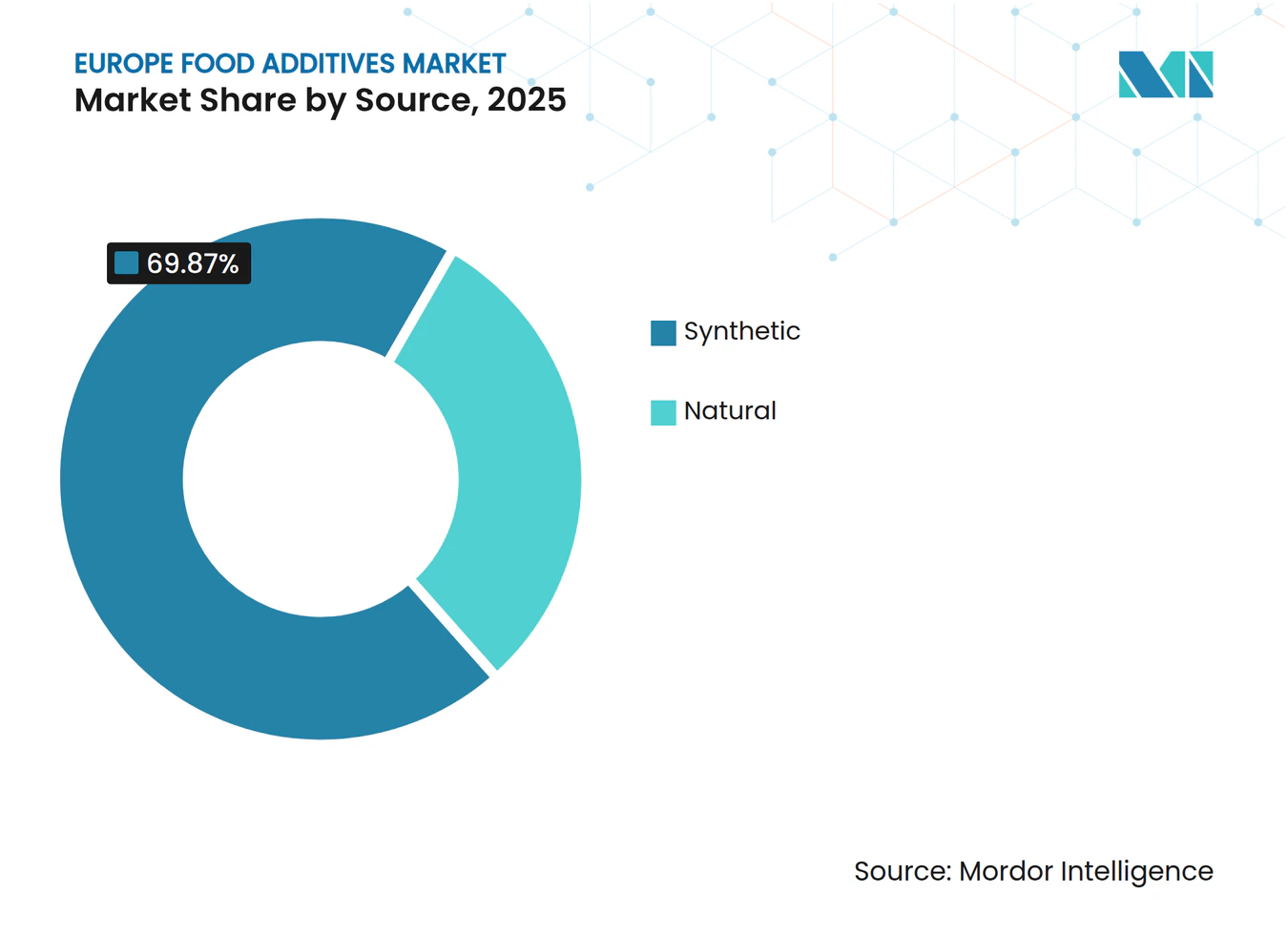
Synthetic Dominance Intact, Natural OutpacesSynthetic additives accounted for 69.87% of the European Food Additives Market in 2025, supported by their consistent functional performance, controlled composition, and suitability for standardized food manufacturing processes. Their production under controlled conditions enables manufacturers to achieve predictable ingredient specifications, repeatable performance, and consistent quality across large production batches. Synthetic additives offer targeted functional properties, allowing manufacturers to address specific formulation requirements with precision and reduce variability associated with differences in raw material composition. Established production technologies and well-characterized performance profiles support their integration into existing manufacturing systems, simplifying formulation control and quality assurance.
Natural additives are projected to be the fastest-growing source in the Europe Food Additives Market, registering a CAGR of 4.74% over 2026–2031, driven by increasing demand for ingredient transparency, clean-label formulations, and alternatives derived from renewable biological resources. Food manufacturers are increasingly reassessing ingredient sourcing and formulation strategies in response to consumer scrutiny of synthetic ingredients and to strengthen the perceived naturalness of their products. According to the Centre for the Promotion of Imports from Developing Countries (CBI), European imports of gum arabic increased by 88% between 2020 and 2024, reaching EUR 277 million, highlighting growing trade activity for a key naturally derived ingredient[2]. Gum arabic's functional versatility in stabilizing emulsions, controlling texture, and supporting formulation consistency reinforces its relevance to ingredient manufacturers.

By Application:
Bakery Leads, Dairy and Desserts the Growth EngineBakery and Confectionery accounted for 27.12% of the Europe Food Additives Market in 2025, driven by the need for consistent product quality, improved processing performance, and greater formulation flexibility across manufactured baked goods and confectionery products. Additives play an important role in controlling dough properties, supporting uniform product structure, managing moisture migration, and maintaining the desired texture throughout production and storage. In confectionery manufacturing, functional ingredients help regulate crystallization, improve product stability, and achieve the required appearance and mouthfeel. The development of new product formulations, including reduced-sugar, gluten-free, and clean-label alternatives, is further increasing the demand for specialized additives that can maintain product quality despite changes in ingredient composition.
Dairy and Desserts is projected to be the fastest-growing application segment in the Europe Food Additives Market, registering a CAGR of 3.53% over 2026–2031. This growth is driven by continuous product innovation, increasing demand for differentiated dairy formulations, and the technical requirements associated with developing products with improved texture, stability, and sensory characteristics. The growing development of high-protein dairy products, lactose-free alternatives, plant-based desserts, and reduced-sugar formulations is increasing the demand for specialized stabilizers, emulsifiers, sweeteners, and texturizing agents. Reformulation in these products often requires careful management of viscosity, protein interactions, moisture retention, and ingredient compatibility to maintain the desired consistency and consumer acceptance.
Geography Analysis
Germany Food Additives Market
Germany accounted for 21.34% of the European Food Additives Market in 2025, supported by its established food processing industry, strong demand for packaged food products, and emphasis on product quality, food safety, and formulation consistency. The country's organic food sector also contributes to demand for additives that comply with applicable organic production standards. According to the German Federation of Organic Food Producers, the organic food market reached EUR 7.42 billion in 2025, reflecting the significance of organic products in the country's food industry[3]. The growth of clean-label formulations and demand for naturally derived ingredients are encouraging manufacturers to explore natural colours, stabilizers, emulsifiers, and other functional ingredients. Germany's focus on food innovation, ingredient traceability, and compliance with European food regulations further supports the adoption of specialized additives that meet evolving manufacturing and product development requirements.
Italy Food Additives Market
Italy is projected to be the fastest-growing geography in the Europe Food Additives Market, registering a CAGR of 4.52% over 2026–2031. Growth is supported by ongoing innovation in food processing, increasing demand for packaged and convenience foods, and the need to maintain product quality across diverse food formulations. The country's established bakery, confectionery, dairy, and processed food industries create demand for additives that improve texture, flavour stability, colour consistency, and shelf life. Growing interest in clean-label products and naturally sourced ingredients is encouraging the development of alternative colouring, preservation, and stabilization solutions. Improvements in food processing technologies and formulation techniques are also enabling manufacturers to enhance production consistency and develop products that meet changing consumer expectations. These factors are expected to strengthen demand for functional and specialized food additives in Italy throughout the forecast period.
Broader European Markets
The United Kingdom, France, Spain, and the Netherlands also contribute to the European food additives market through their food manufacturing capabilities and evolving product development priorities. In the United Kingdom, demand is supported by reformulation initiatives focused on sugar reduction, ingredient transparency, and improved product quality. France benefits from innovation across dairy, bakery, confectionery, and processed food manufacturing, alongside growing interest in natural ingredients and organic formulations. In Spain, the expansion of packaged foods, sauces, beverages, and processed food products supports the use of preservatives, acidity regulators, emulsifiers, and flavouring ingredients. The Netherlands contributes through its food ingredient processing, research, and international distribution activities, supporting the development and supply of specialized additive solutions.
Competitive Landscape
Market Concentration
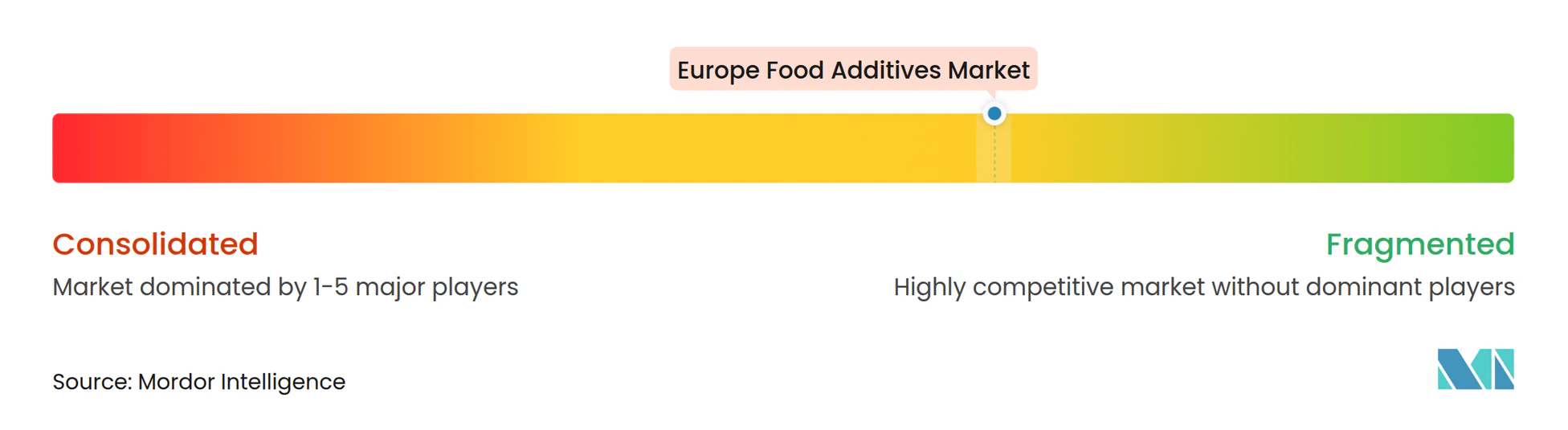
The European Food Additives Market is moderately fragmented, with competition driven by ingredient innovation, functional performance, product quality, and the ability to meet evolving food manufacturing requirements. Participants compete across a broad range of additive categories, leveraging technical expertise and formulation capabilities to address changing requirements for food safety, shelf life, texture, flavor, and ingredient stability. The market includes established ingredient suppliers such as Cargill, Incorporated, Kerry Group plc, Archer-Daniels-Midland Company, dsm-firmenich AG, and Corbion N.V., alongside specialized producers serving specific functional ingredient categories. Competitive positioning increasingly depends on the ability to provide reliable ingredient performance, maintain consistent quality, and respond to growing demand for natural and clean-label solutions.
Differentiation is shifting from ingredient portfolio breadth toward application expertise, customized formulations, and co-development capabilities. Manufacturers are increasingly seeking ingredient suppliers that can help optimize formulations, resolve technical challenges, and improve processing efficiency rather than simply supply standardized additives. This is encouraging greater investment in research and development, application laboratories, and collaborative product development. Innovation in fermentation, enzyme technology, natural ingredient extraction, and stabilization systems is creating opportunities to develop additives with improved functionality and more consistent performance. Companies are also focusing on reformulation support to help food manufacturers respond to ingredient transparency expectations, changing regulatory requirements, and demand for alternatives to certain synthetic ingredients.
Technology and distribution infrastructure are becoming increasingly important competitive differentiators in the European market. Advances in biotechnology, precision fermentation, encapsulation, and process optimization are enabling ingredient producers to improve manufacturing efficiency, develop specialized functional ingredients, and strengthen product consistency. Established sourcing networks, production capabilities, technical support services, and distribution partnerships also help suppliers maintain reliable ingredient availability and serve customers across multiple markets. Companies that combine technological capabilities with dependable supply chains and responsive customer support are better positioned to address changing formulation needs and maintain long-term customer relationships.
Europe Food Additives Industry Leaders
-
Cargill, Incorporated
-
Kerry Group plc
-
Archer-Daniels-Midland Company
-
dsm-firmenich AG
-
Corbion N.V.
- *Disclaimer: Major Players sorted in no particular order
Europe Food Additives Market Companies Covered in this Report
- Cargill, Incorporated
- Kerry Group plc
- Archer-Daniels-Midland Company
- dsm-firmenich AG
- Corbion N.V.
- Ingredion Incorporated
- Givaudan SA
- BASF SE
- International Flavors & Fragrances Inc.
- Symrise AG
- Sensient Technologies Corporation
- Novonesis A/S
- Tate & Lyle PLC
- Chr. Hansen Holding A/S
- Dohler GmbH
- Jungbunzlauer Suisse AG
- Brenntag SE
- Roquette Freres
- Ajinomoto Co., Inc.
- Palsgaard A/S
Recent Industry Developments in Europe Food Additives Market
- June 2026: Ingredion agreed to acquire Tate & Lyle for GBP 2.7 billion, a deal that would create one of the world's largest specialty ingredient platforms spanning texture, sugar reduction, mouthfeel, sweetening, and fortification.
- April 2026: Kerry expanded its biotechnology manufacturing facility in Carrigaline, Cork, Ireland, increasing industrial-scale lactase enzyme production to support global demand for lactose-free and sugar-reduced dairy products.
- April 2026: Cargill invested EUR 25 million at its Baupte, France, hydrocolloids site. The introduction of Mechanical Vapor Recompression (MVR) technology reduces CO₂ emissions at the site by approximately 13,700 tonnes per year.
Europe Food Additives Market Report Scope
Food additives are natural or synthetic chemical substances added to food during production, processing, storage, or packaging to improve safety, shelf life, appearance, taste, or texture. The European Food Additives Market is segmented by product type, form, source, application, and geography. Based on product type, the market is segmented into preservatives, bulk sweeteners, sugar substitutes, emulsifiers, anti-caking agents, enzymes, hydrocolloids, food flavors and enhancers, food colorants, and acidulants. Based on form, the market is segmented into dry and liquid. Based on source, the market is segmented into natural and synthetic. Based on application, the market is segmented into bakery and confectionery, dairy and desserts, beverages, meat and meat products, soups, sauces, and dressings, and other applications. Based on geography, the market is segmented into the United Kingdom, Germany, France, Italy, Spain, the Netherlands, Poland, Belgium, Sweden, and the rest of Europe. For each segment, the market sizing and forecast have been done based on the value (in USD).
Segmentation Overview
By Product Type
| Preservatives |
| Bulk Sweeteners |
| Sugar Substitutes |
| Emulsifiers |
| Anti-Caking Agents |
| Enzymes |
| Hydrocolloids |
| Food Flavors and Enhancers |
| Food Colorants |
| Acidulants |
By Form
| Dry |
| Liquid |
By Source
| Natural |
| Synthetic |
By Application
| Bakery and Confectionery |
| Dairy and Desserts |
| Beverages |
| Meat and Meat Products |
| Soups, Sauces, and Dressings |
| Other Applications |
By Geography
| United Kingdom |
| Germany |
| France |
| Italy |
| Spain |
| Netherlands |
| Poland |
| Belgium |
| Sweden |
| Rest of Europe |
| By Product Type | Preservatives |
| Bulk Sweeteners | |
| Sugar Substitutes | |
| Emulsifiers | |
| Anti-Caking Agents | |
| Enzymes | |
| Hydrocolloids | |
| Food Flavors and Enhancers | |
| Food Colorants | |
| Acidulants | |
| By Form | Dry |
| Liquid | |
| By Source | Natural |
| Synthetic | |
| By Application | Bakery and Confectionery |
| Dairy and Desserts | |
| Beverages | |
| Meat and Meat Products | |
| Soups, Sauces, and Dressings | |
| Other Applications | |
| By Geography | United Kingdom |
| Germany | |
| France | |
| Italy | |
| Spain | |
| Netherlands | |
| Poland | |
| Belgium | |
| Sweden | |
| Rest of Europe |
Key Questions Answered in the Report
What is the projected value of the Europe food additives market by 2031?
The Europe food additives market is projected to reach USD 49.13 billion by 2031, growing at a 2.81% CAGR from 2026 to 2031.
Which product category leads food additive demand in Europe?
Bulk Sweeteners lead demand, accounting for 55.54% of market value in 2025 because of their broad use in bakery, beverages, and dairy products.
Which food additive category is growing the fastest in Europe?
Natural additives are the fastest-growing source category, with a projected CAGR of 4.74% through 2031. Food Colorants are the fastest-growing product category at 3.45%.
Why are natural food additives gaining demand in Europe?
Clean-label reformulation, regulatory scrutiny of synthetic ingredients, and demand for plant-based products are increasing the use of natural colors, enzymes, preservatives, and flavor systems.