
Market Overview
| Study Period | 2021 - 2031 |
|---|---|
| Forecast Data Period | 2026 - 2031 |
| Base Year Market Size (2025) | USD 6.99 Billion |
| Market Size (2026) | USD 7.42 Billion |
| Market Size (2031) | USD 9.98 Billion |
| Growth Rate (2026 - 2031) | 6.12 % |
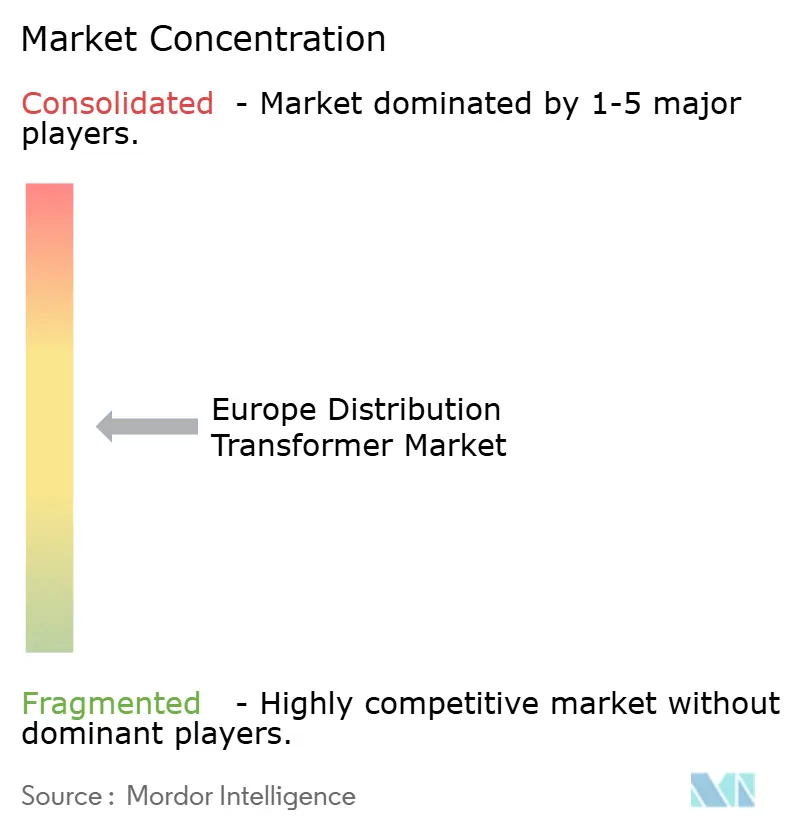
| Market Concentration | Medium |
Major Players *Disclaimer: Major Players sorted in no particular order Image © Mordor Intelligence. Reuse requires attribution under CC BY 4.0. | |
Europe Distribution Transformer Market Analysis by Mordor Intelligence
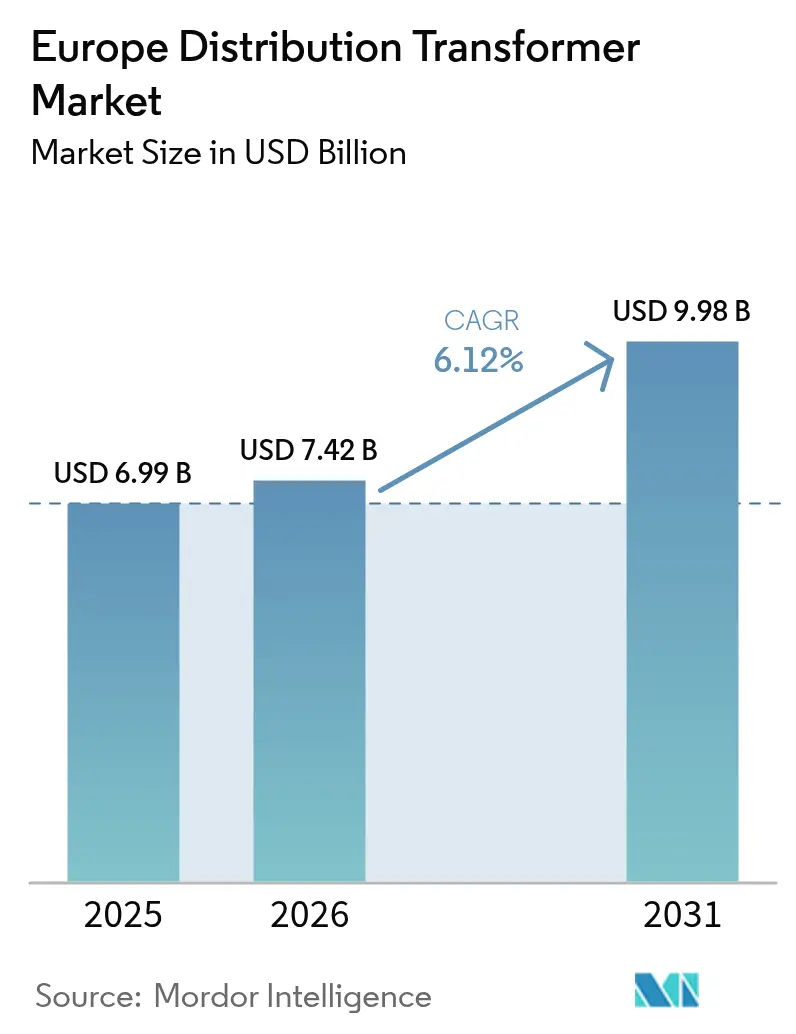
Europe Distribution Transformer Market size in 2026 is estimated at USD 7.42 billion, growing from 2025 value of USD 6.99 billion with 2031 projections showing USD 9.98 billion, growing at 6.12% CAGR over 2026-2031.
Solid momentum stems from grid modernization funding, stricter EU energy-efficiency rules, and surging demand from electric-vehicle charging hubs and hyperscale data center clusters.[1]European Investment Bank, “Financing the Energy Transition 2025,” eib.org Utility capital-expenditure pipelines are rising after the pandemic pause as operators deploy digital, high-efficiency units to reduce network losses and increase hosting capacity for renewable energy integration. At the same time, specification shifts triggered by the EU Fit-for-55 package are steering procurement toward premium-efficiency cores and biodegradable insulating fluids, inflating average selling prices yet lowering lifetime losses. Supply-chain tightness in electrical steel remains a brake on output; however, strategic stockpiling, dual sourcing, and incremental capacity additions are tempering the impact on short-term deliveries. Mergers and factory expansions by leading OEMs signal growing competition for geographic reach and cost leadership, while utilities consolidate order books with framework agreements to lock in supply.
Key Report Takeaways
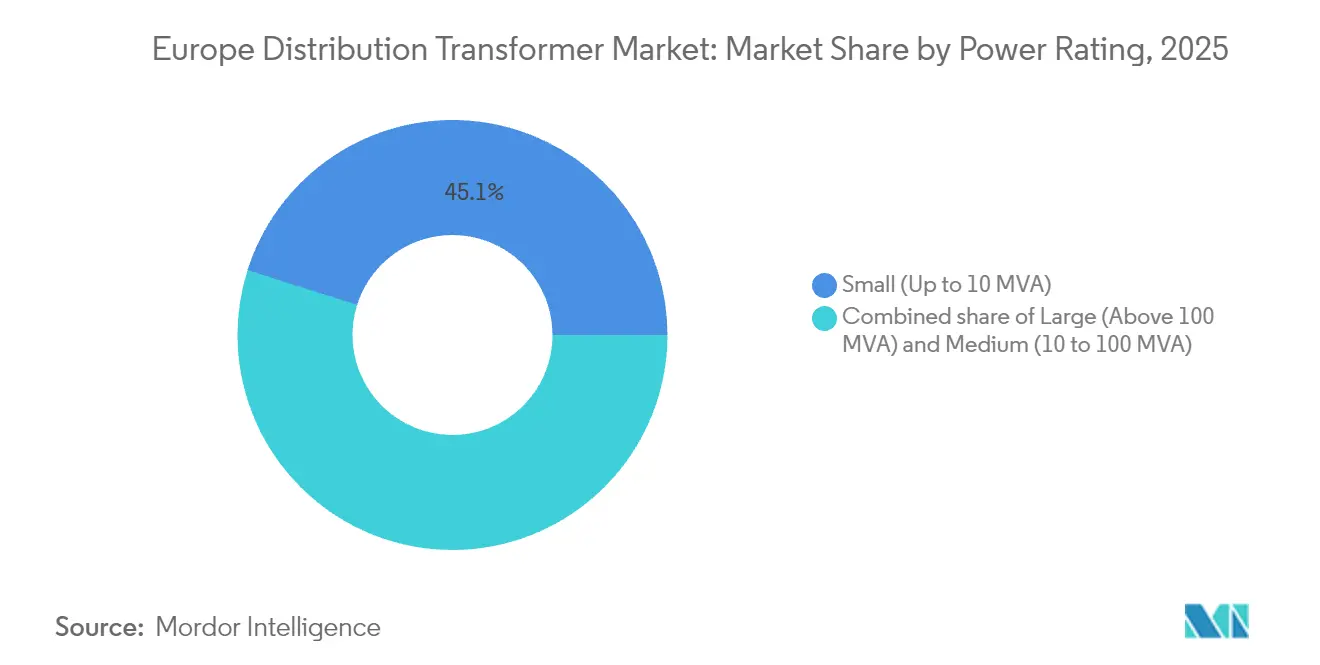
- By power rating, small transformers (≤ 10 MVA) held 45.12% of 2025 revenue; large transformers (> 100 MVA) are projected to register a 6.74% CAGR through 2031.
- By cooling type, oil-cooled units led with 79.85% share in 2025 and are expected to post the fastest 6.18% CAGR over the forecast window.
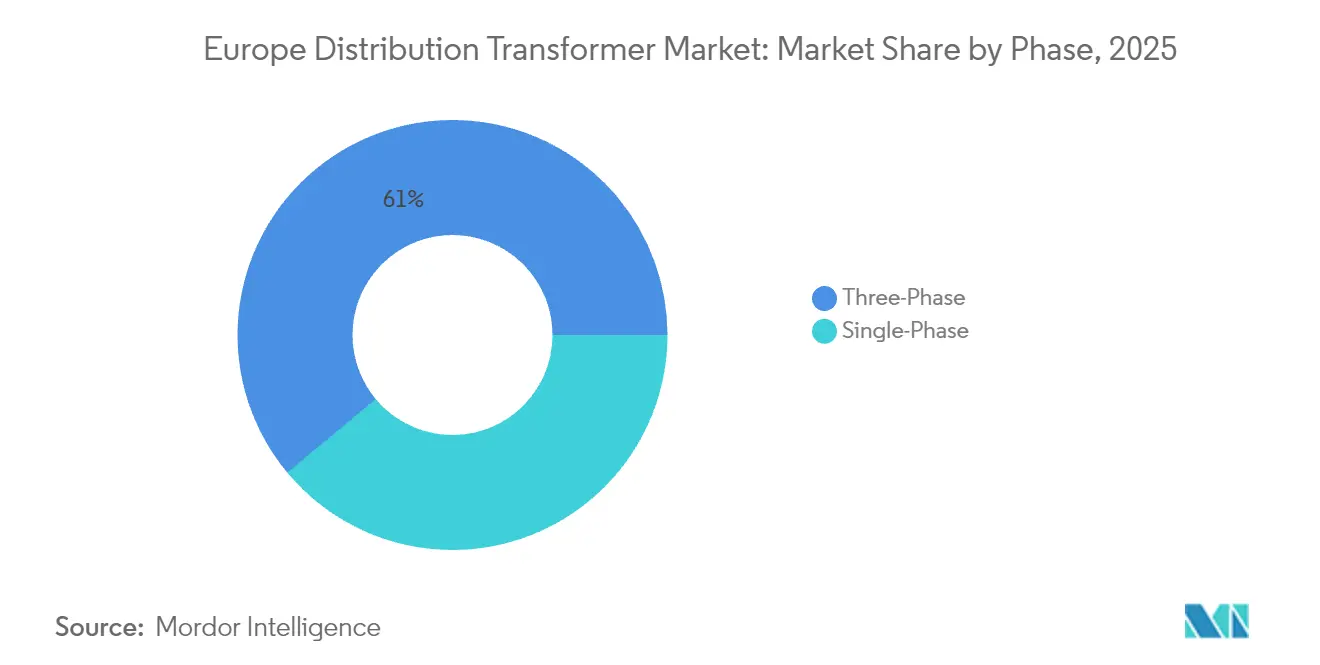
- By phase, three-phase designs accounted for 61.05% of 2025 sales and are forecasted to expand at a 6.41% CAGR through 2031.
- By end-user, power utilities accounted for 40.05% of 2025 revenue, whereas industrial customers are poised for a 7.03% CAGR through 2031.
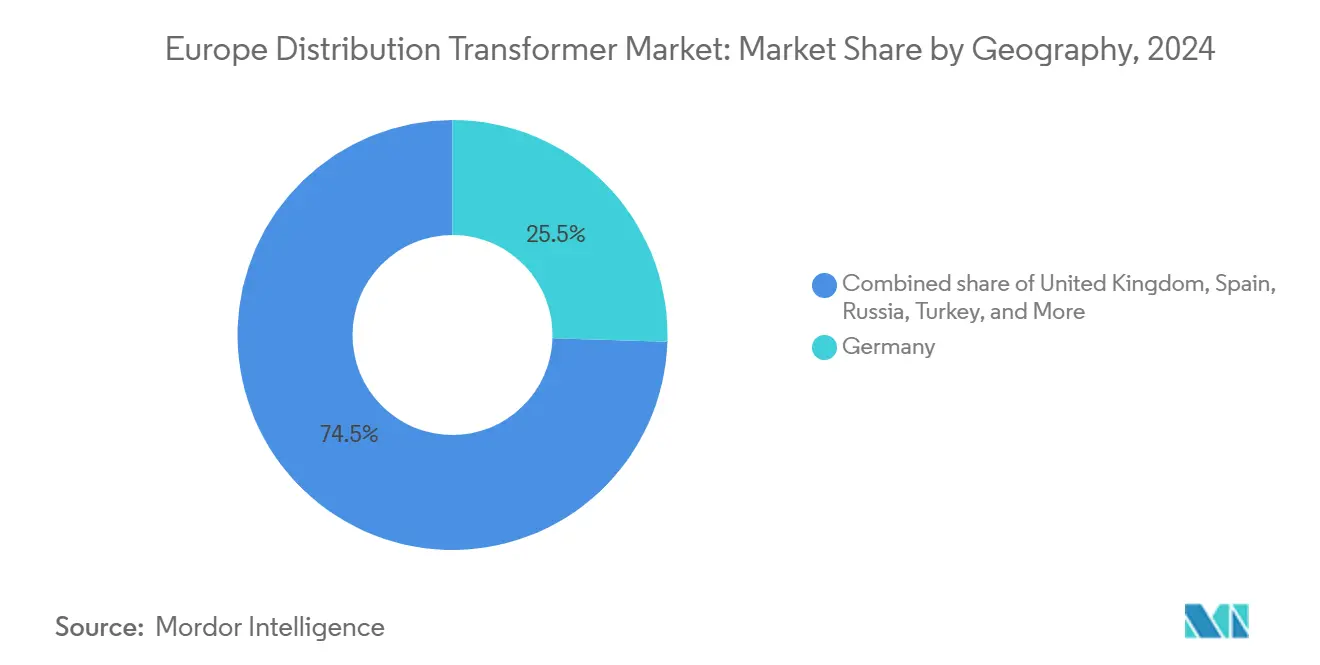
- By geography, Germany captured 25.12% of regional revenue in 2025; Russia is expected to grow the fastest at an 8.37% CAGR by 2031.
Note: Market size and forecast figures in this report are generated using Mordor Intelligence’s proprietary estimation framework, updated with the latest available data and insights as of 2026.
Market Trends and Insights
Drivers Impact Analysis of Europe Distribution Transformer Market*
| Driver | (~) % Impact on CAGR Forecast | Geographic Relevance | Impact Timeline |
|---|---|---|---|
| Grid-modernization capex rebound post-2024 | +1.8% | Germany, France, Spain, NORDIC Countries | Medium term (2-4 years) |
| EU Fit-for-55 energy-efficiency mandates | +1.2% | Global | Long term (≥ 4 years) |
| Surge in MV/LV transformer retrofits for data-centre clusters | +0.9% | Germany, NORDIC Countries, Netherlands | Short term (≤ 2 years) |
| EV-charge hub roll-outs under TEN-T corridors | +0.7% | Germany, France, Spain, Rest of Europe | Medium term (2-4 years) |
| Fast-tracking of rural RES hybrid micro-grids | +0.5% | Spain, NORDIC Countries, Rest of Europe | Long term (≥ 4 years) |
| Utility-led pilot uptake of biodegradable ester fluids | +0.3% | Germany, NORDIC Countries, France | Long term (≥ 4 years) |
| Source: Mordor Intelligence | |||


Grid-modernization capex rebound post-2024
The European Investment Bank has earmarked EUR 100 billion (USD 107 billion) for 2025, setting aside EUR 11 billion (USD 11.8 billion) specifically for electrical grid upgrades. High-profile projects include the EUR 400 million (USD 428 million) Czech distribution upgrade and Iberdrola’s EUR 100 million (USD 107 million) redesign of the Valencia network. Such financing revives deferred utility projects, stimulating bulk procurement of medium-capacity units that match standardized, high-efficiency templates favored for rapid roll-out. As orders solidify, OEMs are ramping plant utilization across Germany, Poland, and Italy, shortening delivery cycles for the European distribution transformer market.
EU Fit-for-55 energy-efficiency mandates
The Fit-for-55 legislative package aims for a 55% reduction in greenhouse gases by 2030, compelling utilities to replace legacy Tier 1 equipment with Tier 2-compliant models and prepare for a likely Tier 3 by 2027.[2]Eurelectric, “Shortage of Grain-Oriented Electrical Steel,” eurelectric.org Transformer losses account for 93 TWh, or 2.9% of EU generation, providing a large technical savings pool. Utilities are therefore specifying amorphous-metal cores, advanced step-lap designs, and ester-filled tanks despite 15-20% higher upfront prices. The European distribution transformer market is experiencing longer tender horizons and value-based award criteria that prioritize life-cycle efficiency over initial cost.
Surge in MV/LV transformer retrofits for data-center clusters
Europe is expected to host nearly 25% of the new global hyperscale capacity planned for 2025-2027, with Germany and the Nordics competing for server-farm investment.[3]ENTSO-E, “Ten-Year Network Development Plan 2024,” entsoe.eu Operators require redundant 20-40 MVA feeds with online dissolved-gas monitoring to ensure 99.999% uptime, pushing specialized MV/LV transformer procurement. Digital-native designs with fiber-optic temperature sensors and partial-discharge analytics are gaining share, reinforcing premium pricing and accelerating product differentiation in the European distribution transformer market.
EV-charge hub roll-outs under TEN-T corridors
The TEN-T revision targets 55.6 GW of public charging by 2030, compared to 18 GW installed in 2024, implying more than 150,000 additional three-phase distribution transformers for highway fast-charge stations.[4]European Commission, “Revised TEN-T Regulation 2024,” ec.europa.eu Designs must tolerate load spikes and harmonics from megawatt chargers, prompting utilities to specify low-loss, high-impedance units with wide overload margins. Component lead times are lengthening, so charge-point operators are entering multi-year framework deals to secure their supply.
Restraints Impact Analysis of Europe Distribution Transformer Market*
| Restraint | (~) % Impact on CAGR Forecast | Geographic Relevance | Impact Timeline |
|---|---|---|---|
| Lengthening lead-times for electrical-steel laminations | -1.4% | Global | Short term (≤ 2 years) |
| Tightened noise & footprint limits in urban substations | -0.8% | Germany, France, United Kingdom, urban areas | Medium term (2-4 years) |
| Volatility in base-oil feedstock for mineral-oil transformers | -0.6% | Global, with acute impact in Germany, France, Spain | Short term (≤ 2 years) |
| CAPEX deferment amid DSOs' tariff-freeze negotiations | -0.4% | Germany, United Kingdom, France, Rest of Europe | Medium term (2-4 years) |
| Source: Mordor Intelligence | |||
Lengthening lead-times for electrical-steel laminations
Global grain-oriented electrical-steel supply remains strained, with lead times stretching to 3-4 years and prices nearly doubling since 2020. Materials now represent 45% of the finished-unit cost, forcing manufacturers to ration allocations and favor high-margin orders. The bottleneck particularly affects the > 100 MVA category, potentially delaying large cross-border interconnection projects that drive demand for the European distribution transformer market.
Tightened noise & footprint limits in urban substations
Urban authorities in Germany, France, and the United Kingdom are imposing stricter 50-dB daytime noise caps and reducing permitted station footprints, which is driving the adoption of compact, low-sound transformers with advanced cooling and acoustic enclosures. Although the shift opens opportunities for dry-type and solid-state variants, higher engineering complexity and cost could deter budget-constrained municipal utilities, restraining growth in densely populated catchments.
*Our forecasts treat driver/restraint impacts as directional, not additive. The impact forecasts reflect baseline growth, mix effects, and variable interactions.
Europe Distribution Transformer Market Segment Analysis
By Power Rating:
Grid upgrades tilt toward higher capacitiesSmall units (≤ 10 MVA) retained the largest 45.12% share of the European distribution transformer market in 2025, serving rooftop solar interconnections, mixed-use real estate electrification, and suburban feeders. Their short production cycles and catalog-based designs support quick deployment. However, capital-intensive transmission reinforcements under the ENTSO-E Ten-Year Network Development Plan are boosting demand for > 100 MVA equipment at a 6.74% CAGR. The European distribution transformer market size for large units is projected to reach USD 3.31 billion by 2031, driven by the development of new 400 kV corridors and offshore wind landing stations. Manufacturers are dedicating separate production halls and high-voltage test bays to shorten factory acceptance testing for these bespoke models. Utilities balance the higher ticket price with 40-year service life and lower relative losses, preserving total-cost-of-ownership economics.


By Cooling Type:
Oil immersion dominates yet ester pilots multiplyOil-cooled designs accounted for 79.85% of the revenue in 2025 and will remain the backbone, thanks to their thermal headroom and cost efficiency. OEMs are upgrading filtration and moisture-monitoring systems to extend oil life to 25 years, helping utilities justify replacements. Pilot projects using natural and synthetic esters are advancing. In 2025, R&S Group shipped a 40 MVA unit filled with Nytro BIO 300X to a Swedish utility, validating field performance. Ester's interest is strongest in fire-sensitive tunnels, ports, and urban substations, where the risk of mineral oil spills is unacceptable. Air-cooled units continue to serve metro rail, semiconductor fabs, and data halls that require zero flammability, but face margin pressure from rising silicon-steel prices. Innovation in solid-state transformer modules, funded by the EU SSTAR program, may open a future niche; however, the high cost keeps deployment marginal for now.
By Phase:
Three-phase keeps grid supremacyThe three-phase topology accounted for 61.05% of shipments in 2025 and is forecast to grow at a 6.41% annual rate as utilities standardize on a balanced three-wire architecture for medium-voltage feeders. Digital protection relays and IEC 61850 communication layers are easier to implement on three-phase platforms, thereby reinforcing the preference for new substations. Single-phase designs sustain relevance in rural feeders, ground-mounted PV farms, and pole-mounted service transformers. Tender volumes remain stable, but price sensitivity is acute because small municipals often buy in batches of 10-20 units.
By End-User:
Industry surges on electrificationPower utilities retained a 40.05% share of the European distribution transformer market in 2025, but industrial customers are expected to log the fastest 7.03% CAGR through 2031. Decarbonization roadmaps in the chemicals, steel, and food processing industries are shifting from fossil-fired heating to electric arc furnaces and high-temperature heat pumps, which demand additional medium-voltage capacity. OEMs are customizing cast-resin transformers with integrated arc-flash sensors for plant safety compliance. Commercial building retrofits and residential heat pump adoption sustain a steady volume, though average unit ratings remain below 2.5 MVA, limiting the revenue impact.
Geography Analysis
Germany Distribution Transformer Market
Germany generated 25.12% of Europe's distribution transformer market revenue in 2025, driven by the Energiewende and grid reinforcement, as well as offshore wind interconnections, such as the 5 GW NOR-3 cluster. The national regulator's focus on Tier 2-plus efficiency elevates demand for amorphous-core technology, supporting OEM margins. Bavaria, Baden-Württemberg, and North Rhine-Westphalia account for more than 60% of domestic orders due to their high industrial density. Persistent labor shortages, however, are driving up installed costs, prompting utilities to consider modular skid designs that are assembled offsite.
Broader European Markets
Russia posted the highest 8.37% CAGR outlook, despite geopolitical headwinds, driven by federal grants for electrification in the Far East and expansion of mineral processing. Domestic producers benefit from import substitution but still rely on European-made sensor packages, creating opportunities for selective export to EU suppliers. Energy-intensive metallurgy and oil refining remain core buyers of > 63 MVA step-down units. France and Spain together held 17.74% of regional sales in 2025. French demand centers on 20 kV feeder upgrades to accommodate rooftop solar, while Spain prioritizes rural hybrid microgrids that combine PV and battery storage. In both countries, noise-reduction mandates under local urban planning laws encourage the adoption of mid-power dry-type equipment. The United Kingdom channels investments into offshore wind landing points and London underground station refurbishments, maintaining a steady appetite for compact three-phase cast-resin designs. Nordic markets, although smaller, outpace the EU average growth as the Finland-Sweden Aurora Line and Baltic Sea HVDC projects trigger secondary substation additions. Turkey, straddling the EU and Middle East trade lanes, imports high-spec units for Istanbul metro extensions while growing a domestic assembly base in Izmir and Kocaeli.
Regulatory Landscape
In Europe, distribution transformer energy-performance requirements are shaped by the EU Ecodesign framework for power transformers under Regulation (EU) 548/2014, as amended by Regulation (EU) 2019/1783. The rules cover units from 1 kVA and drive minimum-loss procurement specifications for utilities and industrial buyers. Technical conformity is increasingly aligned to the EN 50708 series (additional European requirements) alongside IEC 60076 test and design practices, which reinforces standardized efficiency and verification expectations in tenders.
Policy direction has also tightened around grid buildout acceleration. The European Grids Package presented in December 2025 emphasized streamlined permitting, strengthened distribution-grid planning, and incentives for anticipatory investments to integrate very large volumes of renewables by 2040. Separately, the European Commission is running an active review process for transformer ecodesign requirements, keeping OEMs and buyers focused on future compliance pathways for low-loss cores, digital-ready monitoring, and environmentally safer insulating solutions.
Competitive Landscape
Supplier concentration is moderate: the five largest OEMs—Hitachi Energy, Siemens Energy, Schneider Electric, R&S Group, and SGB-SMIT—collectively controlled roughly 40% of 2024 deliveries. Acquisition activity is tightening the field; R&S Group’s USD 268 million takeover of Kyte Powertech in 2024 extended its footprint across Ireland and the UK, while Siemens Energy purchased a stake in KONČAR Transformer Tanks in 2025 to back-integrate enclosure fabrication. Capacity expansions are running in parallel: Siemens Energy is spending USD 235.4 million to increase Nuremberg output by 50% and add 350 staff, whereas Hitachi Energy has earmarked an additional USD 250 million in 2025 on top of a USD 1.5 billion global package to alleviate supply shortages. Smaller challengers, such as R&S Group’s new 10,000 m² Polish plant and Tamini’s bolt-on acquisition of Transformer Electro Service, illustrate regional scaling tactics. Competitive advantage is increasingly tied to digitalization: Schneider’s EcoStruxure Transformer Connect and Hitachi’s Lumada Asset Performance suites use embedded IoT sensors and AI-based analytics to offer predictive maintenance contracts. Compliance with ISO 14001 environmental management and IEC 61850 data models is now a prerequisite in major tenders, disadvantaging legacy designs.
Europe Distribution Transformer Industry Leaders
Hitachi Energy Ltd.
Siemens Energy AG
Schneider Electric SE
GE Vernova
Eaton Corporation plc
- *Disclaimer: Major Players sorted in no particular order
Europe Distribution Transformer Market Companies Covered in this Report
- Hitachi Energy Ltd.
- Siemens Energy AG
- Schneider Electric SE
- Eaton Corporation plc
- GE Vernova
- SGB-SMIT Group
- CG Power Systems Belgium NV
- Westrafo SRL
- SEA SpA (Societa Elettromeccanica Arzignanese)
- GBE SpA
- Brush Transformers Ltd.
- Ormazabal (Velatia)
- Efacec Power Solutions SA
- VEO Oy
- JST Transformateurs
- Koncar D&ST Inc.
- Kolektor Etra d.o.o.
- Wilson Power Solutions Ltd.
- WEG Transformers Europe
- Hyosung Heavy Industries Co., Ltd.

Market Opportunities and Future Outlook
Near-term whitespace is concentrated in premium-efficiency and digitally instrumented distribution transformers that support DSOs and industrial sites in reducing technical losses and moving toward condition-based maintenance, as EU ecodesign requirements tighten. The EU Grids Action Plan advances coordination between the European Commission, the EU DSO Entity, and industry to improve visibility on distribution-network planning and manufacturing needs, including a planned platform for EU distribution network planning and a 2026 Energy Infrastructure Forum milestone. This demand signaling supports multi-year framework buying and encourages standardization around commonly specified ratings and monitoring packages.
Supply security is another opportunity area, particularly as Europe addresses reliance on imports and long lead times for critical materials and components. Recent company investments reflect this focus: Hitachi Energy signed a June 2026 agreement with Fingrid to supply seven 400 kV large power transformers linked to a new Vaasa, Finland manufacturing expansion scheduled for completion by 2027. Siemens Energy also announced a May 2026 investment to expand transformer operations in Linz and Weiz, Austria, with an emphasis on higher-capability units such as phase-shifting transformers. Technical harmonization work by ENTSO-E and T&D Europe, including a Q2 2026 target for a harmonized document structure for HVDC project specifications, can help shorten engineering cycles by simplifying qualification for buyers in MV/LV transformer tenders and broadening eligible supplier pools.
Recent Industry Developments in Europe Distribution Transformer Market
- June 2026: Hitachi Energy signed an agreement with Fingrid to supply seven 400 MVA, 400 kV transformers for Finland's grid development program. The units are linked to a Vaasa-region manufacturing expansion scheduled for completion by 2027, strengthening regional supply capacity and shortening delivery risk for high-specification transformer orders.
- May 2026: Siemens Energy announced a EUR 155 million investment to expand its transformer operations in Linz and Weiz, Austria, adding production and service-center capacity. The investment targets higher-complexity transformer categories and supports faster turnaround for grid-reliability and power-flow management projects across Europe.
- September 2025: Siemens Energy committed EUR 220 million to expand its Nuremberg, Germany transformer factory by adding new production space and increasing output capacity. The investment supports multi-year utility procurement programs and helps ease bottlenecks for large and specialized transformer builds tied to grid modernization.


Europe Distribution Transformer Market Report Scope and Research Methodology
Market Definition and Coverage
For this study, the market covers distribution transformers sold and installed across Europe, counted in revenue terms, and used to step down electricity for final distribution to residential, commercial, and industrial loads.
Scope exclusions: We exclude power transformers mainly used for transmission networks and other electrical equipment that does not perform the distribution transformer step down function.
Segments Covered in This Report
- By Power Rating
- Large (Above 100 MVA)
- Medium (10 to 100 MVA)
- Small (Up to 10 MVA)
- By Cooling Type
- Air-cooled
- Oil-cooled
- By Phase
- Single-Phase
- Three-Phase
- By End-User
- Power Utilities (includes, Renewables, Non-renewables, and T&D)
- Industrial
- Commercial
- Residential
- By Geography
- Germany
- United Kingdom
- France
- Spain
- NORDIC Countries
- Turkey
- Russia
- Rest of Europe
Data Sources, Market Sizing, and Validation
Desk Research
Desk research started with building the demand context for grid upgrades and new connections across Europe, and then converting that into a realistic transformer replacement and new build cycle. Public sources such as Eurostat, ENTSO-E publications, the International Energy Agency, and national transmission and distribution network plans were used to understand electricity consumption trends, renewable integration pressure, and network investment direction.
To ground the equipment side, we reviewed documents such as the European Commission and IEC energy efficiency guidance for transformers, customs and trade statistics where applicable, and a set of manufacturer annual reports, investor presentations, and product catalogs for rating mix and efficiency positioning. Select paid subscriptions were used only to speed up company financial checks, patent scanning for material and design shifts, and shipment level trade screening. The sources listed above are illustrative only, and many other public documents and datasets were also referred to for data collection, validation, and clarification.
Primary Interviews and Surveys
Primary work focused on validating pricing, replacement rates, and procurement patterns that are not consistently visible in public datasets, especially when tenders bundle equipment with services. We spoke with utilities, EPC and contractor teams, component and material participants, and channel partners across Europe so assumptions could be checked country by country, and then rolled up to the regional total.
Distribution of primary research fieldwork respondents
| Company type | Respondent position |
|---|---|
| Top tier: 34% | CXOs: 15% |
| Mid tier: 49% | Functional/Unit leaders: 38% |
| Smaller Players: 17% | Managers: 47% |
Market-Sizing & Forecasting
Sizing began with a top-down build where electricity network investment signals and grid expansion needs were translated into an equipment demand pool, and then filtered into distribution transformer share by voltage step-down use. That demand pool was then reconciled through selective bottom-up approximations, including sampled tender price checks, country level supplier shipment patterns, and ASP times unit volumes for common kVA bands, which helped adjust totals when procurement cycles were lumpy.
Key model inputs included the split of oil-filled versus dry type demand, typical kVA mix used in urban versus rural feeders, replacement cadence tied to asset age and loss-reduction programs, material cost movement affecting transformer pricing, and the timing of utility tenders and framework agreements. Forecasts were developed using scenario analysis, where macro drivers such as grid reinforcement spend and renewable and EV connection intensity were stress-tested, and the variable paths were aligned to expert feedback so the final numbers stayed realistic. Where gaps appeared for smaller countries, proxies were applied using network length, consumption growth, and neighboring market procurement similarity, and then rechecked with interview feedback before finalizing.
Data Validation & Update Cycle
Validation was done by comparing model results against independent signals such as grid capex direction, tender awards and timelines, and observed price ranges by kVA band, and then checking that the implied unit demand stayed plausible. Outliers were flagged early, and the assumptions were revisited, followed by a second analyst review so the math and logic stayed consistent across countries.
The report is refreshed on an annual cycle, and interim updates are triggered when major policy moves, tariff changes, or unusually large utility programs shift the near-term demand picture. Before delivery, a fresh check is done so clients receive the most current version of the market view rather than an older snapshot.
Mordor Intelligence's Europe Distribution Transformer Market Estimate Compared With Other Published Estimates
Published market values for Europe distribution transformers can look far apart even when they talk about similar equipment, because the counting rules behind revenue, timing, and pricing are not always the same. Differences usually come from what is treated as a distribution transformer sale, how tenders are recognized across years, and how exchange rates are applied when local pricing is converted to USD.
In this study, the refresh cycle and currency timing are kept consistent with the base year, and ASP logic is cross-checked against recent tender bands and material-linked price shifts, which keeps the 2025 value traceable. This is the same modeling discipline applied by Mordor Intelligence.
Benchmark comparison
| Source | Market Size | Gaps in Research Methodology |
|---|---|---|
| Mordor Intelligence | USD 6.99 B (2025) | |
| Industry Data Provider A | USD 5.80 B (2025) | This figure likely applies a narrower revenue boundary, where parts of utility framework contracts and service-bundled replacements are excluded or deferred, and it may also use conservative ASP progression that does not fully reflect recent tender resets. |
| Trade Journal B | USD 7.10 B (2024) | This estimate appears to be reported on a different base year, and it can drift due to currency conversion timing and a faster uplift assumption that treats price inflation as uniform across countries and kVA ranges. |
The table shows that the spread mainly comes from timing and pricing treatment, and not just from demand direction. By aligning the base year cut-off, rechecking tender-linked ASP ranges, and keeping country roll-ups consistent, we keep the result easy to audit and repeat when new utility programs or price shifts appear.


Key Questions Answered in the Report
What was the value of the Europe distribution transformer market in 2026?
The market stood at USD 7.42 billion in 2026.
What CAGR is projected for European distribution transformers through 2031?
The market is expected to expand at 6.12% annually between 2026 and 2031.
Which power-rating segment is growing the fastest?
Units above 100 MVA are forecast to rise at a 6.74% CAGR.
Why are ester-filled transformers gaining traction?
Utilities are adopting biodegradable fluids to meet stricter environmental and fire-safety rules, especially in urban and sensitive locations.
Which country leads regional demand?
Germany commanded 25.12% of 2025 revenue thanks to large-scale grid modernization.
What is the main supply-chain bottleneck?
Limited availability of high-grade grain-oriented electrical steel is extending transformer lead times.
Page last updated on:





