
Market Overview
| Study Period | 2019 - 2031 |
|---|---|
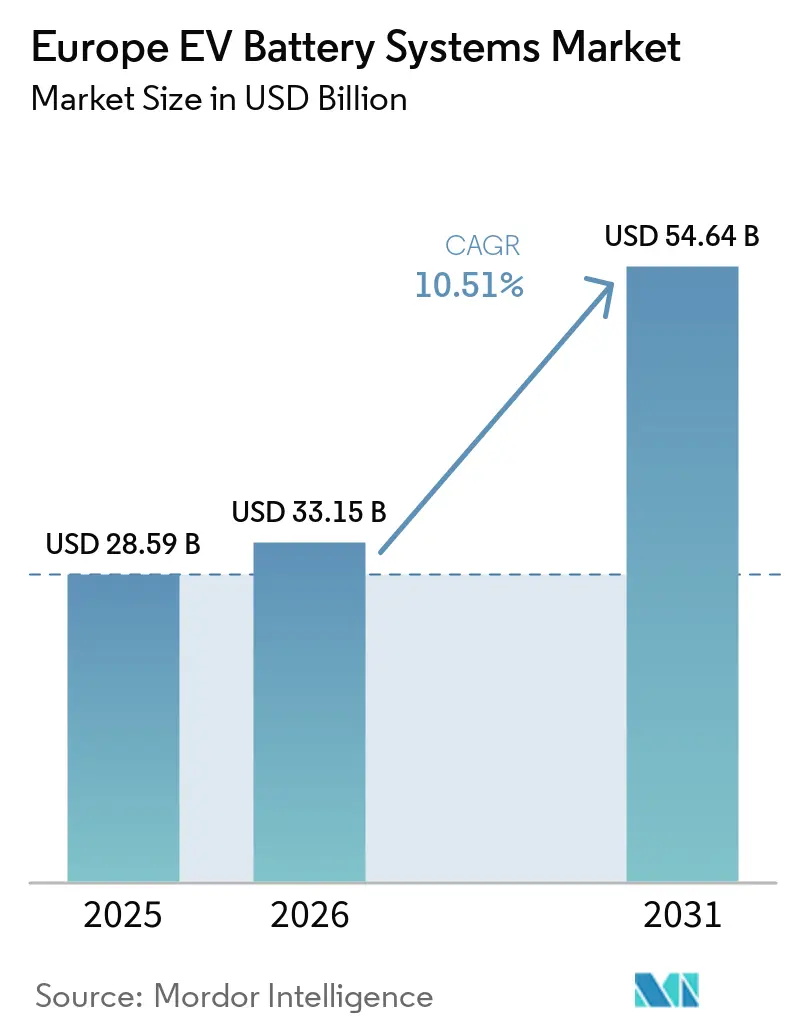
| Base Year Market Size (2025) | USD 28.59 Billion |
| Market Size (2026) | USD 33.15 Billion |
| Market Size (2031) | USD 54.64 Billion |
| Growth Rate (2026 - 2031) | 10.51 % |
| Fastest Growing Market | Europe |
| Largest Market | Europe |
Major Players *Disclaimer: Major Players sorted in no particular order Image © Mordor Intelligence. Reuse requires attribution under CC BY 4.0. | |
Europe EV Battery Systems Market Analysis by Mordor Intelligence
The Europe EV Battery System market size was valued at USD 28.6 billion in 2025 and estimated to grow from USD 33.2 billion in 2026 to reach USD 54.6 billion by 2031, at a CAGR of 10.5% during the forecast period (2026-2031). Battery electric vehicles accounted for 21% of new EU passenger car registrations in H1 2026, thereby supporting demand for traction batteries[1]. Fleet emissions compliance, lower pack costs, and the wider adoption of 800V platforms are shaping purchasing and product decisions across the European EV Battery System market. The EU Digital Battery Passport Registry became operational in July 2026, and battery passport obligations will apply from February 2027 [2]. This increases the value of traceable data systems and established supplier relationships. Producers also face a difficult cost position because European battery production can cost up to 50% more than Chinese production without public support.
Key Report Takeaways
- By vehicle type, passenger cars held 78.63% of the European EV Battery System market share in 2025, while medium and heavy-duty trucks are forecast to grow at a 13.27% CAGR through 2031.
- By propulsion type, battery electric vehicles held 83.15% of the European EV Battery Systems market share in 2025, and are projected to grow at an 13.38% CAGR through 2031.
- By battery chemistry, NMC held 48.89% market share in 2025, while LMFP is forecast to expand at an 11.21% CAGR through 2031.
- By cell format, pouch cells held 51.29% market share in 2025, while prismatic cells are forecast to expand at an 11.87% CAGR through 2031.
- By battery capacity, the 60–80 kWh band held 40.81% market share in 2025, while the 100–150 kWh band is forecast to expand at an 11.69% CAGR through 2031.
- By voltage class, the 400–600V class held 58.37% market share in 2025, while the above-800V class is forecast to expand at a 12.32% CAGR through 2031.
- By module architecture, cell-to-pack held 44.67% market share in 2025 and recorded the highest projected CAGR at 12.67% through 2031.
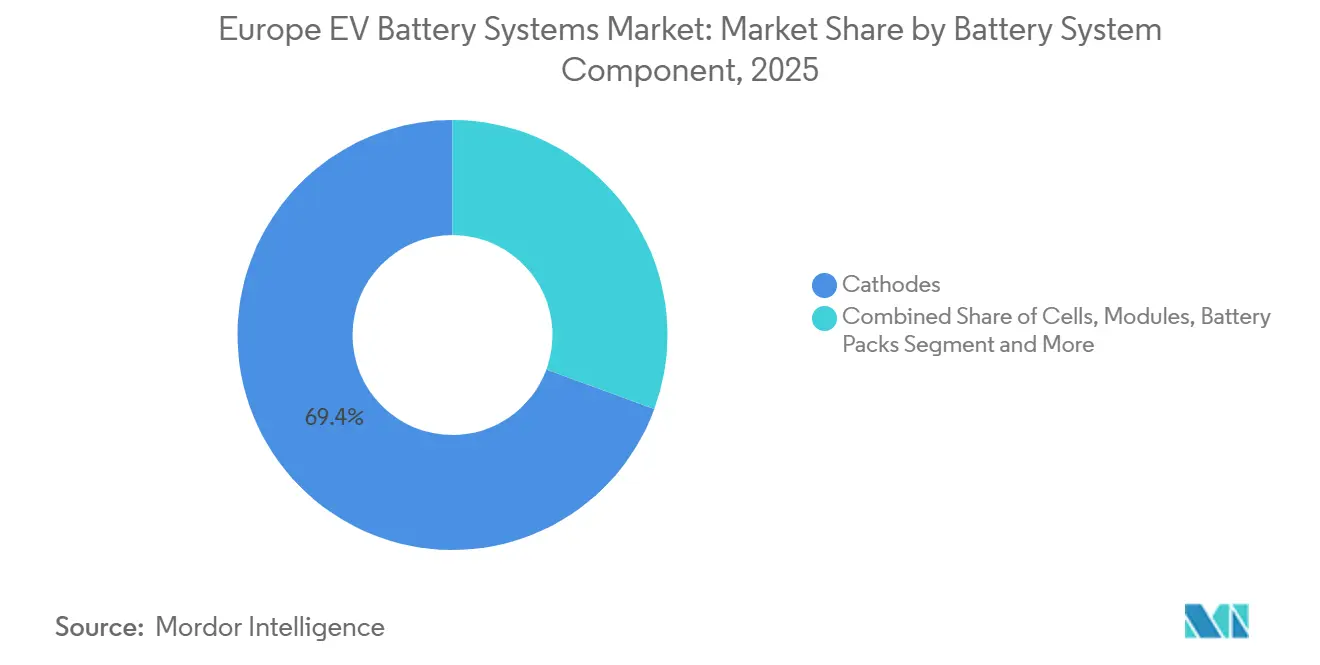
- By battery system component, cathodes held 69.41% market share in 2025, while separators are forecast to expand at an 11.69% CAGR through 2031.
- By sales channel, OEM channels held 78.91% market share in 2025, while aftermarket and replacement channels are forecast to expand at a 13.39% CAGR through 2031.
- By geography, Germany held 42.33% market share in 2025, while the United Kingdom is forecast to expand at a 13.87% CAGR through 2031.
Note: Market size and forecast figures in this report are generated using Mordor Intelligence’s proprietary estimation framework, updated with the latest available data and insights as of January 2026.
Europe EV Battery Systems Market Trends and Insights
Drivers Impact Analysis*
| Driver | (~) % Impact on CAGR Forecast | Geographic Relevance | Impact Timeline |
|---|---|---|---|
| EU Fleet-Emission Compliance and Zero-Emission Transition | +2.4% | EU-wide, especially Germany, France, and Spain | Medium term (2-4 years) |
| Falling Pack Costs and Wider LFP Adoption | +2.0% | All European markets | Short term (≤ 2 years) |
| Gigafactory Localization and OEM Supply Security | +1.7% | Poland, Hungary, France, Germany, and Spain | Medium term (2-4 years) |
| Commercial Fleet Electrification and High-Use Duty Cycles | +1.5% | Germany, the Netherlands, France, and Sweden | Medium term (2-4 years) |
| 800V Platforms and Faster Charging Requirements | +1.2% | Germany, the United Kingdom, Norway, and the Netherlands | Medium term (2-4 years) |
| Battery Passport Readiness and Supplier Qualification | +0.8% | EU-wide | Short term (≤ 2 years) |
| Source: Mordor Intelligence | |||
EU Fleet-Emission Compliance and 2035 Zero-Emission Vehicle Transition
Regulation (EU) 2019/631 was revised in 2025 and set a 100% CO2 reduction target for new passenger cars and vans from 2035. It also established a multiannual compliance window for 2025 through 2027. Manufacturers met their 2025 CO2 target 1 year early, according to the ICCT. The 2030 and 2035 requirements still require continued BEV deployment. This keeps procurement demand visible for battery suppliers in the European EV Battery System market. A proposed corporate fleet measure would direct financial support toward zero-emission corporate vehicles from 2028, reinforcing demand for European-assembled vehicles and battery systems.
Falling Pack Costs and Wider LFP Adoption
Lower lithium-ion battery pack prices are expected to support demand. European battery pack prices remain higher than those in China. LFP is expected to account for a growing share of EU EV battery demand, with China supplying nearly all of this volume. While LFP supports more affordable vehicle programs, it also extends reliance on external supply. LMFP offers a pathway to higher energy density without using cobalt or nickel. Its manganese content also presents a potential localization opportunity for the European EV battery system market.
Gigafactory Localization and OEM Battery-Supply Security
European battery cell production capacity has expanded significantly. Poland and Hungary account for a substantial share of current output. Localization provides vehicle manufacturers with greater control over delivery schedules, production planning, and regulatory documentation. It also increases the importance of long-term cell supply agreements in the European EV Battery System market. Volkswagen's PowerCo has commissioned its Salzgitter plant, establishing a domestic source for Unified Cell production. However, new plants may continue to operate below efficient utilization levels as customer programs ramp up.
800V Platforms and Faster Charging Requirements
BMW’s Neue Klasse platform is scheduled to enter production with a native high-voltage architecture. The Alternative Fuels Infrastructure Regulation mandates high-output charging infrastructure along TEN-T core corridors. As faster charging expands, high-voltage platforms are becoming increasingly relevant beyond premium vehicle models. These architectures require separators and electrolyte systems that can withstand higher voltage stress. This technical requirement supports demand for specialized components in the European EV Battery System market and helps explain the growth of the high-voltage class and the separator segment.
Restraints Impact Analysis*
| Restraint | (~) % Impact on CAGR Forecast | Geographic Relevance | Impact Timeline |
|---|---|---|---|
| Critical-Mineral Import Dependence and Price Volatility | -1.5% | EU-wide, especially German and French OEM supply chains | Long term (≥ 4 years) |
| High European Energy, Labor, and Compliance Costs | -1.3% | Germany and new market entrants, with partial relief in Eastern Europe | Medium term (2-4 years) |
| Gigafactory Underutilization and Ramp-Up Delays | -0.8% | Eastern and Southern Europe | Short term (≤ 2 years) |
| Battery-Data Interoperability Gaps Across the Value Chain | -0.5% | EU-wide, especially multinational OEM and supplier links | Short term (≤ 2 years) |
| Source: Mordor Intelligence | |||
Critical-Mineral Import Dependence and Price Volatility
Cobalt prices rose significantly following export restrictions in the Democratic Republic of the Congo. Lithium prices rose sharply as energy storage demand grew amid supply constraints. These developments reversed the prior price correction. China continues to play a significant role in supplying processed cathode active materials and graphite. The Critical Raw Materials Act aims to expand domestic extraction and processing capacity. Until supply sources diversify, material costs will continue to constrain margin visibility in the European EV battery system market.
*Our forecasts treat driver/restraint impacts as directional, not additive. The impact forecasts reflect baseline growth, mix effects, and variable interactions.
Segment Analysis
By Vehicle Type: Commercial Trucks Gain Share as Passenger Cars Anchor Volume
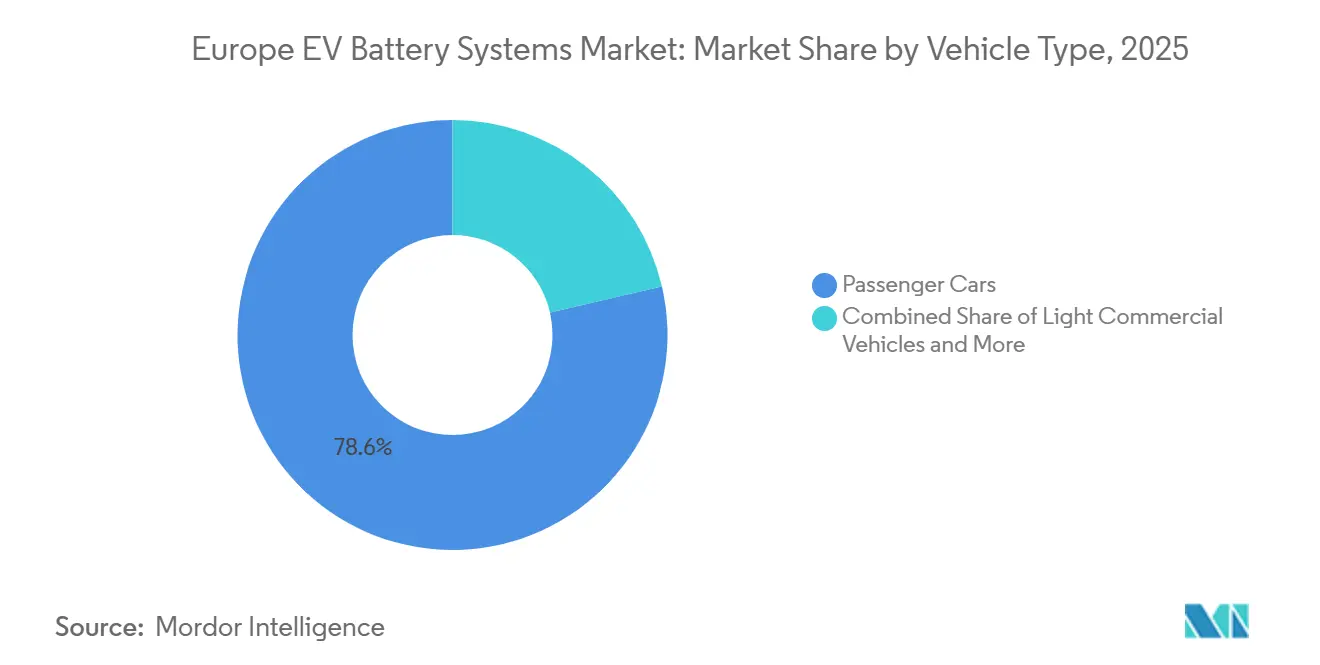
Passenger cars accounted for 78.63% of the European EV Battery System market in 2025. Their large installed program base anchors battery demand across mainstream BEV models. Medium and heavy-duty trucks are forecast to grow at a 13.27% CAGR through 2031. Zero-emission heavy-truck registrations are rising significantly. This segment requires larger battery packs, increasing battery value per vehicle. Consequently, its growth shifts the revenue mix, even as passenger cars remain the primary source of volume.
Light commercial vehicles benefit from recurring last-mile delivery routes. Buses and coaches continue to increase their BEV share, while electric adoption in city buses is expanding rapidly. According to the ICCT, two-wheelers and micro-mobility remain the smallest vehicle category. The growing role of trucks increases the average battery pack value in the European EV Battery System market. Fleet purchases can generate concentrated orders for battery suppliers, often requiring more demanding cycle-life performance than private passenger vehicle applications. While passenger-car programs continue to provide the volume base, commercial vehicles add a higher-value layer of demand. This vehicle mix favors companies that can serve both high-volume passenger cars and intensive-duty applications.

By Propulsion Type: BEV Dominance Concentrates Chemistry and Architecture Decisions
Battery electric vehicles accounted for 83.15% of the European EV Battery System market size in 2025 and are forecast to grow at a 13.38% CAGR through 2031. The average EU BEV battery was close to 70 kWh in 2025. This scale gives BEV platform decisions a significant influence on demand for specific cell formats and chemistries. PHEVs remain a secondary channel, using relatively small battery packs. However, they remain relevant to OEM compliance planning over the longer term. HEVs represent the smallest propulsion category because they use lower-capacity, lower-cost battery packs.
BEV volumes concentrate supplier investment on a narrower range of cell and pack specifications. Consequently, changes in BEV chemistry have greater revenue implications than shifts among propulsion types. LFP adoption has expanded across EU EV programs, while LMFP deployment has begun in BEV programs. These trends create opportunities for the European EV Battery System market to balance cost, energy density, and material availability. The market favors suppliers that can support multiple chemistries across high-volume BEV platforms and develop common designs adaptable to several vehicle lines. Pack suppliers must maintain performance while managing changes in cell inputs. Large BEV programs provide successful designs with a broad revenue base, while the concentration of investment makes procurement decisions within this propulsion category particularly important.
By Battery Chemistry: NMC Leads but LMFP Repositions the Value Chain
NMC held 48.89% market share in the European EV Battery Systems market in 2025. It remains important for long-range and premium vehicle programs that require high energy density. LMFP is forecast to grow at an 11.21% CAGR through 2031. LMFP can deliver higher energy density than standard LFP while avoiding cobalt and nickel. The OLiMPUS Horizon Europe project received funding to develop LMFP cells at an industrial scale and targets future mass production in Europe.
LFP accounted for a notable share of EU EV battery demand, with China supplying nearly all of this demand. NCA, LTO, and other chemistries serve premium, cylindrical, and industrial applications. NMC remains the primary chemistry for established European programs. LFP supports price-sensitive vehicle volumes, while LMFP addresses the mid-range localization opportunity. These chemistry choices will determine the material supply relationships that develop in the European EV Battery System market. Demand for NMC keeps high-energy cathode materials central to premium programs, while LFP provides an alternative for vehicle manufacturers seeking lower battery pack costs. LMFP aims to combine part of this cost advantage with higher energy density. Therefore, the chemistry mix shapes both technical development and the geographic distribution of material sourcing.
By Cell Format: Pouch Leads, Prismatic Ascends on Integration Economics
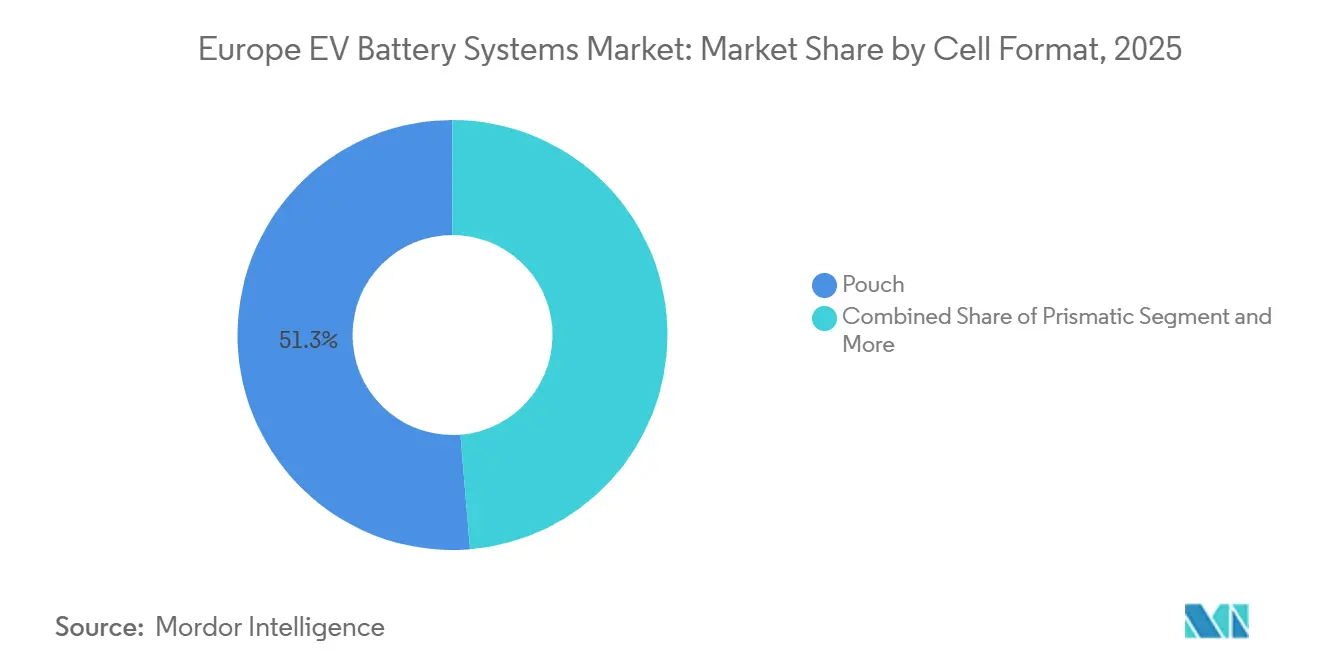
Pouch cells held a 51.29% market share in the Europe EV Battery System market in 2025. Their position reflects long-standing relationships between Korean producers and European OEMs. Prismatic cells are forecast to grow at an 11.87% CAGR through 2031. LFP chemistry aligns naturally with prismatic geometry. This supports more integrated battery designs and simpler packaging. Format selection now affects the cost and design choices made by vehicle makers.
Cylindrical cells are gaining use in premium applications, including BMW's Neue Klasse 46xx platform. Blade and cell-to-pack designs are architectural approaches rather than standalone cell formats. Pouch formats remain important in large OEM supply relationships. Prismatic cells are gaining ground in cost-focused, high-volume programs. Chemistry and architecture choices are becoming more closely linked. This makes cell format a central design decision in the Europe EV Battery System market. It affects supplier tooling, vehicle packaging, and the balance between energy density and manufacturing cost. OEMs must align these choices with their chemistry roadmaps before a vehicle enters production. Producers that support multiple formats can address more customer programs. The choice also influences whether a pack can adopt deeper cell-to-pack integration. These links make format changes difficult to implement late in the development cycle. They also explain why established pouch supply relationships remain significant while prismatic use grows. Suppliers must demonstrate that a new format can meet the required cost, safety, and output standards.
By Battery Capacity: Mid-Range Anchors Share, Large-Capacity Grows Fastest
The 60–80 kWh band accounted for 40.81% of the market in 2025. Its position is consistent with the EU average BEV battery size of close to 70 kWh. The 100–150 kWh band is forecast to grow at an 11.69% CAGR through 2031. It serves premium long-range BEVs and medium-duty commercial vehicles. These vehicle uses require larger packs to meet range and duty-cycle needs. Larger capacity bands, therefore, add more battery value per vehicle.
Below-60 kWh systems serve PHEVs, compact BEVs, and micro-mobility. The 80–100 kWh band connects mid-range volume vehicles with premium models. Systems above 150 kWh are used primarily on heavy commercial platforms. The fastest growth in the 100–150 kWh range lifts average revenue per unit. This effect remains material even if the 60–80 kWh band continues to lead volume. Capacity demand will continue to influence the product mix of the European EV Battery System market. Large-capacity systems require stronger thermal controls and careful charging management. They are therefore more closely associated with commercial and premium vehicle requirements. Mid-range packs remain relevant because they support the broadest range of passenger-car programs. The resulting mix requires suppliers to offer multiple capacity ranges rather than relying on a single standard pack. Battery sizing is closely linked to intended vehicle use and charging behavior. A compact urban vehicle does not need the same pack as a long-range commercial vehicle. This preserves demand for lower-capacity products even as larger systems grow faster. Suppliers must manage this range without losing manufacturing efficiency.
By Voltage Class: 400–600V Holds Volume, Above-800V Defines the Technology Frontier
The 400–600V class held 58.37% market share in 2025. It reflects the existing base of BEV platforms developed before the high-voltage shift. The above-800V class is forecast to grow at a 12.32% CAGR through 2031. BMW's new platform uses 800V architecture, indicating the direction of newer vehicle designs. Higher voltage systems reduce charging time when supported by suitable infrastructure. They also place greater demands on cells and pack components.
The 600–800V band supports the transition for some commercial applications. Below-400V systems decline as older platforms are replaced. The AFIR charging requirement supports the practical use of 800V systems on major corridors. Producers need stronger separators and specialized electrolytes for higher voltage stress. The move is expanding the role of technical component suppliers. It will remain a focus of product development in the European EV Battery System market. Suppliers need to qualify materials under more demanding voltage and fast-charge conditions. Vehicle makers also need charging access to realize the benefits of the architecture. This links infrastructure progress to the selection of battery components. The transition will be gradual because the installed vehicle base still includes lower-voltage platforms. New vehicles are the primary route for adopting 800V designs. The pace will depend on model launches and charging infrastructure deployment. A mixed-voltage landscape will persist throughout the forecast period. This requires suppliers to retain products for legacy systems while developing components for new architectures.
By Module Architecture: Cell-to-Pack Leads and Grows Through Integration
Cell-to-pack accounted for 44.67% of the European EV Battery System market size in 2025 and is projected to grow at a 12.67% CAGR through 2031. Cell-to-pack architecture reduces the role of separate modules within the battery pack. European OEMs are adopting this approach to reduce costs and improve space utilization. Škoda plans to open a cell-to-pack facility in Mladá Boleslav. The facility is expected to assemble a high volume of battery systems each day while reducing production costs compared with modular predecessors.
Cell-to-module designs remain relevant where field repairability is a priority. Module-to-pack systems are playing a declining role as OEMs standardize more integrated designs. Cell-to-pack technology holds the leading share and growth rate, indicating its transition from a development target to an active production choice. This shift increases the importance of cell-level quality control and will influence cost competition across the European EV Battery System market.
Eliminating modules can reduce component counts and free up space within the battery pack. However, it also increases the importance of cell consistency and production control. OEMs must balance these benefits against repairability and service requirements, creating a different manufacturing model for suppliers of integrated battery packs. Cost savings can be substantial when manufacturers produce these designs at scale. However, the integration process requires close coordination between cell manufacturers and vehicle assemblers, while cell-level quality issues become more consequential. Therefore, battery architecture represents both a commercial and an engineering decision.
By Battery System Component: Cathodes Command Value, Separators Gain Strategic Importance
Cathodes held 69.41% market share in 2025. Cathode active materials account for 30–40% of the total cell cost. Separators are forecast to grow at an 11.69% CAGR through 2031. Higher-voltage systems require ceramic-coated separators that can manage elevated voltage and fast-charging conditions. This brings more attention to suppliers of specialized separator materials. It also increases the value of reliable electrochemical performance.
Anodes, electrolytes, battery management systems, and thermal management systems make up the rest of the value stack. Battery management requirements rise as platforms use more chemistries and higher voltage levels. European gigafactories still depend heavily on imported cathode precursors from China and South Korea. This leaves cathode localization as an important supply-chain issue. Component sourcing affects both cost and compliance in the European EV Battery System market. It also informs investment decisions by materials producers. Cathode supply is especially important because it accounts for a large portion of the cell's cost. A more localized cathode base could reduce exposure to imported precursors. It could also support more dependable documentation for battery passport requirements. Separator demand is likely to rise with the move toward high-voltage and fast-charging programs. The component segment includes materials that help manage safety and cell performance. Higher system requirements give specialist providers a clearer role in the value chain. Yet imported material inputs remain a practical constraint for European production. Local investment needs to address both cell capacity and the component supply base.
By Sales Channel: OEMs Anchor Volume, Aftermarket Accelerates from a Small Base
OEM channels accounted for 78.91% market share in 2025. Long-term supply agreements connect traction packs directly to vehicle assembly programs. The aftermarket and replacement channel is forecast to grow at a 13.39% CAGR through 2031. Older BEV cohorts are entering replacement periods in Germany, Norway, and the United Kingdom. This moves aftermarket demand from a future possibility to an active planning issue. Organized providers can use traceability information to support these services.
Commercial fleet operators present a near-term replacement opportunity because high-mileage vehicles tend to experience faster capacity loss. The EU Battery Regulation requires lifecycle traceability, state-of-health documentation, and recycled-content information. These requirements favor organized replacement channels over informal providers. OEMs remain the primary source of unit volume in the European EV Battery System market. The aftermarket becomes more relevant as the vehicle fleet ages. The result is a broader service opportunity around battery condition and replacement. State-of-health records can improve the assessment of batteries before replacement decisions. Traceability can also support the handling of used packs. Fleet operators are likely to need organized service partners as battery cohorts age. These requirements create a distinct channel alongside the new-vehicle battery supply. Replacement work needs diagnostic capability, traceability, and appropriate handling processes. This differs from the large planned orders that characterize OEM supply. As fleets age, demand can become more recurring and service-led. The channel may therefore help companies active in the European EV Battery System market diversify revenue sources.
Geography Analysis
Germany held 42.33% of the European EV Battery System market share in 2025. Its position reflects its large vehicle manufacturing base and long-standing investment in batteries. CATL's Arnstadt plant and PowerCo's Salzgitter facility illustrate the country’s production footprint. Salzgitter is ramping toward 20 GWh through 2026. France has ACC's 13 GWh Billy-Berclau plant and Verkor's 16 GWh Dunkirk gigafactory. Spain hosts PowerCo's Valencia facility and the Stellantis-CATL Zaragoza joint venture.
The United Kingdom is forecast to grow at a 13.87% CAGR through 2031. Envision AESC's Sunderland expansion supports this outlook. Battery capacity across European countries outside the major producing regions is increasing significantly. Norway has achieved strong adoption of electric buses, supporting the development of battery remanufacturing models. In Sweden, battery assets are being redistributed following Lyten’s acquisition of Northvolt’s Heide assets.
Poland and Hungary remain the backbone of battery production in Eastern Europe. LG Energy Solution’s Wrocław facility represents a substantial share of Europe’s total battery capacity. Samsung SDI’s Göd plant further supports the region’s position in the European EV Battery System market. CATL’s investment in Debrecen is advancing construction activity. The Netherlands holds a leading share of EU electrically chargeable truck registrations, creating a favorable operating environment for commercial battery demand[3].
France and Spain are expanding capacity through local gigafactory projects, while Germany remains important because it links cell production with a broad OEM base. The United Kingdom provides an additional regional supply hub through Sunderland. Collectively, these locations demonstrate that battery manufacturing and vehicle demand are expanding beyond a single European hub. The production landscape combines established automotive centers with emerging cell manufacturing locations, thereby shortening supply chains for nearby vehicle plants. However, this expansion may also intensify competition for skilled labor, energy, and local infrastructure. National policy support remains important, as cost competitiveness varies across countries. Consequently, regional specialization is likely to remain a key feature of the European EV Battery System market.
Competitive Landscape
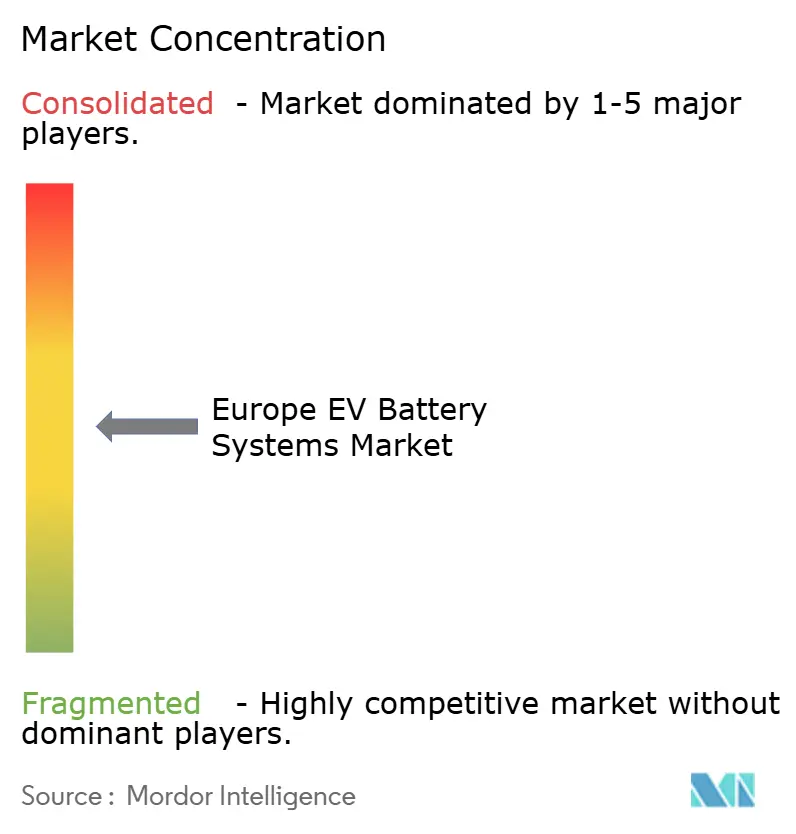
The European EV Battery System market is moderately concentrated in cell production and fragmented across pack integration and components. Chinese producers are expected to nearly double their share of the EU EV battery sector, while Korean manufacturers’ share is projected to decline. Competition will focus on cost, customer commitments, and compliance capabilities.
Battery passport requirements will favor companies with robust data and traceability. Domestic production may benefit from European-content criteria in future procurement programs and fleet incentives. Verkor is expected to begin serial production at its Dunkirk facility for Renault’s Alpine A390, while ACC is establishing an operational manufacturing base. Success will depend on stable yields, customer contracts, and ramp-up cost control.
Northvolt’s potential bankruptcy highlights the risks of unstable yields at new gigafactories. European suppliers must support capacity plans with realistic customer qualification and manufacturing ramp-up strategies. Competitive positioning will depend on reliable output, acceptable customer costs, and compliance with battery passport data, carbon footprint, and lifecycle requirements.
PowerCo plans to begin cell production at Salzgitter and supply cell-to-pack assembly sites in Spain and the Czech Republic. Škoda’s Mladá Boleslav facility is expected to implement cell-to-pack production at scale, while BASF and CATL are expected to establish a cathode active material supply framework. Commercial vehicle batteries, aftermarket reconditioning, LMFP batteries, cell-to-pack integration, proprietary cell design, and data infrastructure offer opportunities for supplier differentiation.
Europe EV Battery Systems Industry Leaders
-
Contemporary Amperex Technology Co. Limited (CATL)
-
LG Energy Solution, Ltd.
-
Samsung SDI Co., Ltd.
-
Panasonic Holdings Corporation
-
Automotive Cells Company SE
- *Disclaimer: Major Players sorted in no particular order
Recent Industry Developments
- August 2026: Ecopro BM, a South Korean battery materials manufacturer, announced plans to renovate its existing NCA production line at its Hungarian plant to produce NMC cathode materials. The company will invest approximately KRW 40 billion (~USD 29 million) to supply high-nickel NMC cathode materials
- August 2026: Schaeffler AG (Schaeffler) signed a memorandum of understanding (MoU) with Contemporary Amperex Technology Co., Ltd. (CATL) to jointly develop battery management systems (BMS) and “X-in-1” Integrated PowerBox (IPB) solutions. The agreement builds on a secured customer project and aims to address the growing demand for innovative electrification solutions in the European market and other regions.
- August 2026: Freudenberg Sealing Technologies, a business group of Freudenberg SE, has developed a customer-specific connector seal concept that improves design flexibility and system integration in modern battery packs. The connector seals use modular cell connector plates for cylindrical, prismatic, and pouch cells. These plates are manufactured to customer specifications using nickel-plated or tin-plated copper and are overmolded with elastomer.
Europe EV Battery Systems Market Report Scope
The Europe EV Battery System Market Report is Segmented by Vehicle Type (Passenger Cars, LCVs, Trucks, Buses, and Two-Wheelers), Propulsion (BEV, PHEV, and HEV), Chemistry (NMC, LFP, LMFP, NCA, and LTO), Cell Format (Pouch, Prismatic, Cylindrical, and Blade/CTP), Capacity (Below 15 kWh, 15-40 kWh, 40-60 kWh, 60-80 kWh, 80-100 kWh, 100-150 kWh, and Above 150 kWh), Voltage Class (Below 400 V, 400-600 V, 600-800 V, and Above 800 V), Architecture (CTP, CTM, MTP), Component (Cells, Modules, Battery Packs, Battery Management Systems, Thermal Management Systems, Busbars, Contactors, Fuses, and High-Voltage Distribution, Anodes, Cathodes, Electrolytes, and Separators), Sales Channel (OEM, Aftermarket), and Geography (Germany, United Kingdom, and More). The market forecasts are in value (USD) and volume.
By Vehicle Type
| Passenger Cars |
| Light Commercial Vehicles |
| Medium and Heavy-Duty Trucks |
| Buses and Coaches |
| Two-Wheelers and Micro-Mobility |
By Propulsion Type
| Battery Electric Vehicles |
| Plug-in Hybrid Electric Vehicles |
| Hybrid Electric Vehicles |
By Battery Chemistry
| NMC |
| LFP |
| LMFP |
| NCA |
| LTO |
| Other |
By Cell Format
| Pouch |
| Prismatic |
| Cylindrical |
| Blade and Cell-to-Pack Formats |
By Battery Capacity
| Below 15 kWh |
| 15-40 kWh |
| 40-60 kWh |
| 60-80 kWh |
| 80-100 kWh |
| 100-150 kWh |
| Above 150 kWh |
By Voltage Class
| Below 400 V |
| 400-600 V |
| 600-800 V |
| Above 800 V |
By Module Architecture
| Cell-to-Module |
| Cell-to-Pack |
| Module-to-Pack |
By Battery System Component
| Cells |
| Modules |
| Battery Packs |
| Battery Management Systems |
| Thermal Management Systems |
| Busbars, Contactors, Fuses, and High-Voltage Distribution |
| Anodes |
| Cathodes |
| Electrolytes |
| Separators |
By Sales Channel
| Original Equipment Manufacturers |
| Aftermarket and Replacement |
By Country
| Germany |
| United Kingdom |
| France |
| Italy |
| Spain |
| Netherlands |
| Norway |
| Sweden |
| Poland |
| Rest of Europe |
| By Vehicle Type | Passenger Cars |
| Light Commercial Vehicles | |
| Medium and Heavy-Duty Trucks | |
| Buses and Coaches | |
| Two-Wheelers and Micro-Mobility | |
| By Propulsion Type | Battery Electric Vehicles |
| Plug-in Hybrid Electric Vehicles | |
| Hybrid Electric Vehicles | |
| By Battery Chemistry | NMC |
| LFP | |
| LMFP | |
| NCA | |
| LTO | |
| Other | |
| By Cell Format | Pouch |
| Prismatic | |
| Cylindrical | |
| Blade and Cell-to-Pack Formats | |
| By Battery Capacity | Below 15 kWh |
| 15-40 kWh | |
| 40-60 kWh | |
| 60-80 kWh | |
| 80-100 kWh | |
| 100-150 kWh | |
| Above 150 kWh | |
| By Voltage Class | Below 400 V |
| 400-600 V | |
| 600-800 V | |
| Above 800 V | |
| By Module Architecture | Cell-to-Module |
| Cell-to-Pack | |
| Module-to-Pack | |
| By Battery System Component | Cells |
| Modules | |
| Battery Packs | |
| Battery Management Systems | |
| Thermal Management Systems | |
| Busbars, Contactors, Fuses, and High-Voltage Distribution | |
| Anodes | |
| Cathodes | |
| Electrolytes | |
| Separators | |
| By Sales Channel | Original Equipment Manufacturers |
| Aftermarket and Replacement | |
| By Country | Germany |
| United Kingdom | |
| France | |
| Italy | |
| Spain | |
| Netherlands | |
| Norway | |
| Sweden | |
| Poland | |
| Rest of Europe |
Key Questions Answered in the Report
What is the projected value of the Europe EV battery system sector by 2031?
It is forecast to reach USD 54.64 billion by 2031, from USD 33.15 billion in 2026, at a 10.51% CAGR.
Which vehicle type drives the most battery demand in Europe?
Passenger cars led with 78.63% market share in 2025, while medium and heavy-duty trucks recorded the strongest forecast growth at a 13.27% CAGR.
What role will battery passports play after 2026?
The DPP Registry is operational and battery passports become mandatory from February 2027, increasing the need for QR-linked data and lifecycle traceability.
Which European country is growing fastest for EV battery systems?
The United Kingdom is forecast to grow at a 13.87% CAGR through 2031, supported by the Sunderland expansion.
Why are 800V battery systems gaining relevance in Europe?
They support faster charging when paired with suitable infrastructure. The above-800V category is forecast to grow at a 12.32% CAGR through 2031.