
Market Overview
| Study Period | 2021 - 2031 |
|---|---|
| Forecast Data Period | 2026 - 2031 |
| Base Year Market Size (2025) | USD 13.22 Billion |
| Market Size (2026) | USD 13.89 Billion |
| Market Size (2031) | USD 17.77 Billion |
| Growth Rate (2026 - 2031) | 5.05 % |
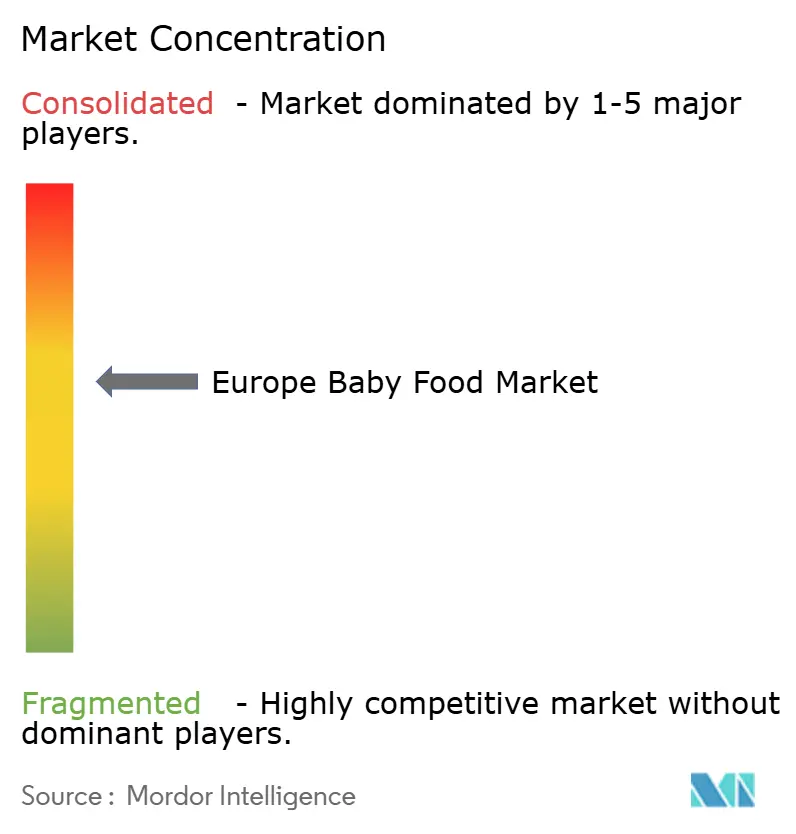
| Market Concentration | Medium |
Major Players *Disclaimer: Major Players sorted in no particular order Image © Mordor Intelligence. Reuse requires attribution under CC BY 4.0. | |
Europe Baby Food Market Analysis by Mordor Intelligence
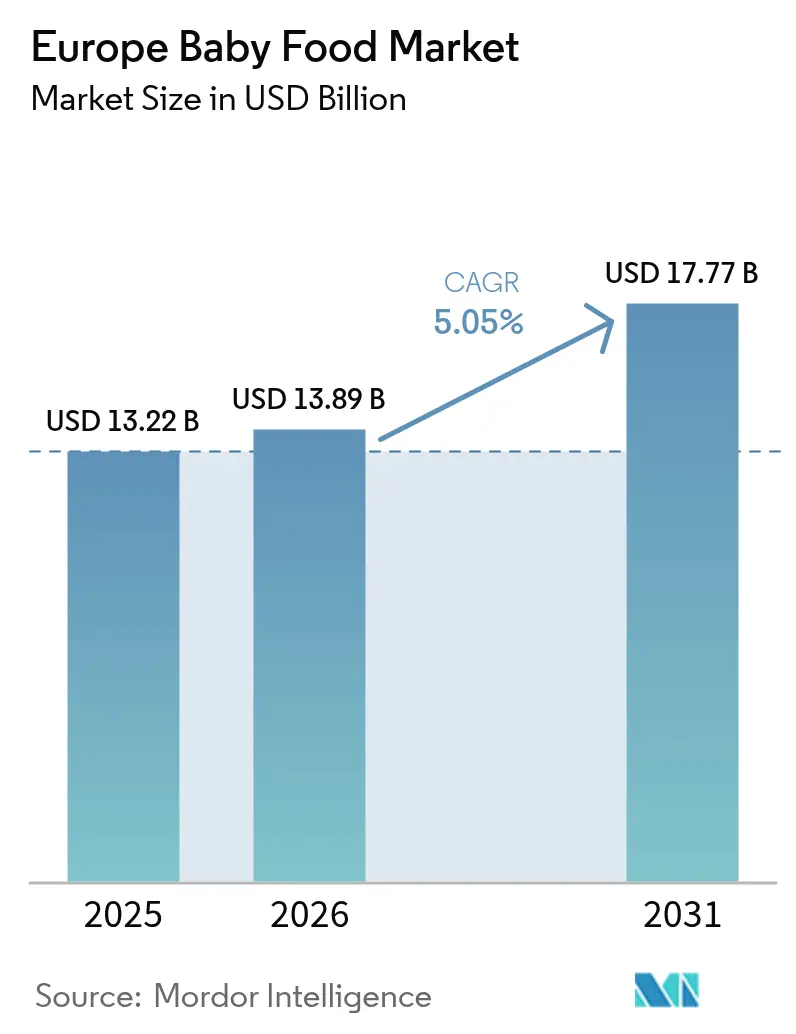
The Europe baby food market size is expected to grow from USD 13.22 billion in 2025 to USD 13.89 billion in 2026 and is forecast to reach USD 17.77 billion by 2031 at 5.05% CAGR over 2026-2031. This growth trajectory reflects the market's resilience despite demographic headwinds, with strategic shifts toward premium nutrition and functional ingredients offsetting volume pressures from declining birth rates across the region. In 2023, 3.67 million babies were born in the European Union[1]. The market continues to expand through value-driven premiumization and innovation in specialized nutrition segments.
Key Report Takeaways
- By product type, milk formula captured 73.58% of the Europe baby food market share in 2025, while prepared baby food is projected to advance at a 7.02% CAGR from 2026-2031.
- By category, conventional products accounted for 71.64% of 2025 revenue, whereas organic alternatives are poised to grow at 7.41% CAGR through 2031.
- By age group, products for infants below 6 months generated 51.92% of 2025 sales, and the 13-24 months cohort is expected to log a 6.87% CAGR in the forecast window.
- By distribution channel, supermarkets/hypermarkets led with 38.67% value in 2025, yet online retail is set for the fastest expansion at 7.22% CAGR to 2031.
- By geography, Germany held the largest 18.11% share of 2025 revenue, while Poland is forecast to register the highest 7.34% CAGR between 2026 and 2031.
Note: Market size and forecast figures in this report are generated using Mordor Intelligence’s proprietary estimation framework, updated with the latest available data and insights as of 2026.
Market Trends and Insights
Drivers Impact Analysis of Europe Baby Food Market*
| Driver | (~) % Impact on CAGR Forecast | Geographic Relevance | Impact Timeline |
|---|---|---|---|
| Rising number of working mothers and dual-income households | +1.2% | Germany, France, Netherlands, Sweden | Medium term (2-4 years) |
| Growing demand for organic and clean-label baby food | +1.8% | Germany, Netherlands, France, United Kingdom | Long term (≥ 4 years) |
| Functional ingredient innovation (DHA, probiotics, hypo-allergenic) | +1.5% | Global, with early adoption in Germany, Netherlands | Long term (≥ 4 years) |
| Influence of pediatric and medical guidance | +0.9% | Global, strongest in Germany, France, Netherlands | Medium term (2-4 years) |
| Rising parental health consciousness | +1.1% | Germany, Netherlands, Sweden, France | Medium term (2-4 years) |
| EU Green Deal incentives for eco-packaging and sustainable sourcing | +0.7% | EU-wide, strongest in Germany, Netherlands, France | Long term (≥ 4 years) |
| Source: Mordor Intelligence | |||
Rising Number of Working Mothers and Dual-Income Households
The transformation of European family structures drives sustained demand for convenient, nutritionally complete baby food solutions as maternal employment rates continue climbing across key markets. The EU Work-Life Balance Directive implementation has strengthened parental leave policies, yet the economic necessity for dual incomes persists, particularly in high-cost urban centers where housing expenses consume larger household budget shares. This demographic shift favors prepared baby food formats and premium convenience products that allow working parents to provide specialized nutrition without extensive meal preparation time. The trend accelerates in Nordic countries, where gender equality initiatives have normalized dual-career families, creating sustained market expansion opportunities for brands positioning around convenience without compromising nutritional integrity.
Growing Demand for Organic and Clean-Label Baby Food
European parents increasingly prioritize organic and clean-label formulations, driven by heightened awareness of agricultural practices and ingredient transparency following recent food safety incidents and environmental concerns. The EU's target of achieving 25% organic farmland by 2030, currently at approximately 11%, creates supply chain momentum supporting organic baby food expansion[2]. Clean-label positioning resonates particularly strongly in Germany and Netherlands, where consumer research indicates parents scrutinize ingredient lists more intensively for baby products than any other food category. This trend intersects with regulatory developments, as EFSA continues updating guidelines on acceptable additives and processing aids in infant nutrition, creating competitive advantages for manufacturers investing early in clean-label reformulations. The organic premium pricing model remains viable despite inflationary pressures, as parents demonstrate willingness to prioritize perceived safety and environmental benefits for infant nutrition over cost considerations.
Functional Ingredient Innovation (DHA, Probiotics, Hypo-allergenic)
Advanced nutritional science drives market premiumization through functional ingredients that address specific developmental needs, with human milk oligosaccharides (HMOs) and targeted probiotic strains leading innovation cycles. Nestlé's NAN Sinergity formula incorporates 6 different HMOs, while dsm-firmenich partnerships with Lallemand Health Solutions focus on early-life synbiotics combining probiotics with prebiotic HMOs. Clinical evidence supporting specific probiotic strains like Bifidobacterium longum subsp. infantis M-63 for HMO utilization and infant gut health development provides manufacturers with substantiated health claims for premium positioning. The regulatory pathway for novel functional ingredients remains rigorous under EFSA evaluation protocols, creating barriers to entry that favor established players with robust R&D capabilities and clinical trial infrastructure. Innovation focus shifts toward personalized nutrition approaches, with emerging research on genetic variations affecting nutrient metabolism potentially enabling customized formulation strategies for different infant populations.
Influence of Pediatric and Medical Guidance
Healthcare professional recommendations significantly shape parent purchasing decisions, with ESPGHAN, EFSA, and WHO Europe guidelines establishing evidence-based frameworks that influence product development and marketing strategies. Recent ESPGHAN recommendations emphasize complementary feeding timing between 4-6 months, iron-rich food introduction, and systematic allergen exposure protocols, creating market opportunities for products aligned with these clinical guidelines. Pediatric guidance increasingly emphasizes texture progression and self-feeding development, supporting growth in finger foods and age-appropriate consistency variations that traditional pureed formats cannot address. The medical community's growing recognition of early nutrition's impact on long-term health outcomes strengthens the scientific foundation for premium pricing and specialized formulations targeting specific developmental windows. Healthcare professional education programs by manufacturers create indirect marketing channels while building clinical credibility for evidence-based product positioning.
Restraints Impact Analysis of Europe Baby Food Market*
| Restraint | (~) % Impact on CAGR Forecast | Geographic Relevance | Impact Timeline |
|---|---|---|---|
| Declining birth rates across Europe | -2.1% | EU-wide, strongest impact in Germany, Italy, Spain | Short term (≤ 2 years) |
| Stringent EU regulation and marketing code for infant formula | -0.8% | EU-wide, particularly affecting new market entrants | Medium term (2-4 years) |
| Climate-driven raw-material volatility for organic inputs | -0.6% | EU-wide, strongest in organic segment | Medium term (2-4 years) |
| Rise of home-made baby-led-weaning solutions | -0.4% | United Kingdom, Germany, Netherlands, Poland | Short term (≤ 2 years) |
| Source: Mordor Intelligence | |||
Declining Birth Rates Across Europe
European fertility rates reached historic lows in 2023, with total births declining 5.4% to 3.67 million across EU member states, creating structural headwinds for volume-based growth strategies in infant nutrition categories[3]. The fertility rate dropped to 1.38 children per woman, well below the 2.1 replacement level, with particularly steep declines in traditional high-birth-rate countries like Poland and Czech Republic. This demographic transition forces manufacturers to pursue value-over-volume strategies, emphasizing premium positioning and extended usage periods rather than market share expansion through broader consumer base growth. Economic uncertainty, housing affordability crises, and career prioritization among millennials compound the fertility decline, creating long-term structural challenges that require strategic pivots toward premiumization and international expansion to maintain revenue growth trajectories.
Stringent EU Regulation and Marketing Code for Infant Formula
Comprehensive regulatory frameworks governing infant formula composition, labeling, and marketing create significant compliance costs and market entry barriers, particularly affecting smaller manufacturers and new product categories. EU Regulation 609/2013 and Delegated Regulation 2016/127 establish detailed compositional requirements for infant formula, while marketing restrictions limit promotional activities for products intended for children under 12 months. Recent EFSA evaluations of novel ingredients like HMOs require extensive clinical documentation and safety assessments, creating regulatory lag times that can exceed 24 months for innovative formulations. The regulatory complexity favors established multinational companies with dedicated regulatory affairs capabilities while constraining innovation speed and market responsiveness for emerging players seeking to introduce differentiated products.
*Our forecasts treat driver/restraint impacts as directional, not additive. The impact forecasts reflect baseline growth, mix effects, and variable interactions.
Europe Baby Food Market Segment Analysis
By Product Type:
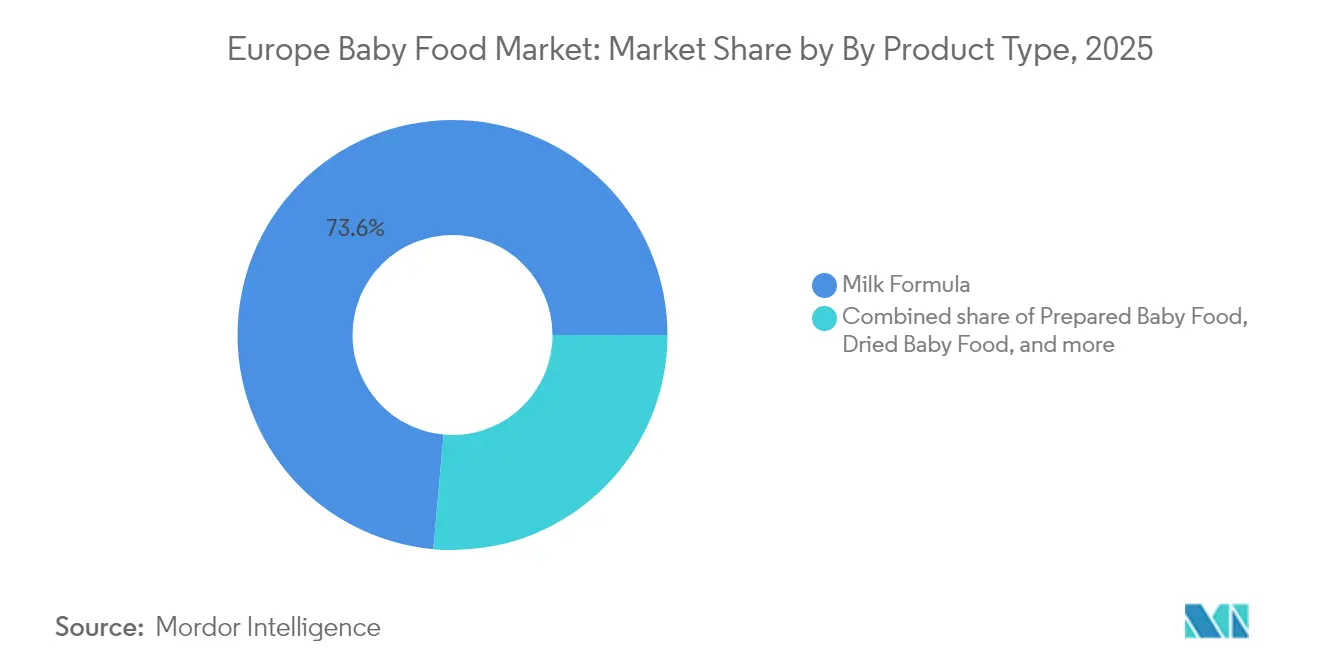
Formula Dominance Drives PremiumizationMilk formula maintains commanding market leadership with 73.58% share in 2025, yet prepared baby food emerges as the fastest-growing segment with 7.02% CAGR from 2026-2031, reflecting shifting consumer preferences toward convenience and variety in infant nutrition. The prepared baby food segment capitalizes on dual-income household time constraints and premiumization trends, with organic and clean-label variants commanding premium pricing despite inflationary pressures across European markets.
Dried baby food maintains a steady market presence through cost-effectiveness and extended shelf life advantages, particularly appealing to price-conscious consumers and bulk purchasing patterns. Innovation within the milk formula category focuses on functional ingredients like HMOs and targeted probiotic strains, with clinical evidence supporting cognitive development and immune system benefits driving premium positioning strategies. The segment's evolution toward personalized nutrition approaches reflects broader healthcare trends emphasizing individualized dietary interventions based on genetic and developmental factors.

By Category:
Organic Acceleration Outpaces Conventional GrowthThe conventional baby food category holds 71.64% market share in 2025, yet organic alternatives demonstrate superior growth momentum with 7.41% CAGR from 2026-2031, indicating accelerating consumer preference shifts toward perceived cleaner and more sustainable nutrition options. Organic positioning benefits from EU agricultural policy support targeting 25% organic farmland by 2030, creating supply chain infrastructure that supports ingredient availability and cost competitiveness over time. Premium pricing strategies for organic products remain viable despite economic pressures, as parents demonstrate willingness to prioritize perceived safety and environmental benefits for infant nutrition over cost considerations.
Conventional products maintain market leadership through established distribution relationships and price accessibility, yet face increasing pressure to adopt clean-label formulations and sustainable packaging to compete with organic alternatives. The category boundary blurs as conventional manufacturers incorporate organic ingredients selectively while maintaining cost-competitive positioning through hybrid approaches. Regulatory frameworks under EU organic certification standards create quality differentiation opportunities while establishing consumer trust through third-party verification systems that support premium pricing strategies.
By Age Group:
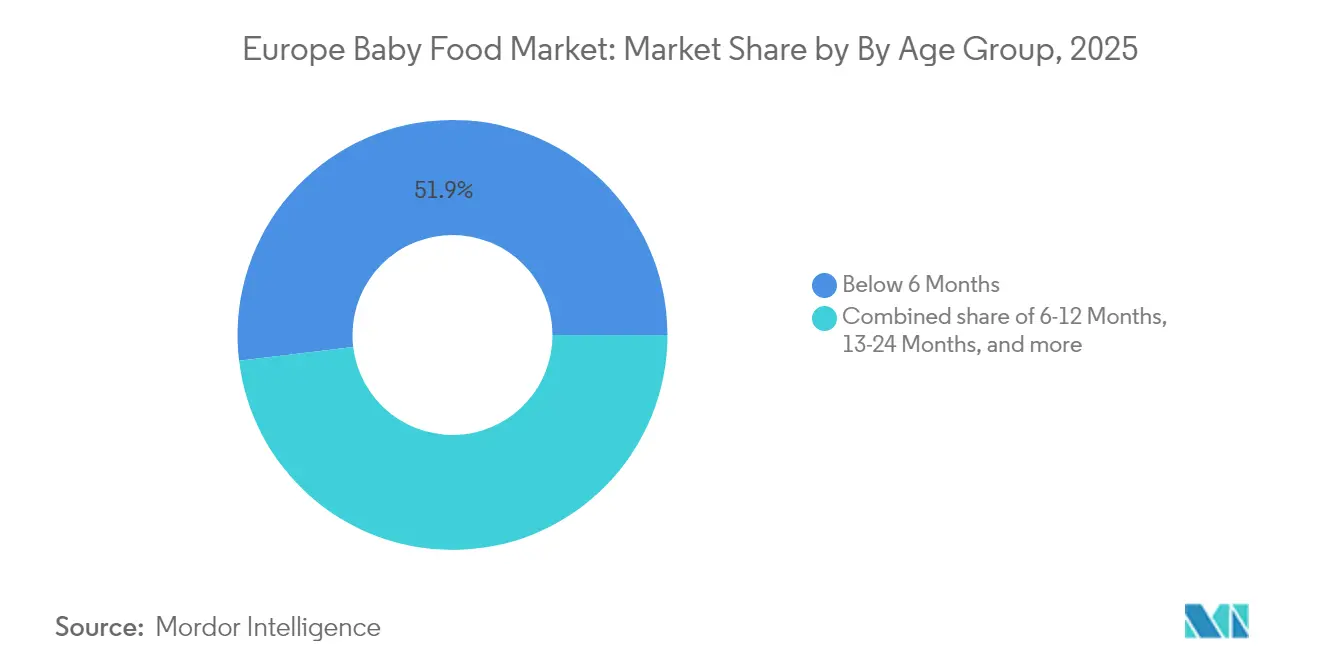
Extended Nutrition Windows Drive GrowthProducts for infants below 6 months represent 51.92% of market share in 2025, reflecting the critical importance of early nutrition during exclusive milk feeding periods, while the 13-24 months category demonstrates the highest growth potential with 6.87% CAGR from 2026-2031. This growth pattern indicates parents increasingly extend specialized nutrition beyond traditional weaning timelines, creating opportunities for age-specific formulations targeting developmental milestones. The 6-12 months segment benefits from complementary feeding introduction guidelines established by ESPGHAN and WHO Europe, emphasizing iron-rich foods and systematic allergen exposure protocols that support specialized product development.
The 25+ months category captures parents seeking continued nutritional insurance as toddlers transition to family foods, with growing-up milks and fortified snacks addressing perceived nutritional gaps in diverse diets. Age-based segmentation strategies enable targeted marketing approaches addressing specific developmental concerns, from cognitive development support in early months to independence-building finger foods for older toddlers. Clinical research supporting age-specific nutritional requirements provides a scientific foundation for premium positioning and specialized formulation strategies that justify higher price points across extended feeding periods.
By Distribution Channel:
Digital Transformation AcceleratesSupermarkets/hypermarkets maintain distribution leadership with 38.67% market share in 2025, leveraging established consumer shopping patterns and product visibility advantages, while online retail stores demonstrate the fastest growth at 7.22% CAGR from 2026-2031. Supermarkets/hypermarkets' leadership position stems from well-established consumer shopping patterns, extensive product assortments, and strategic in-store product placement that maximizes visibility. These traditional retail formats continue to benefit from their ability to offer immediate product availability and tactile shopping experiences. Moreover, online channels enable subscription models and personalized product recommendations that increase customer lifetime value while reducing acquisition costs for specialized brands.
Pharmacies and drugstores maintain important roles in premium and specialty product distribution, particularly for hypoallergenic and medical nutrition categories where healthcare professional recommendations influence purchasing decisions. Convenience stores capture impulse purchases and emergency restocking needs, though limited shelf space constrains assortment breadth compared to larger format retailers. The distribution landscape evolves toward omnichannel integration, with successful brands developing coherent strategies across physical and digital touchpoints while leveraging retail media opportunities for targeted consumer engagement.
Geography Analysis
Germany Baby Food Market
Germany's market leadership position with 18.11% share in 2025 reflects the country's robust economic fundamentals and deeply embedded organic food culture that extends naturally to infant nutrition categories. German consumers demonstrate exceptional willingness to pay premium prices for perceived quality and safety benefits, with organic baby food penetration rates significantly exceeding European averages. The regulatory environment supports innovation through efficient EFSA coordination and an established clinical research infrastructure that enables rapid product development cycles.
Poland Baby Food Market
Poland's exceptional 7.34% CAGR growth from 2026-2031 represents the most dynamic expansion opportunity within European markets, driven by unique demographic factors and accelerating premiumization trends among rising middle-class consumers. Polish consumers increasingly embrace Western European feeding practices and premium nutrition concepts, creating market expansion opportunities for established brands seeking growth beyond mature home markets. The retail infrastructure rapidly modernizes, with international hypermarket chains and emerging e-commerce platforms providing distribution access for specialized baby food categories previously unavailable in the market.
Broader European Markets
The United Kingdom, Italy, France, Spain, and Netherlands collectively represent mature markets requiring innovation-driven differentiation strategies to capture incremental growth beyond demographic constraints. These markets demonstrate established brand loyalties and sophisticated distribution networks that create barriers to entry for new players while rewarding sustained investment in product development and consumer education. Regional preferences vary significantly, with Mediterranean markets showing stronger retention of traditional feeding practices that affect prepared food acceptance rates, while Nordic countries demonstrate higher organic adoption and functional ingredient appreciation.
Regulatory Landscape
The Europe baby food market operates under the EU framework for foods for infants and young children, anchored by Regulation (EU) No 609/2013, which sets overarching compositional and labeling requirements across categories including infant formula and baby foods. For infant formula specifically, Commission Delegated Regulation (EU) 2016/127 defines detailed compositional and labeling rules, shaping product development, claims substantiation, and packaging content across EU member states. Regulatory updates in 2025 and 2026 tightened technical criteria for specialized formulations using protein hydrolysates; Commission Delegated Regulation (EU) 2025/2017 issued 8 October 2025 amended 2016/127 to align with an EFSA opinion (November 2024), followed by Commission Delegated Regulation (EU) 2026/743 issued 30 March 2026, which further refined protein-related requirements for infant and follow-on formula manufactured from protein hydrolysates. In parallel, processed cereal-based foods and baby foods remain subject to dedicated EU safety provisions such as pesticide control requirements under Commission Directive 2006/125/EC, reinforcing a high-compliance operating environment for both established manufacturers and new entrants.
Competitive Landscape
The European baby food market exhibits moderate concentration, indicating balanced competitive dynamics where established multinational players compete alongside regional specialists and emerging premium brands. Strategic patterns emphasize innovation in functional ingredients, with major players investing heavily in HMO technology, targeted probiotic strains, and clean-label formulations to justify premium positioning despite demographic headwinds. Nestlé's introduction of NAN Sinergity with 6 different HMOs exemplifies the science-driven differentiation approach.
Technology adoption focuses on personalized nutrition platforms and direct-to-consumer subscription models that increase customer lifetime value while reducing traditional retail dependencies. White-space opportunities emerge in specialized nutrition categories targeting specific dietary needs, environmental sustainability positioning, and digital-native brand development that bypasses traditional distribution constraints.
Emerging disruptors leverage e-commerce platforms and social media marketing to build direct relationships with millennial parents seeking transparency and ingredient education beyond traditional marketing approaches. The regulatory environment under EFSA guidelines creates both barriers and opportunities, favoring companies with robust clinical research capabilities while constraining rapid market entry for innovative formulations requiring extensive safety documentation.
Europe Baby Food Industry Leaders
-
Nestlé SA
-
Danone SA
-
Reckitt
-
Abbott Laboratories
- *Disclaimer: Major Players sorted in no particular order
Europe Baby Food Market Companies Covered in this Report
- Nestlé SA
- Danone SA
- Reckitt
- Abbott Laboratories
- HiPP GmbH
- Hero Group AG / Organix Brands
- Kraft Heinz Co.
- FrieslandCampina N.V.
- Arla Foods amba
- Bellamy’s Organic
- Holle baby food GmbH
- Kendal Nutricare Ltd
- DMK Deutsches Milchkontor GmbH
- Dana Dairy Group Ltd
- Ella’s Kitchen (Hain Celestial)
- Oliver’s Cupboard Brand Ltd
- Bubs Australia Ltd
- Topfer GmbH
- Perrigo Co. plc (Aptamil Store brands)
- Ausnutria Dairy Corp.
Market Opportunities and Future Outlook
The EU rule set for infant and follow-on formula (Regulation (EU) No 609/2013) and the De delegated Regulation (EU) 2016/127, along with category safety constraints under Directive 2006/125/EC, reward manufacturers with strong regulatory affairs, traceability, and ingredient qualification processes. This creates whitespace for EFSA-aligned ingredient dossiers (for functional additions such as prebiotics, postbiotics, or other substantiated components) and translates compliance into trust-led positioning, particularly in pharmacy and digital channels where parents scrutinize product claims and ingredient lists. Portfolio and footprint reshaping is increasingly enabling brands that can combine scale manufacturing with premium positioning in prepared foods and specialized nutrition, supported by integrated European production assets and the ability to serve multiple baby food formats while maintaining compliance with EU requirements.
Recent Industry Developments in Europe Baby Food Market
- June 2026: Reckitt announced the completion of its acquisition of Mead Johnson Nutrition Company. The deal adds infant and child nutrition powerbrands such as Enfa and Nutramigen, expanding Reckitts scale and portfolio depth in early life nutrition, with implications for competition and brand investment across European baby nutrition channels.
- April 2026: Danone issued a targeted recall for specific infant formula batches. The action highlighted the importance of batch-level traceability and quality management in maintaining retailer continuity and caregiver trust in regulated infant nutrition categories.
- February 2026: Nestle widened its infant formula recall for specific batches after the European Union requested new toxin analysis. This development showed how regulator-driven testing requirements can rapidly affect product availability and compliance workflows across supply chains serving European markets.
Europe Baby Food Market Report Scope and Research Methodology
Market Definition and Coverage
For this study, the Europe baby food market is defined as packaged, commercially sold nutrition products meant for infants and young children, across formula and complementary feeding items that are bought through retail and online channels in European countries.
Scope exclusions: This sizing excludes homemade baby meals and informal, unbranded foods, and it also excludes supplements or medicines that are not sold as baby food.
Segments Covered in This Report
- By Product Type
- Milk Formula
- Standard Formula
- Follow-on Formula
- Growing-Up Formula
- Specialty Formula
- Prepared Baby Food
- Dried Baby Food
- Other Baby Food
- Milk Formula
- By Category
- Conventional
- Organic
- BY Age Group
- Below 6 Months
- 6–12 Months
- 13–24 Months
- 25 Months +
- By Distribution Channel
- Supermarkets/Hypermarkets
- Pharmacies and Drugstores
- Convenience Stores
- Online Retail Stores
- Other Distribution Channels
- By Geography
- Germany
- United Kingdom
- Italy
- France
- Spain
- Netherlands
- Poland
- Belgium
- Sweden
- Rest of Europe
Data Sources, Market Sizing, and Validation
Desk Research
Desk work starts with building the basic demand and supply picture using public data that can be checked by anyone. For Europe, we typically pull demographic and birth trend series from sources such as Eurostat, then cross-check food category signals through sources such as FAOSTAT and national statistics offices.
To keep definitions consistent, we also refer to public materials and guidance, such as European Commission publications, EFSA related updates on infant and young child nutrition, and customs or trade statistics portals where relevant for packaged food flows. Company annual reports, investor presentations, and credible press coverage are used to understand category mix shifts, pricing behavior, and channel expansion. In a few cases, paid subscriptions for company financials and news intelligence, patent databases, and shipment-level import and export views are used to pressure-test assumptions. These examples are not exhaustive, and many other public references were reviewed to collect data, validate it, and clarify open questions.
Primary Interviews and Surveys
Primary work is used to check what the numbers mean in practice, especially around how much formula versus complementary foods are being sold, how pricing is moving, and which channels are gaining share by country. We speak with a mix of manufacturers, distributors, retailers, and category specialists across Europe so that desk assumptions can be adjusted by what respondents see at the shelf and in ordering behavior, and then the final model can be aligned to real buying patterns and packaging formats.
Distribution of primary research fieldwork respondents
| Company type | Respondent position |
|---|---|
| Top tier: 32% | CXOs: 13% |
| Mid tier: 50% | Functional/Unit leaders: 27% |
| Smaller Players: 18% | Managers: 60% |
Market-Sizing & Forecasting
The core model starts from a top-down demand reconstruction, where country level infant population, births, and age cohort counts are translated into expected consumption pools for infant formula and complementary foods, and then converted into value using realistic price bands by channel. Once that picture is built, it is checked with selective bottom-up approximations such as sampled brand and retailer shelf prices, channel checks on volume movement, and a limited roll-up of supplier revenue exposure to Europe. Totals are then adjusted if the gaps remain persistent.
Inputs are kept practical and market specific, so the model uses variables such as live births and the under-3 population by country, breastfeeding and formula feeding patterns where public health data is available, the pace of pouch and ready-to-eat adoption, online retail penetration for baby food, and observed unit price inflation for packaged foods. Where data is thin for smaller countries, ratios are borrowed from similar markets using income level and modern trade penetration as the filters, then re-reviewed during interviews.
For forecasting, scenario analysis is used to reflect different birth-rate paths and price trajectories, and the chosen path is anchored to what interviewees see in near-term demand and promotion intensity. Growth is then distributed by product groups and channels so the final forecast remains consistent with how parents buy across Europe.
Data Validation & Update Cycle
Validation is done through multiple passes, not in one step, because the biggest errors usually come from mismatched scope or one-off pricing assumptions. We compare the model outputs against independent signals such as demographic trends, packaged food inflation indicators, and the direction of category mix changes reported in public filings, and any outliers are flagged for a second review.
If a country total looks too high or too low versus these checks, the assumptions are reopened and the interview list is extended for that topic until the variance is understood. Before sign-off, another analyst reviews the calculations and the logic chain so the steps can be repeated. The report is refreshed annually, and interim updates are made when material events affect pricing, regulation, or consumer buying behavior, followed by a final pre-delivery pass to ensure the latest view is reflected.
Mordor Intelligence's Europe Baby Food Market Estimate Compared With Other Published Estimates
Published market sizes for Europe baby food can look far apart even when the topic label is the same, because the counted products and the time base are not always aligned. Differences usually come from what age band is included, whether infant formula is treated as part of baby food, and how retail pricing and inflation are carried into the current year.
Birth trends, under-3 population checks, and channel level price points are the evidence used to anchor the Mordor Intelligence estimate at USD 13.22 B (2025), because those signals keep the value tied to realistic consumption rather than a broad packaged food spend pool.
Benchmark comparison
| Source | Market Size | Gaps in Research Methodology |
|---|---|---|
| Mordor Intelligence | USD 13.22 B (2025) | |
| Industry Publisher A | USD 24.42 B (2025) | Uses a wider toddler definition (birth to 36 months) and can capture adjacent toddler foods and snacks more aggressively, which lifts the total even before any pricing differences are applied. |
| Global Publisher B | USD 18.48 B (2024) | Anchors on an earlier year and may apply broader product mapping for baby cereals and prepared foods across Europe, which can raise value when converted into a single regional total. |
The comparison shows that the spread is mainly explained by age coverage and how strictly product boundaries are applied, followed by timing and price conversion choices. By keeping the scope tied to clear baby food definitions and checking totals against demographic and channel signals, the final number stays traceable to inputs that a buyer can follow and recheck.
Key Questions Answered in the Report
How large is the Europe baby food market?
It is valued at USD 13.89 billion in 2026 and is projected to reach USD 17.77 billion by 2031.
Which product type holds the biggest share across Europe?
Milk formula commands 73.58% of 2025 sales, led by specialty and follow-on variants.
What is driving the shift toward organic baby food?
EU policy support for organic agriculture and parental concern over pesticide exposure are propelling organic SKUs at a 7.41% CAGR.
Which distribution channel is expanding quickest?
Online retail is growing 7.22% per year due to subscription models and doorstep convenience.