
Market Overview
| Study Period | 2020 - 2031 |
|---|---|
| Forecast Data Period | 2026 - 2031 |
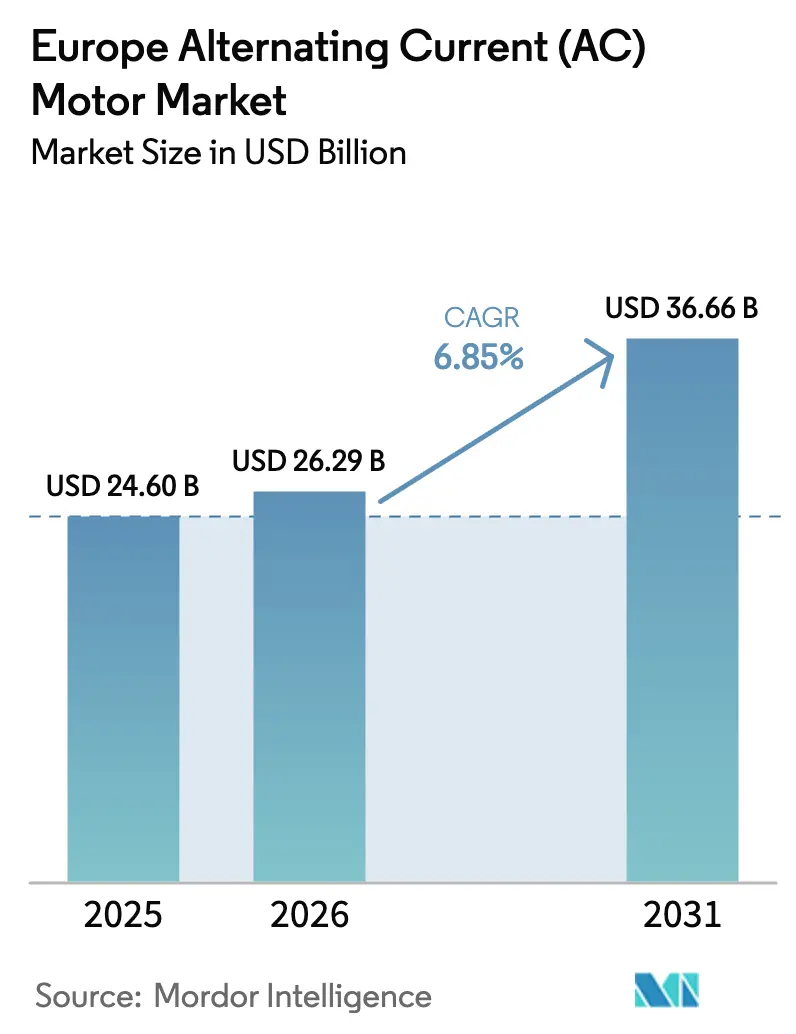
| Base Year Market Size (2025) | USD 24.6 Billion |
| Market Size (2026) | USD 26.29 Billion |
| Market Size (2031) | USD 36.66 Billion |
| Growth Rate (2026 - 2031) | 6.85 % |
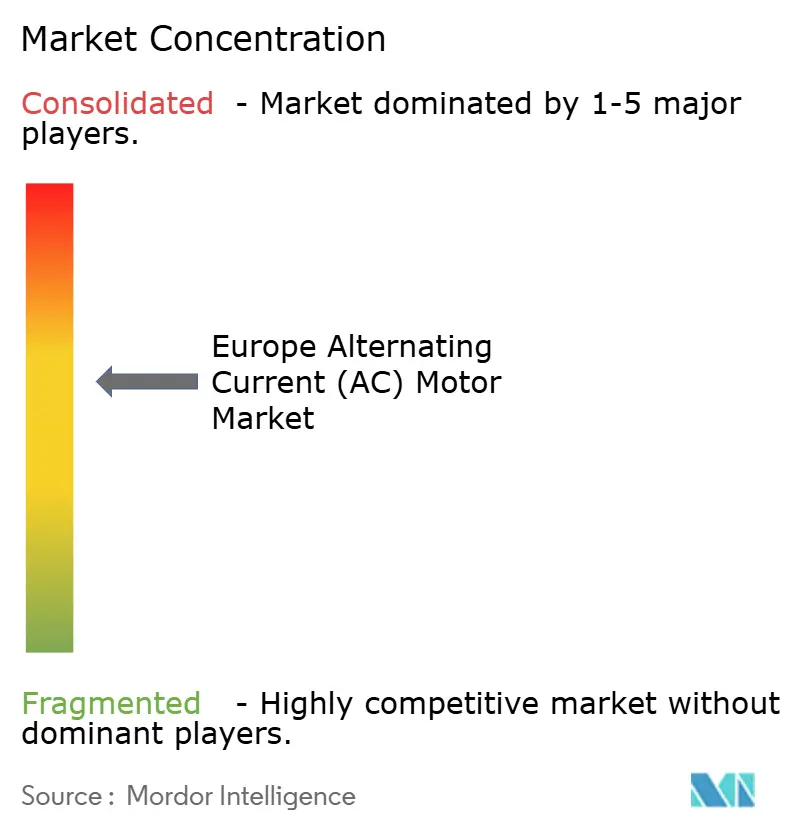
| Market Concentration | Medium |
Major Players *Disclaimer: Major Players sorted in no particular order Image © Mordor Intelligence. Reuse requires attribution under CC BY 4.0. | |
Europe Alternating Current (AC) Motor Market Analysis by Mordor Intelligence
The Europe alternating current motor market size is expected to grow from USD 24.6 billion in 2025 to USD 26.29 billion in 2026 and is forecast to reach USD 36.66 billion by 2031 at 6.85% CAGR over 2026-2031. This trajectory reflects the convergence of stringent EU energy-efficiency mandates, the reshoring of sophisticated manufacturing, and capital spending on hydrogen and renewable infrastructure. Manufacturers are prioritizing IE3-plus efficiency classes, integrating sensors that feed plant-wide IoT platforms, and redesigning drive packages to lower installation complexity amid tight labor markets. At the same time, large electrolyzer projects, district energy schemes, and medium-voltage retrofits are broadening demand beyond the traditional pump-fan-compressor core of the Europe alternating current motor market. Competitive dynamics remain moderate as global majors leverage integrated motor-drive offerings while regional specialists exploit application depth to defend share against price-led imports.
Key Report Takeaways
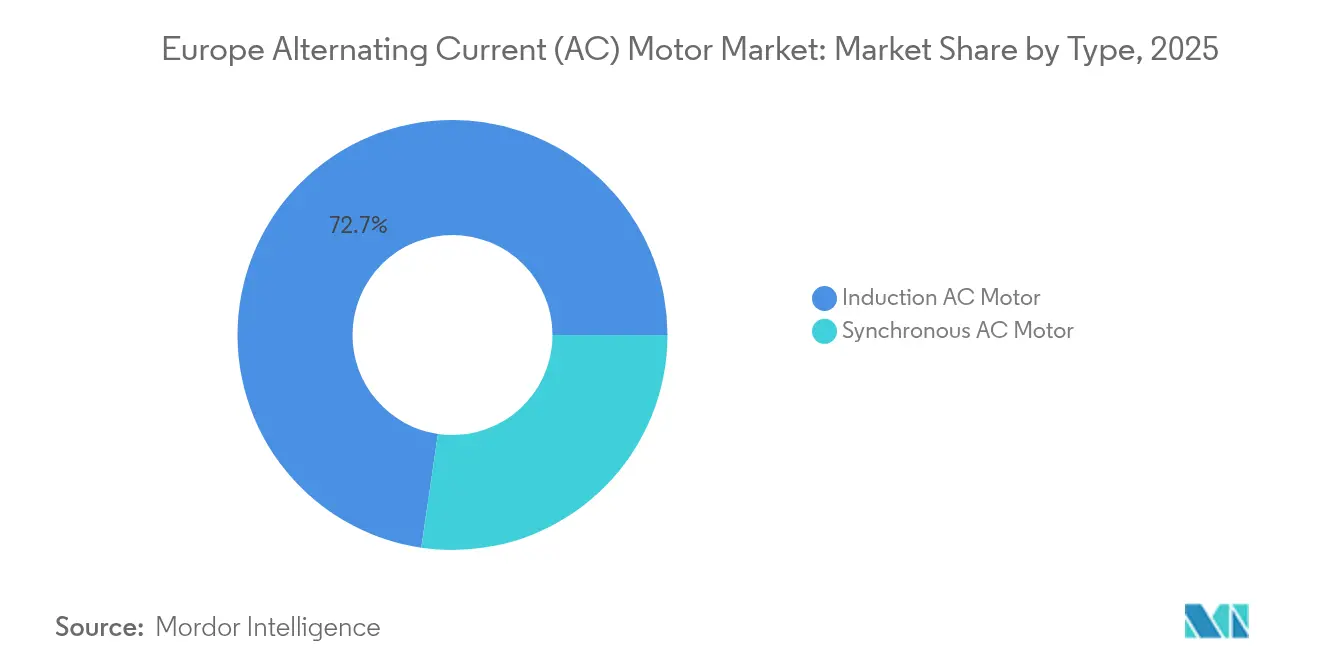
- By type, induction designs led with a 72.68% share of the European alternating current motor market in 2025, whereas synchronous designs are advancing at a 8.67% CAGR through 2031.
- By power rating, sub-1 kW units accounted for 37.02% of the Europe alternating current motor market size in 2025, while the 101-500 kW band is forecast to grow at an 8.29% CAGR.
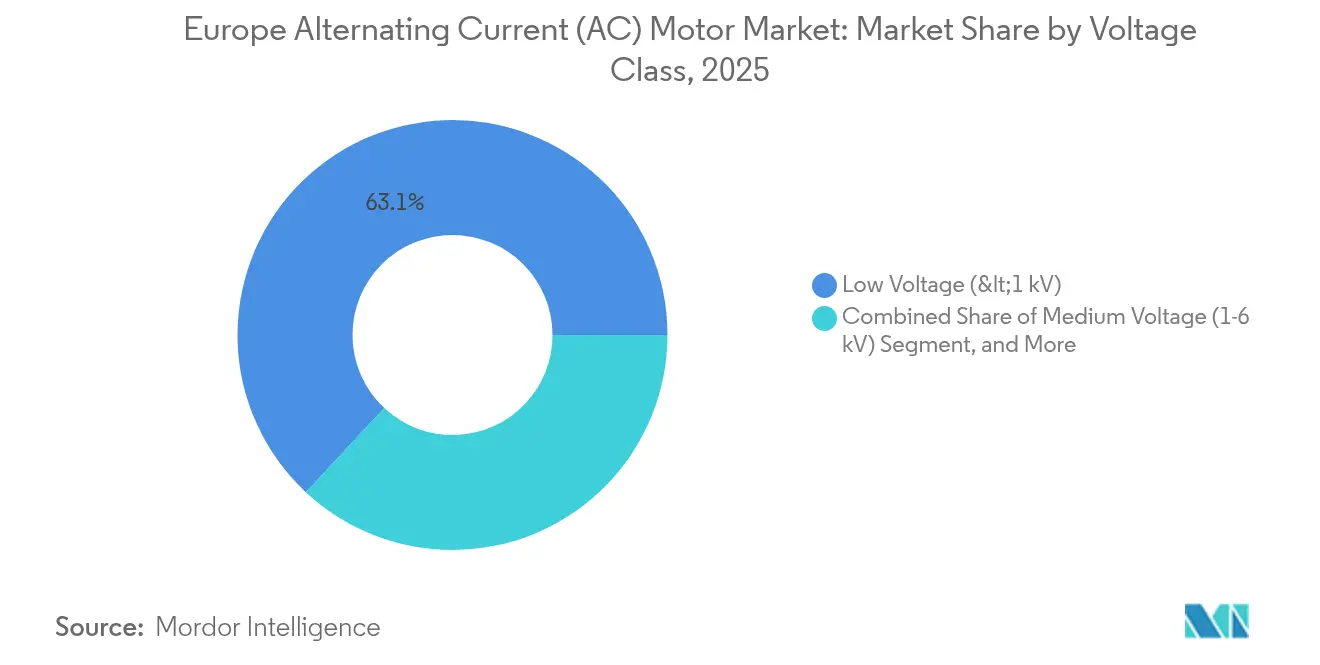
- By voltage class, low-voltage units below 1 kV held 63.05% revenue share in 2025, and medium-voltage units between 1-6 kV are on track for an 8.44% CAGR.
- By end-user industry, discrete manufacturing captured 23.35% revenue share in 2025, while water and wastewater applications are projected to expand at a 7.12% CAGR.
- By geography, Germany accounted for 26.10% of 2025 revenues, whereas Italy is projected to have the fastest growth rate of 7.42% from 2025 to 2031.
Note: Market size and forecast figures in this report are generated using Mordor Intelligence’s proprietary estimation framework, updated with the latest available data and insights as of 2026.
Market Trends and Insights
Drivers Impact Analysis of Europe Alternating Current (AC) Motor Market*
| Driver | (~) % Impact on CAGR Forecast | Geographic Relevance | Impact Timeline |
|---|---|---|---|
| Accelerating industrial automation and IoT adoption | +1.5% | Germany, Netherlands, Nordic countries | Medium term (2-4 years) |
| Stringent energy-efficiency regulations for electric motors | +1.2% | EU-wide, United Kingdom alignment | Short term (≤ 2 years) |
| Expansion of HVAC and refrigeration infrastructure | +0.9% | Southern Europe urban centers | Medium term (2-4 years) |
| Revival of automotive manufacturing and EV powertrain demand | +0.8% | Germany, France, Eastern Europe | Long term (≥ 4 years) |
| Growing adoption of high-frequency spindle motors in machine-tool re-shoring | +0.6% | Germany, Italy, Switzerland | Medium term (2-4 years) |
| Emergence of hydrogen electrolyzer projects needing large synchronous motors | +0.4% | Netherlands, Germany, Scandinavia | Long term (≥ 4 years) |
| Source: Mordor Intelligence | |||
Accelerating Industrial Automation and IoT Adoption
European factories are incorporating smart drives that collect data on vibration, temperature, and load to enable predictive maintenance and optimize line changeovers. Early projects report double-digit energy savings and sub-four-year paybacks as asset performance systems shift from fixed-speed to variable-speed regimes supported by edge computing nodes. German automotive suppliers have led pilot deployments, specifying Ethernet-ready IE5 platforms that publish diagnostic tags directly to manufacturing execution systems for real-time quality loops. The Europe alternating current motor market benefits from the resulting replacement cycle for legacy induction units with sensor-rich, firmware-upgradable models. Tier-one vendors are responding with subscription-based analytics modules that bundle hardware, firmware, and artificial-intelligence monitoring in a single service contract.[1]ABB Ltd., “ABB Drives Highlights and References,” abb.com
Stringent Energy-Efficiency Regulations for Electric Motors
EU Regulation 2019/1781 elevated the minimum requirement for three-phase motors above 0.75 kW to IE3 and extended coverage to submersible and close-coupled configurations. Penalties for non-compliance, enforced through national surveillance authorities, have accelerated retrofit programs across chemical, food, and building services sites. Suppliers now differentiate on IE4 and IE5 lines marketed as “future-proof,” while installers promote pay-per-savings contracting that sidesteps upfront capital hurdles. Certification-ready testing labs offer fast-track conformity assessments, giving domestically rooted brands an edge in the Europe alternating current motor market.[2]European Commission, “Commission Regulation (EU) 2019/1781 of 1 October 2019 laying down ecodesign requirements for electric motors and variable speed drives,” eur-lex.europa.eu
Expansion of HVAC and Refrigeration Infrastructure
Heat-pump sales surged after national decarbonization incentives tied to the REPowerEU plan, lifting demand for electronically commutated motors that maintain a high coefficient of performance across variable ambient temperatures. Supermarkets replacing hydrofluorocarbon systems with transcritical CO₂ racks deploy permanent-magnet drive compressors, each requiring precise speed modulation to meet food safety regulations while trimming electricity bills. Urban district-cooling schemes in southern capitals are specifying multi-megawatt synchronous machines paired with harmonic-free medium-voltage drives to compress chilled water at scale. These trends collectively reinforce mid-range growth in the Europe alternating current motor market.[3]Danfoss A/S, “How a new water pumping station keeps supply flowing in Bern,” danfoss.com
Revival of Automotive Manufacturing and EV Powertrain Demand
Battery-cell, module, and drivetrain plants reshored from Asia are equipping robotic stations with low-inertia motors that achieve micron-level positioning repeatability. Clean-room protocols demand sealed housings and integrated encoders, nudging customers toward premium synchronous architectures. Assembly lines for next-generation electric vehicles require high-torque servo packages to manage heavier battery packs without sacrificing takt time, stimulating value-added sales above conventional induction offerings. Charging-infrastructure OEMs simultaneously source forced-cooling motors for 350 kW DC fast-charge cabinets, thereby expanding the total addressable market for suppliers that can certify to both ATEX and automotive functional safety standards.
Restraints Impact Analysis of Europe Alternating Current (AC) Motor Market*
| Restraint | (~) % Impact on CAGR Forecast | Geographic Relevance | Impact Timeline |
|---|---|---|---|
| High initial procurement and installation costs | -0.7% | Price-sensitive markets, SME segment | Short term (≤ 2 years) |
| Rising raw-material price volatility (copper, rare earths) | -0.5% | EU-wide, import-dependent regions | Medium term (2-4 years) |
| Competitive pressure from permanent-magnet DC and servo drives | -0.4% | Precision applications, robotics | Medium term (2-4 years) |
| Supply chain tightness in insulated lamination steel | -0.3% | Manufacturing hubs, OEM suppliers | Short term (≤ 2 years) |
| Source: Mordor Intelligence | |||
High Initial Procurement and Installation Costs
Premium IE4-plus motors cost 20-40% more than standard units, and the prerequisite variable-frequency drives can double a project’s hardware bill. Retrofitting drives often necessitate switchboard upgrades, harmonic filters, and mechanical realignment, which can stretch payback models for small enterprises operating on tight margins. Energy-performance contracting mitigates sticker shock by spreading payments across multiple savings streams, but adoption remains uneven outside blue-chip industries. Until financing models mature, upfront economics will temper the pace at which the Europe alternating current motor market converts its installed base.
Rising Raw-Material Price Volatility (Copper, Rare Earths)
Windings account for a sizable share of motor manufacturing cost, leaving producers exposed to swings in copper prices exacerbated by global electrification programs. Permanent-magnet synchronous designs enhance sensitivity to the supply of neodymium and dysprosium, which is dominated by a narrow set of producers. Design engineers are trialing ferrite hybrid topologies and copper-alloy substitutes, but performance or tooling trade-offs persist. Periods of raw-material inflation therefore compress margins, elevate selling prices, and prompt some buyers to delay procurement cycles, suppressing near-term shipments in the Europe alternating current motor market.
*Our forecasts treat driver/restraint impacts as directional, not additive. The impact forecasts reflect baseline growth, mix effects, and variable interactions.
Europe Alternating Current (AC) Motor Market Segment Analysis
By Type:
Synchronous Motors, Advance Premium ApplicationsSynchronous units controlled 27.32% of 2025 revenue yet are forecast for the highest 8.67% CAGR because precise torque response, low acoustic signature, and rising spindle-speed requirements outweigh higher capital costs in machine-tool, hydrogen, and HVAC drives. Integrated motor-drive packages that auto-tune power factors boost line-level efficiency and enable full-torque zero-speed starts that induction machines cannot match.
Induction units defend baseline duties such as fans, pumps, and conveyors thanks to their ruggedness and commoditized repair ecosystem. However, regulatory tightening, combined with predictive-maintenance preferences, is steadily redirecting orders to synchronous alternatives in the Europe alternating current motor market. ABB’s MV Titanium concept, which embeds a medium-voltage inverter within the motor frame, illustrates how synchronous architectures are converging mechanical and electronic components to lower total ownership cost.



By Power Rating:
Industrial Electrification Drives Higher Power DemandSub-1 kW models dominate the volumes, accounting for 37.02% of the Europe alternating current motor market size in 2025. Yet the 101-500 kW slice is the fastest climber, expanding at 8.29% CAGR as cement, steel, and chemical sites electrify mechanical drives formerly powered by steam or hydraulics. Operators appreciate the ability to curtail idle loads through variable-torque algorithms and to synchronize multi-megawatt compressors directly with plant-wide energy-management systems.
In parallel, packages exceeding 500 kW win replacement business in legacy cogeneration plants and pumped-storage facilities, although growth is steadier due to longer project cycles. The power-rating spectrum, therefore, mirrors Europe’s industrial makeup, with mid-sized sites modernizing toward net-zero objectives.
By Voltage Class:
Medium Voltage Gains Industrial TractionLow-voltage frameworks remain the workhorse, accounting for 63.05% of the revenue share, making them ideal for quick-connect installation on standard plant distribution networks. Medium-voltage units are gaining ground with an 8.44% CAGR because they enable loads of 101-500 kW to operate at lower currents, smaller cable cross-sections, and reduced heat losses.
Advances in silicon-carbide switching have reduced the footprint of MV inverters, eliminating bulky step-down transformers. Utilities and water authorities in Italy and Spain have consequently specified 3.3 kV pump trains that halve total harmonic distortion and qualify for grid-service incentives, reinforcing the migration up the voltage curve within the Europe alternating current motor market.
By End-User Industry:
Water Treatment Accelerates ModernizationDiscrete manufacturing held 23.35% of 2025 turnover, but municipal water and wastewater plants are forecast to deliver the fastest 7.12% CAGR. Regulators cap specific energy consumption per cubic meter pumped, spurring tenders for premium IE4 motors coupled to real-time SCADA analytics. Retrofit awards across Northern Europe mandate variable-torque profiles that throttle pumps during low-demand windows, cutting both kilowatt-hours and pipe bursts.
Metal, mining, and food processors maintain steady order books with specialized requirements, including washdown ingress protection and explosion-proof housings. Oil and gas capex stays muted pending clarity on carbon-capture economics, yet operators continue to order hazardous-area induction machines for mid-life asset refreshes.
Geography Analysis
Europe Alternating Current (AC) Motor Market
Germany anchored 26.10% of 2025 sales on the strength of its automotive, machinery, and chemical sectors that embed motors deep into digitized production cells. Federal support for hydrogen clusters is driving large synchronous-drive orders for electrolyzers, while offshore wind OEMs source pitch-control servos from domestic suppliers. Italian revenues are rising at a 7.42% CAGR as water-infrastructure concessions and renewable-heat incentives accelerate pump and compressor upgrades. Lombardy food processors further bolster demand by transitioning to variable-speed synchronous ammonia-based refrigeration packages to meet F-gas quotas. France, the United Kingdom, and the Benelux region each exhibit mid-single-digit growth trajectories tied to pharmaceutical, data center, and maritime electrification projects. Eastern European countries are attracting relocated assembly lines, thereby creating greenfield opportunities for low-voltage IE3 induction fleets and a nascent layer of premium synchronous retrofits. Nordic markets, although smaller, specify ruggedized IP66 housings and wide-temperature bearings for hydropower and district heating duties, keeping average selling prices above the continental mean. Collectively, these geographic subtleties ensure healthy, albeit varied, expansion across the Europe alternating current motor market.
Regulatory Landscape
EU ecodesign rules remain the primary compliance anchor for AC motors and variable speed drives placed on the European market. Commission Regulation (EU) 2019/1781 (Ecodesign) sets mandatory minimum energy-efficiency levels (IE classes) across a broad power range (0.12 kW to 1000 kW) and is enforced through national market-surveillance authorities. As a result, OEMs and importers stay focused on documentation, conformity assessment, and migrating portfolios toward higher-efficiency motor and drive combinations.
Alongside implementation, the European Commission (DG ENER) has entered a formal evaluation and impact-assessment cycle for Regulation (EU) 2019/1781, scheduled from December 2024 to Spring 2027 and included in the Commission working plan for 2025-2030. The process includes an impact-assessment consultation survey starting April 30, 2026, and a stakeholder meeting planned for the second half of 2026. This keeps attention on future rule updates beyond efficiency, including additional product requirements discussed under the Ecodesign for Sustainable Products approach such as circularity and information disclosure.
Value Chain Analysis
The Europe AC motor value chain covers motor design and engineering, tier-1 and tier-2 component supply (castings and housings, copper magnet wire, bearings, thermal materials, insulation systems, and electrical steel laminations), motor assembly and test, and then distribution via OEM machine builders, system integrators, and MRO and service networks supporting retrofit demand. Production and integration hubs across Germany, Italy, Poland, and Romania serve both industrial and building-services end uses. At the same time, EU ecodesign compliance has increased the role of test labs, documentation, and drive compatibility (VSD-ready designs) as a gating requirement for market access.
Upstream dependencies are most concentrated around high-grade non-oriented electrical steel (NOES) and specialty insulation and wire. The evidence base cited in the RD context points to NOES supply meeting only about 60-70% of EU demand, along with 8-14 week lead times for some magnet wire and Class H insulation materials. EuroGroup Laminations supplies stator laminations into industrial and automotive programs, while Italy-based specialists such as OEMER and ISGEV support customized motor and servo designs for automation. Regional players such as Elprommotors (Bulgaria) also supply custom asynchronous motors aligned with European OEM requirements.
Competitive Landscape
The market exhibits moderate concentration, with the top five brands holding roughly 55% of shipments, leaving a meaningful share for mid-tier regional specialists. ABB, Siemens, and Nidec defend their installed bases with lifecycle-service packages that integrate cloud analytics with drive firmware updates, while Regal Rexnord and WEG accelerate speed-to-market through modular assembly centers.
Private-equity-backed carve-outs underscore the consolidation appetite; the EUR 3.5 billion purchase of Siemens' Innomatics by KPS Capital Partners creates a stand-alone champion committed to deeper vertical integration and faster decision-making cycles. Portfolio gaps are being filled through M&A focused on embedded software, power electronics, and condition monitoring assets that shorten the time to compliance under EU eco-design rules.
Product differentiation leans on permanent-magnet designs, medium-voltage packages, and cybersecurity-hardened connectivity stacks. Suppliers are also localizing their copper and steel sourcing to hedge against raw-material swings, a capability that small importers struggle to replicate. As tender criteria prioritize lifecycle cost and service responsiveness, vendors equipped with pan-European field engineering teams are best placed to secure repeat business in the Europe alternating current motor market.
Europe Alternating Current (AC) Motor Industry Leaders
ABB Ltd.
Siemens AG
Nidec Corporation
Regal Rexnord Corporation
Toshiba Mitsubishi-Electric Industrial Systems Corporation
- *Disclaimer: Major Players sorted in no particular order
Europe Alternating Current (AC) Motor Market Companies Covered in this Report
- ABB Ltd.
- Siemens AG
- Nidec Corporation
- Regal Rexnord Corporation
- Toshiba Mitsubishi-Electric Industrial Systems Corporation
- WEG S.A.
- Leroy-Somer SAS
- Brook Crompton UK Ltd.
- Nord Drivesystems Group
- Bonfiglioli S.p.A.
- SEW-Eurodrive GmbH and Co KG
- TECO Electric Machinery Co., Ltd.
- VEM Gruppe
- Cantoni Group
- Wolong Electric Group Co., Ltd.
- Lafert Group
- Oemer S.p.A.
- Hoyer Motors A/S
- ZF Friedrichshafen AG
- Johnson Electric Holdings Limited
Read Analysis of Europe Alternating Current (AC) Motor Companies

Market Opportunities and Future Outlook
The ongoing EU review of Ecodesign Regulation (EU) 2019/1781, with the work program running from December 2024 to Spring 2027 and consultation activities continuing through 2026, gives suppliers a defined window to refresh portfolios, expand testing capability, and update documentation toolchains for higher-efficiency motor-drive packages. As the policy discussion broadens under the Ecodesign for Sustainable Products direction to cover topics such as circularity and disclosure, differentiation is shifting from nameplate efficiency toward design-for-service, traceability, and material choices. That also ties into supply-chain strategies aimed at reducing exposure to rare-earth sourcing.
On the supply side, capital formation in Europe points to room for advanced motor designs and automated manufacturing. Safran Electrical & Power announced a EUR 14.7 million EU Innovation Fund grant (May 2026) to automate high-rate production of the ENGINeUS 100 electric motor at its Niort facility in France over a multi-year program (2026-2032). Alva Industries reported EUR 16 million in financing (July 2026) to expand production capacity for lightweight frameless electric motors in Norway. Together, these moves reinforce opportunities across AC-motor-adjacent components, including precision laminations, power electronics integration, and local manufacturing capability aligned with European customers' tighter efficiency and sustainability requirements.
Recent Industry Developments in Europe Alternating Current (AC) Motor Market
- May 2026: ABB announced a magnet-free IE6 Hyper-Efficiency motor certified for hazardous areas (ATEX and IECEx Zone 1 and 2). The launch advances synchronous reluctance technology for regulated industrial environments while reducing dependence on rare-earth magnets, strengthening ABBs position in high-efficiency replacement and safety-critical applications.
- November 2025: Siemens completed the acquisition of ebm-papsts Industrial Drive Technology business and integrated it into its mechatronic systems portfolio. The deal broadens Siemens capabilities in integrated drive solutions for automation use cases such as intralogistics and machine-level motion, supporting more complete motor-drive offerings in Europe.
- October 2025: Siemens launched the Sinamics S220 drive system within the Siemens Xcelerator portfolio, highlighting an updated safety architecture (including SIL 3) and fast safety-cycle performance. The platform targets compact, scalable machine builds and increases pull-through for matched motor and drive packages across European automation customers.


Europe Alternating Current (AC) Motor Market Report Scope and Research Methodology
Market Definition and Coverage
We define the Europe alternating current (AC) motor market as the value of AC motors sold for use across industrial, commercial, and utility applications within Europe, counted at the motor level and expressed in USD for the study period.
Scope exclusions: This sizing excludes DC motors and adjacent non-motor drive components (such as variable frequency drives, gearboxes, and couplings) unless they are priced and shipped as part of the motor itself.
Segments Covered in This Report
- By Type
- Induction AC Motors
- Single Phase
- Poly Phase
- Synchronous AC Motors
- DC Excited Rotor
- Permanent Magnet
- Hysteresis Motor
- Reluctance Motor
- Induction AC Motors
- By Power Rating
- less than 1 kW
- 1-100 kW
- 101-500 kW
- above 500 kW
- By Voltage Class
- Low Voltage (<1 kV)
- Medium Voltage (1–6 kV)
- High Voltage (>6 kV)
- By End-user Industry
- Oil and Gas
- Chemical and Petrochemical
- Power Generation
- Water and Wastewater
- Metal and Mining
- Food and Beverage
- Discrete Industries
- Other End-user Industries
- By Country
- United Kingdom
- Germany
- Italy
- France
- Russia
- Rest of Europe
Data Sources, Market Sizing, and Validation
Desk Research
Desk research starts by mapping the demand pool and rules that shape what gets sold in Europe, and then converting those signals into a usable market model. We relied on public sources such as Eurostat industrial production and trade series, International Energy Agency (IEA) energy and industrial indicators, European Commission publications on Ecodesign and energy-efficiency requirements, and energy performance standards from IEC and CENELEC, which help anchor efficiency classes, voltage ranges, and replacement cycles.
To turn those building blocks into market values, we also reviewed company annual reports, investor presentations, and product catalogs to understand revenue exposure, pricing tiers, and shipment mixes by voltage and power bands. Where needed, paid subscriptions were used selectively for company financial intelligence, patent landscaping, and shipment-level import and export checks so assumptions on mix shifts could be stress-tested against observed trade flows. The desk sources listed here are illustrative, and many other public documents were consulted for data collection, validation, and clarification.
Primary Interviews and Surveys
Primary work was used to pressure-test pricing and volume assumptions that are hard to read from public data alone, especially around low-voltage replacement demand and medium-voltage project timing. We spoke with a balanced set of respondents across manufacturers, distributors, system integrators, and large end users, and coverage was kept broad across major European industrial hubs to confirm country-level differences in standards adoption and purchasing behavior.
Distribution of primary research fieldwork respondents
| Company type | Respondent position |
|---|---|
| Top tier: 39% | CXOs: 14% |
| Mid tier: 46% | Functional/Unit leaders: 36% |
| Smaller Players: 15% | Managers: 50% |
Market-Sizing & Forecasting
Sizing was built using a top-down and bottom-up workflow, where industrial activity and equipment demand signals were first translated into AC motor consumption across Europe, and then validated using selective supply-side rollups. On the top-down side, we reconstructed demand using indicators such as industrial production by sector, capital spending cadence in process industries, motor efficiency upgrade cycles linked to EU Ecodesign timelines, and the installed base behavior seen in pumps, fans, compressors, and conveyor-heavy applications.
Those volumes were then converted into value by applying average selling prices that differ by voltage class, power rating, and typical duty cycle, followed by checks against published revenue splits and channel feedback from interviews. When a segment lacked clean public visibility, gaps were handled with proxy ratios from similar end-user industries, followed by a second pass through distributor and integrator feedback to avoid overstating project-driven spikes.
For forecasting, scenario analysis was used because demand swings with industrial output, retrofit intensity, and project delays, and these variables do not move in a straight line. The scenarios were guided by consensus ranges shared by practitioners, and then blended into a base case that reflects expected efficiency upgrades, electrification-related capex, and normal replacement demand over the forecast window.
Data Validation & Update Cycle
Validation is done through multiple checks so the final totals stay consistent with real-world signals. We compare the model outputs against independent indicators such as sector-level production trends, trade flows for relevant motor categories, and reported order patterns shared during interviews, and then investigate any large variances before sign-off.
A second analyst review is completed to confirm that units, currency conversions, and mix assumptions are applied consistently across countries and end uses. The study is refreshed annually, and interim updates are triggered when material events occur, such as major regulatory changes or sharp shifts in industrial activity. Before delivery, a final pass is completed so clients receive the latest updated view.
Mordor Intelligence's Europe Alternating Current Motor Market Estimate Compared With Other Published Estimates
Published market values for Europe AC motors often look different because the scope lines are drawn in different places, and because pricing and mix assumptions are refreshed at different times. Differences also come from whether the estimate is tied to motor-only shipments or whether it blends in surrounding drive package spend.
A common gap driver in this space is how studies treat motor efficiency upgrades and the replacement cycle, since an aggressive retrofit assumption can lift volumes quickly without matching near-term purchasing behavior. Another driver is the handling of currency conversion timing and project-heavy medium-voltage orders, where a single year with delayed deliveries can shift the value materially. Counting motor-only value, and separating out adjacent drive components unless they are shipped within the motor price, explains part of the spread applied by Mordor Intelligence.
Benchmark comparison
| Source | Market Size | Gaps in Research Methodology |
|---|---|---|
| Mordor Intelligence | USD 24.6 B (2025) | |
| Regional Consultancy A | USD 27.8 B (2025) | This estimate appears to include broader electric motor coverage and may roll AC motors together with adjacent motor types, which pushes the total above a motor-only AC scope. |
| Trade Journal B | USD 21.9 B (2025) | This figure likely applies conservative replacement and retrofit timing, and it may undercount medium-voltage project orders by using a narrower set of industrial end uses and older price points. |
The table shows that most of the variation can be traced back to what is counted in scope, and how quickly pricing and replacement demand are assumed to move. By keeping the inputs tied to observable industrial activity, efficiency-related replacement behavior, and realistic price bands by voltage and power, the resulting market value stays easier to replicate and explain during planning discussions.


Key Questions Answered in the Report
How large is the Europe alternating current motor market in 2026?
The market is valued at USD 26.29 billion in 2026 and is expected to grow at a 6.85% CAGR to USD 36.66 billion by 2031.
Which motor type is growing fastest across European industries?
Synchronous designs, particularly permanent-magnet models, are expanding at a 8.67% CAGR thanks to efficiency gains and precise speed control advantages.
Why are medium-voltage motors gaining share?
Medium-voltage units lower current draw for 101-500 kW loads, cut cabling costs, and now benefit from compact silicon-carbide drives that simplify installation.
Which end-user segment shows the highest growth?
Water and wastewater facilities are projected to post a 7.12% CAGR as utilities retrofit pumps to meet strict energy and circular-economy targets.
What is the main barrier to faster adoption of IE4 and IE5 motors?
High upfront costs for the motors and necessary variable-frequency drives make payback challenging for small and medium enterprises without performance-contract financing.
How concentrated is the supplier landscape?
The top five players control roughly 55% of shipments, indicating a moderately concentrated market with room for regional specialists to thrive.
Page last updated on:





