
Market Overview
| Study Period | 2025 - 2031 |
|---|---|
| Forecast Data Period | 2026 - 2031 |
| Base Year Market Size (2025) | USD 19.23 Billion |
| Market Size (2026) | USD 20.27 Billion |
| Market Size (2031) | USD 26.37 Billion |
| Growth Rate (2026 - 2031) | 5.42 % |
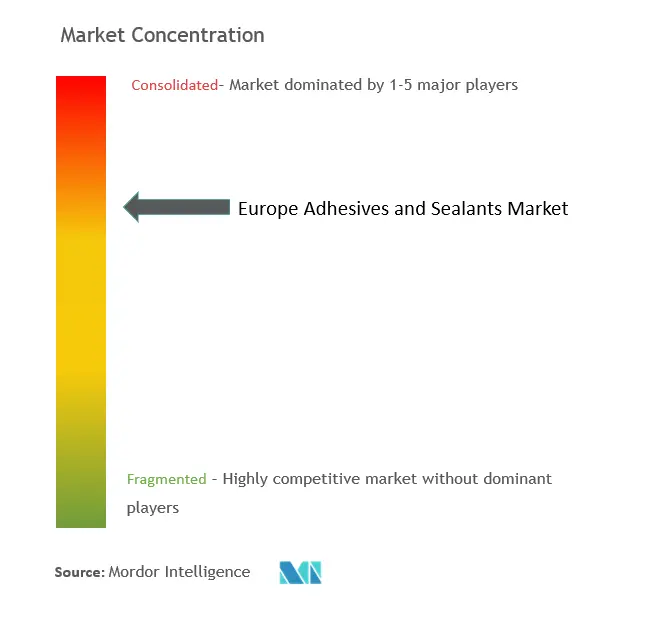
| Market Concentration | High |
Major Players *Disclaimer: Major Players sorted in no particular order Image © Mordor Intelligence. Reuse requires attribution under CC BY 4.0. | |
Europe Adhesives and Sealants Market Analysis by Mordor Intelligence
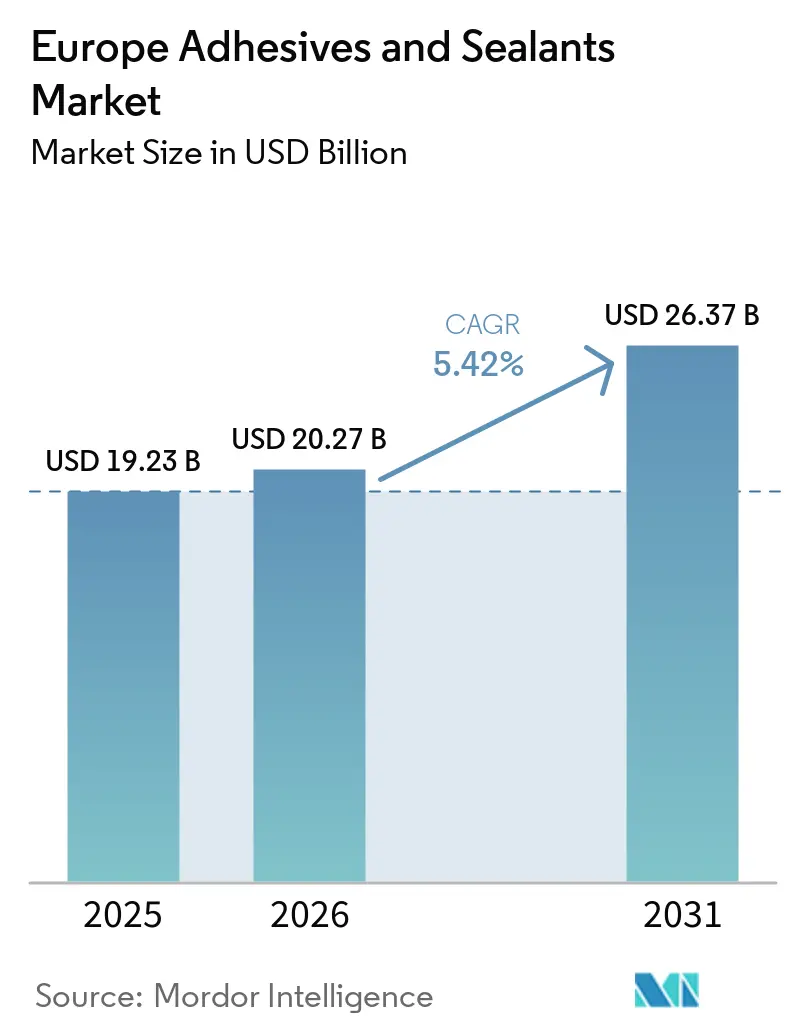
The Europe Adhesives And Sealants Market size in 2026 is estimated at USD 20.27 billion, growing from 2025 value of USD 19.23 billion with 2031 projections showing USD 26.37 billion, growing at 5.42% CAGR over 2026-2031. This trajectory reflects the sector’s ability to navigate stringent EU Green Deal regulations while capitalizing on construction recovery, automotive lightweighting mandates, and renewable-energy expansion. Water-borne systems gain traction as VOC limits tighten, and UV-cured chemistries accelerate line speeds in electronics and automotive plants. German infrastructure outlays underpin steady demand, while Spain’s renewable build-out positions it as the region’s quickest-growing buyer of structural bonding solutions. Competitive intensity remains moderate, with large incumbents refocusing portfolios on bio-based resins and acquisition-driven capability expansion to safeguard margins against feedstock price volatility and carbon-reduction costs.
Key Report Takeaways
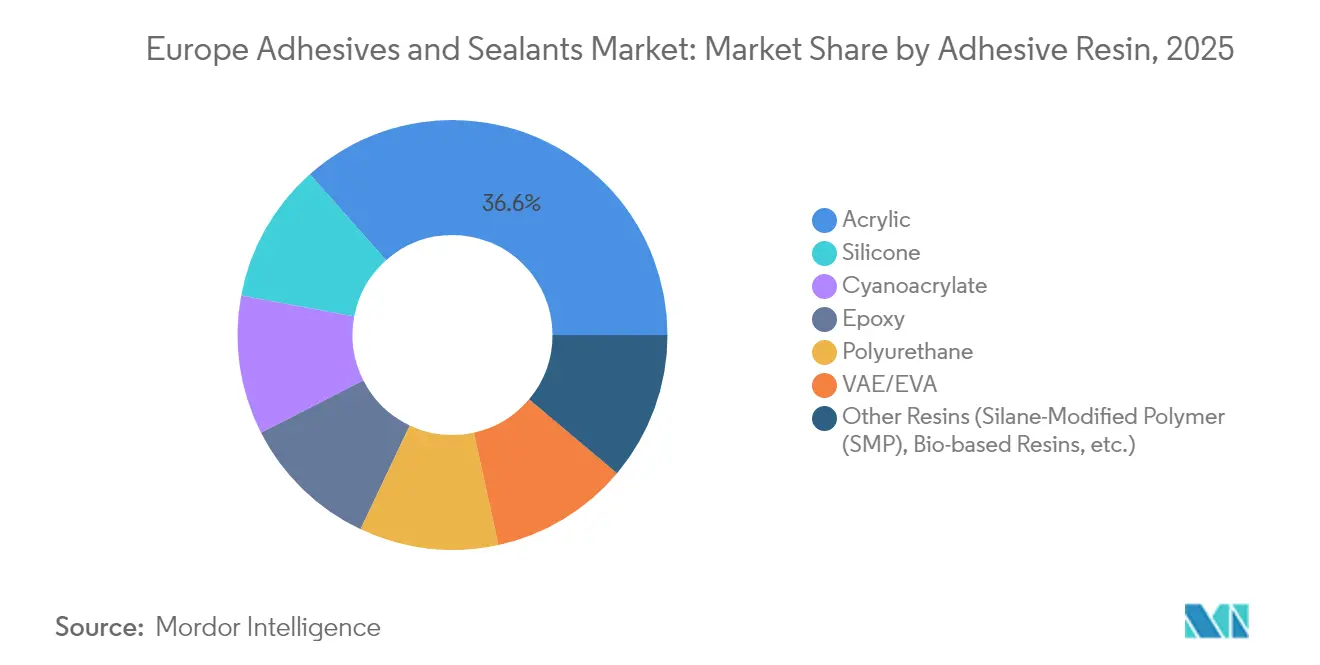
- By adhesive resin, acrylics captured 36.55% of the European adhesives and sealants market share in 2025; other resins will expand at 6.58% CAGR over 2026-2031.
- By technology, waterborne platforms commanded 42.70% share of the European adhesives and sealants market size in 2025, while UV-cured systems are projected to grow 6.21% CAGR through 2031.
- By sealant resin, silicone products led with 32.10% revenue in 2025, whereas hybrid and other chemistries are forecast to rise 5.63% CAGR.
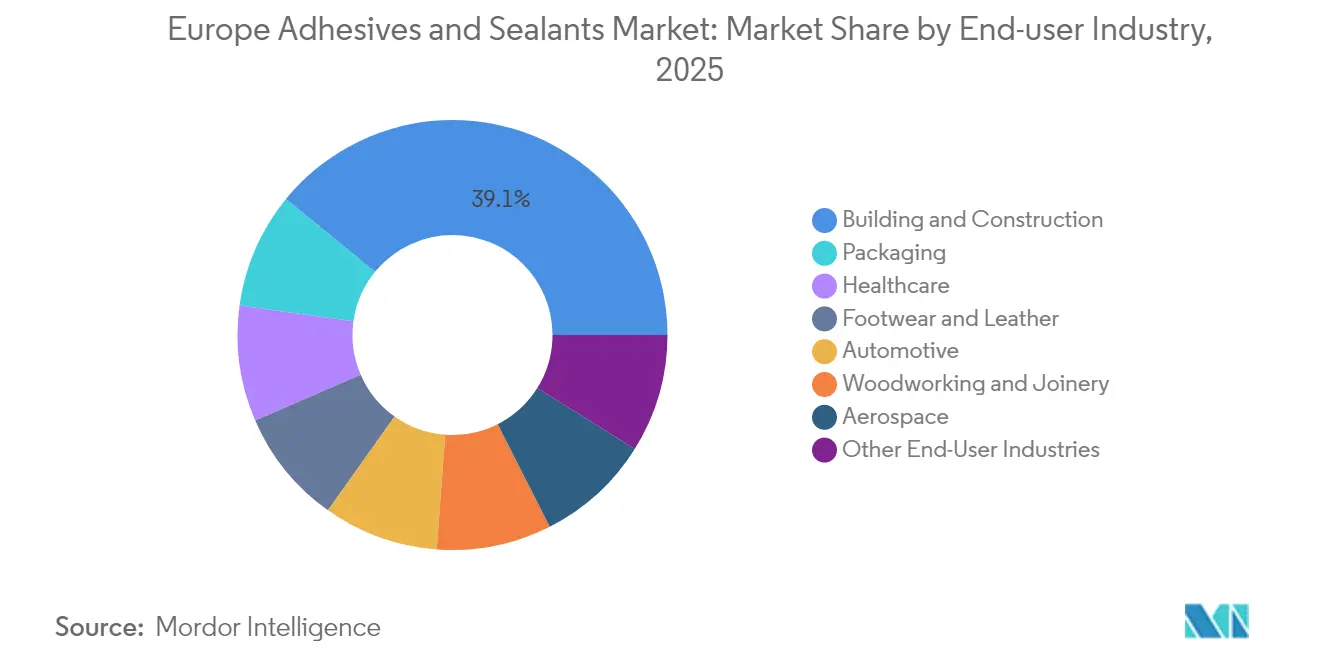
- By end-user industry, building and construction held 39.10% of Europe's adhesives and sealants market share in 2025; other industries are set to record the fastest 5.96% CAGR to 2031.
- By geography, Germany represented 21.95% of 2025 revenue; Spain is expected to deliver a 5.58% CAGR during the outlook period.
Note: Market size and forecast figures in this report are generated using Mordor Intelligence’s proprietary estimation framework, updated with the latest available data and insights as of 2026.
Market Trends and Insights
Drivers Impact Analysis of Europe Adhesives and Sealants Market*
| Drivers | (~) % Impact on CAGR Forecast | Geographic Relevance | Impact Timeline |
|---|---|---|---|
| Rising demand from residential renovation | +1.2% | Germany, France, Nordic countries | Medium term (2-4 years) |
| Surge in e-commerce packaging volumes | +0.8% | Germany, UK, Netherlands | Short term (≤ 2 years) |
| Accelerating lightweighting in the auto industry | +1.0% | Germany, France, Italy | Medium term (2-4 years) |
| Fast-growing wind-turbine blade bonding | +0.7% | Nordic countries, Germany, and Spain | Long term (≥ 4 years) |
| Prefab modular construction uptake | +0.6% | Nordic countries, Germany, Netherlands | Long term (≥ 4 years) |
| Source: Mordor Intelligence | |||
Rising Demand from Residential Renovation
European renovation activity is gathering momentum as energy-efficiency mandates and post-pandemic lifestyle shifts lift spending on insulation, flooring, and window upgrades. The EU Renovation Wave aims to double building refurbishment rates by 2030, bolstering demand for continuous-bonding systems that eliminate thermal bridging. Germany’s EUR 50 billion (~USD 58.45 billion) annual renovation market increasingly specifies bio-based products such as Henkel’s LOCTITE HB S ECO, which cuts embodied CO₂ by more than 60% compared with fossil-based counterparts. Nordic suppliers pioneer factory-applied adhesives for prefabricated façade panels, allowing rapid site assembly while meeting stringent indoor-air-quality norms. This renovation push is set to sustain volume growth for the European adhesives and sealants market through 2028[1].
Surge in E-Commerce Packaging Volumes
Rising parcel shipments prompt converters to adopt high-speed, solvent-free bonding solutions compatible with paper-recycling guidelines published by FEICA. Flexible-packaging adhesives must balance bond strength and de-inkability while supporting mono-material designs that simplify recycling under the EU Plastics Strategy. Germany and the Netherlands are upgrading automated lines that require tight viscosity control and quick setting. These trends underpin incremental gains for the European adhesives and sealants market, especially in hot-melt and waterborne grades engineered for rapid throughput[2].
Accelerating Lightweighting in European Auto Industry
Modern vehicles incorporate more than 400 linear feet of adhesive, up from 30 feet in 2001, to bond steel-aluminum structures and reinforce battery enclosures. DuPont BETAMATE enabled a 30% weight reduction in the TX5 electric taxi, while Sika’s thermally conductive lines address battery thermal management. German OEMs deploy precision-dispensing robots to meet 2030 emissions targets, propelling structural adhesive volumes in the European adhesives and sealants market.
Fast-Growing Wind-Turbine Blade Bonding Market
Larger composite blades rely on epoxy and polyurethane systems providing fatigue resistance under cyclic loads. Research into acrylic-matrix composites promises recyclability advantages, and debondable chemistries are being developed for end-of-life blade disassembly. Sweden’s green-industrial program and Spanish coastal wind farms amplify structural-bonding consumption over the long term.
Restraints Impact Analysis of Europe Adhesives and Sealants Market*
| Restraints | (~) % Impact on CAGR Forecast | Geographic Relevance | Impact Timeline |
|---|---|---|---|
| Rising Environmental Concerns | -0.9% | EU-wide, particularly Germany and Nordic countries | Medium term (2-4 years) |
| Volatile Feedstock Prices | -1.1% | Germany, France, Netherlands | Short term (≤ 2 years) |
| Skill Gap in Robotic Adhesive-Dispensing Workforce | -0.8% | Germany, Italy, Nordic countries | Long term (≥ 4 years) |
| Source: Mordor Intelligence | |||
Rising Environmental Concerns
REACH diisocyanate restrictions effective August 2023 force reformulation of polyurethane systems or mandatory worker training, while formaldehyde emission ceilings effective August 2026 drive shifts to ultra-low-emission grades. The addition of 247 SVHCs, including octamethyltrisiloxane, extends regulatory uncertainty. Sustainability investment needs 70% higher annual capital outlays across Europe’s chemical sector, compressing margins yet spurring long-run innovation in bio-based feedstocks.
Volatile Feedstock Prices
Natural-gas-driven electricity spikes since the Russia-Ukraine conflict, alongside supply disruptions, have cut European chemical output volumes. BASF’s switch to bio-based ethyl acrylate carries a price premium that customers must absorb. Producers now prioritize cost discipline and capacity rationalization, potentially crimping near-term expansion prospects for the European adhesives and sealants market.
*Our forecasts treat driver/restraint impacts as directional, not additive. The impact forecasts reflect baseline growth, mix effects, and variable interactions.
Europe Adhesives and Sealants Market Segment Analysis
By Adhesive Resin:
Bio-Based Alternatives Challenge Acrylic DominanceAcrylics retained 36.55% revenue share of the European adhesives and sealants market in 2025, thanks to versatility and adhesion to diverse substrates. Other resins, including bio-based innovations, are forecast to expand 6.58% CAGR to 2031 as carbon-reduction mandates intensify. Europe adhesives and sealants market size for bio-based grades is projected to widen as BASF’s renewable ethyl acrylate rolls out and xylan hot-melts demonstrate 30 MPa lap-shear while remaining reusable. Cyanoacrylates gain traction in electronics miniaturization, and polyurethane formulators pursue moisture-curing systems that bypass diisocyanate training. Silicone chemistries grow in high-temperature segments, whereas VAE/EVA retains cost-driven niches.

By Adhesive Technology:
UV-Cured Innovation Outpaces Water-Borne LeadershipWaterborne platforms accounted for 42.70% of the 2025 revenue base, reflecting entrenched production lines and alignment with VOC caps. UV-cured systems, however, will post a 6.21% CAGR through 2031 as assembly plants seek instant-bond processing. Panacol’s black UV epoxies cure in thicker layers, eliminating shadow areas, and are now specified in EV motor wire stress-relief joints.
Reactive hot melts combine rapid set with strong final bonds, serving high-speed packaging lines. Solvent-borne demand persists in aerospace, where long open time is critical, but higher-solids versions help meet tightening emission norms. Equipment upgrades toward LED-UV lamps cut energy use and further incentivize technology switching in the European adhesives and sealants market.
By Sealant Resin:
Silicone Versatility Drives Market LeadershipSilicone grades delivered 32.10% of 2025 turnover owing to durability in façade joints and automotive glazing. Hybrid silane-modified-polymer sealants are predicted to log a 5.63% CAGR, merging silicone weathering with polyurethane adhesion. Medical care adopts Wacker’s SILPURAN tapes for atraumatic removal, while construction sites demand low-modulus SMP products compatible with damp substrates. Polyurethane sealants tweak isocyanate levels to meet training thresholds, and epoxies satisfy chemical-resistant flooring. Ongoing research and development into renewable polyols and fume-free curing aids the transition to lower-carbon offerings within the European adhesives and sealants market.
By End-User Industry:
Renewable Energy Diversification Challenges Construction DominanceBuilding and construction supplied 39.10% of revenue in 2025 as renovation incentives and energy-efficiency codes sustained adhesive uptake in insulation and flooring. Renewable energy and electronics will outpace at 5.96% CAGR, enlarging the Europe adhesives and sealants market size for specialty structural adhesives in turbine blades and thermally conductive pastes for EV batteries. Automotive lightweighting continues, with structural bonding replacing spot welds, and aerospace recovers as fleet renewals progress. Packaging formulators build solvent-free laminating capability, while healthcare acquisitions by H.B. Fuller expand wound-closure solutions in a bid to offset cyclical construction exposure.
Geography Analysis
Germany Adhesives and Sealants Market
Germany’s 21.95% revenue weight in 2025 stems from EUR 500 billion infrastructure plans that maintain a baseline of construction sealant demand. The country’s auto sector, though confronted by EV transition headwinds, keeps investing in bonding robots that enhance precision and reduce weld spatter. The Europe adhesives and sealants market size is attached to Germany and adhesives sealants distribution is supported by deep supplier networks and research and development clusters around Cologne and Düsseldorf.
Spain Adhesives and Sealants Market
Spain is forecast to log a 5.58% CAGR as wind-turbine component plants in Galicia and Valencia expand capacity to meet EU renewable targets. Construction modernization programs integrating modular timber frames also boost the consumption of moisture-curing polyurethane adhesives.
Western Europe Adhesives and Sealants Market
The United Kingdom maintains resilient niches in roofing and specialty composites, aided by Sika’s acquisition of Cromar Building Products. France leans on renovation subsidies and industrial policy backing for sustainable chemistry, but high electricity tariffs temper growth. Italy progresses on bonus-driven façade upgrades.
Eastern Europe Adhesives and Sealants Market
Eastern European cohesion-fund projects strengthen demand in Poland and Romania, while the Russia market remains constrained by sanctions that limit feedstock flows and technology transfer, thereby reshaping trade routes within the broader Europe adhesives and sealants market.
Value Chain Analysis
The European adhesives and sealants value chain starts with petrochemical and bio-based inputs, including acrylic and epoxy building blocks, polyurethane precursors (MDI and propylene oxide), silicones, tackifiers, and performance additives. Upstream supply depends heavily on large chemical producers and European industrial clusters, with key precursor concentrations along the Rhine-Ruhr corridor that can introduce exposure to energy and logistics disruptions.
In the midstream, formulators and branded manufacturers (including Henkel, Sika, H.B. Fuller, Arkema, and others) compound and convert these inputs into resin- and technology-specific systems (water-borne, hot-melt, reactive, UV-cured, solvent-borne) for building and construction, automotive, packaging, electronics, and renewables. Downstream, distribution and application support are handled through a mix of direct-to-OEM sales, converter relationships, and specialty chemical distributors such as Brenntag, IMCD, and Bodo Moeller Chemie, which provide local warehousing, technical service, and regulatory documentation support. Recent moves point to tighter integration across the chain: in February 2026, Henkel announced a strategic partnership and majority stake acquisition of UK-based Wetherby Laroc to broaden facade solutions for energy-efficient construction, and Bodo Moeller Chemie expanded its distribution partnership with Henkel across multiple European markets for automotive components. In parallel, Henkel's collaboration with Sekab on bio-based ethyl acetate reflects efforts to secure lower-carbon raw materials and reduce Scope 3 exposure, while acquisitions and regional expansion strategies aim to shorten lead times and diversify supply routes within Europe.
Competitive Landscape
The European adhesives and sealants market is consolidated in nature. Strategic moves focus on vertical integration and specialty niches. Automation investments proliferate, with in-line quality monitoring and robotic dispensing reducing scrap rates and meeting OEM audit requirements. Feedstock volatility drives interest in local sourcing agreements, though production scale keeps petrochemical majors central to supply. Technology leadership and sustainability credentials underpin pricing power in the European adhesives and sealants market.
Europe Adhesives and Sealants Industry Leaders
-
Sika AG
-
H.B. Fuller Company
-
3M
-
Arkema
-
Henkel AG & Co. KGaA
- *Disclaimer: Major Players sorted in no particular order
Europe Adhesives and Sealants Market Companies Covered in this Report
- 3M
- Akzo Nobel N.V.
- Arkema
- Avery Dennison Corporation
- BASF
- Dow
- Dymax
- H.B. Fuller Company
- Henkel AG & Co. KGaA
- Huntsman International LLC.
- Jowat
- Mapei S.p.A
- Momentive
- Münzing
- PPG Industries, Inc.
- Sika AG
- Soudal Group
- Wacker Chemie AG
Market Opportunities and Future Outlook
Sustainability-driven reformulation and circular design requirements continue to open whitespace for low-VOC, SVHC-reduced, and recyclable-by-design adhesive systems across packaging, construction, and transportation applications. Packaging is a visible opportunity area where paper-based and barrier-coated structures need compatible bonding technologies that preserve performance while supporting recycling pathways, and in February 2026, Henkel launched a cold-seal solution for barrier-coated paper packaging, reflecting ongoing product development aligned with the EU Packaging and Packaging Waste Regulation direction of travel. In building renovation, the EU Renovation Wave and national energy-efficiency programs sustain demand for facade, insulation, and airtightness systems, reinforcing pull-through for construction sealants and specialty bonding solutions, including bio-attributed and mass-balance offerings.
Electrification, automation, and localized production footprints also support opportunity in specialty grades and regional supply. Water-borne, UV-cured, and thermally functional materials for electronics and battery-adjacent use benefit from plant-level productivity goals and tighter environmental constraints, while manufacturers are adding European capacity closer to customers: in May 2026, tesa held a topping-out ceremony for a 4,500-square-meter expansion at its Offenburg plant, adding adhesive compound manufacturing and coating capability. The industry is also building out silicone and specialty elastomer platforms for high-durability sealing and thermal performance; in June 2026, WACKER Chemie opened a specialty silicones production site in Karlovy Vary, Czech Republic. On the go-to-market side, consolidation and channel expansion widen access to faster-growing geographies and segments, illustrated by Sika's February 2026 agreement to acquire Akkim to strengthen its presence in markets including Eastern Europe and adjacent regions.
Recent Industry Developments in Europe Adhesives and Sealants Market
- April 2026: Henkel expanded its heavy-equipment adhesive sealant portfolio with Teroson MS 9381 HPT, positioned as a tin-free, solvent-free, and isocyanate-free solution for interior and exterior applications. The launch supports customers seeking simplified compliance and lower-hazard formulations while maintaining performance in demanding mobile-equipment assemblies.
- May 2025: Henkel and Nordmeccanica elevated their long-standing collaboration to a strategic partnership focused on low-VOC adhesive-laminating technology for European converters. The step strengthens joint development and process integration around solvent reduction, aligning equipment and adhesive innovation with packaging sustainability requirements.
- December 2024: A strategic expansion by H.B. Fuller through the acquisition of Medifill Ltd. and the signing of a provisional agreement for GEM S.r.l. expands its European wound-closure and healthcare adhesives platform. The acquisition deepens exposure to medical applications that require validated performance and regulatory-grade manufacturing, diversifying end-market mix beyond cyclical construction demand.
Europe Adhesives and Sealants Market Report Scope and Research Methodology
Market Definition and Coverage
For this study, the market covers the total revenue earned from adhesives and sealants sold in Europe for industrial and construction use, counted at the point where products are supplied into the regional market.
Scope exclusions: This scope does not count downstream installation labor, equipment rental, or any unrelated coatings and surface treatments that are not adhesives or sealants.
Segments Covered in This Report
- By Adhesive Resin
- Acrylic
- Cyanoacrylate
- Epoxy
- Polyurethane
- Silicone
- VAE / EVA
- Other Resins (Silane-Modified Polymer (SMP), Bio-based Resins, etc.)
- By Adhesive Technology
- Hot-Melt
- Reactive
- Solvent-Borne
- UV-Cured
- Water-Borne
- By Sealant Resin
- Polyurethane
- Epoxy
- Acrylic
- Silicone
- Other Resins (Polysulfide, SMP Hybrid, etc.)
- By End-User Industry
- Aerospace
- Automotive
- Building and Construction
- Footwear and Leather
- Healthcare
- Packaging
- Woodworking and Joinery
- Other End-User Industries (Renewable Energy,Electronics and Appliances, etc.)
- By Geography
- Germany
- United Kingdom
- France
- Italy
- Spain
- Russia
- NORDIC Countries
- Rest of Europe
Data Sources, Market Sizing, and Validation
Desk Research
Desk research was used to build a solid base for the model and to keep our assumptions realistic for Europe. We relied on public and official sources such as Eurostat (industrial production, construction output, and trade flows), the European Commission and ECHA updates on chemicals regulation, and national statistics offices for building permits and manufacturing indicators. We also reviewed association and standards body materials that influence formulation and use patterns, along with peer-reviewed journals that discuss technology shifts like waterborne, reactive, and UV-cured systems.
To translate these signals into a usable sizing structure, we also used company annual reports, investor presentations, and reputable press coverage on capacity changes, plant expansions, and end-use demand trends. In a few places, paid subscriptions that cover company financials and intelligence, news and financials, patent databases, and shipment-level import and export data were used to cross-check direction and timing, especially when public datasets lagged. The examples of sources listed above are not exhaustive, and additional public references were also consulted to collect data points, validate assumptions, and clarify open questions.
Primary Interviews and Surveys
Primary work was used to pressure-test the model logic and to fill gaps that desk research cannot reliably answer, such as typical price movement, product mix shifts, and how quickly regulations are changing formulations. We spoke with a spread of stakeholders across the value chain, including manufacturers, raw material suppliers, distributors, and large end users in building and construction, automotive, packaging, woodworking, and healthcare. Responses were balanced across major European markets and the rest of the region.
Distribution of primary research fieldwork respondents
| Company type | Respondent position |
|---|---|
| Top tier: 39% | CXOs: 18% |
| Mid tier: 43% | Functional/Unit leaders: 37% |
| Smaller Players: 18% | Managers: 45% |
Market-Sizing & Forecasting
Sizing started from a top-down build that reconstructs the demand pool by linking Europe-wide end-use activity to adhesives and sealants consumption intensity, and then translating volume into value using realistic pricing bands. We used variables that can be tracked year to year, such as construction output and new build indicators, automotive production and model mix, packaging conversion activity, and the pace of technology shifts toward waterborne, hot-melt, reactive, and UV-cured systems. Where public data was not granular, conversion factors were applied and then tuned based on expert feedback and country differences.
After the top-down view was formed, it was corroborated with selective bottom-up approximations, such as supplier and distributor channel checks and sampled volume times average selling price (ASP) ranges by product family. Any gaps in these checks, especially in fragmented applications and smaller countries, were handled using conservative penetration assumptions and then re-validated through follow-up expert calls. For forecasting, multivariate regression was used alongside scenario checks, where the key drivers were construction and manufacturing outlooks, regulation-led substitution, and ASP progression tied to input cost direction and product mix.
Data Validation & Update Cycle
Model outputs were validated through stepwise checks, starting with internal variance reviews across countries, end uses, and technology splits, and then comparing the totals with independent market signals like trade movements, major plant utilization commentary, and observed pricing direction. When results moved outside expected ranges, the assumptions were revisited, and parts of the interview pool were re-contacted to confirm whether the change was structural or temporary.
Before sign-off, the work is reviewed across analysts so calculation logic, units, and currency handling are consistent, and any anomalies are explained clearly. Reports are refreshed annually, and interim updates are triggered when there are material events such as major capacity additions, regulatory shifts, or sudden demand shocks. Right before delivery, a final review pass is performed so clients receive the most current view available.
Mordor Intelligence's Europe Adhesives Sealants Market Estimate Compared With Other Published Estimates
It is normal to see different market values for Europe adhesives and sealants because publishers do not always use the same product boundaries, year definitions, and conversion steps. Differences can come from whether the estimate blends adhesives and sealants in the same way, uses constant prices versus current prices, or applies a different year for currency conversion.
By checking end-use output signals and refreshing the price and volume bridge with interview inputs, Mordor Intelligence keeps the total tied to adhesives and sealants sold into Europe and avoids mixing in adjacent chemicals that do not function as bonding or sealing materials in use.
Benchmark comparison
| Source | Market Size | Gaps in Research Methodology |
|---|---|---|
| Mordor Intelligence | USD 19.23 B (2025) | |
| Regional Consultancy A | USD 8.34 B (2022) | Uses an earlier base year and a narrower country list, and the reported value level is consistent with partial end-use coverage or a different value capture point, which reduces the apparent total. |
| Trade Publisher B | USD 12.78 B (2029) | Quotes a forward-year value that can reflect a faster assumed ramp in construction and packaging demand and a steeper ASP path, without showing the implied volume reconciliation by major European markets. |
Overall, the gap across sources is mainly explained by the year being quoted, the scope of Europe used, and how volume and ASP are carried forward into the forecast. When the steps are tied back to observable end-use indicators and are cross-checked through interviews, the final number is easier to reproduce and update as conditions change.
Key Questions Answered in the Report
What is the current value of the Europe adhesives and sealants market?
The market is worth USD 20.27 billion in 2026 and is projected to grow to USD 26.37 billion by 2031.
Which end-user industry holds the largest share?
Building and construction leads with 39.10% share in 2025, driven by renovation and energy-efficiency mandates.
Which adhesive technology is growing fastest?
UV-cured systems are expected to expand at a 6.21% CAGR through 2031 owing to instant-bond processing benefits.
Why is Spain the fastest-growing geography?
Spain’s 5.58% CAGR outlook stems from robust wind-energy investments and construction-modernization programs.
How are regulations influencing product development?
REACH restrictions on diisocyanates and formaldehyde, plus VOC limits, accelerate shifts to water-borne, UV-cured, and bio-based chemistries.