
Market Overview
| Study Period | 2020 - 2031 |
|---|---|
| Forecast Data Period | 2026 - 2031 |
| Historical Data Period | 2020 - 2024 |
| Growth Rate | 4.06 % |
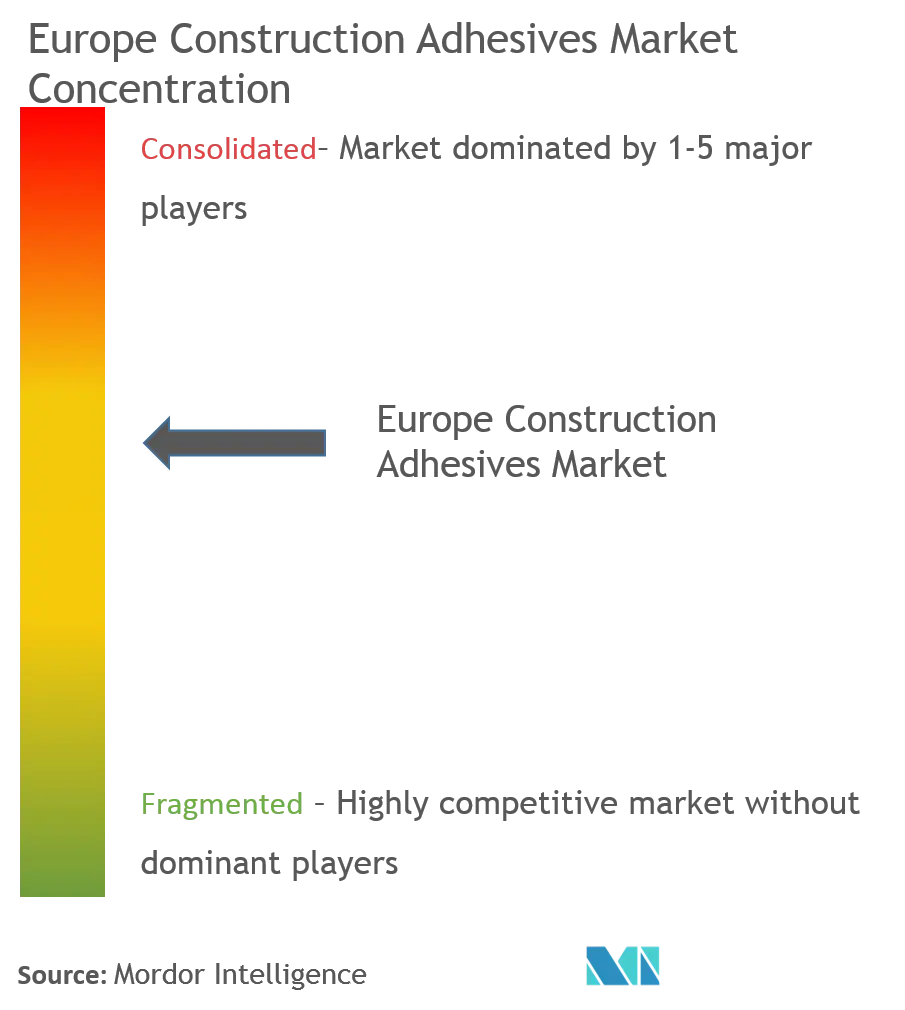
| Market Concentration | High |
Major Players *Disclaimer: Major Players sorted in no particular order Image © Mordor Intelligence. Reuse requires attribution under CC BY 4.0. | |
Europe Construction Adhesives Market Analysis by Mordor Intelligence
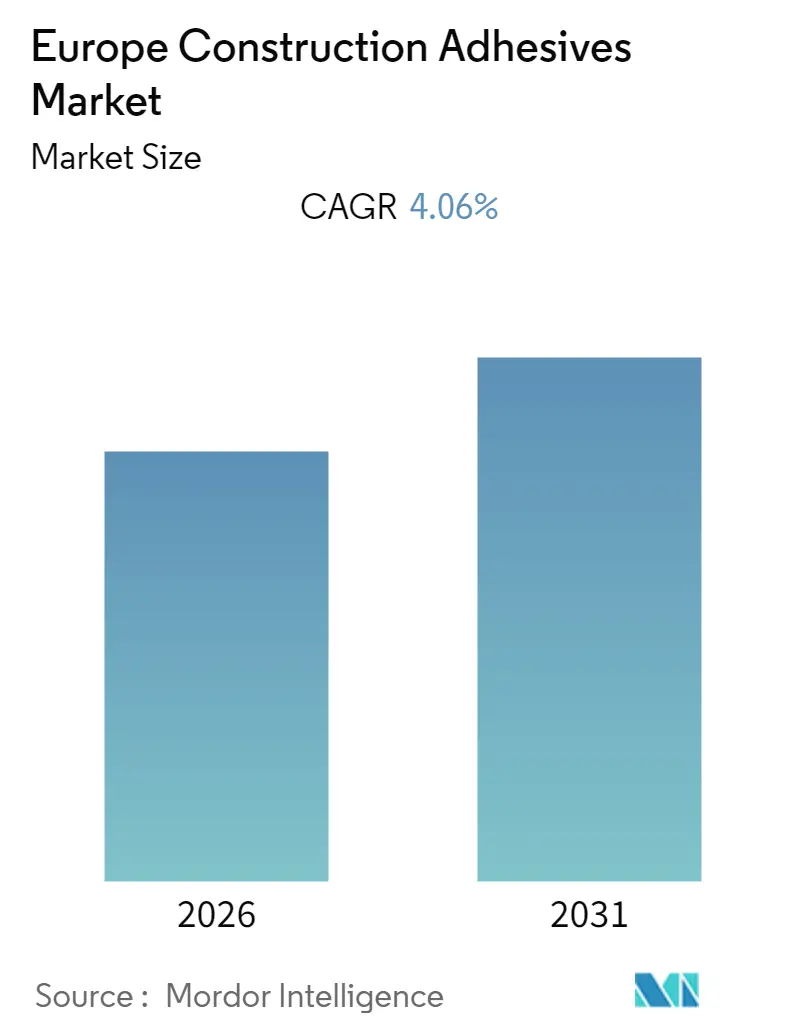
The Europe Construction Adhesives Market size is expected to register a CAGR of 4.06% during the forecast period.
- Rising Demand from Panels and Glazing in High-Rise Buildings is expected to provide a major growth opportunity for the Europe construction adhesives market studied.
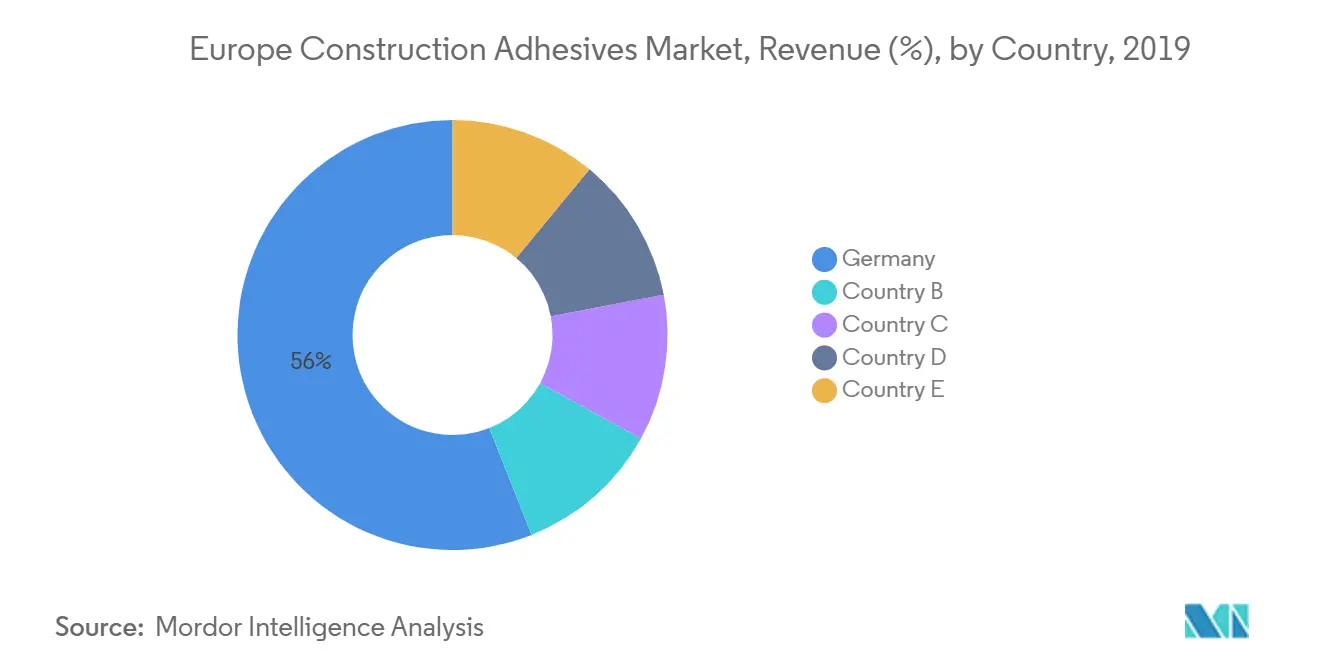
- Germany accounted for the highest share of the market and is likely to continue dominating the Europe construction adhesives market during the forecast period.
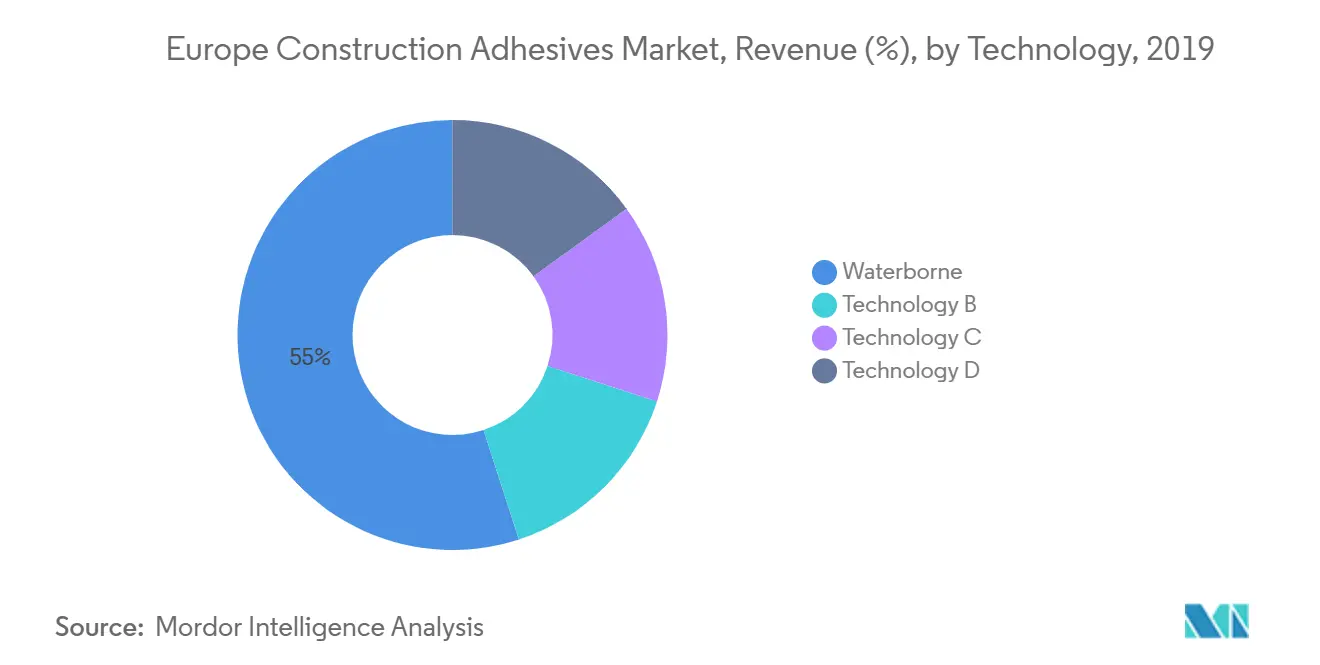
- Among the technology, waterborne adhesives are expected to dominate the Europe construction adhesives market studied during the forecast period.
Note: Market size and forecast figures in this report are generated using Mordor Intelligence’s proprietary estimation framework, updated with the latest available data and insights as of 2026.
Europe Construction Adhesives Market Trends and Insights
Waterborne Technology to Dominate the Market
- Water-borne adhesives use water as a carrier or a diluting medium, to disperse a resin. They are set by allowing the water to evaporate or be absorbed by the substrate. These adhesives are compounded with water as a diluent, rather than a volatile organic solvent.
- They can be considered as low-VOC adhesives. Water-borne adhesives are produced from either soluble synthetic polymers (from polymers, such as cellulose ethers, polyvinyl alcohol, methylcellulose, carboxymethylcellulose, and polyvinyl pyrrolidone) or natural polymers (from vegetable sources, such as starches and dextrins; protein sources, such as blood, fish, milk albumen, and soybean; and animal sources, such as bones and hides).
- Acrylic water-borne adhesives and latex water-borne adhesives are majorly employed for different applications, in the building and construction industry.
- Acrylic water-borne adhesives are mainly used as a pressure-sensitive adhesives in the construction sector, in the form of labels and tapes, for tile bonding and laminating purposes.
- Hence, owing to the above-mentioned reasons, waterborne construction adhesive technology is expected to dominate the Europe construction adhesives market.
Germany to Dominate the Market
- Germany currently accounts for the major share of the Europe construction adhesives market owing to the growing demand from residential construction.
- Additionally, the non-residential and commercial building has also witnessed significant growth in the recent past which is driving the market studied.The growth is supported by lower interest rates, increase in real disposable incomes, and numerous investments by the EU and German governments.
- The short-term and mid-term outlook for the German construction market forecast a strong demand for infrastructure and housing investments. The construction sector in the country shows a high degree of capacity utilisation, with increased competition for sub-suppliers and faces workforce shortness.
- Hence, owing to the above-mentioned factors, Germany is likely to dominate the Europe construction adhesives market during the forecast period.
Competitive Landscape
The Europe construction adhesives market is moderately consolidated as the market of the market share is divided among a few players. Some of the key players in the market include 3M, Arkema Group, Dow, Henkel AG & KGaA, and Sika AG, among others.
Europe Construction Adhesives Industry Leaders
-
3M
-
H.B. Fuller Company
-
Dow
-
Henkel AG & Co. KGaA
-
Sika AG
- *Disclaimer: Major Players sorted in no particular order
Market Opportunities and Future Outlook
Panels and glazing demand in high-rise buildings continues to pull construction adhesive consumption toward bonding systems that balance performance with easier processing. Water-borne technologies remain a key track for compliance-led reformulation in Europe, and the move toward hybrid and low-VOC systems is reinforced by upstream and midstream capacity, including WACKER starting production of hybrid polymers at its Nuenschritz site (2025).
At the same time, regulatory and data-transparency requirements are shaping demand for suppliers that can provide sustainability documentation alongside end-use performance. The revised EU Construction Products Regulation, Regulation (EU) 2024/3110, puts additional emphasis on life-cycle and environmental sustainability performance for marketed construction products, while the European Federation for Construction Chemicals (EFCC) has pointed to interoperable Digital Product Passports in the REACH and CPR context. On the supply side, Sika's announced agreement (February 2026) to acquire Akkim, with production facilities in Turkey and Romania, highlights a strategy to broaden manufacturing and distribution reach toward Eastern Europe and the Mediterranean, while expanding adhesives and sealants capabilities for construction applications.
Recent Industry Developments
- May 2026: Henkel launched the 1K-PUR Loctite HB XE adhesive aimed at improving fire safety and production efficiency in timber construction applications in Europe. The product supports engineered-wood building systems where adhesives must meet tightening performance and safety requirements while enabling faster fabrication.
- February 2026: Sika announced an agreement to acquire Akkim, an adhesives and sealants manufacturer with production facilities in Turkey and Romania, with closing targeted for Q3 2026. The transaction strengthens Sika's regional footprint and adds manufacturing capacity and routes to market that can support construction-adhesives supply in Europe and adjacent corridors.
- March 2024: The European Union adopted the revised Construction Products Regulation, Regulation (EU) 2024/3110, updating harmonized rules for marketing construction products and elevating sustainability and life-cycle performance considerations. This increases the emphasis on low-emission formulations and documentation-ready construction chemical systems used alongside regulated building products.
Research Methodology Framework and Report Scope
Market Definition and Coverage
This market covers the value of construction-grade adhesives sold in Europe for bonding and installation needs in buildings and civil works, across common resin chemistries and technologies, and counted at the point of sale for construction uses.
Scope exclusions: We exclude sealants, tapes, mechanical fasteners, and general-purpose consumer glues that are not specified for construction applications.
Segmentation Overview
- Resin Type
- Acrylics
- Epoxy
- Polyurethanes
- Polyvinyl Acetate (PVA)
- Silicones
- Other Resin Types
- Technology
- Water-borne
- Reactive
- Hot-melt
- Other Technologies
- End-use Sector
- Residential
- Commercial
- Infrastructure
- Industrial
- Geography
- Germany
- United Kingdom
- France
- Italy
- Rest of Europe
Data Sources, Market Sizing, and Validation
Desk Research
Desk research was used to set the market boundaries, build the first demand map, and stress-test pricing ranges before fieldwork began. We relied on public construction and materials indicators, such as Eurostat construction output and producer price series, European Commission energy-efficiency and renovation policy trackers, and national statistics offices for new build and refurbishment activity.
To keep the chemistry and product-use logic grounded, we also reviewed sources such as ECHA and EU REACH guidance on VOC and chemical restrictions, trade association publications for adhesives and construction materials, and peer-reviewed journals for performance trends, including waterborne and reactive systems. Company annual reports, investor presentations, and trusted trade press were then used to confirm product mix, plant footprints, and where demand was shifting by country. In a few places, paid subscriptions supporting company financials, patent searching, and shipment-level trade checks were used to cross-verify public signals. The desk sources listed above are illustrative only, and many additional public and paid references were used for data collection, validation, and clarification.
Primary Interviews and Surveys
Primary work was used to validate the share of demand coming from residential, commercial, and infrastructure activity, and to pin down how pricing differs between waterborne, hot-melt, and reactive products across Europe. We spoke with a mix of manufacturers, raw material and channel participants, applicator-facing specialists, and large buyer groups, and then used follow-up calls to close gaps where secondary data was thin. Coverage was balanced across the major European markets and the rest-of-region group so country-level construction cycles did not skew the total.
Distribution of primary research fieldwork respondents
| Company type | Respondent position |
|---|---|
| Top tier: 28% | CXOs: 19% |
| Mid tier: 50% | Functional/Unit leaders: 40% |
| Smaller Players: 22% | Managers: 41% |
Market-Sizing & Forecasting
The core sizing logic uses a top-down build where construction output and renovation intensity are translated into adhesive demand pools by application, and then converted into value using country-adjusted price bands. We then corroborate totals with selective bottom-up approximations, such as supplier revenue exposure checks, channel feedback on volumes, and sampled price per kg multiplied by realistic consumption ranges, which helps keep the final number within a plausible operating window.
Inputs that were treated as key drivers include the split between new build and refurbishment, flooring and tile installation activity, insulation and facade retrofit momentum, the shift toward waterborne and reactive systems under VOC rules, and raw material cost movements that influence average selling prices. Where a bottom-up cross-check was incomplete for smaller countries, gaps were handled by using proxy indicators like construction output shares and import patterns, followed by a sanity check with local respondents.
For forecasting, we used scenario analysis supported by a light multivariate regression view, where construction output, housing starts permits trends, renovation funding momentum, and price indices explain most of the movement. Assumptions were adjusted after primary feedback, especially around how quickly lower-VOC formulations replace solvent-borne products and how fast pricing normalizes after raw material swings.
Data Validation & Update Cycle
Validation was done in layers so the model stayed explainable and repeatable. We compared the output against independent signals, such as construction output series, trade flows for relevant adhesive chemistries, and reported mix shifts between technologies, and then flagged country outliers for re-check.
Before sign-off, assumptions and calculations go through a multi-step internal review, where variances are traced back to a specific driver like volume, mix, or price. If a material mismatch shows up, respondents are re-contacted to confirm whether the issue is scope, timing, or a local demand shock. The report is refreshed annually, and interim updates are made when large regulatory, construction-cycle, or cost events materially change the outlook. Right before delivery, we run a final pass to ensure the latest public indicators are reflected.
Mordor Intelligence's Europe Construction Adhesives Market Estimate Compared With Other Published Estimates
It is normal to see different market sizes published for the same topic because analysts may draw the boundary around products differently, pick different price points, and anchor demand to different construction indicators. Timing also matters, since adhesives pricing and construction activity can move meaningfully within a year.
Key gaps usually come from whether sealants are blended into the total, whether the scope is limited to building interiors or includes infrastructure bonding uses, and how average selling prices are carried forward when raw material costs swing. By tracking country-level construction output and renovation intensity and then refreshing the ASP bands with channel checks, Mordor Intelligence keeps the estimate tied to construction-use adhesives only, instead of mixing in adjacent sealing chemicals or broader building materials spend.
Benchmark comparison
| Source | Market Size | Gaps in Research Methodology |
|---|---|---|
| Mordor Intelligence | USD 2.08 B (2024) | |
| Regional Consultancy A | USD 4.75 B (2024) | This estimate appears to use a wider value pool for Europe, where the counted product set and use cases may extend beyond construction-use adhesives, and where price carry-forward is not clearly linked to construction activity and mix shifts. |
| Industry Publisher B | USD 2.65 B (2025) | The year differs and the scope description is less explicit on exclusions, which can pull in small adjacent categories and create a higher starting point when pricing is assumed to rise uniformly across chemistries. |
Taken together, the spread is mainly explained by scope boundaries and how pricing is applied over time, not by a single demand driver. Our approach stays traceable to a short list of observable construction indicators and practical price bands, which makes the result easier to repeat and to update when the market shifts.
Key Questions Answered in the Report
What is the current Europe Construction Adhesives Market size?
The Europe Construction Adhesives Market is projected to register a CAGR of 4.06% during the forecast period (2026-2031)
Who are the key players in Europe Construction Adhesives Market?
3M, H.B. Fuller Company, Dow, Henkel AG & Co. KGaA and Sika AG are the major companies operating in the Europe Construction Adhesives Market.
What years does this Europe Construction Adhesives Market cover?
The report covers the Europe Construction Adhesives Market historical market size for years: 2019, 2020, 2021, 2022, 2023 and 2024. The report also forecasts the Europe Construction Adhesives Market size for years: 2026, 2027, 2028, 2029, 2030 and 2031.