
Emergency Medical Services Products Market Size and Share
Market Overview
| Study Period | 2020 - 2031 |
|---|---|
| Market Size (2026) | USD 35.49 Billion |
| Market Size (2031) | USD 49.02 Billion |
| Growth Rate (2026 - 2031) | 6.67 % |
| Fastest Growing Market | Asia Pacific |
| Largest Market | North America |
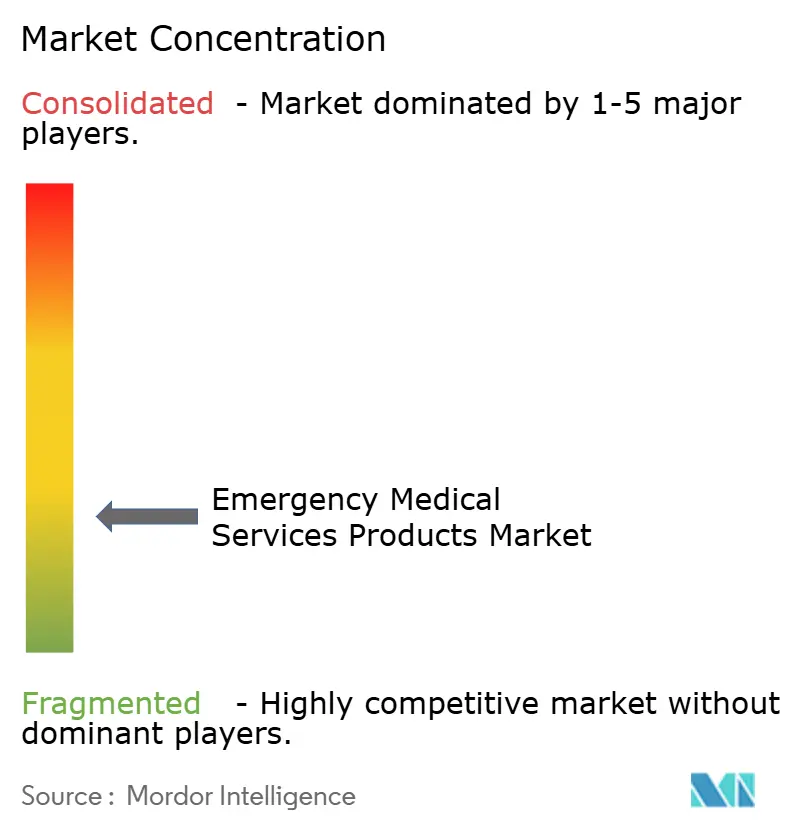
| Market Concentration | Low |
Major Players *Disclaimer: Major Players sorted in no particular order Image © Mordor Intelligence. Reuse requires attribution under CC BY 4.0. | |
Emergency Medical Services Products Market Analysis by Mordor Intelligence
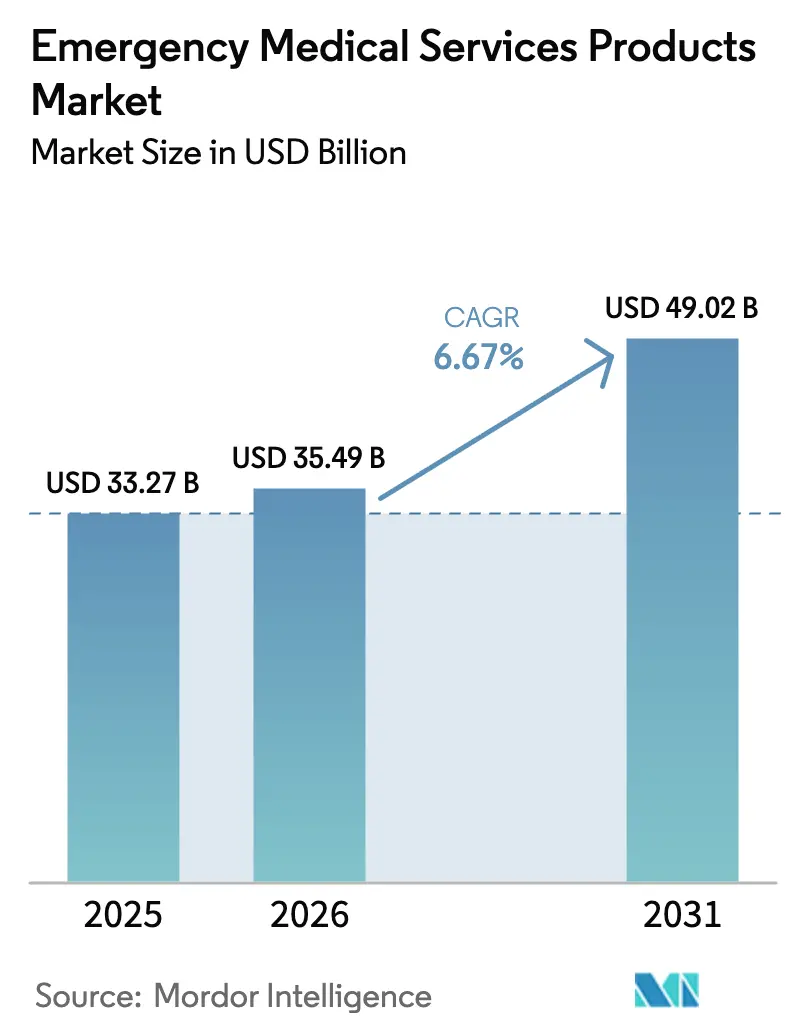
Emergency Medical Services Products Market size in 2026 is estimated at USD 35.49 billion, growing from 2025 value of USD 33.27 billion with 2031 projections showing USD 49.02 billion, growing at 6.67% CAGR over 2026-2031.
Demand arises from the confluence of aging populations, rising chronic-disease incidence, and technology that embeds artificial intelligence into portable monitors and defibrillators. AI-driven triage guidance now shortens on-scene assessment times, easing the paramedic workload during critical workforce shortages in rural districts. Community paramedicine programs, which dispatch clinicians to manage patients at home, have trimmed emergency-department visits by 17%, underscoring the market’s shift from reactive transport to proactive care. Mandates for public-access defibrillators, exemplified by Maryland’s 2024 school AED requirement, accelerate equipment adoption in non-healthcare venues. Simultaneously, aging ambulance fleets in OECD countries generate recurring replacement cycles that favor integrated, cloud-connected life-support systems. These dynamics collectively sustain a robust, geographically diversified revenue base for the Emergency medical services products market through the forecast horizon.
Key Report Takeaways
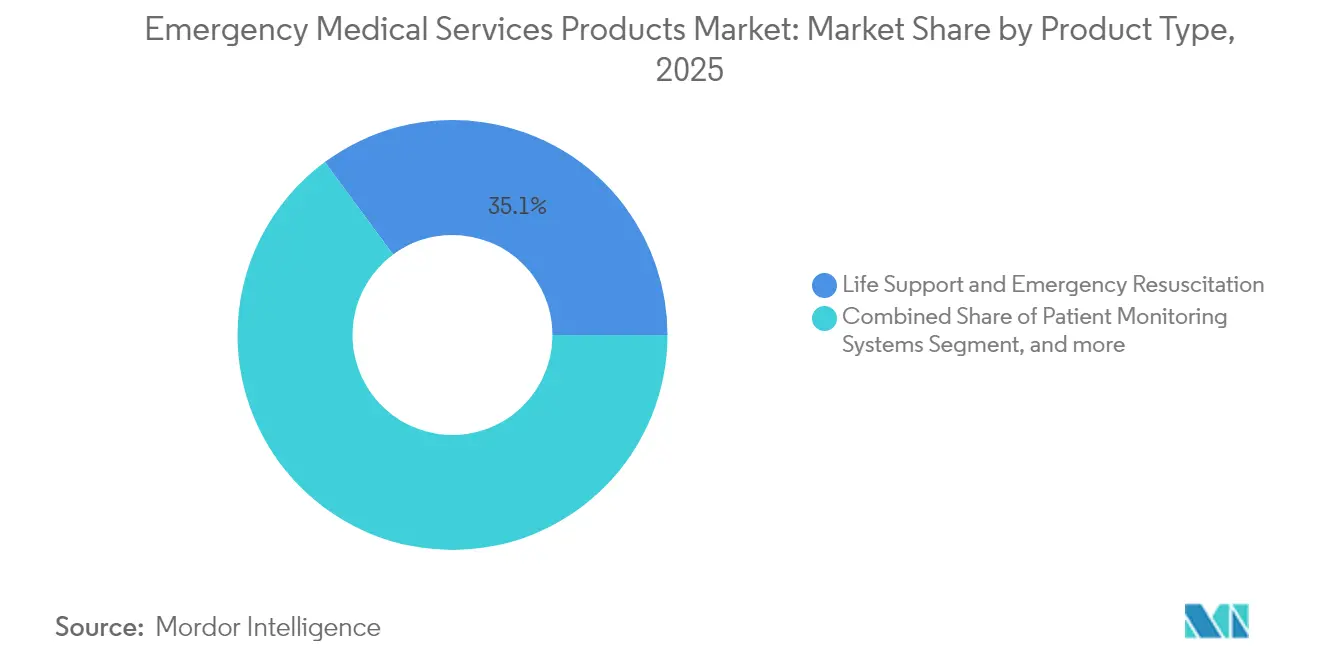
- By product type, life support and emergency resuscitation systems commanded a 35.12% revenue share in 2025, whereas automated chest compressors showed the strongest momentum, with a 7.72% CAGR through 2031.
- By application, cardiac care accounted for a dominant 42.10% of the emergency medical services products market share in 2025, while disaster & mass-casualty response is projected to expand at a 9.62% CAGR to 2031.
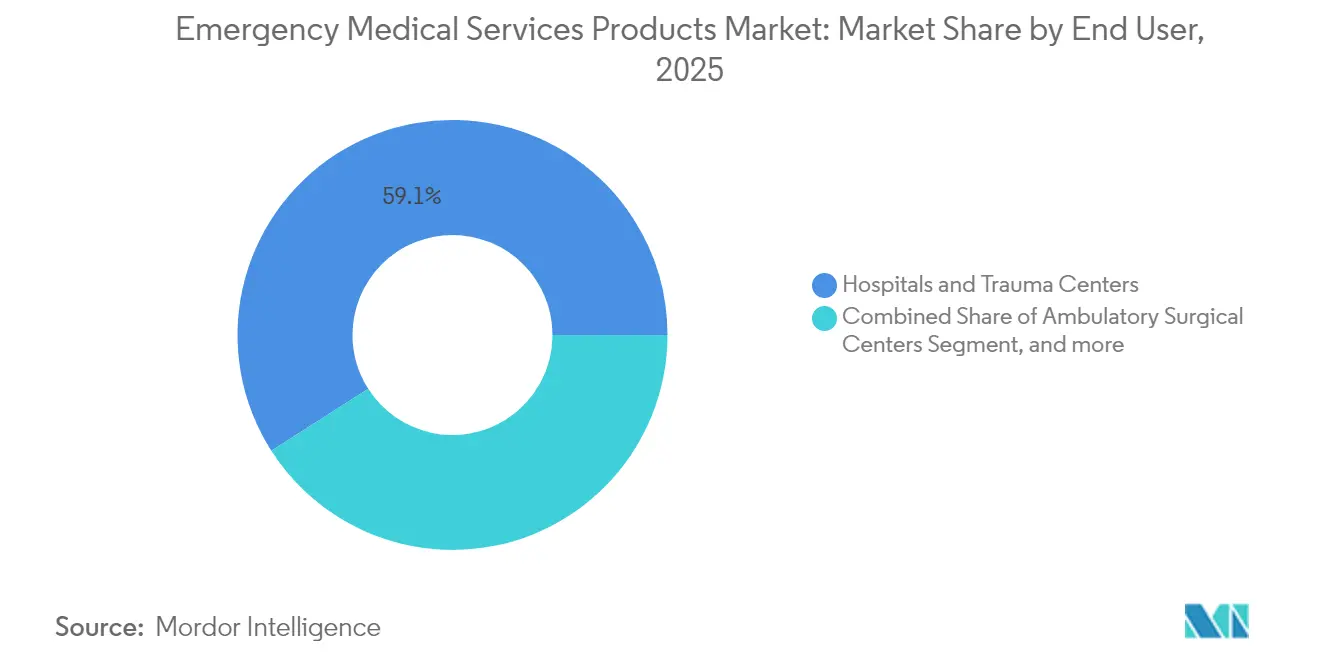
- By end user, hospitals & trauma centers held 59.05% of the emergency medical services products market size in 2025; ambulatory surgical centers are advancing at a 10.06% CAGR during the outlook period.
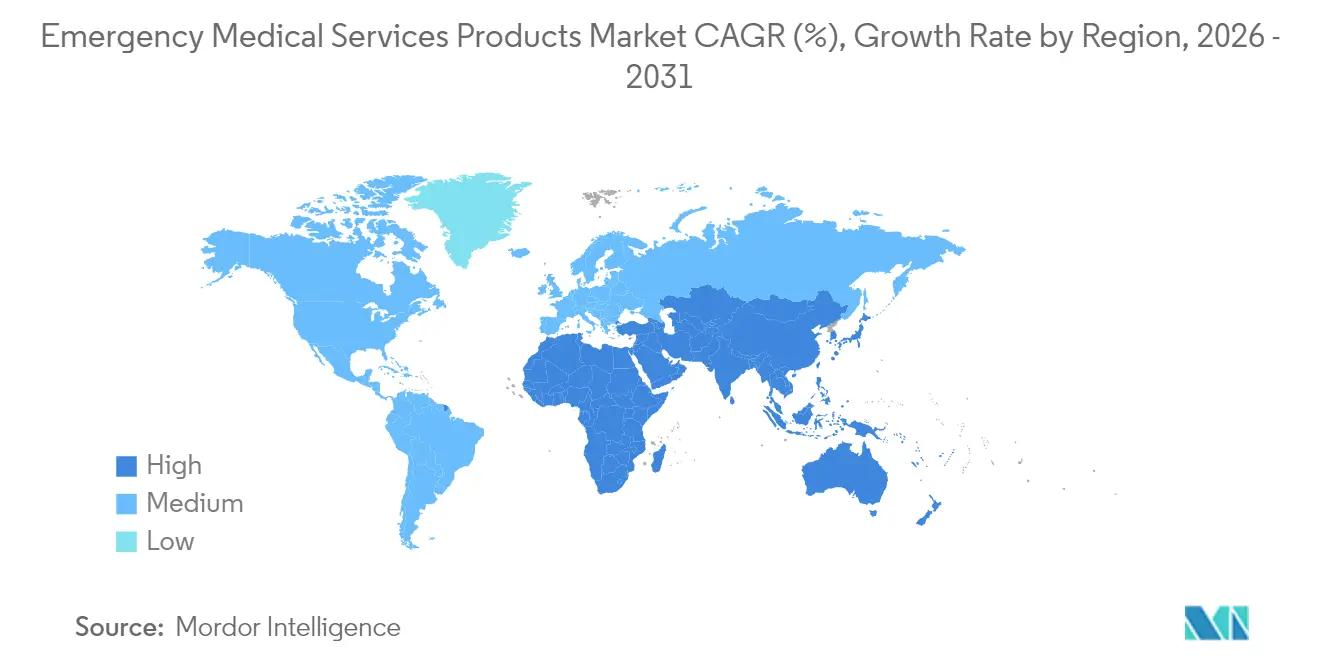
- By geography, North America led with a 36.78% revenue share in 2025, whereas Asia Pacific was the fastest-growing region, with a 8.97% CAGR.
Note: Market size and forecast figures in this report are generated using Mordor Intelligence’s proprietary estimation framework, updated with the latest available data and insights as of 2026.
Market Trends and Insights
Drivers Impact Analysis of Emergency Medical Services Products Market*
| Driver | (~) % Impact on CAGR Forecast | Geographic Relevance | Impact Timeline |
|---|---|---|---|
| Rising Incidence of Chronic Diseases & Injuries | +1.8% | Global, with concentration in North America & Europe | Long term (≥ 4 years) |
| Ageing EMS Vehicle & Equipment Fleets in OECD Regions | +1.2% | North America & Europe primarily | Medium term (2-4 years) |
| Government Mandates for Public-Access Defibrillators | +1.0% | North America, Europe, with expansion to APAC | Medium term (2-4 years) |
| Expansion of Hospital-Based Community Paramedicine Programs | +0.9% | North America core, spill-over to Europe & APAC | Long term (≥ 4 years) |
| Surge in Extreme-Weather Disasters Driving Pre-Positioned Kits | +0.7% | Global, with emphasis on disaster-prone regions | Short term (≤ 2 years) |
| AI-Enabled Triage Devices for On-Scene Decision Support | +0.6% | North America & Europe early adoption, APAC following | Medium term (2-4 years) |
| Source: Mordor Intelligence | |||
Rising Incidence of Chronic Diseases & Injuries
Cardiovascular, diabetic, and trauma cases continue to climb, with cardiac events alone driving 42.64% of EMS product deployments. Portable monitors that transmit encrypted vitals directly into hospital records improve care continuity for these patients. Community paramedicine units that manage chronic illnesses at home cut treatment costs by up to 30%, reinforcing demand for rugged, multi-parameter devices. Hospital-at-home models, now green-lighted for 10% of inpatient populations, rely on field-grade technology with hospital-grade accuracy.[1]American Hospital Association, “Hospital-at-Home Expansion Primer,” aha.org Equipment capable of self-calibration ensures functionality in regions lacking biomedical technicians, further boosting the Emergency medical services products market.
Aging EMS Vehicle & Equipment Fleets in OECD Regions
Ambulances typically serve for 12 years, but electronics need refreshing every 5-7 years to stay compliant. This predictability creates replacement cycles that favor integrated telemedicine consoles over legacy devices. Electric ambulances introduce unique power-management constraints, driving demand for low-draw ventilators and defibrillators. Dual labeling under FDA and UKCA rules raises compliance costs, so providers increasingly select platforms that can be software-updated remotely to meet changing standards. Satellite-enabled communication modules ensure data flow in areas lacking stable cellular networks, reinforcing adoption across dispersed geographies.
Government Mandates for Public-Access Defibrillators
Statutes enacted in states such as Maryland obligate AED installation in schools, offices, and transport hubs, broadening the customer base beyond traditional EMS buyers.[2]ZOLL Medical Corporation, “School AED Compliance Guide,” zoll.com Europe’s parallel requirements under updated device legislation mirror this push. Each new deployment seeds a recurring revenue stream: pads must be replaced every 2-4 years, and batteries every 3-5 years. Public training programs demand manikins and simulation platforms, opening secondary revenue avenues for manufacturers already present in the Emergency medical services products market.
Expansion of Hospital-Based Community Paramedicine Programs
Health-systems now integrate EMS crews into value-based-care models that reward avoided admissions. Programs in the United States report 17% fewer emergency visits, validating the economic logic of equipping field teams with advanced diagnostics. Paramedics carry handheld ultrasound, point-of-care blood analyzers, and AI-enhanced triage tablets. These tools collect longitudinal data that hospitals mine for predictive analytics, creating a flywheel effect that continues to drive the Emergency medical services products market.
Restraints Impact Analysis of Emergency Medical Services Products Market*
| Restraint | (~) % Impact on CAGR Forecast | Geographic Relevance | Impact Timeline |
|---|---|---|---|
| High Capital Cost & Complex Regulatory Approvals | -1.4% | Global, with emphasis on emerging markets | Long term (≥ 4 years) |
| Supply-Chain Disruptions for Critical Electronic Sub-Assemblies | -1.1% | Global, with particular impact on APAC manufacturing | Short term (≤ 2 years) |
| Talent Shortage of Biomedical Technicians in Rural Areas | -0.8% | North America & Europe rural regions | Medium term (2-4 years) |
| Growing Scrutiny on Single-Use Plastics in EMS Disposables | -0.5% | Europe primarily, expanding to North America | Medium term (2-4 years) |
| Source: Mordor Intelligence | |||
High Capital Cost & Complex Regulatory Approvals
Gaining FDA clearance for AI-embedded devices can stretch development timelines by three years and add USD 10-15 million to unit costs, deterring entrants and slowing rollout in low-resource settings. The EU Medical Device Regulation demands parallel technical files, doubling documentation. Smaller EMS agencies often rely on municipal grants to modernize fleets, yet budget ceilings still force staged procurement. The result is an adoption gap between flagship urban programs and cash-strapped rural services, constraining the Emergency medical services products market in price-sensitive segments.
Supply-Chain Disruptions for Critical Electronic Sub-Assemblies
Semiconductor shortages have lengthened component lead times to 52 weeks, prompting firms such as Stryker to dual-source printed circuit boards and boost inventory buffers.[3]Stryker Corporation, “Operational Update on Supply-Chain Diversification,” stryker.com Freight volatility adds further cost pressure. Design revisions that swap scarce chips for readily available equivalents necessitate fresh regulatory notifications, delaying shipments. The ripple effect is particularly harsh on start-ups that depend on just-in-time deliveries, dampening near-term growth prospects within the Emergency medical services products market.
*Our forecasts treat driver/restraint impacts as directional, not additive. The impact forecasts reflect baseline growth, mix effects, and variable interactions.
Emergency Medical Services Products Market Segment Analysis
By Product Type:
Life Support Dominance Meets Automation InnovationLife Support & Emergency Resuscitation gear retained a 35.12% slice of the emergency medical services products market in 2025. Adoption is anchored in the indispensable role of defibrillators, ventilators, and multi-parameter monitors during the golden hour of care. Mechanical CPR devices are transforming practice because they maintain consistent compressions during transport when the manual technique often deteriorates. The clinical evidence underpinning the LUCAS 3 and AutoPulse platforms has triggered procurement policies in multiple U.S. state EMS agencies. This trend is set to propel automated chest compressors at a 7.72% CAGR.
Wound-care consumables are under scrutiny due to mounting restrictions on single-use plastics. Manufacturers such as Verathon responded by introducing bio-based polymers that cut cradle-to-gate carbon footprints by 74% compared with petroleum-based equivalents. Patient handling rigs benefit from the aging demographic, while PPE demand persists amid ongoing pathogen vigilance. Drug-delivery and airway modules now incorporate audio prompts that coach correct dosing and tube placement, minimizing operator error in high-stress circumstances. Collectively, these sub-categories broaden solution suites and underpin the resilient trajectory of the Emergency medical services products market.



By Application:
Cardiac Care Leadership Challenged by Disaster PreparednessCardiac care captured 42.10% of the revenue in 2025 of the emergency medical services products market. High cholesterol prevalence, sedentary lifestyles, and population aging sustain this dominance. At-scene defibrillation within three minutes triples survival odds, a statistic that continues to prioritize cardiac intervention devices on municipal spending agendas. However, disaster and mass-casualty response is expanding at a 9.62% CAGR. The frequency of extreme weather and geopolitical conflicts keeps curated response kits in permanent demand, especially across seismically active and conflict-prone territories.
Trauma & injury management equipment registers steady procurement, supported by public bleeding-control campaigns. Respiratory care devices enjoy renewed interest due to fresh air-quality concerns after consecutive wildfire seasons. Specialized applications such as pediatric resuscitation remain small but critical niches, attracting players with ultra-compact ventilators and dosing tools. The evolving risk landscape ensures balanced growth across use cases and continues to diversify the emergency medical services products market.
By End User:
Hospital Concentration Faces Ambulatory DisruptionHospitals & trauma centers represented 59.05% of spending in 2025, reflecting their role as regional hubs that orchestrate both ground and air transport. The cluster maintains a technology refresh cycle that prioritizes interoperability with electronic health records. Yet, ambulatory surgical centers are gaining ground, underpinned by procedure volumes that are 40-60% cheaper than hospital equivalents, and are projected to grow by 25% by 2030. These centers require ready-for-use code carts and portable ventilators to stabilize sudden complications, driving a 10.06% CAGR in purchases.
Municipal EMS agencies, fire departments, and volunteer squads operate within fixed budgets, encouraging bulk procurement of modular devices that share batteries and disposables. Industrial sites, sports arenas, and educational institutions adopt easy-to-use AEDs outfitted with animated instructions, ensuring layperson confidence. Cumulatively, this widening user base strengthens the revenue diversity of the Emergency medical services products market.
Geography Analysis
North America Emergency Medical Services Products Market
North America held 36.78% of the Emergency medical services products market in 2025, buoyed by stable reimbursement and mature trauma-care networks. More than 320 U.S. hospitals have CMS approval for hospital-at-home programs, compelling investment in broadband-enabled telemetry systems. Canada expands satellite-linked ambulance coverage to remote territories, while Mexico leverages medical tourism to benchmark equipment against international standards. The ongoing replacement of analog radios with secure digital protocols further stimulates spending across the region.
Europe Emergency Medical Services Products Market
Europe combines steady demand with regulatory complexity. The EU Medical Device Regulation requires detailed clinical effectiveness data, prolonging launch timelines yet guaranteeing safety. Germany and France sustain procurement of AI-capable monitors, whereas the United Kingdom navigates dual MDR and UKCA filings. Nordic systems showcase end-to-end tele-EMS, integrating smart stretchers that weigh patients and adjust ventilator parameters in transit. Southern Europe, seeking cost-efficient answers, experiments with leasing models that spread capital outlays over contract lifecycles.
APAC Emergency Medical Services Products Market
Asia Pacific is projected to clock a 8.97% CAGR through 2031. China’s rural emergency network expansion funnels grants into drone-assisted AED delivery in remote villages. India, now the world’s most populous nation, pairs its vibrant private hospital sector with public ambulance upgrades to maintain credentialing for global insurers. Japan pilots robotics in rapid extracorporeal CPR, whereas South Korea integrates 5G coverage to stream high-definition ultrasound from moving ambulances. Emerging ASEAN economies co-invest in regional training centers to standardize paramedic skill sets, securing a pipeline of consumables and durable medical hardware. The multi-layered growth map cements Asia’s role as the incremental engine of the Emergency medical services products market.

Regulatory Landscape
Emergency medical services (EMS) products are primarily regulated as medical devices, so market access depends on quality-system and post-market requirements, not only on clinical and safety evidence. In the United States, the FDA implemented the Quality Management System Regulation (QMSR) effective February 2, 2026, replacing the legacy Quality System Regulation and raising the bar for integrated risk management across design, manufacturing, and corrective actions, which is especially relevant for high-acuity, electronics-heavy EMS devices such as monitors and defibrillators. FDA cybersecurity expectations for device premarket submissions were updated in February 2026 to align with this framework, increasing compliance workload for connected, cloud-linked, and software-updatable field equipment.
In Europe, the EU Medical Device Regulation (MDR) continues to drive deeper technical documentation and clinical evidence demands. The mandatory use of EUDAMED starting May 28, 2026 adds another operational layer for manufacturers placing EMS products on the EU market. For AI-enabled EMS tools, regulatory overlap has increased: the EU Artificial Intelligence Act (Regulation (EU) 2024/1689) intersects with MDR, and MDCG 2025-6 guidance clarifies expectations around AI-related conformity activities for medical devices. These changes reinforce the advantage of manufacturers with mature quality, cybersecurity, and regulatory infrastructure, while extending timelines and raising costs for smaller vendors bringing AI-embedded triage and monitoring capabilities into regulated EMS workflows.
Competitive Landscape
The emergency medical services products market remains fragmented. Stryker, Medtronic, and GE HealthCare dominate high-acuity equipment by pairing long-standing brand trust with AI software roadmaps. Stryker’s USD 4.9 billion buyout of Inari Medical in 2024 broadened its vascular-emergency portfolio, while Medtronic deepened ties with cloud analytics firms to enrich remote-monitoring dashboards. GE HealthCare exploits its installed base in hospital imaging to cross-sell transport monitors that share user interfaces with stationary machines.
Private equity has intensified its presence, epitomized by Bridgefield Capital acquiring Philips’ Emergency Care division in January 2025. The carve-out underscores the financial-sponsor belief that scale and supply-chain consolidation can unlock margin expansion in a USD 26 billion addressable arena. Meanwhile, mid-tier challengers differentiate through eco-friendly materials. Verathon’s bio-polymer disposables resonate with European customers seeking to curb single-use plastic waste. Start-ups focus on AI-only solutions, but many partner with incumbents to access regulatory infrastructure.
Supply-chain resilience is emerging as a decisive moat. Stryker diversifies printed-circuit sourcing across three continents, reducing chip-shortage risk. ZOLL integrates edge-processing chips that reduce cloud dependency, delivering uninterrupted guidance in disaster zones. Players with vertically integrated manufacturing and in-house software talent are best positioned to navigate a landscape that increasingly rewards interoperability, data security, and environmental stewardship in the Emergency medical services products market.
Emergency Medical Services Products Industry Leaders
GE Healthcare
Medtronic
3M
Stryker Corporation
McKesson Corporation
- *Disclaimer: Major Players sorted in no particular order
Emergency Medical Services Products Market Companies Covered in this Report
- Mckesson
- Medline Industries
- Stryker
- ICU Medical
- Cardinal Health
- Beckton Dickinson
- GE Healthcare
- Medtronic
- 3M
- B. Braun
- Zoll Medical
- Koninklijke Philips
- Hill-Rom Holdings Inc. (Baxter)
- Johnson & Johnson
- Laerdal Medical
- Teleflex
- Hamilton Medical
- Getinge
- Smiths Group
- Mölnlycke Health Care
Read Analysis of Emergency Medical Services Products Companies

Market Opportunities and Future Outlook
Interoperability and integrated monitoring ecosystems are a key whitespace for EMS providers that need to connect pre-hospital vitals capture with in-hospital workflows, within ongoing workforce constraints and more digitized care pathways such as community paramedicine and hospital-at-home. A specific example is the March 2026 expansion of the Medtronic and GE HealthCare global strategic alliance to integrate Medtronic monitoring parameters (Nellcor, Microstream, INVOS, BIS) into GE HealthCare monitoring platforms. This reinforces supplier roadmaps focused on parameter consolidation, standardized user interfaces, and data continuity across care settings, supporting opportunities for EMS-ready transport monitors and gateways that reduce device variability across fleets and simplify training, maintenance, and quality audits.
Capital availability and supply-chain resilience also support modernization of EMS consumables and durable devices, especially where aging equipment cycles intersect with procurement constraints. In June 2026, McKesson closed a USD 1.25 billion strategic investment with Apollo Funds for a minority interest in its Medical-Surgical Solutions business (valued at USD 13 billion), highlighting investor interest in scaled distribution and supply reliability for frontline medical products. At the same time, lead-time pressure for critical electronic sub-assemblies, with component lead times extending to 52 weeks in the sector, keeps attention on dual sourcing, inventory buffering, and design-for-availability. That mix creates opportunities for vendors offering standardized, serviceable EMS platforms with secured software updates and more stable component strategies across multiple geographies.
Recent Industry Developments in Emergency Medical Services Products Market
- July 2026: Medtronic completed the acquisition of SPR Therapeutics, Inc. for $650 million, expanding access to minimally invasive, non-opioid peripheral nerve stimulation therapies. The deal strengthens Medtronic's neuromodulation portfolio and broadens chronic pain management capabilities, positioning the company to capture growing demand for non-opioid pain relief solutions.
- July 2026: Stryker Corporation announced the U.S. commercial launch of the Mako RPS (Robotic Power System) for total knee replacement procedures, introducing Mako Handheld Robotics. The launch expands Stryker's robotic-assisted surgery ecosystem and may accelerate adoption of precision knee replacement in the high-volume U.S. market.
- June 2026: GE HealthCare received U.S. Food and Drug Administration (FDA) 510(k) clearance for MIM Contour ProtégéAI+ 2.0, an AI-enabled auto-contouring software for radiation therapy planning. The clearance strengthens GE HealthCare's radiation oncology workflow by enabling faster treatment planning and potential throughput gains, supporting AI-assisted planning in oncology settings.


Emergency Medical Services Products Market Report Scope and Research Methodology
Market Definition and Coverage
This market covers the value of products used in pre-hospital emergency care and patient transport, including equipment and consumables typically stocked on ambulances and used by emergency responders, as well as related clinical-use items purchased for EMS readiness.
Scope exclusions: We exclude ambulance vehicle sales, staffing and dispatch services, training, and most long-term hospital equipment purchases that are not tied to EMS use cases.
Segments Covered in This Report
- By Product Type
- Life Support & Emergency Resuscitation
- Defibrillators
- Ventilators
- Laryngoscopes
- Automated Chest Compressors
- Other Systems
- Patient Monitoring Systems
- Wound Care Consumables
- Dressings & Bandages
- Sutures & Staples
- Hemostatic Agents
- Other Consumables
- Patient Handling Equipment
- Medical Beds
- Wheelchairs & Scooters
- Stretchers & Transfer Equipment
- Other Equipment
- Infection Control & PPE
- Disinfectant & Cleaning Agents
- Personal Protective Equipment
- Air Filtration & Isolation Supplies
- Other Supplies
- Drug Delivery & Airway Management
- Intraosseous Access Devices
- Bag Valve Masks
- Infusion Pumps
- Other Products
- Life Support & Emergency Resuscitation
- By Application
- Cardiac Care
- Trauma & Injury Management
- Respiratory Care
- Disaster & Mass-Casualty Response
- Other Applications
- By End User
- Hospitals & Trauma Centers
- EMS Agencies & Fire Departments
- Ambulatory Surgical Centers
- Other End Users
- By Geography
- North America
- United States
- Canada
- Mexico
- Europe
- Germany
- United Kingdom
- France
- Italy
- Spain
- Rest of Europe
- Asia Pacific
- China
- Japan
- India
- Australia
- South Korea
- Rest of Asia-Pacific
- Middle East & Africa
- GCC
- South Africa
- Rest of Middle East & Africa
- South America
- Brazil
- Argentina
- Rest of South America
- North America
Data Sources, Market Sizing, and Validation
Desk Research
Desk research was used to build the starting structure for the model, and then to place guardrails around volumes, pricing, and adoption by geography. Public sources help us interpret demand triggers like emergency incident burden, population aging, and policy focus on first-response readiness, before detailed market splits are finalized.
Sources consulted include non-paywalled statistics and publications such as CDC injury and emergency care indicators, WHO health and emergency care datasets, OECD health statistics, UN population data, and FDA medical device safety communications and recall notices. We also reviewed company annual reports, investor presentations, and reputable press for product mix clues and channel changes, along with paid subscriptions for company financials and intelligence, patent databases, and shipment-level import and export trade data to cross-check supply movement. These examples are not exhaustive, and many other sources were also used for data collection, validation, and clarification during the research process.
Primary Interviews and Surveys
Primary work was used to pressure-test what the desk data could not fully explain, especially how EMS agencies and distribution channels behave when budgets tighten or when protocols change. We spoke with a mix of manufacturers, distributors, EMS procurement teams, and clinical experts across major regions so the final assumptions reflect real ordering patterns and reasonable average selling prices (ASPs) rather than list prices.
Inputs from these discussions were used to confirm replacement cycles, tender behavior, product bundling (kits versus individual items), and the adoption path of critical care monitoring and resuscitation devices in ambulances, which then helped us tighten the model before finalizing the market totals.
Distribution of primary research fieldwork respondents
| Company type | Respondent position | Region |
|---|---|---|
| Top tier: 26% | CXOs: 15% | APAC: 46% |
| Mid tier: 57% | Functional/Unit leaders: 31% | EMEA: 30% |
| Smaller Players: 17% | Managers: 54% | Americas: 24% |
Market-Sizing & Forecasting
Sizing was built using a top-down approach where the demand pool is reconstructed from EMS activity and readiness needs by region, and then mapped to product consumption and equipment stocking norms in ambulances and response units. Because public data rarely shows product spend directly, the model uses practical bridges like ambulance fleet and call volume signals, expected equipment sets per vehicle, and replacement frequency, which are then translated into value using ASP ranges.
To make sure totals stayed realistic, we also ran selective bottom-up approximations using supplier revenue cues, channel checks from distributors, and sampled ASP times estimated units for high-value categories like defibrillation, ventilation, and patient monitoring, followed by a consistency check against smaller consumables such as wound care and infection control items. Where product volume visibility was limited in certain countries, gaps were handled by using proxy ratios from comparable markets and then adjusting based on primary feedback on stocking levels and procurement maturity.
For forecasting, we relied on scenario analysis supported by expert views on budget cycles and protocol updates, and then applied trend curves for a few inputs that materially move the market. Key variables tracked include emergency incident burden and trauma load, aging population share, EMS funding and tender cadence, replacement cycles for capital devices, and ASP progression driven by feature upgrades and mix shift toward advanced life support kits.
Data Validation & Update Cycle
Model outputs were checked against independent signals such as regional EMS spend direction, procurement patterns seen in tenders, and whether implied unit demand fit realistic fleet and call activity. When large variances showed up, assumptions were revisited, outliers were discussed internally, and follow-up conversations were triggered with selected interviewees to confirm what changed and why.
Before sign-off, the work goes through multi-step analyst review so category totals, regional splits, and growth drivers stay consistent with the evidence trail. Reports are refreshed annually, and interim updates are made when material events affect pricing, supply availability, or demand patterns. Right before delivery, a fresh pass is done so clients receive the most current view that can be supported by traceable inputs.
Mordor Intelligence's Emergency Medical Services Products Market Size Compared Against Other Published Estimates
Published market values for EMS products can differ because teams choose different timing, scope boundaries, and pricing logic, and then these choices add up across many product lines. In this market, the spread is usually driven by whether the estimate counts only pre-hospital product demand or also includes adjacent hospital purchases, and whether values are stated in constant currency or current currency.
A refresh-led difference shows up when pricing is updated using current-year procurement behavior, currency conversion timing, and realistic ASPs net of typical channel discounts and tender effects, which is then rechecked with distributor feedback and device replacement patterns, before the final number is locked in for Mordor Intelligence.
Benchmark comparison
| Source | Market Size | Gaps in Research Methodology |
|---|---|---|
| Mordor Intelligence | USD 35.49 B (2026) | |
| Trade Journal A | USD 31.00 B (2024) | Uses an earlier base year and may understate later-period ASP inflation and mix shift toward higher-value monitoring and resuscitation devices, which can pull the value down when compared on a later currency timing. |
| Industry Platform B | USD 7.96 B (2024) | Appears to apply a narrower product scope that likely captures only select device categories, which can omit large consumable and patient handling spend that is typically bundled into EMS procurement. |
Taken together, the differences are mainly about what gets counted as EMS-only product demand, and how pricing and currency are treated across years. By keeping the scope tied to pre-hospital use, updating ASP inputs with validated purchasing behavior, and reconciling totals with independent demand signals, the final estimate stays practical to audit and easier to reuse for planning.


Key Questions Answered in the Report
What is the current size of the emergency medical services products market?
It is valued at USD 35.49 billion in 2026 and is forecast to grow to USD 49.02 billion by 2031.
Which product category leads market revenue?
Life support & emergency resuscitation devices hold 35.12% of 2025 sales, led by defibrillators and ventilators.
Why are automated chest compressors gaining traction?
Clinical studies show consistent mechanical CPR improves survival, supporting a 7.72% CAGR for this segment.
Which region is expanding fastest?
Asia Pacific is growing at 8.97% CAGR due to infrastructure upgrades and rising healthcare investment.
How do public-access defibrillator mandates influence demand?
Legislation requiring AEDs in schools and workplaces expands installations and drives steady consumables revenue.
What challenges hamper market growth?
High regulatory costs and semiconductor supply-chain disruptions can delay product launches and inflate prices.
Page last updated on:





