
Ambulance Stretchers Market Size and Share
Market Overview
| Study Period | 2020 - 2031 |
|---|---|
| Market Size (2026) | USD 2.38 Billion |
| Market Size (2031) | USD 2.79 Billion |
| Growth Rate (2026 - 2031) | 3.27 % |
| Fastest Growing Market | Asia-Pacific |
| Largest Market | North America |
| Market Concentration | Medium |
Major Players *Disclaimer: Major Players sorted in no particular order Image © Mordor Intelligence. Reuse requires attribution under CC BY 4.0. | |
Ambulance Stretchers Market Analysis by Mordor Intelligence
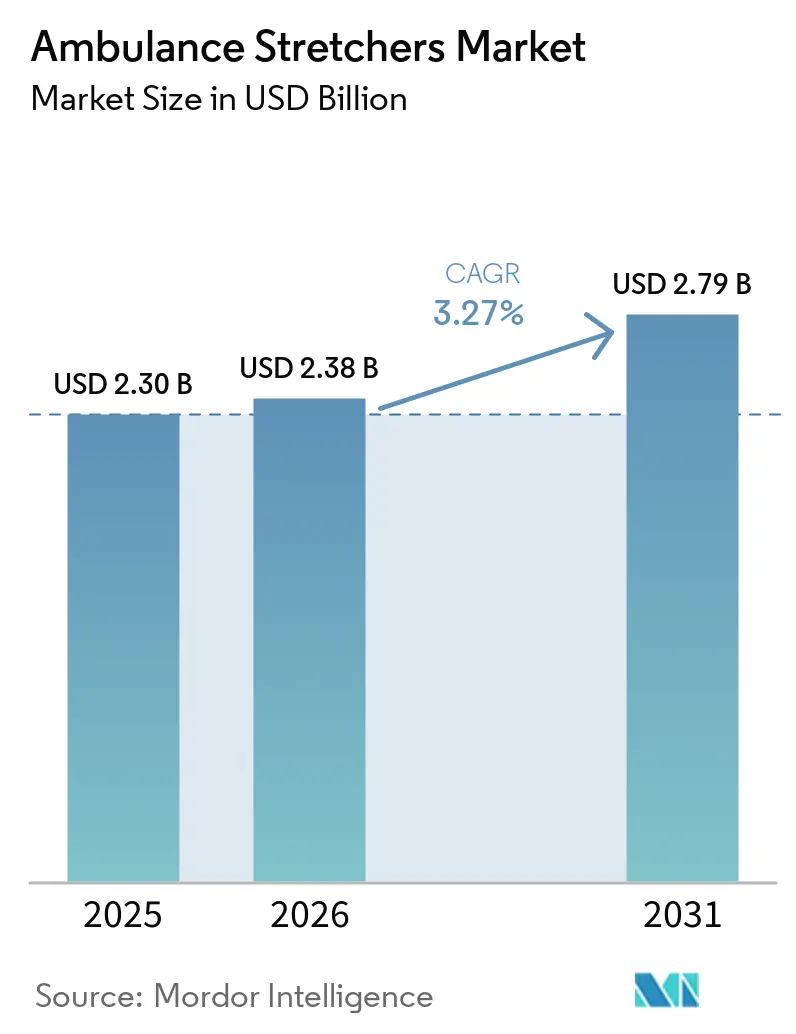
ambulance stretchers market size in 2026 is estimated at USD 2.38 billion, growing from 2025 value of USD 2.30 billion with 2031 projections showing USD 2.79 billion, growing at 3.27% CAGR over 2026-2031. Demand is rising as aging populations require equipment that accommodates multiple chronic conditions and as low- and middle-income countries expand trauma-care capacity. Workforce-safety regulations in developed economies are accelerating the shift from manual to electric-powered models, while road-traffic injuries in emerging regions sustain baseline volume growth. The dual focus on bariatric capability and rapid patient transfers is reshaping procurement priorities, opening white-space for platform-based products compatible across ambulance types. Supply-chain disruption during the pandemic has also lowered the entry barrier for regional suppliers willing to address cost-sensitive buyers with compliant yet affordable designs.
Key Report Takeaways
- By product type, transport stretchers held 45.74% of the ambulance stretcher market share in 2025, whereas bariatric stretchers are forecast to expand at a 9.1% CAGR through 2031.
- By technology, the manual segment retained 60.62% of ambulance stretcher market share in 2025, while electric systems are advancing at a 10.02% CAGR to 2031.
- By end user, hospitals and trauma centers captured 67.95% of the ambulance stretcher market size in 2025; military and disaster-relief agencies are projected to grow at an 8.18% CAGR.
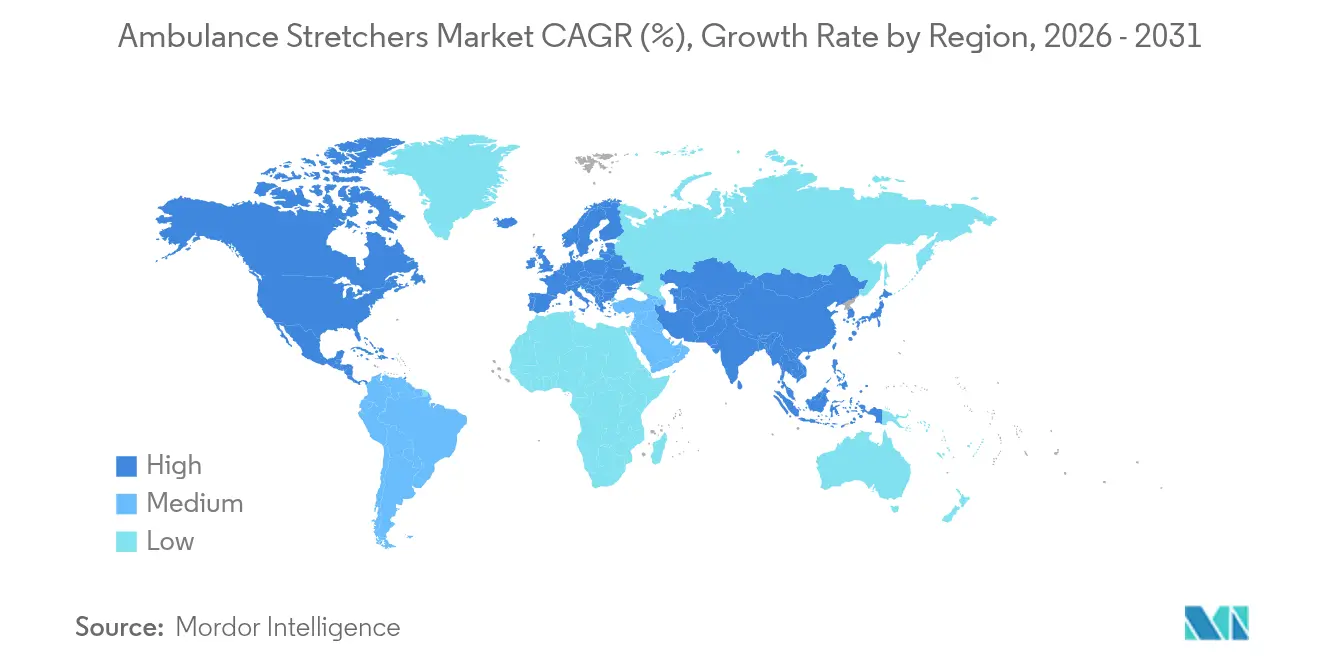
- By geography, North America led with 35.34% revenue share in 2025, whereas the Middle East and Africa region is growing fastest at 7.33% CAGR.
Note: Market size and forecast figures in this report are generated using Mordor Intelligence’s proprietary estimation framework, updated with the latest available data and insights as of 2026.
Market Trends and Insights
Drivers Impact Analysis of Ambulance Stretchers Market*
| Driver | (~) % Impact on CAGR Forecast | Geographic Relevance | Impact Timeline |
|---|---|---|---|
| Aging-Linked Chronic Disease Burden | +0.80% | Global, with concentration in North America & Europe | Long term (≥ 4 years) |
| Road-Traffic Trauma Growth In EMs & LMICs | +0.60% | APAC, MEA, Latin America | Medium term (2-4 years) |
| Worldwide Upgrade To Type III & Modular Ambulances | +0.40% | North America, Europe, developed APAC markets | Medium term (2-4 years) |
| EMS Reimbursement Expansion In APAC | +0.30% | APAC core markets | Short term (≤ 2 years) |
| Extreme-Temperature Response-Ready Composite Stretchers | +0.20% | Global, with emphasis on extreme climate regions | Long term (≥ 4 years) |
| OEM-Agnostic IoT Sensor Retrofits Driving Aftermarket | +0.20% | Developed markets globally | Short term (≤ 2 years) |
| Source: Mordor Intelligence | |||
Aging-Linked Chronic Disease Burden
One in five U.S. residents will be at least 65 years old by 2030, intensifying demand for stretchers with multi-position functions, wider frames, and enhanced pressure-relief surfaces.[1] Healthcare providers facing physician shortages are adopting ergonomic equipment to transfer complex cases safely with fewer staff, making stretcher design a workforce-retention lever rather than a routine purchase. Bariatric devices now double as mobility platforms inside emergency departments, shortening handoff times and lowering fall risk. Procurement teams increasingly specify weight ratings above 300 kg and integrated monitoring rails as baseline requirements. These shifts collectively amplify premium-segment revenue and expand the addressable pool for electric power-lift models.
Road-Traffic Trauma Growth in EMs & LMICs
Road accidents account for 37.3% of trauma cases in Addis Ababa and similar shares across sub-Saharan hubs, yet only 13.6% of victims receive adequate stabilization before hospital transfer in countries like Tanzania. This mismatch drives demand for durable stretchers able to perform both extraction and transport functions under resource constraints. International donor programs now bundle stretcher purchases with ambulance grants, accelerating first-generation upgrades in provincial fleets. Manufacturers responding with cost-down versions that still meet EN1789 and FDA class I requirements widen their reach without compromising safety. As governments adopt WHO trauma-system guidelines, spending on transport and scoop stretchers is shifting from sporadic tenders to multiyear budgets, lifting baseline volumes across Africa and South Asia.
Worldwide Upgrade to Type III & Modular Ambulances
Advanced chassis allow caregivers to reconfigure interiors between trauma, cardiac, and neonatal loads, raising the importance of stretchers that dock to multiple floor tracks and maintain compatibility with equipment used across the hospital stretchers market. Composite frames that resist biofluid corrosion and contain RFID tags for preventive maintenance are moving from premium to mainstream. OEM-agnostic stretcher mounts shorten vehicle build cycles and lower whole-life costs, a key selling point for fleet operators under fixed-payment EMS contracts. Integration of multi-point restraint systems improves crash survivability and supports national road-safety targets. The net effect is sustained replacement demand across mature markets even as fleet counts plateau.
EMS Reimbursement Expansion in APAC
Japan’s increase in ambulance transport payments improved hospital acceptance rates and prompted regional neighbors to trial similar policies.[2] Higher tariffs free up working capital for devices that cut unloading times, such as powered cots with one-button lift functions. Singapore’s prototype motorized stretcher, designed for single-operator use, illustrates how fee reforms spur local R&D tailored to dense urban environments.[3] Private hospital chains in Southeast Asia are replicating this approach to differentiate service quality and attract medical tourists. As reimbursement ceilings rise, procurement decisions shift from the lowest up-front price to total cost of ownership, encouraging the adoption of telematics-ready stretchers that flag maintenance needs automatically.
Restraints Impact Analysis of Ambulance Stretchers Market*
| Restraint | (~) % Impact on CAGR Forecast | Geographic Relevance | Impact Timeline |
|---|---|---|---|
| Device-Related Musculoskeletal Injuries To EMS Staff | -0.40% | Global, with highest impact in developed markets | Short term (≤ 2 years) |
| Capital-Intensive Power-Lift Systems For Low-Income Fleets | -0.30% | LMICs, rural healthcare systems globally | Medium term (2-4 years) |
| Stricter Biocontamination Norms Lengthen Approval Cycles | -0.20% | Global, with emphasis on FDA and EU regulated markets | Medium term (2-4 years) |
| Raw-Material Price Volatility | -0.20% | Global, with highest impact on cost-sensitive markets | Short term (≤ 2 years) |
| Source: Mordor Intelligence | |||
Device-Related Musculoskeletal Injuries to EMS Staff
EMS personnel register injury rates surpassing construction workers, with manual cot lifting singled out as a primary cause. University of Waterloo research found a 78% drop in paramedic injuries after powered stretcher deployment. Despite clear ROI from reduced compensation claims, some municipal services defer upgrades due to procurement cycles and union negotiations. Worker-safety advocacy groups now lobby regulators to set mandatory force-exertion thresholds, potentially accelerating electric adoption but raising near-term compliance costs. Persistent staffing shortages magnify the operational impact of each injury, incentivizing fleets to accelerate replacement timetables once financing aligns.
Capital-Intensive Power-Lift Systems for Low-Income Fleets
A powered cot and compatible loading rail can exceed USD 40,000, a sum greater than annual equipment budgets for many district hospitals. Maintenance complexity and patchy electricity supply add hidden costs that deter rural buyers even when grant funding offsets the purchase price. As a result, the ambulance stretchers market bifurcates into premium, automation-rich offerings for developed settings and rugged manual designs for cash-strapped operators. Non-governmental aid organisations often procure refurbished stretchers to stretch limited funds, but upcoming FDA regulations on remanufacturing could constrain this workaround by imposing stricter traceability requirements. Unless financing models evolve, penetration of power-lift systems will stall in underserved regions, capping upside for global volume growth.
*Our forecasts treat driver/restraint impacts as directional, not additive. The impact forecasts reflect baseline growth, mix effects, and variable interactions.
Ambulance Stretchers Market Segment Analysis
By Product:
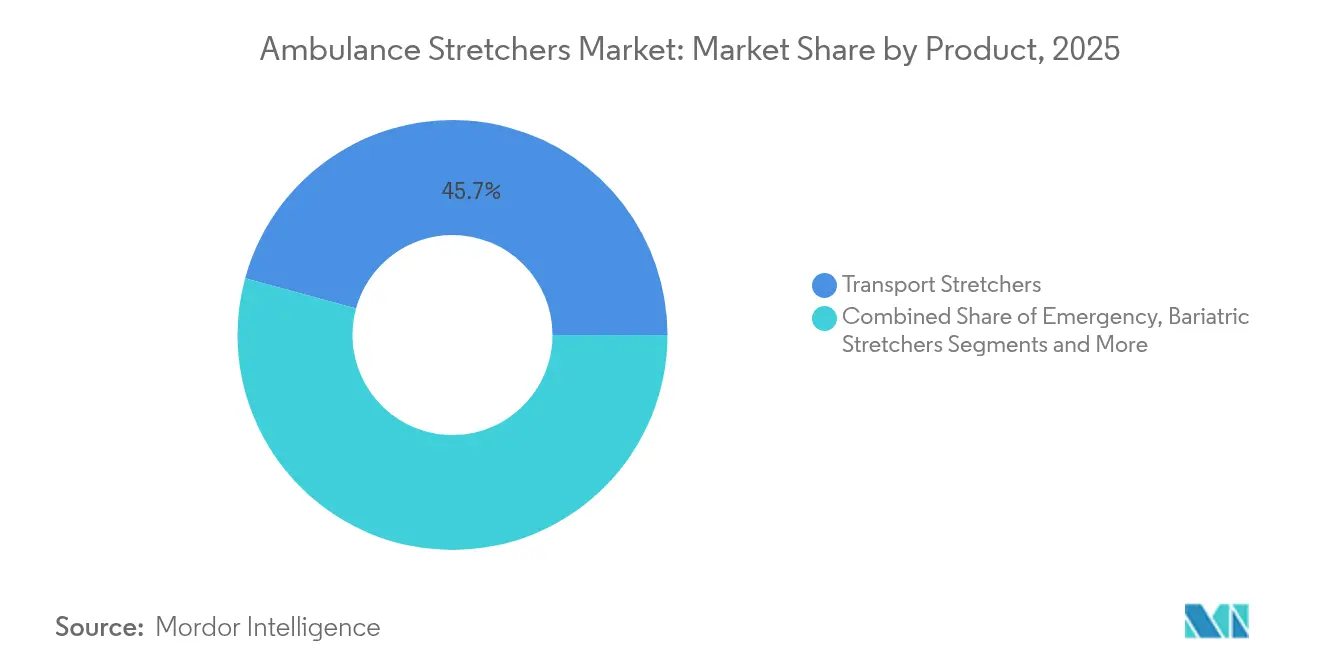
Transport Dominance Masks Bariatric OpportunityTransport stretchers generated the most significant revenue slice, accounting for 45.74% of the ambulance stretchers market size in 2025. Their ubiquity across emergency fleets ensures predictable replacement cycles, but commoditization pressures margins as specifications standardize. Bariatric models, by contrast, are climbing at 9.1% CAGR as obesity prevalence rises in developed economies. Scoop and basket stretchers continue to serve confined-space rescues, yet remain niche. Neonatal variants see steady demand tied to hospital birthing volumes, while trauma-specific designs face moderate growth as modular ambulance interiors assume more tasks.
Demand for bariatric equipment is reinforced by regulations that stipulate minimum safe-working loads above 300 kg and require four-point harnesses for larger patients. These standards drive the procurement of stretchers with more expansive decks and motorized height adjustment. In turn, manufacturers integrate antimicrobial coatings and quick-swap mattress systems to minimize turnaround time in high-occupancy departments. As a result, the bariatric line is transitioning from optional inventory to essential stock in tertiary-care facilities, expanding its revenue contribution in the broader ambulance stretchers market.

By Technology:
Electric Transition Accelerates Despite Manual DominanceManual designs will still command 60.62% of the ambulance stretcher market in 2025, supported by lower up-front cost and minimal maintenance. Yet, electric units exhibit 10.02% CAGR as care providers quantify lifetime savings from injury avoidance and faster turnaround. Pneumatic and hydraulic platforms serve rural or military users where battery reliability is uncertain, but their share is shrinking as lithium-iron-phosphate cells improve cold-weather performance.
Adopters of electric coats often bundle automated loading rails, cutting patient loading time by up to 30 seconds and lowering exertion forces below occupational-safety thresholds. Real-time diagnostics embedded in motor controllers trigger service alerts before faults immobilize vehicles, enhancing fleet uptime. Coupled with IoT telemetry, these features position electric stretchers as data-generating assets, aligning with hospital digital twin initiatives. Consequently, the technology shift is poised to reshape the ambulance stretchers market as mature purchasers replace legacy rigs on five- to seven-year cycles.
By End User:
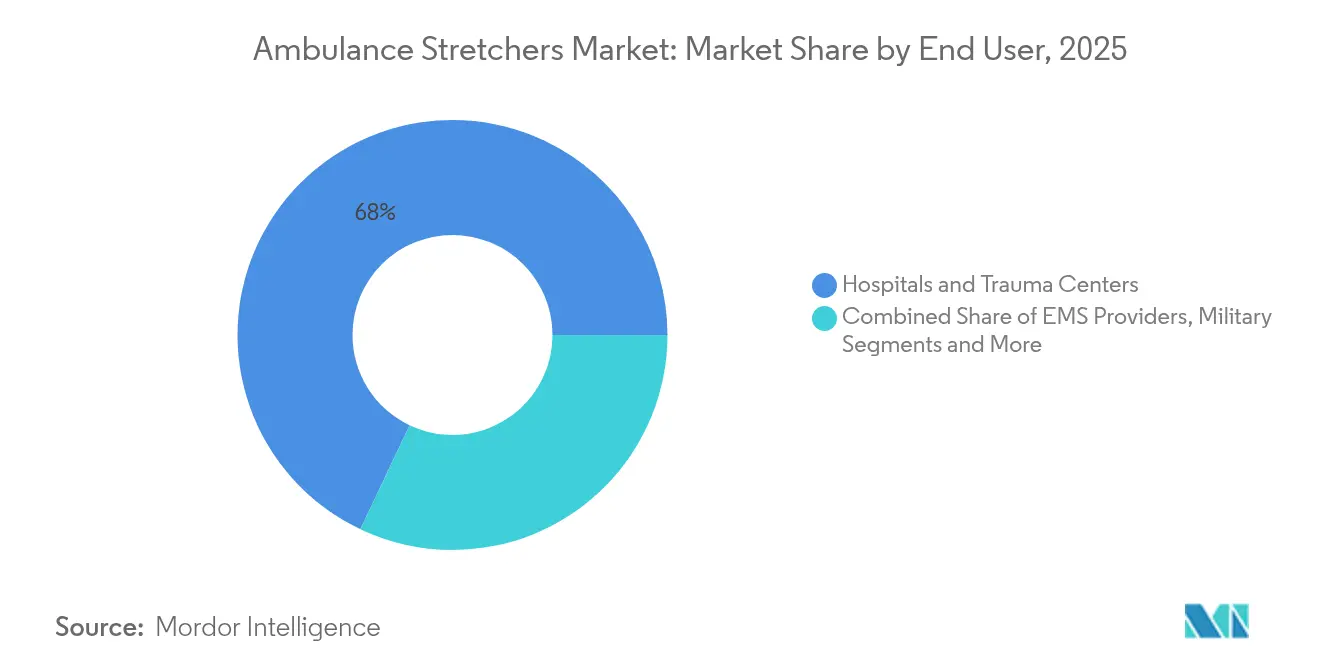
Military Growth Outpaces Traditional HealthcareHospitals and trauma centers contribute 67.95% of the ambulance stretcher market share, reflecting their central role in patient stabilization and intra-facility transfers. Procurement volumes mirror admission rates and regulatory mandates for worker safety. Military and disaster-relief agencies, however, are growing at 8.18% CAGR, buoyed by modernization programs that prioritize rapid casualty evacuation. The trend spans NATO and non-aligned nations alike, spurred by heightened geopolitical risk and climate-driven natural disasters.
Defense buyers specify stretchers compatible with rotary-wing platforms and CBRN-resistant materials, pushing suppliers into niche engineering. Disaster agencies need collapsible, lightweight frames deployable in austere conditions, often with thermal blankets integrated for hypothermia management. These divergent requirements spur product-line extensions that subsequently filter into civilian ambulance fleets seeking multipurpose capability, creating spillovers that benefit the entire ambulance stretchers industry.
Geography Analysis
North America Ambulance Stretchers Market
North America holds a 35.34% revenue share and sets the pace for regulatory and technology trends. Occupational-safety statutes and high labor costs favor powered systems, sustaining premium pricing. The U.S. CARES Act capital allocations enabled county EMS agencies to refresh fleets post-pandemic, while Canadian provinces adopted similar stimulus frameworks. The ongoing alignment of the FDA Quality System Regulation with ISO 13485 raises compliance costs while stabilizing product quality, reinforcing the market position of well-capitalized incumbents.
MEA Ambulance Stretchers Market
The Middle East and Africa region delivers the fastest CAGR at 7.33% by 2031. Governments channel oil revenues into tertiary hospitals and trauma centers, with Saudi Arabia alone budgeting USD 50.4 billion for health-sector development in 2023. Private operators building medical-tourism hubs in the Gulf import U.S. and European stretcher brands to meet Joint Commission International accreditation. Simultaneously, African Union programs subsidize basic EMS fleets, opening doors for value-engineered models. This two-tier demand landscape encourages multinational vendors to localize assembly to sidestep import duties and qualify for public tenders.
APAC Ambulance Stretchers Market
Asia Pacific is the most diverse territory. Japan and Singapore mandate advanced safety features, fostering early adoption of motorized stretchers and telematics. Conversely, populous nations such as Indonesia focus on scaling fleet numbers with robust manual units. Domestic manufacturing incentives under schemes like India’s Production-Linked Incentive encourage joint ventures, facilitating technology transfer while containing costs. As digital health funding rises, hospitals in South Korea and Australia pilot stretchers with integrated RFID to streamline asset tracking, setting precedents that the wider region may emulate.
Regulatory Landscape
Ambulance stretchers and related patient handling equipment fall under medical-device frameworks that also intersect with ambulance-vehicle safety requirements. In the United States, wheeled stretchers used in ambulances are regulated by the US Food and Drug Administration under 21 CFR 880.6910 as Class II (special controls) devices, with an exemption from 510(k). As a result, market entry focuses on meeting special controls, labeling, and quality requirements rather than premarket submission timelines.
In Europe, access to the market is governed by the EU Medical Device Regulation (MDR) 2017/745, with risk-based classification that is commonly Class I for non-invasive devices under Annex VIII Rule 1. Compliance is supported through conformity evidence to relevant standards that ambulance services and builders use for technical documentation and procurement specifications. A 2026 anchor is DIN’s June 2026 release of updated EN 1865 series adoptions, including DIN EN 1865-1:2026 (general stretcher systems and patient handling equipment) and related parts covering heavy-duty stretchers and transfer chairs. This is expected to translate into updated test evidence, documentation requirements, and procurement specs for crashworthiness and interoperability with ambulance fixation systems.
Value Chain Analysis
Upstream, the value chain relies on high-strength aluminum and steel, medical-grade polymers and foams, composites, and, for powered platforms, electric motors, actuators, batteries, and electronic control modules. OEM manufacturing then converts these inputs into stretcher builds through metal fabrication (including CNC machining and welding), deck and chassis assembly, and integration of powered lift and drive systems as well as fastening interfaces. Final stages include load, stability, and safety testing aligned with ambulance-use standards, including stretcher fixation and dynamic testing expectations linked to EN 1789 and the EN 1865 family.
On the downstream side, suppliers reach buyers through direct sales to hospital and EMS fleets, public tenders, and regional distributor networks. Ambulance upfitters also pull demand by bundling stretchers with vehicle interiors and locking or fastening systems. Cost and timing bottlenecks show up in tariff and cross-border shipping exposure for key components, longer lead times for electronics and actuators, and dependence on closed-loop cot-fastener ecosystems that can limit fleet standardization. On the localization side, examples such as Indian suppliers aligning products to AIS-125 certified ambulance requirements show how domestic sourcing and serviceability are used to compete in cost-sensitive tenders while still meeting compliance thresholds.
Competitive Landscape
The ambulance stretchers market features a moderately consolidated structure anchored by Stryker, Ferno-Washington, and Hill-Rom. Collectively, these players leverage global distribution, broad product portfolios, and certification expertise to defend share against price-focused entrants. Their innovation pipelines center on injury-reduction technology, IoT integration, and modular component platforms that shorten new-product cycles. Stryker’s MedSurg division posted 10.6% growth in 2024 on the back of powered cot demand, reinforcing the profitability of premium positioning.
Regional manufacturers in China, Turkey, and Poland exploit supply-chain resiliency concerns by touting localized sourcing and faster lead times. Some collaborate with ambulance OEMs to supply private-label stretchers bundled in turnkey vehicles, eroding incumbents' brand visibility in cost-sensitive markets. Regulatory convergence around ISO 13485 eases cross-border expansion for compliant mid-tier firms, intensifying competition in Latin America and Eastern Europe.
Strategic moves increasingly revolve around data services. Leading vendors embed sensor suits that track load cycles, battery health, and cleaning compliance, offering subscription analytics that create recurring revenue. Partnerships with fleet-management software providers integrate stretcher status into dispatch dashboards, enhancing value propositions beyond hardware. Meanwhile, aftermarket refurbishment gains traction as hospitals seek circular-economy credentials, although forthcoming FDA remanufacturing guidance will likely thin the field to operators with robust quality systems.
Ambulance Stretchers Industry Leaders
-
Stryker Corporation
-
Ferno-Washington Inc.
-
Narang Medical Limited
-
Fu Shun Hsing Technology Co. Ltd
-
Hill-Rom Services Inc. (Baxter)
- *Disclaimer: Major Players sorted in no particular order

Ambulance Stretchers Market Companies Covered in this Report
- Stryker
- Ferno-Washington
- Hill-Rom
- Medline Industries
- Arjo AB
- GF Health Products
- Spencer Italia S.r.l.
- Dragon Industry (ZJG) Co. Ltd.
- Fu Shun Hsing Technology Co. Ltd.
- Jiangsu Rixin Medical Equipment Co. Ltd.
- ROYAX s.r.o.
- Narang Medical Ltd.
- Zhangjiagang New Fellow Med Co. Ltd.
- Allied Healthcare Products
- Dragerwerk
- Promeba SL
- MeBer s.r.l.
- EMSRUN Technology Co. Ltd.
- Junkin Safety Appliance Co.
- Laerdal Medical AS
- Ambulanz Mobile GmbH
Market Opportunities and Future Outlook
Standards updates and fleet safety programs are creating room for suppliers that can document compliance while reducing caregiver lifting forces. The June 2026 publication of DIN EN 1865-3:2026-06 for heavy-duty stretchers, together with the broader EN 1865 family emphasis on powered assistance and patient handling performance, supports demand in bariatric and high-load transport configurations. It also strengthens the case for compatible fastening ecosystems that simplify ambulance retrofits across mixed fleets.
Capacity additions and localization efforts are another pathway to capture awards where lead times and aftersales coverage influence purchasing decisions. In North America, REV Group’s Horton Emergency Vehicles completed a facility expansion step in November 2025 through a 20,000 square foot building purchase in Grove City, Ohio, for final assembly and delivery with early-2026 operations. This reinforces how coordination between stretcher builds, mounting systems, and vehicle integration can affect timing and competitiveness. Separately, domestic manufacturing programs in markets such as India, where suppliers position AIS-125-aligned stretcher lines backed by local supply chains, point to opportunities for value-engineered manual and hybrid platforms that remain serviceable outside major metro hubs.
Recent Industry Developments in Ambulance Stretchers Market
- March 2026: The United States Patent and Trademark Office published a patent assigned to Stryker for an ambulance cot and loading and unloading system (filed June 2025). The publication signals ongoing R&D around integrated cot and fastener workflows, supporting differentiation through automation, ergonomics, and system-level compatibility.
- April 2025: Ferno introduced the Power F2 Fastening System with Cross-Drive technology and the Power X2 Ambulance Cot at FDIC International 2025. The paired launch reinforces the shift toward powered cot ecosystems where fastening, loading, and cot design are engineered together to improve safety and reduce handling time.
- August 2024: Road Rescue debuted the RediMedic Type I and Type III ambulance platform featuring composite body panels and Per4Max restraint integration. By tying interior safety systems and vehicle configuration to EMS workflows, the platform launch raises the importance of stretcher mounting interfaces and restraint compatibility in ambulance procurement.
Ambulance Stretchers Market Report Scope and Research Methodology
Market Definition and Coverage
This market covers revenue earned from ambulance stretchers used to move patients in pre-hospital and transport settings, including both manual and powered systems, plus key accessories that are typically sold with the stretcher.
Scope exclusions: We exclude fixed hospital stretchers that are not designed for ambulance loading, and we also exclude ambulance vehicle sales and broader EMS consumables.
Segments Covered in This Report
- By Product
- Transport Stretchers
- Emergency Stretchers
- Bariatric Stretchers
- Neonatal & Paediatric Stretchers
- Scoop & Basket Stretchers
- By Technology
- Manual
- Electric-Powered
- Hydraulic/Pneumatic
- Automated Loading Systems
- By End-User
- Hospitals & Trauma Centers
- EMS Providers
- Military & Disaster-Relief Agencies
- Others
- By Geography
- North America
- United States
- Canada
- Mexico
- Europe
- Germany
- United Kingdom
- France
- Italy
- Spain
- Rest of Europe
- Asia Pacific
- China
- Japan
- India
- South Korea
- Australia
- Rest of Asia Pacific
- Middle East & Africa
- GCC
- South Africa
- Rest of Middle East & Africa
- South America
- Brazil
- Argentina
- Rest of South America
- North America
Data Sources, Market Sizing, and Validation
Desk Research
We start by mapping what gets purchased, who buys it, and how often replacement happens, then we align those inputs with healthcare activity and safety requirements. For grounding, we refer to public sources such as the World Health Organization, OECD health statistics, the US CDC and NHTSA road safety datasets, and national procurement portals and tender archives where equipment specifications and buying cycles are visible.
Next, we cross-check demand signals with supplier disclosures and product documentation. Company annual reports, investor presentations, and regulatory and standards references that influence EMS equipment design help confirm adoption drivers, such as staff injury reduction and bariatric transport readiness. Where available, paid subscription sources for company financials and intelligence are used alongside patents and import-export shipment-level tracking to confirm directionality on volumes, pricing bands, and trade flows. These desk sources are illustrative and not exhaustive, and we reviewed other public references to collect, validate, and clarify inputs.
Primary Interviews and Surveys
To reduce uncertainty in areas where public datasets are thin, we run expert interviews and structured surveys with EMS providers, ambulance operators, hospital procurement staff, distributors, and service technicians, then reconcile those inputs with the desk research. Because demand patterns vary with emergency response funding and fleet modernization pace, we collect feedback across APAC, EMEA, and the Americas to test assumptions on replacement cycles, the powered-stretcher mix, and service attachment rates against what buyers and technicians describe from day-to-day operations.
Distribution of primary research fieldwork respondents
| Company type | Respondent position | Region |
|---|---|---|
| Top tier: 30% | CXOs: 16% | APAC: 39% |
| Mid tier: 48% | Functional/Unit leaders: 27% | EMEA: 37% |
| Smaller Players: 22% | Managers: 57% | Americas: 24% |
Market-Sizing & Forecasting
Sizing is built using top-down and bottom-up logic, beginning with a demand pool reconstructed from ambulance fleet counts, EMS run volumes, and equipment replacement behavior, then translated into annual unit needs and value. We corroborate totals with selective bottom-up checks, such as sampled price points by stretcher class and channel feedback on shipment mix, then adjust when local purchasing patterns differ.
A few practical inputs shape the model, including the share of powered versus manual stretchers, typical replacement cycles by fleet maturity, penetration of automated loading and ergonomic features, average selling price progression by technology, and the portion of demand linked to bariatric-capable units. When unit data is limited for smaller markets, we use proxy indicators like population served, emergency incidence trends, and public spending direction to keep totals consistent with observed procurement behavior.
For forecasting, scenario analysis is used because policy funding levels, labor safety priorities, and product mix shifts can change adoption faster or slower than a simple trend line. Assumptions on technology mix and pricing are stress-tested with primary feedback, and the final forecast is produced only after the drivers remain coherent across regions and end users.
Data Validation & Update Cycle
We validate outputs by triangulating market totals against independent signals such as fleet renewal announcements, tender volumes, and the implied units-per-ambulance relationship, then reviewing any variance that appears out of range. If a country total shifts sharply or the pricing curve no longer fits recent procurement reality, analysts re-check the underlying inputs and, where needed, reconnect with respondents to confirm what changed.
Before sign-off, the model and assumptions go through a multi-step internal review to confirm calculation logic and scope consistency. Reports are refreshed annually, with interim updates when material events occur, and a final pre-delivery check is completed so clients receive the most current view available at the time of release.
Mordor Intelligence's Ambulance Stretchers Market Size Compared With Other Published Estimates
Published market sizes for ambulance stretchers can vary widely because researchers do not always count the same products, geographies, or selling channels, and they may use different base years and inflation assumptions. The differences are often more visible when powered systems and loading aids are either bundled into the counted value or kept separate.
The largest gap drivers usually come from whether hospital-only stretcher demand is blended into ambulance demand, how accessories and service contracts are treated in revenue, and whether pricing is converted using a single spot rate versus an average-year currency assumption. Another common factor is refresh timing, since procurement can move quickly after funding changes, and some models do not re-check replacement cycles with buyers and technicians often enough.
Benchmark comparison
| Source | Market Size | Gaps in Research Methodology |
|---|---|---|
| Mordor Intelligence | USD 2.38 B (2026) | |
| Industry Research Firm A | USD 2.62 B (2025) | Uses a different base year and appears to mix end-user coverage more broadly (including wider facility purchasing), which can lift value before adjusting for the ambulance-only demand pool. |
| Research Platform B | USD 0.85 B (2025) | Reports a much narrower revenue capture that seems closer to stretcher hardware only, with limited inclusion of powered feature premiums and bundled accessories, which reduces the stated total. |
The spread across sources mainly points to scope alignment issues, particularly on what gets counted with the stretcher and how end-use settings are filtered, and that scope discipline is applied consistently in the model used by Mordor Intelligence.
Key Questions Answered in the Report
What is the current value of the ambulance stretchers market?
The ambulance stretchers market stands at USD 2.38 billion in 2026.
How fast is the ambulance stretchers market expected to grow?
It is projected to expand at a 3.27% CAGR, reaching USD 2.79 billion by 2031.
Which product segment is growing quickest?
Bariatric stretchers are advancing at 9.1% CAGR due to rising obesity rates and updated safe-handling regulations.
Why are electric ambulance stretchers gaining traction?
They reduce caregiver injuries and speed patient loading, leading to a 10.02% CAGR despite higher initial cost.
Which region offers the highest growth potential?
The Middle East and Africa region leads in growth at 7.33% CAGR thanks to large-scale health-infrastructure spending.