
Electronic Shift Operations Management Solutions Market Size and Share
Market Overview
| Study Period | 2020 - 2031 |
|---|---|
| Market Size (2026) | USD 6.83 Billion |
| Market Size (2031) | USD 10.33 Billion |
| Growth Rate (2026 - 2031) | 8.62 % |
| Fastest Growing Market | Asia Pacific |
| Largest Market | North America |
| Market Concentration | Medium |
Major Players *Disclaimer: Major Players sorted in no particular order Image © Mordor Intelligence. Reuse requires attribution under CC BY 4.0. | |
Electronic Shift Operations Management Solutions Market Analysis by Mordor Intelligence
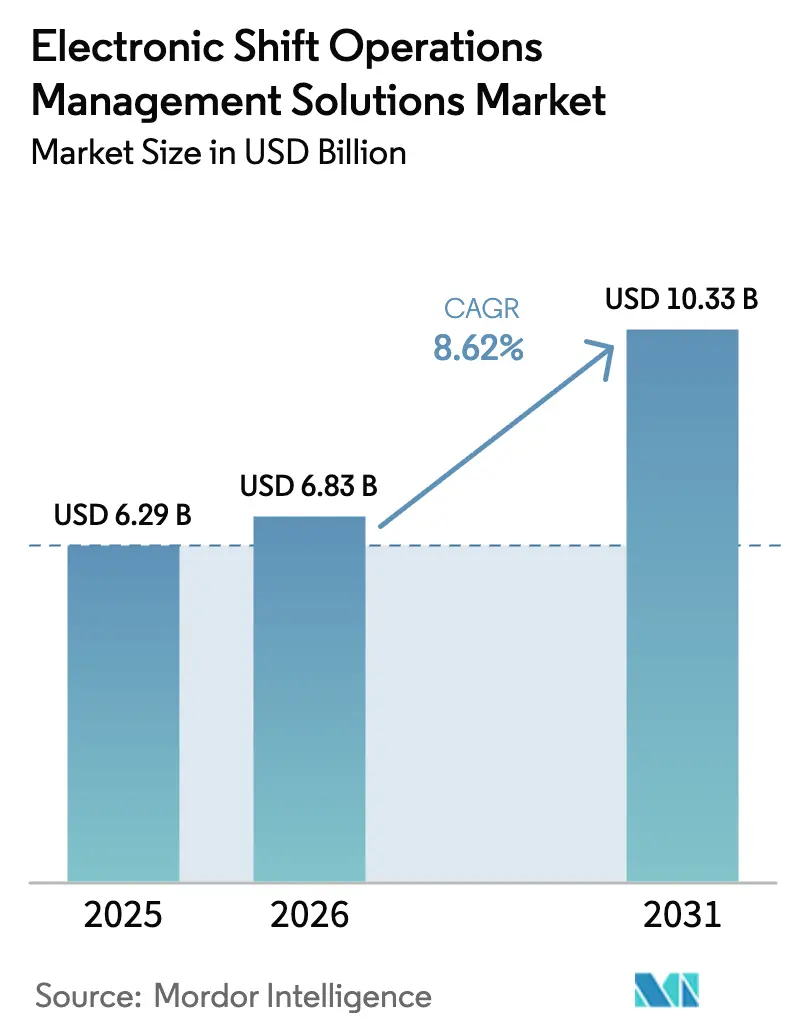
The Electronic Shift Operations Management Solutions market size is expected to grow from USD 6.29 billion in 2025 to USD 6.83 billion in 2026 and is forecast to reach USD 10.33 billion by 2031 at 8.62% CAGR over 2026-2031. This growth is driven by the retirement of paper-based shift handovers, the fusion of operational technology with cloud-native platforms, and the push for higher safety and regulatory compliance in critical infrastructure. Large energy and utilities operators accelerate adoption by linking workforce scheduling to asset-performance data, while AI-powered predictive analytics unlock productivity gains in manufacturing and mining. Cloud deployment lowers upfront costs, yet hybrid architectures gain traction as operators safeguard sensitive operational technology data. Heightened cyber-risk in industrial control systems further prompts investment in integrated solutions that unite security with shift coordination.
Key Report Takeaways
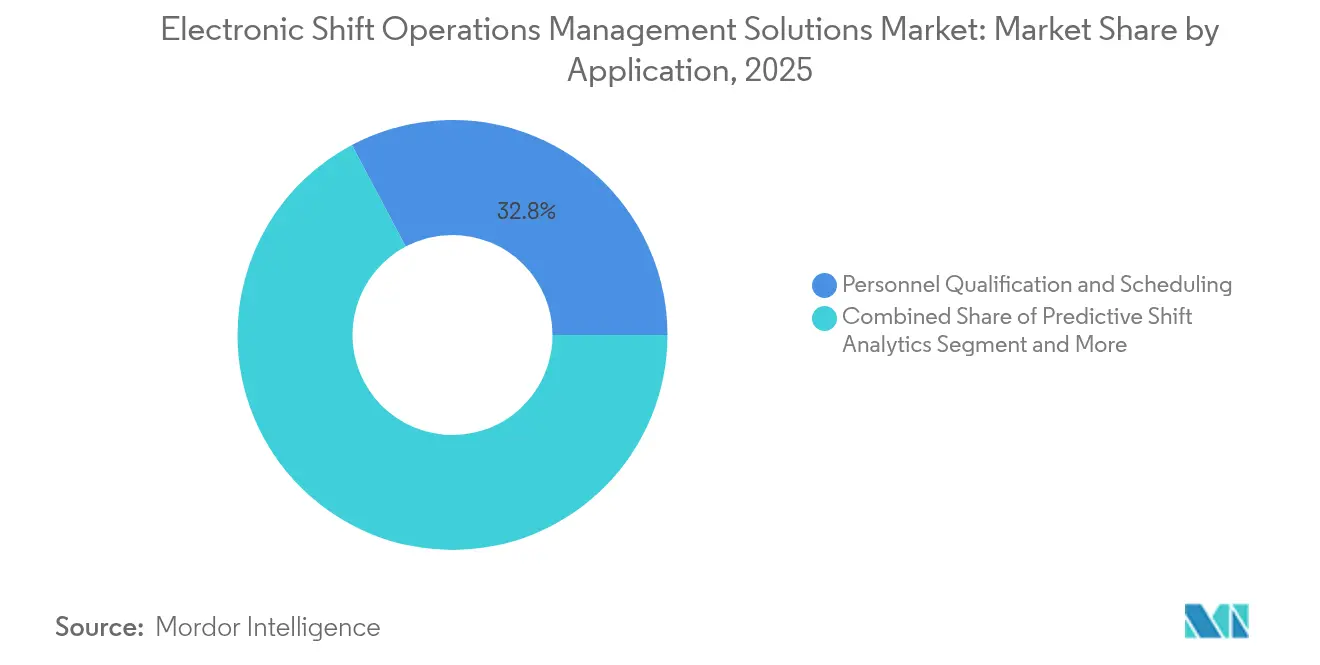
- By application, Personnel Qualification and Scheduling led with a 32.75% revenue share of the Electronic Shift Operations Management Solutions market in 2025, whereas Predictive Shift Analytics is projected to advance at an 11.05% CAGR through 2031.
- By end-user industry, oil and gas accounted for 26.65% of the Electronic Shift Operations Management Solutions market share in 2025; metals, mining, and materials are expected to grow at a 10.55% CAGR to 2031.
- By deployment mode, cloud solutions held 53.95% of the Electronic Shift Operations Management Solutions market in 2025, yet hybrid models show the quickest expansion at an 10.75% CAGR to 2031.
- By organization size, large enterprises captured 62.85% of the Electronic Shift Operations Management Solutions market value in 2025, while small and mid-sized enterprises are set to rise at an 11.25% CAGR through 2031.
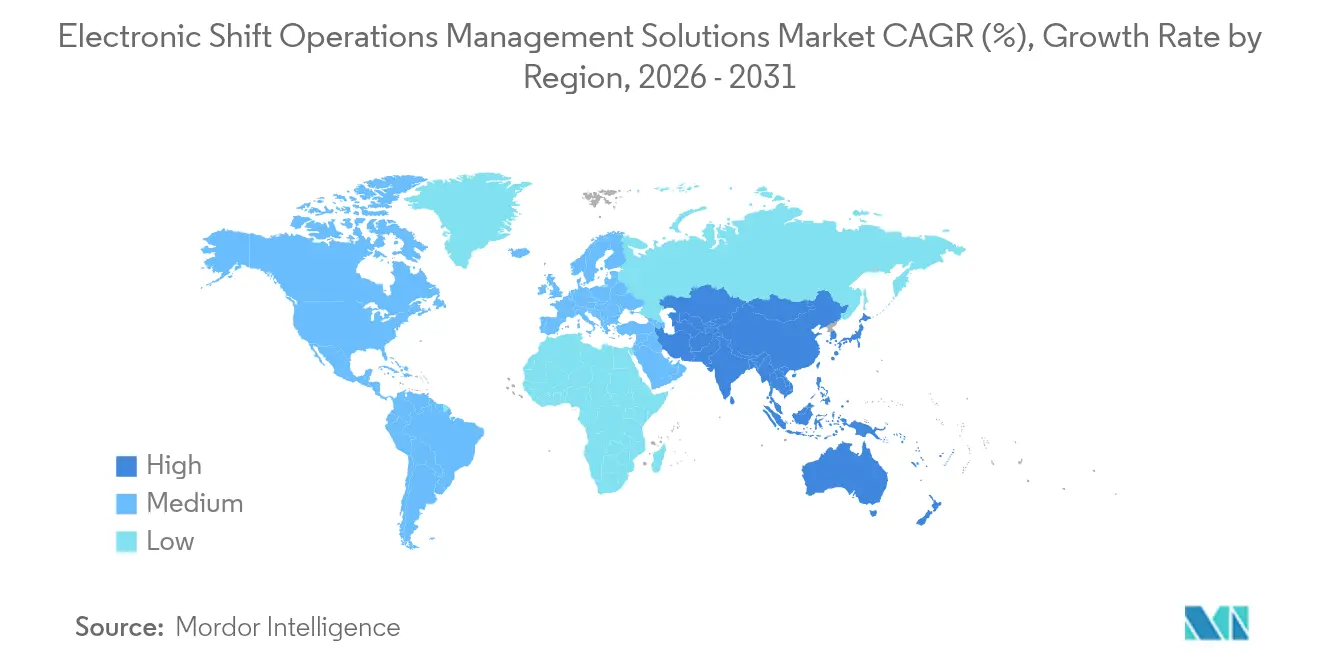
- By geography, North America commanded 36.25% of 2025 revenue, whereas Asia-Pacific is poised for an 11.05% CAGR to 2031.
Note: Market size and forecast figures in this report are generated using Mordor Intelligence’s proprietary estimation framework, updated with the latest available data and insights as of 2026.
Market Trends and Insights
Drivers Impact Analysis of Electronic Shift Operations Management Solutions Market*
| Driver | ( ~ ) % Impact on CAGR Forecast | Geographic Relevance | Impact Timeline |
|---|---|---|---|
| Rising demand across energy and utilities | +2.1% | Global, with a concentration in North America and Europe | Medium term (2-4 years) |
| Automation and integration of mission-critical operations | +1.8% | Global, led by Asia-Pacific manufacturing hubs | Long term (≥ 4 years) |
| Adoption of cloud-native shift platforms | +1.5% | North America and EU, expanding to APAC | Short term (≤ 2 years) |
| Regulatory push for digital logbooks and safety compliance | +1.3% | Global, strongest in regulated industries | Medium term (2-4 years) |
| AI-driven predictive scheduling and LLM copilots | +1.2% | North America and EU early adopters, APAC following | Long term (≥ 4 years) |
| Digital-twin convergence for real-time shift analytics | +0.9% | Global, concentrated in process industries | Long term (≥ 4 years) |
| Source: Mordor Intelligence | |||
Rising Demand Across Energy and Utilities
Energy operators seek to minimize outage risk and reduce maintenance costs. Argonne National Laboratory estimates that AI-enabled grid maintenance software can cut crew visits by up to 66%. Utilities, therefore, prioritize platforms that merge workforce scheduling with asset insights to keep grids reliable amid renewable variability. Shiftboard’s energy-focused suite showcases how compliance tracking and emergency roster management are packaged for sector needs. [1]Shiftboard, “Energy Workforce Scheduling Software,” shiftboard.com These factors buoy the Electronic Shift Operations Management Solutions market as utilities retire spreadsheets in favor of real-time, rule-based scheduling.
Automation and Integration of Mission-Critical Operations
Industry 4.0 initiatives dissolve the divide between plant-floor controls and enterprise software, fueling unified shift-handover systems. PPG’s digital paint lines achieved 30% productivity gains via GE Vernova’s iFIX deployment. Bosch Connected Industry’s Shift Book demonstrates similar gains by automating data capture for operators. These examples illustrate why integrated solutions become standard in the Electronic Shift Operations Management Solutions market.
Adoption of Cloud-Native Shift Platforms
Cost-effective SaaS models open enterprise-grade tools to smaller firms. Microsoft’s patent for virtual assistant technology signals a future where conversational AI supports supervisors during shift turnover. Hybrid cloud adoption rises as operators weigh scalability against data-sovereignty rules; MIT Technology Review notes 37% of firms now favor hybrid strategies. This dynamic broadens the Electronic Shift Operations Management Solutions market user base.
Regulatory Push for Digital Logbooks and Safety Compliance
The FDA’s 2026 Quality Management System Regulation compels life-science plants to adopt electronic documentation. Sun Pharmaceuticals cut errors through AmpleLogic’s digital logbook, underscoring compliance benefits. Similar mandates in chemicals and energy reinforce demand, cementing recurring revenue in the Electronic Shift Operations Management Solutions market.
Restraints Impact Analysis of Electronic Shift Operations Management Solutions Market*
| Restraint | (~) % Impact on CAGR Forecast | Geographic Relevance | Impact Timeline |
|---|---|---|---|
| High initial installation and switching costs | -1.4% | Global, particularly affecting SMEs | Short term (≤ 2 years) |
| Shortage of skilled technical workforce | -1.1% | Global, acute in developed markets | Medium term (2-4 years) |
| Heightened cyber-risk in critical infrastructure | -0.8% | Global, concentrated in OT environments | Long term (≥ 4 years) |
| Legacy OT/IT data-silo integration hurdles | -0.7% | Global, prevalent in established industries | Medium term (2-4 years) |
| Source: Mordor Intelligence | |||
High Initial Installation and Switching Costs
Licensing, integration, and training outlays deter budget-constrained firms. FHI Works estimates hidden warehouse labor costs can erode productivity by 40%. [2]FHI Works, “The Hidden Costs of Warehouse Labor,” fhiworks.com While SaaS models defray capital expenses, fear of disruption slows decisions, restraining immediate Electronic Shift Operations Management Solutions market uptake among smaller operators.
Shortage of Skilled Technical Workforce
Only 13% of manufacturers possess centralized operational-technology visibility, reflecting a talent gap. Cyber expertise is scarce as incidents rise 73% in industrial networks. Limited staff slows platform rollouts and underscores the need for vendor training services, tempering Electronic Shift Operations Management Solutions market growth.
*Our forecasts treat driver/restraint impacts as directional, not additive. The impact forecasts reflect baseline growth, mix effects, and variable interactions.
Electronic Shift Operations Management Solutions Market Segment Analysis
By Application:
Personnel Qualification Anchors Predictive AnalyticsPersonnel Qualification and Scheduling contributed USD 2.06 billion to the Electronic Shift Operations Management Solutions market size in 2025 and remained the cornerstone because operator credentials directly influence safety. Utilities, refineries, and pharmaceutical plants leverage competency matrices to ensure staff meet evolving regulatory mandates. Kahuna’s software aligns certifications with shift rosters, preventing unqualified assignments. Coupled with automated reminders for expiring licenses, such tools reduce audit risk and downtime.
Predictive Shift Analytics, though smaller, is poised for an 11.05% CAGR. AI models adapt schedules to weather, demand, and asset-health signals, trimming overtime costs and elevating employee satisfaction. Early adopters in mining pair analytics with digital twins to forecast labor needs against haul-truck availability. This synergy enlarges the Electronic Shift Operations Management Solutions market as analysis becomes embedded within day-to-day shift planning.
Administrative and Compliance modules grow steadily by digitizing logbooks and procedure checklists, replacing binders with timestamped e-records. Tracking and Control Dashboards broaden situational awareness for supervisors, integrating alarms, KPI charts, and crew locations in one interface. Limited Condition of Operation tracking, vital in nuclear and chemical plants, gains ground as regulators demand continuous parameter logging. Vendors that deliver a unified application stack tap cross-selling synergies, reinforcing market stickiness.



By End-user Industry:
Oil and Gas Leads Mining TransformationThe oil and gas sector held USD 1.68 billion of the Electronic Shift Operations Management Solutions market size in 2025, reflecting complex permit-to-work rules and hazardous conditions. Skedulo’s use in upstream operations improved safety metrics while shrinking dispatch times. Refiners embed digital shift logs into control-room consoles, linking incident data and maintenance notes to facilitate regulatory reporting.
Metals, mining, and materials are set to expand 10.55% annually as autonomous trucks and remote underground operations demand synchronized human oversight. Barrick’s Turquoise Ridge mine applied advanced scheduling to raise ore throughput, showcasing ROI for analytics-driven rosters. Chemicals, utilities, and automotive industries sustain significant adoption, each propelled by distinct compliance or lean-manufacturing imperatives.
Pharmaceutical and life-science plants invest ahead of looming GMP changes, integrating digital logbooks with electronic batch records. Military and defense users emphasize redundancy and secure offline modes, prompting ruggedized deployments. Cross-industry parallels in safety culture and traceability create avenues for horizontal platform vendors, broadening the Electronic Shift Operations Management Solutions market penetration.
By Deployment Mode:
Cloud Dominance, Hybrid UpswingCloud deployments contributed 53.95% of 2025 revenue, equating to USD 3.39 billion in the Electronic Shift Operations Management Solutions market size. Multitenant SaaS offerings allow rapid provisioning and automatic upgrades, appealing to distributed workforces. Vendors bundle mobile apps for field technicians, cutting paperwork and allowing instant status updates.
Hybrid models grow fastest at 10.75% CAGR as operators retain telemetry on-premise yet leverage cloud analytics. Cloud Security Alliance stresses rigorous secret-management in such architectures. Nuclear plants and defense sites opt for air-gapped local instances with periodic secure replication to cloud, balancing resilience and security.
On-premise solutions persist where data-sovereignty rules or latency constraints dominate, such as maritime terminals. Suppliers, therefore, offer license portability so customers can shift workloads across deployment modes without rewriting code. This flexibility sustains Electronic Shift Operations Management Solutions' market expansion into conservative sectors.

By Organization Size:
Enterprise Scale Inspires SME MomentumEnterprises with revenue above USD 1 billion commanded 62.85% of spending in 2025, reflecting complex operations and ample budgets. Honeywell’s Connected Enterprise unit grew 20% by bundling shift management with process controls. Such firms deploy multi-site rollouts with identity-management integrations and advanced analytics layers.
Small and mid-sized enterprises, although contributing a smaller slice, represent the Electronic Shift Operations Management Solutions market’s liveliest growth at 11.25% CAGR. SaaS subscriptions and pre-configured templates lower adoption barriers. Vendors emphasize no-code workflow editors so operations managers can tailor forms without IT intervention. This democratization diffuses advanced scheduling, fostering vendor ecosystems of plug-ins and specialized content packs.
Support partners capitalize on SME demand by offering managed implementations, aligning configurations with industry norms. As success stories accumulate, peer influence accelerates uptake, further enlarging the Electronic Shift Operations Management Solutions market.
Geography Analysis
North America Electronic Shift Operations Management Solutions Market
North America generated USD 2.28 billion from the Electronic Shift Operations Management Solutions market size in 2025 and maintained a 36.25% share, underpinned by rigorous OSHA, FDA, and FERC mandates. US refineries integrate digital logbooks into distributed control systems, while Canadian utilities modernize outage management with AI-assisted crew dispatch. Honeywell’s plan to split into three entities by 2026 illustrates regional specialization aimed at higher customer intimacy.
APAC Electronic Shift Operations Management Solutions Market
Asia-Pacific posts the steepest climb at an 11.05% CAGR, adding USD 1.56 billion to the Electronic Shift Operations Management Solutions market by 2031. Chinese factories adopt cloud scheduling as 92% of decision-makers already host workloads in the cloud. India’s chemicals sector implements hybrid models to overcome bandwidth gaps, while Japanese firms align implementations with Society 5.0 objectives. Nonetheless, IBM notes 71% of regional firms struggle to translate digital projects into value, fueling demand for integrators.
EMEA and South America Electronic Shift Operations Management Solutions Market
Europe follows with consistent growth, driven by Germany’s Industry 4.0 roadmaps and the United Kingdom’s pharmaceutical modernization. EU GMP Annex 1 compliance timelines hasten digital logbook rollouts in sterile plants. France’s nuclear fleet pursues resilient on-premise architectures, and Italy’s manufacturers embed shift dashboards within MES suites. South America and the Middle East and Africa show emerging momentum as mining and petrochemicals upgrade control rooms, expanding the Electronic Shift Operations Management Solutions market footprint to new frontiers.

Regulatory Landscape
Electronic shift operations management deployments are shaped by safety, quality, and industrial cybersecurity obligations that require tighter control of electronic records, access, and change management across OT and IT. In the United States, regulated operators align digital logbooks and shift handover records to sector rules, including OSHA-driven safety documentation and FDA documentation expectations, while critical infrastructure environments increasingly benchmark controls to IEC 62443 for industrial security hardening.
In Europe, compliance pressure is intensifying around AI-enabled safety functions and digital-twin-enabled operations. The EU Machinery Regulation (EU) 2023/1230 raises the bar for conformity assessment of safety-related functions that use AI, pushing solution providers to document risk controls in line with standards such as EN ISO 12100 and EN ISO 13849-1:2023. In July 2026, the European Commission announced Regulation (EU) 2026/1189, tying industrial Digital Twin platforms placed on the EU market after August 1, 2026 to CE conformity expectations focused on cybersecurity and interoperability, which increases demand for audit-ready shift records and security-by-design architectures.
Value Chain Analysis
The value chain begins with industrial software vendors and automation and platform providers that package the core eSOMS capabilities, including narrative logs, operator rounds, scheduling, and tracking. It then extends to cloud infrastructure and identity and security tooling that supports SaaS, hybrid, and on-premise delivery. Offerings are often sold as modules within broader operations or asset platforms, which allows vendors to monetize adjacent needs such as analytics, workflow configuration, and reporting.
System integrators and specialized implementation partners are typically central to requirements mapping, workflow design, and OT/IT integration. They connect eSOMS to historians, CMMS/EAM/APM, and control-room data sources to automate capture and build a single operational record. Site operators such as oil and gas, utilities, chemicals, pharmaceuticals, mining, and discrete manufacturing close the chain as the primary adopters, and they commonly drive long-tail services demand for validation, training, cybersecurity hardening, and continuous improvement, since standardization across plants often requires coordination between corporate technology teams and site-level operational stakeholders.
Competitive Landscape
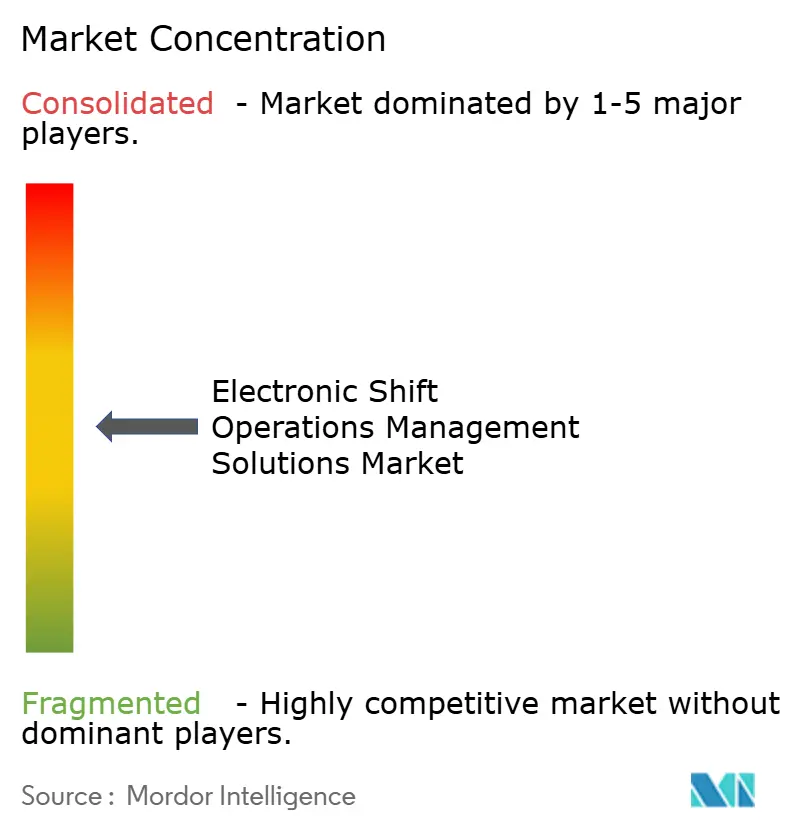
Competition remains moderate, with no single vendor exceeding 15% revenue share. Industrial automation leaders—Honeywell, Siemens, ABB, Schneider Electric—bundle shift management into broader control portfolios, using installed sensors and historians to create sticky ecosystems. Platform breadth, global service teams, and cybersecurity certifications differentiate these incumbents.
Specialists such as Shiftboard, UKG, ARCOS, and WorkForce Software attack niche pain points with mobile-first interfaces and vertical templates. Shiftboard’s energy edition includes call-out automation for storm response, while ARCOS integrates outage analytics for utilities. These focused offerings compel larger vendors to acquire or partner; Honeywell’s USD 2.2 billion purchase of Sundyne signals appetite for domain expertise. [4]Honeywell, “Honeywell Reports First Quarter Results; Updates 2025 Guidance,” honeywell.com
Cloud hyperscalers and ERP vendors also enter the Electronic Shift Operations Management Solutions market, embedding scheduling into enterprise suites. SAP’s Multi-Resource Scheduling deployment at Jemena showcases this trend. Microsoft invests in conversational AI patents to infuse Copilots into shift workflows, raising innovation pressure. Startups leverage AI forecasting and low-code customization to win pilot projects, targeting hybrid deployments that coexist with legacy operational technology networks.
Vendor roadmaps converge on three priorities: predictive labor demand, cyber-resilient architectures, and ESG reporting. Patent filings in these domains rise, and open-API ecosystems attract partner developers. Services revenue grows as customers seek change-management support, creating annuity streams that stabilize supplier margins within the Electronic Shift Operations Management Solutions market.
Electronic Shift Operations Management Solutions Industry Leaders
ABB Ltd.
Hexagon AB (HxGN Shift Operations)
Honeywell International Inc.
Siemens AG
Schneider Electric SE
- *Disclaimer: Major Players sorted in no particular order
Electronic Shift Operations Management Solutions Market Companies Covered in this Report
- ABB Ltd.
- Hexagon AB (HxGN Shift Operations)
- Honeywell International Inc.
- Siemens AG (Siemens Xcelerator)
- Schneider Electric SE
- Emerson Electric Co.
- General Electric Co. (GE Digital)
- IBM Corporation
- AVEVA Group plc
- Aspen Technology Inc.
- Yokogawa Electric Corporation
- PTC Inc.
- Dassault Systèmes SE
- Oracle Corporation
- SAP SE
- ServiceNow Inc.
- UKG Inc. (Kronos)
- WorkForce Software LLC
- Fluke Reliability (eMaint)
- Rockwell Automation Inc.
- NICE Ltd. (CXone Workforce Engagement)
- Infor Inc.
- Aptean Industrial Manufacturing ERP
- Conmitto Inc.
- Trinoor LLC
- Globorise Technologies LLC
Read Analysis of Electronic Shift Operations Management Solutions Companies

Market Opportunities and Future Outlook
A key whitespace sits in compliance-grade, cyber-resilient shift operations that can be deployed in hybrid architectures without fragmenting the operational record. Industrial buyers increasingly ask for interoperability and security controls that map to OT cybersecurity expectations, including IEC 62443, while Europe adds another compliance anchor with the July 2026 announcement of Regulation (EU) 2026/1189, which links industrial Digital Twin platforms to CE conformity expectations that emphasize cybersecurity and interoperability. Vendors that support hardened identity, role-based approvals, and tamper-evident audit trails across logbooks, permits, and shift handovers can translate that compliance pull into broader operations governance beyond scheduling.
Platform consolidation also creates opportunities for suppliers that unify shift handover, inspection rounds, asset health, and analytics, rather than operating as point tools. Hexagon has pointed to this direction by integrating j5 Operations Management inspection data into HxGN APM (April 2026), which supports continuity from operator observations to maintenance decisioning. In parallel, manufacturers running broader operational transformation programs documented in digital manufacturing change efforts are generating demand for configurable workflows and cross-functional adoption across operations, quality, maintenance, and IT, which favors solutions with strong integration patterns to historians, APM/EAM, and cloud analytics stacks.
Recent Industry Developments in Electronic Shift Operations Management Solutions Market
- April 2026: Hexagon AB integrates j5 Operations Management Solution operator inspection data into HxGN APM to improve predictive maintenance and asset health. The integration supports asset-health data continuity across OT/IT and strengthens Hexagon's integrated shift-ops and asset-management ecosystem.
- March 2026: eschbach released Shiftconnector Activity Scheduler, an equipment-level scheduling and coordination feature for pharmaceutical and chemical manufacturing. This advancement increases scheduling granularity within ESOMS for highly regulated sectors and reflects vendor-driven bundling of shift management with plant-wide data platforms.
- July 2024: Hexagon AB launched HxGN SDx2, a cloud-native SaaS solution for managing industrial assets and operations with process-data integration. The cloud-native platform entering the ESOMS ecosystem signals continued platform expansion and data-integration capabilities into shift operations.


Electronic Shift Operations Management Solutions Market Report Scope and Research Methodology
Market Definition and Coverage
For this report, the market covers paid software and related solution revenue earned from electronic shift operations management solutions that digitize shift handovers, operator logs, shift notes, task tracking, and coordination workflows for industrial and operations-heavy sites.
Scope exclusions: We exclude generic HR scheduling tools, pure time and attendance products, and services that do not directly support shift-to-shift operational handover and logging.
Segments Covered in This Report
- By Application
- Limited Condition of Operation (LCO) Tracking
- Administration and Compliance
- Tracking and Control Dashboards
- Personnel Qualification and Scheduling
- Predictive Shift Analytics
- By End-user Industry
- Oil and Gas
- Chemicals and Petrochemicals
- Energy and Utilities
- Automotive and Transportation
- Military and Defense
- Pharmaceuticals and Life Sciences
- Metals, Mining and Materials
- Other End-user Industries
- By Deployment Mode
- Cloud-Based
- On-Premise
- Hybrid
- By Organization Size
- Large Enterprises
- Small and Mid-sized Enterprises (SMEs)
- By Geography
- North America
- United States
- Canada
- Mexico
- South America
- Brazil
- Argentina
- Chile
- Rest of South America
- Europe
- Germany
- United Kingdom
- France
- Italy
- Spain
- Russia
- Rest of Europe
- Asia-Pacific
- China
- India
- Japan
- South Korea
- Singapore
- Malaysia
- Australia
- Rest of Asia-Pacific
- Middle East and Africa
- Middle East
- United Arab Emirates
- Saudi Arabia
- Turkey
- Rest of Middle East
- Africa
- South Africa
- Nigeria
- Rest of Africa
- Middle East
- North America
Data Sources, Market Sizing, and Validation
Desk Research
Desk research was used to define the measurable market frame and to map initial demand and adoption for shift-based operations digitization. We relied on public sources such as the US Bureau of Labor Statistics, the US Energy Information Administration, Eurostat, the International Energy Agency, and the International Labour Organization to understand workforce intensity, shift-heavy sectors, and industrial activity trends that typically influence buying.
On the supply side, we reviewed company filings, annual reports, investor decks, product documentation, and reputable press coverage to track how these vendors position their solution and how they describe go-to-market patterns. We also used paid subscriptions for company financials and intelligence, news and financials, and patent databases selectively to cross-check product footprints and corporate structures that can complicate revenue attribution. The desk sources listed here are illustrative, and we also referenced other public documents and databases for data collection, validation, and research clarification.
Primary Interviews and Surveys
Primary work focused on validating what is actually purchased under electronic shift operations management, how deployments are priced (site, user, or enterprise contracts), and how usage expands after pilot rollout. We spoke with a mix of solution owners, plant and operations leaders, and functional managers across major industrial regions so assumptions on adoption pace, renewal behavior, and implementation time could be checked against real procurement experiences.
Distribution of primary research fieldwork respondents
| Company type | Respondent position | Region |
|---|---|---|
| Top tier: 33% | CXOs: 12% | APAC: 43% |
| Mid tier: 53% | Functional/Unit leaders: 29% | EMEA: 32% |
| Smaller Players: 14% | Managers: 59% | Americas: 25% |
Market-Sizing & Forecasting
Sizing starts with a top-down demand pool assessment where industrial software spend is narrowed using shift-based operations intensity and the practical addressable footprint of sites that run 24-7 operations. Once the market pool is constructed, we corroborate it with selective bottom-up checks such as sampled contract values, estimated seats per site, and channel feedback on typical rollout sizes. This helps correct over-counting that can occur when broad software categories are used as the starting point.
Inputs used in the model include the share of facilities with continuous operations, the pace of replacing paper logbooks with electronic logs, cloud versus on-premise preference in operational environments, average contract value progression as modules get added, and renewal and expansion behavior after the first year. Forecasts were built using scenario analysis supported by expert views on industrial digitization budgets, compliance pressure in safety-critical operations, and integration readiness with existing operational systems. When bottom-up evidence was missing for smaller geographies, we handled the gap with proxy assumptions tied to industrial output and site counts, then applied a reasonableness check using interview feedback.
Data Validation & Update Cycle
Outputs are validated through multiple checks so the final numbers remain explainable and repeatable. The model is compared against independent signals such as industrial activity trends, reported software revenue mix clues, and realistic site rollout capacity, and then we investigate variances before sign-off.
We also run consistency checks across regions and end-user groups to spot adoption rates that look too high for the local operating context. If a material mismatch is found, respondents are re-contacted and the assumptions are updated, followed by another review cycle. Reports are refreshed annually, and interim updates are made when major market events change demand, pricing, or deployment patterns. A final pre-delivery pass is then completed to reflect the latest view.
Mordor Intelligence's Electronic Shift Operations Management Solutions Market Size Measured Against Other Published Estimates
Published market numbers for electronic shift operations management solutions often do not match because different studies count different software categories, and they also treat services, deployment types, and end-use coverage in their own ways. Differences also come from how pricing is projected over time and how quickly the dataset is refreshed after product shifts or large industrial spending changes.
Some estimates expand the scope into adjacent workforce tools or broader operations platforms that are not typically bought mainly for shift handover and operator logging. From Mordor Intelligence's perspective, revenue is counted only when the solution directly supports electronic shift handover, shift logs, and associated operational coordination, with generic scheduling and timekeeping excluded so the demand pool stays tied to plant operations usage.
Benchmark comparison
| Source | Market Size | Gaps in Research Methodology |
|---|---|---|
| Mordor Intelligence | USD 6.29 B (2025) | |
| Industry Research Outlet A | USD 8.20 B (2023) | Uses a broader functional scope that can fold in wider operations software and related workflow tools, and it also applies an earlier base year that may not reflect newer pricing and deployment mix changes. |
| Research Publisher B | USD 2.29 B (2024) | Appears to apply a narrower revenue capture approach that can undercount enterprise contracts and multi-site rollouts, and it may treat services and integrations inconsistently across regions. |
Across the three figures, most of the spread is explained by how far the scope extends into adjacent workforce and operations software, plus how contract values and rollout expansion are treated. By keeping the counted revenue tied to documented shift handover and logging use cases, and then cross-checking it with contract and site-level signals from interviews, the sizing stays transparent and easier to replicate.


Key Questions Answered in the Report
What is the current size of the Electronic Shift Operations Management Solutions market?
The market values USD 6.83 billion in 2026 and is projected to reach USD 10.33 billion by 2031.
Which region leads in revenue contribution?
North America holds 36.25% of revenue, driven by stringent regulatory mandates and mature automation ecosystems.
Which application segment grows fastest?
Predictive Shift Analytics is forecast to rise at an 11.05% CAGR thanks to AI-based roster optimization.
Why are hybrid deployments gaining momentum?
Hybrid models balance cloud scalability with on-premise security, expanding by 10.75% CAGR through 2031.
What restrains faster adoption among small firms?
High installation and switching costs, along with limited technical talent, slow uptake despite SaaS availability.
Which industry vertical offers the biggest growth window?
Metals, mining and materials is expected to expand 10.55% annually as autonomous and predictive operations spread.
Page last updated on:





