
Market Overview
| Study Period | 2021 - 2031 |
|---|---|
| Market Volume (2026) | 2.67 Million tons |
| Market Volume (2031) | 3.27 Million tons |
| Growth Rate (2026 - 2031) | 4.18 % |
| Fastest Growing Market | Middle East and Africa |
| Largest Market | Asia Pacific |
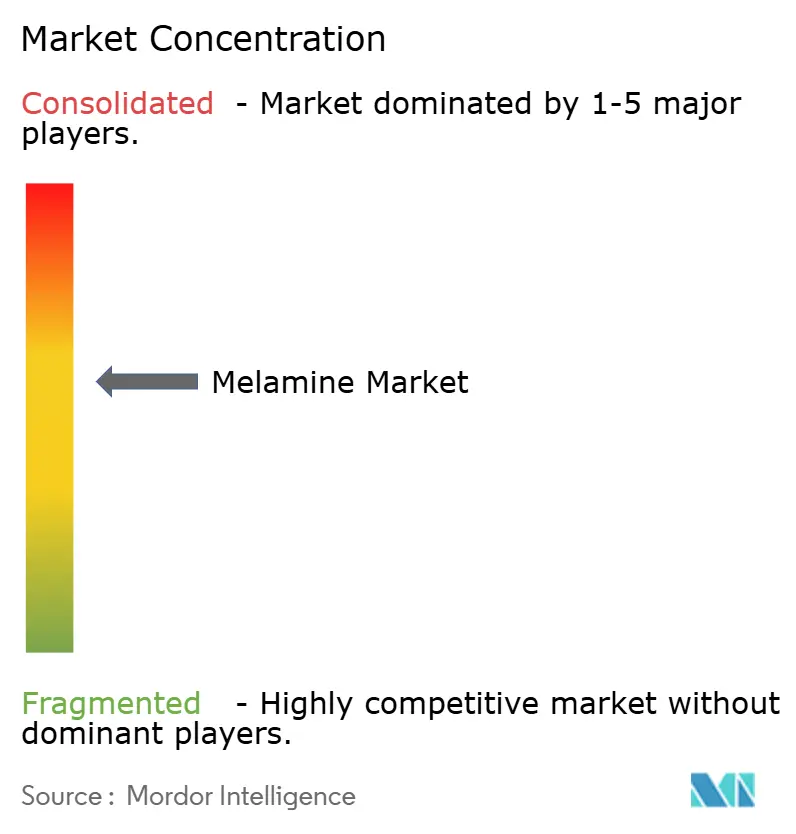
| Market Concentration | Medium |
Major Players *Disclaimer: Major Players sorted in no particular order Image © Mordor Intelligence. Reuse requires attribution under CC BY 4.0. | |
Melamine Market Analysis by Mordor Intelligence
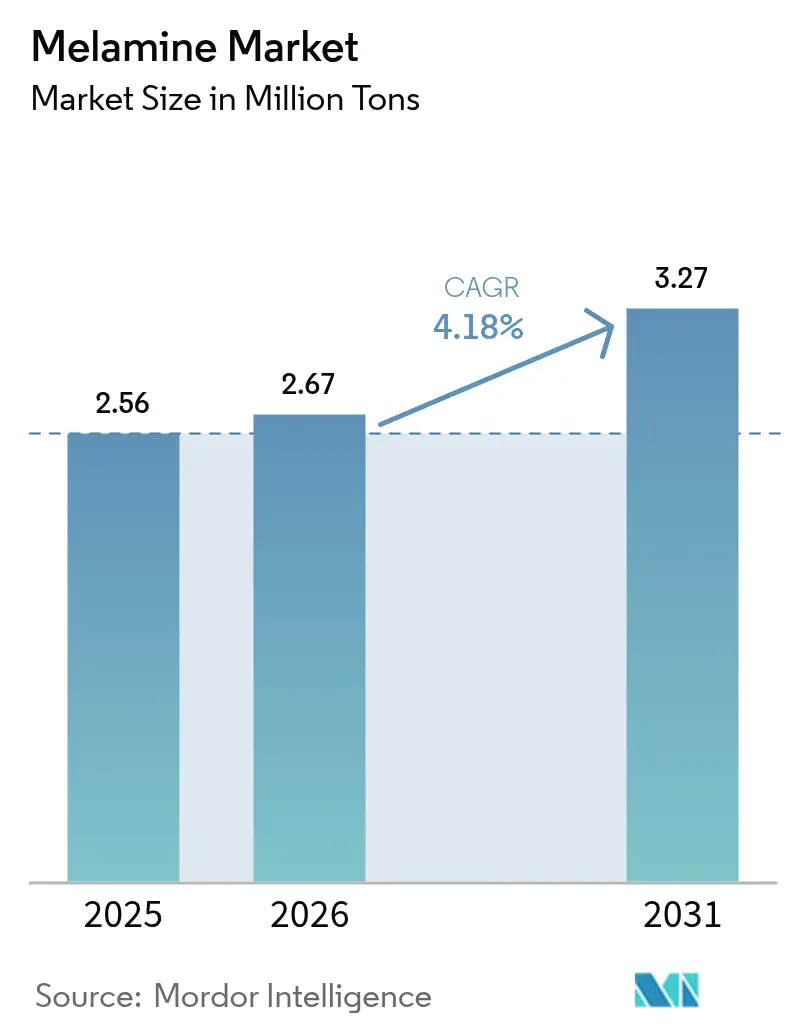
The Melamine Market size is expected to grow from 2.56 Million tons in 2025 to 2.67 Million tons in 2026 and is forecast to reach 3.27 Million tons by 2031 at 4.18% CAGR over 2026-2031.
Construction recovery in the United States and the European Union is lifting demand for melamine-rich wood adhesives that meet tightening indoor-air-quality rules[1]United States Environmental Protection Agency, “TSCA Title VI Formaldehyde Standards,” epa.gov. In Asia-Pacific, integrated urea–melamine complexes in China and India are scaling output for high-pressure laminates and molding compounds[2]China Petroleum and Chemical Industry Federation, “Annual Chemical Statistics 2025,” cpcif.org.cn. Middle East and Africa producers are capitalizing on low-cost gas feedstock, adding capacity that positions the region for the fastest geographic growth through 2031. Specialty uses such as ASTM E84 Class A melamine foam in aerospace and rail cabins are creating a high-margin sub-segment that supplements core laminate demand.
Key Report Takeaways
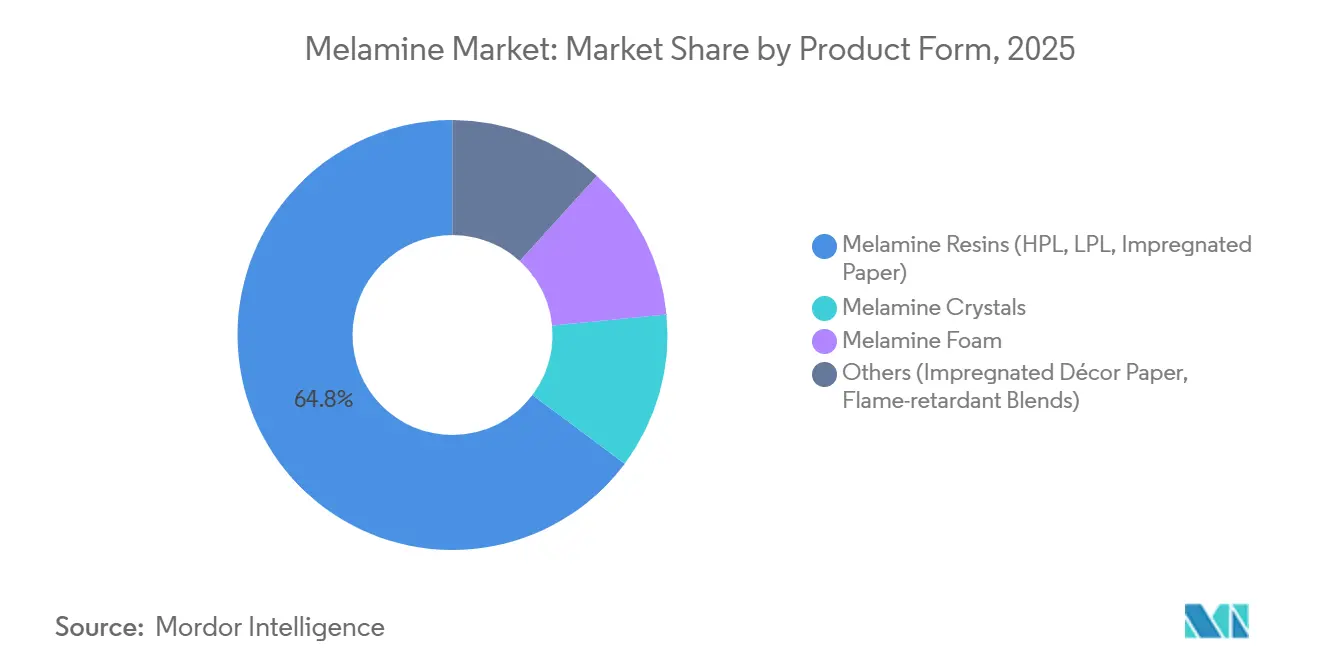
- By product form, melamine resins accounted for 64.78% of the melamine market share in 2025, while melamine foam is poised to advance at a 4.78% CAGR to 2031.
- By application, laminates dominated with 48.15% share of the melamine market size in 2025, and flame-retardants and textile resins are set to grow at a 4.55% CAGR through 2031.
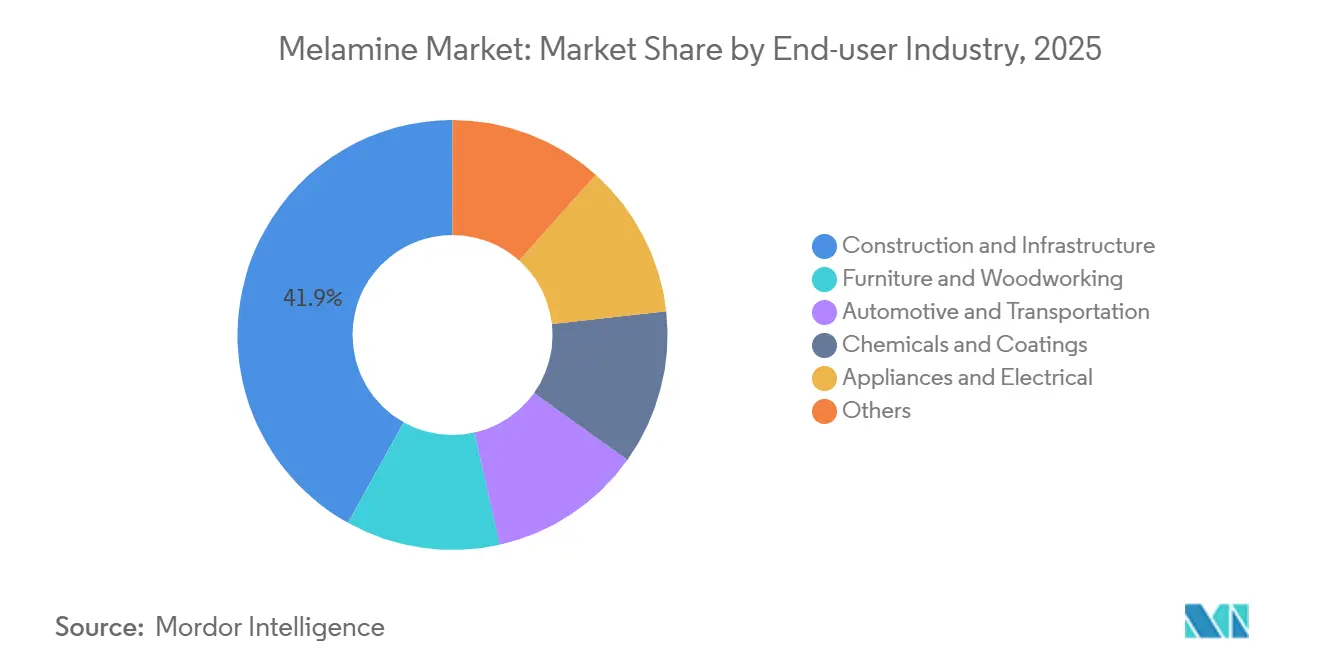
- By end-user, construction and infrastructure captured 41.92% of the 2025 volume, whereas automotive and transportation represent the fastest-growing user group at a 4.42% CAGR to 2031.
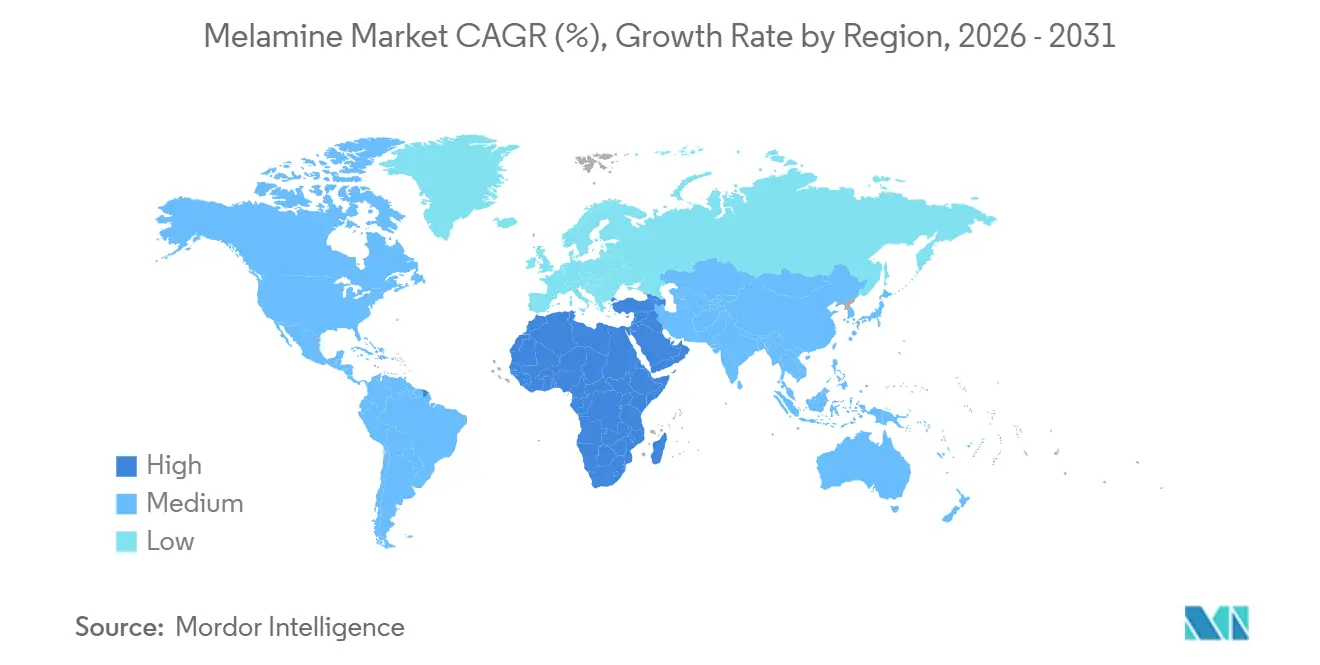
- By geography, Asia-Pacific retained 51.16% of global volume in 2025, and the Middle East and Africa region is projected to record the highest regional CAGR at 4.35% through 2031.
Note: Market size and forecast figures in this report are generated using Mordor Intelligence’s proprietary estimation framework, updated with the latest available data and insights as of 2026.
Market Trends and Insights
Drivers Impact Analysis of Melamine Market*
| Drivers | (~) % Impact on CAGR Forecast | Geographic Relevance | Impact Timeline |
|---|---|---|---|
| Surge in laminated flooring and furniture demand in emerging economies | +1.2% | Asia-Pacific core, spillover to Middle East and Africa | Medium term (2-4 years) |
| Construction rebound in US/EU boosting wood-adhesive consumption | +0.9% | North America and Europe | Short term (≤ 2 years) |
| Industrial expansion in Asia-Pacific spurring HPL and molding compounds uptake | +1.0% | Asia-Pacific, particularly China and India | Medium term (2-4 years) |
| Lightweight, heat-resistant melamine foams for aero and rail acoustics | +0.5% | Global, with early adoption in North America and Europe | Long term (≥ 4 years) |
| Adoption of low-carbon urea-to-melamine processes (green ammonia routes) | +0.4% | Europe and Middle East, with pilot projects in Asia-Pacific | Long term (≥ 4 years) |
| Source: Mordor Intelligence | |||
Surge in Laminated Flooring and Furniture Demand in Emerging Economies
Rapid urbanization and rising disposable incomes in Asia-Pacific are steering consumers toward engineered wood products that rely on melamine laminates for scratch resistance and aesthetic variety. India’s furniture sector, estimated at USD 18 billion in 2024, is spreading modular kitchens and flat-pack furniture across second-tier cities, boosting laminate consumption per dwelling. China’s wood-based panel output surpassed 300 million m³ in 2024, and thermally fused laminate lines that consume melamine-impregnated décor paper now anchor export-oriented capacity. E-commerce platforms shorten delivery cycles, favoring suppliers with on-site resin impregnation that lowers lead time. Stricter indoor-air-quality rules are prompting higher melamine-to-urea ratios in adhesives, which multiply volume demand even when overall panel output grows modestly. Consequently, incremental furniture and flooring growth translates into outsized melamine uptake in the melamine market.
Construction Rebound in US / EU Boosting Wood-Adhesive Consumption
U.S. housing starts climbed to 1.43 million units in 2024, reversing a prior lull and reviving oriented strand board and particleboard demand. The European Union’s Renovation Wave targets 35 million building upgrades by 2030, fueling timber-frame and interior-fit-out projects that specify melamine-bonded panels. EPA TSCA Title VI caps formaldehyde emissions well below what urea-formaldehyde resins can meet, so panel mills are shifting to MUF adhesives with 15%–25% melamine content. Although melamine raises adhesive cost by up to USD 80 per ton, green-building certifications generate price premiums that offset the expense. North American mills are also sourcing melamine domestically to curb tariff and logistics exposure, strengthening local supply resilience for the melamine market.
Industrial Expansion in Asia-Pacific Spurring HPL and Molding Compounds Uptake
Integrated complexes in China and India convert ammonia, urea, and melamine on one site, achieving cost positions 10%–15% below European averages. Gujarat State Fertilizers & Chemicals ramped capacity in 2024 to meet Indian HPL producers that serve commercial interiors and metro projects. Southeast Asian infrastructure—mass-rapid-transit systems across Jakarta, Bangkok, and Manila—specifies ISO 4586-compliant laminates, raising regional draw for melamine resins. Molding compounds made from melamine and cellulose are gaining ground in appliance and electric-vehicle parts that require arc resistance, positioning the melamine market for downstream value capture. Electric-mobility programs further enlarge the addressable pool by demanding flame-retardant components compliant with UL 94 V-0.
Lightweight, Heat-Resistant Melamine Foams for Aero and Rail Acoustics
Melamine foam offers densities near 10 kg/m³ and achieves ASTM E84 Class A ratings, meeting FAA cabin safety norms while trimming aircraft weight. Airbus and Boeing cabin suppliers specify the material for overhead bins and sidewalls, where every kilogram saved lowers fuel burn. Rail operators in Europe and Asia deploy melamine foam in HVAC ducts and under-floor panels to satisfy EN 45545-2 fire-behavior codes. The foam’s noise-reduction coefficient approaches 1.0, which is prized in electric vehicles where motor silence makes road noise more obvious. Chinese producers are narrowing cost gaps, broadening availability for commercial construction acoustics. These dynamics establish melamine foam as a specialty growth engine inside the wider melamine market.
Restraints Impact Analysis of Melamine Market*
| Restraint | % Impact on CAGR Forecast | Geographic Relevance | Impact Timeline |
|---|---|---|---|
| Stricter formaldehyde-emission norms in EU and North America | -0.6% | North America and Europe | Short term (≤ 2 years) |
| Bio-based adhesive substitutes (soy, lignin, liquefied wood) | -0.3% | North America and Europe, niche adoption in Asia-Pacific | Medium term (2-4 years) |
| Urea price volatility linked to fertilizer-market disruptions | -0.5% | Global, with acute impact in Europe and South Asia | Short term (≤ 2 years) |
| Source: Mordor Intelligence | |||
Stricter Formaldehyde-Emission Norms in EU and North America
EPA TSCA Title VI and CARB Phase 2 mandate emissions below 0.09 ppm for particleboard, thresholds unattainable with plain urea-formaldehyde systems. Panel mills must add melamine or switch to polyurethane, increasing adhesive cost and squeezing margins for smaller operators. Europe’s REACH program lists melamine as an SVHC, triggering authorization hurdles that lengthen product-approval cycles. Some West Coast U.S. mills have already migrated to no-added-formaldehyde adhesives for premium product lines. Short-run demand may dip as manufacturers recalibrate formulations, though higher melamine loading per batch keeps absolute tonnage relatively stable in the melamine market.
Bio-Based Adhesive Substitutes
Soy-protein, lignin, and liquefied-wood resins are gaining LEED credits for interior panels in green buildings. Moisture resistance and pot life lag behind melamine-formaldehyde, confining use to niche plywood and furniture. Lignin supply is tied to paper-mill economics, and soy isolate output is under 1 million tons per year, capping growth potential. Premium pricing of 5%–10% persuades only sustainability-driven buyers, so displacement of melamine remains gradual. Nonetheless, continued research and development signal a moderate long-term challenge to the melamine market.
*Our forecasts treat driver/restraint impacts as directional, not additive. The impact forecasts reflect baseline growth, mix effects, and variable interactions.
Melamine Market Segment Analysis
By Product Form:
Resins Remain the Workhorse while Foam AcceleratesMelamine resins for high-pressure laminates and impregnated paper captured 64.78% of 2025 volume, reflecting deep integration with laminate flooring and furniture production lines across China, India, and the EU. This share anchors the melamine market size for commodity grades, and capacity additions in Asia-Pacific ensure stable supply even as formaldehyde regulations tighten.
Demand for melamine foam is growing at a 4.78% CAGR to 2031, outpacing total market growth as aerospace, rail, and electric-vehicle makers prioritize weight reduction and flame safety. Although foam accounts for a small slice of melamine market share today, its high unit value and expanding acoustic uses position it as the specialty bright spot of the decade.



By Application:
Laminates Lead yet Flame-Retardants Gain SpeedLaminates commanded 48.15% of tonnage in 2025, supported by rising modular furniture adoption and renovation activity worldwide. The segment will keep anchoring absolute demand, since each square meter of HPL consumes 150–200 g of resin.
Flame-retardants and textile resins are advancing at a 4.55% CAGR, aided by bans on halogenated chemistries and stricter fire codes in public transport. Their climb broadens the application base of the melamine market beyond construction into protective apparel and electronics.
By End-User Industry:
Construction Dominates yet Automotive Gains MomentumConstruction and infrastructure absorbed 41.92% of 2025 demand, with housing starts and renovation mandates underpinning panel and laminate purchases. Strong refurbishment programs in Europe reinforce this bedrock for the melamine industry.
Automotive and transportation volumes are expanding at a 4.42% CAGR as electric-vehicle platforms integrate melamine foam for cabin acoustics and melamine molding compounds for high-voltage connectors. Over the forecast window, mobility applications will add incremental tonnage and value, reinforcing diversification inside the melamine market.
Geography Analysis
APAC Melamine Market
Asia-Pacific accounted for 51.16% of global volume in 2025, owing to integrated urea–melamine complexes and proximity to furniture export clusters. China alone operates over 1.5 million tons of capacity, while India’s GSFC is scaling plants that feed growing HPL lines across Gujarat and Maharashtra. Japan and South Korea supply premium electronic-grade resins, adding value-focused diversity.
MEA Melamine Market
Middle East and Africa posted the fastest regional growth at 4.35% CAGR, powered by Qatar Melamine Company’s 60,000 ton plant and Borouge’s 80,000 ton expansion that leverages low-cost gas feedstock. GCC construction booms and Vision 2030 industrialization plans amplify downstream demand for laminates and panels.
The Americas and Europe Melamine Market
North America and Europe together accounted for a significant market share in 2025. U.S. producers such as Cornerstone Chemical benefit from shale-gas economics and reshoring of panel supply chains. Europe is restructuring under high energy prices; Grupa Azoty idled Polish output, while CBAM favors imports from low-carbon exporters. South America remains a net importer but is adding volume as Brazilian housing starts recover.

Regulatory Landscape
Regulation for melamine and melamine-based downstream products is tightening around chemicals management and indoor air quality, which affects allowable formulations and the pace of approvals. In the European Union, melamine remains on the REACH Candidate List as an SVHC, and in November 2025 ECHA recommended melamine for inclusion in the REACH Authorisation List (Annex XIV), a reference point that downstream users monitor for possible sunset dates and exemption scope. Separately, Germany's proposal to update the harmonised classification of melamine under the CLP Regulation entered ECHA public consultation starting February 16, 2026, with a deadline of April 17, 2026, adding near-term compliance focus for EU supply chains.
North American requirements center on exposure and use-specific requirements rather than broad authorisation. In the United States, melamine-formaldehyde resins for food-contact applications are regulated under 21 CFR 177.1460 with extraction limits, and the FDA maintains Threshold of Regulation exemptions for specific melamine uses in certain polymer systems. In Canada, Health Canada published a revised Risk Management Scope and an updated Human Health Assessment for melamine for public comment in January 2025, supporting continued scrutiny of uses and exposure pathways relevant to construction, furniture, and consumer-facing applications.
Value Chain Analysis
The melamine value chain is anchored in nitrogen and gas-linked feedstocks, moving from natural gas to ammonia and urea, then to melamine crystals and onward to resins, laminates, wood adhesives, molding compounds, and specialty foams used in construction, furniture, and transportation. Because melamine production is capital-intensive and tightly integrated with urea and methanol value chains, cost structure and availability are closely influenced by ammonia and urea economics, as well as the ability to recycle process streams on integrated sites. Technology licensing is a key link, with licensors such as Casale S.A. and Eurotecnica supplying process packages that shape energy intensity, effluent management, and achievable product purity.
Upstream integration and technology selection are increasingly important for competitiveness and supply security. In China, recent project activity highlights the role of licensors and large-scale complexes, including Zhongneng Chemicals' July 2025 selection of Eurotecnicas Euromel technology for a 120,000 t/y plant and multiple 60,000 t/y G5 Euromel project milestones reported in late 2025. In Southeast Asia, Petronas Chemicals Group's first Malaysian melamine plant at Kedah (60,000 t/y) reaching Ready For Start Up status in October 2025 illustrates new regional supply nodes that can shorten supply lines to laminate and panel manufacturers. Downstream, distributors and converters prioritize consistent quality and regulatory documentation (for example for low-emission wood panels and fire-rated foam applications), making producer compliance capabilities and traceability differentiators.
Competitive Landscape
The melamine market is moderately consolidated, with the top five players holding a significant market share. Leading players in the market, including BASF, OCI, Qatar Melamine, EuroChem, and AGROFERT, control roughly half of the global installed capacity. Vertical integration secures ammonia and urea feedstock, buffering margin exposure to gas price swings that drove European spot urea beyond USD 400 tons in 2024.
Process innovation shapes cost curves. OCI and EuroChem patents describe a single-vessel urea-to-melamine conversion that cuts energy by nearly one-fifth and lowers capital intensity. BASF completed a debottlenecking that lifted German capacity by 10,000 tons while trimming gas use 12%, illustrating continual process tweaks.
Specialty niches offer price premiums. BASF’s Basotect foam leads aerospace and rail acoustics, commanding multiples over commodity resin pricing. Chinese entrants such as Junhua Acoustic Materials are targeting cost-driven mid-tier sectors. Bio-based adhesive suppliers remain peripheral, limited by performance gaps and feedstock constraints. Regulatory shifts, especially REACH SVHC listing, add compliance complexity yet also raise entry barriers that incumbent leaders can manage.
Melamine Industry Leaders
BASF SE
OCI NV
Borealis AG
Grupa Azoty
Qatar Melamine Company
- *Disclaimer: Major Players sorted in no particular order
Melamine Market Companies Covered in this Report
- BASF SE
- Borealis AG
- Cornerstone Chemical Company
- EuroChem Group
- Fushun Huaxing Petroleum Chemical Co., Ltd
- Grupa Azoty
- Gujarat State Fertilizers & Chemicals Ltd (GSFC)
- Henan Xinlianxin Chemicals Group Co. Ltd
- Hexion Inc.
- Methanol Holdings (Trinidad) Ltd (MHTL)
- Mitsui Chemicals Inc.
- Nissan Chemical Corporation
- OCI NV
- Prefere Resins Holding GmbH
- Qatar Melamine Company
- Sichuan Chemical Works Group Ltd

Market Opportunities and Future Outlook
New integrated capacity in Southeast Asia, along with ongoing process upgrades, creates whitespace for regionally anchored melamine-to-resin supply chains serving laminates, wood adhesives, and molding compounds. A concrete example is Indonesia's first melamine project, where PT GEABH Joint Technology broke ground in April 2026 on a USD 600 million facility in the Gresik Special Economic Zone with planned capacity of 120,000 tons per year, supporting local availability for furniture, panel, and construction value chains that have relied on imports. At the same time, melamine technology development is moving toward lower-energy purification and reduced auxiliary chemical use, exemplified by Casale's uLEM-N technology deployment (first application at Anhui Haoyuan Chemical Group), which emphasizes an updated purification section designed to minimize energy consumption and eliminate caustic soda usage.
Low-carbon and compliance-ready melamine offerings provide another opportunity track, particularly where downstream customers face building-material and chemicals-management scrutiny. In April 2026, OCI partnered with Prefere Resins to introduce MelaminebyOCI Novo, positioned as a low-carbon melamine produced with biogas and ISCC PLUS certification, aligning melamine supply with decarbonisation programs at resin and panel producers. In Europe, ECHA's November 2025 Annex XIV recommendation activity, together with the EU's shift to ad valorem anti-dumping duties on Chinese melamine imports implemented in February 2025, is pushing buyers to diversify sourcing, qualify alternative grades, and evaluate local or lower-carbon supply routes where available. Export-led balancing in Asia also remains visible, with reported Chinese melamine exports rising sharply in March 2026, reinforcing the role of trade flows and customer qualification in where incremental tonnage can be placed profitably.
Recent Industry Developments in Melamine Market
- April 2026: OCI partnered with Prefere Resins to introduce MelaminebyOCI Novo, positioned as a low-carbon melamine produced with biogas and ISCC PLUS certification. The move supports decarbonisation claims for downstream resin and panel products and adds a differentiated grade for customers managing product carbon footprint requirements.
- November 2025: Eurotecnica signed a contract with China Coal Ordos Energy & Chemical for a 60,000 tonnes-per-year G5 Euromel melamine plant and achieved final acceptance of a 60,000 tonnes-per-year G5 plant for Shaanxi Longhua Group in China. These milestones reinforce China's role as the primary deployment base for large-scale melamine process technology and add momentum to new supply coming from integrated complexes.
- February 2025: BASF launched Basotect EcoBalanced, a melamine resin foam positioned with a reduced product carbon footprint achieved via green electricity and renewable feedstock through a mass balance approach. The product expands melamine foams reach in applications where fire performance and acoustics are required while procurement increasingly screens for lower-carbon materials.


Melamine Market Report Scope and Research Methodology
Market Definition and Coverage
In this study, the melamine market is defined as the global demand and supply of melamine products used as an industrial input for resins and other downstream applications, captured at the point of material sale or use in manufacturing.
Scope exclusions: We exclude downstream finished goods value (like furniture and panels), and we do not count internal transfer pricing inside fully integrated producers.
Segments Covered in This Report
- By Product Form
- Melamine Crystals
- Melamine Resins (HPL, LPL, Impregnated Paper)
- Melamine Foam
- Others (Impregnated Décor Paper, Flame-retardant Blends)
- By Application
- Laminates
- Wood Adhesives
- Molding Compounds
- Paints and Coatings
- Flame-retardants and Textile Resins
- By End-user Industry
- Construction and Infrastructure
- Furniture and Woodworking
- Automotive and Transportation
- Chemicals and Coatings
- Appliances and Electrical
- Others
- By Geography
- Asia-Pacific
- China
- India
- Japan
- South Korea
- Rest of Asia-Pacific
- North America
- United States
- Canada
- Mexico
- Europe
- Germany
- United Kingdom
- Italy
- France
- Russia
- Rest of Europe
- South America
- Brazil
- Argentina
- Rest of South America
- Middle-East and Africa
- Saudi Arabia
- South Africa
- Rest of Middle-East and Africa
- Asia-Pacific
Data Sources, Market Sizing, and Validation
Desk Research
Desk work starts with building a clean picture of the melamine supply chain and the main demand pull points, then mapping where volume is produced, traded, and consumed. For trade direction, we typically rely on public sources such as UN Comtrade and national customs statistics. For chemical and industrial context, we use USGS and other government chemical statistics, and we supplement with OECD and World Bank macro indicators tied to construction and manufacturing activity. We also review peer reviewed papers that discuss melamine resin usage and substitution behavior.
In parallel, we review producer disclosures such as annual reports, investor presentations, and plant announcements. These documents help us cross-check capacity additions, utilization narratives, and product mix shifts. When needed, we use paid subscriptions for company financials and intelligence, patent databases, and shipment-level import export databases to validate timelines and reduce data gaps. The sources listed here are illustrative and not exhaustive, and other references are also used for data collection, validation, and clarification.
Primary Interviews and Surveys
Primary work is used to stress test the desk assumptions on operating rates, trade substitution, and application-level demand shifts that do not show up clearly in public data. We speak with a mix of producers, distributors, compounders, and large buyers across APAC, EMEA, and the Americas, so the model reflects regional operating conditions and channel patterns. Afterward, the inputs are reconciled into a single regional view.
Distribution of primary research fieldwork respondents
| Company type | Respondent position | Region |
|---|---|---|
| Top tier: 28% | CXOs: 17% | APAC: 47% |
| Mid tier: 50% | Functional/Unit leaders: 28% | EMEA: 33% |
| Smaller Players: 22% | Managers: 55% | Americas: 20% |
Market-Sizing & Forecasting
Sizing is built with a top-down and bottom-up approach, where production capacity, utilization, and net trade are used to reconstruct apparent consumption by region, and then the split is refined by application demand checks. To keep the totals grounded, we corroborate this with selective bottom-up approximations such as sampled supplier roll-ups, distributor channel checks, and volume times price sanity checks in a few high-visibility countries.
A few inputs that materially move the model include nameplate capacity changes and shutdown timing, operating rate ranges by region, import-export flows into large consuming hubs, laminates and wood panel activity indicators, and the shift in resin and adhesive formulations that changes melamine intensity. For forecasting, we use scenario analysis supported by short trend models because the market is sensitive to new capacity starts, energy and feedstock conditions, and construction cycles. Where country detail is thin, we fill gaps by using neighboring trade patterns and capacity-weighted proxies, and then we recheck the implied per-capita and per-output consumption to avoid overstating demand.
Data Validation & Update Cycle
Validation is done by checking the model output against independent signals such as capacity utilization commentary, trade balances, and downstream production indicators, and then reviewing any sharp jumps that do not match known events. We also run variance checks across regions so a change in one geography does not unintentionally double count supply moving through trade.
Before sign-off, the work is reviewed in steps by another analyst, and experts are re-contacted if a key assumption moves outside the interview range. Reports are refreshed annually, and interim updates are made when material events occur, such as large plant startups, major outages, or policy changes that affect trade. Right before delivery, an analyst performs a final pass so clients receive the latest updated view.
Mordor Intelligence's Melamine Market Sizing Compared With Other Published Estimates
Published melamine market sizes often do not match, even when the topic name looks identical, because the unit of measure, boundary of what is counted, and the year used for the base can be different. In this category, a common split is between volume-based totals that track physical tons and value-based totals that reflect price assumptions.
Trade-flow checks and capacity-utilization cross-checks are the evidence points that keep the Mordor Intelligence estimate tied to physical melamine tonnage moving through production and cross-border flows, which is why the benchmark here is presented in tons rather than in USD revenue.
Benchmark comparison
| Source | Market Size | Gaps in Research Methodology |
|---|---|---|
| Mordor Intelligence | USD 2.56 M (2025) | |
| Global Consultancy A | USD 9.03 B (2024) | This estimate is reported as revenue, which can shift materially with assumed average selling prices and may also include value from melamine-based resins or broader downstream value rather than only melamine tonnage. |
| Industry Publisher B | USD 8.72 B (2026) | The number is value-based and anchored to a different base year, so price reference timing and grade mix weighting can move totals even if the underlying volume trend is similar. |
The main takeaway is that the spread is driven mostly by unit and scope alignment. A tonnage view can be reconciled back to capacity and trade, while a value view depends heavily on price and mix assumptions. By keeping the steps repeatable and checking inputs against independent signals, the final number stays traceable to clear demand and supply markers.


Key Questions Answered in the Report
What is the current size of the melamine market?
The melamine market is estimated at 2.67 million tons in 2026 and is on track to hit 3.27 million tons by 2031.
How fast is global melamine demand growing?
Demand is forecast to rise at a 4.18% CAGR from 2026 to 2031, supported by construction, furniture, and specialty foam applications.
Which product form dominates sales?
Melamine resins for laminates lead with 64.78% of 2025 volume, far ahead of other forms such as crystals and foam.
Which region offers the highest growth prospects?
The Middle East and Africa region is projected to log the fastest regional CAGR at 4.35% through 2031 due to low-cost gas-based capacity additions.
What is driving specialty melamine foam demand?
Aerospace, rail, and electric-vehicle manufacturers are adopting lightweight Class A fire-rated melamine foam to cut weight and meet stricter acoustic and safety standards.
How are formaldehyde regulations affecting melamine consumption?
Stricter emission caps in North America and Europe are forcing panel mills to switch to higher-melamine MUF adhesives, raising resin intensity per panel and sustaining overall melamine tonnage.
Page last updated on:


 Your data is secure and never sold or shared.


