
Direct-Fed Microbials Market Size and Share
Market Overview
| Study Period | 2021 - 2031 |
|---|---|
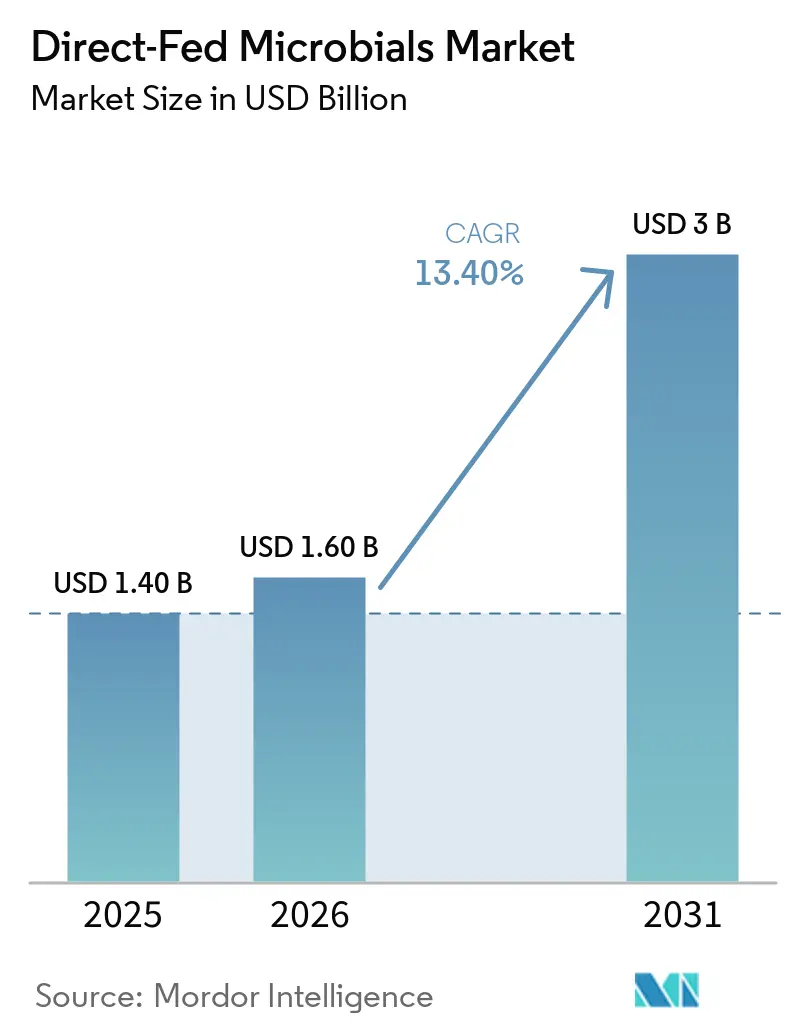
| Market Size (2026) | USD 1.60 Billion |
| Market Size (2031) | USD 3 Billion |
| Growth Rate (2026 - 2031) | 13.40 % |
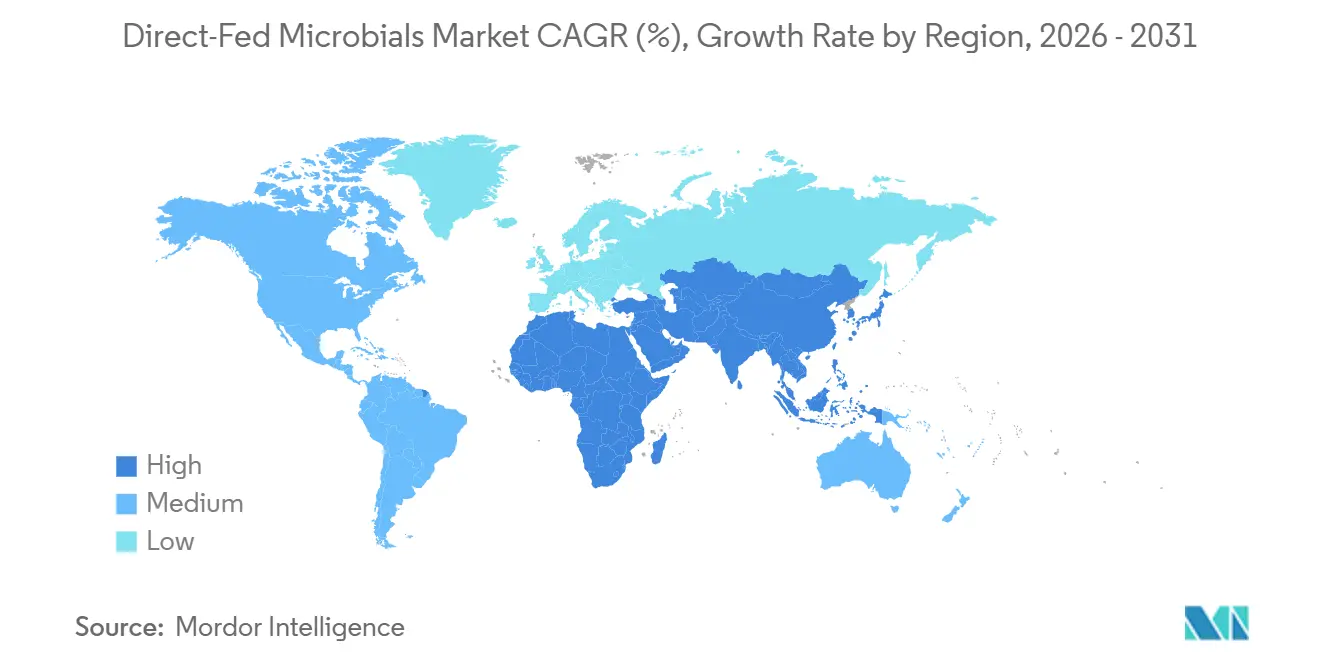
| Fastest Growing Market | Asia-Pacific |
| Largest Market | North America |
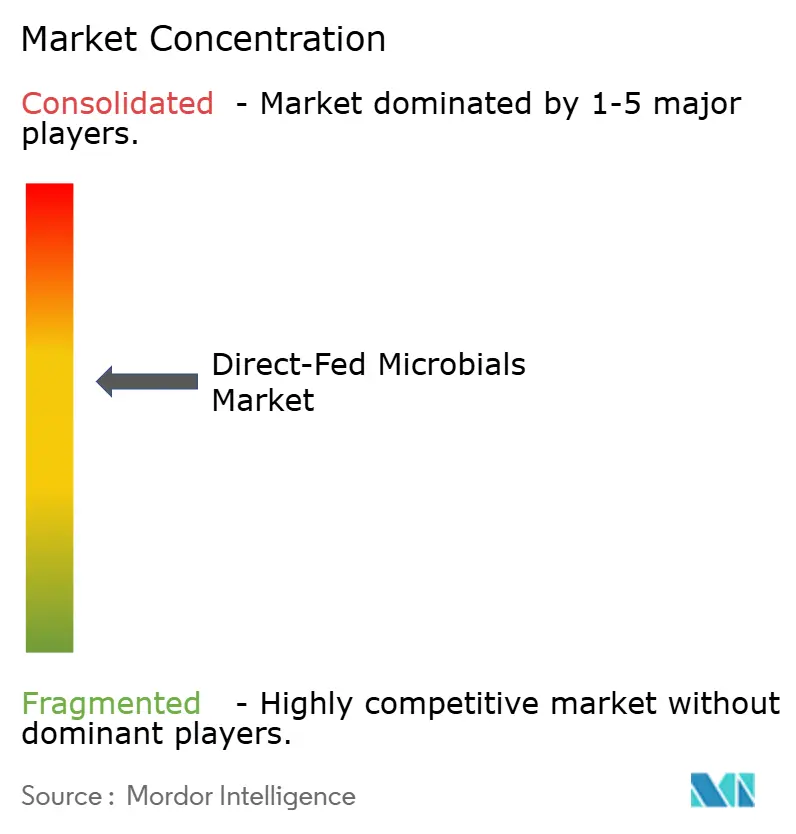
| Market Concentration | Medium |
Major Players *Disclaimer: Major Players sorted in no particular order Image © Mordor Intelligence. Reuse requires attribution under CC BY 4.0. | |
Direct-Fed Microbials Market Analysis by Mordor Intelligence
The direct-fed microbials market size is projected to be USD 1.40 billion in 2025, USD 1.60 billion in 2026, and reach USD 3.00 billion by 2031, growing at a CAGR of 13.40% from 2026 to 2031. This growth is driven by regulatory measures to reduce routine antibiotic use, rising feed costs, and performance improvements associated with live microbial cultures. The ban on colistin sulfate in India and the accelerated enforcement of the Veterinary Feed Directive in the United States have shortened compliance timelines for integrators, prompting feed mills to adopt strain-validated probiotic alternatives that ensure both productivity and residue-free labeling. Strain libraries with heat-stable Bacillus spores, capable of withstanding temperatures up to 95 degrees Celsius, that support pelleted feed compatibility and facilitate rapid commercial scaling. Additionally, higher corn and soybean meal prices in China during 2025 reduced the feed-to-egg ratio, increasing demand for functional additives that enhance nutrient extraction and lower overall ration costs. Furthermore, the expansion of aquaculture in Southeast Asia, where vaccines are limited for many finfish pathogens, highlights the importance of direct-fed microbials as essential tools for improving water quality and gut health in shrimp and warm-water species.
Key Report Takeaways
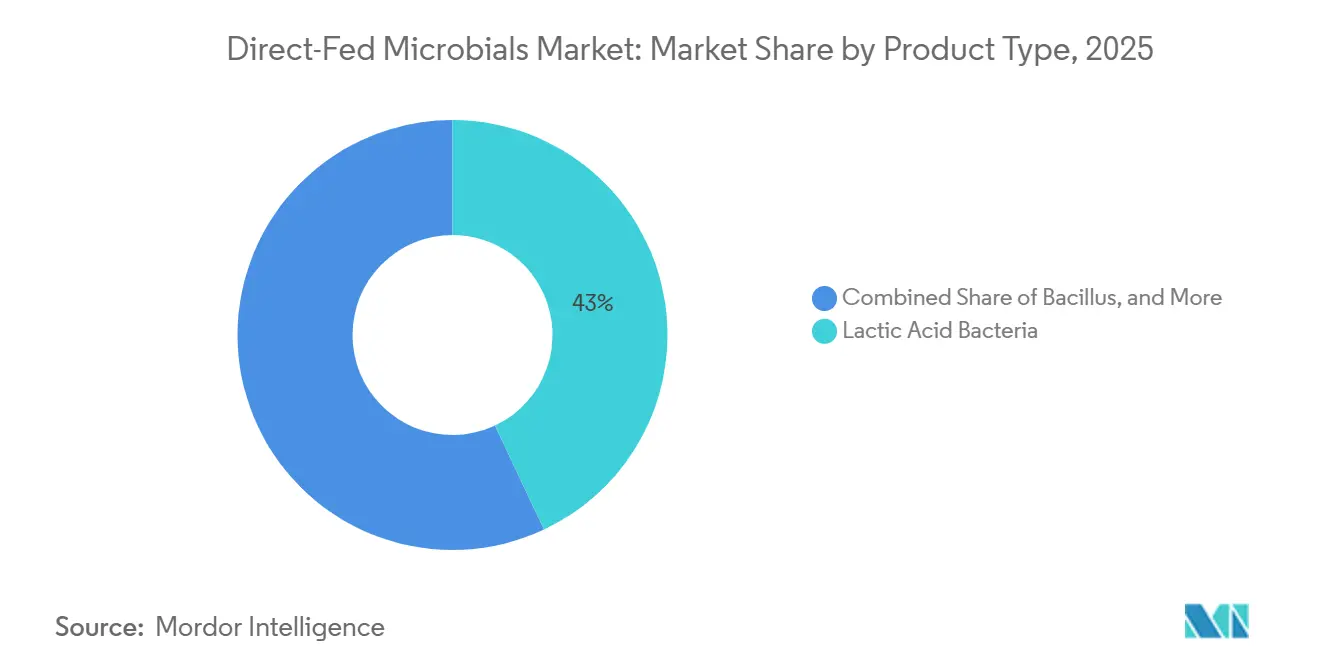
- By product type, lactic acid bacteria accounted for the largest 43% of the direct-fed microbials market share in 2025, whereas Bacillus is projected to grow at the fastest 15.2% CAGR from 2026 to 2031.
- By livestock, poultry captured the largest 37% of the direct-fed microbials market size in 2025, while aquaculture is projected to expand at the fastest 17.4% CAGR from 2026 to 2031.
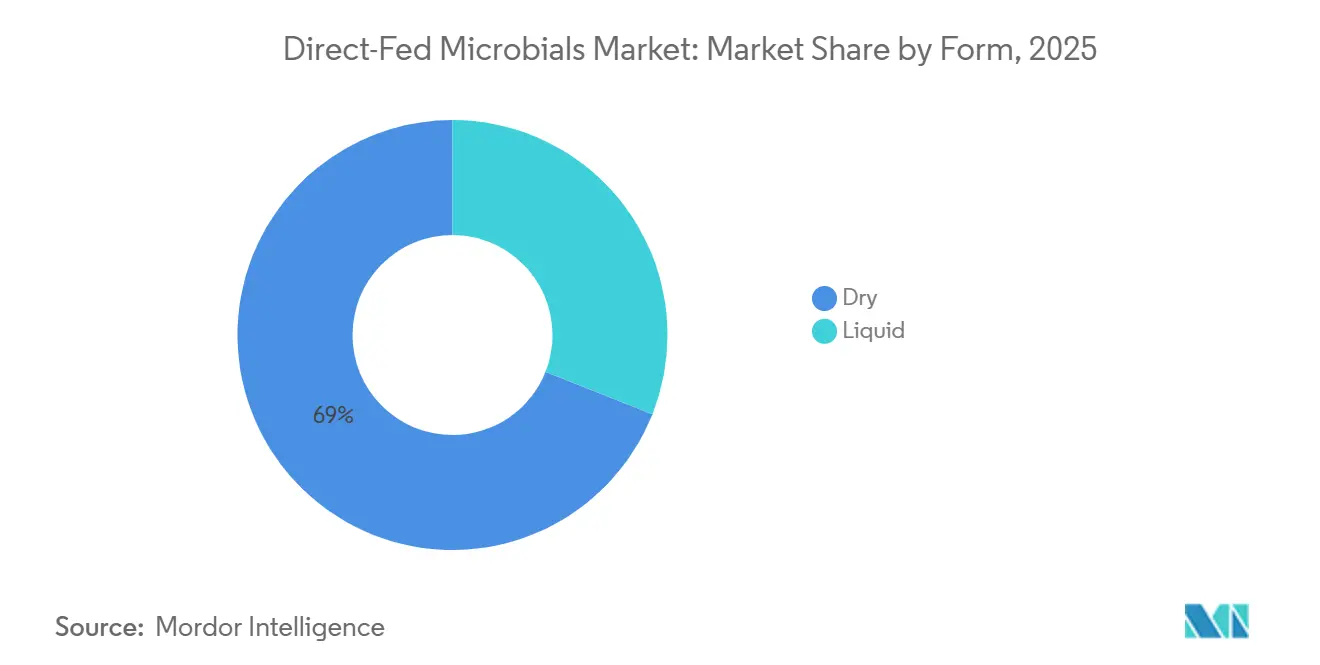
- By form, dry held the largest 69% of the market share in 2025, whereas liquid is anticipated to grow at the fastest 18.6% CAGR from 2026 to 2031.
- By geography, North America held the largest 32% of the market share in 2025, while Asia-Pacific is projected to grow at the fastest 14.8% CAGR from 2026 to 2031.
Note: Market size and forecast figures in this report are generated using Mordor Intelligence’s proprietary estimation framework, updated with the latest available data and insights as of January 2026.
Market Trends and Insights
Drivers Impact Analysis of Direct-Fed Microbials Market*
| Driver | (~) % Impact on CAGR Forecast | Geographic Relevance | Impact Timeline |
|---|---|---|---|
| Surging demand for antibiotic-free animal protein | +3.2% | Global, strongest in North America and Europe | Medium term (2–4 years) |
| Stringent regulations on antibiotic growth promoters | +2.8% | North America, Europe, China, and India | Short term (≤ 2 years) |
| Rapid expansion of commercial poultry and swine industries | +2.5% | China, India, Vietnam, Brazil, and Argentina | Long term (≥ 4 years) |
| Shift toward functional feed additives focusing on gut health | +1.9% | Global, early adoption in North America and Europe | Medium term (2–4 years) |
| Heat-stable spore-forming probiotic strains enabling pelleted feed | +1.6% | Regions with high pelleting rates worldwide | Medium term (2–4 years) |
| On-farm precision dosing systems integrating live microbials | +0.8% | North America and Europe, emerging Asia-Pacific | Long term (≥ 4 years) |
| Source: Mordor Intelligence | |||
Surging Demand for Antibiotic-free Animal Protein
A notable shift toward antibiotic-free animal protein production is evident from the consistent decline in antibiotic usage within poultry systems. The United States Poultry and Egg Association Antibiotic Stewardship Report (2025) indicates that the percentage of broiler chickens in the United States receiving antibiotics at hatcheries has decreased from approximately 90% to less than 1% in 2024 over the past decade [1]Source: United States Poultry and Egg Association, “Antibiotic Stewardship Report 2025,” uspoultry.org. This data, derived from a comprehensive analysis of the majority of national production, underscores the near elimination of routine antibiotic use in commercial poultry production, particularly in North America. Consequently, producers are increasingly relying on alternatives such as direct-fed microbials to support animal health, enhance feed efficiency, and meet evolving retailer and consumer demands.
Stringent Regulations on Antibiotic Growth Promoters
Stringent regulations on antibiotic usage in livestock production are driving a shift toward alternative feed solutions. According to the United States Food and Drug Administration (2024), all medically important antibiotics for livestock now require veterinary authorization under the Veterinary Feed Directive (VFD) [2]Source: United States Food and Drug Administration, “Veterinary Feed Directive (VFD) Final Rule and Guidance Updates,” fda.gov. These regulatory changes significantly limit routine and prophylactic antibiotic use, increasing compliance requirements for producers. Consequently, livestock operators are adopting alternatives such as direct-fed microbials to support animal health, enhance gut function, and maintain productivity while meeting regulatory standards.
Rapid Expansion of Commercial Poultry and Swine Industries
The commercial poultry and swine industries are experiencing rapid growth, driven by increasing global livestock production. According to the Food and Agriculture Organization (2025), global meat production reached 374 million metric tons in 2024, with chicken and pig meat being among the most produced categories worldwide [3]Source: Food and Agriculture Organization, “Agricultural Production Statistics 2010–2024,” fao.org . This growth highlights the expanding scale and industrialization of livestock production, particularly in key markets such as China, Brazil, and India. As production scales up, ensuring feed efficiency, gut health, and disease resilience has become essential, especially with reduced antibiotic usage. In response, producers are increasingly utilizing direct-fed microbials to improve nutrient utilization and support high-performance livestock systems, emphasizing their role in modern feed strategies.
Shift Toward Functional Feed Additives Focusing on Gut Health
The focus on functional feed additives aimed at gut health is bolstered by regulatory and scientific validation of microbial-based solutions in animal nutrition. The European Food Safety Authority (2025) has evaluated a feed additive containing Bacillus subtilis DSM 32324, Bacillus subtilis DSM 32325, and Bacillus amyloliquefaciens DSM 25840, confirming its potential efficacy as a zootechnical additive for all poultry species under specified usage conditions. This classification under "gut flora stabilizers" underscores the increasing importance of microbiome management as a key strategy for productivity. As livestock producers place greater emphasis on consistent performance and intestinal health, direct-fed microbials are being incorporated into feed formulations as functional additives, enhancing production efficiency and aligning with modern feeding practices.
Restraints Impact Analysis of Direct-Fed Microbials Market*
| Restraint | (~) % Impact on CAGR Forecast | Geographic Relevance | Impact Timeline |
|---|---|---|---|
| Variable product efficacy across farm conditions | -1.4% | Global, diverse management practices | Short term (≤ 2 years) |
| Higher cost versus conventional feed additives | -1.2% | Price-sensitive Asia-Pacific, South America, and Africa | Medium term (2–4 years) |
| Supply-chain bottlenecks for freeze-dried cultures | -0.9% | Regions lacking cold-chain infrastructure | Short term (≤ 2 years) |
| Regulatory uncertainty for engineered microbial strains | -0.7% | Europe and parts of Asia-Pacific | Long term (≥ 4 years) |
| Source: Mordor Intelligence | |||
Variable Product Efficacy Across Farm Conditions
Inconsistent performance in real-world farming environments remains a significant challenge for the adoption of direct-fed microbials. The European Food Safety Authority (2024) states that the efficacy of feed additives must be demonstrated through multiple controlled studies designed for specific animal species and conditions of use, with clearly defined zootechnical parameters and trial requirements. This highlights that outcomes are heavily influenced by trial design and operational conditions, making it challenging to replicate results across diverse farm settings. Variations in management practices, feed composition, biosecurity measures, and environmental conditions contribute to inconsistent on-farm results, limiting widespread adoption and reducing confidence among producers seeking reliable performance outcomes.
Higher Cost Versus Conventional Feed Additives
The higher costs associated with advanced feed additives remain a limiting factor for their widespread adoption. Probiotic-based solutions require additional formulation, processing, and stability measures compared to conventional additives, leading to higher inclusion costs. Although studies demonstrate improvements in growth performance and gut health, the economic benefits are not consistently realized across all production systems. This creates a cost-benefit trade-off for producers, especially in price-sensitive markets with tight margins, leading to cautious adoption and closer evaluation of return on investment.
*Our forecasts treat driver/restraint impacts as directional, not additive. The impact forecasts reflect baseline growth, mix effects, and variable interactions.
Direct-Fed Microbials Market Segment Analysis
By Product Type:
Bacillus Advances on Heat StabilityLactic acid bacteria accounted for the largest 43% of the direct-fed microbials market share in 2025. Their dominance is attributed to their strong colonization efficiency and compatibility with poultry and swine systems, where rapid stabilization of gut microbiota is essential. These strains are commonly used in feed premixes due to their proven digestive benefits and ease of formulation. Innovations in stabilization techniques, such as microencapsulation and co-granulation, are enhancing survivability during feed processing. These advancements enable manufacturers to maintain efficacy while addressing thermal-sensitivity challenges during pelleting operations.
Bacillus is projected to grow at the fastest 15.2% CAGR from 2026 to 2031. This growth is driven by its superior thermal resistance, allowing spores to withstand high-temperature pelleting processes without losing viability. Bacillus strains also produce enzymes such as protease and cellulase, which improve nutrient breakdown and feed efficiency across various livestock categories. Their versatility in poultry, swine, and aquaculture systems supports increasing adoption. Advancements in strain engineering and the development of multi-strain combinations are further enhancing performance consistency, making Bacillus-based solutions a preferred choice for industrial-scale feed production.



By Livestock:
Aquaculture Surges on Antimicrobial BansPoultry accounted for the largest 37% of the direct-fed microbials market size in 2025. Poultry production systems benefit significantly from microbial supplementation due to their short production cycles and susceptibility to disruptions in gut health. Direct-fed microbials are commonly used to enhance feed conversion, reduce early mortality, and improve disease resistance in broilers and layers. Their integration into commercial feed programs has become a standard practice, particularly in antibiotic-restricted production systems. The scalability of poultry operations and the consistent demand for high-quality protein continue to drive the adoption of microbial solutions across global poultry supply chains.
Aquaculture is projected to expand at the fastest 17.4% CAGR from 2026 to 2031. This growth is primarily due to increasing restrictions on antibiotic use in aquaculture, especially in shrimp and fish farming. Microbial solutions, particularly Bacillus-based strains, are gaining popularity for their dual benefits: improving gut health and enhancing water quality by breaking down organic matter. The rising demand for residue-free seafood is further driving adoption in export-oriented markets. Additionally, liquid and powder formulations designed for aquatic environments are supporting the expansion of microbial applications in intensive aquaculture systems.
By Form:
Liquid Adoption Accelerates via Precision ToolsDry formulations accounted for the largest 69% of the direct-fed microbials market share in 2025. These formulations are preferred due to their extended shelf life and compatibility with existing feed manufacturing systems. They can be easily integrated into premix and compound feed systems, ensuring uniform distribution and stability during storage. Their cost-effectiveness and logistical benefits have driven widespread adoption, particularly in large-scale livestock operations. Additionally, advancements in drying technologies and carrier materials are enhancing stability, enabling manufacturers to maintain product viability under diverse environmental and processing conditions.
Liquid formulations are projected to grow at the fastest CAGR of 18.6% from 2026 to 2031. This growth is attributed to the increasing adoption of precision dosing systems, especially through automated water-line delivery in poultry and swine production. Liquid formulations enable rapid microbial administration during critical periods, such as weaning or disease outbreaks, thereby improving responsiveness and efficacy. Their flexibility in application and faster absorption rates make them appealing for targeted interventions. Ongoing advancements in fermentation and stabilization technologies are further supporting scalability and ensuring consistent performance of liquid microbial products.
Geography Analysis
North America Direct-Fed Microbials Market
North America accounted for the largest 32% of the direct-fed microbials market share in 2025, driven by robust regulatory frameworks and the widespread adoption of antibiotic-free production systems. The region's livestock industry has incorporated microbial solutions into routine feed strategies to maintain productivity while adhering to regulatory requirements. Large-scale poultry and swine operations continue to fuel demand, supported by advanced feed manufacturing infrastructure. The increasing emphasis on animal health and performance optimization further strengthens adoption. Established distribution networks and strong research support facilitate consistent product validation and commercialization across the region.
APAC Direct-Fed Microbials Market
The Asia-Pacific region is projected to grow at the fastest CAGR of 14.8% from 2026 to 2031, driven by rapid livestock expansion and regulatory changes restricting antibiotic use. Countries such as China and India are increasingly adopting microbial feed solutions to enhance feed efficiency and support large-scale production systems. Rising aquaculture production and export-oriented requirements are accelerating the adoption of microbial-based feed additives. The expansion of commercial farming operations and the growing awareness of antibiotic alternatives further drive regional growth, boosting demand for microbial solutions across various livestock segments.
EMEA and South America Direct-Fed Microbials Market
Europe's highly structured regulatory framework for feed additives is shaping the adoption of microbial-based solutions in livestock systems. Producers in the region prioritize products that are scientifically validated and compliant to ensure consistent performance and safety in feed applications. This regulatory rigor promotes the use of direct-fed microbials that meet established quality and efficacy standards, particularly in dairy and swine production. South America is expanding its export-oriented livestock production, while the Middle East and Africa are gradually strengthening their feed infrastructure. These developments collectively support the broader regional adoption of microbial feed solutions, contributing to the global growth of the direct-fed microbials market.

Competitive Landscape
The market is moderately concentrated, with prominent companies such as Novonesis A/S, Archer-Daniels-Midland Company, DSM-Firmenich AG, Cargill, Incorporated, and Evonik Industries AG focusing on product innovation and strategic expansion to enhance their market presence. Key players are investing in advanced fermentation technologies and strain development to improve product efficacy and stability. Partnerships and acquisitions are being leveraged to expand geographic reach and diversify product portfolios. Additionally, companies are integrating probiotics with complementary feed solutions to offer comprehensive animal nutrition strategies. Ongoing investments in research and development are driving differentiation in performance and formulation capabilities.
Innovation efforts are focused on developing multi-strain microbial formulations and enhancing stability under industrial feed processing conditions. Companies are prioritizing solutions that ensure consistent performance across various livestock systems, addressing variability challenges in field conditions. The integration of digital tools and precision feeding technologies is being pursued to optimize dosing and improve outcomes. Rising demand for antibiotic alternatives is prompting manufacturers to invest in scalable production systems and secure regulatory approvals, ensuring compliance with evolving global standards while maintaining product reliability and effectiveness.
In 2026, Cargill, Incorporated invested USD 3.5 million to upgrade its postbiotic fermentation capabilities at its Cedar Rapids facility, strengthening its portfolio of advanced microbial-based feed solutions. This investment highlights the industry's growing focus on expanding production capacity and advancing next-generation microbial technologies, including postbiotics and paraprobiotics. Such initiatives are enabling companies to enhance scalability, improve product differentiation, and address evolving livestock nutrition requirements, thereby bolstering competitive positioning and supporting sustained demand for functional feed additives in global markets.
Direct-Fed Microbials Industry Leaders
Novonesis A/S
Archer-Daniels-Midland Company
DSM-Firmenich AG
Cargill, Incorporated
Evonik Industries AG
- *Disclaimer: Major Players sorted in no particular order
Direct-Fed Microbials Market Companies Covered in this Report
- Archer-Daniels-Midland Company
- Novonesis A/S
- DSM-Firmenich AG
- International Flavors & Fragrances Inc.
- Lallemand Inc.
- Kemin Industries, Inc.
- Evonik Industries AG
- Cargill, Incorporated
- Bio-Vet, Inc.
- Huvepharma EOOD
- Provita Eurotech Limited
- Asahi Biocycle Co., Ltd.
- Synbio Tech Inc.
- Phibro Animal Health Corporation

Recent Industry Developments in Direct-Fed Microbials Market
- April 2026: Novonesis A/S introduced Europe’s first Bacillus-based probiotic, Bovacillus, specifically formulated for dairy cows to enhance feed efficiency and gut health. The product has shown the capability to increase milk production by approximately 1 kilogram per cow per day.
- February 2026: Cargill, Incorporated invested USD 3.5 million to upgrade its facility in Cedar Rapids, Iowa, United States, enhancing postbiotic production capacity. This investment aims to improve supply reliability and meet the increasing demand for microbial-based feed solutions in livestock nutrition.
- August 2025: Evonik Industries AG has submitted a food additive petition to the Food and Drug Administration, requesting approval for the use of Bacillus velezensis as a viable microorganism in animal feed for all species. The petition seeks to amend feed additive regulations to facilitate the wider adoption of microbial-based solutions.


Global Direct-Fed Microbials Market Report Scope
Direct-fed microbials are live beneficial microorganisms incorporated into animal feed to promote gut microbial balance and digestive health. They enhance nutrient absorption, support immune function, and improve feed efficiency in livestock. In contemporary production systems, they are used as alternatives to antibiotics to sustain animal performance and health.
The direct-fed microbials market report is segmented by product type (lactic acid bacteria, bacillus, and others), by livestock (poultry, swine, cattle, aquaculture, and others), by form (dry and liquid), and by geography (North America, South America, Europe, Asia-Pacific, the Middle East, and Africa). The market forecasts are provided in terms of value (USD).
| Lactic Acid Bacteria |
| Bacillus |
| Others |
| Poultry |
| Swine |
| Cattle |
| Aquaculture |
| Others |
| Dry |
| Liquid |
| North America | United States |
| Canada | |
| Mexico | |
| Rest of North America | |
| South America | Brazil |
| Argentina | |
| Rest of South America | |
| Europe | Germany |
| France | |
| United Kingdom | |
| Spain | |
| Italy | |
| Russia | |
| Rest of Europe | |
| Asia-Pacific | China |
| India | |
| Japan | |
| South Korea | |
| Australia | |
| Rest of Asia-Pacific | |
| Middle East | Saudi Arabia |
| United Arab Emirates | |
| Rest of Middle East | |
| Africa | South Africa |
| Egypt | |
| Rest of Africa |
| By Product Type | Lactic Acid Bacteria | |
| Bacillus | ||
| Others | ||
| By Livestock | Poultry | |
| Swine | ||
| Cattle | ||
| Aquaculture | ||
| Others | ||
| By Form | Dry | |
| Liquid | ||
| By Geography | North America | United States |
| Canada | ||
| Mexico | ||
| Rest of North America | ||
| South America | Brazil | |
| Argentina | ||
| Rest of South America | ||
| Europe | Germany | |
| France | ||
| United Kingdom | ||
| Spain | ||
| Italy | ||
| Russia | ||
| Rest of Europe | ||
| Asia-Pacific | China | |
| India | ||
| Japan | ||
| South Korea | ||
| Australia | ||
| Rest of Asia-Pacific | ||
| Middle East | Saudi Arabia | |
| United Arab Emirates | ||
| Rest of Middle East | ||
| Africa | South Africa | |
| Egypt | ||
| Rest of Africa | ||


Key Questions Answered in the Report
What is the current value of the direct-fed microbials market?
The direct-fed microbials market size reached USD 1.60 billion in 2026 and is projected to hit USD 3.00 billion by 2031.
How fast is the direct-fed microbials market projected to grow?
The market is forecast to post a 13.40% CAGR between 2026 and 2031.
Which livestock segment will grow the quickest for direct-fed microbials?
Aquaculture is set to expand at the fastest 17.4% CAGR from 2026 to 2031.
What regions will lead future demand for direct-fed microbials?
Asia-Pacific market size project to grow at the fastest 14.8% CAGR from 2026 to 2031.
Page last updated on:





