
Demulsifier Market Size and Share
Market Overview
| Study Period | 2020 - 2031 |
|---|---|
| Market Size (2026) | USD 2.93 Billion |
| Market Size (2031) | USD 3.57 Billion |
| Growth Rate (2026 - 2031) | 4.01 % |
| Fastest Growing Market | Asia Pacific |
| Largest Market | North America |
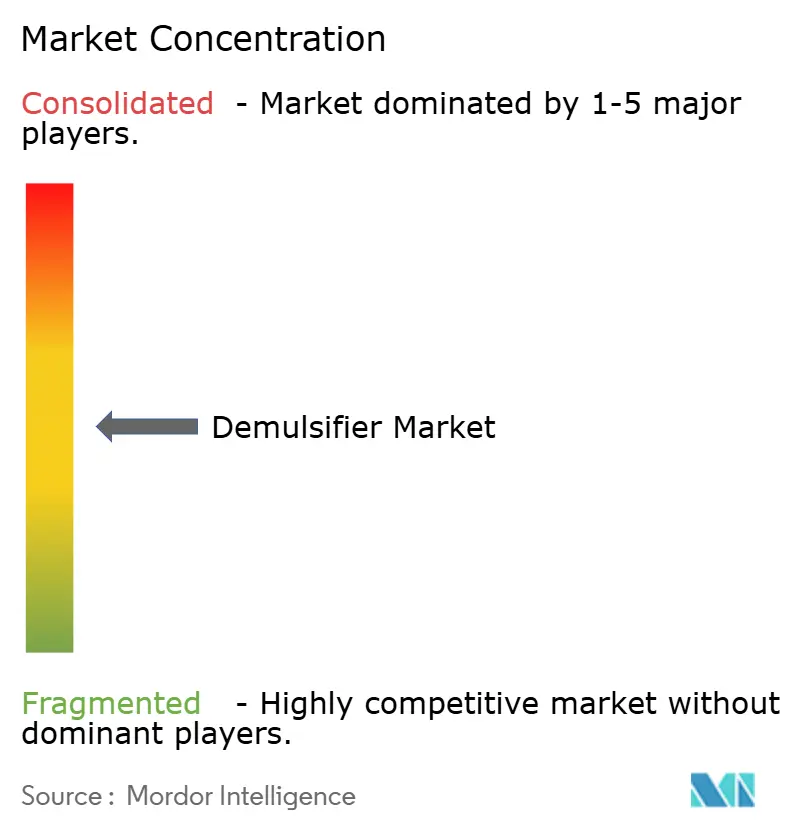
| Market Concentration | Medium |
Major Players *Disclaimer: Major Players sorted in no particular order Image © Mordor Intelligence. Reuse requires attribution under CC BY 4.0. | |
Demulsifier Market Analysis by Mordor Intelligence
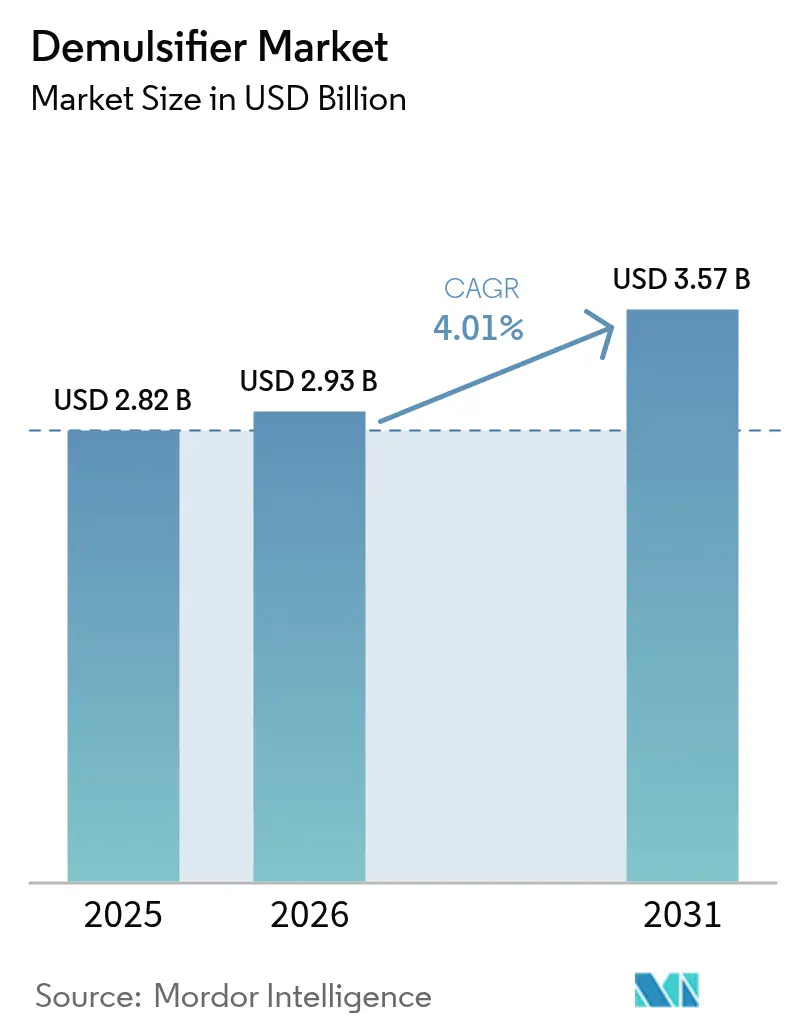
Demulsifier market size in 2026 is estimated at USD 2.93 billion, growing from 2025 value of USD 2.82 billion with 2031 projections showing USD 3.57 billion, growing at 4.01% CAGR over 2026-2031. Expansion stems from the rapid build-out of deepwater production systems and tighter environmental rules that push operators toward higher-efficiency separation chemicals. Growing water-cut levels in mature wells amplify demand for advanced formulations that maintain crude quality while managing produced-water volumes, further propelling the demulsifier market. Competitive activity is intensifying as suppliers race to commercialize biodegradable chemistries and ionic-liquid platforms that align with global sustainability goals. Operators increasingly treat chemicals as strategic levers for field optimization, channeling spending toward products that lower total lifting costs, support emissions compliance, and extend asset life.
Key Report Takeaways
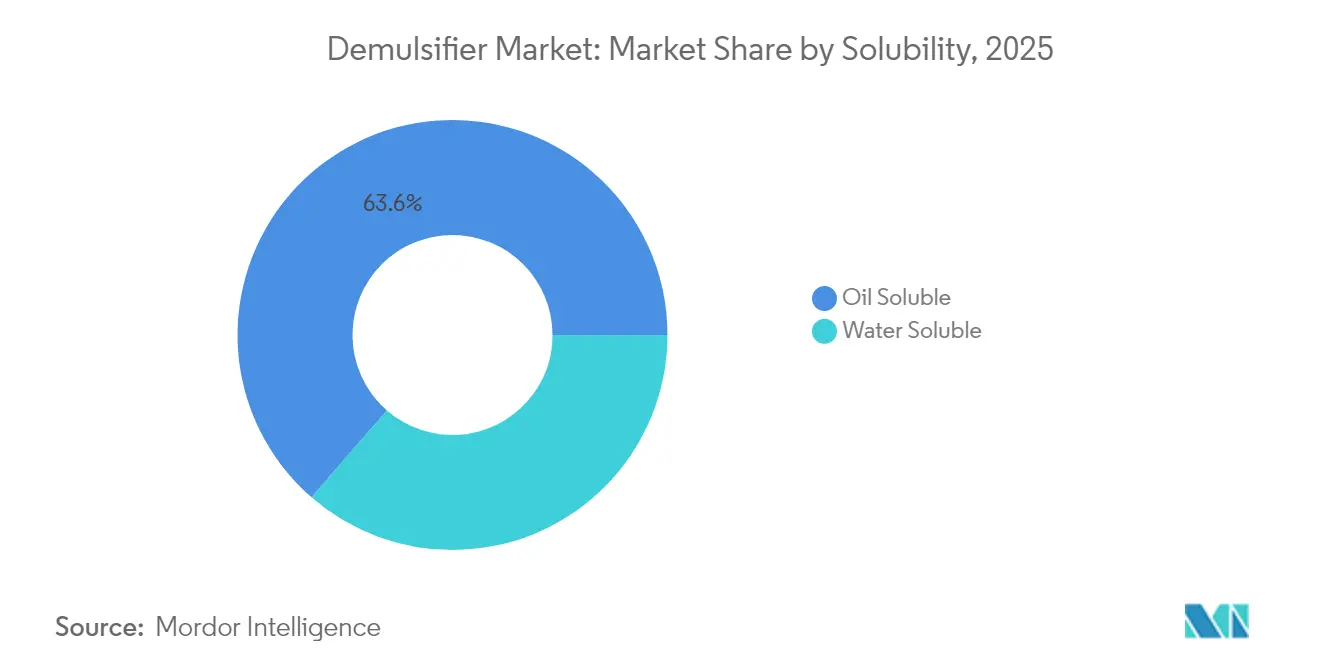
- By solubility, oil-soluble products led with 63.62% of the demulsifier market share in 2025, while water-soluble variants are projected to achieve a 5.78% CAGR through 2031.
- By chemistry, non-ionic reagents held 34.74% revenue in 2025; ionic liquids register the fastest growth at a 6.47% CAGR to 2031.
- By oilfield location, onshore operations commanded 59.51% of the demulsifier market size in 2025, whereas offshore deployments are expanding at 4.97% CAGR over the forecast period.
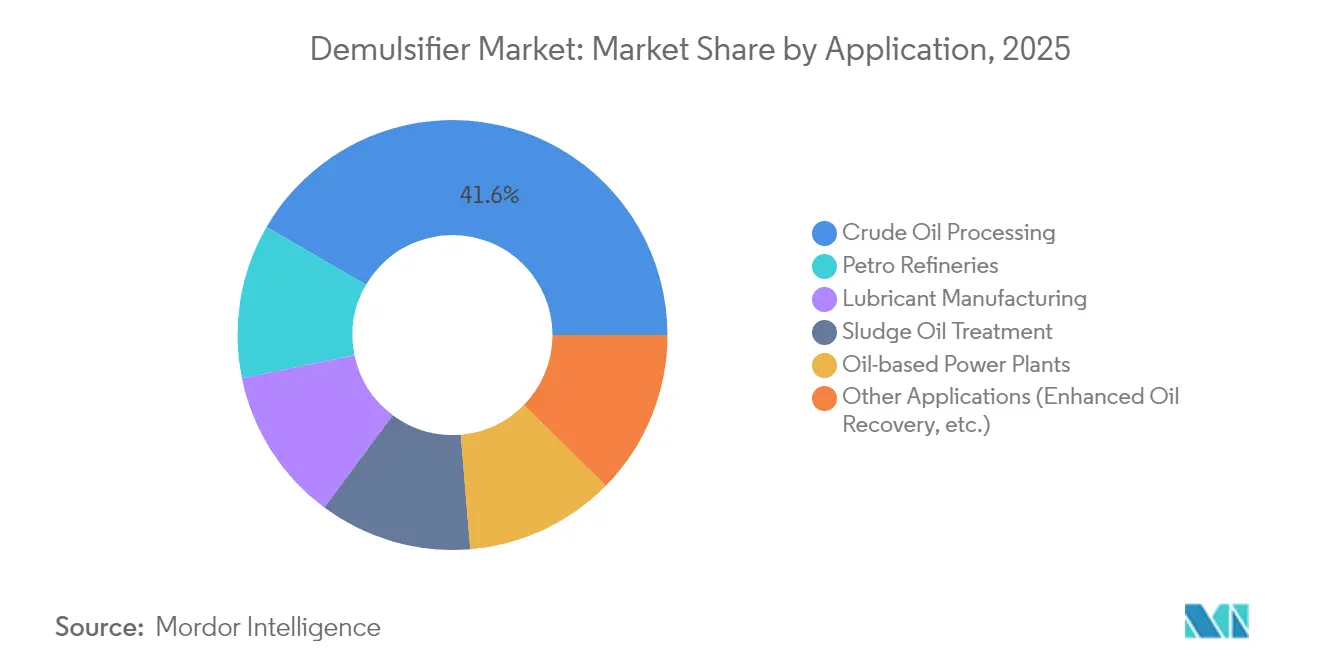
- By application, crude-oil processing captured 41.63% of the demulsifier market size in 2025, while enhanced oil recovery is slated for a 6.62% CAGR up to 2031.
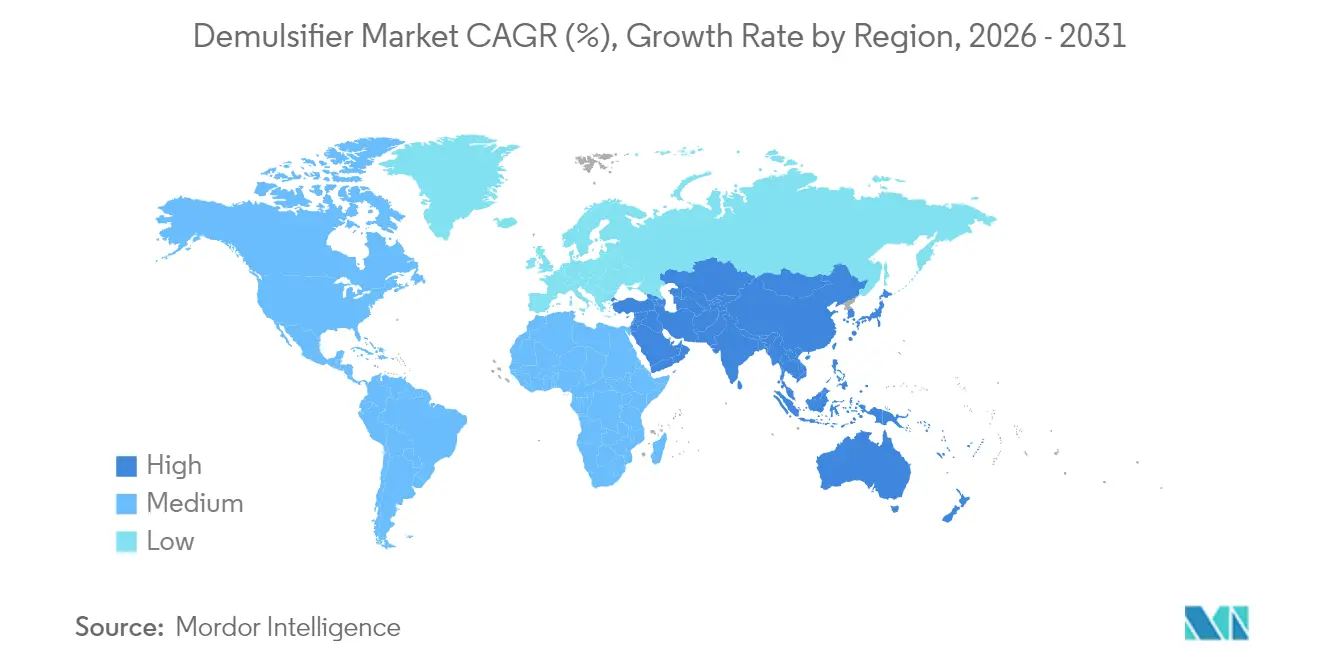
- By geography, North America dominated with 30.24% revenue in 2025; Asia-Pacific exhibits the highest regional growth at 6.52% CAGR to 2031.
Note: Market size and forecast figures in this report are generated using Mordor Intelligence’s proprietary estimation framework, updated with the latest available data and insights as of 2026.
Market Trends and Insights
Drivers Impact Analysis of Demulsifier Market*
| Driver | (~) % Impact on CAGR Forecast | Geographic Relevance | Impact Timeline |
|---|---|---|---|
| Supply-chain security needs in mature oilfields | +0.8% | Global, concentrated in North America & Middle East | Medium term (2-4 years) |
| Shift toward deeper offshore production & higher water-cut wells | +1.2% | Global offshore regions, led by Gulf of Mexico & North Sea | Long term (≥ 4 years) |
| Stringent water-discharge norms raising separation performance specs | +0.9% | Global, with stricter enforcement in North America & Europe | Short term (≤ 2 years) |
| Growing demand from increasing production of crude oil | +0.7% | Asia-Pacific core, spill-over to Middle East | Medium term (2-4 years) |
| Commercialization of biodegradable polyester-based demulsifiers | +0.4% | Global, early adoption in Europe & North America | Long term (≥ 4 years) |
| Source: Mordor Intelligence | |||
Supply-chain Security Needs in Mature Oilfields
Rising water-cut levels in declining reservoirs are forcing producers to adopt tailored separation programs that keep established assets viable. Baker Hughes reports that 70% of global crude flows now originate from mature fields, a share that heightens dependence on high-efficiency demulsifiers[1]Baker Hughes, “Mature Assets Solutions,” bakerhughes.com. Field trials demonstrate that squeeze-treatment packages can lift production between 50% and 200% while bringing per-well chemical costs down to USD 2,500, reinforcing the cost-effectiveness of chemical intervention. Operators view these gains as vital for offsetting lower reservoir pressures and shrinking margins. As a result, demulsifier market demand is tightly linked to life-extension programs for legacy assets. The trend is expected to remain a medium-term growth pillar as global producers optimize brownfield portfolios to hedge against crude-price volatility.
Shift Toward Deeper Offshore Production & Higher Water-Cut Wells
Deepwater investments in the Gulf of Mexico, the North Sea, and pre-salt Brazil place exacting performance requirements on demulsifier technology. Separators on floating production systems must process emulsions that may exceed 80% water content while meeting discharge limits below 40 mg oil per liter[2]Offshore Magazine, “Deepwater Separation Challenges,” offshore-mag.com. The demulsifier market is therefore innovating around formulations that tolerate high pressure and temperature without sacrificing dehydration efficiency. Offshore applications are delivering a 5.08% CAGR as operators pair chemicals with compact coalescers and membrane skids to save topside weight. These projects are inherently long-cycle, locking in durable chemical demand across the life of field. Suppliers that provide proven performance under extreme subsea conditions secure multi-year contracts, anchoring revenue visibility.
Stringent Water-Discharge Norms Raising Separation Performance Specs
Environmental regulators are ratcheting down permissible oil-in-water limits, compelling producers to revisit separation schemes. The U.S. Environmental Protection Agency enforces broad spill-prevention rules under 40 CFR Part 112, pushing discharge targets below 30 mg oil per liter. Canada’s addition of coal tars and PAHs to its toxic-substances list underscores a similar drive toward lower aromatic releases[3]Government of Canada, “Toxic Substances List,” canada.ca. Water-soluble demulsifiers, which enhance downstream clarification, benefit most and are advancing at a 5.90% CAGR. Operators are also scrutinizing chemical biodegradability, prompting a pivot toward polyester-based blends that degrade rapidly yet maintain interfacial activity. Short-term compliance pressures are stimulating a wave of product reformulations that strengthen the demulsifier market entry barriers.
Growing Demand from Increasing Production of Crude Oil
Asia-Pacific refiners chalked up record throughputs of 14.8 million bpd in 2023, a volume that widens the region’s appetite for separation chemicals. The build-out of integrated petrochemical hubs in China and India introduces heavier crude slates that challenge conventional dehydration practices. Specialty-chemical vendors note parallel opportunities in the Middle East, where new refining expansions are tied to hydrocarbon diversification strategies. These capacity hikes underpin the 6.67% regional CAGR and reinforce the demulsifier market’s cyclical linkage to crude-production growth. Medium-term prospects remain upbeat as Southeast Asian projects move from FEED to execution, driving chemical demand throughout the late 2020s.
Restraints Impact Analysis of Demulsifier Market*
| Restraint | (~) % Impact on CAGR Forecast | Geographic Relevance | Impact Timeline |
|---|---|---|---|
| Volatile crude-oil prices curbing CapEx on production chemicals | -1.1% | Global, most pronounced in North America & Middle East | Short term (≤ 2 years) |
| Increasing bans on alkyl-phenol ethoxylates | -0.6% | Europe & North America, expanding to Asia-Pacific | Medium term (2-4 years) |
| Scale-up challenges for ionic-liquid formulations | -0.3% | Global, concentrated in advanced technology markets | Long term (≥ 4 years) |
| Source: Mordor Intelligence | |||
Volatile Crude-Oil Prices Curbing CapEx on Production Chemicals
The International Energy Forum predicts a 1.4 million bpd surplus in 2025, a scenario that pressures operators to defer discretionary chemical spend. When spot prices slide below breakeven thresholds, procurement teams prioritize base-load volumes and renegotiate price-indexed contracts that compress supplier margins. Specialty blends carrying higher unit costs, including ionic liquids, become prime targets for short-term cutbacks. This cyclical pullback is the strongest near-term headwind and subtracts 1.1 percentage points from the projected CAGR. Although chemical adoption rebounds with pricing recovery, the restraint underscores the demulsifier market’s sensitivity to macro-oil cycles.
Increasing Bans on Alkyl-Phenol Ethoxylates
Endocrine-disruption data have prompted regulatory agencies to phase out alkyl-phenol ethoxylates. The European Chemicals Agency classifies several phenolic surfactants as substances of very high concern, spurring multi-year reformulation programs across the supplier base. Similar draft rules in the United States are under review, portending wider restrictions. Manufacturers must run parallel production during the transition, inflating operating costs and temporarily limiting product availability. Medium-term headwinds will ease once new chemistries achieve full commercial scale, yet the reformulation burden weighs on the demulsifier industry’s near-term growth momentum.
*Our forecasts treat driver/restraint impacts as directional, not additive. The impact forecasts reflect baseline growth, mix effects, and variable interactions.
Demulsifier Market Segment Analysis
By Solubility:
Water Treatment Drives Soluble GrowthOil-soluble products controlled 63.62% of 2025 revenues, underscoring their entrenched role in primary dehydration units and separator train injections. Their dominance is rooted in quick interfacial action that expedites free-water drop-out at the wellhead, a critical step in minimizing corrosion and desalter upsets. Water-soluble alternatives, though smaller today, are scaling quickly at a 5.78% CAGR as operators expand produced-water treatment infrastructure to meet stricter disposal limits. This surge aligns with the demulsifier market’s pivot toward holistic water management rather than singular focus on crude quality.
Second-generation membrane-bioreactor systems increasingly specify soluble demulsifiers to pre-condition feed streams, boosting oil-in-water polishing stages. Hybrid treatment trains employing coalescing media and polymeric adsorbents gain efficiency when soluble chemistries improve emulsion destabilization upstream. Consequently, suppliers broaden portfolios beyond conventional resin bases to polyethylene glycol, polyetheramine, and biodegradable ester backbones that perform across varying pH windows. The trend signals a gradual but unmistakable shift in specification patterns that will reshape future demulsifier market demand profiles.



By Chemistry:
Ionic Liquids Challenge Traditional FormulationsNon-ionic blends held 34.74% revenue in 2025, prized for versatility across crude grades from light tight oil to extra-heavy. They integrate seamlessly with corrosion inhibitors, scale squeezes, and paraffin solvents, simplifying chemical management for multi-well pads. Ionic liquids, in contrast, are the breakout story with a 6.47% CAGR, buoyed by laboratory data showing superior stability under reservoir conditions up to 200 °C and salinities above 200,000 ppm.
Commercial momentum is tempered by cost barriers and supply-chain immaturity, yet pilot successes in the South China Sea and Gulf of Mexico underscore their potential. Amphoteric and cationic products retain niche appeal where charge-based separation mechanisms yield higher efficiency in acidic crudes. Meanwhile, anionic surfactants see steady demand in refinery desalter circuits, where their compatibility with brine desalting aids in chloride removal. Over the coming decade, competitive edge will hinge on suppliers’ ability to hybridize ionic-liquid functionalities with non-ionic cost profiles, a prospect that could further disrupt the demulsifier market.
By Oilfield Location:
Offshore Technology Demands Drive InnovationOnshore fields retained 59.51% revenue in 2025 thanks to massive shale plays across North America and conventional output in the Middle East. Their chemical-consumption patterns are mature, emphasizing cost-per-barrel efficiencies and ease of logistics for pad-based delivery systems. Offshore projects, however, represent the innovation frontier as deepwater producers face severe space and weight constraints on floating platforms. Offshore volumes are expanding at 4.97% CAGR, introducing complex emulsions that test conventional chemistries.
High-pressure, high-temperature conditions in pre-salt reservoirs demand demulsifiers that withstand 15,000 psi while preserving droplet coalescence rates. Operators also seek formulations compatible with monoethylene glycol, hydrate inhibitors, and topside foam-control chemicals to avoid cross-treatment interference. Successful deployments in the Campos Basin demonstrate how bespoke blends can maintain production uptime, illustrating why offshore applications will shape the future requirements of the demulsifier market.
By Application:
Enhanced Recovery Accelerates Chemical DemandCrude-oil processing remains the cornerstone application at 41.63% of 2025 sales, encompassing wellhead separation, transportation tank treatments, and refinery desalting. Operators value reliable break times and low basic sediment and water readings to avoid downstream fouling. Enhanced oil recovery constitutes the fastest-growing use case at 6.62% CAGR as alkali-surfactant-polymer floods gain traction in aging reservoirs. Laboratory studies show displacement efficiencies improving by 19% when demulsifiers are optimized alongside surfactant packages.
Chemical EOR campaigns prioritize demulsifiers that mitigate injectant back-production issues while safeguarding treater performance. Petrochemical refineries, sludge-oil remediation, and lubricant blending supply steady if modest demand streams that diversify supplier revenue. Over the forecast horizon, integrated EOR programs will account for a growing share of the demulsifier market as producers chase incremental recovery factors to balance investment discipline and reserve replacement pressures.
Geography Analysis
North America Demulsifier Market
North America led the global demulsifier market with 30.24% revenue in 2025, anchored by prolific shale liquids output and complex Gulf of Mexico deepwater assets. Operators in the United States are set to boost 2025 production, reinforcing a steady draw on separation chemicals even as ESG mandates tighten discharge permits. Canada’s heightened scrutiny of PAHs further nudges suppliers toward eco-friendly chemistries that avoid phenolic precursors. Regional service companies partner with chemical majors to deliver bundled optimization offerings, embedding demulsifier selection into holistic water-management strategies as pad counts rise across the Permian and Montney formations.
APAC Demulsifier Market
Asia-Pacific stands out with a 6.52% CAGR, underpinned by China’s record 14.8 million bpd refining throughput and sustained petrochemical investment across Zhejiang and Guangdong clusters. Integrated complexes amplify demulsifier usage by processing heavier crudes and resid-based feeds that generate stable emulsions. Southeast Asia’s chemical market is poised to nearly double to USD 448 billion by 2030, drawing specialty-chemical players into Vietnam, Indonesia, and Malaysia. India’s expanded refinery slate and coal-bed methane developments present additional volume upside as local operators adopt advanced separation packages to meet Bharat Stage-VI fuel standards.
EMEA and South America Demulsifier Market
Europe and the Middle East & Africa display mature yet resilient demand, guided by stringent REACH compliance and large-scale brownfield upgrades in the North Sea and Arabian Peninsula. European operators prioritize biodegradable demulsifiers to satisfy Water Framework Directive thresholds, whereas Middle Eastern producers focus on reducing water-handling costs in high-salinity reservoirs. South America offers moderate growth led by Brazil’s expanding pre-salt portfolio and Argentina’s unconventional drives. Collectively, geographic variations reveal how local production profiles, regulatory regimes, and investment cycles shape the trajectory of the demulsifier market.

Value Chain Analysis
The demulsifier value chain starts with petrochemical and specialty-surfactant feedstocks (notably ethylene oxide, propylene oxide, alcohols, amines, and polyoxyalkylene block copolymers) that are converted into formulated demulsifier blends and then qualified through laboratory screening and field trials. Manufacturing and formulation are generally concentrated around major chemical and refining corridors, with distribution often set up as hub-and-spoke networks near refining and production basins (for example, the Texas and Louisiana Gulf Coast and the Rotterdam port area) to support fast replenishment, onsite troubleshooting, and application-specific validation.
Downstream, oilfield service companies and chemical suppliers deliver products in bulk, totes, or field-ready packages, and performance support (sampling, compatibility testing, and dosage optimization) is a key value-add for complex crude and high water-cut systems. Recent supply-side adjustments underscore resilience and lead-time management as competitive levers: Centrium Energy Solutions launched in 2025 with a domestic sourcing and distribution model aimed at reshoring oilfield chemical supply, while 2026 logistics disruptions tied to suspended maritime routes and reduced vessel capacity have reinforced the need for local inventory, flexible sourcing, and shorter sample-to-field cycles for specialized formulations.
Competitive Landscape
The demulsifier market features moderate fragmentation, with diversified chemical conglomerates sharing space with niche oilfield service specialists. Baker Hughes, BASF, Clariant, and Halliburton leverage global logistics and wellsite technical staff to secure master-service agreements across supermajor portfolios. Their integrated offerings bundle demulsification with flow-assurance, corrosion inhibition, and production-optimization analytics, raising switching costs for operators. Competitive edge now hinges on data-backed evidence of value creation, driving suppliers to invest in real-time emulsion-quality monitoring and AI-driven dosage optimization.
Pricing pressure remains acute in commoditized onshore basins, forcing suppliers to pursue efficiency gains in supply logistics and raw-material sourcing. Offshore and EOR markets, by contrast, reward high-specification performance and technical support, allowing premium pricing. Intellectual-property portfolios centered on novel chemistries and application-specific formulations serve as key barriers to entry. Vendors that demonstrate robust ESG credentials and transparent stewardship metrics further differentiate themselves, shaping procurement decisions as operators align supply chains with corporate sustainability targets.
Demulsifier Industry Leaders
Baker Hughes Company
Halliburton Company
BASF
Clariant
SLB
- *Disclaimer: Major Players sorted in no particular order
Demulsifier Market Companies Covered in this Report
- Baker Hughes Company
- BASF
- Clariant
- Croda International Plc
- Dorf Ketal
- Dow
- Ecolab
- Halliburton Company
- Innospec
- NCPIQ8 (National Chemical & Petroleum Industries Co.)
- PT Eonchemicals Putra
- Sasol
- SLB
- Solvay
- Stepan Company

Market Opportunities and Future Outlook
Near-term opportunity centers on programs that reduce total separation cost while meeting tighter produced-water and refinery wastewater specifications, which is shifting demand toward higher-efficiency and lower-toxicity demulsifier chemistries. Water-soluble systems are gaining specification space as operators expand produced-water treatment trains, while reformulation away from restricted phenolic surfactants is pushing suppliers to bring aromatic solvent-free and more biodegradable options into mainstream procurement.
Commercial moves in 2025-2026 point to whitespace in integrated supply plus application support across both upstream and downstream users. Baker Hughes announced a multiyear agreement in February 2026 to supply downstream chemical technologies, including XERIC heavy oil demulsifiers, across Marathon Petroleum refineries and renewable fuel facilities in the United States, reflecting a shift toward preferred-provider models. On the supply side, CrudeChem Technology (Fineotex Group) commissioned a Midland, Texas facility in March 2026 with large-scale blending and R&D capacity, which supports faster customization and local availability for Permian-centered operations. Technology development also suggests space for differentiated performance tools, with 2026 academic work highlighting machine-learning-assisted optimization approaches for demulsifier formulations and separation materials, consistent with supplier investment in data-backed dosage and performance programs.
Recent Industry Developments in Demulsifier Market
- February 2026: Baker Hughes announced a multiyear agreement to become the preferred provider of hydrocarbon treatment products for Marathon Petroleum, covering 12 US refineries and two renewable fuel facilities, including XERIC heavy oil demulsifiers. The award strengthens supplier positioning as refiners consolidate chemical procurement under multi-site frameworks and link product performance to operational reliability and compliance targets.
- June 2025: M Vest Water signed a trial agreement with a major oil and gas producer in Oman to treat 110,000 m3/day of produced water using its nature-based NORWAFLOC de-oiler and demulsifier. The trial scale highlights produced-water treatment as a major pull-through channel for demulsifier demand beyond conventional crude dehydration.
- March 2024: SLB expanded the DS-83066 subsea demulsifier to support additional offshore field applications, indicating the scaling of offshore demulsifier programs. The update points to continued offshore capability development aligned with safe operations and field uptime improvements.


Demulsifier Market Report Scope and Research Methodology
Market Definition and Coverage
For this study, the demulsifier market covers chemical formulations used to break oil and water emulsions so separation happens faster and more consistently across upstream production, midstream handling, and refinery processing.
Scope exclusions: We exclude mechanical separation equipment and generic water treatment chemicals that are not primarily positioned or sold as demulsifiers.
Segments Covered in This Report
- By Solubility
- Water Soluble
- Oil Soluble
- By Chemistry
- Anionic
- Cationic
- Non-ionic
- Amphoteric
- Ionic Liquids
- By Oilfield Location
- Onshore
- Offshore
- By Application
- Crude Oil Processing
- Petro Refineries
- Sludge Oil Treatment
- Oil-based Power Plants
- Lubricant Manufacturing
- Other Applications (Enhanced Oil Recovery, etc.)
- By Geography
- Asia-Pacific
- China
- Japan
- India
- South Korea
- ASEAN Countries
- Rest of Asia-Pacific
- North America
- United States
- Canada
- Mexico
- Europe
- Germany
- United Kingdom
- France
- Italy
- Spain
- Russia
- NORDIC Countries
- Rest of Europe
- South America
- Brazil
- Argentina
- Rest of South America
- Middle East and Africa
- Saudi Arabia
- South Africa
- Asia-Pacific
Data Sources, Market Sizing, and Validation
Desk Research
Desk research started with mapping where demulsifiers are used and what drives demand, then aligning that to measurable oil and water handling activity. Public sources such as the U.S. Energy Information Administration, International Energy Agency, OPEC, and the World Bank were used to understand crude production, downstream runs, and macro trends that influence chemical consumption.
To anchor assumptions around produced water volumes, treatment intensity, and offshore versus onshore exposure, we also reviewed sources such as U.S. EPA material, publications from regional environmental regulators, and relevant peer reviewed papers on emulsion breaking and separation performance. Company filings, investor presentations, and association websites were used to capture product positioning and typical end use language, while paid subscriptions for company financials and patent databases were selectively checked for capacity expansion signals and formulation activity. These examples are not exhaustive, and many other sources were reviewed for data collection, cross verification, and clarification.
Primary Interviews and Surveys
Primary work focused on confirming how demulsifiers are purchased and applied across crude production, enhanced oil recovery, refinery desalting, and sludge oil treatment, since use rates can vary by field conditions and fluid properties. We spoke with manufacturers, distributors, oilfield service teams, and end users across major producing and refining regions, then used their inputs to validate dosage ranges, pricing direction, and the share of oil soluble versus water soluble demand.
Distribution of primary research fieldwork respondents
| Company type | Respondent position | Region |
|---|---|---|
| Top tier: 27% | CXOs: 14% | APAC: 51% |
| Mid tier: 51% | Functional/Unit leaders: 38% | EMEA: 29% |
| Smaller Players: 22% | Managers: 48% | Americas: 20% |
Market-Sizing & Forecasting
Market sizing was built mainly with a top down model that reconstructs demand from oil production and processing activity, then applies realistic treatment intensity for emulsions that need chemical breaking. We started from regional crude production and refinery throughput, and then layered in indicators such as produced water volumes, offshore share of production, crude quality trends that influence emulsion stability, and typical demulsifier dosage ranges used for separation and desalting.
Once the demand pool was formed, pricing was modeled using observed ASP ranges by chemistry and solubility, with adjustments for inflation, feedstock cost direction, and mix shifts between oil soluble and water soluble products. Totals were then checked using selective bottom up approximations, such as sample supplier revenue mapping, channel checks on packaged volume, and sanity checks against the share of production chemicals inside broader oilfield chemicals spend. Where bottom up inputs were incomplete for smaller local suppliers, the gaps were handled with regional coverage factors that were reviewed in interviews.
For forecasting, we used scenario analysis supported by a multivariate view of the key drivers, since crude activity and produced water handling do not move in a straight line every year. Growth paths were tied to expected upstream investment, offshore project timelines, refinery utilization, and environmental compliance pressure, and the assumptions were aligned to what industry experts described as a realistic base case.
Data Validation & Update Cycle
Outputs were validated by comparing the model against independent signals such as regional oil production direction, refinery run rates, and changes in offshore activity, which should track demulsifier consumption at the regional level. If a region showed a step change that could not be explained by these drivers, the assumptions were reviewed and the interview pool was re contacted to understand whether the change reflected a pricing spike, a mix shift, or a scope mismatch.
Before sign off, results go through multi step analyst review where calculations, units, currency handling, and growth logic are checked, followed by a final pass for internal consistency across regions and applications. Reports are refreshed annually, and interim updates are completed when there are material events such as major upstream capex resets, refinery shutdown waves, or regulatory changes that can shift chemical usage patterns. Right before delivery, a fresh check is done so the final view reflects the latest available inputs.
Mordor Intelligence's Demulsifier Market Size Compared With Other Published Estimates
Published market values for demulsifiers often differ because groups draw the market boundary in different ways and also use different pricing and activity drivers. In practice, the biggest swings come from what gets counted as a demulsifier versus adjacent production chemicals, and whether the model follows oil production, refinery runs, or broader industrial separation use.
By tracking produced water handling intensity and refreshing mix and ASP assumptions by region, Mordor Intelligence keeps the demulsifier total tied to oilfield and refinery separation use cases, instead of blending in wider surfactant or general water treatment demand. Differences also show up when one estimate assumes a faster move to premium chemistries, applies a single global price, or uses older base year currency conversions, which can shift the USD total even if volumes are similar.
Benchmark comparison
| Source | Market Size | Gaps in Research Methodology |
|---|---|---|
| Mordor Intelligence | USD 2.82 B (2025) | |
| Industry Publisher A | USD 2.64 B (2025) | Uses a narrower demand lens that leans on upstream volumes and standard dosages, with less adjustment for regional produced water complexity and the mix of refinery versus oilfield use, which can compress the total. |
| Data Provider B | USD 3.07 B (2025) | Appears to include a broader application perimeter (for example, sludge oil treatment and refinery related chemicals counted more widely) and may apply higher average pricing, which can lift the value estimate. |
The spread across sources is mainly explained by scope boundaries and how pricing and use rates are refreshed over time. When the model is linked to observable oil production and refining activity, and the mix and pricing logic are stated clearly, the final market value becomes easier to trace and repeat for planning.


Key Questions Answered in the Report
What is the current Demulsifier Market size?
The demulsifier market size stands at USD 2.93 billion in 2026 and is projected to climb to USD 3.57 billion by 2031 at a 4.01% CAGR.
Which region leads global demand for demulsifiers?
North America holds the largest regional share at 30.24% due to intensive shale production and Gulf of Mexico deepwater projects.
Why are water-soluble demulsifiers growing faster than oil-soluble types?
Stricter produced-water discharge limits favor water-soluble chemistries that excel in polishing steps, pushing their CAGR to 5.78% through 2031.
How will deepwater expansion affect demulsifier consumption?
Deepwater fields require high-performance formulations that withstand extreme conditions, supporting a 4.97% CAGR for offshore applications and driving product innovation.
Page last updated on:


 Your data is secure and never sold or shared.


