
Cyclopentane Market Size and Share
Market Overview
| Study Period | 2020 - 2031 |
|---|---|
| Market Size (2026) | USD 460.58 Million |
| Market Size (2031) | USD 658.32 Million |
| Growth Rate (2026 - 2031) | 7.41 % |
| Fastest Growing Market | Asia Pacific |
| Largest Market | Asia Pacific |
| Market Concentration | Medium |
Major Players
*Disclaimer: Major Players sorted in no particular order Image © Mordor Intelligence. Reuse requires attribution under CC BY 4.0. |
|
Cyclopentane Market Analysis by Mordor Intelligence
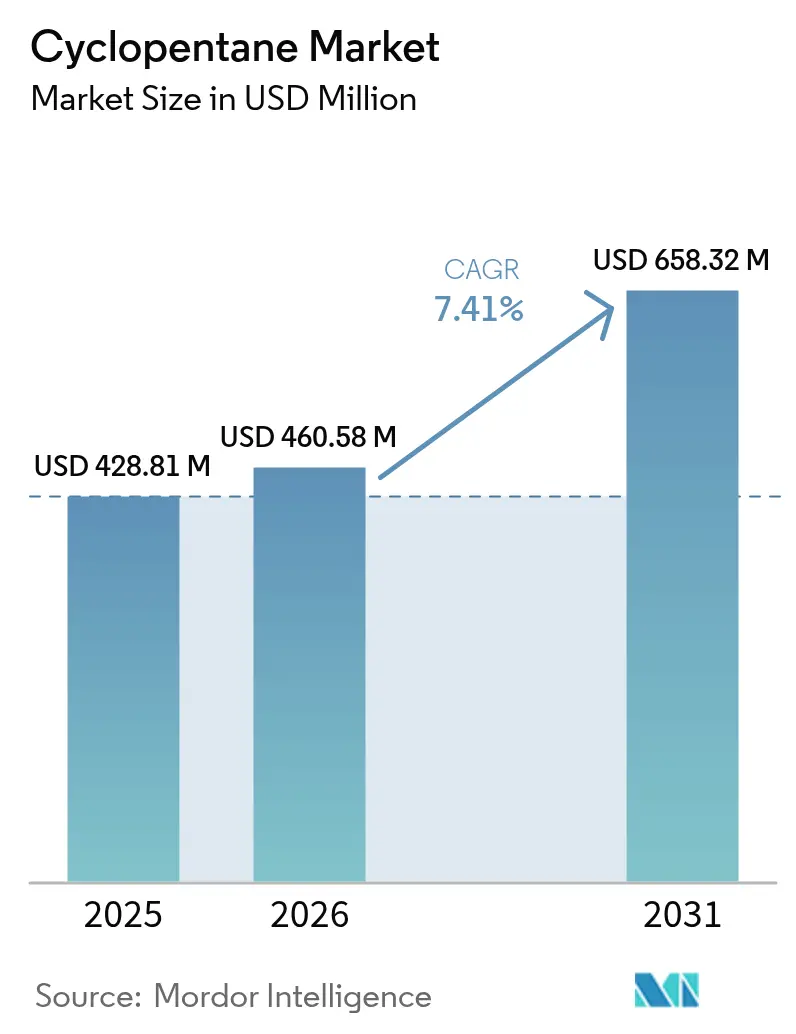
The Cyclopentane Market size was valued at USD 428.81 million in 2025 and estimated to grow from USD 460.58 million in 2026 to reach USD 658.32 million by 2031, at a CAGR of 7.41% during the forecast period (2026-2031). Regulatory accelerators—most notably the Kigali Amendment’s stepped-down HFC quotas—have elevated cyclopentane from a niche hydrocarbon to a mainstream compliance pathway for appliance, construction and cold-chain manufacturers. Producers are simultaneously confronting constrained feedstock supply, limited global capacity and rising transportation costs, prompting investments in on-site blending and high-purity processing assets. Competitive strategies now hinge on balancing volume-driven foam markets with higher-margin specialty end uses such as vacuum insulated panels (VIPs) and electric-vehicle battery modules, where tighter chemical specifications command premium prices. While raw-material volatility and stricter hydrocarbon safety codes weigh on margins, the cyclopentane market continues to benefit from multi-industry decarbonization mandates, widening its application footprint across emerging and mature economies alike.
Key Report Takeaways
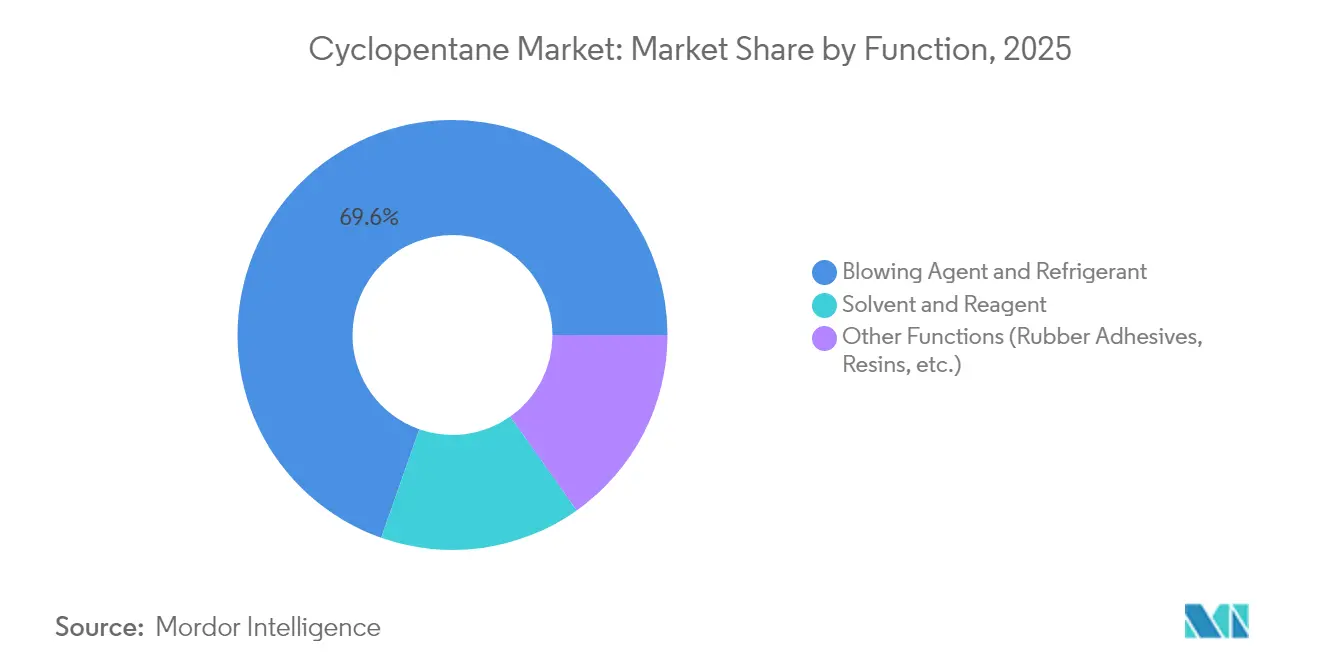
- By function, blowing agents and refrigerants captured 69.62% of cyclopentane market share in 2025, whereas solvents and reagents are forecast to grow at an 7.98% CAGR through 2031.
- By purity grade, ≥98% cyclopentane led with 54.71% revenue share in 2025; this grade is advancing at a 7.75% CAGR to 2031.
- By application, refrigeration accounted for a 61.62% share of the cyclopentane market size in 2025, yet insulation applications are expected to expand at 7.99% CAGR over 2026-2031.
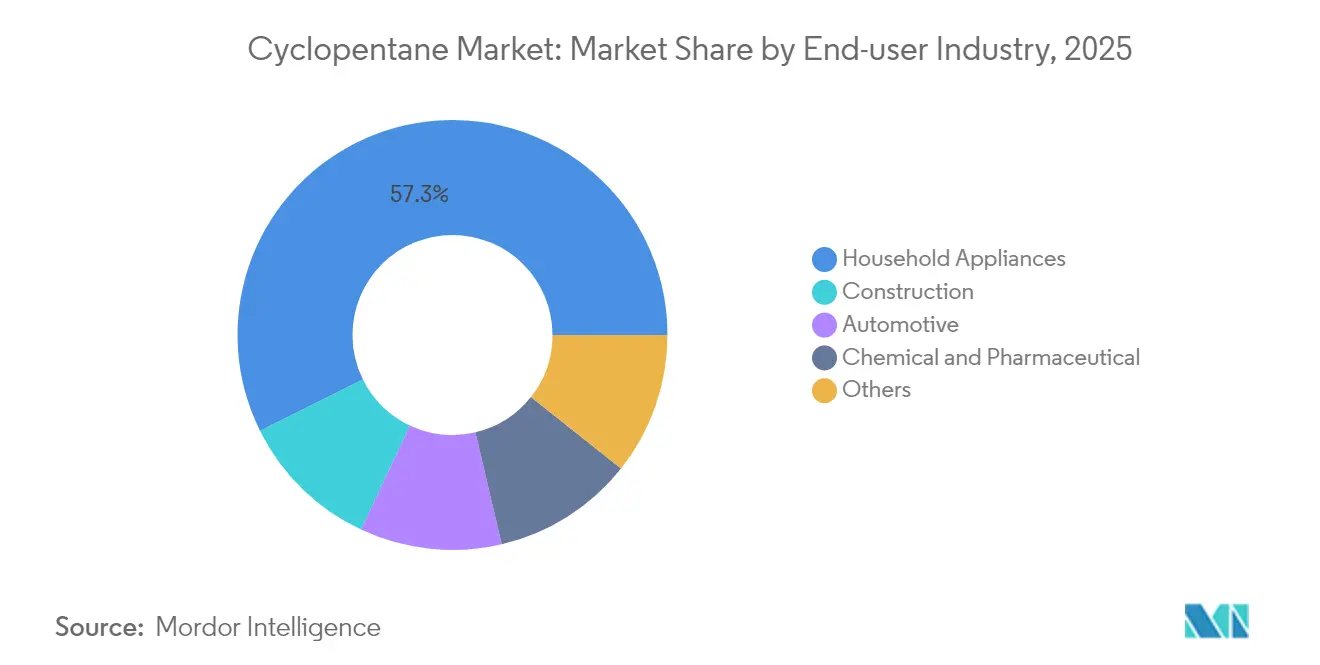
- By end-use industry, household appliances commanded 57.34% of the cyclopentane market in 2025, while construction is projected to post the fastest 8.04% CAGR to 2031.
- By geography, Asia-Pacific held 45.22% of the global cyclopentane market in 2025 and is set to grow at an 8.21% CAGR through 2031.
Note: Market size and forecast figures in this report are generated using Mordor Intelligence’s proprietary estimation framework, updated with the latest available data and insights as of 2026.
Market Trends and Insights
Drivers Impact Analysis of Cyclopentane Market*
| Driver | (~) % Impact on CAGR Forecast | Geographic Relevance | Impact Timeline |
|---|---|---|---|
| Adoption of cyclopentane VIP blowing agents | +1.2% | North America, EU, Asia-Pacific | Medium term (2-4 years) |
| Kigali Amendment-driven HFC phase-down | +2.1% | EU, North America, global | Short term (≤2 years) |
| Cold-chain demand for eco-refrigerants | +1.8% | Asia-Pacific core; MEA & Latin America spill-over | Medium term (2-4 years) |
| EV battery pack lightweight foams | +0.9% | China, EU, North America | Long term (≥4 years) |
| On-site pentane blending cost savings | +0.7% | High-volume manufacturing hubs | Short term (≤2 years) |
| Source: Mordor Intelligence | |||
Growing Adoption of Cyclopentane Blowing Agents in High-Performance Vacuum Insulated Panels
Cyclopentane-based VIP cores enable refrigerator and building-panel producers to achieve top-tier thermal resistance while slimming wall thickness, freeing interior volume and cutting energy use. Studies show that substituting 40% of fumed silica with cyclopentane foam maintains λ-values below 4 mW/m·K, lowering material costs without performance sacrifice. Premium appliance makers are leveraging the thinner-wall advantage to boost storage capacity within fixed external dimensions, a key differentiator in tightly regulated efficiency tiers. Haltermann Carless’s incremental debottlenecking in Germany is directed at these high-specification batches, reflecting the price premium VIP grades fetch[1]Haltermann Carless, “Expanding High-Purity Pentane Capacities for VIP Applications,” haltermann-carless.com. Rising electricity tariffs worldwide further strengthen the value proposition, making VIP adoption a cost-effective route to compliance and consumer savings.
Regulations Phasing-Down HFC Blowing Agents Under Kigali Amendment
Europe’s F-Gas Regulation drops HFC quotas to 9 Mt CO2-eq by 2030, triggering immediate shortages that amplify cyclopentane uptake in foam and refrigeration lines. Parallel rules in the United States, where the EPA approved additional hydrocarbon substitutes under SNAP in December 2024, remove lingering adoption barriers and streamline permitting[2]Environmental Protection Agency, “SNAP Rule 26—Acceptable Substitutes for Refrigeration and Air-Conditioning,” epa.gov. UNIDO-backed conversions in Chinese appliance factories demonstrate scalable, incident-free transitions when robust safety protocols are applied. As a result, board-room investment ranking now classifies cyclopentane capacity as an essential permit-to-operate, not an optional sustainability upgrade.
Demand for Eco-Friendly Refrigerants in Expanding Cold-Chain Logistics Across Emerging Economies
Emerging economies are racing to build temperature-controlled warehousing to meet booming demand for perishable foods and vaccines. The zero-ODP, low-GWP profile of cyclopentane satisfies multinational retail and pharma corporate governance codes while meeting local efficiency mandates. Operators in Indonesia, Vietnam and Nigeria report energy cost ratios up to 30% of operating expenses, making high-performance insulation critical for profitability. Asia-Pacific governments increasingly embed HFC phase-down clauses in bilateral trade deals, accelerating timelines for substitution and reinforcing growth for the cyclopentane market.
Lightweight Composite Insulating Foams for EV Battery Packs
Organic Rankine cycle tests confirm that cyclopentane achieves 72% heat-transfer efficiency at stable pressures suited to automotive systems. Automakers integrating pack-level thermal shields gain dual benefits of weight reduction and consistent battery temperature, supporting range extension and safety compliance. Composite suppliers are co-developing thermoplastic skins with embedded cyclopentane foams, offering recyclability advantages over epoxy-based alternatives. The electrification wave therefore unlocks a long-tail growth curve beyond legacy white-goods demand.
Restraints Impact Analysis of Cyclopentane Market*
| Restraint | (~) % Impact on CAGR Forecast | Geographic Relevance | Impact Timeline |
|---|---|---|---|
| Feedstock (naphtha/crude) price volatility | -1.4% | Net-import regions in Asia & Europe | Short term (≤2 years) |
| Stricter safety codes for flammable HC gases | -0.8% | Developed markets first, global rollout | Medium term (2-4 years) |
| Limited capacity & unplanned outages | -1.1% | Regions lacking indigenous production | Short term (≤2 years) |
| Source: Mordor Intelligence | |||
Feedstock (Naphtha/Crude) Price Volatility
Cyclopentane’s synthesis from cracker-grade streams exposes producers to propylene and naphtha price spikes. Argus forecasts show Northwest Europe propylene contracts climbing on planned refinery rationalizations, compressing foam-grade margins. Integrated refiners partially shield earnings by channeling co-product streams into captive cyclopentane units, but such scale remains unattainable for many standalone formulators. Smaller firms lack the credit lines to hedge multi-month feedstock swings, propelling sector consolidation as they seek balance-sheet relief within larger portfolios.
Stricter Safety Codes for Flammable Hydrocarbons Raise Compliance Costs
The U.S. Pipeline and Hazardous Materials Safety Administration’s October 2024 rulemaking adds tank-car design reviews and facility registration, projecting USD 97.3 million in net benefits, yet requiring significant upfront capex. OSHA’s May 2024 HazCom revision mandates pictogram-rich labeling and extended training, elevating administrative spend. EPA’s concurrent Risk Management Program amendments cover 11,740 facilities and introduce third-party audits, driving annual costs of USD 256.9 million. Compliance disproportionately affects sub-10 ktpa producers, intensifying exit or acquisition decisions and heightening the cyclopentane market’s consolidation trajectory.
*Our forecasts treat driver/restraint impacts as directional, not additive. The impact forecasts reflect baseline growth, mix effects, and variable interactions.
Cyclopentane Market Segment Analysis
By Function:
Blowing Agents Drive Market LeadershipBlowing agents and refrigerants held 69.62% of cyclopentane market share in 2025, as appliance and panel producers adopted the hydrocarbon to satisfy HFC-phase-down quotas. This mainstream volume anchors cash flow for suppliers; nevertheless, the solvent and reagent niche, though representing modest tonnage, is charted to grow at 7.98% CAGR, reflecting diversification into pharmaceutical synthesis and specialty polymerization lines. Developers targeting these chemistries must guarantee ultra-low benzene content and sub-20 ppm sulfur, characteristics that fetch a 20-30% price premium. Future revenue therefore hinges on balancing scale economics with niche customization—a dual-track strategy increasingly evident across the cyclopentane industry.



By Purity Grade:
High-Purity Specifications Command Premium≥98% purity grades captured 54.71% of 2025 demand, buoyed by VIPs and high-efficiency refrigerator walls where off-spec impurities jeopardize λ-performance. The segment is forecast to widen its lead at a 7.75% CAGR, supported by expanded distillation columns in Singapore and the U.S. Gulf Coast. The mid-tier 95-98% bracket services conventional rigid-foam boards, while technical grades (<95%) retreat to solvent duty as regulatory baselines tighten. EPA sets a 95% minimum purity for SNAP-approved cyclopentane, embedding a compliance floor that squeezes low-grade production economics. Investors therefore prioritize debottlenecking purity towers rather than green-field technical-grade assets.
By Application:
Refrigeration Dominance Faces Insulation GrowthRefrigeration lines accounted for 61.62% of the cyclopentane market size in 2025, reflecting decades-long brand familiarity in refrigerator foams. Insulation boards and VIP cores, however, are slated for 7.99% CAGR, boosted by net-zero building codes and retro-fit subsidies in the EU and South Korea. Chemical solvent usage remains steady at single-digit share, limited by alternative hydrocarbon blends. Strategic focus is shifting toward building-sector procurement, where public-sector tender volumes incentivize locked-in supply contracts, shielding suppliers from spot volatility.
By End-Use Industry:
Household Appliances Lead Amid Construction GrowthHousehold appliances absorbed 57.34% of global cyclopentane volumes in 2025, a reflection of refrigerator and freezer output in China, Turkey and Mexico. Construction is the brightest growth pocket at 8.04% CAGR, riding stringent insulation requirements under Europe’s EPBD recast and India’s Eco-Niwas Samhita code. Automotive uptake, though presently niche, gains momentum via battery thermal barriers and lightweight interior panels. Chemical and pharmaceutical users favor cyclopentane for reaction control in select syntheses, though volumes stay modest. Producers tailoring additive packages for construction foams stand to capture outsized margins as architects specify lower λ-values for tall-building façades.
Geography Analysis
North America, EMEA, APAC and LATAM Cyclopentane Market
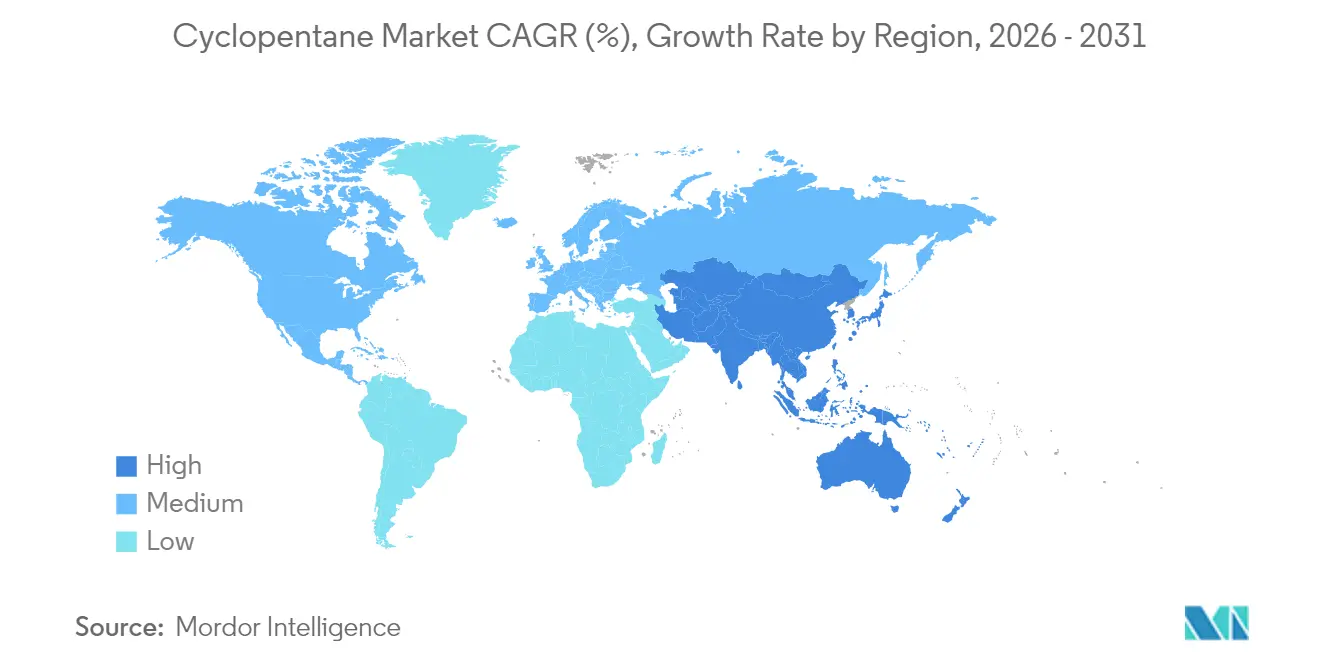
Asia-Pacific’s 45.22% market hold, coupled with 8.21% CAGR to 2031, is driven by rising appliance penetration and government-funded cold-chain nodes. China, backed by UNIDO technical training, retrofitted 140+ refrigerator lines to cyclopentane without incident, underscoring scalable safety viability. Japan’s Top-Runner efficiency mandate fuels continuous VIP innovation, while India’s PLI scheme incentivizes localized foam-grade production, curbing import reliance. North America and Europe focus on high-purity cycles and stringent occupational-safety audits, commanding price premiums that offset slower volume growth. EPA SNAP revisions and Europe’s quota cliff accelerate HFC exit, making cyclopentane the default drop-in across foams. MEA and Latin America trail yet present latent upside once logistics corridors and regulatory clarity mature.
APAC, Europe and North America Cyclopentane Market
Sub-regional dynamics reveal intra-Asia shifts: Southeast Asian contract packagers increasingly source cyclopentane from Singapore and South Korea to mitigate Chinese port congestion. In Europe, importers balance Russian feedstock risk by diversifying to U.S. Gulf Coast supply. North American blenders co-locate with polyurethane panel plants across Mexico’s Bajío corridor, curtailing hazardous-goods haulage miles. Altogether, the cyclopentane market landscape intertwines regulatory cadence, logistics elasticity and purity demands, shaping divergent regional strategies over the forecast horizon.

Regulatory Landscape
Cyclopentane faces dual regulatory pressure: environmental rules that accelerate substitution away from high-GWP HFCs in foams and refrigeration (notably Kigali Amendment-aligned phase-down programs and Europe’s F-gas framework), and safety and chemicals-control obligations tied to its flammability. In the United States, EPA actions under SNAP in December 2024 expanded acceptable hydrocarbon substitutes for refrigeration and air-conditioning, supporting broader use pathways where product and facility safety measures are in place.
On the compliance and trade side, cyclopentane is regulated under major chemical inventory regimes (EU REACH registration, US TSCA listing, and China IECSC inclusion) and is transported as a flammable liquid under UN 1146 (Class 3), which constrains packaging, labeling, and routing decisions. China updated product standardization for industrial cyclopentane with GB/T 18825-2024 (issued March 15, 2024, implemented October 1, 2024), which tightens conformity expectations for domestic supply and imports. This feeds into the report’s emphasis on higher-purity grades as downstream OEM specifications and permitting practices become more stringent.
Value Chain Analysis
Cyclopentane supply starts with hydrocarbon feedstocks, primarily the C5 fraction generated in naphtha steam cracking and related refinery streams. Producers separate cyclopentane via fractionation from close-boiling C5 components (n-pentane, isopentane, isoprene), and some routes use catalytic hydrogenation of cyclopentadiene to improve selectivity and quality. Integrated petrochemical operators with C5 splitters and purification infrastructure generally secure the most stable supply positions, while standalone players rely more on purchased mixed-C5 streams and third-party tolling.
Downstream, the largest volume flows into polyurethane (PU) foam systems used by household-appliance manufacturers and insulation producers (refrigeration cabinets, cold-chain panels, and building envelopes). Distribution commonly uses ISO tanks and steel drums under hazardous-goods rules, making logistics a material cost and continuity variable, which helps explain industry moves toward on-site or near-site blending and local storage around major foam and appliance manufacturing hubs. Higher-purity grades require additional processing steps and tighter QA (impurity control, consistent volatility), which supports higher value capture for suppliers with advanced distillation, certification, and dedicated specialty batches for VIP and other high-spec end uses.
Competitive Landscape
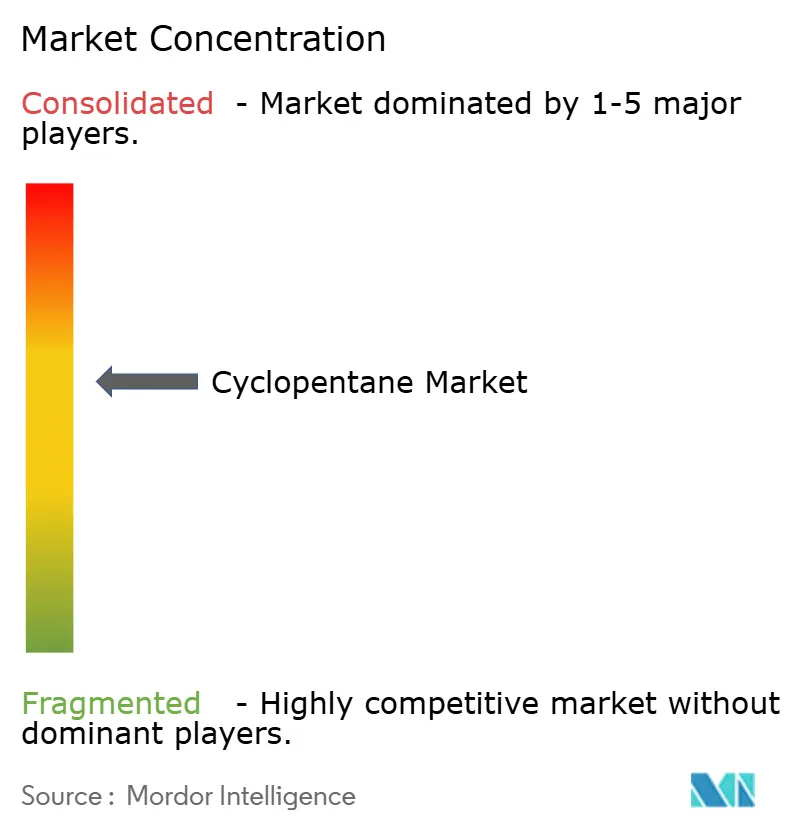
The cyclopentane market exhibits moderate concentration: the top five suppliers hold an estimated 55-60% output, while niche formulators address specialty applications. Chevron Phillips Chemical leverages integrated ethylene crackers to stabilize feedstock and is upgrading C5 splitter capacity in Cedar Bayou for high-purity throughput. INEOS capitalizes on its European refinery footprint, enabling backward integration that insulates margins during crude spikes. Haltermann Carless focuses on specialty purification, launching ISCC PLUS mass-balance certified cyclopentane in 2023 to tap circular-economy premiums. Regional independents install on-site blending skids to serve captive foam plants, a strategic hedge against maritime delays.
Consolidation is poised to continue as regulatory compliance costs and feedstock volatility strain under-scale operators, opening acquisition runways for cash-rich majors aiming to broaden geographic coverage.
Cyclopentane Industry Leaders
-
INEOS
-
Haltermann Carless Group GmbH
-
SK Geo Centric Co., Ltd.
-
Chevron Phillips Chemical Company LLC
-
Maruzen Petrochemical
- *Disclaimer: Major Players sorted in no particular order
Cyclopentane Market Companies Covered in this Report
- Chevron Phillips Chemical Company LLC
- Dymatic Chemicals Inc.
- Haltermann Carless Group GmbH
- INEOS
- Liaoning Yufeng Chemical Co., Ltd
- Maruzen Petrochemical
- Meilong Cyclopentane Chemical Co., Ltd.
- Merck KGaA
- Pure Chem Co., Ltd.
- Sinteco S.R.L.
- SK Geo Centric Co., Ltd.
- Trecora LLC

Market Opportunities and Future Outlook
A clear whitespace sits at the intersection of capacity security and higher-spec demand. The market is increasingly split between large-volume foam grades and premium batches for applications with tighter chemical tolerances, including VIP cores and other high-performance insulation. Producers are responding with process investments that add purification capability and hydrogenation flexibility. Haltermann Carless pointed to expanded hydrogenation capability at Speyer, Germany (commissioned in 2026 per company materials referenced in the evidence pack), aligning with the report theme that purity constraints and supply tightness are driving debottlenecking and high-purity processing, rather than a purely volume-led production focus.
Opportunity also comes from end-market standards that reward lower thermal conductivity and higher energy efficiency in refrigeration and building insulation. The report links this shift to HFC phase-down momentum (Kigali Amendment-linked programs and EU F-gas quota tightening) and to safety-compliant adoption pathways (US EPA SNAP updates in December 2024). Updated national specifications such as China’s GB/T 18825-2024 for industrial cyclopentane further support more standardized procurement, which can reduce variability for downstream formulators and OEMs, particularly in Asia-Pacific where integrated petrochemical chains and appliance manufacturing density strengthen the business case for localized blending, storage, and long-term supply agreements.
Recent Industry Developments in Cyclopentane Market
- January 2026: Haltermann Carless (HCS Group) referenced the commissioning of a hydrogenation plant in Speyer, Germany, positioned to strengthen supply security and broaden raw-material flexibility for hydrocarbon specialties. The added processing capability supports higher and more consistent purity outputs that are important for refrigeration, insulation, and premium VIP-grade cyclopentane applications.
- December 2025: China issued GB/T 18825-2024 for industrial cyclopentane with implementation beginning October 2024, and its effects continued to shape procurement and QA expectations across 2025 as supply chains aligned to the updated specification. Standardization at the product level reduces variability for downstream foam formulators and appliance OEMs that increasingly specify tighter impurity control.
- December 2024: The US Environmental Protection Agency expanded acceptable hydrocarbon substitutes under the SNAP program for refrigeration and air-conditioning. The regulatory update lowered barriers for hydrocarbon-based pathways in relevant equipment categories, supporting broader compliance-led conversions away from higher-GWP alternatives where flammability risk management is addressed.


Cyclopentane Market Report Scope and Research Methodology
Market Definition and Coverage
For this study, the cyclopentane market covers sales value generated from cyclopentane used across industrial and commercial applications, counted where the chemical is purchased for end use such as foam blowing, refrigeration, and solvent or reagent use.
Scope exclusions: We do not count downstream finished products value, and we exclude non-cyclopentane substitutes even when they serve a similar performance need.
Segments Covered in This Report
-
By Function
- Blowing Agent and Refrigerant
- Solvent and Reagent
- Other Functions (Rubber Adhesives, Resins, etc.)
-
By Purity Grade
- ≥ 98 % Purity
- 95 - 98 % Purity
- < 95 % Purity (Technical grade)
-
By Application
- Refrigeration
- Insulation
- Chemical Solvents
- Other Applications (Personal Care, Fuel Additives)
-
By End-use Industry
- Household Appliances
- Construction
- Automotive
- Chemical and Pharmaceutical
- Others
-
By Geography
-
Asia-Pacific
- China
- India
- Japan
- South Korea
- ASEAN
- Rest of Asia-Pacific
-
North America
- United States
- Canada
- Mexico
-
Europe
- Germany
- United Kingdom
- Italy
- France
- Russia
- Rest of Europe
-
South America
- Brazil
- Argentina
- Rest of South America
-
Middle East and Africa
- Saudi Arabia
- South Africa
- Rest of Middle East and Africa
-
Asia-Pacific
Data Sources, Market Sizing, and Validation
Desk Research
Desk research is used to set the market boundaries, build the country and regional structure, and pressure test the demand drivers that typically move cyclopentane consumption. We rely on public and official references such as UN Comtrade trade statistics, national customs and tariff schedules, and USGS style chemicals and materials releases where available, along with energy efficiency or refrigerant policy publications from agencies like the US EPA and the European Commission.
To make the inputs more usable, we also reviewed company annual reports and investor presentations, product technical datasheets, and credible industry press coverage that discusses insulation and refrigeration demand. Paid subscriptions are used selectively for company financials and intelligence, patent databases, and shipment level import export data when a country shows unusual swings that need explanation. These source examples are illustrative only, and many other public references were also used to collect, cross check, and clarify data points.
Primary Interviews and Surveys
Primary work was conducted via expert interviews and structured questionnaires with producers, distributors, and downstream users in insulation, refrigeration, and chemical processing. We spoke with participants across APAC, EMEA, and the Americas so price movement, currency effects, and regulatory timing could be checked before assumptions were finalized.
Distribution of primary research fieldwork respondents
| Company type | Respondent position | Region |
|---|---|---|
| Top tier: 39% | CXOs: 15% | APAC: 47% |
| Mid tier: 41% | Functional/Unit leaders: 42% | EMEA: 32% |
| Smaller Players: 20% | Managers: 43% | Americas: 21% |
Market-Sizing & Forecasting
The core sizing uses a top-down approach where regional demand pools are reconstructed from insulation and refrigeration activity and then allocated to cyclopentane usage based on adoption and dosage assumptions. Once the first totals are produced, they are corroborated with selective bottom-up approximations such as sampled supplier and distributor checks, and an ASP times volume view for key countries, which is then used to adjust outliers.
Inputs that matter in this market include polyurethane foam output proxies tied to appliance and building insulation activity, adoption rates of low-GWP blowing agents influenced by refrigerant and emissions rules, trade flows for cyclopentane and related hydrocarbons, the typical purity mix used in end-use processes, and regional price spreads that can redirect supply. For forecasting, scenario analysis is used around insulation demand and regulatory enforcement timing, and the price path is guided by interview based consensus and observed feedstock linked movements. Where local volume splits are not visible, gaps are handled by using neighboring country trade and consumption ratios and then rechecked against the regional total so the model stays consistent.
Data Validation & Update Cycle
Outputs are validated through multiple checks, including currency and unit consistency, year over year variance review, and comparison against independent signals like trade movements and insulation and appliance production trends. When a country shows an unusual jump, assumptions are revisited and follow-up calls are triggered to confirm whether the change came from pricing, demand, or a one-off supply disruption.
A second analyst review is completed before sign-off so calculation steps and source logic are easier to trace. Reports are refreshed annually, and interim updates are made when material events occur, such as regulatory changes or major capacity shifts. Before delivery, we do a final pass so the published view reflects the latest available data cut.
Mordor Intelligence's Cyclopentane Market Size Measured Against Other Published Estimates
Published market sizes for cyclopentane often differ, even when everyone is discussing the same chemical, because the scope edges and the pricing math are not handled the same way. Differences also show up when the base year is not aligned and when regional coverage is uneven.
In this market, the biggest gap drivers are usually whether solvent and reagent demand is fully counted or treated as a minor add-on, how purity mix is treated in value calculations, and whether the study uses spot-heavy prices or a blended annual ASP. Refresh cadence and currency timing also matter, because a fast moving year can shift USD values without a real change in tons, which is why the model is rechecked with late-year price averages and trade signals before final release, a step applied in the cyclopentane sizing by Mordor Intelligence.
Benchmark comparison
| Source | Market Size | Gaps in Research Methodology |
|---|---|---|
| Mordor Intelligence | USD 460.58 M (2026) | |
| Global Consultancy A | USD 573.61 M (2026) | Uses a different base-year anchoring and a longer forecast window, and the 2026 value appears to reflect broader application roll-ups with a price deck that can run higher in regions where insulation demand is weighted more heavily. |
| Industry Publisher B | USD 465.48 M (2024) | Uses an earlier base year and a different historical window, so the reported value is influenced by 2024 pricing and currency conversion timing and may not match a 2026 run-rate view built from updated demand indicators. |
The spread in the table is mainly explained by timing choices and how value is built from volume and ASP across regions, rather than a disagreement that cyclopentane demand exists in insulation and refrigeration. By keeping the scope tied to clear end-use consumption and then revalidating price and trade signals before locking the year, the estimate stays easier to reconcile and repeat.


Key Questions Answered in the Report
What is the current cyclopentane market size and projected growth?
The cyclopentane market size is USD 460.58 million in 2026 and is forecast to reach USD 658.32 million by 2031, growing at a 7.41% CAGR.
Which region dominates the cyclopentane market?
Asia-Pacific leads with 45.22% share in 2025 and is also the fastest-growing region at an 8.21% CAGR through 2031.
Why are vacuum insulated panels important for cyclopentane demand?
VIPs require high-purity cyclopentane to achieve ultra-low thermal conductivity, enabling thinner walls and higher energy efficiency, a segment growing at 7.75% CAGR.
How are regulations influencing cyclopentane adoption?
Kigali Amendment HFC phase-downs and EPA SNAP approvals are accelerating the shift to cyclopentane, especially in foams and refrigeration, adding an estimated +2.1% to forecast CAGR.
What are the key restraints on cyclopentane market growth?
Feedstock price volatility, stricter flammable-gas safety codes and limited global capacity together subtract around 3.3% from potential CAGR.
Which end-use industry is growing fastest outside appliances?
Construction uses of cyclopentane-based insulation are expanding at an 8.04% CAGR, driven by stringent building-energy codes worldwide.
Page last updated on:


 Your data is secure and never sold or shared.


