
Crown Caps Market Size and Share
Market Overview
| Study Period | 2020 - 2031 |
|---|---|
| Market Size (2026) | USD 1.87 Billion |
| Market Size (2031) | USD 2.33 Billion |
| Growth Rate (2026 - 2031) | 4.48 % |
| Fastest Growing Market | Asia Pacific |
| Largest Market | Asia Pacific |
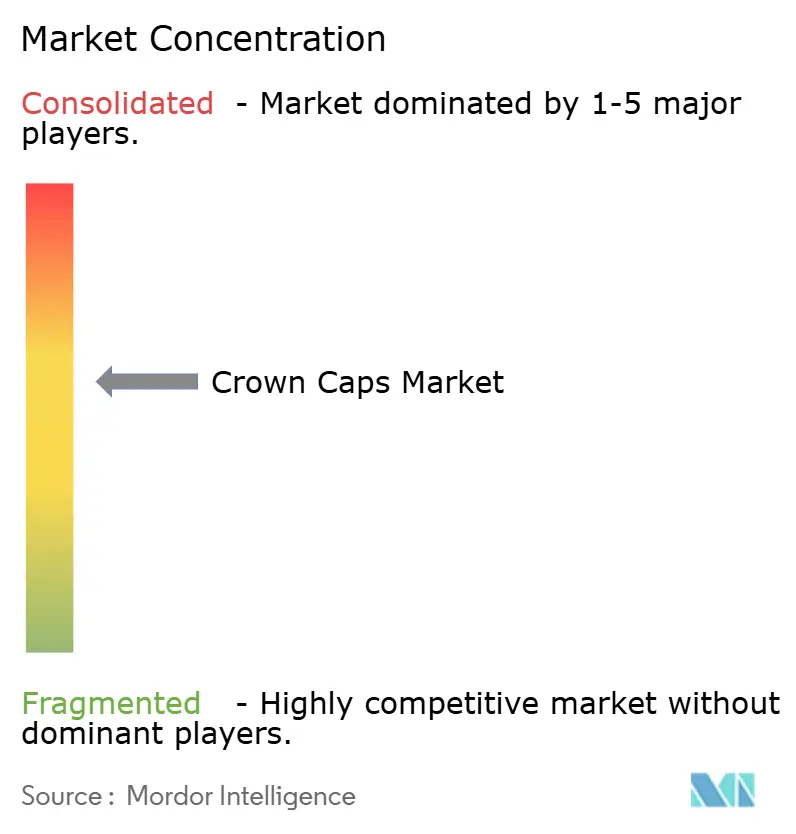
| Market Concentration | Medium |
Major Players *Disclaimer: Major Players sorted in no particular order Image © Mordor Intelligence. Reuse requires attribution under CC BY 4.0. | |
Crown Caps Market Analysis by Mordor Intelligence
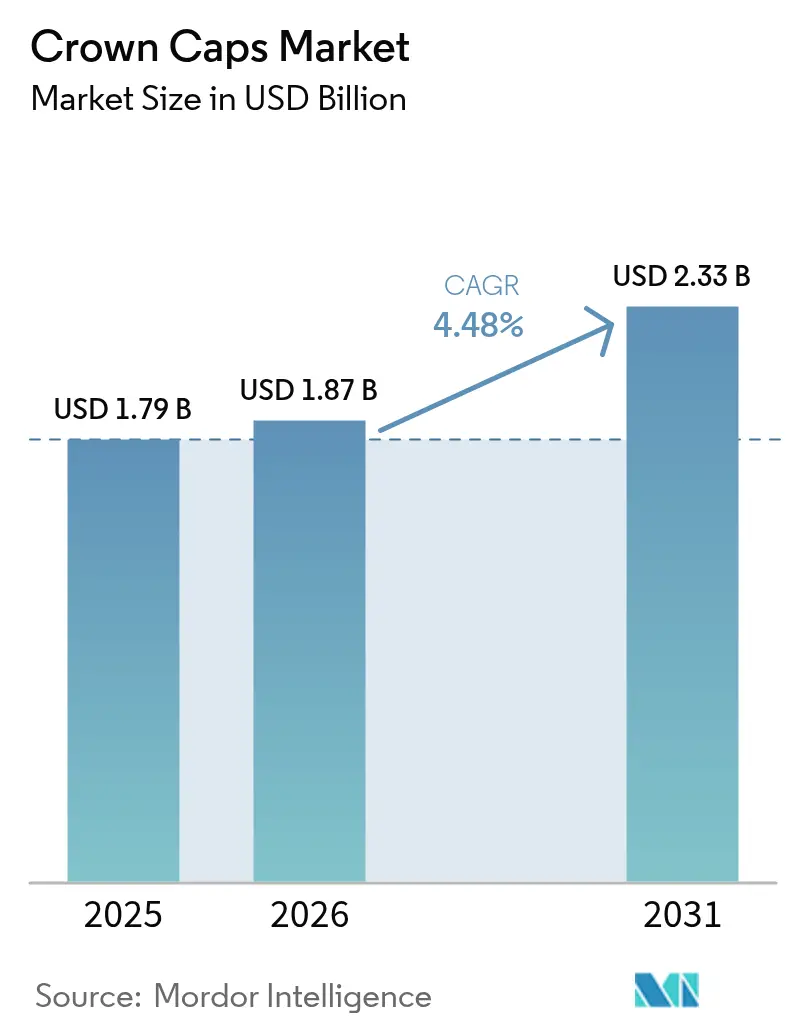
The crown caps market size is expected to grow from USD 1.79 billion in 2025 to USD 1.87 billion in 2026 and is forecast to reach USD 2.33 billion by 2031 at 4.48% CAGR over 2026-2031. Rising craft-beer production, premium glass packaging uptake, and liner technology upgrades continue to unlock new demand pockets. Leading suppliers focus on lightweight aluminum variants and PVC-free liners that anticipate regulatory tightening, while smart closures with QR or NFC functionality strengthen brand engagement and anti-counterfeiting defenses. At the same time, producers face intensified competition from PET bottles fitted with plastic screw caps, along with margin pressure stemming from tin-plate and aluminum price swings. Nonetheless, the superior tamper-evidence, carbonation retention, and high-speed line compatibility of metal crowns keep them entrenched across beverage, food, and pharmaceutical channels.[1]
Key Report Takeaways
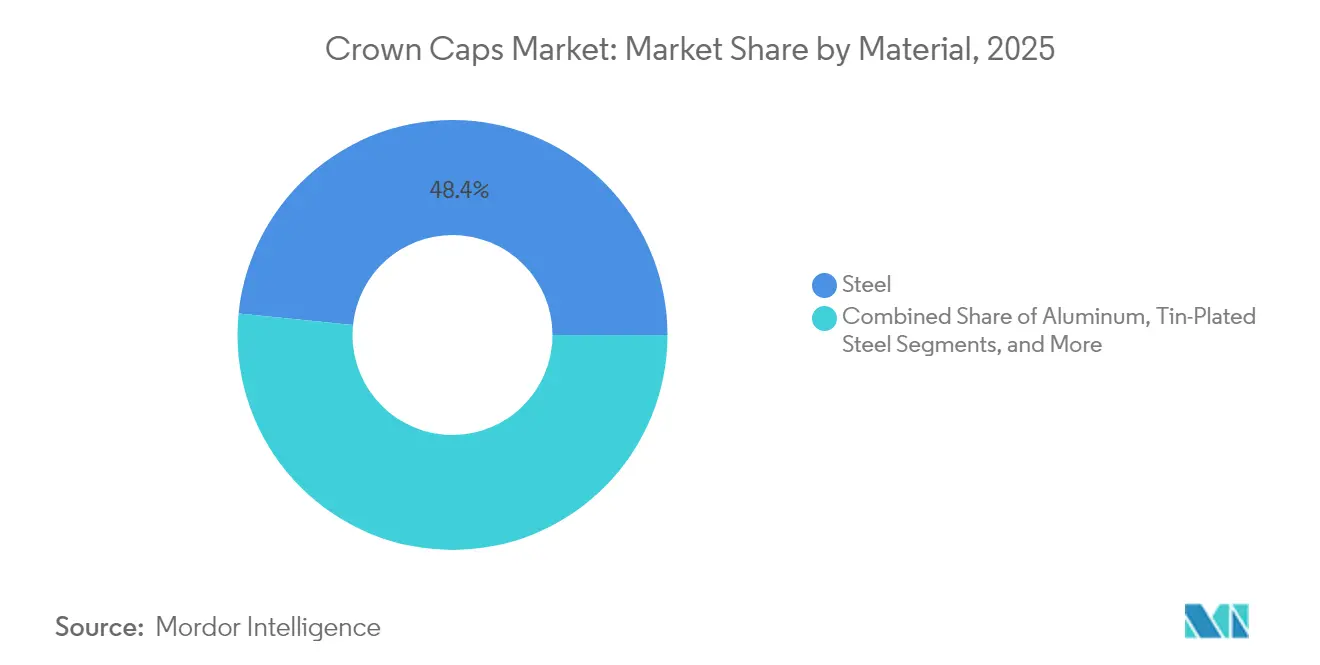
- By material, steel led with 48.40% of the crown caps market share in 2025; aluminum is projected to grow at a 5.56% CAGR through 2031.
- By closure type, pry-off closures captured 61.75% of the crown caps market size in 2025, while twist-off variants are expected to expand at a 5.89% CAGR between 2026-2031.
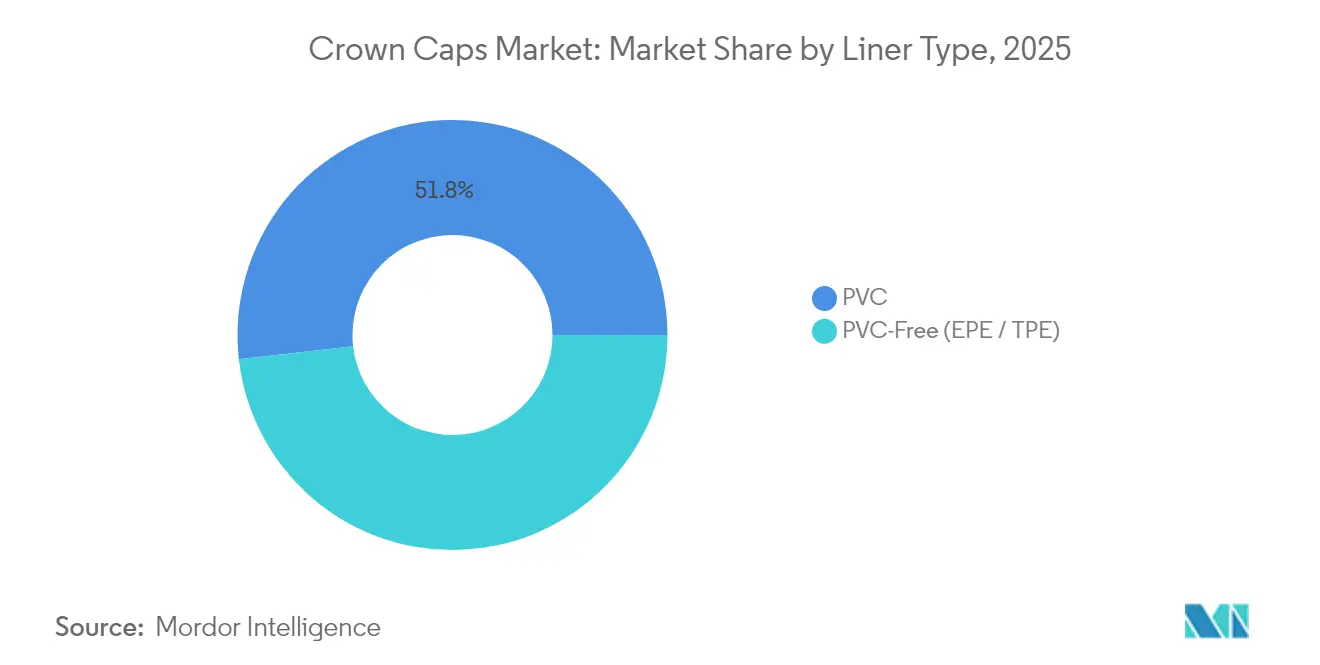
- By liner type, PVC accounted for 51.80% of the 2025 crown caps market size; PVC-free liners are forecast to post a 6.01% CAGR to 2031.
- By application, beverages dominated with a 61.95% share of the crown caps market size in 2025, whereas pharmaceuticals and nutraceuticals are advancing at a 5.87% CAGR through 2031.
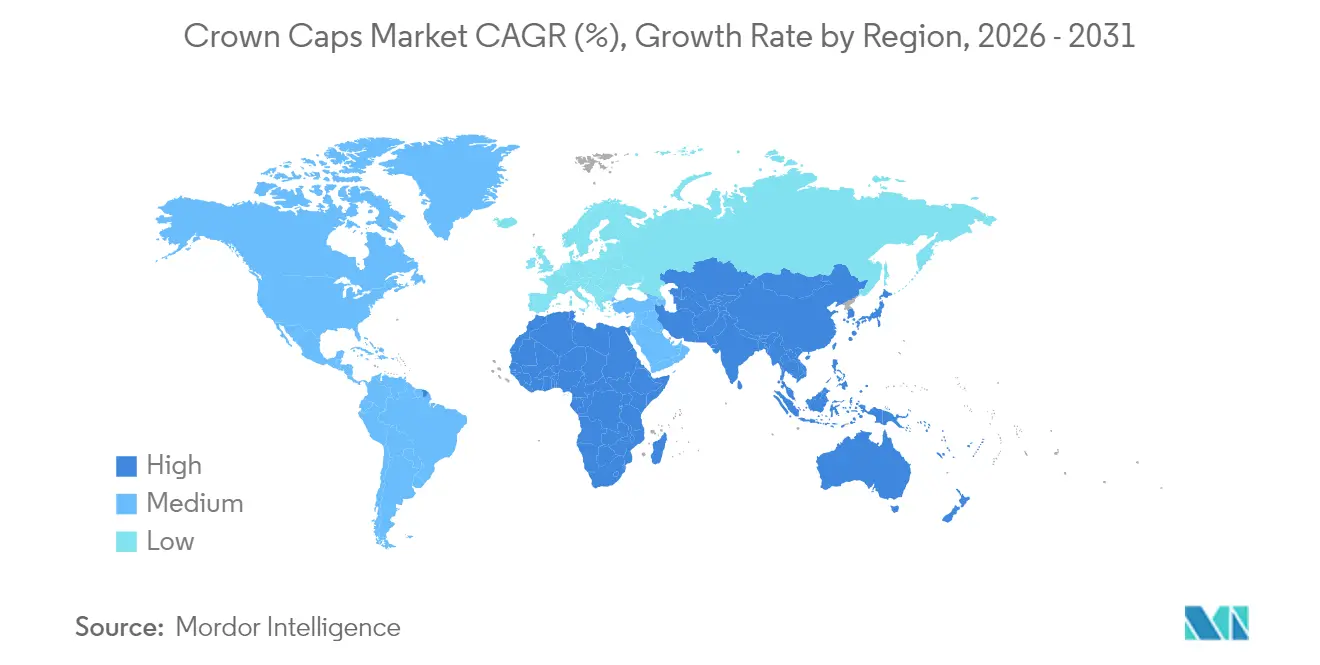
- By geography, Asia-Pacific held 40.10% of the crown caps market share in 2025 and is also the fastest-growing region at 7.05% CAGR to 2031.
Note: Market size and forecast figures in this report are generated using Mordor Intelligence’s proprietary estimation framework, updated with the latest available data and insights as of 2026.
Market Trends and Insights
Drivers Impact Analysis of Crown Caps Market*
| Driver | (~) % Impact on CAGR Forecast | Geographic Relevance | Impact Timeline |
|---|---|---|---|
| Rising craft-beer micro-brewery expansion | +1.2% | North America & Europe, expanding to APAC | Medium term (2-4 years) |
| Regulation-driven shift toward PVC-free liners | +0.8% | Global, with EU and North America leading | Long term (≥ 4 years) |
| Resurgence of glass packaging in premium beverages | +0.9% | Global, concentrated in developed markets | Medium term (2-4 years) |
| Interactive QR-coded crown caps boost brand engagement | +0.4% | North America & Europe initially | Short term (≤ 2 years) |
| Emerging demand from kombucha and functional drinks | +0.6% | Global, with North America and APAC leading | Medium term (2-4 years) |
| Advanced tamper-evident cap designs | +0.5% | Global, pharmaceutical focus | Long term (≥ 4 years) |
| Source: Mordor Intelligence | |||
Rising Craft-Beer Micro-Brewery Expansion
More than 9,000 breweries operated in the United States in 2024, up 15% from 2023, and nearly all specify pry-off metal crowns because they seal carbonation reliably at small batch scales.[2] European microbreweries in Germany, Belgium, and the United Kingdom mirror this momentum, prompting converters to develop custom-printed crowns that preserve unique flavor profiles. As taproom-to-retail distribution widens, microbrewers demand liners with tighter oxygen transmission rates and overt tamper evidence. The segment’s premium-priced offerings also justify the adoption of lightweight aluminum to reinforce sustainability claims and shelf impact.
Regulation-Driven Shift Toward PVC-Free Liners
Global food-contact legislation is accelerating the migration from PVC to EPE or TPE liners. The FDA’s ongoing reassessment of plasticizers and the European Union’s Packaging and Packaging Waste Regulation (PPWR) push beverage brands to phase in recyclable, non-chlorinated solutions. The transition entails production line retrofits, resin validation, and higher raw material outlays, yet early adopters secure premium positioning with compliant, eco-friendly closures. Over the forecast period, suppliers that scale PVC-free capacity are expected to gain share as regulators heighten enforcement and brand owners expand life-cycle auditing.
Resurgence of Glass Packaging in Premium Beverages
Glass bottle shipments for alcoholic drinks grew 12% year on year in 2024, driven by premiumization and sustainability narratives that resonate with affluent consumers. Crown caps complement glass through superior CO₂ retention and heritage aesthetics, especially for seasonal craft spirits and artisanal sodas priced 20-30% above plastic counterparts. Premium food brands also leverage glass plus metal crowns to convey authenticity. As a result, demand for decorative crowns with embossing and color-matched shellac is accelerating, especially in limited-edition launches.
Interactive QR-Coded Crown Caps Boost Brand Engagement
Smart crowns transform closures into digital touchpoints. Early deployments by Coca-Cola show consumers willingly scanning personalized QR codes to unlock promotions, generating valuable behavioral data, and reinforcing loyalty programs. Implementation requires inline, high-resolution printing and vision systems that verify code readability. Over time, declining electronics costs and near-universal smartphone adoption will spread QR or NFC crowns from premium beverages into mainstream SKUs, creating ancillary revenue streams linked to direct-to-consumer marketing.
Restraints Impact Analysis of Crown Caps Market*
| Restraint | (~) % Impact on CAGR Forecast | Geographic Relevance | Impact Timeline |
|---|---|---|---|
| Lightweight PET bottles with plastic screw caps | -1.1% | Global, particularly Asia-Pacific | Short term (≤ 2 years) |
| Volatility in tin-plate and aluminum pricing | -0.7% | Global, with manufacturing concentration in Asia | Medium term (2-4 years) |
| Policy push against single-use metal closures | -0.6% | Europe and North America leading, expanding globally | Long term (≥ 4 years) |
| Penetration of ring-pull crowns in ASEAN breweries | -0.4% | Southeast Asia, spillover to broader APAC | Medium term (2-4 years) |
| Source: Mordor Intelligence | |||
Lightweight PET Bottles with Plastic Screw Caps
Bottle manufacturers now deliver PET packs that weigh 60-70% less than comparable glass containers and integrate tethered screw caps that satisfy the EU Single-Use Plastics Directive, eroding cost-conscious segments traditionally served by metal crowns. PET’s logistics savings and improved barrier resins increasingly threaten the carbonated soft drink niche, especially in emerging economies where freight expenses dominate value chains. Crown cap suppliers mitigate the substitution risk by emphasizing heritage aesthetics, recyclability, and premium positioning that PET struggles to replicate.
Volatility in Tin-Plate and Aluminum Pricing
Aluminum spot prices swung 25-30% during 2024, while tin-plate availability tightened amid geopolitical disruptions, compressing converter margins. Smaller players without long-term hedging contracts find it difficult to pass cost spikes through to annual beverage tenders. Currency fluctuations further complicate multi-regional sourcing, prompting consolidation moves-such as Sonoco’s USD 3.87 billion purchase of Eviosys-to secure backward integration and purchasing leverage.
*Our forecasts treat driver/restraint impacts as directional, not additive. The impact forecasts reflect baseline growth, mix effects, and variable interactions.
Crown Caps Market Segment Analysis
By Material:
Steel Dominance Faces Aluminum ChallengeSteel retained 48.40% share of the crown caps market in 2025 due to its low cost and robustness on high-speed lines. The crown caps market size attributed to steel will edge higher but cede mix to aluminum, whose 5.56% brand lightweighting targets and superior corrosion resistance fuel CAGR. Aluminum recyclability and premium aesthetics appeal to craft distillers that command price premiums covering the material differential. Suppliers experiment with 3104 and 5052 alloys that lower shell mass by up to 20% without compromising cap rigidity.
Second-tier materials such as tin-plated steel serve niche segments requiring glossy finishes or elevated barrier performance but face price sensitivity amid raw-material volatility. Hybrid designs that marry a steel inner shell with an aluminum skirt are emerging to balance cost with shelf appeal. Over the forecast horizon, material evolution may hinge on cradle-to-cradle audits by major beverage groups, making post-consumer scrap recovery rates a critical differentiator.

By Closure Type:
Twist-Off Innovation AcceleratesPry-off variants commanded 61.75% share in 2025, reflecting entrenched use in mainstream beer markets. Yet twist-offs are projected to outpace at 5.89% CAGR as aging demographics value easy opening and as premium non-alcoholic brands adopt resealability to support multi-serve consumption occasions. The crown caps market embraces thread-forming technologies that maintain seal pressure across repeated openings and closings. Investment in precision die sets and vision inspection drives unit costs higher, but converters recoup through product differentiation and value-added fees.
Hybrid formats combining twistability with overt tamper bands seek to satisfy regulatory scrutiny in pharmaceuticals. Additionally, the ring-pull derivatives pilot in ASEAN breweries, positioning convenience as an alternative growth lever. Suppliers successful in this segment will integrate tooling flexibility that permits rapid changeovers between pry-off and twist-off SKUs without protracted downtime.
By Liner Type:
PVC-Free Transition Gains MomentumPVC liners still represent 51.80% of 2025 shipments thanks to proven sealing performance. However, the crown caps market is pivoting to EPE or TPE linings, which are set to expand at a 6.01% CAGR after regulators in the EU and North America flagged chloride content and plasticizer migration concerns. Early-stage capacity constraints for PVC-free compounds inflate input costs, yet beverage majors accept price trade-offs to secure compliance and avoid recall liabilities.
Suppliers emphasize linear adhesion enhancements and micro-cellular structures that deliver equal or better torque retention. R&D roadmaps also explore bio-based elastomers derived from sugarcane or algae oils, targeting a 25% carbon footprint reduction versus legacy PVC. Over time, converters with high-shear compound mixers and automated wad applicators will outcompete smaller firms reliant on manual liner punches.
By Application:
Pharmaceuticals Drive Premium GrowthBeverages maintained a 61.95% share in 2025 on the back of beer, carbonated soft drinks, and emerging functional drinks. Nevertheless, pharmaceutical and nutraceutical fills are set to clock a 5.87% CAGR as regulators tighten tamper-evidence standards on OTC syrups, tinctures, and liquid supplements. The crown caps market size derived from healthcare SKUs commands premium pricing, reflecting sterility validation and 100% camera inspection requirements.
Food applications-chiefly sauces and preserves-provide steady but slower growth, while specialty chemicals and personal-care lines furnish niche demand. Diversification across end-uses shelters suppliers from beverage seasonality. Firms with clean-room production and certified ISO 15378 processes will capture the highest-margin healthcare volumes.
Geography Analysis
APAC Crown Caps Market
Asia-Pacific led with a 40.10% share in 2025, and its 7.05% CAGR makes it the largest and fastest geography within the crown caps market. Rising disposable incomes in China, India, Indonesia, and Vietnam lift per-capita beer and soft-drink consumption, while foreign direct investment into brewery build-outs underpins closure volumes. Regional converters secure supply-chain resilience by co-locating shell stamping and liner compounding near bottling hubs, minimizing freight costs and customs exposure. Government incentives in China’s eastern provinces further encourage aluminum cap manufacturing, bolstering export competitiveness.
North America Crown Caps Market
North America retains a robust position, fueled by over 9,000 breweries and a strong craft-beer culture. Regulations pushing PVC-free liners prompt early adoption, rewarding domestic suppliers that scale compliant wads ahead of enforcement deadlines. Aluminum import volumes worth USD 4.08 billion from Canada in 2022 underscore the integrated regional metals market supporting closure production.
Europe Crown Caps Market
Europe shows stable demand, anchored by premium beverages and stringent recycling targets. Implementation of deposit-return systems sharpens focus on detachable closure waste, nudging fillers toward tethered or resealable crowns. Producers respond with shell geometry tweaks that allow post-consumer collection without compromising heritage design cues. Meanwhile, breweries in Germany and Belgium pilot ring-pull formats to enhance consumer convenience.
The Americas and MEA Crown Caps Market
South America and the Middle East and Africa present emerging growth corridors. Brazil’s established beer scene underpins steady closure consumption, whereas Mexico’s tequila exports drive demand for customized, tamper-evident crowns. In Africa, urbanization accelerates bottled soda uptake, though price sensitivity fosters competition from PET. Manufacturers that localize stamping lines or partner with regional beverage groups reduce import duties and shorten lead times, building a platform for long-term penetration.
Regulatory Landscape
Crown caps used on beverages, food, and liquid OTC products operate under food-contact safety rules that cover the metal shell, coatings, and especially liner materials. In the European Union, closures must meet the requirements of Framework Regulation (EC) No 1935/2004 for food contact materials and Regulation (EC) No 2023/2006 on Good Manufacturing Practice, with plastic liner components aligned to Commission Regulation (EU) No 10/2011 and supported by Declarations of Compliance and migration testing. In the United States, FDA oversight for packaging components used in contact with food commonly references applicable sections such as 21 CFR 177.1210 for closures with sealing gaskets and 21 CFR 175.300 for resinous and polymeric coatings, reinforcing the need for documented formulation control and compliance testing across suppliers.
Alongside food-contact compliance, packaging sustainability policies are tightening requirements around recyclability design, labeling, and lifecycle accountability, reinforcing the shift away from PVC liners toward PVC-free (EPE/TPE) alternatives. Regulation (EU) 2025/40 introduces additional packaging sustainability and labeling obligations with applicability from 2026, increasing scrutiny of multi-material closure designs and the compatibility of liners, inks, and coatings with circularity targets. Brand-owner programs and supplier declarations (for example, documented compliance packages used for European crown closures) are increasingly used to validate both regulatory conformity and sustainability positioning, as procurement specifications formalize PVC-free and recyclable-material preferences.
Value Chain Analysis
The crown caps value chain starts with raw materials, primarily tinplate or other steel sheet for shells, aluminum sheet for lightweight crowns, and inputs such as inks, varnishes, protective coatings, and food-grade liner compounds (PVC, EPE, or TPE). Upstream metal pricing and availability drive key cost pressures, while liner resins and additives are constrained by food-contact compliance requirements that can limit substitution flexibility. Tooling and machinery suppliers (for example, SACMI production lines for crown closures) enable high-speed conversion economics, but cap manufacturing remains capital intensive and sensitive to utilization rates.
In conversion, producers typically run a sequence of sheet feeding, printing and curing, punching/forming, and high-speed liner application with vision inspection to control defects, followed by packing for shipment to beverage and other fillers. Distribution often favors proximity to bottlers because closures are bulky relative to value and require reliable just-in-time delivery to prevent line stoppages at filling plants. Logistics and warehousing partnerships support service levels across regional filler networks, while downstream demand is shaped by large beverage brand tenders, craft beverage customization needs, and growing compliance documentation requirements associated with PVC-free liner transitions and traceability.
Competitive Landscape
The crown caps market exhibits moderate concentration: the top five converters control roughly 55-60% of global capacity. Crown Holdings, Pelliconi, and Nihon Closures leverage multi-continent plants, vertical tin-plate sourcing, and proprietary liner chemistries to defend share. Digital inkjet presses integrated on crown lines enable multi-sku, low-MOQs that resonate with craft beverage rollouts. Pelliconi’s 2025 AI-driven quality system cuts liner defects by 15%, signaling convergence between traditional forming operations and Industry 4.0 analytics.
M&A shapes capacity distribution: Sonoco’s USD 3.87 billion acquisition of Eviosys in March 2025 created a metal packaging platform with expanded European footprint, diversified lid formats, and improved raw-material bargaining power. Smaller, regional specialists pursue niche focuses such as embossed aluminum or ring-pull variants to avoid direct scale competition. Patent filings show heightened activity in tamper-indicative skirt scoring and moisture-activated security inks, reinforcing non-price differentiation.
Sustainability remains a battleground. Finn-Korkki achieved carbon-neutral Finnish operations in 2024 by installing 325 kWp of rooftop PV and switching to 100% fossil-free electricity. Crown Holdings announced a USD 150 million Asia-Pacific expansion that embeds PVC-free liner capability and smart code print stations. Suppliers effective at integrating life-cycle assessments, renewable energy, and digital consumer engagement into their value propositions are likely to capture premium brand contracts.
Crown Caps Industry Leaders
-
Crown Holdings Inc.
-
Pelliconi & C. SpA
-
Nippon Closures Co., Ltd.
-
Silgan Holdings Inc.
-
Guala Closures Group S.p.A.
- *Disclaimer: Major Players sorted in no particular order
Crown Caps Market Companies Covered in this Report
- Crown Holdings Inc.
- Pelliconi & C. SpA
- Nippon Closures Co., Ltd.
- Silgan Holdings Inc.
- Guala Closures Group S.p.A.
- Astir Vitogiannis Bros SA
- Finn-Korkki Oy
- Samhwa Crown & Closure Co., Ltd.
- A.M.D. Industries Limited
- Avon Crowncaps & Containers Nigeria Ltd.
- Viscose Closures Ltd.
- Closure Systems International Inc.
- Berlin Packaging LLC
- O.Berk Company LLC
- Tapi S.p.A.
- Evergreen Resources Ltd.
- Yantai Closures Co., Ltd.
- Standard Crown Caps (India) Pvt Ltd.
- SKS Bottle & Packaging Inc.
- Toyo Seikan Group Holdings, Ltd.
Market Opportunities and Future Outlook
PVC-free liner conversion remains a central whitespace as regulators and brand procurement teams push non-chlorinated, food-contact compliant solutions. That creates room for suppliers with validated EPE/TPE liner systems, high-shear compounding, and robust declarations of compliance for multi-material closures. The market also has an opportunity in smart and high-resolution printed crowns that support QR-enabled brand engagement and anti-counterfeiting, where converters that integrate inline printing and inspection can serve premium beverage and limited-edition programs. Healthcare and nutraceutical liquid products add another value pool for tamper-evidence and inspection-intensive crowns, aligning with the segment trend toward tighter quality systems and camera inspection.
Geographically, investment and localization activity in beverage packaging supply chains highlights opportunities to place capacity closer to high-growth fillers and reduce lead times and import exposure. For example, Coleus Packaging reported an investment in a PMC500 machine for high-speed crown manufacturing targeting African brewery and beverage demand (March 2024), showing a pathway for regional players to add modern conversion capability where local supply is constrained. Separately, closure-manufacturing productivity upgrades such as Husky Technologies HyCap 4.0 tooling (May 2026) illustrate how durability and maintenance reduction in high-volume closure production can support higher throughput and tighter quality control, complementing crown cap converters pursuing automation and inspection-led differentiation.
Recent Industry Developments in Crown Caps Market
- July 2026: CREALIS PE.DI published a collaborative study with the University of Reims Champagne-Ardenne on how crown cap permeability and storage conditions influence sparkling wine aging. The work reinforces technical differentiation around oxygen management, supporting premium beverage customers that specify closure performance beyond basic sealing.
- March 2025: Sonoco closed its EUR 3.615 billion (USD 3.87 billion) acquisition of Eviosys, adding 44 plants and expanding its metal packaging footprint, including crown-related formats in Europe and selected emerging markets. The deal strengthens procurement leverage and manufacturing scale for metal packaging, affecting competitive dynamics for crown cap supply and adjacent closure categories.
- December 2024: Finn-Korkki declared carbon-neutral production across Finland following renewable electricity sourcing and efficiency upgrades. This move sharpened competitive positioning around low-carbon metal closures as brand owners increase scrutiny of packaging life-cycle impacts and supplier sustainability credentials.
Crown Caps Market Report Scope and Research Methodology
Market Definition and Coverage
This market covers the value of crown caps (metal crown closures) sold for sealing bottles, mainly for beverages and selected food products, across major consuming regions.
Scope exclusions: It excludes plastic screw caps, cork stoppers, and dispensing closures, and it also excludes downstream bottle filling and distribution services.
Segments Covered in This Report
- By Material
- Aluminum
- Steel
- Tin-Plated Steel
- By Closure Type
- Pry-Off
- Twist-Off
- By Liner Type
- PVC
- PVC-Free (EPE / TPE)
- By Application
- Beverages
- Alcoholic Beverages
- Beer
- Wine
- Spirits
- Non-Alcoholic Beverages
- Carbonated Soft Drinks
- Functional and Energy Drinks
- Other Non-Alcoholic Beverages
- Alcoholic Beverages
- Food
- Pharmaceuticals and Nutraceuticals
- Other Applications
- Beverages
- By Geography
- North America
- United States
- Canada
- Mexico
- South America
- Brazil
- Argentina
- Chile
- Rest of South America
- Europe
- United Kingdom
- Germany
- France
- Spain
- Italy
- Rest of Europe
- Asia-Pacific
- China
- India
- Japan
- Australia
- South Korea
- Vietnam
- Rest of Asia-Pacific
- Middle East and Africa
- Middle East
- Saudi Arabia
- United Arab Emirates
- Turkey
- Rest of Middle East
- Africa
- South Africa
- Nigeria
- Egypt
- Rest of Africa
- Middle East
- North America
Data Sources, Market Sizing, and Validation
Desk Research
Desk work starts with building a clean view of the demand pool for bottled drinks and other relevant packaged products, and then connecting that to closure usage patterns. We refer to public sources such as UN Comtrade trade statistics, USITC DataWeb for US import and export trends, Eurostat manufacturing and PRODCOM series, and national statistics offices that publish beverage output and packaging indicators. Where available, we also use trade association publications (such as packaging and beverage bodies) and peer reviewed papers on closure performance and liner material shifts.
On the supply side, company annual reports, investor presentations, and press releases help us map capacity additions, plant footprints, and material exposure. Select paid subscriptions for company financials and news, and an import and export shipment-level database, are used to cross-check supplier activity and pricing direction without relying on a single disclosure. The desk sources listed here are illustrative only, and we also used many other public references for data collection, validation, and clarification during the study.
Primary Interviews and Surveys
Primary work is used to pressure-test the desk model where data is not directly reported, especially around crown cap usage per bottle, liner mix changes, and how contracts translate into realized pricing. We spoke with a mix of closure producers, bottlers, converters, and packaging distributors across APAC, EMEA, and the Americas, so regional consumption patterns and trade flows could be reconciled before final sizing.
Distribution of primary research fieldwork respondents
| Company type | Respondent position | Region |
|---|---|---|
| Top tier: 30% | CXOs: 19% | APAC: 45% |
| Mid tier: 51% | Functional/Unit leaders: 31% | EMEA: 37% |
| Smaller Players: 19% | Managers: 50% | Americas: 18% |
Market-Sizing & Forecasting
We size the market using a top-down build that starts from bottled beverage output and trade signals, then translates that into crown cap demand using typical closure fitment rates and pack format splits. To keep the totals grounded, we corroborate with selective bottom-up checks, such as rolling up a sample of supplier revenues by region and validating implied volumes through ASP x units for common crown diameters.
Key inputs that steer the model include glass bottle usage trends in beer and carbonated soft drinks, on-trade versus off-trade mix shifts that affect returnable glass circulation, aluminum and tinplate price direction and pass-through timing, liner migration from PVC to PVC-free options, and regional import reliance where local capacity is limited. When some country-level indicators are missing, we handle the gap by proxying with close beverage output series and calibrating with interview feedback before applying it.
For forecasting, we use scenario analysis supported by short trend fits on the main drivers, and we finalize assumptions after checking what industry experts expect for bottled beverage volumes, material cost normalization, and pricing resets. Where the driver outlook diverges by region, the scenario is adjusted locally and then rolled back up to the global total.
Data Validation & Update Cycle
Validation is done by comparing the modeled market totals against independent signals, such as regional beverage production changes, crown cap trade balances, and supplier commentary on utilization and order books. Any large variance is reviewed, the assumptions behind ASP progression and volume translation are revisited, and follow-up calls are triggered when the mismatch cannot be explained by seasonality or one-off events.
Before sign-off, the model goes through step-by-step analyst reviews, so the math, units, and currency conversions are consistent across regions. The report is refreshed annually, and interim updates are added when major events can change demand or pricing. Right before delivery, a final pass is completed so clients receive the latest updated view rather than an older snapshot.
Mordor Intelligence's Crown Caps Market Size Compared Against Other Published Estimates
Published market sizes for crown caps can look far apart, even when the product sounds simple, because different studies lock their pricing and currency conversion at different points in time, and they do not always refresh the same inputs together. Small choices around whether pricing is taken at contract start, shipment month, or annual average can move the value estimate more than people expect.
Key gap drivers usually come down to scope and model tuning, where some sources blend crown caps with broader metal closures, apply aggressive ASP escalation without checking material pass-through timing, or keep older beverage volume baselines that miss recent shifts in glass packaging. By updating FX timing and price realization checks during refresh cycles, and then running variance tests against trade and beverage output signals, Mordor Intelligence keeps the estimate tied to a repeatable demand pool and a consistent USD conversion approach.
Benchmark comparison
| Source | Market Size | Gaps in Research Methodology |
|---|---|---|
| Mordor Intelligence | USD 1.79 B (2025) | |
| Industry Data Publisher A | USD 1.23 B (2024) | Uses a lower starting year value and appears to rely more on reported sales snapshots by type and region, which can undercount informal trade and does not clearly show how ASP is normalized across currencies. |
| Market Research Publisher B | USD 3.95 B (2024) | Likely applies a wider scope that can blend crown caps with adjacent closure formats and may use higher assumed price points, which inflates value when pack-format and beverage mix are not reconciled to glass bottle usage. |
The spread in the table mainly reflects how tightly each study keeps the product boundary and how pricing is converted and refreshed by year. When the scope is held to crown caps only, and volume is anchored to bottled beverage and trade indicators with realistic ASP timing, the market value becomes easier to trace and to update in a consistent way.
Key Questions Answered in the Report
What is the forecast revenue value for the crown caps market in 2031?
Published estimates place revenue at USD 2.33 billion by 2031 on a 4.48% CAGR track.
Which region contributes the largest volume of crown caps today?
Asia-Pacific leads with 40.10% of 2025 shipments, underpinned by brewery expansions across China, India, and Southeast Asia.
Which material is gaining share fastest in crown cap production?
Aluminum crowns are advancing at a 5.56% CAGR thanks to lightweighting and superior corrosion resistance.
Why are PVC-free liners becoming important?
Global regulations and brand sustainability targets favor EPE and TPE liners that avoid chlorine content and improve recyclability.
How are smart crown caps used by beverage brands?
QR-coded or NFC-enabled crowns deliver interactive promotions, collect consumer data, and enhance anti-counterfeiting protection.
What competitive strategy helps manufacturers offset raw-material price swings?
Vertical integration, hedging contracts, and M&A-such as Sonoco’s Eviosys acquisition-secure feedstock and improve bargaining power.