
Cross-Linked Polyethylene (XLPE) Market Size and Share
Market Overview
| Study Period | 2021 - 2031 |
|---|---|
| Market Size (2026) | USD 10.12 Billion |
| Market Size (2031) | USD 13.26 Billion |
| Growth Rate (2026 - 2031) | 5.56 % |
| Fastest Growing Market | Asia Pacific |
| Largest Market | Asia Pacific |
| Market Concentration | Medium |
Major Players *Disclaimer: Major Players sorted in no particular order Image © Mordor Intelligence. Reuse requires attribution under CC BY 4.0. | |
Cross-Linked Polyethylene (XLPE) Market Analysis by Mordor Intelligence
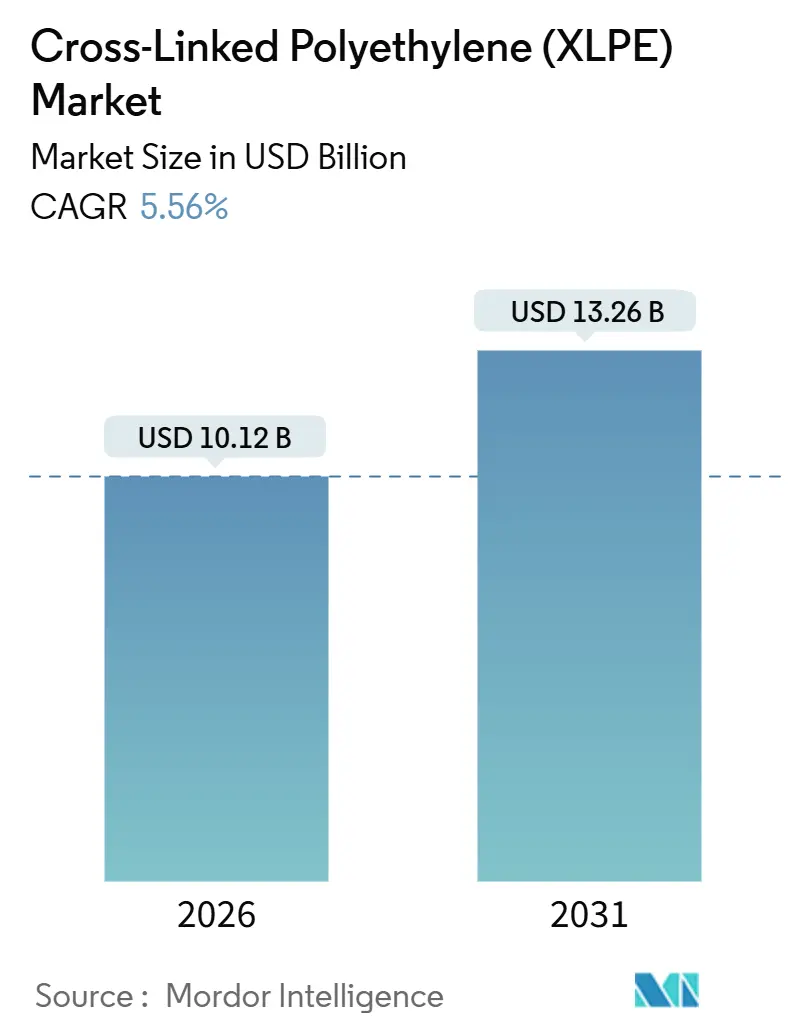
The Cross-Linked Polyethylene (XLPE) Market size is estimated at USD 10.12 billion in 2026, and is expected to reach USD 13.26 billion by 2031, at a CAGR of 5.56% during the forecast period (2026-2031). Energy-transition spending, residential plumbing conversions from copper to PEX tubing, and ultra-high-voltage transmission upgrades are steering demand toward high-performance cable compounds and medium-density grades with superior flexibility. Renewable-energy projects require export cables rated for 220 kV and higher, shifting specifications toward low-dielectric-loss XLPE compounds. Parallel growth in single-family housing starts across North America is reinforcing medium-density PEX installations because they cut on-site labor costs by one-third and withstand freeze-burst conditions better than CPVC. Feedstock integration, advanced recycling, and bio-attributed naphtha sourcing are now strategic differentiators as utilities and automakers insist on verifiable Scope 3 emissions reductions. Price volatility in ethylene and regulatory scrutiny of certain alkoxy-silanes continue to pressure non-integrated compounders, fostering mergers and acquisitions interest from backward-integrated petrochemical majors.
Key Report Takeaways
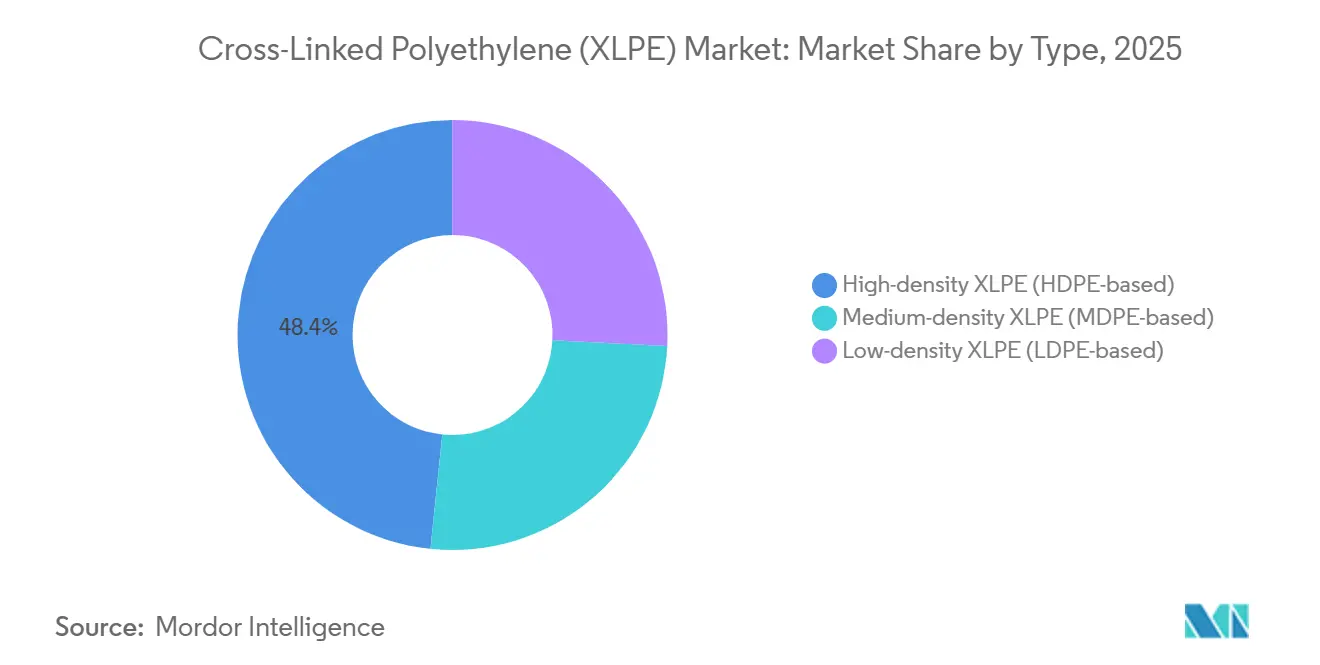
- By type, high-density XLPE led with 48.36% of the Cross-Linked Polyethylene market share in 2025, while medium-density grades are forecast to expand at a 6.14% CAGR through 2031.
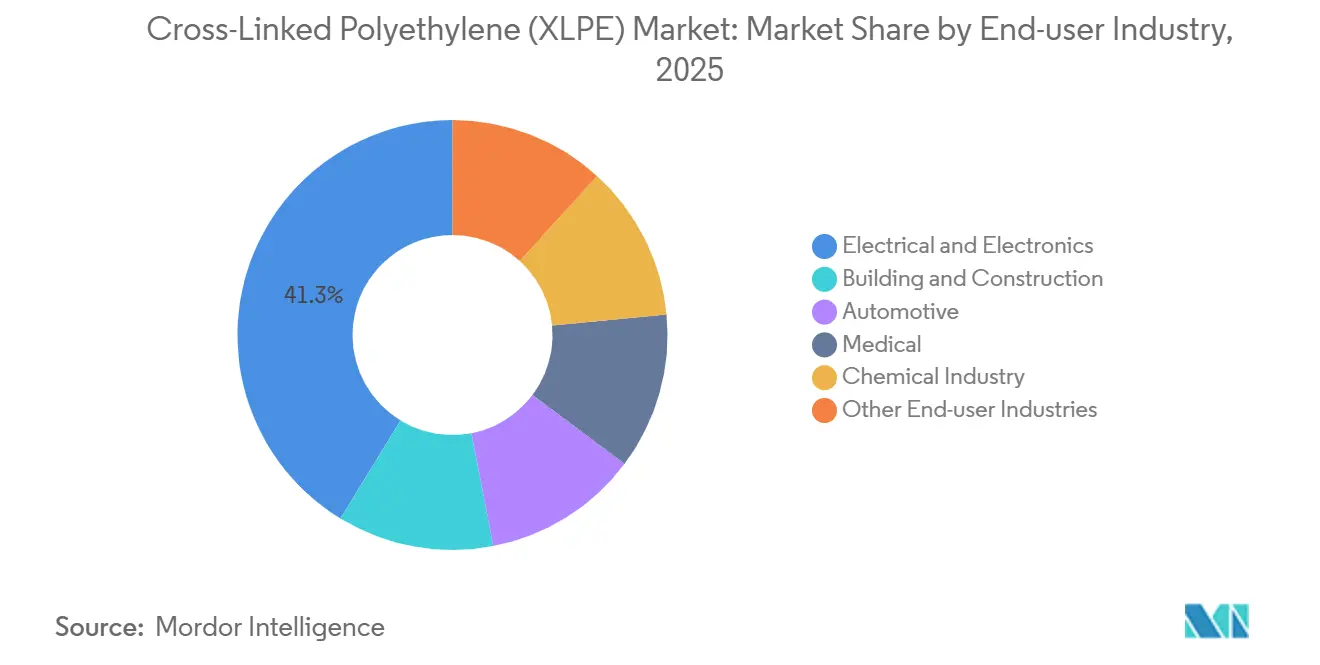
- By end-user, electrical and electronics captured 41.28% revenue in 2025, whereas automotive applications are expected to grow at a 6.27% CAGR to 2031 as 800-V EV architectures scale.
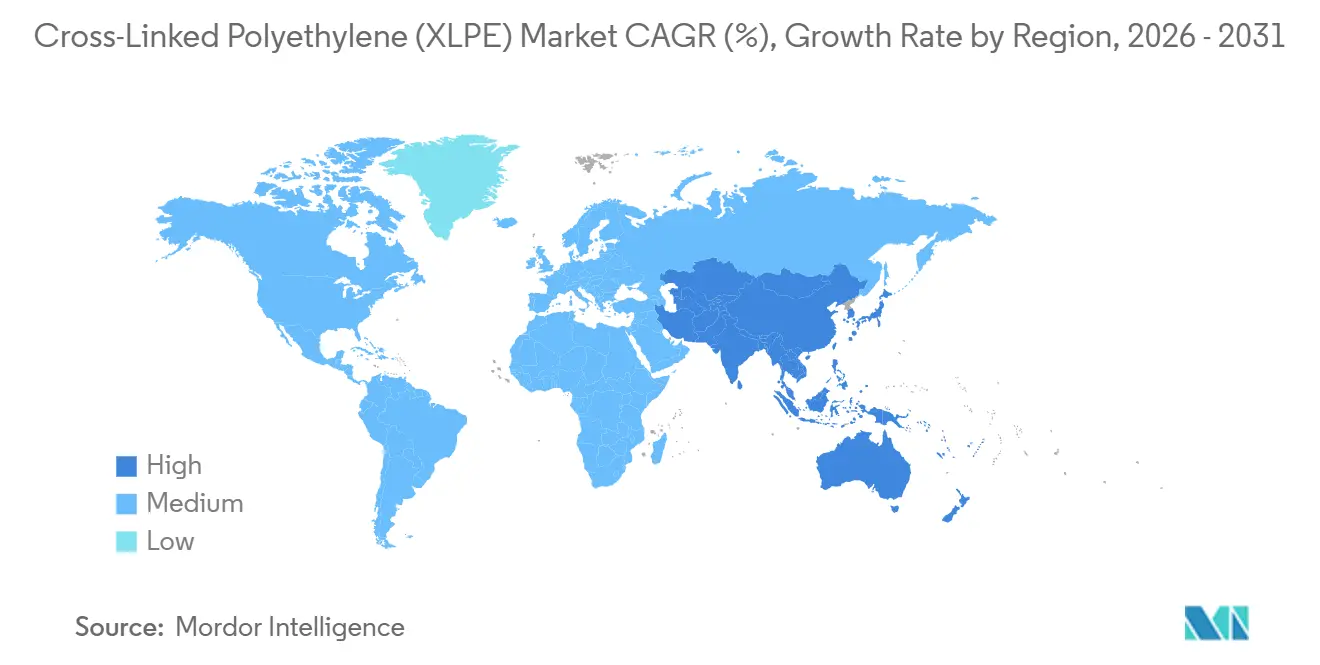
- By geography, Asia-Pacific accounted for 47.52% of the Cross-Linked Polyethylene market size in 2025 and is set to progress at a 5.93% CAGR through 2031 on the back of ultra-high-voltage grid corridors and rapid urban infrastructure spending.
Note: Market size and forecast figures in this report are generated using Mordor Intelligence’s proprietary estimation framework, updated with the latest available data and insights as of January 2026.
Market Trends and Insights
Drivers Impact Analysis of Cross-Linked Polyethylene (XLPE) Market*
| Drivers | (~) % Impact on CAGR Forecast | Geographic Relevance | Impact Timeline |
|---|---|---|---|
| Low-cost flexibility and easy installation | +0.9% | Global, pronounced in North America and Asia-Pacific construction | Short term (≤ 2 years) |
| Surge in demand for pipe and tubing (PEX) | +1.2% | North America and Europe core, expanding in Asia-Pacific | Medium term (2-4 years) |
| Grid-upgrade and renewable-energy cables | +1.5% | Asia-Pacific infrastructure corridors, North America backbone, Europe winds | Long term (≥ 4 years) |
| Rapid Asia-Pacific urban infrastructure | +1.1% | China, India, ASEAN, Middle East spillover | Medium term (2-4 years) |
| Bio-based cross-linkable feedstocks | +0.4% | Europe regulation-driven, North America niche | Long term (≥ 4 years) |
| Source: Mordor Intelligence | |||
Low-Cost Flexibility and Easy Installation of XLPE
Since 2020, the United States has seen a decline in residential plumbers. This shortage has led builders to turn to PEX systems, which can cut fitting counts and labor hours [1]. In medium-voltage substations, XLPE cables can bend at a tighter diameter ratio compared to older paper-insulated cables. This flexibility allows for tighter routing, especially valuable in urban areas where land prices are high. XLPE's portion of North American medium-voltage cable volumes has increased over time. These advantages in labor and space are driving faster adoption in both retrofit and new projects, especially under tight construction timelines. Contractors highlight that PEX rough-in jobs, taking just a day, stand in stark contrast to the three-day copper work, helping keep projects within budget amidst a shortage of skilled trades.
Surge in Demand for Pipe and Tubing (PEX)
In 2025, PEX tubing captured a significant share of North America's residential plumbing market, bolstered by its freeze-burst resistance and manifold compatibility, which curtails material waste. Additionally, PEX received the green light for in-home fire-sprinkler systems, thanks to the 2024 update of the International Residential Code[2]. While European adoption lags, it's gaining momentum. Germany's push for district-heating retrofits mandates polymer pipes boasting a 50-year service life, effectively steering the choice towards PEX-a or PEX-b. In South Korea, deployments of radiant floor heating surged in 2025, with PEX dominating new installations, thanks to its compatibility with low-temperature heat pumps. Moreover, the manifold approach not only shortens pipe runs but also trims installation time, cutting down hot-water wait periods, thereby boosting household efficiency.
Grid-Upgrade and Renewable-Energy Cable Investments
In 2025, the United States Department of Energy allocated funding for high-voltage direct-current interconnections, specifically using XLPE insulation rated for 525 kV and capable of 90 °C continuous operation. Offshore wind farms, on average, need export cables for every gigawatt, which equates to significant demand for XLPE compound for each project. In 2025, China's State Grid integrated 500 kV XLPE cable, connecting distant solar hubs to coastal demand centers, and successfully reduced curtailment. In 2024, India, as part of its renewable-integration strategy, awarded contracts for a 400 kV cable. These concerted investments not only underscore public-sector climate ambitions but also provide a long-term demand outlook for XLPE compound producers.
Rapid Asia-Pacific Urban Infrastructure Expansion
Urbanization in ASEAN is driving the adoption of moisture-resistant XLPE in underground distribution networks. The ASEAN Power Grid initiative mandated XLPE insulation to combat tropical humidity. In 2024, Indonesia's utility, PLN, awarded a tender for 20 kV distribution cable, enforcing a domestic-content rule, which has spurred local compounding investments. India's Smart Cities Mission has allocated funds for underground cabling initiatives through 2027, aiming to reduce technical losses. These initiatives not only elevate the status of lower-voltage distribution grades, which enjoy premium margins over standard building wire, but also promise contractors diminished outage risks and enhanced public safety by eliminating overhead lines.
Restraints Impact Analysis of Cross-Linked Polyethylene (XLPE) Market*
| Restraints | (~) % Impact on CAGR Forecast | Geographic Relevance | Impact Timeline |
|---|---|---|---|
| Volatile ethylene and additive prices | -0.8% | Global, acute for Europe and North America non-integrated producers | Short term (≤ 2 years) |
| Limited recyclability of thermoset XLPE | -0.5% | Europe scrutiny, North America EPR emerging | Medium term (2-4 years) |
| Upcoming limits on silane coupling agents | -0.3% | Europe first, potential global procurement spillover | Medium term (2-4 years) |
| Source: Mordor Intelligence | |||
Volatile Ethylene and Additive Prices
Feedstock accounts for a significant portion of the cost of XLPE compounds, and spot ethylene price volatility challenges the stability of fixed-price contracts. In 2024-2025, the United States Gulf Coast ethylene prices fluctuated due to disruptions in NGL supply that affected crackers. Due to curtailments from Russia, European producers incurred additional premiums when transitioning from pipeline gas to naphtha. In 2024, amid shortages of cumene, peroxide cross-linking agents experienced price hikes. This led compounders to incorporate quarterly price-adjustment clauses, transferring the risk to cable OEMs. As margin pressures mount, consolidation in the industry accelerates, with a clear advantage for suppliers that are backward-integrated.
Limited Recyclability of Thermoset XLPE
Thermoset covalent bonds complicate mechanical reprocessing, leading to end-of-life cable insulation often ending up in landfills or being used for energy recovery. While the EU Waste Framework Directive mandates increased plastic recycling rates by 2025, cable polymers have achieved limited progress, with the majority of recovery value derived from metal cores. LyondellBasell’s MoReTec pyrolysis pilot demonstrated that XLPE can depolymerize at high temperatures. However, challenges such as the need for segregated feed, significant capital expenditure for plants, and yield losses hinder large-scale adoption. Without improvements in the economics of chemical recycling, recyclability will continue to be a reputational challenge, particularly in regions with legislated extended producer responsibility.
*Our forecasts treat driver/restraint impacts as directional, not additive. The impact forecasts reflect baseline growth, mix effects, and variable interactions.
Cross-Linked Polyethylene (XLPE) Market Segment Analysis
By Type:
Medium-Density Flexibility Sparks PEX MomentumMedium-density XLPE is expected to post a 6.14% CAGR through 2031, outpacing high-density despite the latter’s 48.36% 2025 share of the Cross-Linked Polyethylene market size. PEX-b, a silane-grafted medium-density grade, captured a substantial portion of North American residential plumbing due to its cost advantage over peroxide-cured PEX-a and its ability to tolerate higher chlorine levels. Low-bend-radius requirements in radiant heating systems further heighten its appeal. High-density XLPE continues to lead in medium- and high-voltage cables, thanks to its dielectric strength meeting industry standards. Borealis’s Borlink LS4201DC, launched in 2024, boasts a reduction in dielectric losses for 525 kV DC cables, solidifying high-density’s premium position.
Electron-beam cross-linking (PEX-c) is gaining traction in automotive wire harnesses, achieving high line speeds and ensuring no chemical residues, an edge for high-voltage EV cables. Hanwha’s 2025 expansion in Yeosu, adding low-density XLPE capacity, aims to cater to EV cable assemblers. Europe’s district-heating sector is witnessing a surge in medium-density PEX-b, driven by mandatory oxygen-barrier layers that leverage EVOH co-extrusion, a method less viable for high-density resin. In conclusion, while high-density maintains its revenue lead, factors like flexibility, chlorine resistance, and cost-effectiveness are steering increasing demand towards medium-density grades.

By End-User Industry:
Automotive Electrification Surges AheadAutomotive demand is projected to grow at 6.27% through 2031. This surge comes as OEMs pivot to 800-V battery packs, necessitating XLPE-insulated cables. These cables are rated for a continuous service temperature of 125 °C and can withstand a dielectric voltage of 1,000 V. Electrical and electronics accounted for 41.28% of 2025 revenues. This is due to a shift in transmission investment focus, now leaning towards asset refurbishment rather than new greenfield lines, leading to a decrease in cable tonnage per kilometer. Aptiv has introduced high-voltage EV harnesses that merge XLPE insulation with aluminum laminate shielding, achieving a weight reduction compared to traditional rubber-insulated cables.
Building and construction, bolstered by PEX's growing role in plumbing, remains the second-largest sector by volume. Single-family homes projected to start in the United States in 2025 translate to an estimated demand for medium-density XLPE. Medical applications, particularly dialysis tubing, maintain a steady demand. This stability follows FDA validation that XLPE can endure gamma sterilization without any mechanical degradation. In the chemical industry, XLPE-lined piping is preferred for corrosive environments, offering a cost advantage compared to fluoropolymers. While the agriculture and marine sectors together command a small market share, they leverage XLPE's UV resistance for irrigation drip lines and aquaculture nets. In summary, driven by the electrification trend and a push for lightweight materials, the automotive sector is poised to be the primary growth driver in the Cross-Linked Polyethylene market.
Geography Analysis
APAC Cross-Linked Polyethylene (XLPE) Market
Asia-Pacific, with 47.52% Cross-Linked Polyethylene market share in 2025, is set to expand at 5.93% CAGR through 2031. This growth is largely driven by China's ambitious initiative to construct extensive 500 kV XLPE cables, facilitating the eastward transport of renewable energy and effectively reducing curtailment. Meanwhile, under its National Electricity Plan, India is set to roll out extensive 400 kV lines, aiming to integrate a staggering amount of renewable energy by 2032. Notably, all project bids emphasize the use of XLPE insulation, particularly for ambient temperatures exceeding 50 °C. Further solidifying the regional demand, the ASEAN Power Grid's Lao-Thailand-Malaysia-Singapore link, which secured financing in 2025, mandates the use of XLPE cables in humid and saline soil conditions. In a move to enhance seismic resilience, Japan's Tokyo Electric Power Company is in the process of burying overhead distribution lines with XLPE cables, a project slated between 2024 and 2027.
North America Cross-Linked Polyethylene (XLPE) Market
A grid-modernization grant in the United States significantly influences North America's trajectory, stipulating the use of high-density XLPE for 525 kV DC lines. In 2024, Canada greenlit an Atlantic offshore wind project, projected to utilize a substantial amount of compound. Mexico, in 2025, awarded a tender for a 230 kV line, specifically designed to link the Baja solar fields, with all components mandated to be XLPE. Additionally, PEX made significant inroads in the United States residential plumbing, achieving a notable penetration rate in 2025, bolstering the demand for medium-density variants.
EMEA and South America Cross-Linked Polyethylene (XLPE) Market
Europe is navigating its course with the ambitious REPowerEU initiative, targeting a monumental amount from offshore wind. This endeavor necessitates extensive subsea XLPE cable. However, execution is hampered by vessel shortages, pushing timelines back. In Germany, the push for polymer district-heating pipes has birthed a lucrative annual market for PEX. Meanwhile, in 2024, the European Chemicals Agency raised alarms on specific alkoxy-silanes, compelling formulators to transition to epoxy or amino alternatives, a shift that incurs added qualification costs. While South America and the Middle East-Africa regions lag, they're rapidly catching up. Brazil, for instance, auctioned off extensive XLPE lines in 2024, and Saudi Arabia's ambitious NEOM megaproject has underscored the importance of cross-linked insulation for its desert cabling needs.
Value Chain Analysis
The XLPE value chain starts with upstream ethylene and polyethylene resin production (HDPE-, MDPE-, and LDPE-based), where backward-integrated polyolefin producers can better manage feedstock volatility. The midstream layer includes cross-linking chemistry and compounding: peroxide suppliers for PEX-a, silane grafting packages and catalysts for PEX-b, and specialty additives for low dielectric loss, cleanliness, and process stability required for MV/HV/EHV cable insulation. Electron-beam cross-linking also supports a parallel wire and harness route where chemical residues are avoided.
Downstream, compound is converted by wire and cable OEMs (including HVDC and subsea export cable makers) and by pipe and tubing extruders for PEX plumbing, radiant heating, and district heating. Supply is split between direct provision under technical-service agreements for high-voltage compounds, where qualification cycles typically run multiple months, and distributor channels for broader PEX plumbing and general industrial uses. Recent capacity additions highlight the role of regional hubs and logistics: Borouge started production from a new 100,000 tpy cross-linkable polyethylene plant at the Borouge 4 complex in Ruwais, with the first batch delivered in May 2026, while Borealis expanded XLPE capacity at Stenungsund, Sweden (October 2025) for MV/HV/EHV power cable applications, tightening links between resin production, compounding, and nearby European cable supply chains.
Competitive Landscape
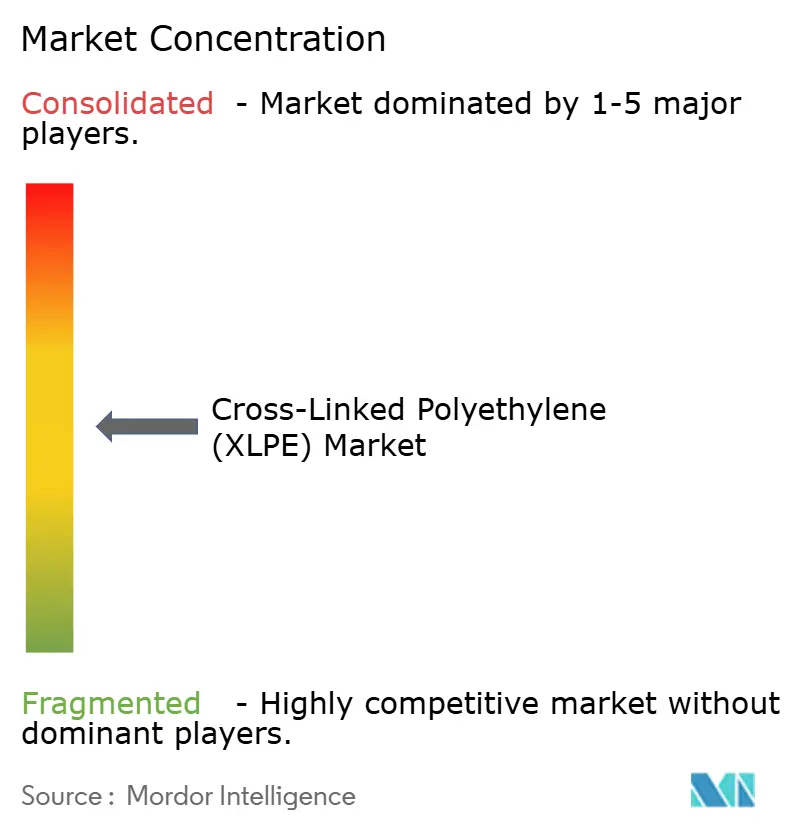
The cross-linked polyethylene (XLPE) market is moderately fragmented in nature. Specialty compounders differentiate via silane-grafting techniques that shorten cure times and improve moisture resistance; Nouryon’s Perkadox series enables 180-200 °C processing, boosting line speeds and lowering energy consumption. Electron-beam service providers such as BGS Beta-Gamma-Service operate 12 German sites processing low-density XLPE annually for automotive harnesses, bypassing chemical cross-linkers. Competitive advantage is drifting from pure cost leadership toward sustainability credentials and rapid technical-service response as buyers demand lifecycle carbon data and accelerated qualification cycles.
Cross-Linked Polyethylene (XLPE) Industry Leaders
-
Dow
-
Borealis AG
-
LyondellBasell Industries NV
-
Exxon Mobil Chemical
-
Solvay SA
- *Disclaimer: Major Players sorted in no particular order
Cross-Linked Polyethylene (XLPE) Market Companies Covered in this Report
- 3H VINACOM CO., LTD
- Arkema
- Armacell
- Avient Corporation
- BASF
- Borealis AG
- Dow
- Exxon Mobil Chemical
- Hanwha Solutions Chemical Division Corporation
- LG Chem
- LyondellBasell Industries NV
- Nouryon
- SACO AEI Polymers
- Solvay SA
- Wanhua
- Zhejiang Wanma Macromolecule Material Group Co.,Ltd. All
Market Opportunities and Future Outlook
Power-grid electrification and renewable integration continue to create room for premium, low-dielectric-loss cable compounds and for localized semicon and insulation compounding near cable manufacturing clusters. This shows up in supply-side moves aimed at MV/HV/EHV applications, including Borealis investments at Stenungsund (announced October 2025) and the scale-up of cross-linkable polyethylene output at Borouge 4 in Ruwais, where the first batch from a new 100,000 tpy XLPE plant was delivered in May 2026. Together, these developments support opportunities for suppliers able to meet cleanliness and electrical-performance needs for 220 kV+ export cables and 525 kV-class HVDC insulation referenced in utility and public funding programs.
Circularity and Scope 3 requirements also broaden the demand base for differentiated products and services, particularly solutions that address end-of-life constraints of thermoset XLPE. Technical work published in 2025 on dynamic covalent approaches, including Diels-Alder based covalent adaptable networks, points to pathways aimed at self-healing and reprocessable polyethylene insulation while maintaining dielectric performance, which aligns with buyer requests for verifiable emissions reductions and improved recoverability. In parallel, the shift in building and plumbing from copper to PEX keeps the opportunity centered on medium-density PEX grades, with code acceptance in residential applications and retrofit-led demand in district heating systems that specify long service life and barrier-layer pipe constructions.
Recent Industry Developments in Cross-Linked Polyethylene (XLPE) Market
- May 2026: Borouge commenced production of cross-linkable polyethylene for XLPE applications at the Borouge 4 facility in Ruwais, UAE, bringing on 100,000 metric tons per year of new capacity. The start-up improves supply availability for medium- and high-voltage cable insulation and supports tighter regional fulfillment to Asia and the Middle East for grid and renewable interconnection projects.
- April 2026: Borouge International announced plans for a semicon compounding facility in Cheonan, South Korea, targeting medium- and high-voltage cable applications. The planned asset increases localization of critical semiconductive layers used in power cables, reducing lead times for cable OEMs and supporting faster qualification and supply continuity in Northeast Asia.
- October 2025: Borealis announced two major investments at its Stenungsund, Sweden site to expand cross-linked polyethylene used for MV, HV, and EHV power cable insulation materials, with completion slated for 2026. The project adds European capacity and supports tighter integration between polymer production and specialty cable-compound supply for grid-upgrade programs.
Cross-Linked Polyethylene (XLPE) Market Report Scope and Research Methodology
Market Definition and Coverage
This market covers revenues from cross-linked polyethylene (XLPE, often referred to as PEX) sold as a material for downstream uses such as wire and cable insulation, plumbing and heating pipes, automotive, medical, and chemical handling applications.
Scope exclusions: We exclude the value of finished cable assemblies, fittings, installation labor, and polyethylene resins that are not cross-linked.
Segments Covered in This Report
- By Type
- High-density XLPE (HDPE-based)
- Medium-density XLPE (MDPE-based)
- Low-density XLPE (LDPE-based)
- By End-user Industry
- Building and Construction
- Electrical and Electronics
- Automotive
- Medical
- Chemical Industry
- Other End-user Industries
- By Geography
- Asia-Pacific
- China
- India
- Japan
- South Korea
- ASEAN Countries
- Rest of Asia-Pacific
- North America
- United States
- Canada
- Mexico
- Europe
- Germany
- United Kingdom
- France
- Italy
- Russia
- Rest of Europe
- South America
- Brazil
- Argentina
- Rest of South America
- Middle-East and Africa
- Saudi Arabia
- South Africa
- Rest of Middle-East and Africa
- Asia-Pacific
Data Sources, Market Sizing, and Validation
Desk Research
Desk research is used to set the structure of the model and to anchor inputs that can be tracked through public channels. We start with polymer and chemical production and trade signals, and then connect them to demand indicators from major consuming sectors like construction activity and power grid expansion.
Typical non-paywalled sources include government trade statistics and customs dashboards, energy and grid agencies for transmission and distribution additions, construction and housing statistics, standards and regulatory bodies that cover plumbing and cable specifications, and peer-reviewed polymer processing journals that discuss cross-linking methods and performance ranges. We also review company filings, investor presentations, and reputable industry news to understand capacity additions, shutdowns, and pricing commentary. For cross-checking company financial exposure and patent activity linked to cross-linking chemistry, a paid company intelligence and patent database subscription is used selectively. These source examples are illustrative only, and many other public sources are also referenced for data collection, validation, and clarification.
Primary Interviews and Surveys
Primary interviews and surveys are used to test assumptions that are not consistently visible in public data, especially grade mix, application split, and regional pricing movements. We speak with a mix of resin producers, compounders, distributors, cable and pipe value chain participants, and technical experts, covering APAC, EMEA, and the Americas, so regional demand signals are not overgeneralized.
Distribution of primary research fieldwork respondents
| Company type | Respondent position | Region |
|---|---|---|
| Top tier: 29% | CXOs: 13% | APAC: 47% |
| Mid tier: 57% | Functional/Unit leaders: 28% | EMEA: 35% |
| Smaller Players: 14% | Managers: 59% | Americas: 18% |
Market-Sizing & Forecasting
Sizing starts with a top-down build where polymer conversion demand is reconstructed using power and telecom cable deployment signals, building pipe replacement activity, and sector output trends, and then translated into XLPE consumption using application-level intensity factors. To keep the totals grounded, we corroborate them with selective bottom-up approximations such as sampled producer and distributor volumes, channel checks on availability and lead times, and observed average selling price ranges for key grades.
Inputs used in the model include cable insulation demand tied to grid expansion and renewable connections, construction and housing starts that influence plumbing volumes, replacement rates for copper and other pipe materials in repair and retrofit work, regional resin price direction linked to ethylene and energy costs, and cross-linking method mix (peroxide, silane, irradiation) that affects performance and pricing. Where bottom-up coverage is uneven, gaps are handled by using regional apparent consumption logic based on production plus net trade, followed by adjustments informed by interview feedback on end-market pull. Forecasting uses scenario analysis supported by regression on the main demand drivers, and the variable outlook is cross-checked with expert views on infrastructure spending cycles and construction activity.
Data Validation & Update Cycle
Outputs are validated through several checks so the numbers do not rely on one data stream. We compare modeled demand against independent signals such as resin price movements, trade balance shifts, and major capacity announcements, and then review any large variance before sign-off.
Before delivery, the model goes through stepwise analyst reviews, including anomaly checks at region and application level, and re-contact triggers when a key assumption looks inconsistent with recent market events. Reports are refreshed annually, and interim updates are made when material events occur, such as new capacity, policy changes, or major revisions in construction and grid spending. Right before publication, a fresh pass is done so clients receive the latest updated view.
Mordor Intelligence's Cross Linked Polyethylene Xlpe Market Size Measured Against Other Published Estimates
Published market values for XLPE can differ because the scope can shift between resin-only revenues and wider downstream coverage that includes fabricated products, and because base years and pricing timelines are not always aligned. Different demand anchors also matter, since wire and cable can be modeled from grid build-outs, or from broader construction plastics pools, which can move the total up or down.
Some published figures treat XLPE and PEX as a combined bucket and may include more of the plumbing system spend, or they apply faster price escalation uniformly across regions. For Mordor Intelligence, the value counts only cross-linked polyethylene material revenues across end-use industries, and it excludes finished cable assemblies, pipe fittings, and installation labor, with ASP progression refreshed using regional resin and energy cost signals.
Benchmark comparison
| Source | Market Size | Gaps in Research Methodology |
|---|---|---|
| Mordor Intelligence | USD 10.12 B (2026) | |
| Industry Data Provider A | USD 8.01 B (2024) | Uses a different base year and forecast window, and presents the scope as XLPE/PEX with explicit application buckets, which can tilt the mix toward plumbing-heavy demand and a lower starting value versus a later-year estimate. |
| Global Research Group B | USD 8.45 B (2024) | Positions XLPE and PEX interchangeably and emphasizes end-use splits like construction share, which can lead to broader interpretation of plumbing-related value, and it relies on a 2024 price and volume baseline that may not match later-year resin pricing cycles. |
The spread across published figures is mainly explained by timing and what is counted as part of the market, not by a single calculation step. When scope stays at material revenues and the totals are checked against cable and construction demand indicators plus trade and price signals, the result is easier to trace and repeat at the next update.
Key Questions Answered in the Report
What is the current value of the Cross-Linked Polyethylene market?
It was valued at USD 10.12 billion in 2026 and is projected to rise to USD 13.26 billion by 2031.
Which segment is growing fastest within Cross-Linked Polyethylene?
Automotive applications are forecast to expand at a 6.27% CAGR through 2031 due to 800-V EV architectures.
Why is medium-density XLPE gaining share in plumbing?
Medium-density PEX-b offers flexibility, chlorine resistance, and lower cost, driving a 6.14% CAGR outlook.
Which region dominates Cross-Linked Polyethylene demand?
Asia-Pacific held a 47.52% share in 2025 and should maintain leadership with a 5.93% CAGR through 2031.
How are producers addressing sustainability pressures?
Strategies include bio-attributed feedstocks, advanced recycling loops, and electrified cracker projects to cut carbon intensity.
What major risk could slow Cross-Linked Polyethylene growth?
Volatile ethylene prices and potential silane-coupling-agent restrictions pose near-term margin and compliance challenges.