
Cookies Market Analysis by Mordor Intelligence
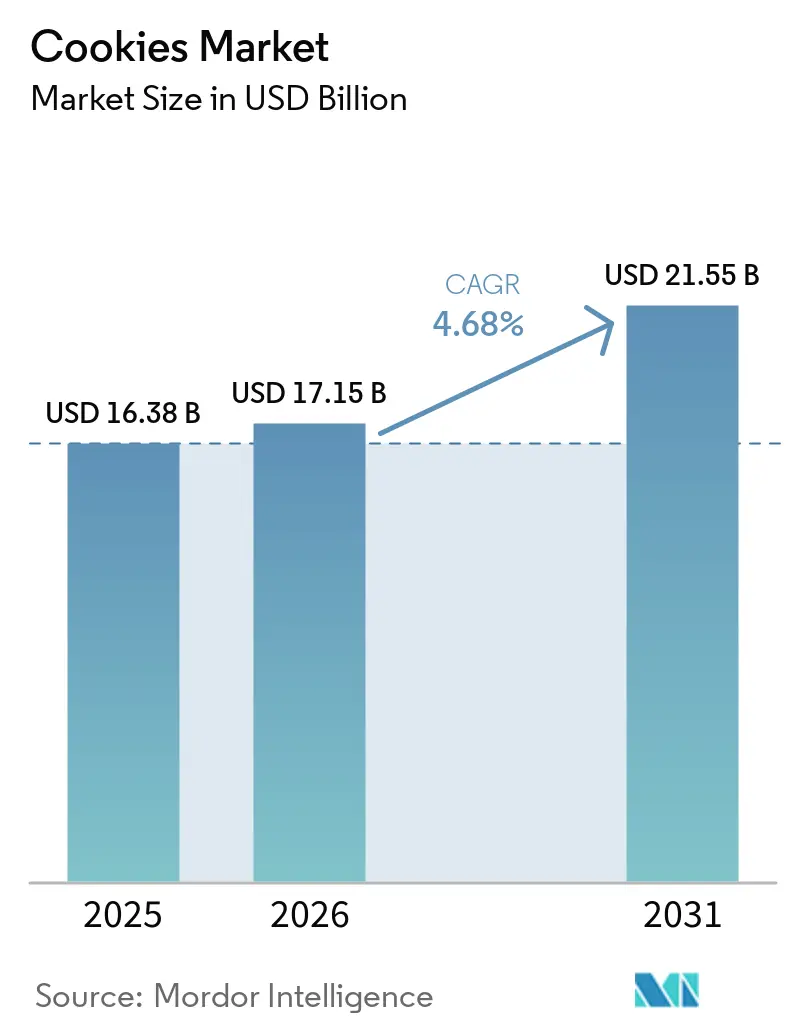
The cookies market size is estimated at USD 17.15 billion in 2026 and is projected to be USD 17.95 billion in 2027, reaching USD 22.21 billion by 2032, growing at a CAGR of 4.35% from 2027 to 2032.
Cookie brands can connect familiar indulgence with defined eating occasions and measurable nutritional propositions. Morning purchases of packaged sweet snacks and protein-focused cookie offers create different routes to shoppers. Ingredient cost pressure in India adds a pricing constraint, while nutrient-triggered restrictions in Chile can narrow child-focused distribution. Sandwich-cookie capabilities and local production partnerships offer manufacturers distinct ways to adapt products and expand local supply. For sandwich-cookie and partner-made launches, occasion positioning creates a scalable opportunity only when the recipe preserves access to the intended channel and production costs leave room for competitive pricing.
Key Report Takeaways
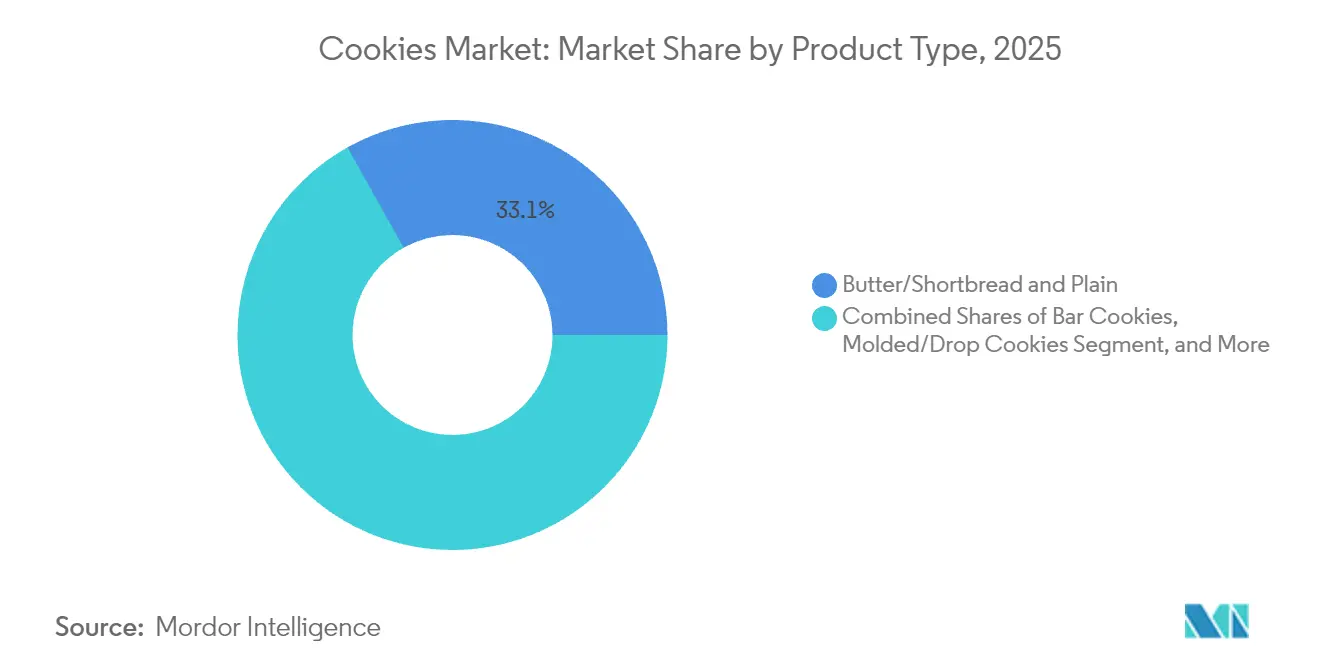
- By product type, butter, shortbread and plain cookies led with a 32.98% cookies market share in 2026, while bar cookies are forecast to be the fastest-growing segment at a CAGR of 5.6% from 2027 to 2032.
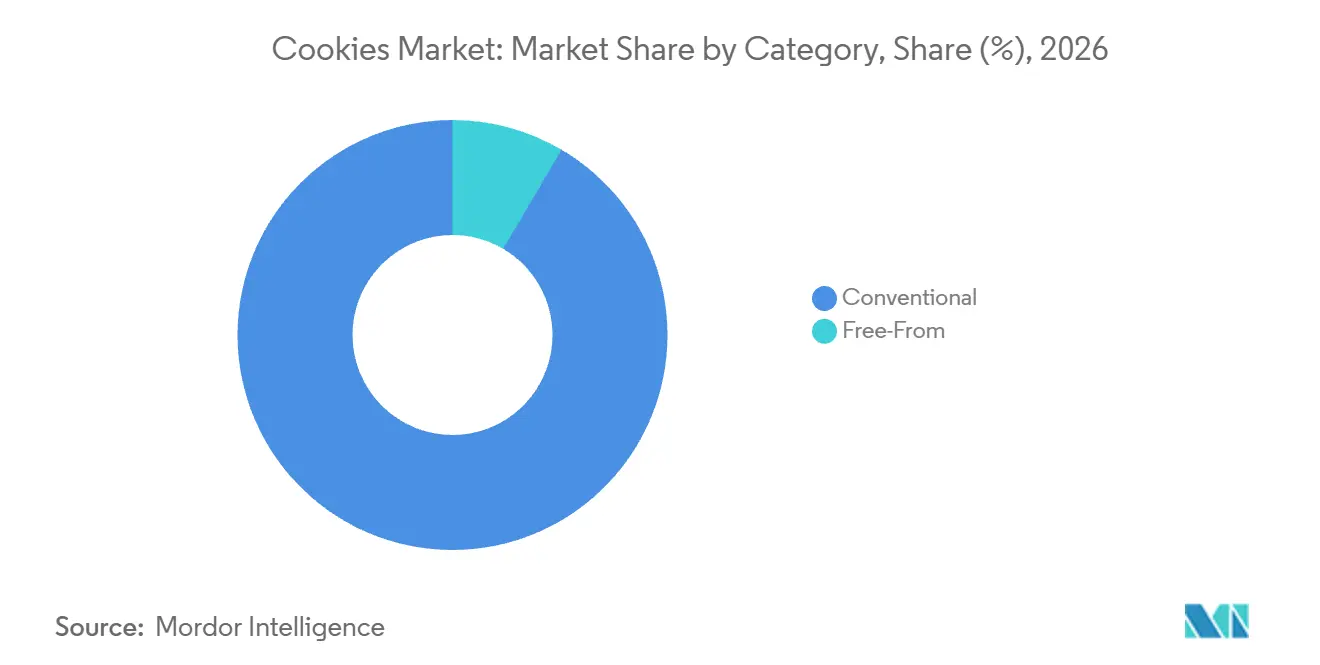
- Across categories, conventional cookies held a 91.54% share of the cookies market size in 2026, and free-from cookies are projected to grow fastest at a CAGR of 6.3% from 2027 to 2032.
- Distribution through hypermarkets and supermarkets accounted for 38.89% of retail cookie spending in 2026, while online retailers are forecast to be the fastest-growing channel at a CAGR of 6.2% from 2027 to 2032.
- By packaging type, pouches and sachets led with 62.8% of retail cookie spending in 2026, with cartons projected to grow fastest at a CAGR of 5.5% from 2027 to 2032.
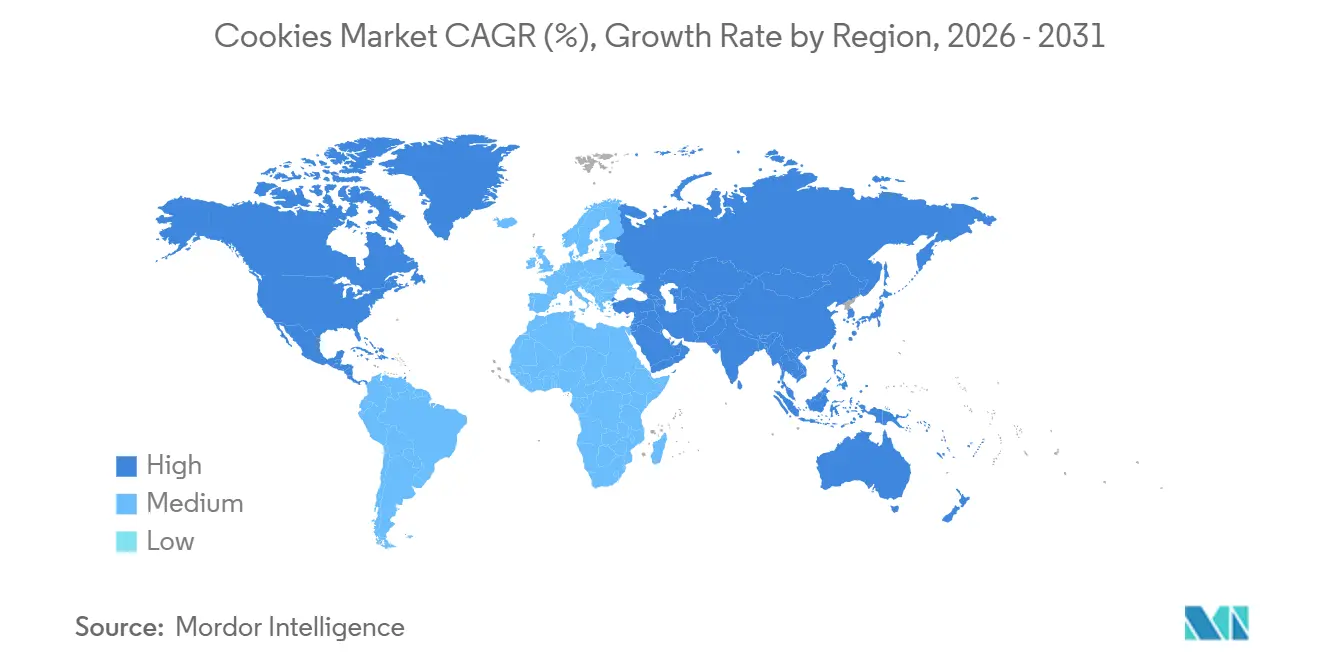
- Europe led the geographic breakdown with 32.96% of retail cookie spending in 2026, while South America is forecast to be the fastest-growing geography at a CAGR of 6.4% from 2027 to 2032.
Note: Market numbers in this report are based on Mordor Intelligence's proprietary estimation framework, which combines nine months of actuals with Q4 projections for base year 2026.
Market Trends and Insights
Drivers Impact Analysis of Cookies Market*
| Driver | (~) % Impact on CAGR Forecast | Geographic Relevance | Impact Timeline |
|---|---|---|---|
| Rising Demand for Portion-Controlled Indulgence Snacks | +1.7% | Across the United States | Short term (≤ 2 years) |
| Accelerated Urban On-the-Go Breakfast Culture in Metropolitan Hubs | +1.3% | Across the United States | Medium term (2-4 years) |
| Fortification and Nutrient Enhancement Drive Cookies Market Growth | +1.1% | United States and Japan | Medium term (2-4 years) |
| Plant-Based Fat Reformulation driving growth | +0.9% | Within Germany’s cookie retail market | Medium term (2-4 years) |
| Direct-to-Consumer Subscription Surge for Gourmet Cookies | +0.4% | Within the United States | Short term (≤ 2 years) |
| Gifting and Premiumization as Emotional Positioning | +0.5% | Across the United States | Short term (≤ 2 years) |
| Source: Mordor Intelligence | |||
Rising Demand for Portion-Controlled Indulgence Snacks
US center-store assorted and multipack cookie sales increased 27.8% over a 52-week period ending in 2025. US center-store cookie dollar sales declined 2.9% over 52 weeks ending in 2025 across multi-outlet channels including convenience stores. Galletas Gullón launched ChocoBom Mini Cookies in Spain in 2025 in a format containing 4 individual packs. That pack structure can divide a larger cookie purchase into separate snacking occasions, connecting format development with a portion-oriented offer. Multipacks offer suppliers a differentiated pack proposition within a weaker center-store category, so their shelf relevance depends on the format rather than the direction of total cookie sales.
Accelerated Urban On-the-Go Breakfast Culture in Metropolitan Hubs
Breakfast demand gives cookie suppliers a reason to design an offer around the time of purchase as well as its serving format. PDI Insights Cloud found that 7 a.m. generated 10.84% of weekly US convenience-store packaged sweet-snack sales in 2025, the highest hourly contribution. Cookies sit within that measured category alongside other packaged sweet snacks, giving the broader morning pattern relevance to a cookie supplier. For suppliers developing a breakfast-led cookie, the buyer context is a convenience-store trip with a pronounced morning sales window. A breakfast-led cookie can compete for that morning convenience-store trip if it is available when shoppers make their early purchases.
Fortification and Nutrient Enhancement Drive Cookies Market Growth
Nutrient-enhanced cookies give brands a way to seek distribution around a defined nutritional proposition. In February 2026, ChunkyFit reported its protein cookies were available in over 80 US retail locations, including Scheels and select GNC franchise locations. That mix of independent outlets and specialist retailers gives a protein-cookie proposition several routes to encounter shoppers. Byron Bay Cookie Company introduced its Protein Plus series online on February 16, 2026, with up to 18 grams of protein and up to 6 grams of fiber per serving. ChunkyFit’s footprint places protein cookies in specialist retail, while Byron Bay’s quantified serving claims make nutritional content part of its online product proposition.
Plant-Based Fat Reformulation driving growth
Plant-based fats can make a cookie suitable for vegan buyers when the rest of the recipe also meets their requirements. In a September 2025 interview, Naughty Cookie reported 82% year-over-year sales growth, and founder Jessica Motes identified vegan butter among its cookie ingredients. The formulation task is to deliver the cookie’s texture and flavor within an animal-free recipe, making fat choice part of product performance. In 2025, Griesson – de Beukelaer announced vegan Cereola Cookies with a plant-based recipe, which are available in Germany. Vegan eligibility gives fat selection a role in which shoppers a cookie can serve, while taste and texture define the finished offer.
Restraints Impact Analysis of Cookies Market*
| Restraint | (~) % Impact on CAGR Forecast | Geographic Relevance | Impact Timeline |
|---|---|---|---|
| Raw Material Price Volatility Affecting Cookie Margins | -0.7% | Biscuit-producing areas within India | Short term (≤ 2 years) |
| Stricter HFSS (High-Fat-Sugar-Salt) Labeling Hindering Growth | -0.5% | Chile’s school premises and access points | Medium term (2-4 years) |
| Stringent Food Safety Regulations | -0.3% | Bakery and manufacturing locations in Scotland | Long term (≥ 4 years) |
| Competition from Alternative Snacks | -0.2% | North America and Europe | Medium term (2-4 years) |
| Source: Mordor Intelligence | |||
Raw Material Price Volatility Affecting Cookie Margins
Ingredient inflation creates a difficult choice between protecting cookie margins and preserving the price customers pay for familiar products. CRISIL reported year-over-year inflation of 3% in sugar and 11% in milk among Britannia’s key raw materials in India in fiscal 2027’s first quarter.[1] These simultaneous increases expose manufacturers using both ingredients to cost pressure across more than one part of the recipe. Intense competition limits manufacturers’ scope to pass higher raw-material costs to consumers. Britannia took some price hikes during that quarter in response to commodity inflation. For biscuit producers facing this tradeoff, price recovery carries a commercial risk because protecting unit margins can weaken affordability.
Stricter HFSS (High-Fat-Sugar-Salt) Labeling Hindering Growth
Nutrient classification can remove school sales opportunities for cookie suppliers targeting children’s snack occasions. Chile’s Law 20.606 requires foods exceeding Ministry of Health nutrient thresholds to carry front-of-package nutrient warnings. Foods exceeding applicable energy, sodium, sugar or saturated-fat limits face bans on sales, promotion and advertising inside preschool, primary and secondary schools. Law 21.778 extended these restrictions to school access points, with implementation beginning in the 2026 school year.[2] The first annual stage of that extension covers preschool and grades 1 to 4, followed by grades 5 through the final secondary-school year in the second. Recipes above the applicable thresholds face channel exclusion as well as warning-label duties, limiting the value of child-focused promotion around the covered school access points.
*Our forecasts treat driver/restraint impacts as directional, not additive. The impact forecasts reflect baseline growth, mix effects, and variable interactions.
Cookies Market Segment Analysis
By Product Type:
Shortbread Scale and Bar Cookie GrowthButter, shortbread and plain cookies accounted for a 32.98% share of the cookies market size in 2026, making them the largest segment. Walker’s Shortbread was producing about 2 million shortbread fingers daily in 2025, its bestselling product. That output illustrates the manufacturing base behind an established shortbread format and the commercial importance of a core product. For a supplier operating at this scale, repeatable production becomes a central way to support a large product franchise. A challenger seeking to match Walker’s shortbread-finger supply would need comparable daily baking throughput, so production scale becomes a competitive hurdle beyond developing a similar recipe.
Bar cookies are forecast to be the fastest-growing segment, with a CAGR of 5.6% from 2027 to 2032. Cutting a baked slab into uniform bars provides a format suited to portable single servings. For shoppers eating on the move, the bar can serve as a contained snack or a light breakfast alternative. A producer can set unit weight through the dimensions of the cut and match the resulting bar to a single-serve pack. Bar-cookie suppliers can use a single wrapped serving to address morning snacking without asking shoppers to handle a loose assortment.

By Category:
Conventional Scale and Free-From SpecializationConventional cookies represented a 91.54% cookies market share in 2026, making them the largest segment. In July 2025, Mondelēz España inaugurated a fully electric oven for Oreo cookies at its Viana plant in Navarra, with 3,400 kg/h of additional plant production capacity. That addition illustrates manufacturing renewal behind an established conventional cookie product. For a producer offering this type of cookie, established products can remain the focus of process investment as well as routine output. The resulting production headroom gives an established conventional brand a route to scale through baking technology as well as through its existing product appeal.
Free-from cookies are forecast to be the fastest-growing segment, with a CAGR of 6.3% from 2027 to 2032. In June 2026, Dr. Schär reported that a recent investment had upgraded infrastructure and production technology at its Dreihausen biscuit and savory-snack site. Dr. Schär operates a gluten-free production facility at Dreihausen, with biscuits distributed worldwide. This puts the biscuit offer within a specialized manufacturing environment, while the upgrades also serve a broader snack site. For a gluten-free supplier distributing biscuits worldwide, specialized site capability supports the reach of the offer as well as its dietary positioning.
By Distribution Channel:
Supermarket Reach and Online Delivery GrowthHypermarkets and supermarkets were the largest segment, accounting for 38.89% of retail cookie spending in 2026. NielsenIQ’s Brazil Retail Index recorded 146,464 metric tons of broader biscuit-category sales at large supermarkets in 2025, down 2.7% from 2024. The example combines considerable physical throughput with falling biscuit volumes at Brazil’s large supermarkets. For cookie suppliers using that route, access to a large retail channel does not by itself ensure that unit demand will rise. A large supermarket footprint can sustain substantial biscuit throughput even in a declining year, so cookie growth needs a product-specific case alongside the channel listing.
Online retailers are forecast to be the fastest-growing segment, with a CAGR of 6.2% from 2027 to 2032. In March 2025, Tiff’s Treats launched one delivery-only outpost serving Burleson, Seagoville and Laredo, Texas. By the week of October 7, 2025, its Dubai Chocolate Cookie had sold out 4 times across multiple markets, with more than 10,000 fans joining a waitlist before the next batch relaunched that week. The outpost model and waitlist show two different commercial tools, extending delivery coverage and organizing interest in limited batches. The sellouts and waitlist make batch availability commercially consequential even where delivery coverage exists, since interest cannot become an order until cookies are available.
By Packaging Type:
Flexible-Pack Scale and Carton GrowthPouches and sachets were the largest segment, accounting for 62.8% of retail cookie spending in 2026. In an interview, More Than A Bakery President Bill Quigg said its Kentucky cookie-and-cracker operation could fill vertical bags from half an ounce to 11 or 12 ounces and supply bag-in-box retail packs. That mixed-bakery example places bagging capability across small and larger packs within one manufacturing operation. For a cookie supplier choosing flexible packs, the producer’s available bag sizes can shape the finished selling unit. Retail presentation must work within the cookie producer’s packaging capabilities because those capabilities constrain which pack choices can reach manufacture.
Cartons are forecast to be the fastest-growing segment, with a CAGR of 5.5% from 2027 to 2032. A folding box can organize several cookies into a defined assortment, giving retailers a display surface and gift buyers a finished presentation. For cookie producers, matching box dimensions to the assortment can keep the outer pack compact while preserving room for the intended product arrangement. Other packaging featured a collectible gift tin in Cheryl’s Cookies’ limited-edition Frank’s RedHot buttercream-frosted cookie collection launched in January 2025. Carton suppliers can compete through the fit between assortment and box, with the retail or gifting unit determining the packaging brief.
Geography Analysis
Europe Cookies Market
Europe accounted for 32.96% of the cookies market size in 2026, making it the largest geography. Biscuit International, a private-label producer of biscuits and bread substitutes, reports 30 factories in Europe. In March 2026, Portugal authorized continuous operation through 2027 at Vieira de Castro Produtos Alimentares’ Vila Nova de Famalicão biscuit and bakery-goods facility after technical and economic justification citing extraordinary order volume and contractual deadlines. The network and authorization illustrate two distinct sources of supply flexibility, with private-label factory coverage complemented by an individual producer’s legal scope to extend operating hours.
South America Cookies Market
South America is forecast to be the fastest-growing geography, with a CAGR of 6.4% from 2027 to 2032. In March 2026, Nestlé Ecuador inaugurated an automated cookie line at its southern Guayaquil plant, with an announced 800 metric tons of additional cookie-production capacity. Caricias moved its broader biscuit-and-bakery operation to a 6,800-square-meter Rosario plant in July 2025, a facility 5 times the size of its previous site. In Brazil retail, coated biscuits and cookies together accounted for 10.3% of biscuit-category revenue from January to June 2026. With added cookie capacity in Ecuador and more factory space in Argentina, producers have a larger physical base from which to serve local demand.
The US Department of Commerce’s 2026 Guatemala guide identifies GAMA as Guatemala’s leading cookie brand. In Asia-Pacific, Monde Nissin’s APAC BFB Group manufactured, distributed and marketed a broader biscuit range, including cookies and cookie sandwiches, mainly in the Philippines in 2025. Mondelēz India’s November 2025 Biscoff launch used production at a partner site in Rajasthan under a Lotus Bakeries licensing pact. Within the Middle East and Africa, Sunveat Foods Limited produces biscuits and wafers in Thika, Kenya, for consumers and businesses across East Africa. Entrants facing GAMA in Guatemala or Monde Nissin in the Philippines must compete with established brand or integrated supply positions, while Mondelēz India’s partner site illustrates how production access can be secured through licensing.
Regulatory Framework and Outlook
Selected labeling requirements are compared from the perspective of manufacturers and importers selling packaged cookies. Canada’s nutrient-triggered nutrition symbols and Saudi Arabia’s Arabic-language requirements impose different adaptations on an otherwise eligible offer. The commercial distinction is the country-specific work needed to align product information, package presentation and claims with the applicable duties.
Regulatory Table of Cookies Market
| Decision factor | Canada | Germany | China | Brazil | Saudi Arabia |
|---|---|---|---|---|---|
| Primary authority | Canadian Food Inspection Agency | State authorities and local food-control offices | State Administration for Market Regulation | Anvisa | Saudi Food and Drug Authority |
| Key instruments or direction | Nutrition symbols for prepackaged foods meeting saturated-fat, sugar or sodium thresholds, subject to exemptions and symbol prohibitions | Regulation 1169/2011 on food information; EU packaging-label transition from 2028 | GB 7718-2025 and synchronized Food Label Supervision Measures, scheduled for March 16, 2027 | RDC 429/2020 and IN 75/2020 on nutrition information and claims | SFDA.FD/GSO 9 label-language rules; SFDA.FD GSO 2810:2025 allergen disclosure |
| Commercial effect | Nutrient-profile assessment and compliant symbols for covered prepackaged foods | Mandatory consumer food information and scheduled package-label adaptation | Preparation for mandatory allergen marking and outer-pack information on the smallest sales unit | Nutrition tables, conditional front labels and compliant nutrition claims | Arabic information; any additional language must match it identically |
| Current policy attractiveness | Medium | Medium | Medium | Medium | Medium |
| Future direction of policy attractiveness | No change | Hardening | Hardening | No change | No change |
| Source: Mordor Intelligence | |||||
For manufacturers and importers, Medium reflects adaptation work under established frameworks, including nutrient-triggered labels in Canada and Brazil, consumer food information in Germany, prepackaged-food labeling in China and Arabic-language and allergen duties in Saudi Arabia. Germany’s scheduled EU packaging-label system from 2028 and China’s shift from recommended to mandatory allergen marking on March 16, 2027 support Hardening. Canada’s No change follows the January 1, 2026 deadline, while Brazil’s July 8, 2026 authorization of a 90-day consultation on ingredient declarations, labeling technologies and irradiated-food labeling began a review rather than imposing final duties. Saudi Arabia’s No change reflects established Arabic and matching-translation duties and an allergen instrument effective on approval because a corresponding national regulation existed.
Value Chain Stages
Value capture differs across ingredient formulation, biscuit production and producer-managed distribution. Ingredion supplies ingredients and formulation expertise for cookies and biscuits. Mondelēz makes and sells biscuits and baked snacks, including cookies, and purchases ingredients and packaging materials for that broader business. Ingredient suppliers earn from inputs, while an integrated producer’s factory and route-to-market activities contribute to the same finished-product revenue.
Value Chain Analysis Table of Cookies Market
| Primary activity | Key participants | Value capture | Bottleneck | Resilience response |
|---|---|---|---|---|
| Ingredient supply and formulation | Bakery ingredient suppliers such as Ingredion | Ingredient sales | Translating a product brief into a workable ingredient specification | Use formulation support when qualifying ingredients |
| Biscuit production and packaging | Biscuit producers such as Mondelēz International Inc. and Lotus Bakeries NV | Finished-product sales | Bringing individual product lines into commercial service | Commission cookie output against defined delivery milestones |
| Distribution | Integrated snack distributors such as Mondelēz International Inc. | Product sales through distribution networks | Coordinating direct and third-party routes | Match warehouse and delivery roles to intended market coverage |
| Source: Mordor Intelligence | ||||
By the end of 2025, Lotus Bakeries had delivered the first Biscoff cookies from its Chonburi facility in Thailand to customers. The first phase was completed toward the end of the first half of 2026, and Lotus Bakeries reported it fully operational in August 2026. That operating base puts cookie production within the intended Asia-Pacific growth region, allowing manufacturing and regional customer deliveries to develop around the same supply location.
Competitive Landscape
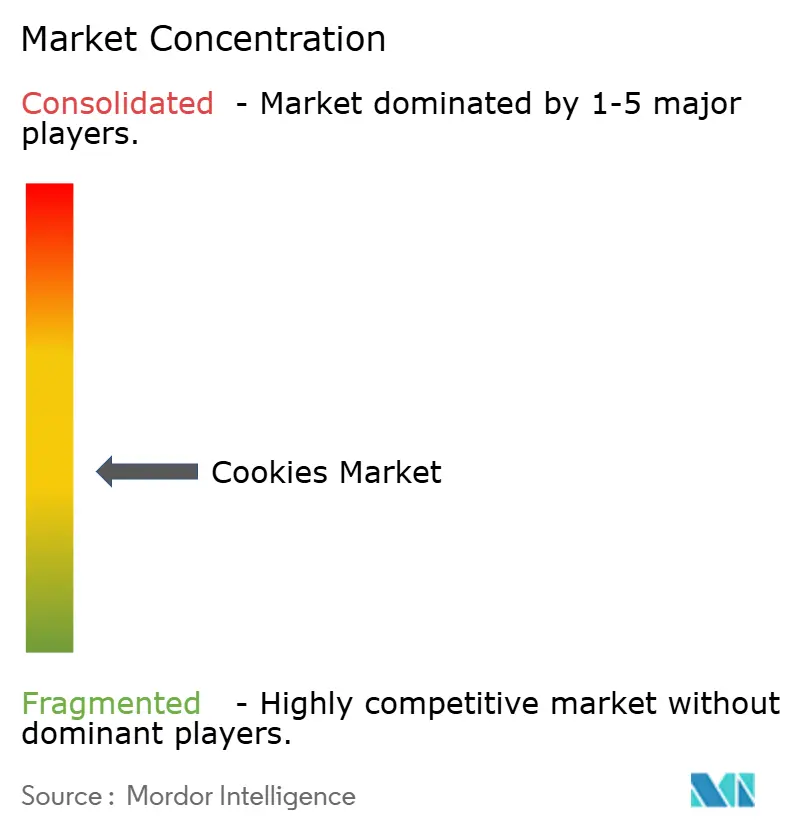
Competition is moderately fragmented, with cookie producer Mondelēz International Inc., Ferrero International S.A., biscuit producer Britannia Industries Ltd., Grupo Bimbo S.A.B. de C.V. and General Mills Inc. alongside national biscuit businesses. Grupo Bimbo lists cookies among its product categories, and General Mills markets Pillsbury refrigerated cookie dough for home baking. Burton’s Biscuit Company, maker of Maryland Cookies, Jammie Dodgers and Wagon Wheels, and Fox’s Biscuits are Ferrero-affiliated businesses that sit outside Ferrero International S.A.’s consolidated financial statements and governance. Fox’s Burton’s Company Group Limited (FBC UK) reported a 13% share of UK branded sweet biscuits for the year ended August 31, 2025, up 0.5 percentage points from 2024.[3] National biscuit businesses with meaningful home-category positions can challenge diversified multinational suppliers through a narrower geographic franchise.
In September 2026, Ferrero and Fine Biscuits Company inaugurated a Nutella Cookies production line at Nieppe, France, the product’s sole manufacturing site in Europe. That dedicated European supply point gives the new cookie proposition a manufacturing base tied to its regional commercialization. Britannia’s earlier equipment choices addressed different biscuit processes, with imports during FY2024-25 of a 4-lane Jim Jam sandwiching machine for Jhagadia and a wafer production line for its subsidiary’s Gwalior factory. Nieppe concentrates European Nutella Cookies supply at one site, while Britannia’s separate sandwiching and wafer lines give challengers distinct manufacturing capabilities to match before they can compete on those formats.
General Mills announced Pillsbury BIG COOKIES refrigerated dough in May 2025, with 3 varieties in 6-count packs and availability planned for Walmart that May and nationwide retailers that summer. FBC UK launched Maryland S’wich in July 2025, describing it as the UK’s first chocolate chip cookie sandwich, with availability at 8 UK retailers. Since January 5, 2026, UK rules have restricted paid advertising of identifiable sweet biscuits and cookies meeting the nutrient-profile test by food manufacturers or sellers with at least 250 employees. Covered products cannot be advertised on TV before 9 p.m. or in paid online ads at any time. Cookie rivals face a formulation choice with direct marketing consequences, since a distinctive format alone does not remove the nutrient-profile restriction.
Cookies Industry Leaders
-
Mondelēz International Inc.
-
Ferrero International S.A.
-
Britannia Industries Ltd.
-
Grupo Bimbo S.A.B. de C.V.
-
General Mills Inc.
- *Disclaimer: Major Players sorted in no particular order
Cookies Market Companies Covered in this Report
- Mondelēz International Inc.
- Ferrero International S.A.
- The Campbell's Co.
- General Mills Inc.
- PepsiCo Inc.
- Grupo Bimbo S.A.B. de C.V.
- Britannia Industries Ltd.
- Parle Products Pvt. Ltd.
- Nestlé S.A.
- Anmol Industries Limited
- Lotus Bakeries NV
- Kellanova
- Bahlsen GmbH and Co. KG
- Lotte Wellfood Co. Ltd.
- Unibic Foods India Pvt Ltd
- Sarjena Foods Pvt. Ltd.
- Orkla ASA
- J and J Snack Foods Corp.
- Gullón S.A.
- Barilla Holding S.p.A.
Key Opportunities for Market Participants
Packaging redesign creates distinct opportunities for cookie producers and importers serving the European Union. The Packaging and Packaging Waste Regulation began applying on August 12, 2026, with a general recyclability requirement, while harmonized design-for-recycling criteria follow a later timetable tied to delegated acts. This sequencing creates a need for work that separates material compliance from the longer development of package designs. Suppliers can address different decisions within that sequence without treating every package change as a complete replacement project.
Market Opportunities Table of Cookies Market
| Opportunity | Why now | Buyer / lead segment | Recommended play | Main barrier | Likely beneficiaries |
|---|---|---|---|---|---|
| Recyclability design services | PPWR application began August 12, 2026; harmonized design criteria follow later, depending on delegated acts | Cookie producers placing packaged products on the EU market | Develop adaptable package specifications for phased requirements | Evolving technical criteria complicate final design choices | Packaging designers and qualified converters |
| Food-contact material qualification | PFAS limits applied from August 12, 2026 where another EU act does not already prohibit the affected packaging | Producers and importers using food-contact cookie packs | Verify materials against applicable limits before qualifying replacements | Demonstrating compliance for each relevant material specification | Material-testing providers and compliant packaging suppliers |
| Functional packaging minimization | Manufacturers and importers face a January 1, 2030 weight-and-volume minimization deadline | Cookie manufacturers and importers supplying the EU | Redesign package dimensions and material use around required functionality | Reductions must preserve functionality, accounting for shape and material | Packaging engineers and converters able to validate redesigned packs |
| Source: Mordor Intelligence | |||||
The central opening is coordinated package qualification, because the duties address different properties and have different implementation schedules. Under Article 5(5), total fluorine above 50 mg/kg requires the manufacturer, importer or downstream user to provide the manufacturer or importer with proof quantifying PFAS or non-PFAS fluorine on request, making documentation part of qualification. Suppliers able to connect those decisions can offer a more useful service than a material substitution assessed in isolation. That creates a practical role for engineering and verification alongside the sale of packaging materials.
Recent Industry Developments in Cookies Market
- Sep 2026: Ferrero and Fine Biscuits Company inaugurated a Nutella Cookies production line at Nieppe, France, the product’s sole manufacturing site in Europe.
- Aug 2026: Lotus Bakeries reported the first phase of its Biscoff production facility in Chonburi, Thailand, fully operational.
- Mar 2026: Nestlé Ecuador inaugurated an automated cookie line at its southern Guayaquil plant, with an announced 800 metric tons of additional cookie-production capacity.
Cookies Market Report Scope and Research Methodology
Market Definition and Coverage
The global cookies market measures annual consumer spending on cookies sold through retail and similar channels worldwide. It covers everyday and specialty cookie products across their available formats, categories, sales channels and packaging.
Scope exclusions: In-store bakery desserts sold as unpackaged items, non-cookie sweet snacks where cookies are not the primary product form, and separately sold cookie ingredients, including flour, sugar, fats and cocoa, are excluded.
Segments Covered in This Report
- By Product Type
- Bar Cookies
- Molded/Drop Cookies
- Sandwich and Cream-Filled Cookies
- Wafer and Rolled Cookies
- Butter/Shortbread and Plain
- Others (Macarons, Meringue, etc.)
- By Category
- Conventional
- Free-From
- By Distribution Channel
- Hypermarkets/Supermarkets
- Convenience Stores
- Specialist Retailers
- Online Retailers
- Other Distribution Channels
- By Packaging Type
- Pouches, Sachets
- Cartons
- Others
- By Geography
- North America
- United States
- Canada
- Mexico
- Rest of North America
- Europe
- Germany
- France
- United Kingdom
- Netherlands
- Italy
- Sweden
- Poland
- Belgium
- Spain
- Rest of Europe
- Asia-Pacific
- China
- India
- Japan
- Australia
- South Korea
- Indonesia
- Thailand
- Singapore
- Rest of Asia-Pacific
- South America
- Brazil
- Argentina
- Chile
- Colombia
- Peru
- Rest of South America
- Middle East and Africa
- United Arab Emirates
- South africa
- Nigeria
- Saudi Arabia
- Egypt
- Morocco
- Turkey
- Rest of Middle East and Africa
- North America
Data Sources, Market Sizing, and Validation
Desk Research
Secondary research draws on sources such as Eurostat PRODCOM statistics for comparable sold-production value and volume by product, FAOSTAT trade data for cookie-related import and export signals where product codes permit, U.S. electronic food-labeling regulations for product and claim context, and Codex Alimentarius texts for international food definitions and standards. These sources help analysts distinguish finished-cookie sales from production, trade, ingredient and regulatory evidence, while country classifications and product codes are checked before use.
Company filings, annual reports, investor materials and reputable business press help identify cookie sales exposure, factory capacity, product launches, pricing actions and channel changes. Those indicators are cross-checked against public production, trade and regulatory records. The named sources are not exhaustive, and further sources inform collection, validation and clarification.
Primary Interviews and Surveys
Interviews and structured surveys would target cookie manufacturers, retailers, distributors and packaging or category specialists, with respondents selected across company sizes and functions relevant to global retail cookie sales. Their input would check secondary evidence on consumer selling prices, channel coverage, product mix, regional demand and the timing of launches or capacity changes, while unresolved differences would be traced to definitions, periods or units and triangulated against independent records before inclusion.
Distribution of primary research fieldwork respondents
| Company type | Respondent position | Region |
|---|---|---|
| Top tier: 30% | CXOs: 20% | APAC: 40% |
| Mid tier: 50% | Functional/Unit leaders: 35% | EMEA: 32% |
| Smaller Players: 20% | Managers: 45% | Americas: 28% |
Market-Sizing & Forecasting
The model starts top down with global consumer spending on finished cookies, then allocates value across the report's product, category, channel, packaging and geographic cuts using reported sales mix, retail presence and product availability. Analysts track cookie sales and shipment direction, retail price and product-mix changes, population and household consumption patterns, and input-cost or regulatory changes that can affect pricing, reformulation or supply. The indicators are compared across countries and periods before their contribution to the forecast is set. A multivariate regression can relate historical market value to these demand and price indicators where observations are sufficiently consistent, while scenario analysis handles structural changes such as new channel access or food rules that lack a stable historical relationship. Selective bottom-up checks use disclosed supplier sales or sampled average selling price times estimated retail volume to test market totals and major regional or channel shares. Missing observations are bridged with the nearest comparable public series, adjusted for known coverage and timing, and flagged for analyst review. Primary experts check whether the selected indicators and resulting variable-level forecast paths fit observed buying, pricing and route-to-market conditions, and discrepancies are reconciled against the evidence before segment shares are finalized.
Data Validation & Update Cycle
Analysts triangulate company disclosures, official production and trade series, retail and channel signals, and primary evidence, then check year-over-year movements, share totals, unit conversions and forecast variance against independent indicators. Anomalies are traced to source definitions, timing, currency or coverage and reviewed by a second analyst before sign-off. Re-contact is triggered when a material answer conflicts with a newer filing, a documented launch or closure, or another independent signal. The dataset is refreshed annually, reviewed between cycles when a material event changes cookie prices, regulation, production or distribution, and given a fresh source and calculation pass before delivery.
Mordor Intelligence's Cookies Market Estimate Compared With Other Published Estimates
The global cookies market measures annual consumer spending on cookies sold through retail and similar channels worldwide. The model starts top down with global consumer spending on finished cookies, then allocates value across the report's product, category, channel, packaging and geographic cuts using reported sales mix, retail presence and product availability.
Key Gap Drivers are addressed through a consistent transaction boundary, market-specific demand inputs and cross-checks across the study. Analysts triangulate company disclosures, official production and trade series, retail and channel signals, and primary evidence, then check year-over-year movements, share totals, unit conversions and forecast variance against independent indicators.
Benchmark comparison
| Source | Market Size | Gaps in Research Methodology |
|---|---|---|
| Mordor Intelligence | USD 17.95 B (2027) | |
| Global Consultancy A | USD 32.5 B (2025) | At its 2025 base, this estimate is 81.1% above this report's 2027 value of USD 17.95 B, 2 years later. |
| Global Consultancy B | USD 42.3 B (2025) | At its 2025 base, this estimate is 135.7% above this report's 2027 value of USD 17.95 B, 2 years later. |
Mordor Intelligence ties the estimate to the study’s defined coverage and demand model. Analysts triangulate company disclosures, official production and trade series, retail and channel signals, and primary evidence, then check year-over-year movements, share totals, unit conversions and forecast variance against independent indicators.
Key Questions Answered in the Report
What is the cookies market size and growth outlook?
The size is estimated at USD 17.15 billion in 2026 and projected at USD 17.95 billion in 2027, reaching USD 22.21 billion by 2032, with a CAGR of 4.35% from 2027 to 2032.
What supports demand for cookies?
Defined eating occasions and nutrient-enhanced offers support product development. In February 2026, ChunkyFit reported distribution in over 80 US retail locations, including Scheels and select GNC franchise locations.
Which product type leads cookie sales?
Butter, shortbread and plain cookies accounted for 32.98% of retail cookie spending in 2026, the largest product-type segment.
Which companies are major competitors in cookies?
Major players include Mondelēz International Inc., Ferrero International S.A., Britannia Industries Ltd., Grupo Bimbo S.A.B. de C.V. and General Mills Inc.
What is a key challenge for cookie suppliers?
Ingredient cost volatility can complicate pricing. CRISIL reported 3% sugar and 11% milk year-over-year inflation among Britannia’s key raw materials in India in fiscal 2027’s first quarter.
Which region leads cookie spending and which is growing fastest?
Europe held 32.96% of retail cookie spending in 2026. South America is forecast to grow fastest at a CAGR of 6.4% from 2027 to 2032.