
Convergent Billing Market Size and Share
Market Overview
| Study Period | 2020 - 2031 |
|---|---|
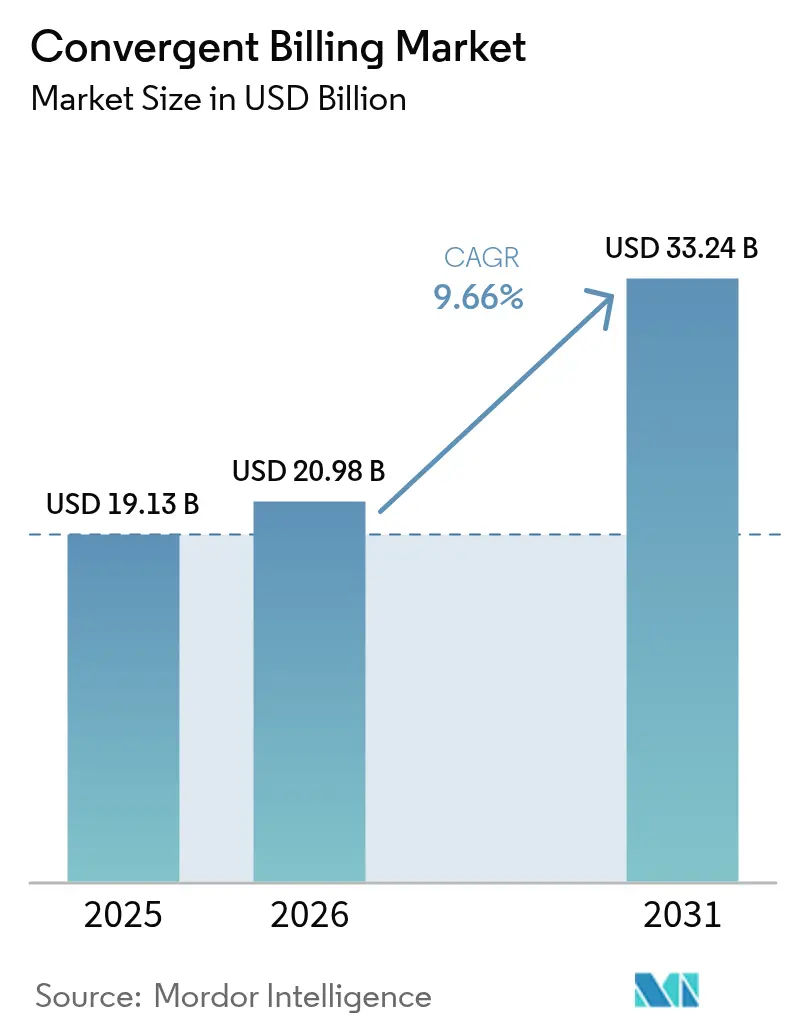
| Market Size (2026) | USD 20.98 Billion |
| Market Size (2031) | USD 33.24 Billion |
| Growth Rate (2026 - 2031) | 9.66 % |
| Fastest Growing Market | Asia Pacific |
| Largest Market | North America |
| Market Concentration | Medium |
Major Players *Disclaimer: Major Players sorted in no particular order Image © Mordor Intelligence. Reuse requires attribution under CC BY 4.0. | |
Convergent Billing Market Analysis by Mordor Intelligence
The convergent billing market size is expected to grow from USD 19.13 billion in 2025 to USD 20.98 billion in 2026 and is forecast to reach USD 33.24 billion by 2031 at 9.66% CAGR over 2026-2031. Operators are scaling unified monetization platforms so that a single engine can rate 5G network slices, bundled over-the-top (OTT) content, Internet of Things (IoT) fleets, and prepaid wallets in real-time. Revenue protection demands policy-controlled charging that works within milliseconds, a requirement that pushed Ericsson to commercialize its cloud-native Charging System in 2024 and led AT&T to renew its five-year platform partnership with Amdocs.[1]Amdocs, “Amdocs and AT&T Extend Strategic Partnership,” amdocs.com Services, spanning integration, consulting, and managed operations, are accelerating faster than software as operators outsource multi-year legacy migrations. Cloud deployment is rapidly overtaking on-premise installations because elastic scaling keeps billing infrastructure aligned with spiky data traffic and saves capital spending. Geographically, North America currently commands the highest revenue, yet the Asia-Pacific region is growing the fastest, as Indian and Chinese operators bundle fintech, commerce, and media into super-app ecosystems. Competitive intensity is rising as hyperscalers enter the convergent billing market with software-as-a-service (SaaS) modules, but most communication-service providers (CSPs) still cite skills gaps in cloud-native business-support systems (BSS) as the main barrier to wholesale platform shifts.
Key Report Takeaways
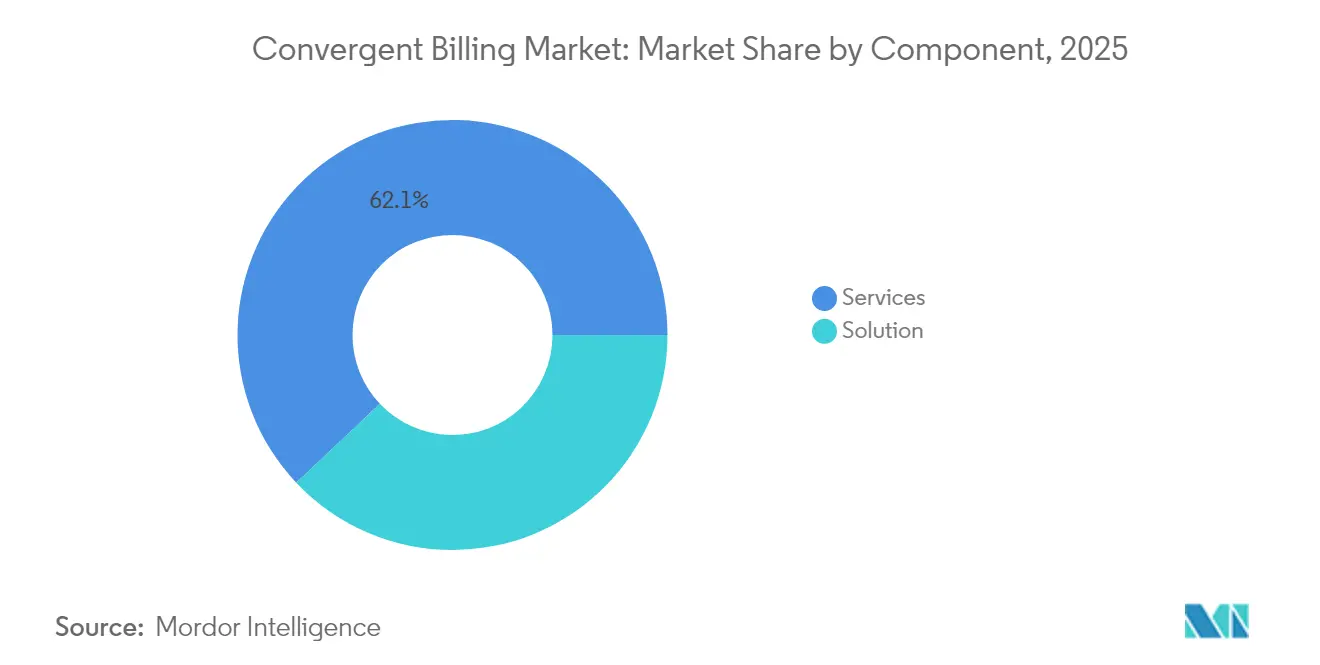
- By component, services captured 62.05% of the convergent billing market share in 2025, while services revenue is projected to expand at a 10.78% CAGR through 2031.
- By deployment model, the cloud segment accounted for 45.78% of the convergent billing market size in 2025, and it is forecast to record a 10.47% CAGR to 2031.
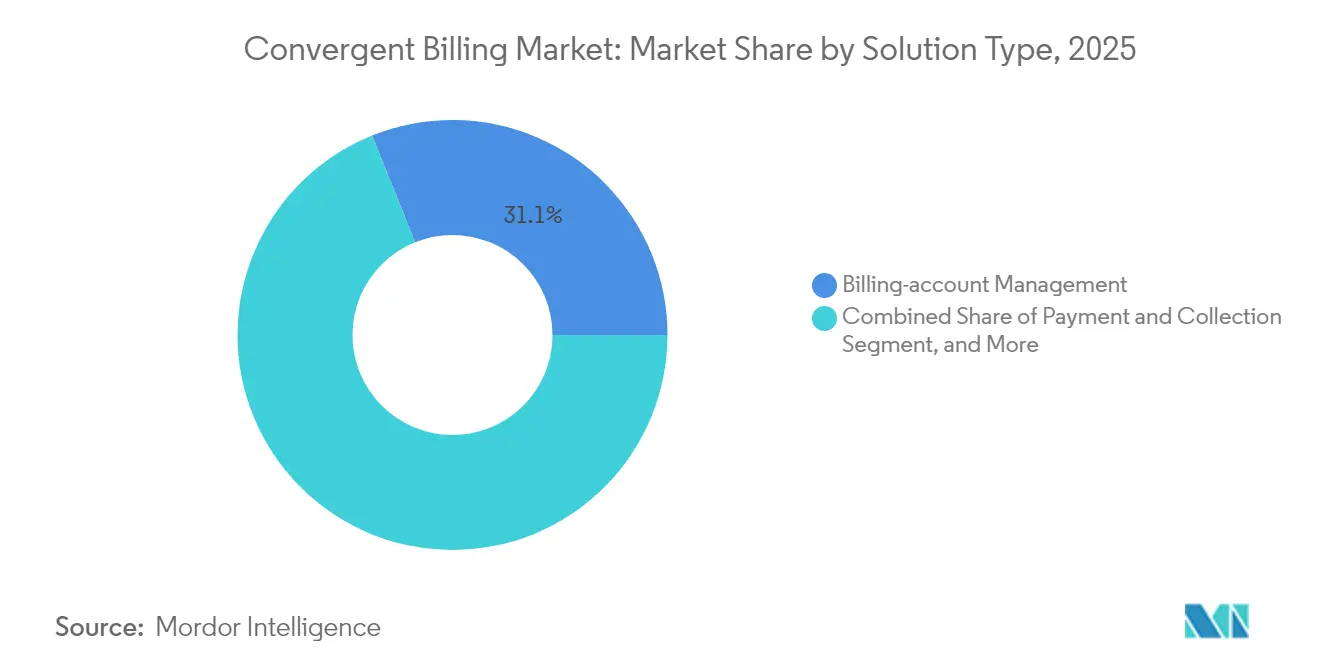
- By solution type, customer-relationship-management modules will post the fastest 9.86% CAGR even though billing-account-management retained the largest 31.10% share of the convergent billing market size in 2025.
- By operator type, fixed-line held 35.10% of the convergent billing market share in 2025, and mobile applications are projected to expand at a 10.23% CAGR through 2031.
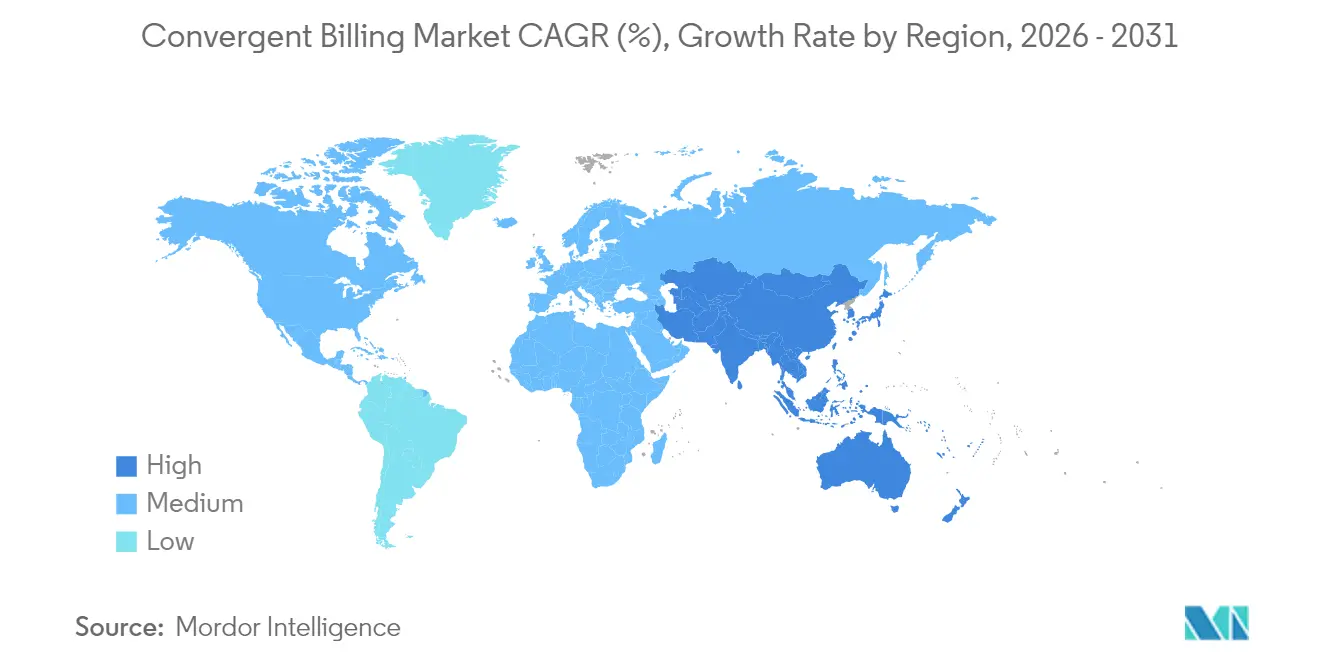
- By region, North America contributed 32.30% of the convergent billing market size in 2025, whereas Asia-Pacific is forecast to achieve a 10.19% CAGR to 2031.
Note: Market size and forecast figures in this report are generated using Mordor Intelligence’s proprietary estimation framework, updated with the latest available data and insights as of 2026.
Market Trends and Insights
Drivers Impact Analysis of Convergent Billing Market*
| Driver | (~) % Impact on CAGR Forecast | Geographic Relevance | Impact Timeline |
|---|---|---|---|
| Real-time 5G network-slicing monetization | +2.1% | Global, with early traction in South Korea, Japan, North America | Medium term (2-4 years) |
| Bundling of telco + OTT/IoT services | +1.8% | North America, Europe, Asia-Pacific urban clusters | Short term (≤ 2 years) |
| Cloud-native micro-services billing adoption | +1.6% | Global, led by Tier-1 operators in North America, Europe, Asia-Pacific | Long term (≥ 4 years) |
| AI-driven revenue-assurance and fraud analytics | +1.3% | Global, with higher ROI in prepaid-heavy MEA and South Asia | Medium term (2-4 years) |
| Rapid growth of prepaid digital wallets in MEA | +1.5% | Middle East and Africa, South Asia | Short term (≤ 2 years) |
| Emerging B2B private-network billing demand | +1.5% | North America, Europe, Japan, South Korea | Medium term (2-4 years) |
| Source: Mordor Intelligence | |||
Real-Time 5G Network-Slicing Monetization
Commercial slices remain scarce, fewer than 15% of CSPs had monetized slicing by mid-2024, but early projects prove that premium pricing is viable. TIM Brasil and Ericsson launched the first Brazilian standalone slice for agribusiness IoT, charging a 30% premium over standard mobile broadband.[2]Ericsson, “Ericsson Charging System Enables Real-Time Monetization of 5G Services,” ericsson.com ETSI’s OpenSlice APIs, ratified in 2024, shorten multi-vendor integration timelines to under six months. Legacy mediation systems that batch usage every 15 minutes leak revenue because slices scale dynamically, so CSPs are shifting to event-driven charging that triggers invoices within 200 milliseconds. Vodafone’s private-5G offer for factories blends connectivity, edge computing, and applications, demanding convergent billing that apportions costs across each layer.
Bundling of Telco, OTT, and IoT Services
Verizon’s myPlan allows subscribers to toggle Netflix, Max, and Disney+ on a monthly basis, forcing billing stacks to reconcile third-party entitlements in real-time. T-Mobile’s “Netflix On Us” promotion reduced churn by 18 percentage points among bundled lines. China Mobile managed 2.5 billion IoT connections in 2024, each generating micro-transactions that strain legacy billing engines. Ericsson’s IoT Accelerator aggregates device events into monthly invoices and cuts per-transaction costs by 60%. EU interoperability rules now compel operators to expose subscription APIs, slightly eroding margin control but widening addressable revenue for the convergent billing market.[3]European Commission, “EU Data Act Implementation 2024,” europa.eu
Cloud-Native Micro-Services Billing Adoption
Rakuten Mobile’s greenfield cloud stack delivered a 40% lower total cost of ownership and scaled to support 6 million subscribers by 2024, demonstrating that containerized components can effectively replace monolithic BSS. Vodafone moved its European billing to Oracle Cloud Infrastructure in 2024 to reduce peak infrastructure load by 35%. The TM Forum’s Open Digital Architecture standardizes more than 50 APIs, enabling CSPs to switch vendors without needing to rewrite interfaces. Yet Deutsche Telekom’s three-year migration reveals the resource drain: parallel runs added USD 131 million per year to operating expense. Engineers fluent in Kubernetes networking remain scarce, reinforcing demand for vendor-led managed services in the convergent billing market.
AI-Powered Revenue Assurance and Fraud Analytics
Neural Technologies’ AI engine recovered USD 47 million in annual leakage for a Middle Eastern Tier-1 operator by flagging unrated roaming events within five minutes. HCLTech embedded machine-learning models into a European CSP’s billing layer and detected abnormal IoT traffic 24 hours faster than legacy systems. Comviva’s fraud suite cut prepaid top-up fraud by 32% for a South Asian operator in six months. Real-time detection has become critical in prepaid-heavy regions, where 58% of connections in the Middle East and Africa remained prepaid as of 2024. The TM Forum’s Autonomous Networks project aims to achieve self-healing billing flows that automatically suspend suspicious SIMs, eliminating the need for human intervention and protecting revenue while enhancing platform stickiness.
Restraints Impact Analysis of Convergent Billing Market*
| Restraint | (~) % Impact on CAGR Forecast | Geographic Relevance | Impact Timeline |
|---|---|---|---|
| High legacy-system migration costs | -1.2% | Global, acute in Europe and North America with aging infrastructure | Long term (≥ 4 years) |
| Data-sovereignty and cross-border privacy rules | -0.9% | Europe (GDPR), China (data localization), Brazil (LGPD) | Medium term (2-4 years) |
| Shortage of OSS/BSS skilled talent | -0.8% | Global, most severe in Asia-Pacific and MEA | Medium term (2-4 years) |
| Vendor lock-in risk with cloud hyperscalers | -0.7% | Global, concentrated in North America and Europe | Long term (≥ 4 years) |
| Source: Mordor Intelligence | |||
High Legacy-System Migration Costs
Vodafone’s seven-year EUR 1 billion modernization covers 21 national markets and more than 200 applications, an outlay that smaller operators cannot match. Deutsche Telekom’s parallel run added USD 131 million per year until the final cutover, illustrating the double-spend that drags down the return on investment. BT Group has set aside GBP 500 million to decouple consumer billing from wholesale, a mandatory step under U.K. functional separation rules. The TM Forum found that 58% of CSPs underestimate the importance of data cleansing and spend up to 14 months reconciling duplicate customer records before migration. Many South American and African operators, therefore, extend the life of legacy stacks, even though patch-based maintenance grows technical debt and stifles innovation in the convergent billing market.
Data-Sovereignty and Cross-Border Privacy Rules
The EU Data Act, effective January 2024, requires in-state storage of telecom billing records unless explicit user consent is obtained, forcing operators such as Vodafone to run 18 discrete database instances across Europe and inflating hosting costs by up to 40%. China obliges international vendors to install domestic data centers, adding USD 50–80 million in capital expenditure per provider. Brazil’s LGPD fines reach 2% of revenue for non-compliant cross-border transfers; TIM Brasil relocated its workloads to a sovereign cloud partner in 2024. GSMA estimates that fragmented sovereignty regimes add USD 2–3 billion in annual compliance costs across the global telecom sector, burdening multi-regional players disproportionately.
*Our forecasts treat driver/restraint impacts as directional, not additive. The impact forecasts reflect baseline growth, mix effects, and variable interactions.
Convergent Billing Market Segment Analysis
By Component:
Services Surge as Migration Complexity DeepensServices represented 62.05% of the convergent billing market share in 2025, driven by integration, consulting, and managed operations that accompany multi-year platform upgrades. Vodafone’s seven-year, EUR 1 billion transformation employed more than 400 consultants and exemplifies why service revenue will climb at a 10.78% CAGR to 2031. Deutsche Telekom’s policy of running legacy and cloud stacks in parallel for 18 months added USD 131 million to service fees, reinforcing demand for external expertise.
Solution licenses stay dominant, but face pricing pressure as TM Forum standard APIs enable vendor mixing. Managed services are rising fastest among Tier-2 operators that lack in-house DevOps. Comarch’s 2024 fixed-fee contract in Central Europe converts capital expense into predictable operating expense. Amdocs bundled a USD 500 million managed-services layer into its 2024 AT&T renewal, locking in five more years of recurring revenue. Training services are an under-appreciated growth lever because 67% of CSPs need vendor-run upskilling to operate cloud-native billing. The convergent billing market, therefore, rewards vendors that pair software with long-term service engagement.



By Deployment Model:
Cloud Gains as CapEx Pressures MountCloud deployment held 45.78% of the convergent billing market size in 2025 and will outgrow on-premise at a 10.47% CAGR through 2031. Rakuten Mobile validated the economics by cutting the total cost of ownership by 40% relative to traditional BSS for 6 million subscribers. Oracle’s USD 100 million annual deal with Vodafone migrates European billing workloads to Oracle Cloud Infrastructure, retiring multiple data centers. Airtel adopted Ericsson Charging on Amazon Web Services to burst capacity during Diwali traffic peaks without permanent over-provisioning.
On-premise persists where localization or latency constraints apply. China Mobile maintains in-country installations for 2.5 billion IoT connections to satisfy national data rules. BT Group’s hybrid model keeps core billing on-site while analytics run in the cloud. Security worries curb public-cloud adoption in several MEA markets, 42% of operators surveyed by GSMA cite breach risk as a barrier. Yet, vendor-agnostic microservices reduce perceived lock-in by allowing CSPs to redeploy workloads across clouds, supporting the long-term ascendancy of cloud in the convergent billing market.
By Solution Type:
CRM Modules Accelerate as Churn Pressures IntensifyBilling-account-management held 31.10% of convergent billing market size in 2025, but CRM modules will grow fastest at a 9.86% CAGR through 2031. T-Mobile credits AI-driven CRM alerts with 2.1 million postpaid net adds in Q3 2024, as the system flags high-value subscribers at risk of churn. Comviva predicts churn 45 days in advance, improving retention by 18 percentage points in pilot deployments.
Automated invoice generation is modernizing with event-driven usage records. Ericsson’s Charging System issues invoices within 200 milliseconds, enabling on-demand pricing for 5G slices. Payment modules now integrate instant payment rails; Vodafone embedded Mastercard real-time transfers and reduced days-sales-outstanding by 12 days. Bill-cycle optimization and fraud detection combine AI and real-time metering to quickly recover lost revenue, solidifying vendor value within the convergent billing industry.
By Operator/Application:
Mobile Segment Leads Growth Despite Fixed DominanceFixed-line services still commanded 35.10% of convergent billing market share in 2025 because fiber and pay-TV bundle margins remain higher, but mobile billing will expand at a 10.23% CAGR to 2031. GSMA reported that 58% of connections in the Middle East and Africa were prepaid in 2024, so mobile operators are monetizing migrations to postpaid plans and digital wallets. Pyypl’s wallet enables users to convert prepaid airtime into merchant payments, integrating telecom usage with financial services within a single ledger.
Fixed operators face margin pressure from overbuilds and therefore bundle fiber, streaming, and hardware. AT&T’s fiber plus streaming bundle needs real-time reconciliation between telco and content catalogs. Sky Glass consolidates broadband, OTT subscriptions, and device financing into a single monthly bill, requiring convergent billing that accommodates mid-cycle changes. Regulatory mandates, such as the EU’s Digital Markets Act, require open APIs, which reduce lock-in while expanding ecosystem revenue for vendors that can orchestrate multiple content partners in the convergent billing market.
Geography Analysis
North America Convergent Billing Market
North America produced 32.30% of convergent billing market size in 2025. Verizon and T-Mobile continue bundling fiber, wireless, and premium video, pushing billing platforms toward sub-second entitlement reconciliation. AT&T signed a USD 500 million annual renewal with Amdocs to keep proven systems in place. CSG won USD 75 million from Dish Network to stand up postpaid 5G billing for more than 8 million lines. Rogers adopted Oracle Cloud to support Canada’s standalone 5G core. América Móvil started migrating Mexican billing to Ericsson Charging ahead of its 2026 completion target.
APAC Convergent Billing Market
Asia-Pacific will post a 10.19% CAGR through 2031, the fastest regional growth in the convergent billing market. Bharti Airtel’s Ericsson Charging rollout spans 18 circles and 350 million subscribers. Jio integrates commerce, music, and cinema under a single wallet, illustrating super-app billing complexity. China Mobile’s 2.5 billion IoT connections demand micro-transaction billing at petabyte scale. KDDI in Japan and SK Telecom in South Korea launched network-slicing tariffs that require policy-based real-time charging. Southeast Asian wallets grew 41% year over year, and telecom brands captured 72% of transaction volume, embedding billing deeper into daily life.
EMEA and South America Convergent Billing Market
Europe confronts cost inflation from data residency. Vodafone runs 18 distinct instances to comply with the Data Act. Orange partners with Oracle to consolidate billing across France, Spain, and Poland, but each country still needs its own database. BT Group decouples wholesale from consumer BSS under U.K. functional separation. Telecom Italia spends EUR 1,500 per consultant day to plug skills gaps, extending timelines. In the Middle East, e& earmarked USD 200 million for cloud-native BSS to power its fintech pivot. Africa’s USD 1.4 trillion mobile-money throughput makes unified wallets essential, and MTN plus Vodacom integrate airtime, data, and merchant payments under one bill. South America’s TIM Brasil monetizes 5G agribusiness slices at a 30% premium, underscoring revenue upside from real-time convergent billing.

Regulatory Landscape
Convergent billing deployments operate under a mix of consumer-billing transparency rules, accounting obligations for regulated operators, and technical charging standards that shape interoperability and auditability. In the EU, the Data Act became effective in January 2024 and affects how billing records and related usage data are stored and shared. BEREC also reinforced the direction toward consistent regulatory accounting application in its 2025 Regulatory Accounting in Practice report (also aligned with the EU Gigabit Recommendation (EU) 2024/539).
Separately, governments have moved toward stronger invoice clarity and tariff-comparison obligations. In July 2026, the Belgian Government approved draft changes requiring telecom providers to inform customers of the most advantageous tariffs and to include a QR code on invoices for price comparison. On the technical side, standards continue to anchor how convergent charging and billing systems are built and verified. 3GPP specifications such as TS 32.240 and TS 32.291 define the architecture for converged online and offline charging in 5G systems, including charging data generation and quota management, which supports real-time rating of 5G and IoT usage. ETSI TS 102 845 provides a standardized model for metering and billing checking processes, supporting charge-accuracy controls and dispute handling. ITU-T published Recommendation D.265 in April 2025 with guidelines on tariff regulation of data services and transparent pricing disclosures.
Value Chain Analysis
The convergent billing value chain spans requirement definition and solution design, core platform supply (rating and charging, product catalog, invoicing, payments, and revenue assurance), and integration into the operator or digital service provider stack (CRM, order management, mediation, ERP, and tax compliance engines). Delivery typically runs through systems integrators and vendor professional services for data cleansing, catalog rationalization, and migration, followed by managed operations for performance, updates, and compliance.
In this report's market context, services take a large share of spending, which aligns with how platform modernization and parallel runs increase reliance on integration and managed services. Downstream, distribution is increasingly cloud-led through public cloud marketplaces, vendor SaaS, and hybrid deployments shaped by data-sovereignty constraints. Ongoing operations depend on observability, security, and audit tooling that can handle sub-second charging and high event volumes, including 5G slices, OTT entitlements, and IoT micro-transactions. Bottlenecks cluster around quote-to-cash fragmentation, legacy mediation and billing batch cycles that create leakage, and multi-party settlement needs for bundles. Recent implementations show cross-stack coupling: in April 2024, Centric Infrastructure Group selected Aria Billing Cloud and integrated it with Salesforce Communications Cloud, and a March 2026 OneBill Software case study described modernizing quote-to-cash and automating convergent invoicing to reduce leakage for usage-based services.
Competitive Landscape
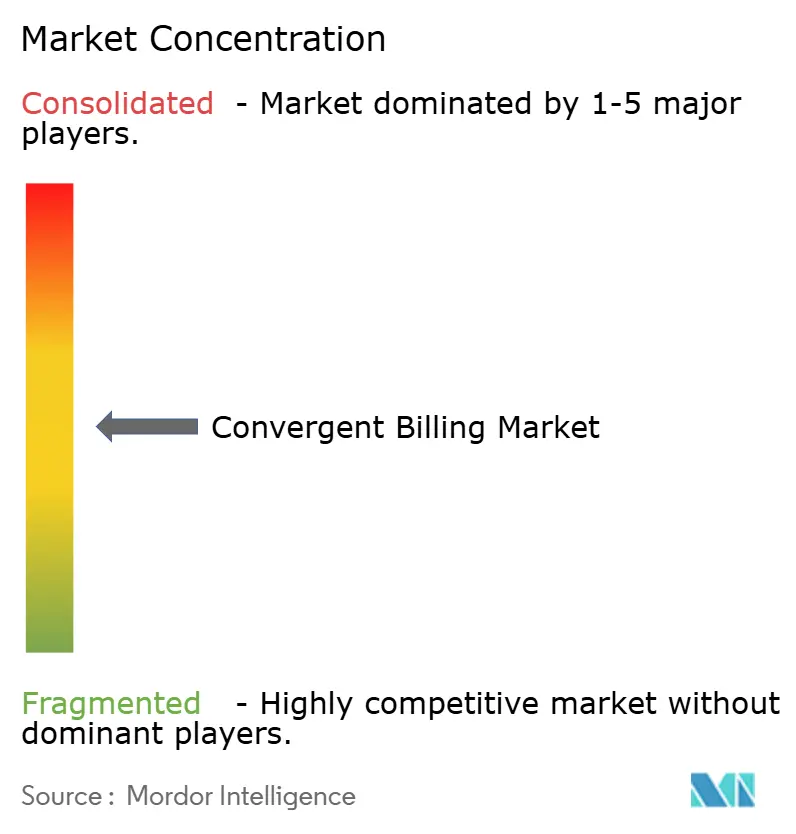
The convergent billing market is moderately concentrated. The five largest vendors, Amdocs, Oracle, Ericsson, Huawei, and CSG Systems, collectively captured roughly 58% of 2024 revenue. Amdocs deepened its AT&T foothold by absorbing USD 100 million-plus switching costs inside a fresh five-year commitment. Oracle bought a billing-analytics startup in 2024 to embed AI-driven revenue assurance, advancing vertical integration. Ericsson broadened its ecosystem by certifying 50 third-party applications on TM Forum Open APIs, positioning its Charging System as an orchestration hub. Huawei retains strength in China’s carrier base, while CSG expanded into U.S. satellite-mobile convergence via Dish Network.
Disruptors are taking greenfield share. Matrixx signed a Tier-1 North American cable operator by offering micro-services that bypass legacy code. Cerillion’s Kubernetes-native stack runs on any cloud or on-premise, appealing to operators wary of hyperscaler lock-in. BillingPlatform raised USD 90 million to expand a usage-based engine for IoT and private networks. Zuora and Chargebee specialize in OTT subscription management, providing telcos faster time-to-market for media bundles. Patent filings confirm industry focus on real-time policy control and machine-learning fraud; Nokia registered 12 billing-related patents, and Subex secured three for IoT anomaly detection in 2024.
Vendor strategy clusters around three vectors: embedding analytics engines to raise switching costs, localizing deployments to meet sovereignty rules, and orchestrating multi-partner ecosystems through open APIs. Skills shortages and data-privacy regulations remain defensive moats for incumbents, even as hyperscalers threaten traditional license streams.
Convergent Billing Industry Leaders
IBM Corporation
Amdocs, Inc.
Oracle Corporation
CSG Systems International, Inc.
Telefonaktiebolaget LM Ericsson
- *Disclaimer: Major Players sorted in no particular order
Convergent Billing Market Companies Covered in this Report
- Amdocs Ltd.
- International Business Machines Corporation
- Oracle Corporation
- Telefonaktiebolaget LM Ericsson
- CSG Systems International Inc.
- Huawei Technologies Co. Ltd.
- Comarch SA
- Tecnotree Oyj
- Netcracker Technology Corp.
- Nokia Corporation
- Optiva Inc.
- Cerillion plc
- Matrixx Software Inc.
- Subex Ltd.
- Mahindra Comviva Ltd.
- Sterlite Technologies Ltd.
- Zuora Inc.
- Aria Systems Inc.
- BillingPlatform LLC
- Chargebee Inc.
- CloudBilling BV

Market Opportunities and Future Outlook
Operator programs to replace legacy charging and billing stacks with cloud-native, real-time platforms create whitespace for vendors that can shorten migrations and reduce operating expense while working within data-residency constraints. KDDI selecting Oracle Cloud Scale Charging and Billing in February 2026 to replace legacy charging platforms and enable AI-ready service innovation is a concrete proof point, and Omantel starting a major BSS/OSS transformation with Cerillion Cloud in April 2026 to support quad-play services while addressing data sovereignty requirements is another.
These transformations expand demand for convergent billing that is modular (catalog, charging, invoicing, payments, and revenue assurance), supports partner settlements for OTT bundles, and operates through localized deployment models. A second opportunity cluster centers on automation within the billing lifecycle, particularly where real-time monetization and fraud control intersect with high transaction volumes. In March 2026, Amdocs unveiled CES26, an agent-driven BSS/OSS suite integrated with the Amdocs aOS cognitive core, pointing to investment in agentic workflows that reduce manual fallout handling across charging, billing, and customer care. In June 2026, Aria Systems and ServiceNow launched an agentic BSS solution that combines workflow automation and real-time billing, and Mavenir introduced infrastructure to meter and monetize AI token usage through existing BSS. Together, these launches reflect an addressable need for convergent billing platforms that can price new consumption units, such as AI usage, and automate revenue-assurance actions without increasing operational overhead.
Recent Industry Developments in Convergent Billing Market
- May 2026: Oracle was selected by Ishan Technologies for an end-to-end digital transformation that includes modernization of charging and billing. The deal reinforces the pull toward integrated charging, billing, and customer experience stacks delivered on cloud infrastructure, increasing competitive pressure on legacy on-premise monetization deployments.
- September 2025: CSG announced a contract extension with Charter Communications, continuing its role in revenue management and monetization through September 30, 2031. The multi-year renewal highlights the durability of large-scale convergent billing incumbency in cable and telecom and raises the bar for challengers that rely on greenfield-only displacement.
- August 2024: A1 Telekom Austria selected Amdocs to consolidate monetization engines into a fully convergent, cloud-based billing and charging platform. The program supports faster product bundling across fixed and mobile services and shows how Tier-1 groups use platform consolidation to reduce fragmentation across operating companies.


Convergent Billing Market Report Scope and Research Methodology
Market Definition and Coverage
For this study, the convergent billing market covers software and related services used by service providers to rate, charge, invoice, and collect payments across multiple services on one customer account, including prepaid and postpaid workflows.
Scope exclusions: We exclude general-purpose accounting and ERP billing that is not designed for multi-service, telecom-style rating and charging.
Segments Covered in This Report
- By Component
- Solution
- Services
- By Deployment Model
- Cloud
- On-premise
- By Solution Type
- Bill-cycle Optimisation
- Billing-account Management
- Automated Invoice and Bill Generation
- Payment and Collection
- Customer-relationship Management
- By Operator / Application
- Mobile
- Fixed
- Broadband
- TV / Streaming
- By Geography
- North America
- United States
- Canada
- Mexico
- South America
- Brazil
- Argentina
- Rest of South America
- Europe
- Germany
- United Kingdom
- France
- Italy
- Spain
- Rest of Europe
- Asia-Pacific
- China
- India
- Japan
- South Korea
- Rest of Asia-Pacific
- Middle East and Africa
- Middle East
- United Arab Emirates
- Saudi Arabia
- Rest of Middle East
- Africa
- South Africa
- Nigeria
- Rest of Africa
- Middle East
- North America
Data Sources, Market Sizing, and Validation
Desk Research
Desk work started with mapping how telecom operators and digital service providers report billing and BSS investments, then aligning those disclosures with what convergent billing platforms deliver across charging, invoicing, and collections. Public references were used for baseline indicators, including the ITU for telecom metrics, the OECD for digital and connectivity statistics, the World Bank for macro and ICT context, and regulator and spectrum authority publications that outline rollout timelines and can shift billing modernization budgets.
We also reviewed company annual reports, earnings transcripts, and investor presentations to track product mix changes, cloud migration pace, and services intensity. Reputable press and association websites were then used to confirm program activity in key regions. Where available, a paid subscription for company financials and a paid patent database were used to cross-check vendor exposure and product focus signals without treating them as direct market totals. The sources listed here are illustrative only, and many other public documents and datasets were referenced for data collection, validation, and clarification.
Primary Interviews and Surveys
Primary work focused on validating what is actually purchased and deployed, and how spend is split across licenses, subscriptions, implementation, and ongoing support. We spoke with billing and revenue assurance leaders at operators, system integrators, and software providers across APAC, EMEA, and the Americas to test assumptions around cloud adoption, replacement cycles, and deal structures, then adjust the model inputs accordingly. These conversations also helped reconcile gaps where public filings do not separate convergent billing from adjacent BSS modules.
Distribution of primary research fieldwork respondents
| Company type | Respondent position | Region |
|---|---|---|
| Top tier: 27% | CXOs: 14% | APAC: 45% |
| Mid tier: 53% | Functional/Unit leaders: 32% | EMEA: 35% |
| Smaller Players: 20% | Managers: 54% | Americas: 20% |
Market-Sizing & Forecasting
Sizing was built by first reconstructing the addressable spend pool using operator and service-provider billing modernization needs, then applying adoption and replacement timing to converge on annual revenue captured by convergent billing solutions and services. That top-down and bottom-up logic was supported through selective roll-ups, including aggregating a sample of supplier revenues where disclosures were usable, and using channel feedback on typical project values and subscription ranges to tune the totals.
A few inputs materially shaped the model, including mobile and fixed subscriber footprints, the pace of 4G to 5G monetization changes (especially real-time charging requirements), the cloud versus on-premise deployment mix, the share of bundled offerings (mobile plus broadband plus TV or streaming), and services intensity during migrations and integrations. Where vendor disclosures were not clean, gaps were handled by using observed deal structures from interviews and applying conservative allocation ratios, then stress-tested across regions.
Forecasts used scenario analysis anchored to expected network upgrades, cloud-native BSS transition rates, and operator capex and opex direction. Assumptions were reviewed against what practitioners expect to be deliverable in rollout calendars, and the final trajectory was adjusted only when multiple signals, such as operator program commentary and integration partner pipeline feedback, pointed in the same direction.
Data Validation & Update Cycle
Estimates were validated through triangulation across independent signals, including operator investment commentary, cloud migration timing, and the implied revenue intensity per active subscriber base. Outliers were flagged when growth rates, regional splits, or the solution to services mix moved beyond what interviews and public programs could support, and the model was revisited before sign-off.
We run multi-step internal reviews so assumptions, calculations, and unit logic are checked by another analyst, followed by a final consistency pass. The report is refreshed annually, and interim updates are triggered when major events occur, such as policy shifts, large operator transformation announcements, or sudden currency and inflation swings that can move deal values. Before delivery, we do a fresh update sweep so clients receive the most current view available.
Mordor Intelligence's Convergent Billing Market Size Versus Other Published Estimates
Published market sizes for convergent billing can vary widely because teams often draw the scope line differently between convergent billing, broader BSS suites, and revenue management services, and then apply different year labels and currency timing. Differences also show up when cloud subscriptions are annualized differently than perpetual licenses, or when implementation services are bundled in or treated as pass-through work.
By tracking deployment mix shifts and refreshing cross-checks on operator application coverage, Mordor Intelligence keeps the total tied to convergent billing functions that support multi-service rating, invoicing, and collections (mobile, fixed, broadband, and TV or streaming) rather than counting adjacent monetization tools that sit outside this market.
Benchmark comparison
| Source | Market Size | Gaps in Research Methodology |
|---|---|---|
| Mordor Intelligence | USD 20.98 B (2026) | |
| Trade Journal A | USD 7.88 B (2024) | Uses an earlier base year and a narrower spend lens that can omit large-scale implementation and migration services, and it may not fully account for multi-operator application coverage within one total. |
| Industry Report B | USD 22.41 B (2026) | Shows a higher 2026 value that is consistent with a wider scope where adjacent billing and digital commerce functions are sometimes counted together, and assumptions on subscription price progression can be applied more aggressively without the same level of deal-structure checks. |
The comparison indicates that the biggest drivers are scope boundaries, the year used for the headline number, and how subscription and services revenue are normalized into annual totals. When definitions are kept tight and inputs are tied back to operator use cases and deployment patterns, the resulting size is easier to trace, update, and reuse for planning.


Key Questions Answered in the Report
What is the current value of the convergent billing market?
The convergent billing market size stands at USD 20.98 billion in 2026 and is projected to reach USD 33.24 billion by 2031.
Which component segment is growing the fastest?
Services, including integration and managed operations, will grow at a 10.78% CAGR due to complex legacy migrations.
Why are telecom operators moving billing to the cloud?
Cloud deployment offers elastic scaling that matches demand spikes and eliminates data-center capital expense while supporting new 5G and IoT monetization models.
How will 5G network slicing influence convergent billing?
Slicing requires sub-second policy control and rating, so operators are adopting event-driven billing engines that can monetize differentiated quality-of-service tiers in real time.
Which region will experience the highest growth through 2031?
Asia-Pacific will achieve the fastest 10.19% CAGR as operators bundle telecom, fintech, and media inside super-app ecosystems requiring unified billing.
Page last updated on:


 Your data is secure and never sold or shared.


