
Communication, Navigation, And Surveillance (CNS) Systems Market Size and Share
Market Overview
| Study Period | 2019 - 2030 |
|---|---|
| Market Size (2025) | USD 23.67 Billion |
| Market Size (2030) | USD 33.61 Billion |
| Growth Rate (2025 - 2030) | 7.26 % |
| Fastest Growing Market | Asia Pacific |
| Largest Market | North America |
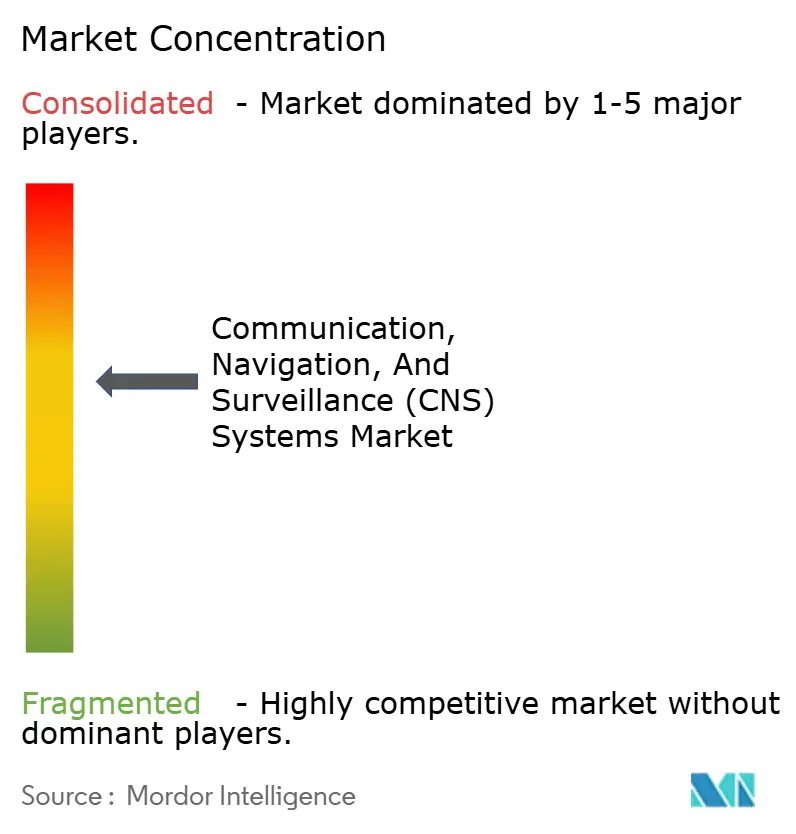
| Market Concentration | Medium |
Major Players *Disclaimer: Major Players sorted in no particular order Image © Mordor Intelligence. Reuse requires attribution under CC BY 4.0. | |

Communication, Navigation, And Surveillance (CNS) Systems Market Analysis by Mordor Intelligence
The communication, navigation, and surveillance (CNS) systems market size stands at USD 23.67 billion in 2025 and is projected to reach USD 33.61 billion by 2030, expanding at a 7.26% CAGR. Heightened demand for integrated digital avionics, performance-based navigation, and autonomous air traffic management is accelerating the transition from analog infrastructure. Airlines are fast-tracking avionics retrofits to comply with ADS-B and performance-based navigation. Air navigation service providers (ANSPs) channel multibillion-dollar budgets into multilateration, datalink, and surface-movement radar systems. Simultaneously, military programs pivot toward multi-domain operations that rely on resilient, spectrum-efficient CNS architectures. Strategic moves by incumbents like Thales and Collins Aerospace center on vertically integrated hardware-plus-software offerings, whereas disruptors like Aireon leverage satellite constellations to reshape surveillance coverage. Despite supply-chain fragility for RF components and spectrum-allocation hurdles, regulatory mandates and cybersecurity standards underpin healthy order pipelines.
Key Report Takeaways
- By system, communication systems held the largest 38.87% share of the CNS systems market in 2024, while surveillance and ATM systems are projected to deliver the fastest 9.10% CAGR through 2030.
- By platform, airborne systems led with 51.56% revenue share in 2024 and recorded the highest 8.24% CAGR forecast to 2030.
- By application, ATM accounted for 46.66% of 2024 spending, whereas military aviation shows the quickest 8.15% CAGR outlook toward 2030.
- By end user, civil authorities and ANSPs commanded a 63.45% share in 2024, yet military organizations are set to grow the fastest at an 8.25% CAGR over the same horizon.
- By geography, North America retained the 27.67% share in 2024, while Asia-Pacific is expected to expand at the highest 7.98% CAGR through 2030.
Note: Market size and forecast figures in this report are generated using Mordor Intelligence’s proprietary estimation framework, updated with the latest available data and insights as of January 2026.
Market Trends and Insights
Drivers Impact Analysis of Communication, Navigation, And Surveillance (CNS) Systems Market*
| Driver | (~) % Impact on CAGR Forecast | Geographic Relevance | Impact Timeline |
|---|---|---|---|
| Fleet modernization programs in commercial aviation | +1.3% | North America; Europe | Medium term (2-4 years) |
| Rising global air traffic volume and ATM investments | +1.6% | Asia-Pacific; Middle East | Long term (≥ 4 years) |
| Defense modernization and multi-domain integration imperatives | +1.1% | North America; Europe; Asia-Pacific | Long term (≥ 4 years) |
| Regulatory mandates for ADS-B and performance-based navigation | +1.5% | Global | Short term (≤ 2 years) |
| Adoption of multilateration and surface movement radar for enhanced situational awareness | +0.9% | Global hub airports | Medium term (2-4 years) |
| AI-enabled cognitive radio enhancing spectrum utilization | +0.6% | North America; Europe | Long term (≥ 4 years) |
| Source: Mordor Intelligence | |||
Fleet Modernization Programs Drive Avionics Transformation
Commercial carriers are retrofitting broad sections of their fleets to meet ADS-B Out, optimize fuel burn, and unlock new airspace routings. American Airlines completed upgrades across 300+ A320-family jets in 2024, integrating Pro Line Fusion avionics that support Required Navigation Performance approaches and cut fuel by 2-3% per flight.[1]American Airlines, “American Airlines Completes Major Avionics Upgrade Program,” aa.com Avianca committed USD 200 million through 2026 for Honeywell flight management systems covering 150+ aircraft, underscoring regional momentum in South America. Financiers are structuring lease-back models so smaller airlines can amortize USD 150,000–300,000 retrofit costs per aircraft without grounding capacity. Collectively, these initiatives reinforce the CNS systems market trajectory as airlines synchronize regulatory compliance with operational savings. As extended-range narrowbody jets enter service, standard line-replaceable units that blend VHF, SATCOM, and datalink radios further boost per-aircraft content for suppliers.
ATM Infrastructure Investments Accelerate Digital Transformation
ANSPs worldwide allocate more than USD 15 billion annually toward digital towers, multilateration arrays, and AI-enabled flow-management platforms. The FAA budgeted USD 3.2 billion to add 500+ ADS-B ground stations and deploy traffic-flow algorithms across the National Airspace System in 2024. EUROCONTROL coordinated 180+ SESAR projects the same year, trimming separation minima and enabling continuous-descent operations that lower fuel burn and CO2. Airport saturation across China and India intensifies the quest for performance-based navigation and surface-movement radar, further enlarging the CNS systems market. Converged satellite navigation, IP-based voice, and automated conflict-resolution platforms position ANSPs for future unmanned traffic flows and urban air mobility (UAM).
Defense Multi-Domain Integration Reshapes Military CNS Requirements
Armed forces pivot from stand-alone avionics toward software-defined radios (SDR) and encrypted datalinks that weave air, land, sea, space, and cyber assets. The US Air Force allocated USD 2.4 billion in 2024 for its Advanced Battle Management System to synchronize fighters, unmanned aircraft, and ground sensors via mesh networks. NATO’s Federated Mission Networking harmonizes communication protocols across allies, compelling iterative CNS upgrades that sustain real-time intelligence sharing.[2]NATO, “Federated Mission Networking,” nato.int Electronic warfare (EW) resilience, frequency agility, and artificial intelligence (AI)-driven spectrum allocation are rising evaluation criteria, creating premium demand niches within the CNS systems market.
Regulatory Mandates Accelerate Global ADS-B Implementation
ADS-B rules and performance-based navigation standards remove discretion from upgrade timelines. The European Union (EU) obligated aircraft above FL095 to broadcast ADS-B from January 2024, adding 15,000+ general aviation airframes to compliance rosters. India finished ADS-B deployment across 50+ airports that year, meeting its ambition to rank third worldwide in passenger traffic. Mandate cascades spur a persistent retrofit backlog while anchoring future CNS technology baselines across civil and military aviation. Consequently, the CNS systems market enjoys a predictable demand floor irrespective of macro-volatility.
Restraints Impact Analysis of Communication, Navigation, And Surveillance (CNS) Systems Market*
| Restraint | (~) % Impact on CAGR Forecast | Geographic Relevance | Impact Timeline |
|---|---|---|---|
| High capital and lifecycle costs of CNS infrastructure | -0.7% | Global; impacts smaller ANSPs and operators | Medium term (2-4 years) |
| Spectrum congestion and allocation bottlenecks | -0.6% | Dense airspace regions | Long term (≥ 4 years) |
| Cybersecurity vulnerabilities in aviation CNS networks | -0.4% | Critical infrastructure regions | Short term (≤ 2 years) |
| Supply chain fragility for specialized RF components | -0.4% | Global; affects system integrators | Medium term (2-4 years) |
| Source: Mordor Intelligence | |||
High Infrastructure Costs Constrain Smaller Market Participants
Multilateration systems demand USD 2–4 million per airport, with maintenance running 8–12% of capital outlays annually, straining the budgets of secondary hubs. Regional airlines weigh USD 150,000–300,000 avionics bills against residual aircraft values, often opting for phased upgrades that elongate compliance horizons. Financing innovations, such as subscription-based hardware-as-a-service, remain nascent because certification and liability frameworks evolve slowly. This cost burden reinforces a two-tier operating environment, even as the CNS systems market enlarges through flagship projects.
Spectrum Allocation Bottlenecks Threaten System Scalability
Congested VHF and L-band channels complicate frequency planning worldwide, heightening the risk of co-channel interference and degraded navigation accuracy. Notwithstanding the ITU’s allocation of fresh aeronautical spectrum in 2023, national licensing programs extend through 2027, prolonging uncertainty. Military operators face jamming and spoofing threats, prompting pricey dual-frequency GPS and directional antennas. Certification cycles for new waveforms can exceed three years, delaying commercialization even as the CNS systems market pursues cognitive-radio solutions.
*Our forecasts treat driver/restraint impacts as directional, not additive. The impact forecasts reflect baseline growth, mix effects, and variable interactions.
Communication, Navigation, And Surveillance (CNS) Systems Market Segment Analysis
By System:
Communication Platforms Lead Market TransformationCommunication systems captured 38.87% of 2024 revenue, driven by mandatory VHF replacements and growing datalink adoption for controller-pilot exchanges. Voice radios still account for most shipments; replacement cycles average 12–15 years, anchoring recurring demand. Navigation systems rank second by revenue, propelled by GNSS modernization and rising inertial-navigation retrofit orders for autonomy-ready aircraft. Surveillance and ATM platforms are the fastest-growing, expanding at a 9.10% CAGR as multilateration and surface-movement radar proliferate. Integrated SDRs that house VHF, UHF, and SATCOM within one unit now debut on new aircraft; Collins Aerospace’s CNS-3000 reduces part count and weight while streamlining certification.[3]Collins Aerospace, “CNS-3000 Integrated Communication System,” collinsaerospace.com Military buyers attach premiums to anti-jam, low-probability-of-intercept features, ensuring robust margins across the CNS systems market.
The value proposition tilts toward lifecycle software updates rather than hardware refreshes. Suppliers bundle firmware upgrades, cybersecurity patches, and cloud-based analytics as subscription add-ons. This pivot reconfigures revenue streams from episodic equipment sales into predictable recurring income, cementing stickier customer relationships and elevating switching costs. While incumbents bank on scale economies, startups exploit narrow gaps in datalink encryption and AI-enabled spectrum management to secure beachhead contracts.




By Platform:
Airborne Systems Dominate Through Retrofit DemandAirborne installations commanded 51.56% of 2024 revenue and will record an 8.24% CAGR through 2030, reflecting higher per-aircraft content and non-discretionary compliance timelines. A single narrowbody retrofit bundle can exceed USD 250,000, covering transponders, VHF radios, GNSS receivers, and inertial systems. Military platforms, notably the F-35, integrate high-value advanced datalinks such as MADL, elevating unit values beyond USD 500,000.[4] Lockheed Martin, “F-35 Lightning II Advanced Systems,” lockheedmartin.com Ground-based infrastructure grows slowly but remains indispensable; tower digitalization, surface-movement radar, and navigation-aid renewals feed steady replacement cycles.
Commercial operators increasingly dovetail cabin-connectivity upgrades with CNS retrofits, minimizing downtime. Line-fit options at the factory now embed multipurpose antennas that handle Satcom broadband, ACARS datalink, and classic voice channels, reducing aerodynamic drag. These dynamics bolster the CNS systems market size for airborne platforms, despite supply-chain jitters for RF chips.
By Application:
ATM Efficiency Drives Infrastructure InvestmentATM systems accounted for 46.66% of 2024 spending, underpinned by national modernization programs. The FAA’s Terminal Flight Data Manager ingests 50 million flight plans annually and relies on resilient, IP-based comms for predictive sequencing. General-aviation and airline operational systems form the second-largest bucket, while military aviation grows fastest at 8.15% CAGR as tactical datalinks and secure navigation pivot to multi-domain mission sets. AI-based conflict-resolution modules raise throughput on congested routes, demanding deterministic, low-latency networks.
Integration across surveillance, communication, and navigation cuts total lifecycle expenses by 15–20% for ANSPs, energizing procurements that pour additional volumes into the CNS systems market. Data-centric architectures also open ancillary revenue streams through analytics and performance dashboards that airlines can purchase as a service.

By End User:
Civil ANSPs Lead Infrastructure DeploymentCivil authorities and ANSPs represented 63.45% of 2024 demand, reflecting regulatory mandates and government funding. Procurement cycles span 5–7 years, favoring suppliers with strong service pedigrees and global support footprints. NAV CANADA’s remote-tower rollout exemplifies partnership models that distribute risk and share cost savings. Military agencies posted the highest growth at 8.25% CAGR, frequenting developmental contracts that bundle technology transfer clauses and local manufacturing, thus expanding the addressable CNS systems market.
Convergence in military and civil standards shortens development timelines: military users increasingly adopt commercial off-the-shelf GNSS receivers augmented with classified encryption modules, while civil operators demand mil-grade cybersecurity. This overlap accelerates volume production and compresses unit costs.
Geography Analysis
North America Communication, Navigation, and Surveillance (CNS) Systems Market
North America retained 27.67% of global revenue in 2024, powered by the US NextGen portfolio and a mature general-aviation base. Aireon’s space-based ADS-B extends surveillance over oceanic routes and Canada’s northern latitudes, proving the viability of satellite augmentation for sparse regions. OEMs leverage local manufacturing capacity and deep aftermarket networks, keeping lead times short despite global supply disruptions.
APAC Communication, Navigation, and Surveillance (CNS) Systems Market
Asia-Pacific led growth at 7.98% CAGR from 2025, fueled by China’s USD 2.8 billion annual CNS spend and India’s aggressive airport build-out. Regulatory harmonization through ICAO Regional Offices accelerates cross-border equipment certification, easing market entry for international vendors. Domestic champions in China and Japan increasingly license Western IP, intensifying price competition and enlarging total fleet penetration for integrated digital avionics within the CNS systems market.
Europe Communication, Navigation, and Surveillance (CNS) Systems Market
Europe remains a technologically advanced but replacement-driven arena. SESAR deployment orchestrates 180+ concurrent projects that enhance performance-based navigation and digital voice, aligning with the EU’s Green Deal aspirations to cut emissions. NATO interoperability targets spark military orders for secure radios and GNSS-denied navigation aids. Chronic spectrum congestion around major hubs compels early adoption of cognitive radio prototypes, providing a testbed for global rollouts.


Competitive Landscape
Market concentration is moderate. Thales Group, RTX Corporation, and L3Harris Technologies, Inc., anchor integrated portfolios covering radios, transponders, and automation software. Thales Group captured a USD 450 million Indian Air Force contract in September 2025, exhibiting breadth from navigation aids to surveillance radars. Collins debuted Pro Line Fusion+ with AI-driven flight management and hardened cybersecurity, targeting line-fit and retrofit markets. L3Harris’s USD 280 million acquisition of Cobham’s CNS division in July 2025 broadened its secure-comms catalog for defense customers.
Challengers deploy asset-light models. Aireon charges ANSPs subscription fees for satellite-sourced ADS-B rather than selling hardware, a blueprint now replicated by Skykraft micro-constellations. Frequentis teams with Microsoft Azure to offer cloud-native voice communications, courting smaller ANSPs hesitant to invest in on-premise switching nodes.
Incumbents answer with open-architecture roadmaps, emphasizing backward-compatible software upgrades that prolong equipment life and deter displacement. Suppliers collectively prioritize common-data-model initiatives to smooth multi-vendor integration, conscious that ANSPs increasingly demand plug-and-play procurement frameworks. Software-defined radios, cyber-certification, and AI-based spectrum management will be decisive battlegrounds as the CNS systems market evolves.
Communication, Navigation, And Surveillance (CNS) Systems Industry Leaders
Thales Group
RTX Corporation
L3Harris Technologies, Inc.
Honeywell International Inc.
Indra Sistemas, S.A.
- *Disclaimer: Major Players sorted in no particular order
Communication, Navigation, And Surveillance (CNS) Systems Market Companies Covered in this Report
- Thales Group
- RTX Corporation
- L3Harris Technologies, Inc.
- Honeywell International Inc.
- Indra Sistemas, S.A.
- Saab AB
- Viasat, Inc.
- Leonardo S.p.A.
- Northrop Grumman Corporation
- Lockheed Martin Corporation
- Frequentis AG
- Rohde & Schwarz GmbH & Co. KG
- ERA a.s.
- Garmin Ltd.
- Terma Group
- Japan Radio Co., Ltd.
- HENSOLDT AG

Recent Industry Developments in Communication, Navigation, And Surveillance (CNS) Systems Market
- September 2025: Thales and Stinville secured their first contract with CORPAC (Peruvian Corporation of Airports and Commercial Aviation) to implement TopSky - AMHS (Aeronautical Message Handling System) across 35 locations in Peru. This system enhances aeronautical message processing and communication between air traffic control centers, airports, and international ANSPs.
- June 2025: Thales secured a contract with Airbus Defence & Space to provide SATCOM safety systems for A400M military transport aircraft.
- April 2024: L3Harris Technologies, Inc. signed an agreement with Air India to supply SRVIVR25 Voice and Data Recorders for the airline's B737-8 fleet. The contract includes equipment installation for 100 aircraft, with a potential extension to cover 40 additional planes.


Global Communication, Navigation, And Surveillance (CNS) Systems Market Report Scope
| Communication Systems |
| Navigation Systems |
| Surveillance and Air Traffic Management (ATM) Systems |
| Airborne |
| Ground-based |
| Air Traffic Management (ATM) |
| Commercial and General Aviation |
| Military Aviation |
| Civil Authorities and Air Navigation Service Providers (ANSPs) |
| Military Organizations |
| North America | United States | |
| Canada | ||
| Mexico | ||
| Europe | United Kingdom | |
| France | ||
| Germany | ||
| Italy | ||
| Spain | ||
| Rest of Europe | ||
| Asia-Pacific | China | |
| India | ||
| Japan | ||
| South Korea | ||
| Australia | ||
| Rest of Asia-Pacific | ||
| South America | Brazil | |
| Rest of South America | ||
| Middle East and Africa | Middle East | United Arab Emirates |
| Saudi Arabia | ||
| Rest of Middle East | ||
| Africa | South Africa | |
| Rest of Africa | ||
| By System | Communication Systems | ||
| Navigation Systems | |||
| Surveillance and Air Traffic Management (ATM) Systems | |||
| By Platform | Airborne | ||
| Ground-based | |||
| By Application | Air Traffic Management (ATM) | ||
| Commercial and General Aviation | |||
| Military Aviation | |||
| By End User | Civil Authorities and Air Navigation Service Providers (ANSPs) | ||
| Military Organizations | |||
| By Geography | North America | United States | |
| Canada | |||
| Mexico | |||
| Europe | United Kingdom | ||
| France | |||
| Germany | |||
| Italy | |||
| Spain | |||
| Rest of Europe | |||
| Asia-Pacific | China | ||
| India | |||
| Japan | |||
| South Korea | |||
| Australia | |||
| Rest of Asia-Pacific | |||
| South America | Brazil | ||
| Rest of South America | |||
| Middle East and Africa | Middle East | United Arab Emirates | |
| Saudi Arabia | |||
| Rest of Middle East | |||
| Africa | South Africa | ||
| Rest of Africa | |||


Key Questions Answered in the Report
What is the projected value of the Communication, Navigation, and Surveillance (CNS) Systems market by 2030?
The CNS systems market stands at USD 23.67 billion in 2025 and is projected to reach USD 33.61 billion by 2030, expanding at a 7.26% CAGR.
Which platform contributes most to CNS revenue?
Airborne systems accounted for 51.56% of 2024 revenue, buoyed by mandated avionics retrofits.
Which region is expanding fastest in CNS adoption?
Asia-Pacific leads with a 7.98% CAGR thanks to airport expansion across China and India.
How are ANSPs addressing high CNS capital costs?
Many adopt remote-tower and subscription-based service models to spread expenditure over time.
What technology trend is reshaping military CNS requirements?
Multi-domain operations are driving demand for SDRs and encrypted mesh networks.
Page last updated on:


 Your data is secure and never sold or shared.


