
Cold Gas Spray Coating Market Size and Share
Market Overview
| Study Period | 2021 - 2031 |
|---|---|
| Market Size (2026) | USD 1.48 Billion |
| Market Size (2031) | USD 1.83 Billion |
| Growth Rate (2026 - 2031) | 4.34 % |
| Fastest Growing Market | Asia Pacific |
| Largest Market | North America |
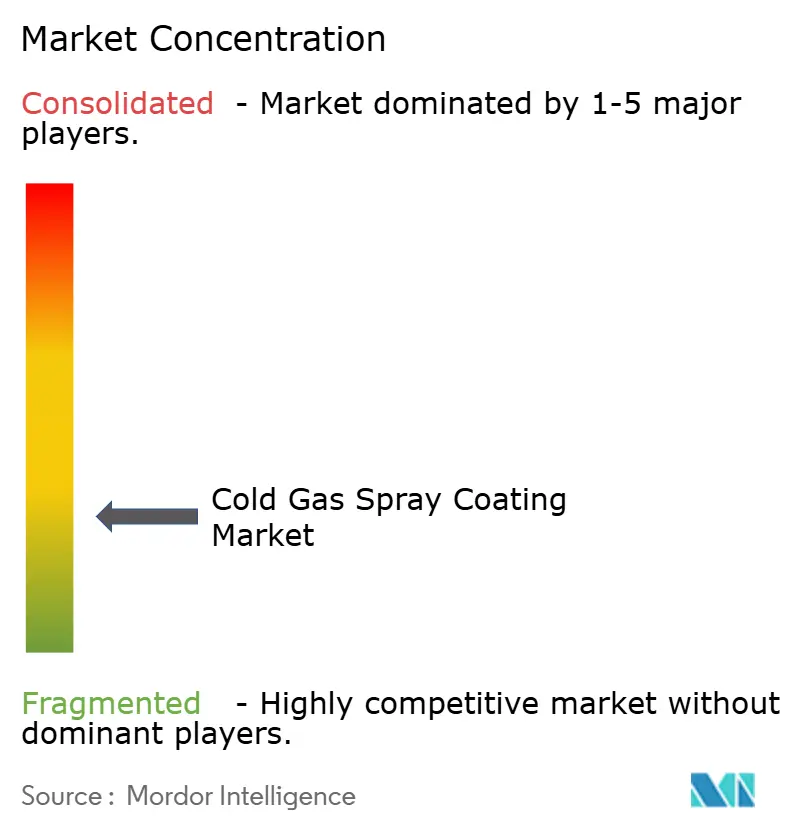
| Market Concentration | Low |
Major Players *Disclaimer: Major Players sorted in no particular order Image © Mordor Intelligence. Reuse requires attribution under CC BY 4.0. | |
Cold Gas Spray Coating Market Analysis by Mordor Intelligence
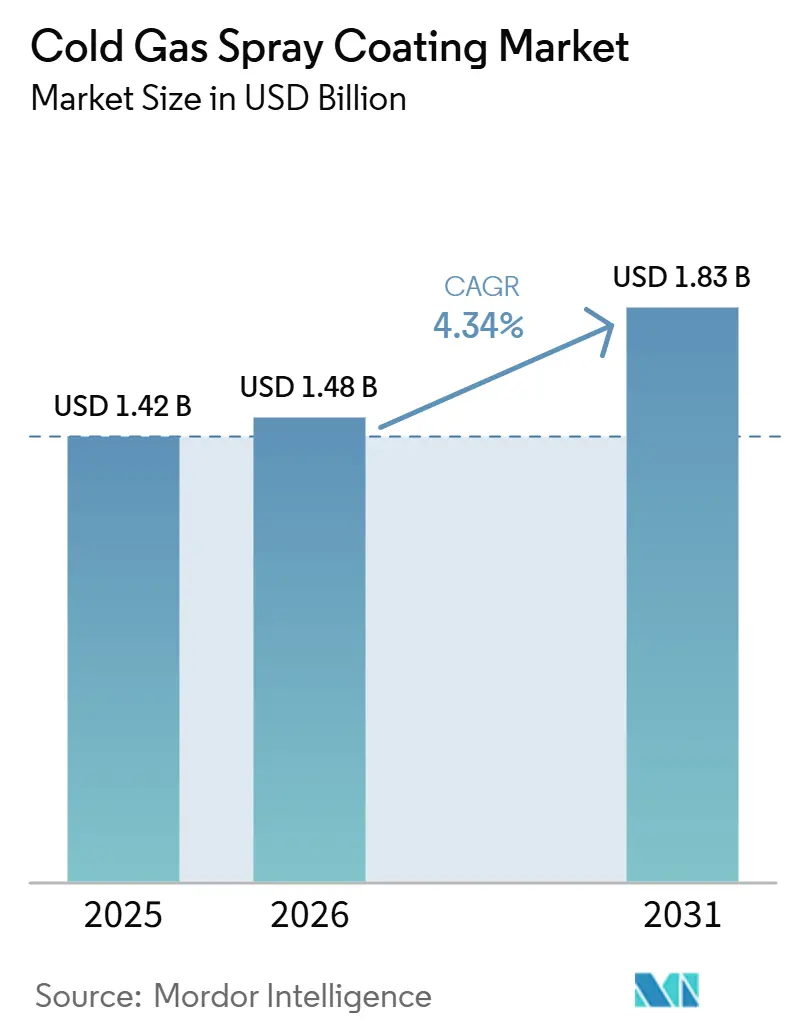
The Cold Gas Spray Coating Market size is expected to grow from USD 1.42 billion in 2025 to USD 1.48 billion in 2026 and is forecast to reach USD 1.83 billion by 2031 at 4.34% CAGR over 2026-2031. Aging military and industrial assets that cannot withstand thermal distortion, along with helium supply instability, are pushing operators toward solid-state deposition methods. In the United States, defense depots now deploy containerized systems to repair magnesium and aluminum structures without causing heat-affected zones. NASA’s 2026 Space Act Agreement with Titomic to validate in-orbit repairs marks a shift from ground-based refurbishment to orbital servicing. Portable, nitrogen-based equipment is closing the performance gap with high-pressure helium units, enabling applications in offshore energy and military field sites. Additionally, high-entropy alloy (HEA) and nanostructured powders maintain phase integrity during flight, providing wear and corrosion resistance beyond the capabilities of thermal spray methods.
Key Report Takeaways
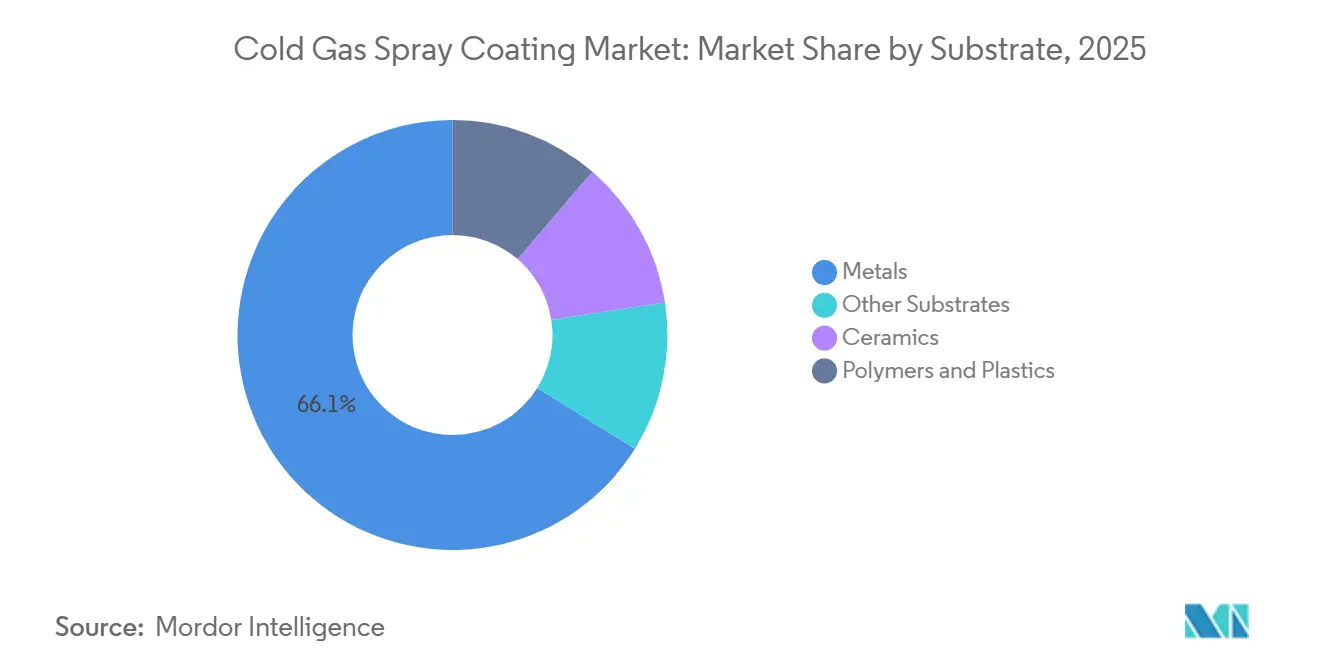
- By substrate, metals commanded 66.12% of the cold gas spray coating market share in 2025, while polymers and plastics are advancing at a 5.32% CAGR through 2031.
- By process, high-pressure cold spray (HPCS) retained 69.98% of the cold gas spray coating market share in 2025; low/medium-pressure cold spray (L/MPCS) is growing at a 4.96% CAGR through 2031.
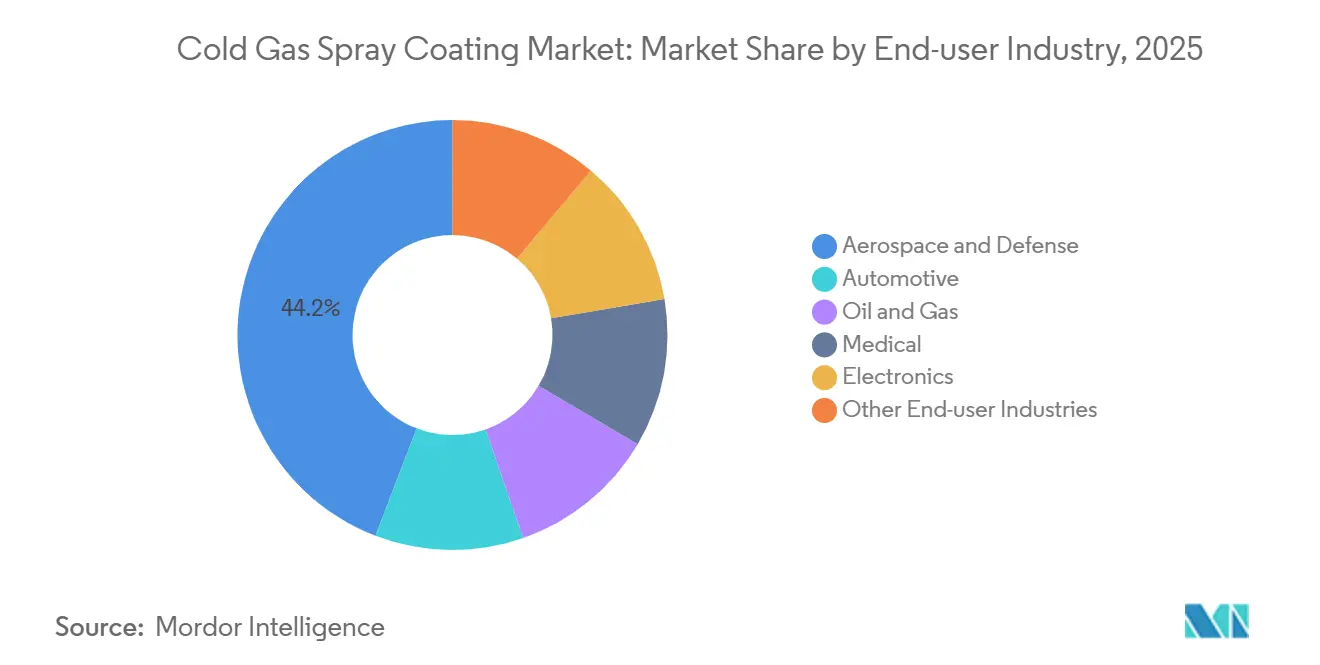
- By end-user industry, aerospace and defense led with 44.17% of the cold gas spray coating market share in 2025, whereas electronics is set to expand at a 4.78% CAGR through 2031.
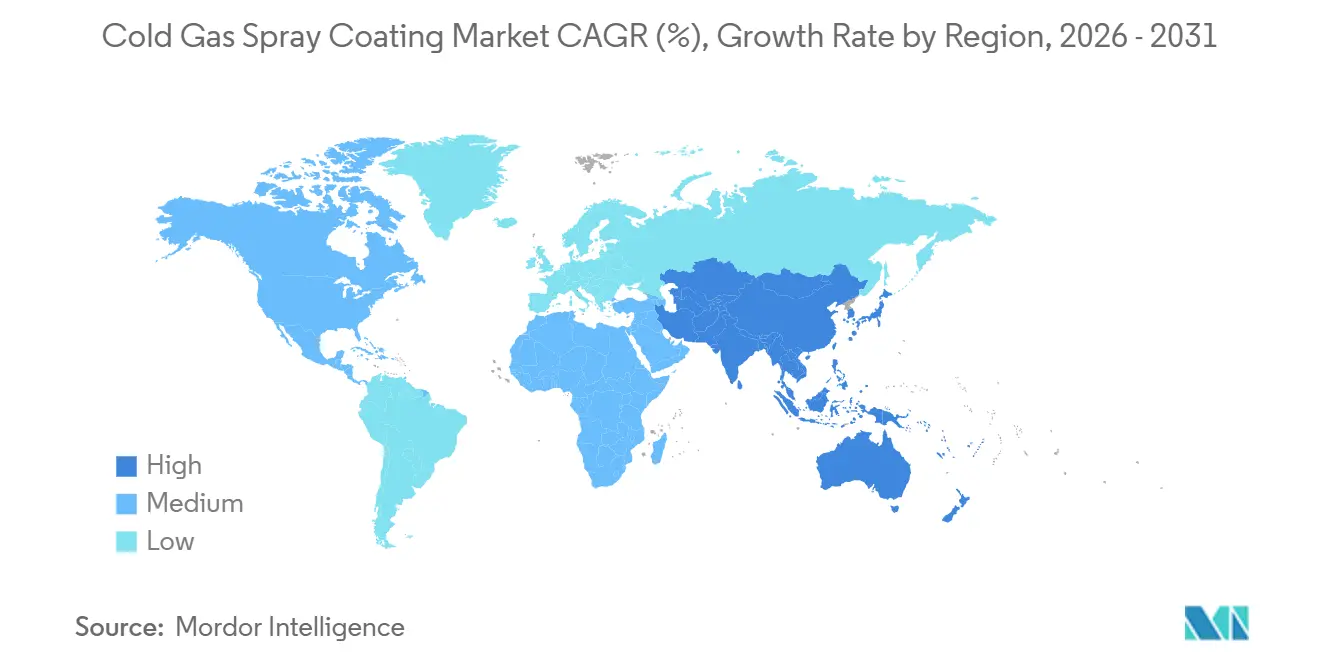
- By geography, North America accounted for 39.22% of the cold gas spray coating market share in 2025; Asia-Pacific is the fastest region at a 5.23% CAGR through 2031.
Note: Market size and forecast figures in this report are generated using Mordor Intelligence’s proprietary estimation framework, updated with the latest available data and insights as of January 2026.
Market Trends and Insights
Drivers Impact Analysis of Cold Gas Spray Coating Market*
| Driver | (~) % Impact on CAGR Forecast | Geographic Relevance | Impact Timeline |
|---|---|---|---|
| Adoption across aging military fleets | +1.2% | North America, Europe (NATO allies) | Medium term (2–4 years) |
| Qualification of CSAM for in-orbit satellite repair | +0.8% | Global, early adoption in North America | Long term (≥ 4 years) |
| Demand for high-performance low-heat coatings on EV power electronics | +0.9% | Asia-Pacific core, spill-over to North America and Europe | Short term (≤ 2 years) |
| HEA and nanostructured powders enabling next-gen functionality | +0.6% | Global, R&D concentrated in North America and Europe | Long term (≥ 4 years) |
| Helium-recovery and N₂-blend systems slashing operating cost | +0.7% | Global, highest uptake in Asia-Pacific and Middle-East | Medium term (2–4 years) |
| Source: Mordor Intelligence | |||
Adoption Across Aging Military Fleets
Cold spray technology is now used to repair aluminum and magnesium components such as gearboxes, wing skins, and hull panels, which previously required depot-level welding or replacement. The U.S. Navy applies this method to F/A-18 and MV-22 structures following MIL-STD-3021 certification for airworthiness, reducing turnaround times from months to weeks[1]. Containerized systems, developed by the University of Tennessee and the Army Research Laboratory, enable in-theater restoration, improving fleet readiness without the need for retrograde logistics. Equipment suppliers are increasingly bundling operator training with powder supply to accelerate field adoption.
Qualification of CSAM for In-Orbit Satellite Repair
Titomic and NASA are focusing on bus and antenna components affected by micrometeorite impacts, where molten repair methods are unsafe in microgravity. The ASTROBEAT experiment aboard the ISS demonstrated the viability of solid-state bonding, and DNV’s April 2026 qualification has provided underwriters with the confidence to finance robotic servicing campaigns. Successful deployment of this technology could extend satellite service life to 25 years, reducing the frequency of constellation replacements.
Demand for High-Performance Low-Heat Coatings on EV Power Electronics
Intel’s copper-diamond coatings achieve thermal conductivities exceeding 400 W/m·K while avoiding solder fatigue at junctions operating above 150 °C. Asian battery and inverter manufacturers are early adopters, utilizing turnkey systems that cold-spray copper onto silicon-carbide modules, reducing inverter cooling mass and increasing vehicle range. In December 2025, Titomic delivered TKF 623 production lines to an automotive OEM for volume manufacturing, demonstrating the crossover of cold spray technology from aerospace repair to high-volume industrial applications.
HEA and Nanostructured Powders Enabling Next-Gen Functionality
Cold-spraying CoCrFeNiMn deposits achieve hardness levels above 400 HV and reduce oxidation by 50% compared to HVOF equivalents after 1,000 hours at 800 °C. Cryomilled aluminum powders with grain sizes under 100 nm double yield strength in turbine shroud repairs. Impact Innovations’ 2026 Gun 6/11 AH EvoCSII, equipped with water-cooled injectors, supports these advanced powders without clogging, enabling commercial-scale applications.
Restraints Impact Analysis of Cold Gas Spray Coating Market*
| Restraint | (~) % Impact on CAGR Forecast | Geographic Relevance | Impact Timeline |
|---|---|---|---|
| Limited material compatibility vs. HVOF/plasma | -0.5% | Global | Medium term (2–4 years) |
| Global helium-supply volatility | -0.6% | Global, acute in Asia-Pacific and Middle-East | Short term (≤ 2 years) |
| Qualification lag for safety-critical parts | -0.4% | North America and Europe (aerospace/medical hubs) | Long term (≥ 4 years) |
| Source: Mordor Intelligence | |||
Limited Material Compatibility vs. HVOF/Plasma
Cold spray technology bonds ductile metals effectively but performs poorly with materials like WC-Co and alumina, where porosities exceed 15%, and bond strength falls below 30 MPa. SAE AMS7057 outlines these limitations, prompting users to adopt hybrid systems that combine HVOF torches with cold spray guns. However, the capital investment for such systems exceeds USD 1 million, limiting adoption to large service bureaus.
Global Helium-Supply Volatility
The 2024 LaBarge outage reduced U.S. helium output by 15 million cubic feet, doubling spot prices within six months[2]. High-pressure cold spray guns consume up to 30 cfm, with a single shift incurring gas costs of approximately USD 500. While closed-loop recovery systems reduce helium consumption to 5%, their cost, around USD 200,000, makes them viable only for multi-shift operations. Asia-Pacific importers face the highest freight premiums, further impacting adoption in the region.
*Our forecasts treat driver/restraint impacts as directional, not additive. The impact forecasts reflect baseline growth, mix effects, and variable interactions.
Cold Gas Spray Coating Market Segment Analysis
By Substrate:
Metals Dominate, Polymers and Plastics AccelerateMetals accounted for 66.12% of the 2025 cold gas spray coating market share, driven by aluminum grades 6061, 7075, and 2024 that bond effectively at nitrogen velocities. Copper coatings for data-center CPUs provide 400 W/m·K thermal paths without oxidation, enhancing the market's role in electronics thermal management. Titanium and nickel alloys contribute to high-margin propulsion and turbine applications; Northrop Grumman’s cold-sprayed thrust chamber passed hot-fire qualification without weld stress.
Polymers and plastics are growing at a 5.32% CAGR through 2031, with PEEK and carbon-fiber housings incorporating aluminum skins for EMI shielding. Water-cooled injectors and gas streams below 150 °C prevent substrate distortion, enabling lightweight enclosures to gain traction in the cold gas spray coating market. Ceramics and glass remain niche due to their brittleness, but are used in busbar and tooling repairs where moderate load adhesion is sufficient.

By Process:
High Pressure Leads, Portability Fuels L/MPCSHigh-pressure cold spray (HPCS) captured 69.98% of the 2025 cold gas spray coating market share, as 7.5 MPa chambers achieve bond strengths exceeding 300 MPa on nickel superalloys. Robotic HPCS cells at CenterLine combine precision with powder recycling, reducing rework and scrap.
Low/medium-pressure cold spray (L/MPCS) is projected to grow at a 4.96% CAGR through 2031, supported by nitrogen portability. Titomic’s D523 demonstrated its capability by restoring offshore manifolds without requiring shutdowns, validating containerized deployment, and expanding the market's reach. VRC’s upcoming hydrogen jets aim to match helium velocities, offering potential cost savings.
By End-user Industry:
Aerospace and Defense Anchors, Electronics SurgesAerospace and defense represented 44.17% of 2025 revenue, driven by U.S. Navy wing-skin and rotor-hub repairs that avoid USD 100,000 part replacements. AS9100 certification at Titomic’s Huntsville facility enables direct service to Boeing and Lockheed fleets, ensuring a secure supply of critical spares.
Electronics is the fastest-growing segment, with a projected 4.78% CAGR through 2031. Copper-diamond layers on silicon-carbide inverters reduce thermal resistance by 30%, allowing 800-V EV drivetrains to minimize cooling hardware and extend range, thereby expanding the cold gas spray coating industry base. Oil and gas, medical, and tooling applications are growing more gradually but are gaining traction as corrosion-resistant zinc-niobium and biocompatible titanium coatings clear regulatory barriers.
Geography Analysis
North America Cold Gas Spray Coating Market
North America held 39.22% of 2025 revenue, supported by Department of Defense budgets and NASA’s space-repair programs. The Dyess Air Force Base center has standardized B-1B repairs for global replication. Titomic’s AS9100-certified line in Alabama supplies Boeing and Northrop Grumman, while CenterLine and Triton collaborate on low-SWaP units for forward repair. Mexico’s EV supply chain is adopting polymer metallization, though on a smaller scale.
APAC Cold Gas Spray Coating Market
Asia-Pacific is expected to grow at a 5.23% CAGR through 2031. Japan’s Plasma Giken achieves 30 MPa bond targets for LNG pump maintenance. China is localizing turbine-blade renewals to reduce reliance on Western MROs. South Korea is integrating copper spraying into EV inverter production lines. India and ASEAN countries are showing initial demand in the automotive and power sectors, but require local helium alternatives for broader adoption.
EMEA and South America Cold Gas Spray Coating Market
Europe maintains a steady share, supported by aerospace and automotive clusters. The Royal Netherlands Aerospace Center purchased a USD 1.7 million Titomic cell in March 2026. Germany’s Fraunhofer is researching HEA powders for turbine shrouds, while RINA’s laboratory in Italy provides third-party validation, accelerating OEM processes. South America and the Middle-East and Africa are experiencing niche growth, driven by offshore oil opportunities in Brazil and corrosion-prone petrochemical assets in the Gulf.
Competitive Landscape
The market is low concentrated, with key players such as TITOMIC, Bodycote plc, OC Oerlikon Management AG, Impact Innovations, and Curtiss-Wright Corporation shaping the cold gas spray coating market. These companies integrate quality management, operator training, and proprietary powders to secure multi-year customer commitments. Nitrogen-based systems designed for field deployment target defense and offshore applications.
Triton and CenterLine introduced ruggedized units at the 2026 Military Additive Manufacturing Summit. Linde’s LOXPLATE closed-loop gas recovery system reduces consumable costs by 70%, making it an attractive option for multi-shift service bureaus. Emerging players are focusing on hybrid HVOF–cold spray robots and hydrogen jets to reduce helium dependency, broadening the industry’s options.
Cold Gas Spray Coating Industry Leaders
-
Curtiss-Wright Corporation
-
Impact Innovations GmbH
-
OC Oerlikon Management AG
-
Bodycote plc
-
TITOMIC
- *Disclaimer: Major Players sorted in no particular order
Cold Gas Spray Coating Market Companies Covered in this Report
- Bodycote plc
- CenterLine (Windsor) Limited
- CSAT
- Curtiss-Wright Corporation
- Dycomet Europe
- Flame Spray Technologies BV
- HAI Inc.
- Hannecard Roller Coatings, Inc
- Impact Innovations GmbH
- Linde PLC
- OC Oerlikon Management AG
- Plasma Giken Co., Ltd.
- TITOMIC
- Turbine Surface Technologies
- VRC Metal Systems
Recent Industry Developments in Cold Gas Spray Coating Market
- August 2025: Nissan introduced the world's first engine valve seats manufactured using cold spray technology in its 1.5-liter turbo e-POWER engine. This process sprayed copper-based alloy powder at supersonic speeds onto the aluminum cylinder head, forming a dense and durable coating without melting, which enhanced cooling performance through improved thermal conductivity.
- December 2024: TITOMIC partnered with SAE International to develop AMS 7057, a globally recognized Aerospace Material Specification for Cold Spray Additive Manufacturing (CSAM). This standard, based on TITOMIC’s Kinetic Fusion technology, was designed to facilitate the adoption of cold spray technology in aerospace and defense by ensuring stringent quality assurance and structural validation.
Global Cold Gas Spray Coating Market Report Scope
Cold Gas Spray (CGS) is a solid-state coating process that employs supersonic gas jets to accelerate metal powders to velocities ranging from 300 to over 1200 m/s. These powders bond to a substrate upon impact without undergoing melting. The process operates at low temperatures, preventing oxidation, thermal stress, and warping. This results in dense, high-adhesion coatings suitable for applications in aerospace, repair, and corrosion protection.
The Cold Gas Spray Coating Market is segmented into substrate, process, end-user industry, and geography. By substrate, the market is segmented into metals, ceramics, polymers and plastics, and other substrates. By process, the market is segmented into high-pressure cold spray (HPCS) and low/medium-pressure cold spray (L/MPCS). By end-user industry, the market is segmented into aerospace and defense, automotive, oil and gas, medical, electronics, and other end-user industries. The report also covers the market size and forecasts for cold gas spray coating in 15 countries across major regions. For each segment, the market sizing and forecasts have been done on the basis of value (USD).
Segmentation Overview
| Metals |
| Ceramics |
| Polymers and Plastics |
| Other Substrates |
| High-Pressure Cold Spray (HPCS) |
| Low/Medium-Pressure Cold Spray (L/MPCS) |
| Aerospace and Defense |
| Automotive |
| Oil and Gas |
| Medical |
| Electronics |
| Other End-user Industries |
| Asia-Pacific | China |
| India | |
| Japan | |
| South Korea | |
| Rest of Asia-Pacific | |
| North America | United States |
| Canada | |
| Mexico | |
| Europe | Germany |
| United Kingdom | |
| France | |
| Italy | |
| Rest of Europe | |
| South America | Brazil |
| Argentina | |
| Rest of South America | |
| Middle-East and Africa | Saudi Arabia |
| South Africa | |
| Rest of Middle-East and Africa |
| By Substrate | Metals | |
| Ceramics | ||
| Polymers and Plastics | ||
| Other Substrates | ||
| By Process | High-Pressure Cold Spray (HPCS) | |
| Low/Medium-Pressure Cold Spray (L/MPCS) | ||
| By End-user Industry | Aerospace and Defense | |
| Automotive | ||
| Oil and Gas | ||
| Medical | ||
| Electronics | ||
| Other End-user Industries | ||
| By Geography | Asia-Pacific | China |
| India | ||
| Japan | ||
| South Korea | ||
| Rest of Asia-Pacific | ||
| North America | United States | |
| Canada | ||
| Mexico | ||
| Europe | Germany | |
| United Kingdom | ||
| France | ||
| Italy | ||
| Rest of Europe | ||
| South America | Brazil | |
| Argentina | ||
| Rest of South America | ||
| Middle-East and Africa | Saudi Arabia | |
| South Africa | ||
| Rest of Middle-East and Africa | ||
Key Questions Answered in the Report
What is the size of the cold gas spray coating market?
The cold gas spray coating market size stands at USD 1.48 billion in 2026 and is on track to reach USD 1.83 billion by 2031.
How fast is demand growing in Asia-Pacific?
Asia-Pacific revenue is advancing at a 5.23% CAGR through 2031, the quickest rate among all regions.
Which end-user industry leads adoption in 2025?
Aerospace and defense accounted for 44.17% of 2025 revenue as military fleets rely on cold spray to avoid heat-affected repairs.
Why are portable low-pressure systems gaining traction?
Nitrogen-driven, containerized units eliminate helium logistics and enable on-site restoration for offshore energy and field military assets.