
Cloud TV Market Size and Share
Market Overview
| Study Period | 2020 - 2031 |
|---|---|
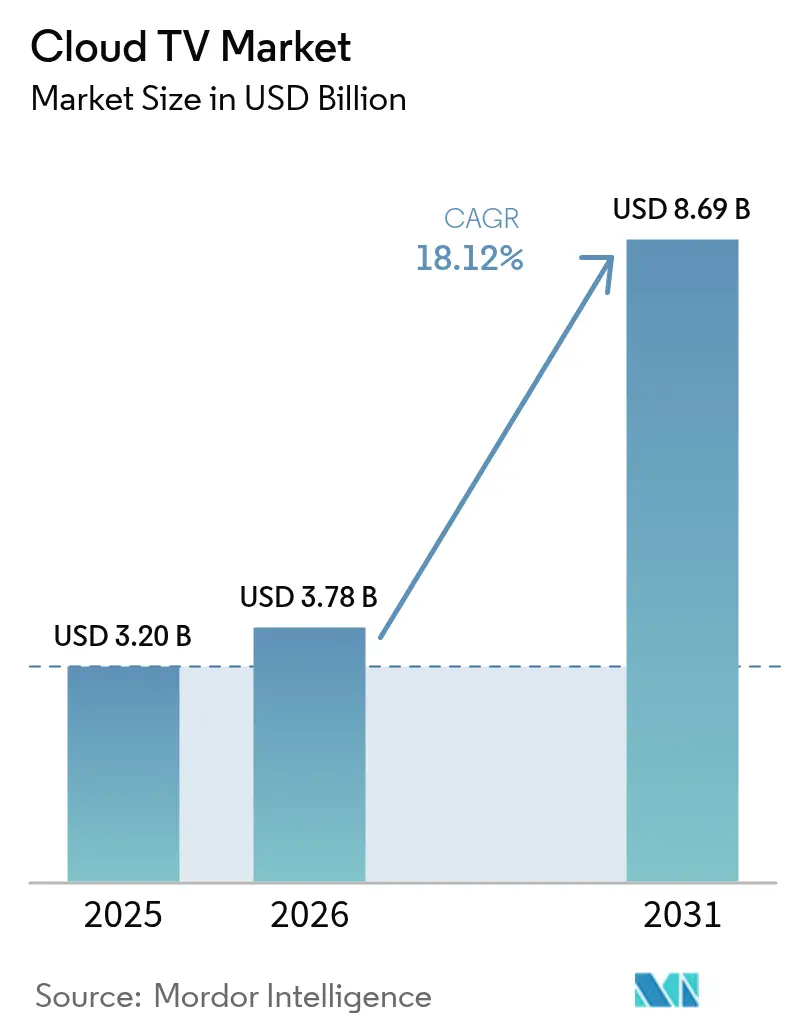
| Market Size (2026) | USD 3.78 Billion |
| Market Size (2031) | USD 8.69 Billion |
| Growth Rate (2026 - 2031) | 18.12 % |
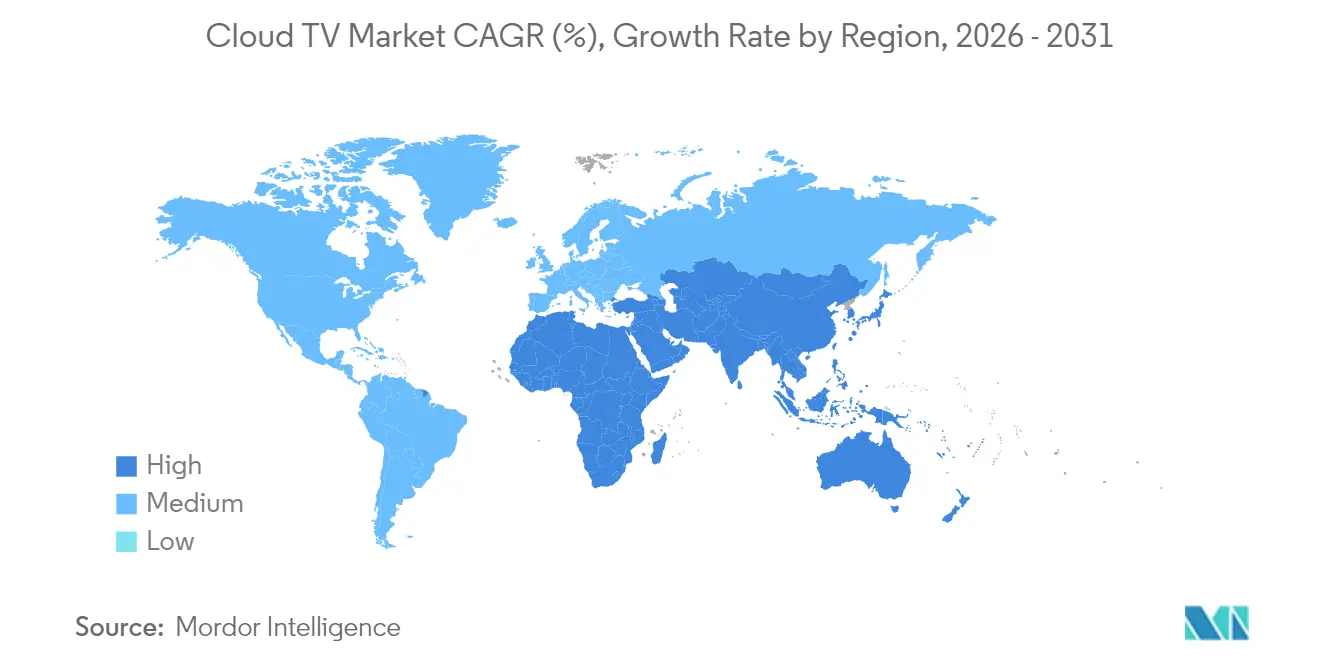
| Fastest Growing Market | Asia Pacific |
| Largest Market | North America |
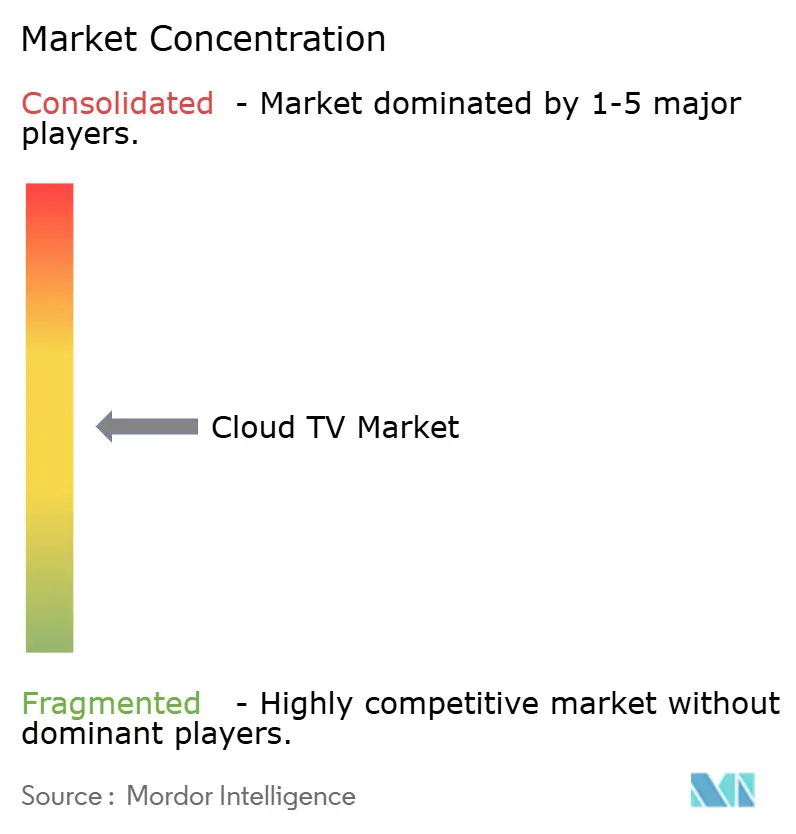
| Market Concentration | Medium |
Major Players *Disclaimer: Major Players sorted in no particular order Image © Mordor Intelligence. Reuse requires attribution under CC BY 4.0. | |
Cloud TV Market Analysis by Mordor Intelligence
Cloud TV market size in 2026 is estimated at USD 3.78 billion, growing from 2025 value of USD 3.20 billion with 2031 projections showing USD 8.69 billion, growing at 18.12% CAGR over 2026-2031. Surging demand for scalable video workflows, rapid 5G deployment, and telco convergence strategies are propelling adoption. Public cloud deployments still dominate, but hybrid architectures are gaining favour as media companies balance elasticity with broadcast-grade performance. Regulatory fragmentation, semiconductor supply constraints, and rising iOS acquisition costs remain growth headwinds. Intensifying competition between platform operators, device OEMs, and telcos is pushing vendors to differentiate through AI-driven discovery, contextual advertising, and integrated cloud gaming services. Early movers in Asia-Pacific are capturing asymmetric advantages thanks to faster network roll-outs and mass smartphone uptake.
Key Report Takeaways
- By deployment, the Public Cloud segment led with 51.20% Cloud TV market share in 2025, while Hybrid Cloud is projected to grow at a 20.7% CAGR to 2031.
- By device type, Connected TVs captured 39.30% of the Cloud TV market size in 2025; Mobile Phones are expected to record the fastest CAGR at 22.9% through 2031.
- By application, Entertainment Media commanded 37.60% of the Cloud TV market size in 2025, whereas Telecom applications are advancing at a 19.4% CAGR to 2031.
- By organisation size, Large Enterprises accounted for 59.10% of 2025 revenue, but SMEs are the fastest-growing cohort at a 21.4% CAGR to 2031.
- By Geographically, North America held 42.50% of 2025 revenue, while Asia-Pacific is the fastest-growing region with a 20.6% CAGR forecast for 2026-2031.
Note: Market size and forecast figures in this report are generated using Mordor Intelligence’s proprietary estimation framework, updated with the latest available data and insights as of 2026.
Global Cloud TV Market Trends and Insights
Drivers Impact Analysis*
| Driver | (~) % Impact on CAGR Forecast | Geographic Relevance | Impact Timeline |
|---|---|---|---|
| Continued fiber-to-home roll-outs enabling stable OTT delivery | +3.20% | Global, concentrated in North America and Europe | Medium term (2-4 years) |
| Rapid expansion of 5G fixed wireless access in rural North America and Europe | +2.80% | North America and Europe rural markets | Short term (≤ 2 years) |
| Tier-1 pay-TV operators’ shift to cloud-first STB replacement | +4.10% | Global, led by North America and Europe | Medium term (2-4 years) |
| OEM bundling of cloud-TV solutions with connected-TV chipsets in Asia | +3.50% | APAC core, spill-over to emerging markets | Long term (≥ 4 years) |
| FAST channel monetization models accelerating publisher adoption in Europe | +2.70% | Europe, expanding to North America | Short term (≤ 2 years) |
| Multi-tenant SaaS platforms reducing TCO for mid-tier operators | +2.50% | Global, strongest in emerging markets | Medium term (2-4 years) |
| Source: Mordor Intelligence | |||
Continued Fiber-to-Home Roll-outs Enabling Stable OTT Delivery
FTTH penetration has surpassed 50% in most developed markets, creating the bandwidth reliability the Cloud TV market needs for unbuffered 4K and 8K streams. Carriers such as AT&T are allocating USD 15 billion through 2025 to extend fiber to 30 million premises, which lowers reliance on costly edge caches and fosters premium live sports streaming. Operators further monetize fiber by bundling unlimited data tiers that remove bitrate ceilings and by leveraging deterministic QoS to support interactive features.
Rapid Expansion of 5G Fixed Wireless Access in Rural North America and Europe
5G FWA provides 100–200 Mbps downlinks at sub-10 millisecond latencies, turning previously underserved rural zones into viable Cloud TV market addresses. Operators, including T-Mobile and Verizon, aim to sign 4–5 million FWA subscribers by 2025, accelerating service reach without multi-year trenching costs. Bundled broadband-plus-TV plans and portable cloud-TV use cases for RV owners further inflate rural demand.
Tier-1 Pay-TV Operators’ Shift to Cloud-First STB Replacement
Deutsche Telekom’s MagentaTV moved 4.6 million subscribers onto a Broadpeak cloud DVR, cutting per-subscriber hardware from USD 150 to below USD 50 and enabling weekly feature roll-outs over the air. Similar migrations across Vodafone, Comcast, and Charter mitigate the PowerKEY conditional-access sunset affecting 20 million legacy boxes. Cloud-first frameworks also support unified back ends for multi-country footprints.
OEM Bundling of Cloud-TV Solutions with Connected-TV Chipsets in Asia
Smart-TV brands such as Sony, Xiaomi, and OnePlus are embedding MediaTek Pentonic silicon with integrated cloud TV OS capabilities. Whale TV’s partnership with TPV brings pre-installed cloud-TV functions to new screens, letting buyers sidestep add-on dongles. In India, Cloud TV 3.0 now serves more than 6 million active users via this embedded route, validating a hardware-software flywheel that shifts lifetime value from one-off device sales to recurring ad revenue.
Restraints Impact Analysis*
| Restraint | (~) % Impact on CAGR Forecast | Geographic Relevance | Impact Timeline |
|---|---|---|---|
| Fragmented CDN footprint in emerging Africa and Caribbean islands | -2.1% | Africa and Caribbean, extending to rural LATAM | Long term (≥ 4 years) |
| Persistent piracy and credential-sharing impacting revenue assurance | -3.4% | Global, most severe in APAC and emerging markets | Medium term (2-4 years) |
| High initial encoding/transcoding costs for UHD/HDR content | -1.8% | Global, constraining premium tier adoption | Short term (≤ 2 years) |
| Legacy CAS/DRM interoperability gaps slowing migration for small MSOs | -1.5% | North America and Europe legacy markets | Medium term (2-4 years) |
| Source: Mordor Intelligence | |||
Fragmented CDN Footprint in Emerging Africa and Caribbean Islands
Average in-country latency hits 78 milliseconds across much of Africa versus sub-45 milliseconds in North America, limiting consistent 1080p streaming. Roughly 50% of the region’s internet traffic transits foreign upstream providers; outages on West African submarine cables in 2024 crippled 13 nations, highlighting fragility. Without local PoPs, Cloud TV service providers must downshift bitrates, impairing the quality of experience and ad yields.
Persistent Piracy and Credential-Sharing Impacting Revenue Assurance
Global video piracy drained USD 67 billion in 2023, while password sharing undercuts 20% of U.S. S-VOD subscriptions. Netflix’s 2024 crackdown recaptured 13.1 million accounts, yet smaller Cloud TV platforms lack the leverage to impose similar policies. Emerging threats, including CDN leeching and illicit IPTV services, erode content-licensing valuations and dampen advertiser spending confidence.
*Our forecasts treat driver/restraint impacts as directional, not additive. The impact forecasts reflect baseline growth, mix effects, and variable interactions.
Segment Analysis
By Deployment: Hybrid Models Gaining Momentum
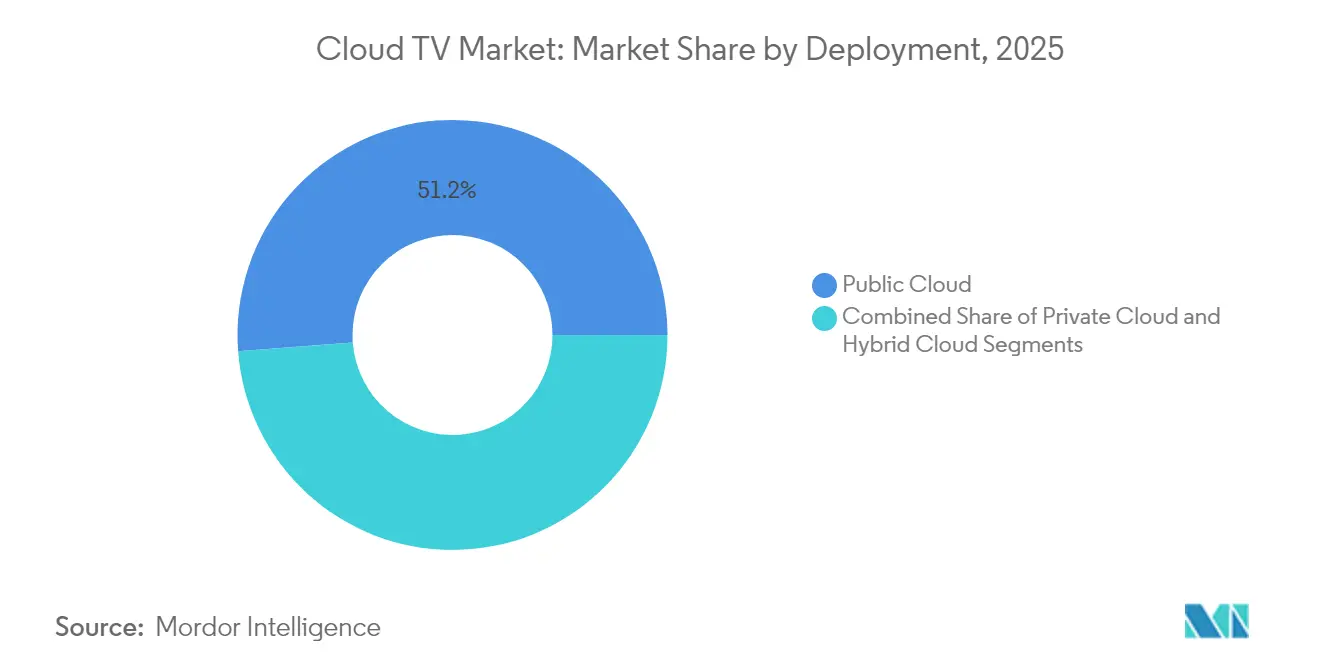
Public cloud held 51.20% of revenue in 2025, yet hybrid configurations are set to grow at a 20.7% CAGR to 2031 as broadcasters pursue flexible burst capacity alongside predictable QoS. This mix lets rights-holders keep premium sports archives in private clusters while relying on hyperscalers for live-event traffic. The Cloud TV market size for hybrid deployments is projected to accelerate as content owners map workloads to cost curves and exit ageing on-prem encoders. Regulatory-sensitive verticals such as public-sector media have already moved 45% of workflows to hybrid nodes to localise user data. Across use-cases, phased migrations de-risk legacy decommissioning, supporting uninterrupted audience reach during peak seasons.
Hybrid adoption also solves cross-border rights management: operators deploy origin caches in public regions close to diaspora populations while watermarking and DRM logic run in private domains. Vendors have responded with Kubernetes-based transcoders that elastically scale across both footprints. As a result, billing shifts from capex to granular usage, letting mid-tier networks test 4K distribution without buying new ASICs. By 2030, decision frameworks for cloud TV investment will weigh energy efficiency, carbon disclosure, and sovereign-cloud mandates as heavily as bitrate economics.

By Device Type: Mobile-First Strategies Reshape Viewing
Connected TVs (CTV) delivered 39.30% of 2025 revenue, yet smartphones are the fastest-growing end-point with a 22.9% CAGR forecast. Open-RAN 5G plus cheaper OLED panels have blurred the experiential gap so that 4K HDR on a 6.7-inch screen rivals lounge-room sets. Short-form series cut for vertical orientation dominate Gen-Z watchlists, forcing publishers to storyboard concurrently for tall and wide frames. The Cloud TV market share of mobile usage is expected to overtake CTVs in several Southeast Asian countries by 2027, powered by lower data tariffs and instalment-plan handset upgrades.
Multi-device sync is now table-stakes: advertisers use household graph technology to sequence a 15-second teaser on mobile, a 30-second deep-dive on CTV, and a shoppable overlay on tablet within the same evening. Cloud encoder vendors embed SSAI markers that cue dynamic QR codes aligned with active screen size. Such convergence recasts the notion of a primary screen; the winning proposition will offer frictionless hand-off rather than device-specific UX.
By Application: Entertainment Dominates, Telecom Accelerates
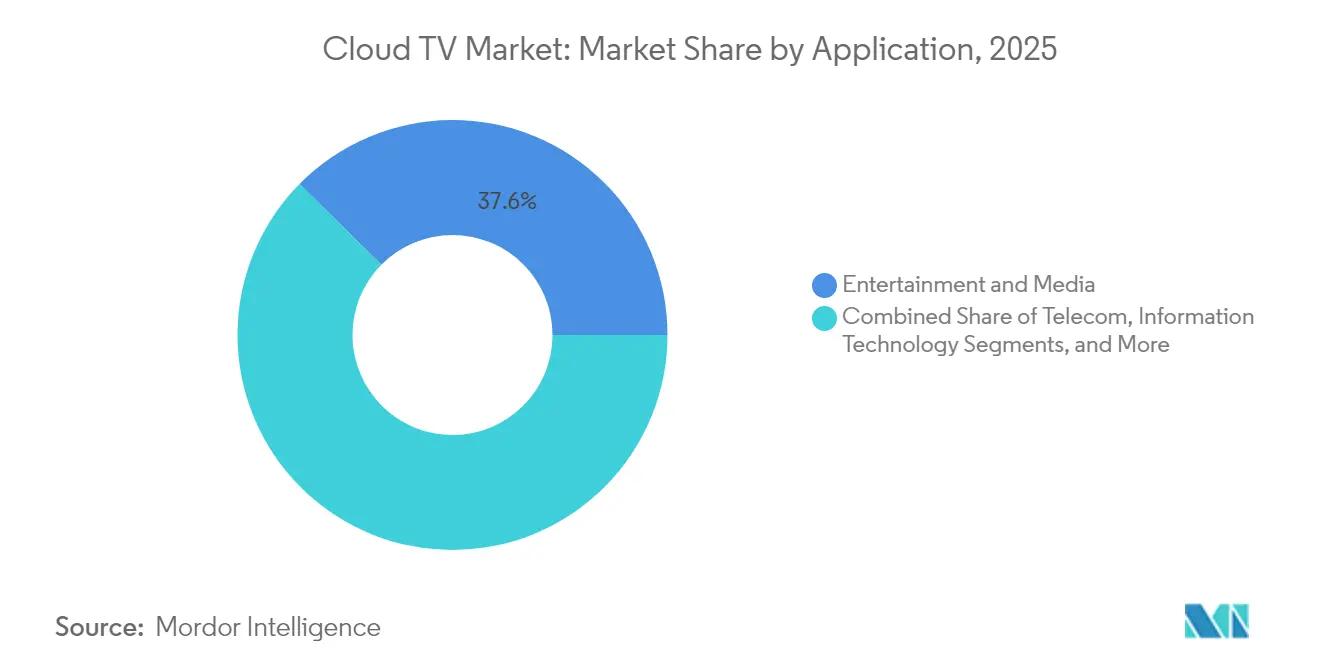
Entertainment and Media applications contributed 37.60% of 2025 revenue, anchored by SVOD giants pursuing global day-and-date strategies. The segment leverages the Cloud TV market’s low-latency capabilities to spin up live talk shows and watch-party features. Telecom-led services, however, are expanding fastest with a 19.4% CAGR as operators bundle TV, cloud gaming, and smart home dashboards to raise ARPU. Deutsche Telekom’s MagentaTV migrates catch-up libraries to cloud DVR, cutting set-top refresh costs while boosting time-shifted consumption telekom.com. Indian carriers embed regional-language hubs in the same app, lowering churn in tier-2 cities.
Cross-vertical mash-ups blur boundaries: e-commerce marketplaces stream shoppable live shows, while fitness brands deliver instructor-led workouts via CTV. Telecom platforms gain leverage because they control both last-mile quality and billing relationships, letting them cross-license content windows. Over time, advertising revenue share models may tilt toward telcos that can guarantee ad viewability metrics baked into QoS SLAs.
By Organisation Size: SMEs Embrace Cloud Flexibility
Large enterprises still generate 59.10% of sales, yet SMEs exhibit a 21.4% CAGR thanks to SaaS pipelines that remove hardware capex. Roughly 78% of small media businesses now rely on subscription-based editing, packaging, and serverless origin services to air long-tail channels hpe.com (cloud partner testimonial). The Cloud TV market size accessible to SMEs widens as white-label FAST channel platforms offer revenue-share rather than licence fees. Influencer-led networks can launch within days, renting per-minute transcode capacity and global CDN egress by the gigabyte.
Cloud orchestration levels the playing field: AI captioning, audience analytics, and contextual ad placement once reserved for tier-1 broadcasters now ship as API calls. Consequently, creative fragmentation rises even as distribution consolidates around a handful of operating-system walled gardens. Expect policy debates on discoverability quotas to intensify as niche producers seek fair shelf space on OEM home screens.
Geography Analysis
North America held 42.50% of 2025 revenue owing to mature broadband penetration, high SVOD stacking, and early adoption of contextual ad tech. Regional CDN nodes deliver sub-second start-up times, reinforcing willingness to pay for 4K and Dolby Vision tiers. Yet elevated iOS CPI threatens smaller studios’ profitability, nudging spend toward Android and web channels. The emergence of retail media networks, exemplified by Walmart’s integration of VIZIO’s SmartCast OS, demonstrates how data-rich retailers can bypass traditional broadcasters and sell incremental connected-TV inventory directly to brands .
Asia-Pacific is the fastest-growing region at a 20.6% CAGR, propelled by mass 5G roll-out, affordable Android TVs, and regional language curation. India’s Cloud TV 3.0 initiative adds voice assistants in 10 dialects, unlocking audiences previously tied to cable. Chinese OEMs preload proprietary TV operating systems that double as commerce gateways, giving device brands a bigger revenue share from advertising. South Korea piloted 8K livestreams of the 2024 Asian Games over 5G SA, setting a benchmark for immersive broadcasting. Collectively, these factors speed viewer migration from terrestrial TV to IP-delivered services.
Europe presents a patchwork of opportunities and constraints. High disposable income supports premium bundle uptake, as seen in Scandinavian markets where fibre households average two paid TV apps plus one cloud gaming pass. Network-slicing pilots in Germany prove that dedicated bandwidth can guarantee 20 ms round-trip for AAA cloud titles, yet country-specific loot-box rules complicate pan-EU launches. At the same time, cross-border M&A such as Swisscom’s acquisition of Vodafone Italia signals a drive to consolidate spectrum, fibre backbones, and streaming rights under fewer umbrellas, promising broader footprint synergies swisscom.com. Europe’s net-zero commitments are prompting broadcasters to move playout into greener data centres, potentially accelerating hybrid-cloud migrations.
Regulatory Landscape
Regulation for cloud TV continues to converge with traditional broadcasting and platform-governance rules, raising compliance complexity for global operators. In the United Kingdom, the On-demand Programme Services (Tier 1 Services) Regulations 2026 introduced enhanced Ofcom oversight for larger VoD services, including a 500,000-UK-user designation threshold. The Television Selection Services (Designation) Regulations 2026 also set a framework for regulated TV selection services on internet television equipment, with the regime taking effect in July 2026. In India, the Telecom Regulatory Authority of India (TRAI) issued an April 2026 consultation paper on a regulatory framework for FAST services, pointing to tighter scrutiny of ad-supported channel aggregation and distribution models.
Across Europe, horizontal platform obligations under the Digital Services Act (Regulation (EU) 2022/2065) and sector rules such as the European Media Freedom Act (Regulation (EU) 2024/1083) raise requirements on transparency, accountability, and content prominence, which shape cloud TV user interfaces and discovery. On the technical side, ITU-T Recommendations such as J.1303 (cloud-based converged media service architecture) and J.1306 (microservices-based audiovisual media systems) provide reference architectures that support cloud-native evolution without frequent terminal upgrades, fitting vendor roadmaps around interoperability and security expectations from rights holders and regulators.
Competitive Landscape
Competition is intensifying across hardware, platform, and service layers. Samsung leverages its 12.9% smart-TV OS footprint to push first-party FAST channels and capture ad spend that would traditionally flow to networks [2]. Roku counters by licensing its OS to budget TV brands while courting marketers with Roku Ad Watermark, a fraud-prevention identifier [3]. Walmart’s USD 2.3 billion VIZIO buyout underscores the strategic value of owning the glass and the data path.
Technology suppliers are bolstering AI capabilities. Amagi acquired Argoid to refine its machine-learning recommendation stack, promising 30% CTR uplift in early A/B tests amagi.com. Cineverse is building cineSearch on Google Cloud Vertex AI to resolve “what to watch” fatigue through vector similarity across dialogue, mood, and actor attributes cineverse.com. Telco incumbents invest in network-edge encoders and containerised CDNs so they can guarantee bitrate and advertising viewability as part of QoS contracts, a differentiator SVOD-only rivals cannot match.
As platforms converge, bargaining power shifts toward OEMs and ISPs that control device real estate or last-mile latency. Content exclusivity remains relevant yet is no longer sufficient; granular audience insights, predictive delivery, and ad measurement now dictate partnership terms. The top five players collectively command roughly 45% of global hours streamed, leaving room for disruptors to carve niches through regional language focus or interactive content.
Cloud TV Industry Leaders
-
Brightcove Inc.
-
Kaltura Inc.
-
Roku Inc.
-
Comcast Technology Solutions
-
Amazon Web Services
- *Disclaimer: Major Players sorted in no particular order
Market Opportunities and Future Outlook
Standards and consortium roadmaps are creating whitespace for interoperable hybrid broadcast-IP discovery, security, and consent flows that reduce operator dependence on proprietary middleware. HbbTV Association published HbbTV 2.0.5 in March 2026, including formal DRM integration and enhanced DVB-I alignment. In parallel, the DVB Project approved major DVB-I and DVB-DASH updates in July 2026, which supports cloud TV platforms in maintaining consistent service lists, rights protection, and signaling across connected TVs and operator apps. That environment creates room for vendors to package compliance-ready, standards-aligned service discovery and entitlement components for broadcasters and pay-TV operators pursuing cloud-first STB replacement and multi-device experiences.
Telcos and platform providers are also consolidating cloud video operations into centralized, multi-country, multi-tenant stacks, which increases demand for cloud-native ingest, metadata, content protection, and origin/CDN control. Telenor went live in February 2026 with a common cloud-based origin platform across Norway, Sweden, and Finland using AWS and Scalstrm, while Altibox selected Comcast Technology Solutions in March 2026 for centralized video management across Norway and Denmark. At the same time, supplier innovation is moving cloud TV workflows toward automation and AI-assisted operations, including Akta launching an AI-first video platform on Oracle Cloud Infrastructure in June 2026, and SIMBA implementing Broadpeak Advanced CDN software in Brazil in July 2026 to improve low-latency delivery economics for streaming networks.
Recent Industry Developments
- May 2026: Brightcove launched Prism, a redesigned platform interface intended to streamline video management and operator workflows across its cloud video stack. The update targets faster day-to-day operations for media teams managing large catalogs and live workflows, and it is positioned for wider enterprise adoption where teams need consistent processes across regions and devices.
- April 2026: Kaltura introduced an AI-native integration for its Events Platform using the Model Context Protocol (MCP), enabling natural-language interactions to manage event workflows. This expands how cloud video platforms can be orchestrated by third-party AI assistants and agentic tools, reducing integration friction for organizations running complex video experiences.
- April 2024: Brightcove introduced Smart TV SDKs for Roku, Samsung, and LG to help media companies deploy streaming experiences across major connected TV ecosystems. Expanding SDK support improves time-to-market for app development and reinforces the role of cloud TV platforms in multi-device distribution strategies where CTV remains a primary monetization surface.
Research Methodology Framework and Report Scope
Market Definition and Coverage
For this study, the cloud TV market is defined as revenues earned from cloud software and managed services that virtualize TV platform functions so live channels, on-demand libraries, and interactive apps can be delivered over IP to supported devices.
Scope exclusions: Hardware sales (such as smart TVs, gaming consoles, and consumer premises equipment) are excluded from this market sizing.
Segmentation Overview
- By Deployment
- Public Cloud
- Private Cloud
- Hybrid Cloud
- By Device Type
- Connected TV
- Mobile Phones
- Set-Top Box (STB)
- By Application
- Entertainment and Media
- Telecom
- Information Technology
- Consumer Television
- Other Applications
- By Organisation Size
- Large Enterprise
- Small and Medium Enterprise
- By Geography
- North America
- United States
- Canada
- South America
- Brazil
- Argentina
- Mexico
- Rest of Latin America
- Europe
- Germany
- United Kingdom
- France
- Italy
- Spain
- Rest of Europe
- Asia-Pacific
- China
- Japan
- South Korea
- India
- Australia
- New Zealand
- Rest of Asia-Pacific
- Middle East and Africa
- United Arab Emirates
- Saudi Arabia
- South Africa
- Rest of Middle East and Africa
- North America
Data Sources, Market Sizing, and Validation
Desk Research
Desk research was used to set the market context and to build clean starting assumptions for the model before interviews began. We relied on public sources such as ITU connectivity indicators, OECD and World Bank digital adoption series, national telecom regulators and spectrum authorities, and open standards bodies that publish streaming and codec related references. Where needed, filings and investor decks from ecosystem participants were reviewed to understand revenue mix language, customer types, and commercialization timing.
To avoid building the model on a single narrative, the same assumptions were cross checked through reputable press coverage, association websites, and peer reviewed papers on cloud video delivery and broadcast modernization. A paid subscription for company financials and intelligence was used selectively to keep entity level revenue signals consistent, and a patent database was referenced to sanity check the direction of platform features being commercialized. The desk sources listed here are illustrative only, and many other public and paid references were consulted to collect, validate, and clarify data points.
Primary Interviews and Surveys
Primary work was done through expert interviews and structured surveys with TV platform teams, telecom and pay TV operators, cloud video engineers, and solution delivery partners across major regions. Those conversations helped validate adoption timing, typical contract structures, pricing progression, and the share of workloads actually moved to cloud environments, which then reduced gaps left by public data. Feedback was also used to sense check the demand pool by device reach and service rollout maturity before finalizing outputs.
Distribution of primary research fieldwork respondents
| Company type | Respondent position | Region |
|---|---|---|
| Top tier: 27% | CXOs: 20% | APAC: 41% |
| Mid tier: 52% | Functional/Unit leaders: 22% | EMEA: 32% |
| Smaller Players: 21% | Managers: 58% | Americas: 27% |
Market-Sizing & Forecasting
Sizing started with a top-down build where broadband households, pay TV and IPTV bases, and active streaming subscribers were used to reconstruct the reachable demand pool by region. From there, adoption and migration rates for cloud TV functions were applied, followed by typical platform and service spend per operator, which was adjusted for rollout phase and scale. Once a first cut number was obtained, it was corroborated with selective bottom-up approximations using sampled supplier revenue signals, channel checks with integrators, and a simple volume times ASP cross check for platform subscriptions and managed services.
A few market fingerprints were kept in view during modeling, such as operator cloud transformation roadmaps, the mix of live versus VOD workloads, CDN and compute intensity expectations, and the cadence of major sports and content cycles that can affect capacity needs. Input assumptions were also linked to measurable indicators like connected TV and smartphone penetration, broadband speed upgrades, and regulatory pressure around service availability and data handling. Forecasts were produced using scenario analysis supported by multivariate regression, where adoption drivers and pricing progression were stress tested with expert feedback, and gaps were handled by using proxy ratios from similar operator cohorts until region specific inputs could be validated.
Data Validation & Update Cycle
Model outputs were checked against independent signals such as operator capex and opex commentary, announced platform launches, and reported subscriber base shifts, and then variances were investigated before sign-off. When an outlier appeared, assumptions were revisited, and targeted re-contacts were triggered to confirm whether the issue came from scope, timing, or pricing. A multi step internal review was followed so calculations, units, and currency conversions stayed consistent across regions.
Reports are refreshed annually, and interim updates are made when material events occur, such as major platform migrations, regulatory changes, or step shifts in cloud pricing that can alter spend patterns. Before delivery, the latest public information is rechecked so the final view reflects the most current market signals available.
Mordor Intelligence's Cloud Tv Market Size Compared Against Other Published Estimates
Published cloud TV market numbers often do not match because each study draws the line around what is counted, which year is used as the base, and how adoption is converted into revenue. Differences also show up when pricing is treated as a flat average instead of being linked to rollout stage and contract types, which can move the total meaningfully.
Hardware sales like smart TVs and consumer premises equipment sit outside Mordor Intelligence's scope, and that single exclusion can widen the gap versus estimates that blend device revenue with platform and services. Another driver is the forecasting stance, where some sources extend higher growth assumptions without checking against operator migration pace, regional broadband readiness, and currency timing for multi-country rollups.
Benchmark comparison
| Source | Market Size | Gaps in Research Methodology |
|---|---|---|
| Mordor Intelligence | USD 3.78 B (2026) | |
| Global Consultancy A | USD 2.15 B (2025) | Uses a different base year and a longer forecast window, and the implied adoption curve is steeper, which can inflate forward values without matching near term operator rollout evidence. |
| Industry Research Group B | USD 2.33 B (2024) | Anchors the model one to two years earlier and applies a broader application framing, so early stage deployments and pre-scale contracts can be counted at higher average spend levels. |
Across the three figures, the spread is mainly explained by base year choice, what revenue items are included, and how fast adoption is assumed to move from pilots into scaled deployments. By tying the total to a clear demand pool and then checking it against real rollout signals and pricing logic, the final number stays easier to trace and repeat when inputs are updated.
Key Questions Answered in the Report
What is the current Cloud TV Market size?
In 2026, the Cloud TV Market size is expected to reach USD 3.78 billion.
Who are the key players in Cloud TV Market?
Ooyala Inc., Brightcove Inc., Amino Technologies PLC, Fordela Corp. and NetSuite Inc. are the major companies operating in the Cloud TV Market.
Which is the fastest growing region in Cloud TV Market?
Asia Pacific is estimated to grow at the highest CAGR over the forecast period (2026-2031).
Which region has the biggest share in Cloud TV Market?
In 2025, the North America accounts for the largest market share in Cloud TV Market.
What years does this Cloud TV Market cover, and what was the market size in 2025?
In 2025, the Cloud TV Market size was estimated at USD 3.20 billion. The report covers the Cloud TV Market historical market size for years: 2020, 2021, 2022, 2023, 2024 and 2025. The report also forecasts the Cloud TV Market size for years: 2026, 2027, 2028, 2029, 2030 and 2031.