
Cleaning Products Market Size and Share
Cleaning Products Market Analysis by Mordor Intelligence
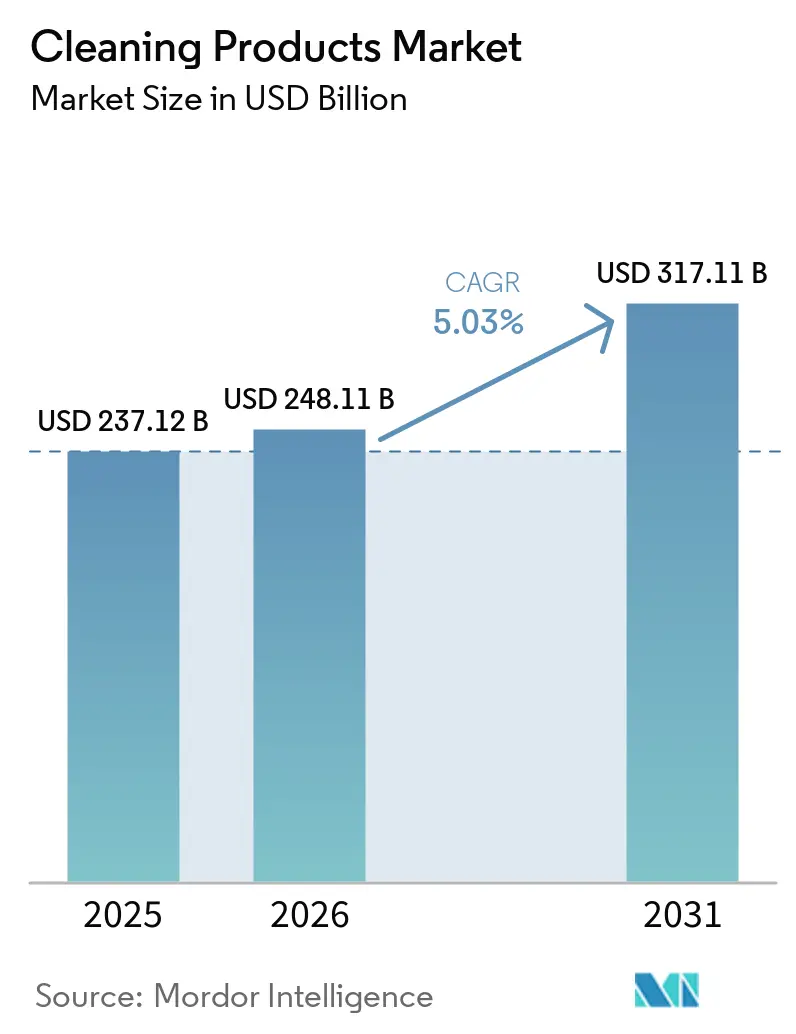
The cleaning products market size is estimated at USD 248.1 billion in 2026 and is projected to be USD 260.6 billion in 2027, reaching USD 330.2 billion by 2032, growing at a CAGR of 4.85% from 2027 to 2032.
Convenient laundry formats in the United States and ingredient-related positioning in the United Kingdom give suppliers ways to differentiate household cleaners. This creates a role for application-specific formulation and for branded or private-label offers that give cleaning buyers distinct value propositions. Shipping disruption in the Strait of Hormuz from March 2026, following the US-Israel conflict with Iran, exposed manufacturers to ingredient-cost pressure. Growth thus rewards the ability to maintain those differentiated offers while managing ingredient costs and product-specific market-access requirements.
Key Report Takeaways
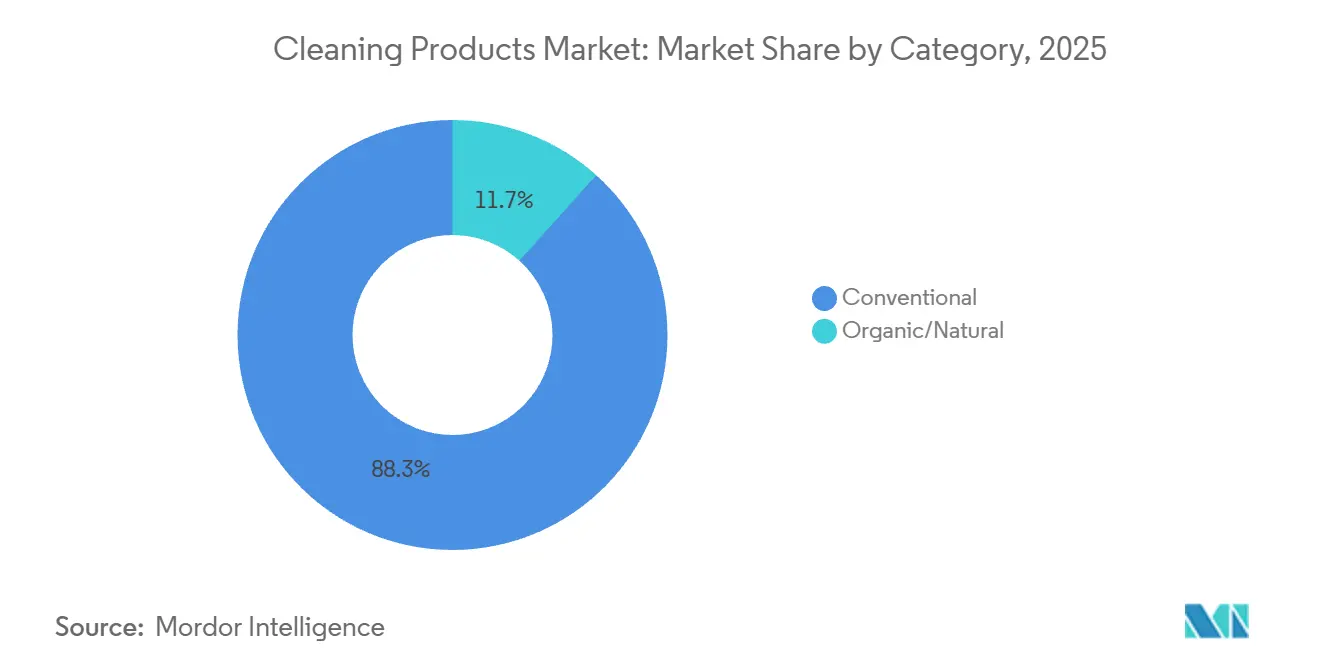
- By category, conventional products held an 87.97% cleaning products market share in 2026, while organic/natural products are projected to be the fastest-growing segment at a CAGR of 8.1% from 2027 to 2032.
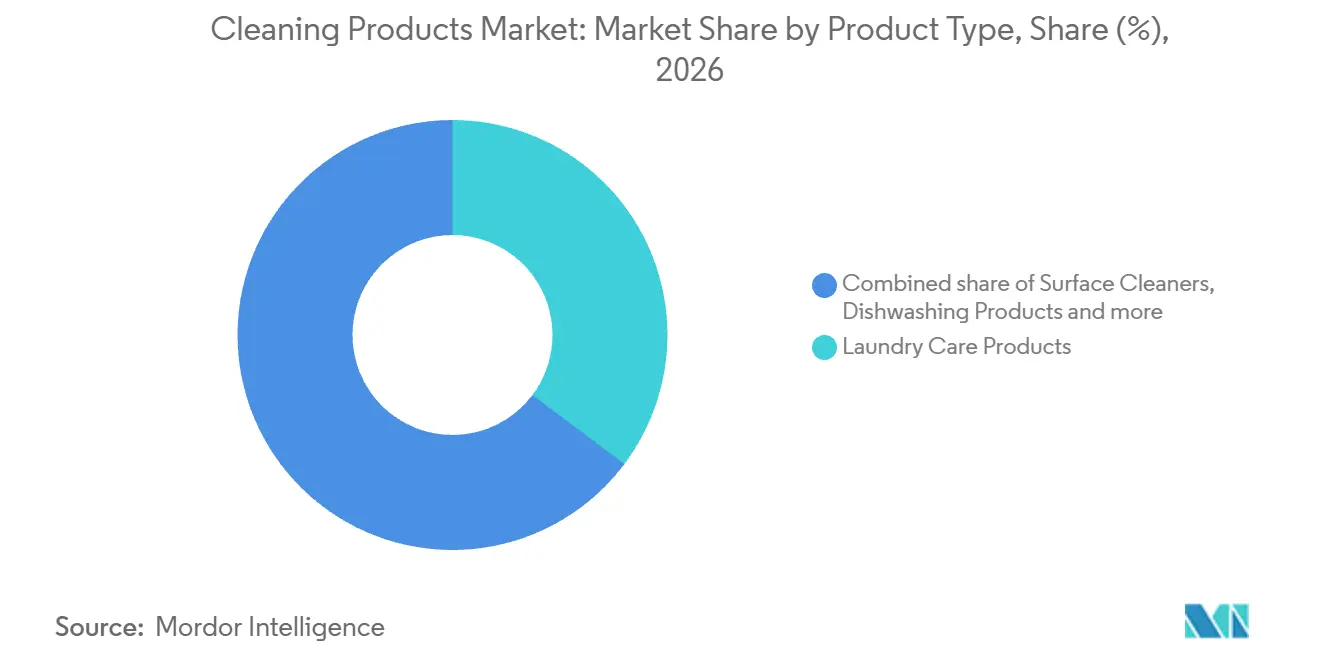
- Across product types, laundry care products accounted for a 35.25% share of the cleaning products market size in 2026, and surface cleaners are projected to grow fastest at a CAGR of 5.68% from 2027 to 2032.
- Among product forms, liquid led with 48% of market sales value in 2026, while wipes are projected to be the fastest-growing segment at a CAGR of 6.3% from 2027 to 2032.
- By application, household and residential use led with 72.28% of market sales value in 2026, while institutional and commercial use is projected to grow fastest at a CAGR of 8.1% from 2027 to 2032.
- For distribution channels, retail held 78.53% of market sales value in 2026 and is also projected to be the fastest-growing segment at a CAGR of 5.2% from 2027 to 2032.
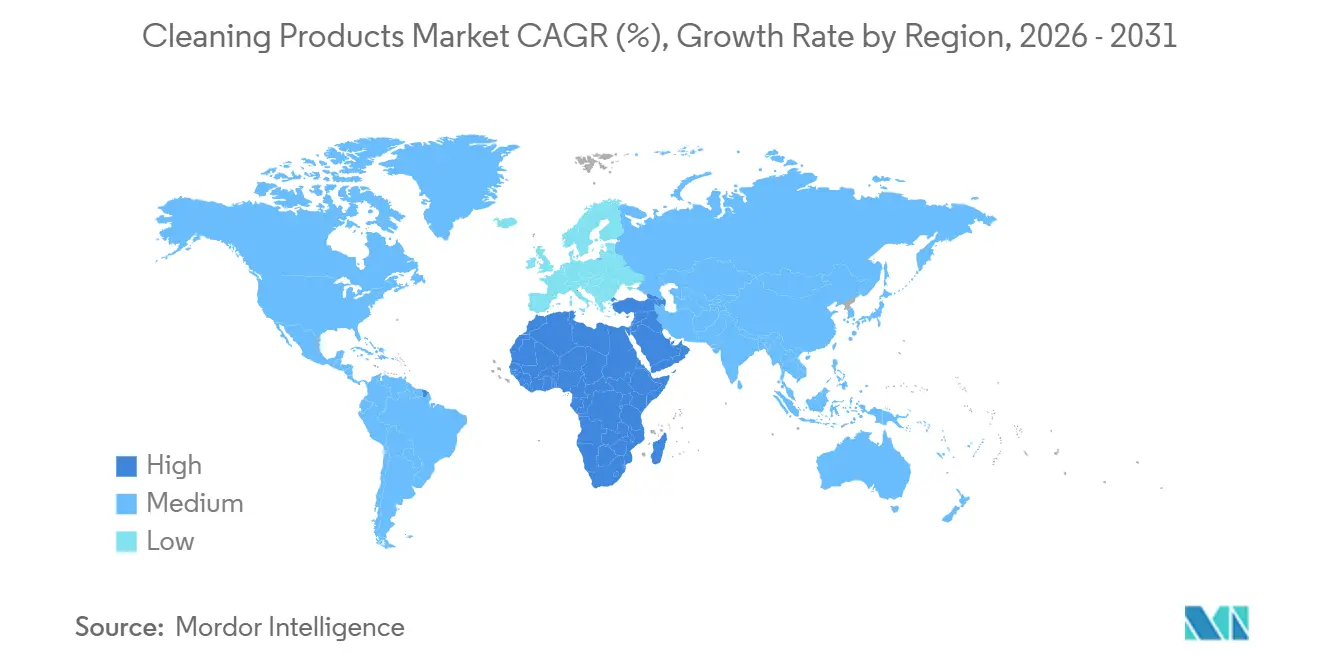
- Geographically, North America led with 29.22% of market sales value in 2026, while the Middle East and Africa is projected to grow fastest at a CAGR of 6.45% from 2027 to 2032.
Note: Market numbers in this report are based on Mordor Intelligence's proprietary estimation framework, which combines nine months of actuals with Q4 projections for base year 2026.
Market Trends and Insights
Drivers Impact Analysis of Cleaning Products Market*
| Driver | (~) % Impact on CAGR Forecast | Geographic Relevance | Impact Timeline |
|---|---|---|---|
| Shift toward eco-friendly, biodegradable, and non-toxic products | +1.7% | Latin America, United Kingdom | Medium term (2-4 years) |
| Demand for natural and plant-based formulations amid preferences for chemical-free options | +1.1% | United Kingdom | Medium term (2-4 years) |
| Busy lifestyles of working professionals favoring convenient formats | +1.9% | United States, United Kingdom | Short term (≤ 2 years) |
| Growth in specialized products for specific surfaces | +1.4% | Canada | Medium term (2-4 years) |
| Technological advancements in formulations for better efficacy and longer-lasting results | +0.8% | Japan, France, United Kingdom | Long term (≥ 4 years) |
| Preference for products with pleasant fragrances and attractive packaging | +0.4% | Latin America, Saudi Arabia | Short term (≤ 2 years) |
| Source: Mordor Intelligence | |||
Shift toward eco-friendly, biodegradable, and non-toxic products
Environmental positioning and ingredient claims can influence cleaner choice through different buyer expectations. In BASF's 2025 survey of 515 Latin American laundry consumers, 29% wanted their most-used brand to be more environmentally friendly, selecting up to 3 of 10 improvement options. In August 2026, Censuswide surveyed 2,000 UK adults for smol, and 84% said they had chosen one cleaning product over another because it claimed to contain fewer chemicals. This creates a role for clearer ingredient information within a cleaner's environmental proposition. A brand can address environmental-improvement demand and claim-sensitive choice through distinct parts of the same finished-product offer.
Demand for natural and plant-based formulations amid preferences for chemical-free options
Natural-formulation labels can influence the price consumers report paying for household cleaners. Censuswide surveyed 2,000 UK adults in August 2026 for research commissioned by smol. Among respondents, 47% said they had paid more for a cleaning product because it claimed to be natural. The same survey found that 40% said they had paid more because a product claimed to be chemical-free. For suppliers, these responses give formulation wording a commercial role in describing the value attached to the finished product. Clear formulation positioning can therefore support a premium proposition around the particular claim the buyer recognizes.
Busy lifestyles of working professionals favoring convenient formats
Convenient formats can address household laundry needs through both established dosing options and new physical product forms. An American Cleaning Institute (ACI) survey in February 2026, conducted by Wakefield Research among 1,000 U.S. adults, reported that 38% of households opted for unit-dose packets, pods, or sheets. The Procter & Gamble Company (P&G) launched Tide evo at major U.S. retailers in February 2026, a 100% concentrated, waterless detergent-fiber tile with 6 cleaning layers. P&G described the fiber tile as a first-of-its-kind format distinct from liquid and pod detergents. That combination lets suppliers address existing household format choices while developing dry detergent products that offer a different physical way to supply the cleaning dose.
Growth in specialized products for specific surfaces
Professional floor-care buyers give specialized chemical suppliers a defined audience for application-specific products. In Sanitary Maintenance's 2025 end-user survey of in-house facility managers and building service contractors, 64% planned to buy floor-care chemicals, compared with 27% in its 2023 survey.[1] The 2025 responses concerned intended purchases over the following 12 months. That interest gives suppliers a reason to explain the floor-care task served by a dedicated chemical, connecting specialization to a specific purchasing decision. For distributors, the commercial opening is a focused floor-care offer to professional end users whose reported purchasing interest had become more widespread.
Restraints Impact Analysis of Cleaning Products Market*
| Restraint | (~) % Impact on CAGR Forecast | Geographic Relevance | Impact Timeline |
|---|---|---|---|
| Regulatory complexity and regional differences | -1% | United States, European Union | Medium term (2-4 years) |
| Consumer health concerns over harsh chemicals causing allergies | -0.7% | Denmark | Long term (≥ 4 years) |
| Low brand loyalty as consumers switch based on promotions or trials | -0.3% | Europe | Short term (≤ 2 years) |
| Supply chain disruptions leading to ingredient shortages | -0.5% | India, Strait of Hormuz | Short term (≤ 2 years) |
| Source: Mordor Intelligence | |||
Regulatory complexity and regional differences
Regional differences make compliance a market-access burden because information duties and sale permissions require separate decisions. Regulation (EU) 2026/405 identified duplicated and incoherent detergent information requirements in the preceding EU framework.[2] It entered into force on March 22, 2026, but generally applies from September 23, 2029. In the United States, the Environmental Protection Agency (EPA) settled with grocery-chain owner Chedraui USA Inc. on December 2, 2025. The action led to illegal disinfectant and sanitizer products being removed from its El Super and Smart & Final stores in Arizona, California, and Nevada. Suppliers serving these jurisdictions therefore face distinct information and market-access requirements, with distribution exposed to interruption when the relevant permission is missing.
Consumer health concerns over harsh chemicals causing allergies
Skin-sensitizing ingredients create a product-safety constraint for cleaning-product formulators. A 2026 Danish Environmental Protection Agency analysis found methylisothiazolinone at 52 mg/kg in a scouring cream purchased in Denmark, above the CLP threshold for skin-sensitizing classification. The sampled result identifies an ingredient-control issue in an actual cleaning product, without establishing market-wide prevalence or a measured change in consumer purchases. Formulators must control preservative levels and communicate applicable hazards when developing products for this use.
*Our forecasts treat driver/restraint impacts as directional, not additive. The impact forecasts reflect baseline growth, mix effects, and variable interactions.
Cleaning Products Market Segment Analysis
By Category:
Conventional Scale and Natural Brand ExpansionConventional products accounted for an 87.97% share of the cleaning products market size in 2026, making them the largest segment. With most sales value residing in the category, manufacturers have a commercial reason to keep conventional cleaners central to application development. For a dosed laundry or surface-cleaning formulation, development can focus on the cleaning task accomplished by each dose and the physical form through which it is delivered. That gives suppliers a route to differentiate conventional offers through the cleaning job itself, making formulation and dosing choices part of defending the main revenue base.
Organic/natural products are the fastest-growing segment, with a projected CAGR of 8.1% from 2027 to 2032. Purdy & Figg produces natural, refillable cleaning products at its Hertfordshire factory. Its company team numbered 100 in 2026. For a manufacturer with its own product and production roles, natural formulation and a refillable format offer separate ways to develop the same finished-cleaner proposition. The commercial opportunity is a branded household range whose formulation positioning can carry across repeated refill purchases, linking product identity to the continuing cleaning task.

By Product Type:
Laundry Scale and Divergent Home Care DemandLaundry care products represented a 35.25% cleaning products market share in 2026, making them the largest segment. The Japan Soap and Detergent Association (JSDA) reported 2025 manufacturer sales of 588,350 metric tons of liquid synthetic laundry detergent in Japan. The figures cover domestic manufacturers with at least 10 employees that produced or imported the products. That physical product flow offers a context for supplier specialization in laundry formulations, allowing development work to focus on the defined wash function served by a substantial, established category of finished cleaning products.
Surface cleaners are the fastest-growing segment, with a projected CAGR of 5.68% from 2027 to 2032. Henkel AG & Co. KGaA reported that hard surface cleaners helped drive 2025 growth in the global Home Care market relevant to its Laundry & Home Care business. Dishwashing products also contributed to growth in that same market assessment. Toilet care products recorded a decline in that 2025 global Home Care assessment. These contrasts favor application-specific ranges, allowing suppliers to link each product-development decision to the demand conditions for its particular cleaning task.
By Form:
Liquid Preference and Wipes GrowthLiquid was the largest segment, accounting for 48% of sales value in 2026. In February 2026, ACI reported that 55% of U.S. households that did laundry at home favored liquid detergent. That preference gives suppliers an established format around which to compete with distinct cleaning formulations, allowing the product proposition to build on a chosen household washing format. The commercial focus can therefore be value within liquid laundry care, where buyers can compare products without simultaneously being asked to adopt a different physical form.
Wipes are the fastest-growing segment, with a projected CAGR of 6.3% from 2027 to 2032. Reckitt Benckiser Group plc linked improved core execution, particularly in wipes, to Lysol's low-single-digit growth in 2025. Powder has a separate composition dimension, with Hungary's consumer-protection authority reporting total salt-free surfactant content of 2% to 13% by mass among tested washing powders in 2025. This variation makes product-specific composition information useful when comparing powder offers. The wipes opportunity rests on executing a branded cleaning offer, while powder suppliers can distinguish products through a measurable formulation attribute.
By Application:
Household Scale and Professional DemandHousehold and residential use accounted for 72.28% of market sales value in 2026, making it the largest segment. Unilever plc's Home Care business reported EUR 5.99 billion (USD 6.99 billion) in turnover in the first half of 2026. The business represented 23% of Unilever's group turnover in that period. Its categories include fabric cleaning, fabric enhancers, and home and hygiene. For household-product manufacturers, that breadth provides several routes to develop finished formulations, tying the commercial offer to both fabric care and cleaning around the home.
Institutional and commercial use is the fastest-growing segment, with a projected CAGR of 8.1% from 2027 to 2032. Ecolab reported good growth in its Institutional division's sales to hospitality customers in the second quarter of 2026. The division's offer combines specialized cleaning and sanitizing products with related programs. That puts the supplier's proposition within the cleaning operation of a commercial site, where a finished formulation can be developed around a defined professional use. The supplier can consequently compete for a place in the site's cleaning program, giving product support a commercial role alongside the formulation.
By Distribution Channel:
Retail Scale and Institutional FulfillmentRetail was the largest segment, with 78.53% of market sales value in 2026, and is the fastest-growing segment, with a projected CAGR of 5.2% from 2027 to 2032. McBride plc reported that its group private-label volumes were a marginal 0.4% higher in the year ended June 30, 2026, partially offsetting softer demand in contract manufacturing and its own brands. Its private-label offering serves retail customers within a business covering household and professional cleaning and hygiene. For retailers, private-label supply allows a cleaning range to be developed under the store's product proposition while sourcing the finished formulation from a manufacturer.
Wholesale and corporate procurement can separate contract negotiation from physical fulfillment in multi-site institutional business. Ecolab's 2025 filing described its Institutional corporate-account personnel negotiating contracts with larger chain customers. Independent foodservice, broad-line, healthcare, and janitorial distributors provided logistics for customers preferring that channel. This arrangement gives a cleaning-product supplier a way to keep larger-account relationships while using a distribution route chosen by the customer. Channel value can therefore come from combining account access with fulfillment capability, even when contracting and logistics are performed by different roles.
Geography Analysis
North America Cleaning Products Market
North America accounted for a 29.22% share of the cleaning products market size in 2026, making it the largest geography. P&G invested more than USD 500 million in the Lima area of Ohio, adding the area's first in-house production line for Downy and Gain in-wash scent beads and an expanded fully automated warehouse. Shipping capacity for the broader expansion increased by 40%, linking the production project with greater capacity to dispatch finished laundry-care products. P&G brought a previously outsourced scent-bead process into an established fabric-care location, making this an expansion of internal manufacturing scope as well as shipping capability.
Middle East and Africa Cleaning Products Market
The Middle East and Africa is the fastest-growing geography, with a projected CAGR of 6.45% from 2027 to 2032. In a Q1 2026 update, Unilever reported that Yumos in Turkey had delivered the highest single day of sales in the brand's history. The company identified Yumos within fabric enhancers, placing this demand example in the finished laundry-care offer. For manufacturers, the brand-level result makes a defined fabric-care identity a relevant focus for developing household demand. Serving the separate enhancement task can broaden a supplier's laundry range while keeping the product proposition tied to an established washing routine.
In Europe, Germany requires German-language labels on covered washing and cleaning products under Regulation (EC) No 648/2004, Article 11(2) to (4), leaving Chemicals Act labeling duties unaffected. In Asia-Pacific, JSDA's May 2025 survey found frequent automatic detergent and softener dosing among married women in their 20s through 50s in Tokyo and 3 neighboring prefectures. Respondents lived in households of at least 2 people and had bought a washer within 5 years. South America has a different channel consideration, with cleaning associations ABIPLA and ABRALIMP reporting 14% informal household cleaning-products consumption in Brazil from 1,219 interviews in July 2025. These differences put labeling, dosing fit, and formal distribution in distinct commercial roles for suppliers.
Mordor Intelligence provides coverage of the cleaning products market across other key regional markets. Detailed country-level analysis extends to South Africa incorporating local coverage and market participation, as required.
Regulatory Framework and Outlook
The comparison examines selected jurisdictions from the perspective of finished-cleaning-product manufacturers seeking market access and manageable compliance work. The United States example concerns covered antimicrobial pesticide products, while China's operative example concerns food-use detergents. Saudi Arabia's detergent regulation covers domestic and industrial uses but excludes disinfectants and certain bulk products supplied for repackaging. Ratings assess the access pathways described here, balancing product and information duties against procedural flexibility and identified transitions.
Regulatory Table of Cleaning Products Market
| Decision factor | United States | Germany | China | Brazil | Saudi Arabia |
|---|---|---|---|---|---|
| Primary authority | Environmental Protection Agency | Designated Länder authorities | State Administration for Market Regulation (SAMR) and local departments | Anvisa | Saudi Standards, Metrology and Quality Organization (SASO) and approved conformity-assessment bodies |
| Key instruments or direction | Federal pesticide-registration rules in 40 CFR Part 152 | Detergents and Cleaning Agents Act (WRMG) and Regulation (EC) No 648/2004; Regulation (EU) 2026/405 generally from September 23, 2029 | Food-use product controls and GB 14930.1-2022 for school tableware; GB 26396-2026 scheduled for May 1, 2027 | RDC 989/2025 and IN 394/2025, amended in August 2026 | Technical Regulation for Detergents and its 2024 amendment |
| Commercial effect | Registration for covered pesticide products, subject to exceptions in sections 152.20, 152.25, and 152.30 | Required, free medical-purpose product-data filing with Bundesinstitut für Risikobewertung (BfR) when no other specified notification duty applies | Pre-sale testing, traceability, and labeling for food-use detergents | Company-run pH tests permitted for risk classification; label changes solely for RDC 989/2025 may be implemented immediately after filing | Type 3 Certificate of Conformity before placing covered detergents on the market |
| Current policy attractiveness | Medium | Medium | Medium | High | Medium |
| Future direction of policy attractiveness | No change | Hardening | Hardening | Easing | No change |
| Source: Mordor Intelligence | |||||
The United States' Medium rating and No change direction reflect the qualified registration gate and a long-term EPA proposal intended to leave substantive requirements unchanged. Germany's Medium rating and Hardening direction reflect conditional product-notification work and additional product-information preparation for the September 2029 framework. China's Medium rating reflects product-conformity duties, while Hardening reflects mandatory GB 26396-2026 replacing recommended GB/T 26396-2011 from May 1, 2027. Saudi Arabia's Medium rating and No change direction reflect the continuing certification route under its 2024-amended detergent framework. Brazil's High rating and Easing direction reflect its August 2026 permission for company-run risk-classification pH tests and immediate implementation after filing of label changes made solely for RDC 989/2025.
Value Chain Stages
The comparison follows the flow from ingredient and packaging supply through finished-product manufacturing to distribution. BASF supplies ingredients to detergent and cleaner industries, while Pact Group designs and manufactures household-cleaning packaging in Australia. These activities capture value through inputs and packaging sold to product makers, with manufacturing and distribution adding separate commercial roles in converting supply into products available to cleaning buyers.
Value Chain Analysis Table of Cleaning Products Market
| Primary activity | Key participants | Value capture | Bottleneck | Resilience response |
|---|---|---|---|---|
| Ingredient production and supply | Ingredient producers such as BASF | Ingredient sales | Meeting formulation-specific ingredient requirements | Qualify ingredients against the intended cleaning function |
| Packaging design and production | Household-cleaning packaging manufacturers such as Pact Group in Australia | Packaging sales | Pact's product-performance conditions for recycled content | Test material changes before increasing recycled content |
| Finished-product manufacturing | Manufacturers such as The Procter & Gamble Company, through its internal Product Supply organization supporting Tide | Finished-product sales | Coordinating manufacturing with supply-chain operations | Integrate production and distribution planning |
| Distribution to cleaning-product buyers | Cleaning and hygiene distributors such as Bunzl plc | Product distribution revenue | Geographic reach of local distribution networks | Extend coverage through local distribution operations |
| Source: Mordor Intelligence | ||||
Bunzl acquired Quindesur in July 2025, adding a Spanish distributor of foodservice and cleaning and hygiene products with a strong southern Spain focus. The transaction illustrates how ownership can combine a local distribution operation with a broader supplier group. Local fulfillment capability consequently represents a source of value alongside the ingredient, packaging, and manufacturing capabilities that shape the product itself.
Competitive Landscape
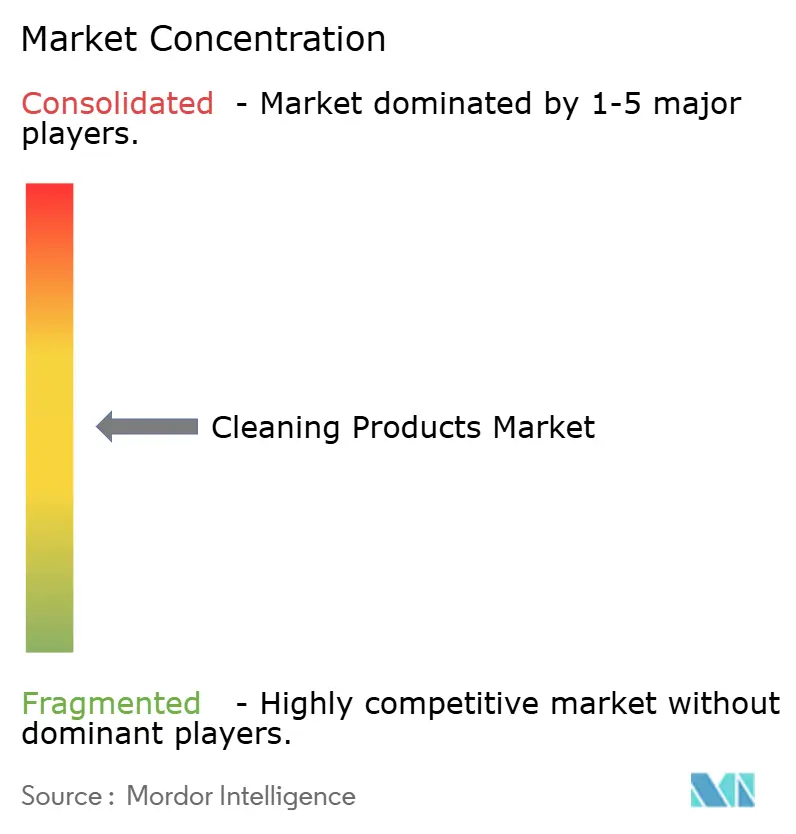
Competition has a moderately consolidated branded core, with multinational suppliers competing across distinct cleaning applications. The Procter & Gamble Company reported over 35% share in the fabric care markets where it competed in fiscal 2026, primarily through Tide, Ariel, and Downy.[3] Unilever plc's Home Care business includes Cif and Dirt Is Good, while Henkel AG & Co. KGaA operates Laundry & Home Care. Reckitt Benckiser Group plc owns Lysol, and Colgate-Palmolive Company sells Fabuloso and Ajax home-care products. This structure favors suppliers able to sustain several branded applications, giving portfolio breadth a role in defending customer access.
Operating performance shows why volume gains and individual brand development both matter to the large portfolios. In the first half of 2026, Unilever reported 7.6% underlying Home Care sales growth versus the first half of 2025, comprising 7.4% volume and 0.2% price. Henkel reported 2025 sales increases for Persil and Perwoll, supported by new Persil Giant Discs and Perwoll's market expansion, even as its broader Laundry & Home Care business slightly declined organically. Volume-led growth gives suppliers a route to higher sales with little reliance on price increases, while successful individual brands can justify selective product investment.
Competitive development is also extending established germ-protection brands into specific cleaning applications. Reckitt reported that Lysol Laundry Sanitizer and Air Sanitizer each recorded double-digit growth in 2025 versus 2024 and drove market-share gains. In the second quarter of 2026, the company said North America benefited from strong Lysol performance. For sanitizing products, regulatory positioning can be built around precise intended-use claims, making the promised function central to the competitive proposition. Challengers can therefore focus on a defined application and a defensible product claim, competing on a function that buyers can compare with the established brand.
Cleaning Products Industry Leaders
-
The Procter & Gamble Company
-
Unilever plc
-
Henkel AG & Co. KGaA
-
Reckitt Benckiser Group plc
-
Colgate-Palmolive Company
- *Disclaimer: Major Players sorted in no particular order
Cleaning Products Market Companies Covered in this Report
- The Procter & Gamble Company
- Unilever plc
- Henkel AG & Co. KGaA
- Reckitt Benckiser Group plc
- Colgate-Palmolive Company
- The Clorox Company
- SC Johnson & Son Inc.
- Church & Dwight Co. Inc.
- Kao Corporation
- Ecolab Inc.
- Diversey Holdings Ltd.
- Amway Corp.
- LG Household & Health Care Ltd.
- Lion Corporation
- Godrej Consumer Products Ltd.
- Blue Moon Group Holdings
- PZ Cussons plc
- Bombril S/A
- McBride plc
- Werner & Mertz GmbH
Key Opportunities for Market Participants
The opportunities compare finished-detergent ranges that prepare household and professional offers for the EU's next regulatory framework. Most provisions of Regulation (EU) 2026/405 apply from September 23, 2029. From that date, specified content for refill detergents may appear digitally, with exceptions for listed preservative and fragrance-allergen information and continuing physical-label duties. Microbial detergents will require demonstrated safe use for human health and the environment through a risk assessment using a Commission methodology to be established.
Market Opportunities Table of Cleaning Products Market
| Opportunity | Why now | Buyer / lead segment | Recommended play | Main barrier | Likely beneficiaries |
|---|---|---|---|---|---|
| Detergent ranges with digital product passports | Model-level digital product passports required before EU market placement from 2029 | Household/residential through EU retail | Connect each detergent model to complete product information before launch | Completing and maintaining model-level information | Detergent manufacturers such as Henkel AG & Co. KGaA |
| Refill detergent ranges | Digital-only option for specified refill content from 2029, subject to retained physical information | Household/residential refill buyers | Design refill offers with coordinated physical and digital information | Keeping both information channels consistent | Manufacturers extending detergent formats, including potential participants such as Henkel AG & Co. KGaA |
| Microbial detergent development | Defined future safety condition for detergents containing microorganisms | Institutional and commercial cleaning users | Build product-specific risk assessments for intended uses | Demonstrating safety under the Commission methodology to be established | Detergent formulators with safety-substantiation capabilities |
| Source: Mordor Intelligence | |||||
The central opening is a detergent portfolio whose product information and safety work support expansion into additional formats. Manufacturers can prepare common information processes while preserving the different conditions governing refill and microbial products. This makes regulatory readiness part of the finished-product offer, giving a supplier more options when deciding which ranges to bring to EU buyers in 2029.
Recent Industry Developments in Cleaning Products Market
- Oct 2026: Henkel announced Somat Smartwash, combining dishwasher detergent, rinse aid, salt, and machine care with automatic dosing. The announcement stated availability in Germany through selected online and retail channels from October 20.
- Sep 2026: P&G Japan announced a refresh of its Bold laundry detergent line. Its announced nationwide release schedule called for gel-ball products in late September 2026 and liquid detergent in late October 2026.
Cleaning Products Market Report Scope and Research Methodology
Market Definition and Coverage
The global cleaning products market measures the annual value of finished cleaning formulations purchased for household, institutional, and commercial use worldwide. Sales are classified by product category, type, form, application, distribution channel, and geography.
Scope exclusions: Cleaning equipment and tools, separately sold cleaning ingredients and chemical inputs, and contract cleaning and janitorial services are excluded.
Segments Covered in This Report
- By Category
- Conventional
- Organic/Natural
- By Product Type
- Laundry Care Products
- Surface Cleaners
- Dishwashing Products
- Toilet/Bathroom Cleaners
- Floor Cleaners
- Glass and Metal Cleaners
- Other Specialty Cleaners
- By Form
- Liquid
- Powder
- Gel and Cream
- Wipes
- Tablets and Aerosol
- By Application
- Household/Residential
- Institutional and Commercial
- By Distribution Channel
- Wholesale/Corporate Procurement
- Retail
- Supermarkets and Hypermarkets
- Convenience/Grocery Stores
- Online Retail
- Other Distribution Channels
- By Geography
- North America
- United States
- Canada
- Mexico
- Rest of North America
- Europe
- Germany
- United Kingdom
- Italy
- France
- Spain
- Netherlands
- Poland
- Belgium
- Sweden
- Rest of Europe
- Asia-Pacific
- China
- India
- Japan
- Australia
- Indonesia
- South Korea
- Thailand
- Singapore
- Rest of Asia-Pacific
- South America
- Brazil
- Argentina
- Colombia
- Chile
- Peru
- Rest of South America
- Middle East and Africa
- South Africa
- Saudi Arabia
- United Arab Emirates
- Nigeria
- Egypt
- Morocco
- Turkey
- Rest of Middle East and Africa
- North America
Data Sources, Market Sizing, and Validation
Desk Research
Illustrative public sources such as the European Commission's detergents impact assessment, Eurostat's PRODCOM documentation, the US EPA's Safer Choice Standard, and UN DESA's World Urbanization Prospects 2025 can inform market definition, supply context, product requirements, and demand geography. PRODCOM and trade series help distinguish annual sold production and cross-border flows from finished-product sales, while urban population projections and formulation criteria provide context for regional demand and product eligibility.
Public company filings and investor materials can separate category sales from total corporate revenue, while reputable press and trade coverage can date launches, capacity changes, and channel developments for cross-checks. These sources are not exhaustive, and further sources inform collection, validation, and clarification.
Primary Interviews and Surveys
To examine demand, pricing, and route to market, primary research should target manufacturers across large, mid-sized, and smaller suppliers, plus retail, wholesale, and institutional buyers, using regional and functional roles. Where transaction records cover shipments or only one outlet, structured interviews and surveys can test secondary-source assumptions by product type, form, application, channel, geography, and price mix. Respondents can check driver direction, while analysts document gaps, bound their effects with adjacent categories or geographies, and triangulate estimates against separate supply, trade, or channel signals.
Distribution of primary research fieldwork respondents
| Company type | Respondent position | Region |
|---|---|---|
| Top tier: 30% | CXOs: 20% | APAC: 40% |
| Mid tier: 45% | Functional/Unit leaders: 35% | EMEA: 30% |
| Smaller Players: 25% | Managers: 45% | Americas: 30% |
Market-Sizing & Forecasting
The model begins with a top-down global value estimate for finished formulations sold to household, institutional, and commercial buyers, and uses country and regional demand signals to estimate the geographic distribution of that total. Key indicators include household formation and urbanization, product-level production and trade, consumer and institutional demand, retail and procurement activity, and selling-price and product-mix changes. Reported sales records and buyer demand evidence establish product and end-user shares, while country sales and channel information support geographic and route-to-market estimates. Scenario analysis carries the market forward by varying demand, price and mix, and professional purchasing conditions, with selected bottom-up checks comparing supplier or channel roll-ups and sampled average selling price times volume with the top-down total. Where an indicator is missing or a sampled roll-up is partial, analysts use the nearest observed category or geography to bound its effect, record the assumption, and retain the difference for review. Respondents can test individual driver directions and recent changes in pricing, format, and procurement before analysts finalize the forecast scenarios.
Data Validation & Update Cycle
Analysts triangulate the market estimate against independent household and institutional demand signals, supplier disclosures, production data, and trade flows, checking that producer output is not counted again as a second sale. They test year-over-year movements, category and regional totals, units, boundary consistency, and current-to-forecast transitions, then trace anomalies to source definitions or timing and resolve them against source records before sign-off. A second analyst reviews the source trail, calculations, boundary, and comparison logic, with respondent re-contact triggered by conflicting accounts, changed definitions, or a material shift in a forecast driver. The evidence and model are refreshed annually, updated between cycles when a material price, regulatory, supply, or channel event changes the outlook, and reviewed afresh immediately before delivery.
Mordor Intelligence's Global Cleaning Products Market Sizing Compared With Other Published Estimates
The global cleaning products market measures the annual value of finished cleaning formulations purchased for household, institutional, and commercial use worldwide. Key indicators include household formation and urbanization, product-level production and trade, consumer and institutional demand, retail and procurement activity, and selling-price and product-mix changes.
Key Gap Drivers are addressed through a consistent transaction boundary, market-specific demand inputs and cross-checks across the study. A second analyst reviews the source trail, calculations, boundary, and comparison logic, with respondent re-contact triggered by conflicting accounts, changed definitions, or a material shift in a forecast driver.
Benchmark comparison
| Source | Market Size | Gaps in Research Methodology |
|---|---|---|
| Mordor Intelligence | USD 260.6 B (2027) | |
| Global Market Research Firm A | USD 295.3 B (2025) | At its 2025 base, this estimate is 13.3% above this report's 2027 value of USD 260.6 B, 2 years later. The published coverage includes packaged cleaning products sold to industrial users, beyond this report's household, institutional, and commercial buyer boundary. |
| Global Consumer Data Publisher B | USD 208.9 B (2026) | At its 2026 base, this estimate is 19.8% below this report's 2027 value of USD 260.6 B, 1 year later. Its definition counts consumable B2C products for private households and excludes professional products, leaving institutional and commercial purchases outside its total. |
Mordor Intelligence ties the estimate to the study’s defined coverage and demand model. A second analyst reviews the source trail, calculations, boundary, and comparison logic, with respondent re-contact triggered by conflicting accounts, changed definitions, or a material shift in a forecast driver.
Key Questions Answered in the Report
What is the cleaning products market size and growth outlook?
The size is projected at USD 260.6 billion in 2027, reaching USD 330.2 billion by 2032, with a CAGR of 4.85% from 2027 to 2032.
Which forces support demand for household cleaning products?
Convenient laundry formats and ingredient-related claims help differentiate offers. ACI reported that 38% of U.S. households opted for unit-dose laundry detergents in its February 2026 survey.
Which cleaning-product type holds the largest share?
Laundry care products held 35.25% of market sales value in 2026. Surface cleaners are projected to grow fastest at a CAGR of 5.68% from 2027 to 2032.
Which major companies compete in the cleaning-products industry?
Major companies include The Procter & Gamble Company, Unilever plc, Henkel AG & Co. KGaA, Reckitt Benckiser Group plc, and Colgate-Palmolive Company.
What is a key constraint on cleaning-product expansion?
Product-specific compliance can limit market access. Germany's new EU detergent framework will generally apply from September 23, 2029, adding product-information preparation.
Which regions lead cleaning-product sales and growth?
North America held 29.22% of market sales value in 2026. The Middle East and Africa is projected to grow fastest at a CAGR of 6.45% from 2027 to 2032.