
China Pharmaceutical Packaging Market Size and Share
Market Overview
| Study Period | 2020 - 2031 |
|---|---|
| Forecast Data Period | 2026 - 2031 |
| Base Year Market Size (2025) | USD 21.13 Billion |
| Market Size (2026) | USD 22.41 Billion |
| Market Size (2031) | USD 30.07 Billion |
| Growth Rate (2026 - 2031) | 6.05 % |
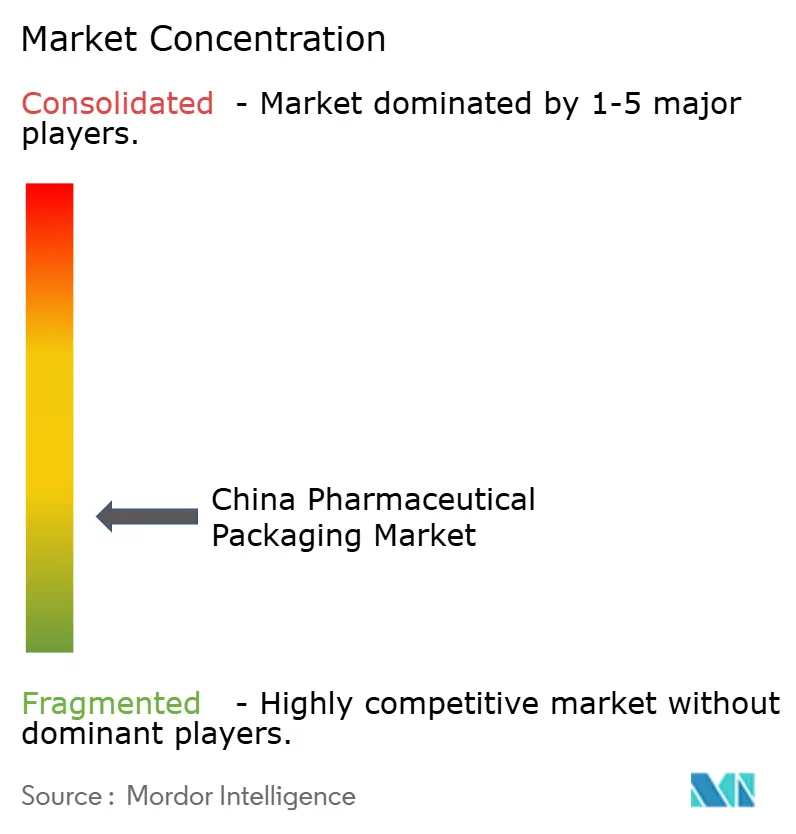
| Market Concentration | Low |
Major Players *Disclaimer: Major Players sorted in no particular order Image © Mordor Intelligence. Reuse requires attribution under CC BY 4.0. | |
China Pharmaceutical Packaging Market Analysis by Mordor Intelligence
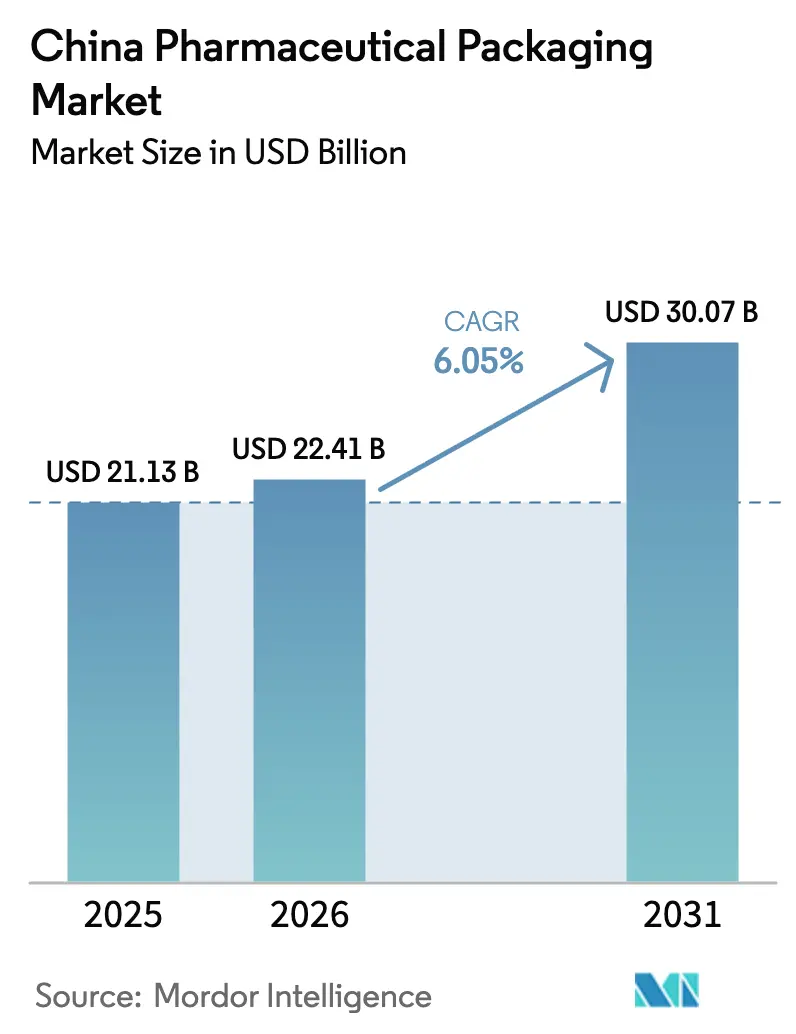
The China pharmaceutical packaging market size is expected to grow from USD 21.13 billion in 2025 to USD 22.41 billion in 2026 and is forecast to reach USD 30.07 billion by 2031 at 6.05% CAGR over 2026-2031. Supply-side investments in biologics capacity, carbon-neutrality pledges that push recyclable formats, and tightening anti-counterfeit rules combine to accelerate premium packaging adoption across the China pharmaceutical packaging market. Regulatory alignment with International Council for Harmonisation guidelines now requires unit-level serialization, driving capital spending on smart lines even as raw-material cost swings curb profit margins. Intensifying biomanufacturing programs—from the Ministry of Industry and Information Technology’s USD 4.17 billion outlay for 2025—to multinational R&D hubs in Beijing raise demand for sterile vials, prefillable syringes, and composite barrier materials. Meanwhile, cross-border e-pharmacy expansion to RMB 21.4 trillion (USD 3.3 trillion) lifts parcel-ready secondary and tertiary packs that withstand longer supply chains.
Key Report Takeaways
- By packaging type, primary packaging held 61.88% of China pharmaceutical packaging market share in 2025; parenteral formats are poised to expand at a 9.12% CAGR through 2031.
- By material, plastics captured 50.05% revenue in 2025, while paper & paperboard are projected to grow at an 8.35% CAGR to 2031.
- By drug form, solid orals controlled 42.12% share of the China pharmaceutical packaging market size in 2025, yet parenteral formulations lead growth at 9.12% CAGR.
- By end user, pharmaceutical manufacturers accounted for 52.01% share in 2025, whereas hospitals and clinics are expected to register the fastest 9.12% CAGR during 2026-2031.
- By technology, conventional formats kept 59.85% share in 2025, while smart packaging solutions integrating NFC or RFID are forecast to advance at 8.47% CAGR.
Note: Market size and forecast figures in this report are generated using Mordor Intelligence’s proprietary estimation framework, updated with the latest available data and insights as of 2026.
China Pharmaceutical Packaging Market Trends and Insights
Drivers Impact Analysis*
| Driver | (~) % Impact on CAGR Forecast | Geographic Relevance | Impact Timeline |
|---|---|---|---|
| Stringent regulatory clamp-down on counterfeit medicines | +1.2% | National, early gains in Tier 1 cities | Medium term (2-4 years) |
| Expansion of domestic generics and biologics manufacturing base | +1.8% | National, concentrated in Jiangsu, Shandong, Guangdong | Long term (≥ 4 years) |
| Ageing population driving chronic-care drug volumes | +1.5% | National, accelerated in northeastern provinces | Long term (≥ 4 years) |
| Provincial reimbursement tilt toward patient-friendly formats | +0.9% | Provincial variations, strongest in developed regions | Medium term (2-4 years) |
| Cross-border e-pharmacy boom needing parcel-ready packs | +0.7% | National, concentrated in coastal trading hubs | Short term (≤ 2 years) |
| Carbon-neutrality targets boosting recyclable/biopolymer packs | +0.6% | National, led by Beijing, Shanghai, Shenzhen | Medium term (2-4 years) |
| Source: Mordor Intelligence | |||
Stringent Regulatory Clamp-Down on Counterfeit Medicines
Enhanced oversight now extends from active ingredients to every packaging layer, underpinned by the National Medical Products Administration’s YY 1001-2024 standards for all-glass syringes. Mandatory serialization at each saleable unit has curtailed supply-chain opacity, prompting larger converters to install interoperable track-and-trace systems that harmonize with EU FMD and U.S. DSCSA rules. Provincial authorities in Shanghai and Shenzhen deploy blockchain-enabled customs channels that shorten clearance times while authenticating serialized codes. Early adopters of open architecture solutions record fewer product-recall incidents and negotiate premium pricing with multinational clients, whereas SMEs grapple with upfront investment and maintenance fees. Market exit of non-compliant lines removes low-price capacity, slowly lifting average selling prices for serialized packs in the China pharmaceutical packaging market.
Expansion of Domestic Generics and Biologics Manufacturing Base
China’s biopharma value exceeded CNY 650.6 billion (USD 91.5 billion) in 2024 and is projected to double by 2029, fueling a pivot from commodity bottles toward sterile barrier systems.[1] Provincial clusters in Jiangsu, Shandong, and Guangdong anchor integrated supply networks where bulk resin suppliers, container converters, and fill-finish plants co-locate to pare logistics cost. Luye Pharma’s U.S. FDA clearance for ERZOFRI®, a long-acting injectable, underscores domestic innovators’ rising demand for cyclic olefin polymer syringes that resist low-temperature storage. Multinationals deepen local footprints through R&D incubators and joint ventures, intensifying competition for packaging partners certified to U.S. and EU pharmacopeia standards. The resulting capacity race spurs capex in ISO 5 cleanrooms and nested vial trays, fortifying growth prospects for the China pharmaceutical packaging market.
Ageing Population Driving Chronic-Care Drug Volumes
Residents aged 65 and above surpassed 15% of the population in 2024, widening the chronic-disease burden and demanding packs that support daily adherence. The 2024 National Medical Insurance Drug List now reimburses roughly 3,900 products, compelling uniform labeling that simplifies regimen comprehension for elderly users. Northeastern provinces pilot color-coded blister sleeves with enlarged fonts to improve visibility, while tier-one hospitals in Beijing deploy NFC-enabled pill bottles that transmit dosage reminders to caregiver apps. Injectable therapies gain popularity, shifting volume toward sterile syringes and IV bags that demand high-clarity polypropylene or Type I borosilicate glass. This demographic wave secures a steady uptick in unit demand across the China pharmaceutical packaging market.
Provincial Reimbursement Tilt Toward Patient-Friendly Formats
Integration of Urban Employee and Urban-Rural insurance pools streamlines funding but preserves latitude for regional tender criteria. Wealthier municipalities reimburse single-dose, compliance-aid packs even at premium prices, prompting manufacturers to offer dual-SKU strategies: high-convenience formats for affluent cities and bulk bottles for price-sensitive counties. Carton converters adapt by adding braille and peel-off labels requested by provincial formularies. Diverse provincial policies thus create micro-markets inside the broader China pharmaceutical packaging market.
Restraints Impact Analysis*
| Restraint | (~) % Impact on CAGR Forecast | Geographic Relevance | Impact Timeline |
|---|---|---|---|
| Volatile petro-feedstock prices inflating plastic pack costs | -1.4% | National, concentrated in manufacturing hubs | Short term (≤ 2 years) |
| Capex burden of serialisation/anti-counterfeit lines for SMEs | -0.8% | National, most severe in Tier 2/3 cities | Medium term (2-4 years) |
| Impending PFAS restrictions threatening blister film obsolescence | -0.6% | National, early impact in export-oriented facilities | Medium term (2-4 years) |
| GMP packaging-design talent shortage slows innovation | -0.5% | National, acute in emerging biotech clusters | Long term (≥ 4 years) |
| Source: Mordor Intelligence | |||
Volatile Petro-Feedstock Prices Inflating Plastic Pack Costs
High-density polyethylene averaged USD 910 per ton in 2024, but a 5 million-ton capacity influx in 2025 skews pricing unpredictably. Simultaneously, PVC import duties rose from 1% to 5.5%, adding USD 23 per ton and squeezing converters reliant on specialized film grades. Currency volatility and crude-oil price swings complicate long-term resin contracts, forcing packaging makers to diversify into glass or fiber substrates when feasible. Manufacturers unable to hedge resin exposure face shrinking margins within the China pharmaceutical packaging market.
Capex Burden of Serialisation/Anti-Counterfeit Lines for SMEs
Turn-key serialization suites that integrate vision inspection, cloud databases, and blockchain ledgers often exceed USD 2 million per line, a cost eclipsing annual revenue for many Tier-3 converters. Following the U.S. DSCSA deadline in 2024, several under-capitalized firms exited export channels, surrendering volume to larger peers. Domestic financing constraints spur consolidation waves as bigger groups absorb SME assets, incrementally raising the market concentration of the China pharmaceutical packaging market.
*Our forecasts treat driver/restraint impacts as directional, not additive. The impact forecasts reflect baseline growth, mix effects, and variable interactions.
Segment Analysis
By Packaging Type: Primary Packaging Dominates Innovation
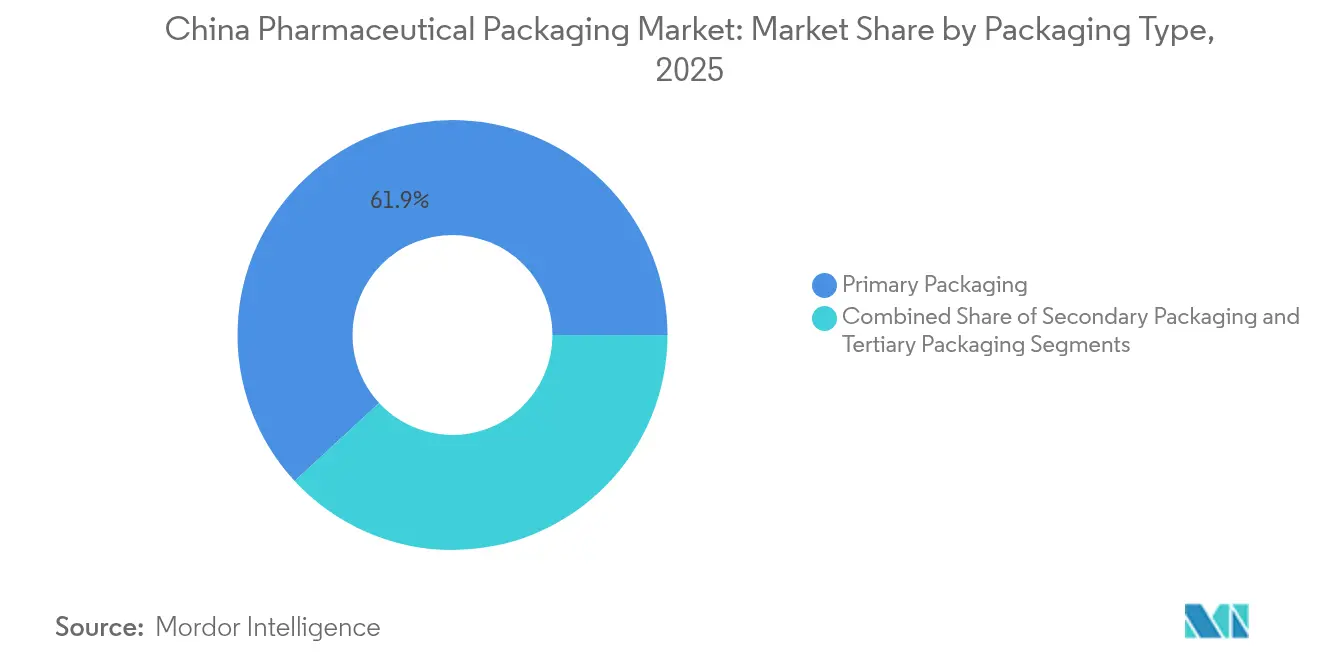
Primary containers captured 61.88% share in 2025 and are projected to grow at 8.96% CAGR through 2031 as drug-delivery functionality merges with containment. SCHOTT Pharma’s TOPPAC polymer syringe range posted 54% sales growth in 2024, signaling appetite for cyclic olefin solutions suitable for mRNA vaccines.Within the China pharmaceutical packaging market size for parenteral packs, nested ready-to-use configurations lower aseptic setup time in fill-finish plants. Secondary and tertiary packs evolve alongside booming e-commerce; corrugated shippers integrate shock sensors, enabling parcel-ready compliance for global export hubs in Shanghai free-trade zones.
Secondary packs advance at mid-single-digit growth, propelled by folding-carton demand that accompanies serialized QR codes and color-coded logistics labels. Tertiary formats integrate with AI-enabled Smart Customs scanners that clear pallets faster, reducing in-bond detention fees. Collectively, these shifts entrench primary-pack-centric innovation as the engine of the China pharmaceutical packaging market.

By Material: Sustainability Reshapes Material Selection
Plastics retained 50.05% share in 2025, buttressed by cost-effective HDPE bottles and polypropylene blisters. Yet fiber substrates clock an 8.35% CAGR as carbon-pricing schemes and hospital green-procurement policies gain traction. DS Smith’s TailorTemp shipper shows that molded-fiber can match thermal performance while trimming CO₂ by 40%. The China pharmaceutical packaging market size for glass vials and cartridges expands steadily amid biologics growth and premium positioning.
Aluminum remains critical for cold-form blisters when barrier integrity outweighs cost. SMEs explore poly(propylene carbonate) blends to meet impending PFAS prohibitions without sacrificing moisture resistance. Material substitution decisions thus balance regulatory headwinds, carbon accounting, and drug-stability imperatives across the China pharmaceutical packaging market.
By Drug Form: Parenteral Growth Accelerates
Solid orals formed 42.12% of 2025 revenue, yet parenteral units grow at a 9.12% CAGR on the back of oncology infusions and long-acting injectables. Hospitals favor ready-to-use prefilled syringes that reduce compounding risk and labour time, increasing cyclic olefin and borosilicate consumption within the China pharmaceutical packaging market. Topical patches gain share among urban asthma and COPD patients, spurring inhaler canister and foil pouch demand.
Ophthalmic solutions employ multi-dose preservative-free bottles enabled by blow-fill-seal technology, an area where TekniPlex expanded Italian capacity in 2024. Such diversification underscores the rising complexity of dosage-form-specific packaging in the China pharmaceutical packaging market.
By End User: Hospital Segment Drives Growth
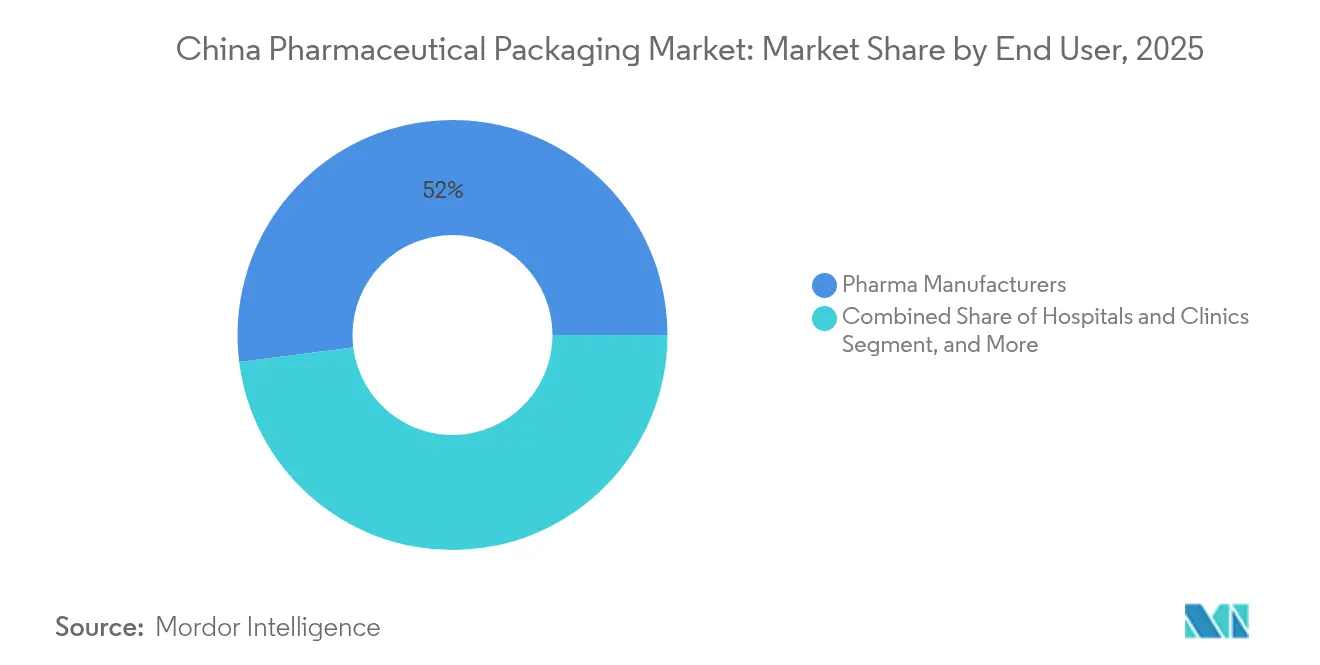
Manufacturers still purchased 52.01% of packs in 2025, but hospital procurement is climbing at 9.12% CAGR as volume-based tendering channels packaging spend through provincial groups. Centralized orders favour bulk IV bags and nested syringe kits that streamline ward workflows, nudging converters to scale ISO 7 cleanrooms. Haleon’s USD 615 million investment to raise its Tianjin stake secures local supply for institution-channel products. Contract manufacturing organizations adapt by offering late-stage customization to align with diverse provincial barcoding rules, sustaining specialized niches inside the broader China pharmaceutical packaging industry.
By Technology: Smart Packaging Integration Accelerates
Conventional formats still comprised 59.85% revenue in 2025, but connected packs climb at 8.47% CAGR as adherence monitoring and cold-chain visibility become standard. Gerresheimer’s Gx Cap, piloted in local oncology trials, embeds an NFC tag that records each opening event, boosting dose-time accuracy. Anti-counterfeit layers—UV inks, tamper sleeves, and dynamic holograms—expand to comply with nationwide rollout of serialization. Sustainability overlaps with technology: Amcor’s recycled-aluminum Stelvin capsule blends carbon cuts with scannable authenticity markers. These converging trends accelerate digital adoption rates across the China pharmaceutical packaging market.
Geography Analysis
East-coast provinces spearhead output, with Jiangsu, Shandong, and Guangdong anchoring export-oriented drug and packaging plants connected to seaports and bonded zones. The China pharmaceutical packaging market size for these regions benefits from established resin supply chains, cleanroom clusters, and local tax incentives. The Yangtze River Delta’s life-sciences corridor hosts SCHOTT, Gerresheimer, and domestic glass majors, facilitating rapid deployment of ready-to-fill vial capacity that meets EU GMP.
Inland, Sichuan and Hubei leverage government grants to lure fill-finish projects, yet lag in GMP-trained packaging engineers, slowing material localization. Western provinces tap central funds for hospital expansion, raising demand for low-cost bulk bottles that suit centralized procurement budgets. At the same time, Smart Customs systems in 71 cities reduce inspection time for serialized export shipments, enabling faster turnaround for e-pharmacy parcels leaving Shenzhen or Shanghai airports.
Beijing and Shanghai cluster R&D investments—AstraZeneca’s USD 2.5 billion centre and Eli Lilly’s incubator—creating pilot grounds for high-end sustainable and smart packs aimed at early-phase clinical trials. Cross-border e-commerce sellers leverage these hubs for drop-shipping high-value biologics, demanding ultra-insulated cartons and data-logger integration. The geographic mosaic of policy, talent, and infrastructure thus shapes growth trajectories inside the China pharmaceutical packaging market.
Regulatory Landscape
China's pharmaceutical packaging is regulated by the National Medical Products Administration (NMPA). The Pharmaceutical Packaging Materials Annex of the Good Manufacturing Practice for Drugs (2010 Revision) comes into force on January 1, 2026. The Regulations for the Implementation of the Drug Administration Law of the PRC, revised in December 2025, come into effect on May 15, 2026. Article 41 requires packaging manufacturers to follow GMP and maintain a sound quality management system, while provincial drug supervisory departments conduct inspections using the NMPA registry platform and related A-status documentation practices for pharmaceutical packaging materials.
Value Chain Analysis
The value chain starts with upstream feedstocks and substrates such as resins for bottles and blister films, glass tubing and molded glass for vials and ampoules, aluminum foils and laminates, and paper and board aligned to GB/T 35594-2023. These inputs move into conversion and component manufacturing, where GMP-aligned systems and documentation readiness support downstream drug-product registration and audits.
Midstream, primary-packaging specialists supply containers and drug-delivery components to pharma manufacturers and CMOs. Secondary and tertiary packaging converters then add printing, labeling, and parcel-ready protection to support wider distribution. A representative anchor is Gerresheimer Shuangfeng in Danyang and Zhenjiang, which reports more than 900 employees, 100 production lines, and 40,000 square meters of production space across three sites, highlighting how capacity, cleanroom capability, and compliance infrastructure differentiate suppliers for biologics, vaccines, and other sterile applications in China.
Competitive Landscape
The China pharmaceutical packaging market is fragmented, yet rising compliance costs spur consolidation. International players—Amcor, SCHOTT Pharma, Gerresheimer—command premium biologics segments thanks to proprietary polymers, molded-glass know-how, and global validation. Domestic firms counter with cost competitiveness and familiarity with shifting provincial tenders.
Strategic moves illustrate this divergence. Gerresheimer recorded 9.2% organic growth in drug-delivery systems by expanding cyclic olefin syringe lines in Changzhou.[3]TekniPlex boosted European blister-film capacity, then routed Asia-bound volumes via free-trade zones to serve China biotech exports. DS Smith introduced fiber-based chill boxes targeting specialty pharmacy couriers, muscling into segments once dominated by expanded polystyrene.
Meanwhile, Chinese converters pursue mergers: Lakeside Holding’s acquisition of Hupan Pharmaceutical widens contract packing capabilities across oral solids and liquids. As serialization deadlines thin SME ranks, top-tier firms accumulate share, steadily lifting bargaining power upstream and downstream. This evolution reshapes competitive intensity in the China pharmaceutical packaging industry.
China Pharmaceutical Packaging Industry Leaders
-
Gerresheimer Shuangfeng Pharmaceutical Glass (Danyang) Co. Ltd (Gerresheimer AG)
-
West Pharmaceutical Services Inc.
-
Taishan Xinhua Pharmaceutical Packaging Co. Ltd
-
Ningbo Zhengli Pharmaceutical Packaging
-
Amcor Plc
- *Disclaimer: Major Players sorted in no particular order
Market Opportunities and Future Outlook
The 2026 revision of the Regulations for the Implementation of the Drug Administration Law, effective May 15, 2026, tightens traceability requirements for pharmaceutical packaging. The 2025 Chinese Pharmacopoeia (2025 ChP) also introduces a modernized 1+4+58 framework for packaging, emphasizing lifecycle management and safety evaluations including extractables and leachables. This direction shifts supplier qualification toward serialized packaging and stronger data packages.
Gerresheimer Shuangfeng operates specialized facilities in Danyang and Zhenjiang that focus on high-quality packaging for biologics, lyophilization, vaccines, and blood preparations, leveraging 100,000-grade clean rooms. West Synchrony prefillable syringe system availability in China in June 2026 supports a move toward premium parenteral formats, consistent with biologics expansion and hospital demand for ready-to-use injectables.
Recent Industry Developments
- July 2026: Amcor expands packaging facility in Dongguan, China, adding 7,000 sqm manufacturing space and automated warehouse, with completion by 2027. The expansion strengthens local supply for premium packaging in Biopharma and supports sustainability targets. The move broadens Amcor's footprint in China, enabling faster fulfillment across regional supply chains.
- July 2026: Amcor commenced an expansion project at its flexible packaging facility in Dongguan, China, involving a 7,000-square-meter manufacturing facility and automated warehouse, with completion expected by July 2027. The capacity addition strengthens premium flexible packaging offerings in the region. The project deepens local manufacturing capabilities and enhances downstream versatility for packaging needs.
- June 2026: West Synchrony prefillable syringe system available in China to support biopharma ecosystem. The launch expands adoption of prefillable syringes in China. It reinforces local supply options for injectables and supports biologics packaging.
Research Methodology Framework and Report Scope
Market Definition and Coverage
For this study, the China pharmaceutical packaging market is defined as the value of packaging used to protect, contain, identify, and distribute finished medicines within China across primary, secondary, and tertiary packaging used in regulated pharmaceutical supply chains.
Scope exclusions: Packaging used only for nutraceuticals, food supplements, cosmetics, and non-pharmaceutical personal care products is excluded from this market sizing.
Segmentation Overview
- By Packaging Type
- Primary Packaging
- Plastic Bottles (HDPE, PET)
- Blister Packs (PVC, Cold-form Alu)
- Pre-fillable Syringes
- Vials and Ampoules
- IV Containers
- Inhalers
- Others Primary Packaging
- Secondary Packaging
- Folding Cartons
- Corrugated Shippers
- Bags and Pouches
- Clamshells and Trays
- Tertiary Packaging
- Primary Packaging
- By Material
- Plastics
- Glass
- Aluminium Foil / Laminate
- Paper and Paperboard
- By Drug Form
- Solid Oral
- Parenteral
- Topical / Transdermal
- Inhalation
- Ophthalmic
- Other Drug Form
- By End-User
- Pharma Manufacturers
- Contract Manufacturing Organisations (CMOs)
- Hospitals and Clinics
- By Technology
- Conventional
- Aseptic and Sterile
- Smart and Connected (NFC/RFID)
- Anti-counterfeit / Serialisation
- Sustainable / Recyclable Solutions
Data Sources, Market Sizing, and Validation
Desk Research
Desk research is used to build the fact base around China pharma production, trade flows for key packaging materials, and the policy timeline that changes packaging requirements. We mainly rely on public sources such as National Bureau of Statistics of China releases, China Customs import-export statistics, National Medical Products Administration (NMPA) notices, and World Health Organization publications for quality and safety context.
We also review sources such as peer-reviewed journals on pharmaceutical packaging performance, public patent databases to see innovation intensity in barrier materials and anti-counterfeit features, and investor presentations or annual reports from listed packaging and pharmaceutical firms to understand capacity additions and utilization. Where needed, paid subscriptions are used for company financials and intelligence, shipment-level trade checks, and patent landscaping to reduce gaps in coverage. The desk sources listed here are illustrative, and many other public and paid references were used for data collection, validation, and clarification.
Primary Interviews and Surveys
Primary work is used to pressure-test the demand drivers and pricing logic that desk research cannot fully explain, especially across injectables, oral solids, and cold-chain sensitive therapies. We speak with a mix of packaging converters, material suppliers, pharmaceutical manufacturers, and distribution-side stakeholders across major producing provinces and key importing hubs, which helps align assumptions on volumes, specifications, and expected pricing changes.
Distribution of primary research fieldwork respondents
| Company type | Respondent position |
|---|---|
| Top tier: 38% | CXOs: 19% |
| Mid tier: 40% | Functional/Unit leaders: 23% |
| Smaller Players: 22% | Managers: 58% |
Market-Sizing & Forecasting
The core model is built using a top-down demand reconstruction, where pharma output and pack-to-product intensity are used to form a demand pool by major drug forms, which is then converted into value using packaging mix and average selling price (ASP) assumptions. To keep it grounded, the total is corroborated with selective bottom-up approximations, such as roll-ups of sampled converter revenues, channel checks on high-volume formats, and ASP times volume spot checks for a few representative pack types.
Key inputs that move the model include production trends for tablets and capsules versus injectables, the mix shift toward prefilled and ready-to-use sterile packaging, changes in glass and polymer feedstock prices, serialization and traceability adoption timing, and export-driven packaging needs that increase secondary and tertiary packaging content. When inputs did not exist in a clean time series, gaps were handled by using adjacent indicators (for example, proxying format growth from therapy mix shifts) and then re-checking the implied unit economics with interview feedback.
Forecasting is done using scenario analysis supported by short-cycle indicators, since policy changes and material price swings can shift packaging value quickly. Variables are projected with a mix of public outlooks and primary consensus, and then the market value is rolled forward with explicit volume and ASP paths rather than a single blanket growth rate.
Data Validation & Update Cycle
Outputs are validated through multiple checks, starting with sanity tests versus independent signals such as pharma manufacturing growth, trade movements of packaging materials, and known capacity expansions. Any large variance is reviewed, assumptions are revisited, and follow-up questions are triggered with industry participants when the model implies unusual price or mix changes.
Before sign-off, the model is reviewed in steps, where calculations are audited, year-to-year jumps are explained, and segment totals reconcile to the overall market. Reports are refreshed annually, and interim updates are made when material events occur such as regulatory changes, large capacity additions, or sustained feedstock price shocks. Right before delivery, a final review pass is completed so the published view reflects the latest available information.
Mordor Intelligence's China Pharmaceutical Packaging Market Size Compared Against Other Published Estimates
Published market values for China pharmaceutical packaging can look far apart because studies often time their currency conversions differently and refresh pricing assumptions at different points in the year, which matters when polymers, glass, and aluminum costs swing. The spread also grows when some sources blend adjacent demand pools like broader healthcare packaging, or when they treat secondary and tertiary packs with a different inclusion threshold.
In our work, the main gap drivers usually come down to how ASP progression is modeled, whether hospital and retail distribution packs are counted consistently, and how strictly policy-driven upgrades like serialization are translated into value uplift. A refresh-led workflow, where RMB to USD timing, key material price movements, and interview-based validation checks are re-run close to publication, is a practical reason the 2025 estimate differs in this report, a modeling choice applied by Mordor Intelligence.
Benchmark comparison
| Source | Market Size | Gaps in Research Methodology |
|---|---|---|
| Mordor Intelligence | USD 21.13 B (2025) | |
| Industry Publisher A | USD 10.11 B (2024) | Uses an earlier base year and a smaller counted scope in practice, and the published view gives limited detail on how packaging mix and ASP are updated when material costs and format mix shift. |
| Industry Journal B | USD 16.94 B (2022) | Relies on an older point-in-time figure and does not clearly separate pharmaceutical packaging from adjacent packaging categories, which can understate upgrades from newer compliance and traceability requirements. |
Taken together, the differences are largely explained by timing and boundary choices rather than arithmetic. When currency timing, pack-content assumptions, and price refresh points are made explicit and then checked with real-world participants, the resulting market size becomes easier to trace and simpler to update in later cycles.
Key Questions Answered in the Report
What is the current size of the China pharmaceutical packaging market?
The market stands at USD 22.41 billion in 2026 and is forecast to rise to USD 30.07 billion by 2031 at a 6.05% CAGR.
Which packaging type leads revenue in China?
Primary packaging dominates with 61.88% share in 2025 as demand for sterile vials, syringes, and high-barrier blisters accelerates.
How fast is smart packaging growing in China?
Smart and connected formats using NFC or RFID are expected to post an 8.47% CAGR between 2026 and 2031.
What raw-material risks affect Chinese converters?
Volatile polyethylene and PVC prices, coupled with higher import tariffs, compress margins and compel diversification into glass and fiber substrates.
Why are parenteral packs the fastest-growing drug-form segment?
Biologics expansion and hospital preference for ready-to-use injectables push parenteral packaging volume at a 9.12% CAGR through 2031.
How do carbon-neutrality goals influence material choices?
Provincial green-procurement policies reward recyclable or fiber-based packs, prompting an 8.35% CAGR for paper & paperboard solutions.