
Market Overview
| Study Period | 2020 - 2031 |
|---|---|
| Forecast Data Period | 2026 - 2031 |
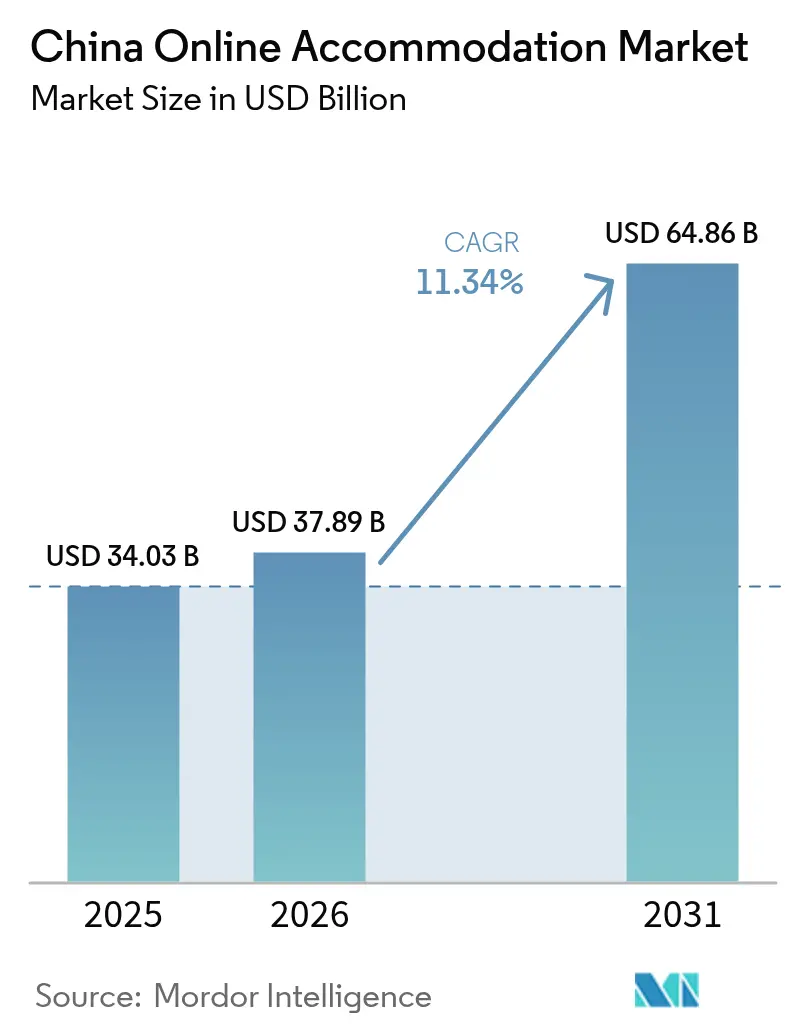
| Base Year Market Size (2025) | USD 34.03 Billion |
| Market Size (2026) | USD 37.89 Billion |
| Market Size (2031) | USD 64.86 Billion |
| Growth Rate (2026 - 2031) | 11.34 % |
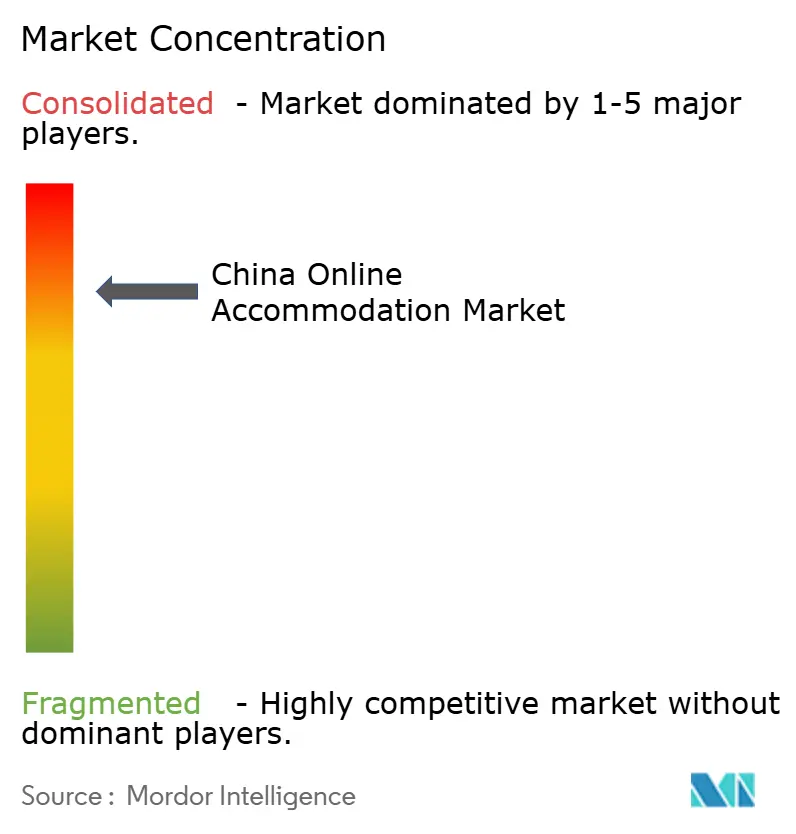
| Market Concentration | High |
Major Players *Disclaimer: Major Players sorted in no particular order Image © Mordor Intelligence. Reuse requires attribution under CC BY 4.0. | |
China Online Accommodation Market Analysis by Mordor Intelligence
The China online accommodation market size was valued at USD 34.03 billion in 2025 and estimated to grow from USD 37.89 billion in 2026 to reach USD 64.86 billion by 2031, at a CAGR of 11.34% during the forecast period (2026-2031). Momentum comes from the domestic tourism rebound, with 4.891 billion trips taken in 2023, and from deeper digital penetration that places mobile booking at the center of every travel journey. Platforms are intensifying investments in AI-driven personalization and in rural homestay supply to capture experience-seeking consumers. Regulatory clarity on cross-border data flows, coupled with government programs that funnel capital into transport nodes, underpins long-term confidence. Price-sensitive independent hotels, however, continue to struggle with rising OTA commissions and cybersecurity compliance costs, prompting experiments with direct-booking channels.
Key Report Takeaways
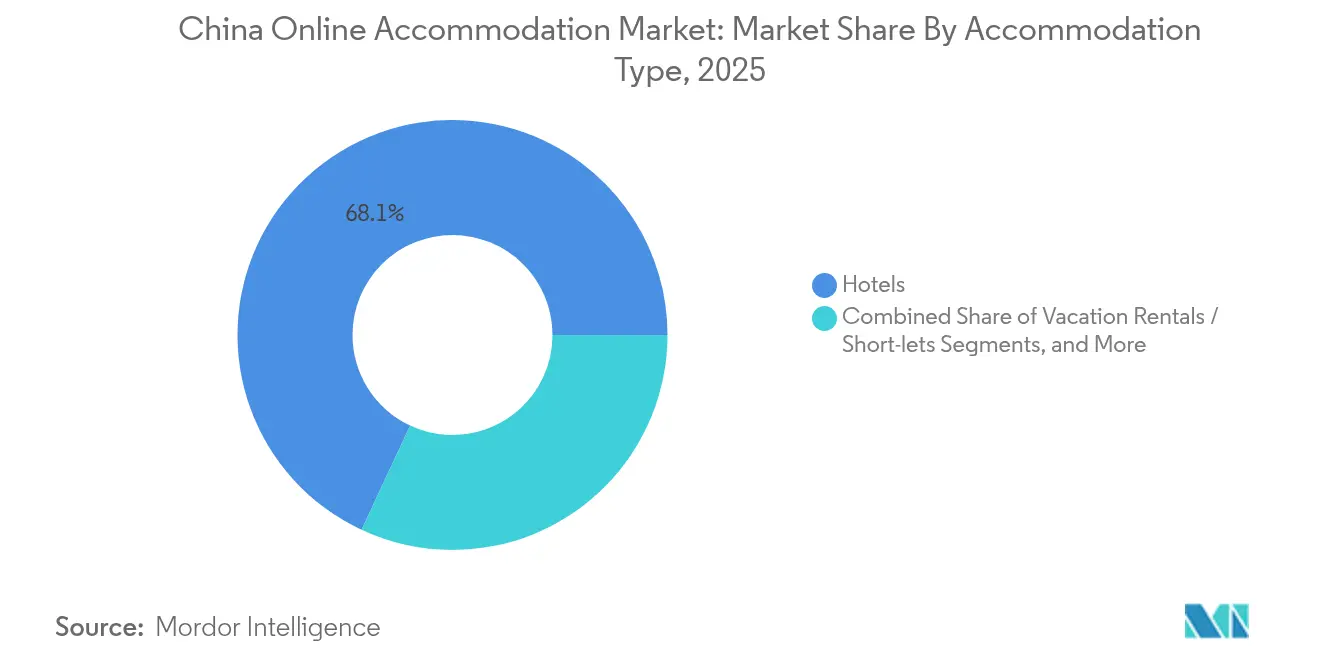
- By accommodation type, hotels led with 68.05% revenue share in 2025; vacation rentals and short-lets are forecast to expand at a 14.03% CAGR to 2031 in the China online accommodation market.
- By booking device, mobile apps captured 81.75% of the China online accommodation market share in 2025, while the same channel is advancing at a 17.12% CAGR through 2031.
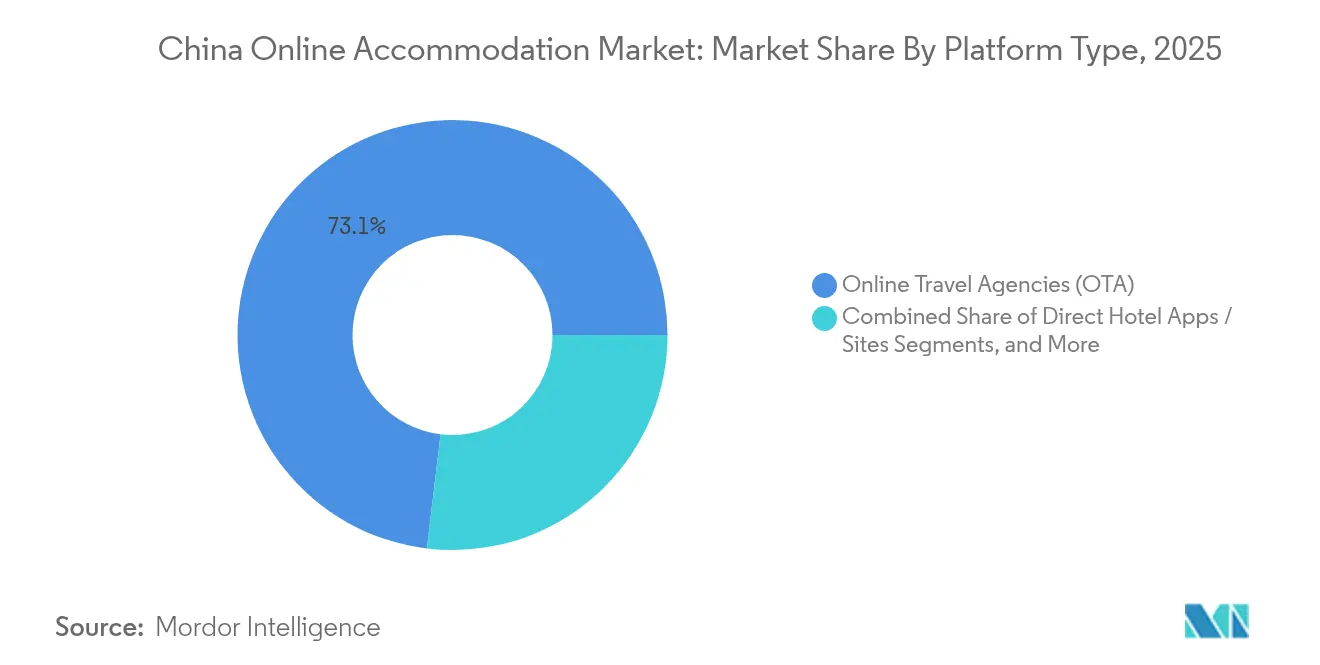
- By platform type, online travel agencies held 73.10% of the China online accommodation market share in 2025; super-app ecosystems are set to grow at a 12.55% CAGR between 2026-2031.
- By customer type, leisure travelers accounted for a 63.88% share of the China online accommodation market size in 2025, whereas long-stay and relocation bookings show the highest projected CAGR at 15.39% to 2031.
- By region, East China commanded 33.22% of the China online accommodation market size in 2025; South-Central China is the fastest-growing region with a 13.05% CAGR expected over 2026-2031.
- The China online accommodation market remains moderately concentrated: Trip.com Group, Meituan, Tongcheng Travel, Fliggy and Booking.com collectively control the majority of online room nights.
Note: Market size and forecast figures in this report are generated using Mordor Intelligence’s proprietary estimation framework, updated with the latest available data and insights as of 2026.
China Online Accommodation Market Trends and Insights
Drivers Impact Analysis*
| Driver | (~) % Impact on CAGR Forecast | Geographic Relevance | Impact Timeline |
|---|---|---|---|
| Post-pandemic domestic tourism rebound | +2.8% | National, with stronger impact in East China and South-Central China | Medium term (2-4 years) |
| Rise of Experience-Based Travel | +2.1% | Urban centers and cultural tourism destinations nationwide | Long term (≥ 4 years) |
| Growth of OTAs and Super Apps | +3.2% | National, with highest penetration in Tier 1 and Tier 2 cities | Short term (≤ 2 years) |
| Government Support and Regulatory Clarity | +1.4% | National, with focused benefits in designated tourism zones | Long term (≥ 4 years) |
| High Internet and Smartphone Penetration | +1.8% | National, with accelerated impact in lower-tier cities | Short term (≤ 2 years) |
| Urbanization and Tier Expansion | +2.2% | Tier 2, Tier 3, and emerging Tier 4 cities | Long term (≥ 4 years) |
| Source: Mordor Intelligence | |||
Post-pandemic Domestic Tourism Rebound
Holiday periods in 2024 kept that pace, with the Spring Festival alone delivering 474 million trips and upscale-hotel occupancy exceeding 80%. Travellers gravitated toward local experiences, which shifted booking volumes from international to domestic inventory and opened incremental demand in rural destinations. Nearly 800 million visitors explored countryside attractions during Q1 2024, prompting platforms to fast-track listings in peripheral counties. The surge unlocked new lodge construction outside urban cores and broadened the China online accommodation market footprint.
Rise of Experience-Based Travel
Millennials and Gen Z now prioritize immersive stays: 77% of their trips are booked less than a month in advance, favoring spontaneous weekend getaways. “Traveling-at-home” trends—young residents checking into hotels in their hometowns—boosted local bookings during major holidays. Hotels, hostels and vacation rentals are weaving regional décor and artisanal workshops into packages to satisfy authenticity cravings. Douyin’s short-video creators amplify this shift by linking viral content to instant booking pages, a loop that accelerates conversion for boutique stays. As cultural immersion becomes mainstream, experience-themed inventory raises ADRs across secondary cities, fortifying long-tail supply on leading platforms.
Growth of OTAs and Super Apps
Leading OTAs together processed more than RMB 700 billion (USD 97.58 billion) in gross bookings during the most recent pre-pandemic half-year and have since scaled further, helped by broader smartphone adoption. WeChat mini-programs embed one-click room reservations inside a daily-use messaging environment, lowering discovery friction and nudging impulse purchases. Trip.com Group reported RMB 4.5 billion (USD 623 million) in Q1 2024 accommodation revenue, up 29% year-over-year, a testament to higher transaction frequency and richer product bundles. As OTAs are pushed into third- and fourth-tier cities, mobile design simplicity and alternative payment methods remain key levers for capturing incremental users.
Government Support and Regulatory Clarity
A May 2024 directive mandated nationwide acceptance of foreign guests at all hotels, lifting legacy licensing barriers that limited international demand[1].Parallel efforts from the Ministry of Commerce and the China Hotel Association provide English-language training, enhancing service consistency at independent properties. New cross-border data-flow rules, effective March 2024, deliver clearer compliance templates, allowing both domestic and international platforms to invest confidently in data analytics and loyalty management. Infrastructure financing—ranging from high-speed rail to rural tourism corridors—reinforces demand stimuli, setting the stage for stable, policy-backed expansion of the Chinese online accommodation market.
Restraints Impact Analysis*
| Restraint | (~) % Impact on CAGR Forecast | Geographic Relevance | Impact Timeline |
|---|---|---|---|
| OTA commission pressure on hotel margins | -1.8% | National, with higher impact on independent hotels | Short term (≤ 2 years) |
| Cyber-security and data-privacy regulations (PIPL) | -1.2% | National, with compliance costs affecting all digital platforms | Medium term (2-4 years) |
| Shrinking supply of urban budget hotels | -1.5% | Tier 1 cities and major urban centers | Medium term (2-4 years) |
| Inter-platform price-parity clamp-downs | -0.9% | National, with strongest impact on major OTA platforms | Short term (≤ 2 years) |
| Source: Mordor Intelligence | |||
OTA Commission Pressure on Hotel Margins
Large OTAs command up to 20% commissions, eroding profitability for budget and mid-range operators. Continuous customer-acquisition spending by platforms pushes commissions higher, and independent properties lack scale to negotiate relief. To offset rising costs, hotels roll out direct-booking apps and partnership loyalty schemes, yet open-web marketing expenses temper their effectiveness. The imbalance is expected to nudge asset-light franchises and monarchized models forward, as they offer combined brand awareness and margin resilience.
Cyber-security and Data-privacy Regulations (PIPL)
China's Personal Information Protection Law and the new Regulations on Network Data Security Management, effective January 1, 2025. Platforms handling the data of over 10 million users must establish specialised security units, store audit logs for three years, and report all incidents within 24 hours[2]. The regulations also impose restrictions on cross-border data transfers, potentially limiting international platforms' ability to integrate Chinese operations with global systems. Compliance costs are particularly burdensome for smaller platforms and accommodation providers, potentially accelerating market consolidation as only well-resourced players can afford a comprehensive data protection infrastructure.
*Our forecasts treat driver/restraint impacts as directional, not additive. The impact forecasts reflect baseline growth, mix effects, and variable interactions.
Segment Analysis
By Accommodation Type: Hotels Maintain Dominance Amid Vacation Rental Surge
Hotels captured 68.05% of China's online accommodation market revenue in 2025, a testament to entrenched loyalty programs and robust distribution through major OTAs. Vacation rentals and short-lets, however, are projected to grow at a 14.03% CAGR, driven by travelers appetite for home-style amenities in emerging leisure hubs. Tujia lists more than 2.3 million units, giving it roughly 60% share of the niche and signaling that branded inventory curation is displacing informal hosts. Diversification is growing serviced apartments win favor among relocating professionals, while rural homestays expand as agritourism booms. Capsule hotels keep attracting value-focused Gen Z guests, yet premiumization across the broader China online accommodation market limits their long-run ceiling.
Preference for authenticity feeds a pipeline of hybrid models that fuse hotel services with residential layouts. Operators pilot subscription-based packages granting pool access and co-working space, aligning with digital-nomad habits. Domestic REITs include compliant homestay portfolios, reflecting investor belief in experience-driven demand. The market is therefore expected to witness intensified competition between asset-heavy hotel groups and asset-light rental platforms, each racing to widen supply breadth without compromising service standards.

By Booking Device: Mobile App Dominance Accelerates
Mobile apps controlled 81.75% of the China online accommodation market share in 2025 and are on course for a 17.12% CAGR through 2031 as super-apps weave reservation capabilities into daily utilities. With built-in wallets and loyalty points, users can book, pay and review within a single interface, collapsing the path-to-purchase into seconds. The China online accommodation market rewards speed: abandoned-cart rates drop sharply when biometric payment shortcuts auto-populate guest information.
Browser-based mobile sites retain value for extended research, especially among older demographics who prefer larger font scaling, yet they concede traffic as app UX refined. Desktop usage now concentrates on corporate travel desks where multi-traveler workflows matter most. Continuous rollouts of AI chatbots, live-stream showrooms and augmented-reality room previews maintain user attention, ensuring that mobile remains the defining battleground for platform differentiation.
By Platform Type: OTAs Lead While Super-Apps Gain Momentum
OTAs accounted for 73.10% of China online accommodation market bookings in 2025, benefiting from deep inventory, powerful cross-sell engines and extensive loyalty umbrellas. Super-apps, spearheaded by WeChat mini programs, are tracking a 12.55% CAGR to 2031 as consumer convenience trumps standalone browsing. WeChat funnels social influence into travel purchase by letting friends co-browse room types and split bills, amplifying word-of-mouth conversions. Hotels respond with targeted flash-sales inside these ecosystems to dilute OTA dependency.
Hotel-brand apps pick up pace through exclusive perks, free room upgrades and points multipliers. Chains such as IHG integrate digital check-in, meeting-room booking and upselling of F&B vouchers, nudging corporate travelers toward direct channels. Aggregators and suppliers now co-exist in an omnichannel mix, compelling revenue managers to juggle channel cost trade-offs. Future competitive edge lies in real-time API connectivity that unifies inventory, pricing, and guest-profile data across all touchpoints of the China online accommodation industry.
By Customer Type: Leisure Dominance with Long-Stay Emergence
Leisure and FIT travel represented 63.88% of the China online accommodation market size in 2025, powered by flexible family time and rising disposable incomes. Parallelly, long-stay and relocation demand a 15.39% CAGR, propelled by remote-work acceptance and urban migration of young professionals. Corporate leases for serviced apartments are lengthened as companies recalibrate mobility budgets, handing operators the chance to guarantee base occupancy. Leisure guests increasingly blend work and holiday, creating “bleisure” patterns that elongate average length of stay and lift ancillary revenue streams.
Business-travel recovery remains uneven; video-conference substitution holds back frequent short trips even as MICE events resume in major convention hubs. Group travel picks up where corporates arrange incentive tours to Tier 3 cities, spreading demand to new nodes and distributing spill-over bookings to smaller hotel chains. Personalized bundled packages—pairing stays with theme-park entry or hot-spring passes—keep broadening the appeal of the China online accommodation market beyond traditional city breaks.
Geography Analysis
East China’s lodging market benefits from sustained international linkages through Pudong and Xiaoshan airports. Continuous high-speed rail integration knits smaller cities into weekend-trip radii, adding depth to demand. Average occupancy in Shanghai premium hotels remained above 70% in 2024, prompting global brands to chase repositioning opportunities in heritage buildings. The region’s hotel operators focus on gastronomic experiences and art-themed interiors to differentiate amid mounting product homogeneity.
South-Central China is evolving into the growth locomotive of the China online accommodation market. Chongqing’s tourism bureau reported multi-digit visitor increases after the opening of its latest suspension bridge jump attraction, while Wuhan leveraged its Yangtze River cruise terminals to woo coastal vacationers. Aggressive airport expansions and upgraded metro networks compress travel friction; hoteliers respond with midscale properties that match rising yet still cost-sensitive middle-class expectations.
Across North, Southwest, Northeast and Northwest China, diverse catalysts shape local lodging contours. Winter sports grants revive demand in Jilin ski resorts, Silk Road heritage circuits spur hostel launches in Gansu, and cross-border e-visa policies increase inflows to Xinjiang. Government-backed eco-tourism pilots in Sichuan’s pandas reserves foster alliances between global hospitality groups and conservation-led developers. Collectively these shifts reinforce geographic diversification, cushioning the national market against regional shocks.
Regulatory Landscape
China online accommodation is governed by a multi-agency framework led by the Ministry of Culture and Tourism, with oversight roles spanning the Ministry of Commerce (inbound service optimization and platform conduct), the State Administration for Market Regulation (platform competition and merchant-rule enforcement), and cyber/data authorities under the Personal Information Protection Law. A May 2024 Ministry of Commerce notice requiring hotels to accept foreign guests nationwide, and prohibiting platforms from using qualification requirements to restrict foreign personnel from booking, directly affects platform merchandising rules and accommodation onboarding practices for inbound demand.
Standardization and data-security compliance have tightened operating requirements for OTAs and super-app ecosystems. LB/T 094-2025 (Specification of accommodation booking service for online travel platform), effective August 19, 2025, formalizes service requirements across booking, change/cancellation, disclosures, and platform responsibilities, reinforcing consistent consumer-facing processes at scale. In parallel, the Regulations on Network Data Security Management effective January 1, 2025 raise governance burdens for large platforms (including incident reporting and audit-log retention), increasing the compliance advantage of well-resourced players while pushing smaller operators toward standardized tooling and platform partnerships.
Value Chain Analysis
Supply begins with hotels, serviced apartments, hostels/capsule operators, and legally registered short-term rentals that create room inventory, set rate fences, and operate property management systems (PMS) and channel managers. Distribution is dominated by OTAs and super-app ecosystems that aggregate inventory, run search and recommendation, manage settlement, and provide customer service, with supporting enablers including payment rails (Alipay/WeChat Pay), cloud and AI stacks, mapping/location services, identity verification, and review/content ecosystems (including short-video led discovery). Conversion and fulfillment span marketing (performance ads, live-streaming, mini-program traffic), booking and payment, confirmation messaging, and post-stay review and refund handling.
The chain is increasingly defined by API-level connectivity and ecosystem partnerships that expand both supply and real-time rate availability. Fliggy expanded its lodging connectivity through technology partnerships such as Amadeus Value Hotels to broaden property types and live rates, while supply-side integrations bring international chains and multi-brand groups into China-facing discovery funnels (for example, Minor Hotels integrating more than 80,000 rooms across eight brands into Fliggy’s Global Discovery platform). On the platform side, AI layers are being embedded into the booking journey to increase attach and reduce friction: Fliggy and the Qwen AI assistant expanded to an ecosystem of 80-plus partners (including Hyatt Hotels Corp and multiple China hotel groups), signaling a move toward AI-assisted planning that influences how inventory is packaged, ranked, and converted.
Competitive Landscape
The China online accommodation market remains moderately concentrated: Trip.com Group, Meituan, Tongcheng Travel, Fliggy and Booking.com collectively control the majority of online room nights. Trip.com logged RMB 17.3 billion (USD 2.4 billion) in accommodation revenue for 2023, up 133% year-on-year, underscoring the platform’s post-pandemic rebound. Meituan cross-sells hotel vouchers to its food-delivery users, capturing impulse bookings through same-app wallet balances. Tongcheng leverages transport ticketing data to upsell rooms adjacent to train stations, pushing conversion via precision targeting.
H World Group advocates an asset-light strategy: franchised and managed hotels contributed RMB 2.5 billion (USD 344 million) revenue in Q1 2025, with 21% growth [3]. Global chains—including Marriott, Accor and Hilton—embrace localization through joint ventures that expedite land-use approvals and tap local design influences. Vacation-rental disruptor Tujia fortifies its lead by onboarding professional property managers and layering service guarantees, lifting consumer trust in private-stay inventory.
Technology is the competitive fulcrum. AI-based chat agents streamline pre-arrival queries, lowering labor costs and heighten satisfaction scores. Dynamic-pricing engines crunch multi-source demand signals to refine RevPAR, and blockchain pilots attest to contract authenticity for corporate allotments. The convergence of travel with super-app ecosystems suggests that future winners will be those embedding lodging into daily-life apps, harvesting network effects that transcend classic search-and-book funnels.
China Online Accommodation Industry Leaders
-
Trip.com Group (Ctrip + Qunar)
-
Meituan
-
Tongcheng Travel
-
Fliggy (Alibaba)
-
Booking.com
- *Disclaimer: Major Players sorted in no particular order
Market Opportunities and Future Outlook
Inbound travel enablement is a clear commercialization whitespace for online accommodation platforms, supported by policy actions that reduce friction and expand addressable demand. The May 2024 directive mandating nationwide acceptance of foreign guests at all hotels, together with programs that improve English-language service capabilities, creates room for platforms to productize inbound-ready inventory (clear ID requirements, multilingual descriptions, and standardized cancellation terms) and to improve payment acceptance and customer support for international users. Trip.com Group has publicly framed inbound travel as a strategic priority, including a stated goal to serve 200 million inbound travelers over five years, which aligns platform investment toward multilingual service, partner onboarding, and inventory curation across cities beyond the traditional gateways.
AI-native booking interfaces and super-app distribution create another opportunity area: platforms are shifting from keyword search and price-led sorting toward agentic flows that bundle lodging with transport and local experiences. Examples include Meituan’s AI-led travel pivot and Tongcheng Travel integrating its AI assistant (DeepTrip) into air ticketing and transportation to deliver end-to-end itineraries, which can increase accommodation conversion through better intent capture and packaging. At the same time, intensified platform oversight on pricing autonomy and advertising practices is forcing clearer merchant rules and disclosures; this pushes opportunity toward compliant merchandising tooling, transparent fee structures, and direct connectivity with PMS/channel managers that can keep inventory accurate while meeting evolving governance requirements.
Recent Industry Developments
- July 2026: Chinese authorities moved to wrap up an antitrust probe into Trip.com Group that began in January 2026, with market discussion centered on a potential multibillion-yuan fine range. The case increased scrutiny of platform conduct and supplier rules, shaping how leading OTAs manage merchant terms, pricing practices, and competitive behavior.
- June 2026: Regulators summoned major travel platforms including Trip.com, Meituan, Tongcheng Travel, Qunar, and Fliggy over alleged deceptive train-ticket sales practices and related data and marketing compliance issues. The action accelerated compliance-driven adjustments to ancillary sales flows and reinforced tighter supervision of platform disclosures that sit adjacent to accommodation conversion.
- May 2025: H World Group expanded its hotel network, increasing inventory across OTAs and super-app ecosystems. The growth amplifies platform competition for inventory and margin-efficient room-night acquisition, reinforcing the importance of scalable onboarding and distribution partnerships.
Research Methodology Framework and Report Scope
Market Definition and Coverage
For this study, the China online accommodation market means the value of paid lodging reservations that are initiated, transacted, and confirmed through internet-enabled platforms in China, mainly mobile apps and websites. It covers bookings across hotels and other legally registered lodging types used by domestic and inbound travelers.
Scope exclusions: We exclude fully offline reservations, pure airline-bundled tour packages, and unlicensed peer-to-peer home-stays.
Segmentation Overview
- By Accommodation Type
- Hotels
- Vacation Rentals / Short-lets
- Hostels and Capsule Hotels
- Serviced Apartments
- By Booking Device
- Mobile App
- Mobile Web
- Desktop / Laptop
- By Platform Type
- Online Travel Agencies (OTA)
- Direct Hotel Apps / Sites
- Super-app Ecosystems (WeChat Mini-Programs)
- By Customer Type
- Leisure / FIT
- Business Travel
- Group and MICE
- Long-stay / Relocation
- By Region
- East China
- North China
- Northeast China
- South-Central China
- Southwest China
- Northwest China
- Hong Kong and Macau SARs
- Taiwan Region
Data Sources, Market Sizing, and Validation
Desk Research
Desk work started with building a clean view of travel demand and lodging supply signals in China, and then aligning definitions so we do not mix online booking value with total hospitality spending. Public sources such as the Ministry of Culture and Tourism releases, the National Bureau of Statistics of China, and the Civil Aviation Administration of China were used to anchor travel flows and seasonality patterns. We also reviewed materials from large tourism and hotel associations, plus major listed company annual reports, investor presentations, and reputable press coverage for business model and commission structures.
To reduce gaps in company-level details, we also leaned on paid subscriptions that compile company financials and news, along with a patent database to understand feature shifts that can affect conversion and cancellation behavior. Where helpful, we checked public policy and consumer trend notes from official portals to understand major rule changes affecting short-term rentals and registrations. The desk research sources mentioned here are illustrative only, and many other public documents and datasets were also used for data collection, validation, and clarification.
Primary Interviews and Surveys
Primary work focused on validating what actually gets counted as online accommodation value in China, and how platform commissions, merchant models, and cancellation practices move reported revenue versus booking value. We spoke with a mix of online travel intermediaries, lodging operators, and supporting ecosystem participants, and then we used those inputs to confirm assumptions across major demand corridors and city tiers in China.
Distribution of primary research fieldwork respondents
| Company type | Respondent position |
|---|---|
| Top tier: 25% | CXOs: 12% |
| Mid tier: 59% | Functional/Unit leaders: 33% |
| Smaller Players: 16% | Managers: 55% |
Market-Sizing & Forecasting
Sizing was built using a top-down approach where travel activity and lodging demand indicators are reconstructed into an online-booking value pool, and then converted into market value using observed online booking behavior. We used bottom-up approximations as a check, mainly by sampling platform and hotel group disclosures, applying typical take rates, and validating average booking values across common room-night patterns.
Key model inputs included domestic and inbound trip volumes, accommodation occupancy and ADR movement, online booking penetration by traveler type, cancellation and refund behavior, and the mix shift between hotels and regulated alternative lodging. Because China has strong holiday-driven peaks, we also stress-tested monthly seasonality against known travel windows to avoid overstating a single quarter. Where the bottom-up check had gaps (for example, private operators with limited disclosures), we filled them using range assumptions that were confirmed through interviews and then capped using demand-side constraints.
For forecasting, we relied on scenario analysis supported by a small set of drivers that interviewees consistently pointed to, including travel recovery pace, app-based booking adoption in lower-tier cities, ADR inflation, and regulatory tightening or easing for short-term rentals. The forecast was then reviewed year by year to ensure the implied room-nights and booking values stayed realistic versus the macro travel signals.
Data Validation & Update Cycle
Validation is done by triangulating the model output with independent signals such as tourism trip counts, hotel performance indicators, and platform-reported operating metrics that relate to lodging bookings. Outliers are flagged, and then the assumptions behind ADR, online penetration, and cancellation rates are revisited before numbers move forward.
A multi-step review is followed, where one analyst checks the build and another reviews logic, math, and reasonableness across years. If a major variance shows up or a new rule meaningfully changes booking behavior, we re-contact sources to confirm what changed and when it started to matter. The report is refreshed annually, with interim updates for material events, and a final pre-delivery check is completed so the latest public information is reflected.
Mordor Intelligence's China Online Accommodation Market Size Measured Against Other Published Estimates
Published market sizes for China online accommodation often do not match because the counted value can shift based on what is treated as an online booking, which lodging types are included, and whether numbers reflect gross booking value or only the platform revenue. Timing also matters, since some sources choose different base years and apply different currency conversion points.
App-based booking share signals, lodging occupancy and ADR checks, and the split between regulated lodging types are the evidence points that keep Mordor Intelligence's 2025 estimate tied to paid reservations confirmed online, instead of drifting into offline hospitality spend. The biggest gaps usually come from mixing in offline hotel reservations, counting packaged travel bundles as accommodation, or applying aggressive online penetration and price growth without validating cancellation and refund behavior.
Benchmark comparison
| Source | Market Size | Gaps in Research Methodology |
|---|---|---|
| Mordor Intelligence | USD 34.03 B (2025) | |
| Industry Data Publisher A | USD 23.80 B (2024) | Uses a different base year and may define the market as online booking platform revenue with narrower lodging coverage, which can understate totals versus gross booking value counted across regulated lodging types. |
| Global Consultancy B | USD 42.05 B (2026) | Starts from a later year and can embed faster assumed recovery and higher ADR progression, and it may include a broader set of booking channels such as social commerce pathways that are not consistently counted as confirmed transactions. |
Overall, the spread is mainly explained by base-year choice, whether the measure is booking value versus platform revenue, and how consistently bundled travel and informal lodging are filtered out. By tying the build to observable demand and pricing signals and then cross-checking with supplier and platform disclosures, the final number stays traceable to clear steps that can be repeated.
Key Questions Answered in the Report
What is the current size of the China online accommodation market?
The China online accommodation market size stood at USD 37.89 billion in 2026.
How fast is the market expected to grow?
The market is projected to expand at an 11.34% CAGR, reaching USD 64.86 billion by 2031.
Which booking device dominates online reservations?
Mobile apps account for 81.75% of all online room bookings and are growing at a 17.12% CAGR.
Which region records the fastest growth in online accommodation demand?
South-Central China shows the highest forecast CAGR at 13.05% between 2026-2031.
What is the biggest challenge for hotels when working with OTAs?
Rising commission fees, which can exceed 20% of room revenue, compress margins for independent hotels.
Which accommodation segment is gaining traction beyond traditional hotels?
Vacation rentals and short-lets are projected to grow at a 14.03% CAGR as travellers seek home-style experiences.