
China Home Loan Market Size and Share
Market Overview
| Study Period | 2020 - 2031 |
|---|---|
| Forecast Data Period | 2026 - 2031 |
| Base Year Market Size (2025) | USD 1.08 Trillion |
| Market Size (2026) | USD 1.16 Trillion |
| Market Size (2031) | USD 1.63 Trillion |
| Growth Rate (2026 - 2031) | 7.09 % |
| Market Concentration | Medium |
Major Players *Disclaimer: Major Players sorted in no particular order Image © Mordor Intelligence. Reuse requires attribution under CC BY 4.0. | |
China Home Loan Market Analysis by Mordor Intelligence
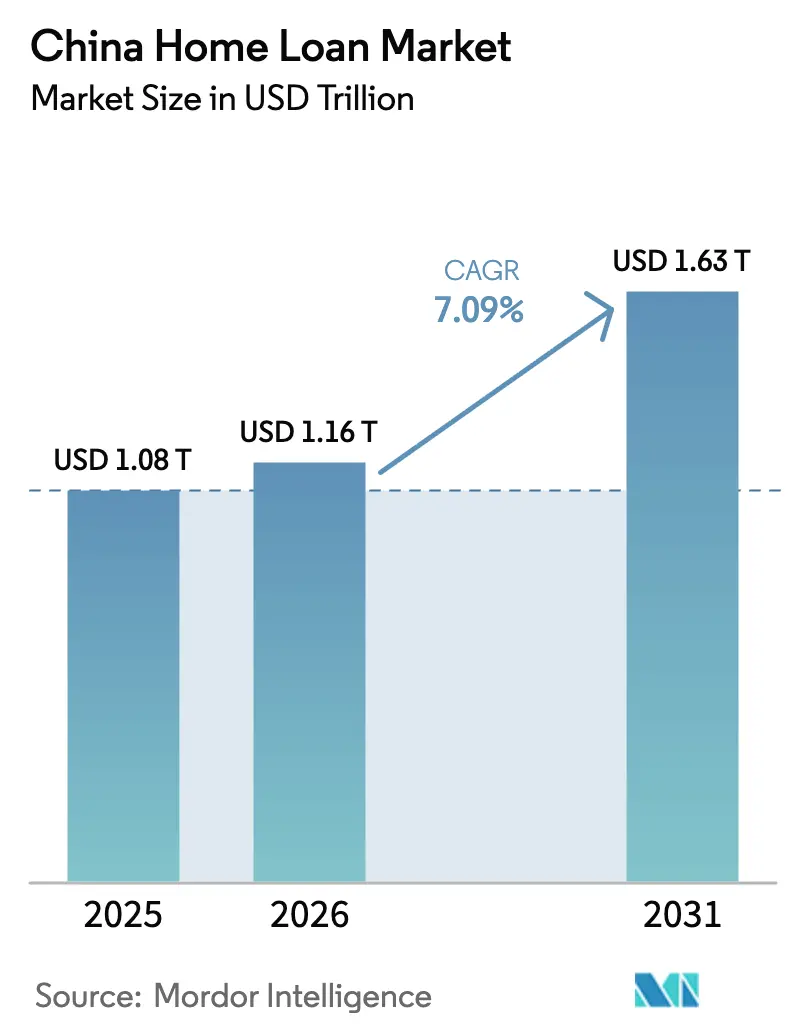
The China home loan market size is expected to grow from USD 1.08 trillion in 2025 to USD 1.16 trillion in 2026 and is forecast to reach USD 1.63 trillion by 2031 at 7.09% CAGR over 2026-2031. Policy loosening has been decisive: the People’s Bank of China (PBOC) cut the 5-year Loan Prime Rate (LPR) multiple times in 2024 and removed mortgage-rate floors, while the State Council lowered minimum down payments to 15% for first-time buyers. Liquidity injections such as a CNY 300 billion affordable-housing facility and larger quotas for the Housing Provident Fund have kept credit flowing and cushioned property-developer stress. At the same time, early digitization gains, especially the adoption of AI-driven origination platforms at WeBank and MYbank, are compressing approval times and broadening borrower coverage. Consolidation momentum—encouraged by regulators to shore up capital—signals a structurally tighter yet more resilient competitive arena.
Key Report Takeaways
- By loan purpose, purchase loans for new and existing homes held a 73.12% share of the Chinese home loan market in 2025, whereas home-improvement loans are projected to advance at a 8.88% CAGR to 2031.
- By provider, banks controlled 86.23% of the China home loan market share in 2025; the “Others” segment is set to expand at 13.55% CAGR through 2031.
- By interest rate structure, floating-rate products captured 93.85% share of the China home loan market size in 2025, while fixed-rate mortgages are expected to post a 10.36% CAGR through 2031.
- By loan tenure, terms above 20 years accounted for 51.69% of the China home loan market size in 2025; the 11-20 year bracket is projected to grow at an 8.54% CAGR over the forecast period.
Note: Market size and forecast figures in this report are generated using Mordor Intelligence’s proprietary estimation framework, updated with the latest available data and insights as of 2026.
Worldwide, activity is shaped by contributions from multiple countries and regions, with China representing one among them. The global report on home loan market by Mordor Intelligence reflects how these countries and regional layers combine into a single system.
Market Trends and Insights
Drivers Impact Analysis of China Home Loan Market*
| Driver | (~) % Impact on CAGR Forecast | Geographic Relevance | Impact Timeline |
|---|---|---|---|
| Easing mortgage rate & down-payment policies | +1.8% | Tier-1 and national spill-over | Short term (≤ 2 years) |
| LPR cuts & accommodative monetary stance | +1.5% | National | Medium term (2-4 years) |
| Housing Provident Fund expansion | +1.2% | Stronger in tier-2/3 cities | Long term (≥ 4 years) |
| AI-driven digital mortgage origination | +0.9% | Urban centres | Medium term (2-4 years) |
| “Quality-home” upgrade demand (green/smart) | +0.6% | Tier-1 cities, expanding to tier-2 markets | Long term (≥ 4 years) |
| Emerging reverse-mortgage solutions for seniors | +0.3% | National, pilot programs in major cities | Long term (≥ 4 years) |
| Source: Mordor Intelligence | |||
Easing Mortgage Rate & Down-Payment Policies
The PBOC’s decision to abolish mortgage-rate floors and trim minimum down payments to 15% for first-time buyers marked the boldest easing since 2008[1]. Immediate traction is visible in Beijing, Shanghai, Shenzhen, and Guangzhou, where first-home rates dropped to 3.05%. The measures entice sidelined buyers back into the market, improve affordability for upgraders, and underpin transaction volumes. Local authorities tailor the parameters by city, balancing stimulus with financial-stability safeguards. Confidence benefits from explicit central-government backing, yet the long-term sustainability of ultra-low rates still depends on broader economic recovery.
LPR Cuts & Accommodative Monetary Stance
The 5-year LPR slipped from 4.2% to 3.5% over 2024, illustrating a structural pivot toward demand-side support [2]. Banks have been instructed to re-price outstanding mortgages lower by roughly 50 basis points, amplifying household cash-flow relief. Fiscal coordination—primarily through larger affordable-housing budgets—reinforces the transmission. Nevertheless, net-interest-margin compression is pressing banks toward tighter cost controls, limiting the room for deeper cuts absent stronger GDP or trade momentum.
Housing Provident Fund Expansion
Outstanding mortgages funded via the Housing Provident Fund rose in 2024 as banks grew cautious on property exposure. The fund’s sub-market rates and government guarantee diversify risk away from commercial balance sheets. Digitalized workflows have slashed approval times, spurring adoption in tier-2 and tier-3 cities. Yet contribution inflows hinge on wage growth, exposing the fund to macro-cycle swings.
AI-Driven Digital Mortgage Origination
WeBank’s cloud-native model now serves 400 million retail users and 4.5 million SMEs, validating AI as a scalable origination engine. Ping An Bank’s in-house algorithms automate document checks and credit scoring, lifting productivity and extending credit to data-light gig-economy borrowers [3]. Regulatory sandboxes facilitate rapid rollout, though data-privacy scrutiny and potential algorithmic bias remain closely watched by the China Banking and Insurance Regulatory Commission.
Restraints Impact Analysis of China Home Loan Market*
| Restraint | (~) % Impact on CAGR Forecast | Geographic Relevance | Impact Timeline |
|---|---|---|---|
| Housing-price volatility & underwater risk | -1.4% | Pronounced in tier-1 | Short term (≤ 2 years) |
| Surge in early mortgage prepayments | -0.8% | Major urban centers | Medium term (2-4 years) |
| Lending-cap rules on banks’ real-estate exposure | -0.7% | National | Long term (≥ 4 years) |
| Credit-risk rise among gig-economy borrowers | -0.5% | Urban centers, particularly tier-1 and tier-2 cities | Medium term (2-4 years) |
| Source: Mordor Intelligence | |||
Housing-Price Volatility & Underwater Risk
Price declines across major cities in 2024 triggered pockets of negative equity that raised delinquency risk and curtailed fresh lending [4]. Lenders responded by front-loading risk buffers and hiking down payments for high-beta districts. Underwater households accelerated repayments, shrinking outstanding portfolios when credit expansion is most needed. Targeted micro-policy relief—such as differentiated rate caps—offsets part of the stress but cannot fully shield balance sheets if broad deflation were to persist.
Surge in Early Mortgage Prepayments
Prepayment volumes spiked in 2024 as borrowers reallocated savings to debt reduction amid weak investment yields. The phenomenon strained mortgage-backed securities cash flows and compressed fee income at originators. Banks now face a balancing act: discouraging uneconomic prepayments while avoiding punitive barriers that could spark consumer backlash.
*Our forecasts treat driver/restraint impacts as directional, not additive. The impact forecasts reflect baseline growth, mix effects, and variable interactions.
China Home Loan Market Segment Analysis
By Loan Purpose:
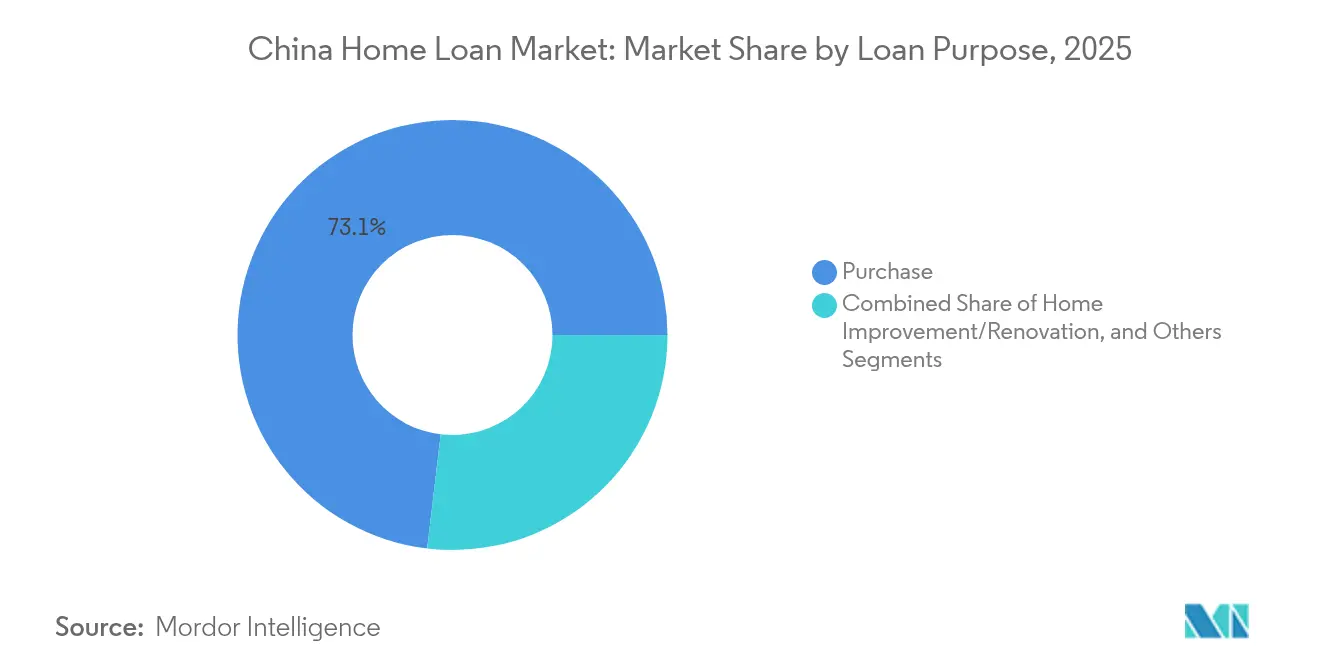
Purchase Loans Drive Market FoundationPurchase loans accounted for 73.12% of the Chinese home loan market in 2025. Benefiting from preferential down-payment rules and LPR-linked pricing, this segment underpins primary-residence demand. The China home loan market size for home-improvement financing is far smaller but is charting a 8.88% CAGR to 2031 as households refurbish ageing stock and tap subsidies for green upgrades.
Policy emphasis on energy-efficient retrofits broadens lender product suites, while digital portals simplify small-ticket loan origination. Conversely, construction and refinancing loans stay muted because developers face funding constraints, and rate differentials between legacy and new mortgages are narrow. Green-building programs spearheaded by local governments nudge lenders to offer rate discounts, a trend likely to add depth to the renovation niche.

By Provider:
Traditional Banks Face Digital DisruptionBanks held 86.23% of the Chinese home loan market share in 2025, underscoring systemic dominance. Other providers are scaling at 13.55% CAGR, propelled by data-driven risk analytics that unlock underserved borrower pools.
Traditional banks are counter-punching through cloud-migration projects and API partnerships; Ping An Bank’s upgraded mobile platform trimmed average approval to under 3 days while ICBC rolled out pre-approval chatbots across 300 cities. Housing Finance Companies, although specialized, lack capital heft and are increasingly seeking tie-ups or merger opportunities to stay relevant. For pure-play fintechs, profitability hinges on maintaining asset-quality discipline as they extend deeper into tier-3 markets.
By Interest Rates:
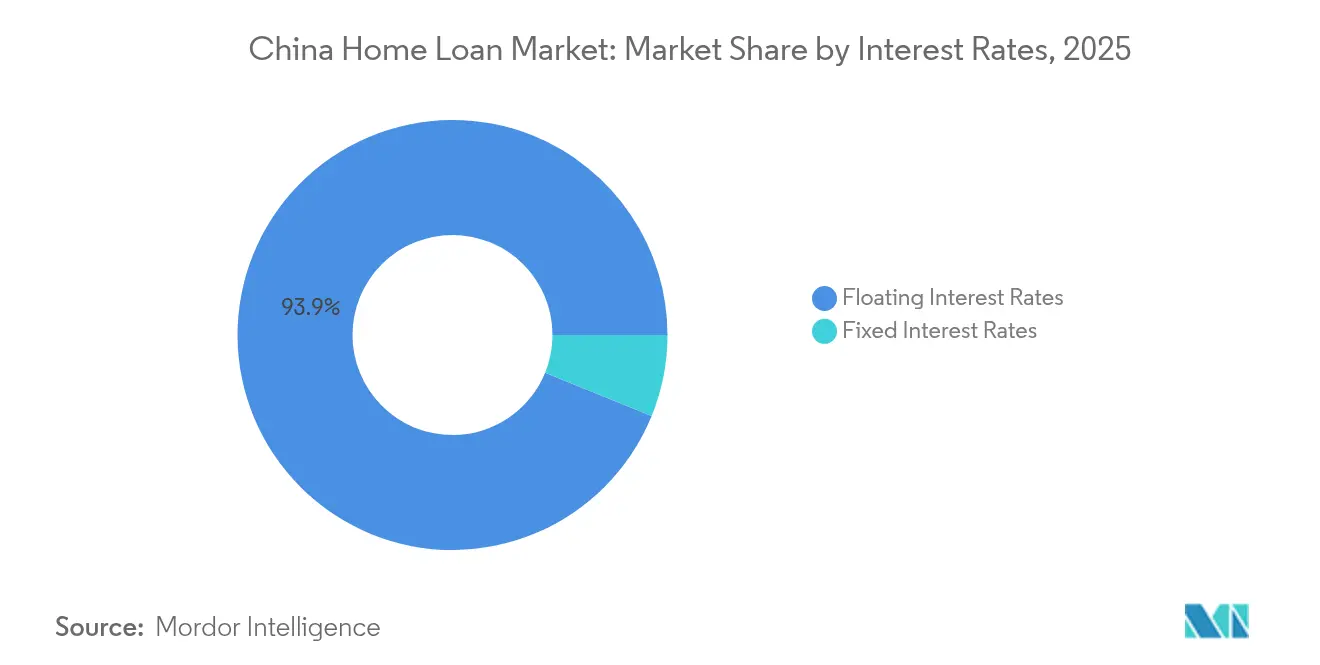
Floating Rates Dominate Amid Policy VolatilityFloating-rate loans, benchmarked to the LPR, made up 93.85% of the Chinese home loan market share in 2025, reflecting borrower expectations of further easing. Yet rising economic uncertainty is nudging a subset of customers toward rate certainty, driving a 10.36% CAGR outlook for fixed-rate products.
Lenders are experimenting with hybrid mortgages that lock a fixed rate for the first 3-5 years before reverting to a float. Such designs preserve margin flexibility for banks yet give borrowers payment stability in the early years. Regional regulators retain discretion to impose minimum spreads, creating scope for competitive positioning across provinces.
By Loan Tenure:
Long-Term Financing Reflects Affordability PressuresLoans above 20 years represented 51.69% of the Chinese home loan market share in 2025, a testament to stretched price-to-income ratios in first-tier hubs. Medium-tenure buckets (11-20 years) are expanding at 8.54% CAGR as borrowers aim to cut lifetime interest while staying within manageable monthly outlays.
Demographic shifts matter: younger households favor longevity to maximize leverage, whereas older cohorts match tenures with projected retirement cash flows. Banks have rolled out step-up repayment schedules and partial principal-holiday options to accommodate income volatility. Parallel pilot programs in reverse-mortgage products could, over time, smooth the exit path for ageing owners, though cultural acceptance remains low.
Geography Analysis
Market depth varies sharply by region. Tier-1 cities retain the largest absolute share of the Chinese home loan market, buoyed by high household incomes, robust employment, and comparatively liquid secondary markets. Beijing’s average first-home rate dipped to 3.05% after the September 2024 policy reset, catalyzing a modest pickup in transactions. However, underwater risk is most acute here, reinforcing risk-adjusted pricing discipline.
Tier-2 and tier-3 cities now deliver the strongest volume momentum thanks to preferential Local Government financing packages and Housing Provident Fund penetration. The China home loan market size within these cohorts is forecast to outgrow tier-1 aggregates over 2026-2031 as lower entry prices intersect with urbanization inflows. Banks, seeing thinner margins in saturated coastal megacities, are redeploying origination capacity inland and partnering with municipal platforms to de-risk exposure.
Western and northeastern provinces remain structurally weaker because of net population outflows and limited industrial diversity. Even so, central-government infrastructure grants and industrial-relocation incentives may gradually brighten credit demand in selected prefectures. Fintech uptake is patchier in these regions as network coverage lags, allowing large state-owned banks to preserve incumbent strengths for the near term.
Mordor Intelligence provides coverage of the home loan market across other key regional markets. Detailed country-level analysis extends to India, United States, and Brazil incorporating local coverage and market participation, as required.
Regulatory Landscape
China's home-loan market is shaped primarily by the People's Bank of China (PBOC) for monetary settings and systemwide mortgage pricing benchmarks, and by the National Financial Regulatory Administration (NFRA) for prudential oversight of lenders. A key anchor for mortgage pricing remains the 5-year Loan Prime Rate (LPR), which stayed at 3.5% through July 2026 (with the 1-year LPR at 3.0%), after being held unchanged for 14 consecutive months, influencing repricing behavior for both new and outstanding mortgages.
Policy easing initiated in 2024 continues to frame retail mortgage terms, including the mechanism that enables rate adjustments on existing residential mortgage loans when a borrower's floating-rate markup diverges materially from prevailing new-mortgage averages. Alongside these pricing levers, authorities keep balancing housing support with financial stability through exposure management at banks and targeted tools designed to keep credit flowing to qualifying housing-related activity without broad-based risk build-up.
Value Chain Analysis
The home-loan value chain in China begins with demand generation through developers, brokers, and online housing platforms, followed by borrower onboarding through bank branches and mobile channels. Underwriting then relies on credit bureaus, income verification, and property valuation, with the core “mortgage manufacturing” concentrated in banks, including ICBC, China Construction Bank, and Agricultural Bank of China, which offer standardized personal housing loan programs. Typical product parameters include maximum tenors up to 30 years and loan-to-value ceilings generally around 80% of the purchase or valuation price.
Execution downstream covers contract signing, mortgage registration and lien perfection, disbursement, and ongoing servicing, including escrow-like repayment collection and post-lending risk management. Digital workflows increasingly span the chain, from application capture to automated checks and customer self-service for interest rate adjustment requests on existing loans, reducing processing frictions and shifting competition toward faster approval and tighter risk selection rather than branch reach alone.
Competitive Landscape
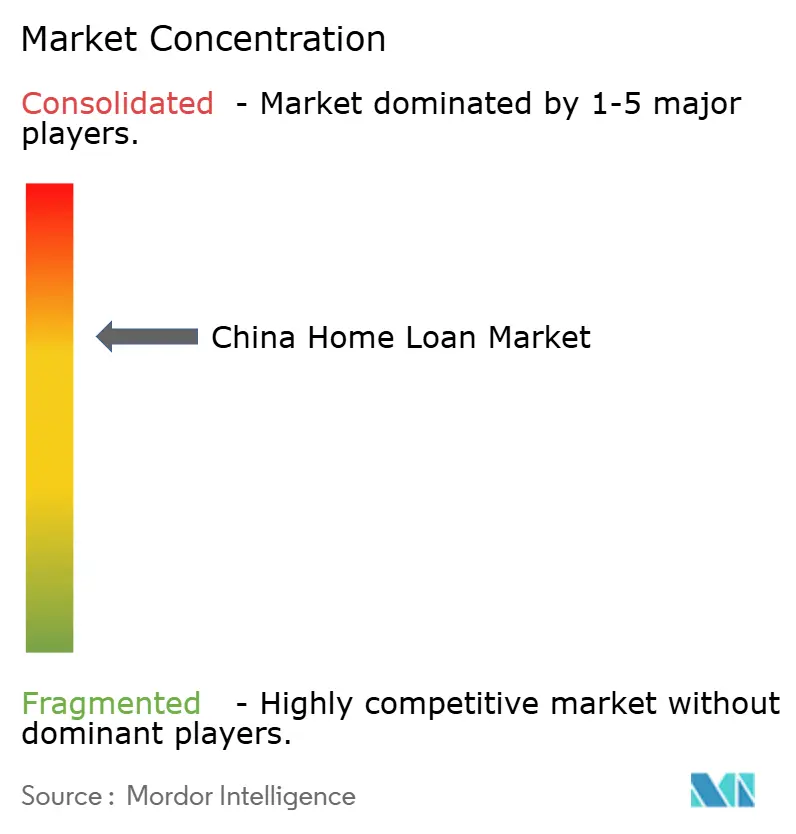
The market structure is concentrated: the top banks hold major shares in the market, and together with leading joint-stock lenders, they account for a considerable market share. Regulatory pushes for consolidation—evidenced by regional bank rescue mergers—support financial stability but also entrench dominance.
Digital-first challengers have seized share in unsecured and SME lending and are now attacking mortgage niches by leveraging AI credit engines that tap alternative data sets. WeBank’s 2023 results highlight a cost-to-income ratio of around 27%, far below traditional peers, enabling competitive pricing. Still, deposit-gathering constraints curb their scale relative to the behemoths.
Strategically, large banks emphasize end-to-end digitization: ICBC won Asia-Pacific’s “Best Consumer Digital Bank” award in May 2024 after deploying a generative-AI-powered virtual assistant. Meanwhile, the Agricultural Bank of China accelerated county-level mortgage expansion in 2025, leveraging branch density to serve peri-urban migration corridors. Foreign banks, despite policy liberalization, continue to lose ground due to compliance burdens and geopolitical frictions.
China Home Loan Industry Leaders
-
Industrial & Commercial Bank of China (ICBC)
-
China Construction Bank
-
Agricultural Bank of China
-
Bank of China
-
Postal Savings Bank of China
- *Disclaimer: Major Players sorted in no particular order
China Home Loan Market Companies Covered in this Report
- Industrial & Commercial Bank of China (ICBC)
- China Construction Bank
- Agricultural Bank of China
- Bank of China
- Postal Savings Bank of China
- China Merchants Bank
- Bank of Communications
- Ping An Bank
- Shanghai Pudong Development Bank
- China Minsheng Bank
- Hua Xia Bank
- Industrial Bank
- China Everbright Bank
- China CITIC Bank
- WeBank
- MYbank
- XWBank
- Guangzhou Rural Commercial Bank
- Anhui Rural Credit Union
- Sunshine Insurance Group (Mortgage Guarantees)
Market Opportunities and Future Outlook
Opportunities in China home loans are increasingly linked to policy-enabled affordability and localized stabilization rather than broad-based credit expansion. In first-tier cities, prices rose for four consecutive months through June 2026, creating a more defined window for lenders to rebuild purchase-mortgage pipelines where transaction liquidity is strongest, while maintaining conservative underwriting in areas with higher negative-equity risk.
A second whitespace sits at the intersection of developer normalization and lender risk appetite. In first-half 2026, 36 typical real estate enterprises recorded year-on-year sales growth, including nine with growth exceeding 100%, pointing to momentum concentrating in stronger sponsors, including central SOE-linked groups and higher-quality regional players. This supports more selective mortgage origination and developer-linked retail acquisition programs, and it lifts the value of bank-fintech tooling, such as AI-assisted origination used by digital lenders like MYbank and WeBank, to serve borrowers with non-traditional income profiles while keeping controls in place amid ongoing household deleveraging signals.
Recent Industry Developments in China Home Loan Market
- July 2026: Hangzhou GreatStar Industrial acquired a 1.54% stake in Zhejiang MYbank to leverage digital supply-chain finance infrastructure. The investment signals a company-level push into a digital lender and strengthens digital lending capabilities alongside supply-chain finance integration for the home-loan ecosystem.
- April 2025: Agricultural Bank of China disclosed above-peer loan growth in county markets. The disclosure points to county-market loan expansion and deeper nationwide mortgage access. The development supports broader home loan origination in rural and peri-urban zones, reinforcing lender presence in key growth corridors.
- March 2025: China Construction Bank extended CNY 190 million to a Suzhou tech firm under a new M&A pilot. The loan ties to financing channels for corporate borrowers. This could expand mortgage-related and project-financing activity connected to technology-sector investments.
China Home Loan Market Report Scope and Research Methodology
Market Definition and Coverage
This market covers the value of home loans issued and outstanding within China for residential purposes, measured in USD. It includes lending used to buy homes, refinance qualifying balances, and fund eligible housing-related upgrades where the loan is secured against housing.
Scope exclusions: We exclude developer construction finance, unsecured consumer credit used for housing-related spending, and informal lending that is not booked as a regulated home loan.
Segments Covered in This Report
- By Loan Purpose
- Purchase (New/Existing)
- Home Improvement/Renovation
- Others (Construction, Refinance, etc.)
- By Provider
- Banks
- Housing Finance Companies
- Others
- By Interest Rates
- Fixed Interest Rates
- Floating Interest Rates
- By Loan Tenure
- Less Than or Equal To 10 Years
- 11 – 20 Years
- Longer Than 20 Years
Data Sources, Market Sizing, and Validation
Desk Research
Desk research is used to map the size of the lending pool and keep assumptions aligned to official series and policy direction. We relied on public statistics and policy releases such as People's Bank of China loan balance and credit structure updates, National Bureau of Statistics housing and macro indicators, and Ministry of Housing and Urban-Rural Development releases where relevant. For pricing and transmission checks, we also reviewed Loan Prime Rate publications and public guidance on down payment and mortgage rules.
To link the macro series to lender activity, we reviewed bank annual reports, investor presentations, and audited financial statements that disclose mortgage balances, portfolio mix, and risk trends. We also used reputable press coverage and association publications to confirm shifts in demand, refinancing behavior, and the role of housing provident fund lending. Paid subscriptions were used selectively for company financials and intelligence, plus patent databases to track process digitization signals that can affect origination throughput. The desk research sources listed here are illustrative, and we also used many other references for data collection, cross-checking, and clarification.
Primary Interviews and Surveys
Primary interviews and surveys focused on lenders, loan distribution partners, and risk and product teams who see pricing, approval flow, and demand shifts firsthand. To reduce single-source bias, we validated inputs across different lender sizes and across major city clusters, as well as lower-tier city exposure. The same inputs were then used to confirm the final assumptions on growth, rate mix, and refinancing intensity.
Distribution of primary research fieldwork respondents
| Company type | Respondent position |
|---|---|
| Top tier: 39% | CXOs: 14% |
| Mid tier: 40% | Functional/Unit leaders: 28% |
| Smaller Players: 21% | Managers: 58% |
Market-Sizing & Forecasting
Sizing starts with a top-down build that reconstructs the home loan value pool using official loan balance series and housing credit indicators, then filters to the residential mortgage portion. After the demand pool is built, we convert it into USD using consistent timing for average exchange rates to avoid distorting year-to-year movements.
We then apply selective bottom-up approximations as a sanity check, especially by rolling up publicly reported mortgage balances from major lenders and testing whether the implied coverage and growth trend are plausible. Where disclosure gaps exist, we use peer ratios based on variables such as changes in household medium and long term loans, the direction of policy rate signals such as the 5-year LPR, housing transaction momentum signals, and observed refinancing and early repayment intensity reported by market participants. For forecasting, we use scenario analysis supported by a light multivariate regression layer, with key drivers including the pace of policy easing, housing sales stabilization, the interest rate path, and credit appetite from lenders and borrowers. Final assumptions are adjusted only after they match the direction and magnitude described by multiple primary respondents.
Data Validation & Update Cycle
Validation is handled through step-by-step cross-checks rather than relying on a single point estimate. Model outputs are compared against independent signals such as central bank loan balance changes, lender mortgage portfolio disclosures, and the implied pace of new lending given housing activity. If a large variance appears, we recheck inputs, review the conversion timing, and reapproach primary contacts to confirm what shifted in underwriting, pricing, or borrower behavior.
Before sign-off, the dataset and calculations go through an analyst review sequence that includes anomaly checks at year boundaries and consistency checks across related indicators. Reports are refreshed annually, and interim updates are made when material events occur, such as major policy changes affecting down payments or mortgage pricing. Right before delivery, we complete a final review pass so the latest public releases are reflected in the numbers.
Mordor Intelligence's China Home Loan Market Size Versus Other Published Estimates
Published market values for China home loans can differ because the measurement choice is not always the same, even when the label is similar. Differences usually come from what is counted as a home loan (outstanding balance versus new originations), the treatment of refinancing and early repayments, and the currency conversion timing used for USD reporting.
Loan balance series from the central bank and large-lender portfolio disclosures are the main checks that keep Mordor Intelligence's estimate aligned to regulated residential mortgage exposure rather than broader real estate credit or housing-related consumer lending. The spread across other figures also reflects whether housing provident fund lending is fully blended, whether only bank loans are counted, and whether the reported year reflects an aggressive recovery scenario or a base case with slower housing transactions.
Benchmark comparison
| Source | Market Size | Gaps in Research Methodology |
|---|---|---|
| Mordor Intelligence | USD 1.08 T (2025) | |
| Industry Association A | USD 5.10 T (2024) | Often reported as total outstanding personal housing mortgage balance in local currency and then converted, which can represent a stock measure that is broader than the defined market boundary and can shift materially with FX timing. |
| Global Consultancy B | USD 1.35 T (2026) | May lean on a faster housing rebound scenario and a different handling of refinancing and early repayment effects, which can lift the implied net growth in outstanding home loans in the forecast year. |
The comparison shows that most gaps are explained by whether the figure is built as an outstanding stock versus a defined lending market boundary, plus how USD conversion and refinancing behavior are treated. By tying the model to repeatable loan balance signals and lender disclosures, the final number stays traceable to clear inputs that can be rechecked during updates.
Key Questions Answered in the Report
What is the current value of the China home loan market?
The China home loan market is valued at USD 1.16 trillion in 2026.
How fast is the China home loan market expected to grow?
It is projected to expand at a 7.09% CAGR, reaching USD 1.63 trillion by 2031.
Which segment is growing the fastest within the Chinese home loan market?
Home-improvement and renovation loans are forecasted to grow at a 8.88% CAGR through 2031.
Why do floating-rate mortgages dominate China’s market?
Floating-rate loans account for 93.85% of the market because borrowers expect further LPR cuts and value rate flexibility.
How are digital banks impacting the China home loan industry?
Digital-native lenders like WeBank are shortening approval times, widening borrower access, and are forecast to grow their loan books at double-digit CAGRs, challenging traditional banks.
What risks could restrain market growth?
Key risks include housing-price volatility that creates underwater mortgages and a surge in early prepayments that erode banks’ interest income.