
Market Overview
| Study Period | 2020 - 2031 |
|---|---|
| Forecast Data Period | 2026 - 2031 |
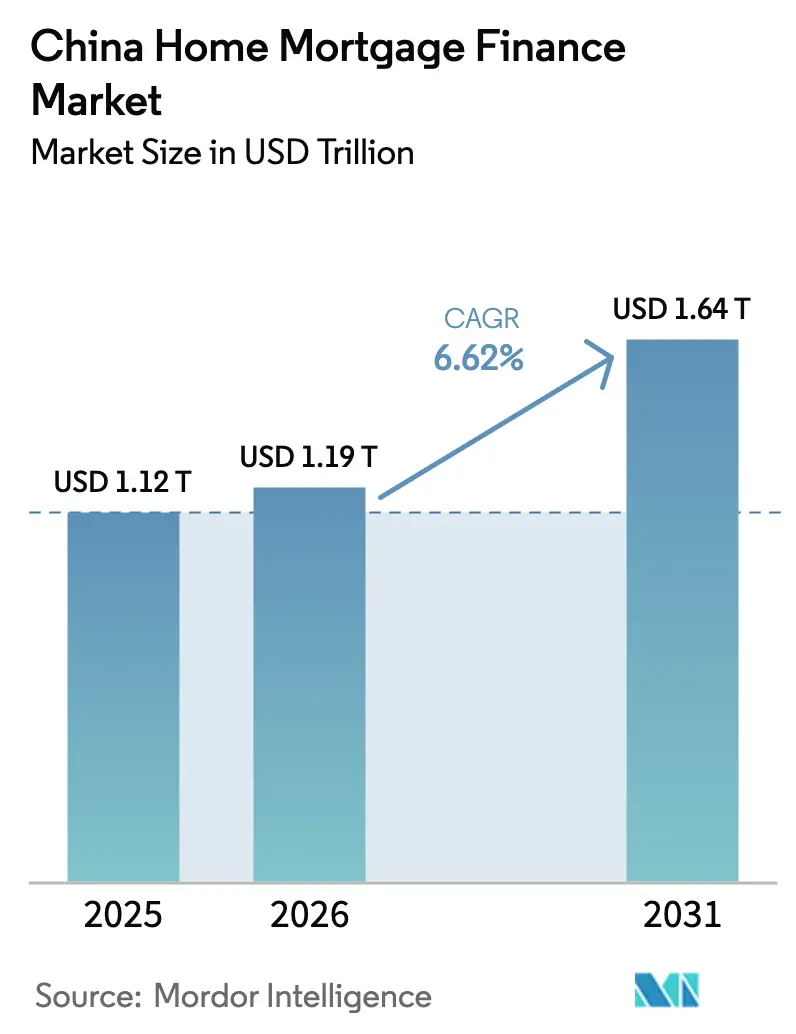
| Base Year Market Size (2025) | USD 1120 Trillion |
| Market Size (2026) | USD 1.19 Trillion |
| Market Size (2031) | USD 1.64 Trillion |
| Growth Rate (2026 - 2031) | 6.62 % |
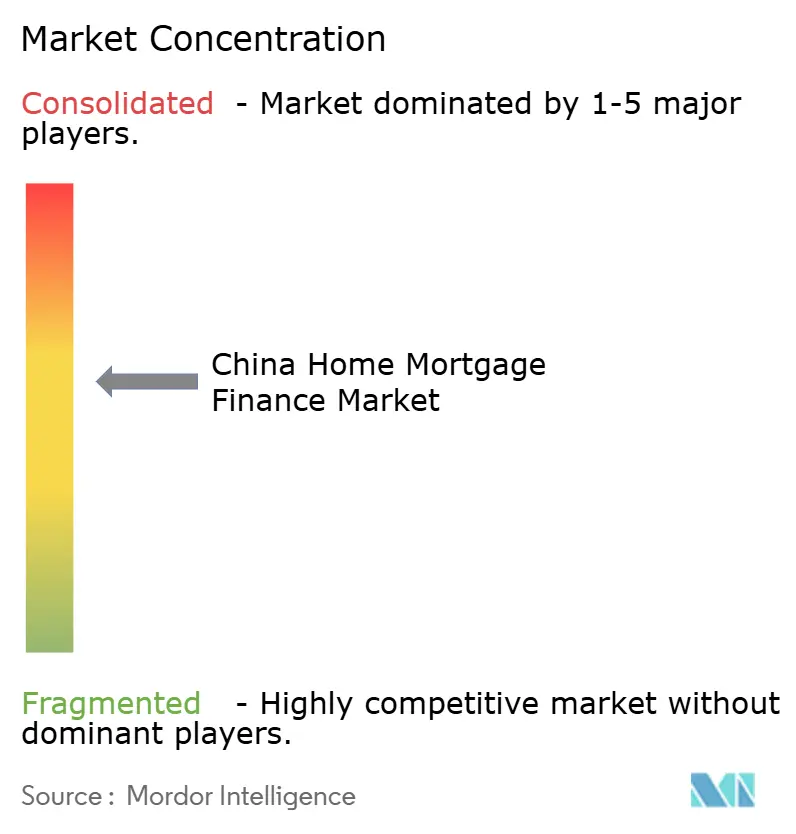
| Market Concentration | Medium |
Major Players *Disclaimer: Major Players sorted in no particular order Image © Mordor Intelligence. Reuse requires attribution under CC BY 4.0. | |
China Home Mortgage Finance Market Analysis by Mordor Intelligence
The Chinese home mortgage finance market size was valued at USD 1120 billion in 2025 and estimated to grow from USD 1194.14 billion in 2026 to reach USD 1644.98 billion by 2031, at a CAGR of 6.62% during the forecast period (2026-2031). The current growth path highlights the market’s resilience as policymakers use targeted rate cuts and down-payment relaxations to steady demand. Lower loan prime rates, the removal of nationwide mortgage-rate floors, and a one-time 50-basis-point reduction applied to outstanding mortgages have lifted affordability for more than 50 million households[1]. Demand is also diversifying home-improvement loans, green-mortgage products, and refinancing packages, growing faster than traditional purchase loans as homeowners shift toward upgrading existing properties. Simultaneously, digital-first origination channels operated by leading banks and fintechs are compressing processing times, improving risk pricing, and broadening access to mortgage credit. The market’s long-term outlook remains constructive despite demographic pressure because lenders are redeploying capital released through residential mortgage-backed securities (RMBS), and the Housing Provident Fund is stepping up concessional lending.
Key Report Takeaways
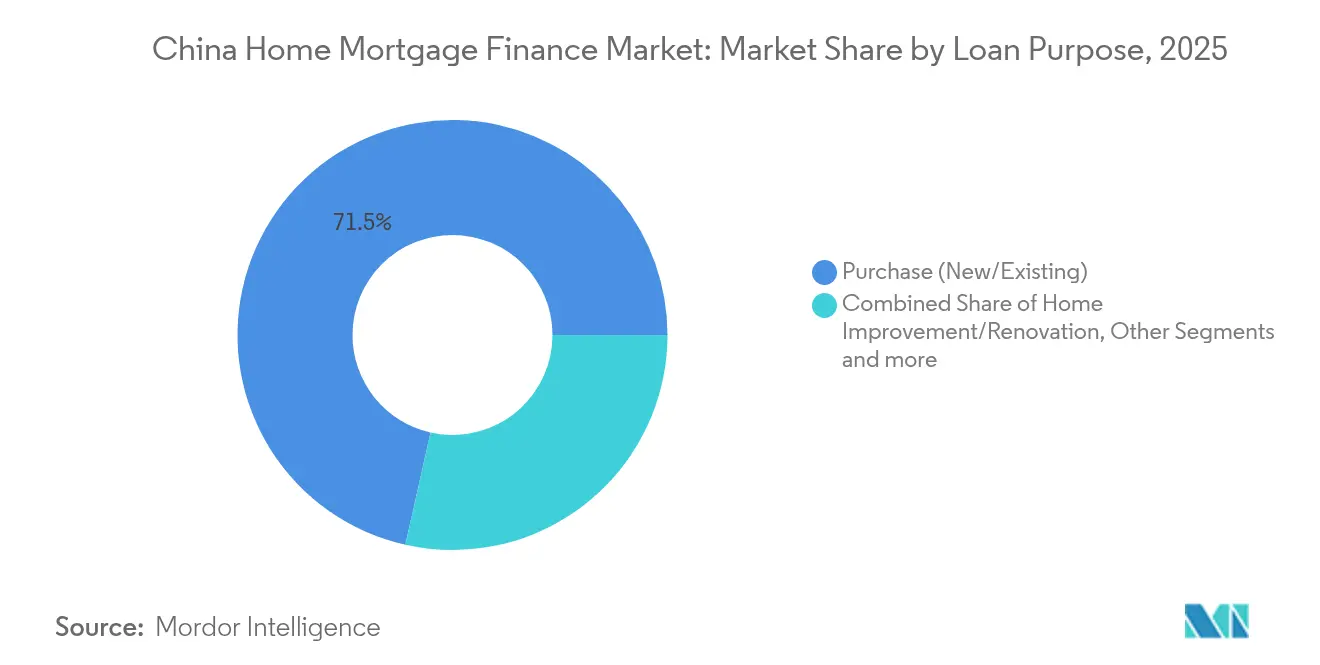
- By loan purpose, purchase mortgages for new and existing homes held 71.48% of the China home mortgage finance market share in 2025, while home-improvement and renovation loans post the fastest 8.52% CAGR through 2031.
- By provider, banks dominated with 84.00% share of the China home mortgage finance market in 2025; the “others” segment, led by digital lenders, records the highest 13.1% projected CAGR.
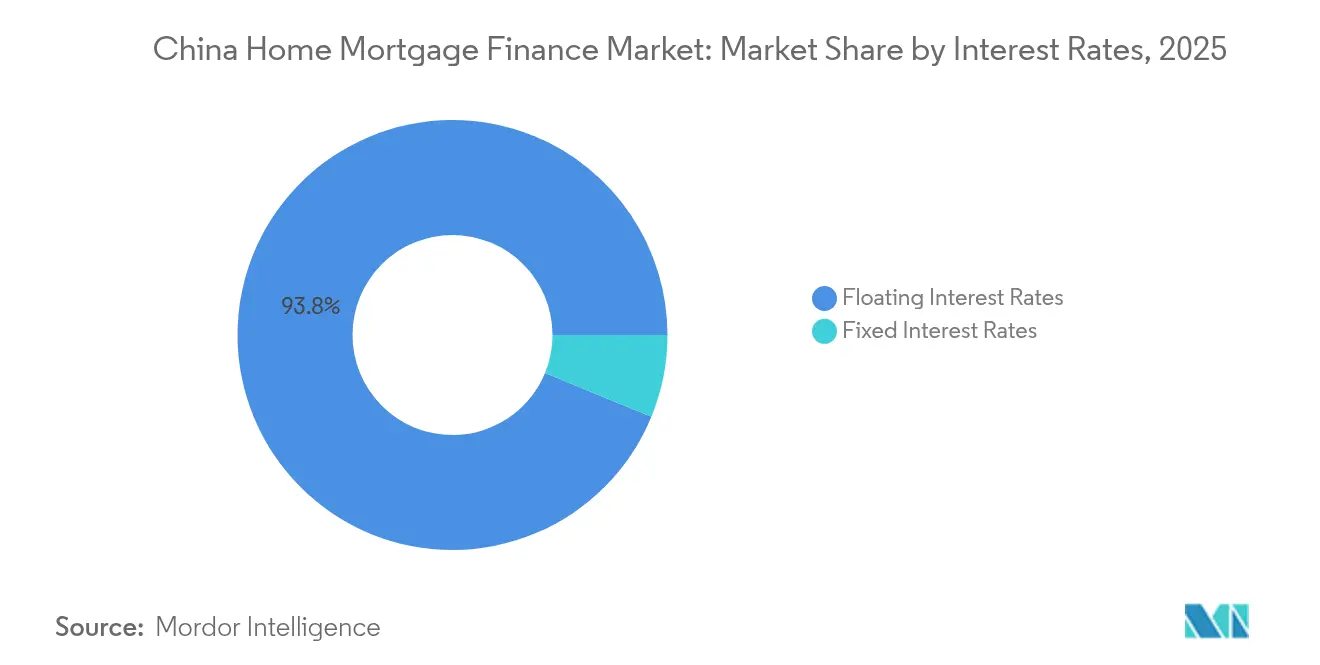
- By interest rate type, floating-rate mortgages accounted for a 93.80% stake of the China home mortgage finance market size in 2025; fixed-rate products are expected to grow at a 10.05% CAGR.
- By loan tenure, mortgages longer than 20 years captured 49.05% of the China home mortgage finance market size in 2025 and are advancing at an 8.22% CAGR.
Note: Market size and forecast figures in this report are generated using Mordor Intelligence’s proprietary estimation framework, updated with the latest available data and insights as of 2026.
China Home Mortgage Finance Market Trends and Insights
Drivers Impact Analysis*
| Driver | (~) % Impact on CAGR Forecast | Geographic Relevance | Impact Timeline |
|---|---|---|---|
| Government policy easing on mortgage rates & down-payments | +1.8% | National; stronger effects in tier-1 cities | Short term (≤ 2 years) |
| Expansion of Housing Provident Fund lending capacity | +1.2% | National; concentrated in urban centers | Medium term (2-4 years) |
| Urbanization-led demand in lower-tier cities | +0.9% | Tier-3 and tier-4 cities | Long term (≥ 4 years) |
| Digital end-to-end mortgage origination by major banks | +0.7% | National; early adoption in major cities | Medium term (2-4 years) |
| Emergence of green-mortgage products tied to building efficiency | +0.5% | National; focus on new construction areas | Long term (≥ 4 years) |
| Mortgage-backed securitization, unlocking bank capital | +0.4% | National; benefits large banks | Medium term (2-4 years) |
| Source: Mordor Intelligence | |||
Government Policy Easing on Mortgage Rates & Down-Payments
A September 2024 directive from the People’s Bank of China lowered existing mortgage coupons by 50 basis points, trimming annual payments by CNY 150 billion (USD 21.3 billion) and reducing minimum down-payments for first and second homes to 15%[2]. By scrapping the nationwide mortgage-rate floor, authorities allowed lenders to compete aggressively on pricing, creating a dual stimulus for new originations and refinancing. These coordinated measures support borrower cash flows and shore up confidence at a time of subdued property sales. Banks now recalibrate funding strategies to balance lower asset yields with volume gains, highlighting the pivotal role of policy in shaping the Chinese home mortgage finance market.
Expansion of Housing Provident Fund Lending Capacity
Outstanding balances in the Housing Provident Fund have significantly increased, while total fund assets have also grown substantially, providing the subsidized scheme with ample capacity to offer long-term, below-market mortgages[3]. Recent rule changes raised individual borrowing limits and broadened eligibility, allowing the fund to relieve the commercial-bank segment during periods of developer stress. Because loans are priced 100–150 basis points below market, the program catalyzes demand from middle-income households and stabilizes origination volumes in the China home mortgage finance market.
Urbanization-Led Demand in Lower-Tier Cities
More than 60% of China’s GDP and housing stock sit in tier-3 and tier-4 cities, which also host 78% of new housing construction activity. Accelerated urbanization, industrial relocation, and infrastructure build-outs sustain mortgage appetite in these locales even as major metropolitan areas mature. Lenders diversify geographically to tap these pockets of growth, but must account for elevated inventory levels and slower income growth that can raise credit-risk volatility over time.
Digital End-to-End Mortgage Origination by Major Banks
WeBank and similar platforms have demonstrated that machine-learning-driven underwriting can cut processing costs by up to 70%, shrinking the application-approval cycle from weeks to days. Traditional banks are moving quickly to launch comparable mobile-first journeys, embedding real-time credit scoring, optical character recognition for document upload, and e-signature tools. End-to-end digitization enhances borrower experience, lowers compliance errors, and differentiates early adopters in the China home mortgage finance market.
Restraints Impact Analysis*
| Restraint | (~) % Impact on CAGR Forecast | Geographic Relevance | Impact Timeline |
|---|---|---|---|
| Prolonged property-developer distress is depressing buyer confidence | -2.1% | National; severe in tier-1 cities | Short term (≤ 2 years) |
| Demographic headwinds are reducing household formation | -1.4% | National; pronounced in aging regions | Long term (≥ 4 years) |
| Surge in early repayments squeezing bank net-interest margins | -0.8% | National; affects all major lenders | Short term (≤ 2 years) |
| Regulatory crackdown on quasi-mortgage consumer loans | -0.6% | National; focus on shadow-banking activity | Medium term (2-4 years) |
| Source: Mordor Intelligence | |||
Prolonged Property-Developer Distress Depressing Buyer Confidence
Roughly half of private developers remain financially strained, leaving high inventories of unfinished units and deterring off-plan purchases, the historical sales model for new homes. A government “whitelist” mechanism has channeled bank funding to select projects, yet consumers still weigh execution risk carefully, prolonging transaction cycles and tempering the growth trajectory of the China home mortgage finance market.
Demographic Headwinds Reducing Household Formation
Official projections show China’s population dipping below 1.39 billion by 2035, with declining fertility and accelerated aging lowering new-household formation rates. Fewer new households translate to structurally lower baseline demand for primary dwellings and, by extension, mortgages. Lenders are therefore pivoting to renovation finance, green upgrades, and equity-release products to offset anticipated volume softness.
*Our forecasts treat driver/restraint impacts as directional, not additive. The impact forecasts reflect baseline growth, mix effects, and variable interactions.
Segment Analysis
By Loan Purpose: Expansion of Enhancement-Focused Lending
Purchase loans for new or existing homes held a 71.48% stake of the Chinese home mortgage finance market in 2025, underscoring their central role in household property transactions. Yet, home-improvement loans register the quickest 8.52% CAGR as owners favor upgrade projects over relocation amid subdued price appreciation. Demand is encouraged by policy subsidies supporting energy-efficient retrofits and urban-renewal grants, nudging lenders to design products that pair renovation finance with building-performance certification. Loan-against-property products serve commercial liquidity needs, whereas construction bridge loans and refinancing packages accommodate borrowers seeking rate optimization under the current low-rate environment.
Growth momentum in the enhancement category signals a maturation of housing consumption patterns. Banks now underwrite larger average balances, given rising material costs and technology-intensive renovations. For credit-risk control, institutions incorporate property-value buffers and stage-payment disbursement schedules tied to verified work completion. These practices safeguard collateral quality while fostering the continued expansion of the China home mortgage finance market.

By Provider: Fintech Challenge to Incumbent Banks
Banks commanded 84.00% the Chinese home mortgage finance market share in 2025, benefiting from deposit-funding advantages and regulatory familiarity. Joint-stock and city commercial banks, however, face margin compression, prompting them to partner with technology vendors to digitize onboarding and reduce operating expenses per loan. Other providers are gaining ground at a 13.1% CAGR by emphasizing seamless mobile interfaces, fast approval cycles, and data-rich credit-scoring models.
Regulatory authorities encourage responsible innovation, granting digital banks-controlled test environments (“regulatory sandboxes”) to pilot smart-contract-based collateral management. The resulting competition accelerates product diversification, improves customer experience, and gradually redistributes volumes within the Chinese home mortgage finance market.
By Interest Rates: Growing Preference for Rate Certainty
Floating-rate mortgages still commanded 93.80% the Chinese home mortgage finance market share in 2025. However, fixed-rate products are forecasted to expand at a robust 10.05% CAGR between 2026-2031 as borrowers seize historically low coupons to stabilize monthly outlays. Banks supply fixed tenures of 3, 5, and 10 years, plus hybrids that switch to floating after an introductory period, thereby broadening choices within the China home mortgage finance market.
Tighter fixed-floating spreads cut the “insurance premium” for payment certainty. Lenders deploy interest-rate swaps and structured deposits to manage the growing share of fixed-rate assets on their balance sheets.
By Loan Tenure: Longer Repayment Horizons Boost Affordability
Mortgages longer than 20 years secured 49.05% of the China home mortgage finance market size in 2025 and are projected to expand at an 8.22% CAGR. Extended schedules reduce monthly payments, making ownership feasible even in high-cost metros such as Beijing and Shenzhen. Products within the 11–20 year range service middle-income cohorts that balance payment comfort with total-interest considerations. Tenures under 10 years appeal mostly to affluent borrowers consolidating short-term liabilities or leveraging rate-cut opportunities to extinguish mortgage debt quickly.
To mitigate long-dated credit-risk exposure, lenders integrate dynamic income verification and periodic collateral re-appraisal during the loan life cycle. Coupled with credit-insurance partnerships, these safeguards preserve asset quality while supporting the affordability objectives that underpin the continued growth of the Chinese home mortgage finance market.
Geography Analysis
Mortgage origination remains concentrated in tier-1 cities, where sizeable loan balances and liquid secondary markets prevail. April 2025 rate cuts dragged first-time buyer coupons in Beijing to 3.05%, spurring a modest revival in transaction volumes. Despite elevated price-to-income ratios, employment density and migration inflow sustain baseline demand, allowing lenders to market premium advisory services alongside standard mortgages.
Tier-2 urban centers such as Hangzhou and Nanjing capture incremental demand released by the relaxation of purchase restrictions and targeted subsidy schemes. Regional banks leverage their granular knowledge of local zoning rules and developer reputations to compete effectively against national lenders. Cross-selling of bundled financial services—wealth management, insurance, and retail payments—further cements customer relationships in this layer of the China home mortgage finance market.
Lower-tier cities shoulder the mantle of medium-term growth as industrial relocation and infrastructure corridors continue to attract rural migrants. Mortgage penetration ratios still trail those of coastal metros, offering headroom for responsible expansion. Nevertheless, lenders apply tighter loan-to-value caps and risk-adjusted pricing to accommodate higher idiosyncratic volatility stemming from demographic outflows and macro-cycle sensitivity.
Regulatory Landscape
China home mortgage finance operates under the oversight of the People’s Bank of China (PBOC) for monetary and credit policy transmission and the National Financial Regulatory Administration (NFRA) for prudential supervision of banks and consumer lending conduct. Policy easing has directly shaped mortgage affordability in recent cycles, including the September 2024 PBOC directive that reduced coupons on existing mortgages by 50 basis points and lowered minimum down-payments for first and second homes to 15%, alongside the earlier removal of the nationwide mortgage-rate floor. In 2025, the PBOC and NFRA also extended the deadline for “reasonable extension” policies covering property development and trust loans through December 31, 2026, keeping refinancing and completion financing channels open. That support indirectly underpins mortgage confidence by reducing delivery risk.
In 2026, regulation has moved toward system modernization and more granular city-level calibration. On June 5, 2026, MOHURD released a draft revision of the Housing Provident Fund (HPF) regulation, the first major rewrite since 1999, aimed at updating governance and usage rules for the subsidized mortgage channel. Separately, as of January 17, 2026, a minimum down payment ratio of no less than 30% was applied for commercial property loans (including commercial-residential properties), with local branches empowered to set specifics based on local conditions, reflecting differentiated city-level management. The April 28, 2026 Politburo meeting’s call to stabilize the real estate market reinforced a policy backdrop that keeps mortgages, HPF lending, and developer project financing tightly coordinated.
Value Chain Analysis
The China home mortgage finance value chain starts with borrower acquisition and pre-qualification (bank branches, developer channels, and increasingly digital front ends), followed by underwriting and pricing (income verification, credit scoring, and property valuation), collateral registration and notarization processes, loan disbursement and servicing, and ongoing risk monitoring (delinquency management and early-repayment management). Funding is dominated by deposit-funded banks, with large state-owned lenders providing scale in origination and servicing, while digital-native lenders support faster workflows and alternative data-driven decisioning for specific customer segments. Policy transmission through the loan prime rate and mortgage-rate guidance remains a key upstream input into pricing decisions, and borrowers’ early repayments feed back into lenders’ net interest margins and product design.
Downstream, balance sheet optimization and capital recycling link mortgages to securitization and capital markets via residential mortgage-backed securities (RMBS), enabling large institutions to redeploy capital into new lending. The Housing Provident Fund (HPF) system functions as a parallel concessional channel and stabilizer; in the first half of 2026, 26 key cities reported an average individual HPF loan utilization rate of 65%, within the commonly referenced 60% to 80% range. Major state-owned banks remain central nodes across the chain, while technology vendors support OCR/e-signature, automated valuation models, and compliance tooling that reduces processing time and error rates across origination and servicing.
Competitive Landscape
The competitive landscape of the Chinese home mortgage finance market is moderately consolidated. The “Big Four” state-owned banks—Industrial and Commercial Bank of China, China Construction Bank, Agricultural Bank of China, and Bank of China—control a majority of outstanding balances due to extensive branch footprints and explicit sovereign support. Their scale ensures funding cost advantages but also exposes them to market-wide margin compression as the loan prime rate trend declines. To protect profitability, these incumbents pivot toward fee-based cross-selling, centralized risk analytics platforms, and streamlined back-office operations.
Joint-stock and regional banks occupy a critical middle ground, combining local market intimacy with growing digital competence. Strategic alliances with fintechs supply modern interfaces, alternative credit data, and automated valuation models, helping these lenders defend niches within the Chinese home mortgage finance market. For instance, Ping An Bank leverages the parent group’s integrated finance-and-health ecosystem to embed property-related wellness and insurance solutions, reinforcing customer stickiness.
Digital-native players, most prominently WeBank, deploy cloud-native architectures and application-programming-interface (API) connectivity to underwrite at scale while maintaining lean cost structures. Continuous iteration based on near-real-time customer analytics unlocks product personalization that traditional banks find challenging to replicate quickly. Regulatory endorsement of such innovation, balanced with strict prudential oversight, ensures sector stability as competition intensifies.
China Home Mortgage Finance Industry Leaders
-
China Construction Bank
-
Industrial and Commercial Bank of China
-
Agricultural Bank of China
-
Bank of China
-
Bank of Communications
- *Disclaimer: Major Players sorted in no particular order
Market Opportunities and Future Outlook
Product opportunities are clustering around usage-led lending and affordability management rather than incremental purchase volume. One key whitespace is expansion of renovation and upgrade-linked lending, supported by local Housing Provident Fund (HPF) reforms that permit withdrawals for home renovations and, in some cities, for property management fees, while also extending coverage to gig workers and the self-employed. This broadens the addressable borrower base for both concessional HPF-linked loans and commercial bank top-up products, and it matches the shift toward home-improvement and refinancing packages as households prioritize upgrading existing properties.
Program-led investment is another opportunity channel through urban renewal and inventory digestion mechanisms tied to mortgage and renovation finance. Central support for urban renewal includes fiscal subsidies per city (up to RMB 800 million for eastern regions, RMB 1 billion for central regions, and RMB 1.2 billion for western regions), creating bankable pipelines for refurbishment, energy-efficiency upgrades, and associated consumer renovation loans. Alongside this, local governments have been rolling out housing trade-in schemes and purchase subsidies to reduce existing inventories, supporting transaction turnover and refinancing activity when new-home sentiment is uneven. On the supply side, the June 2026 MOHURD draft revision to the HPF regulation provides a concrete pathway for standardization and modernization of the concessional mortgage channel, creating room for banks and platforms to build interoperable, digital-first origination and servicing that reduces turnaround time and improves risk pricing.
Recent Industry Developments
- April 2026: China Construction Bank (CCB) publishes loan-contract adjustments and mortgage-related terms to reflect policy shifts. The changes update loan appraisal and pricing to align with policy shifts. The action redirects origination practices and risk pricing in the sector.
- April 2026: National Banking Sector - New yuan loans experienced a contraction of 10 billion yuan, reflecting a broader property slump impacting demand. This underscores tighter credit conditions affecting housing finance activity. The development signals lenders adjusting risk appetite amid slower housing demand.
- March 2026: Agricultural Bank of China reports stabilization in interest rates on newly issued personal mortgage and consumption loans. The stabilization supports a steadier financing environment for households. It aligns with 2026 mortgage finance outlook assumptions.
Research Methodology Framework and Report Scope
Market Definition and Coverage
In this methodology, the China home mortgage finance market is defined as the value of residential mortgage lending activity supported by regulated financial institutions, tracked in USD terms and tied to housing purchase financing within mainland China.
Scope exclusions: This sizing excludes non-residential property loans, informal lending between individuals, and purely advisory services that do not create or refinance a mortgage balance.
Segmentation Overview
- By Loan Purpose
- Purchase (New/Existing)
- Home Improvement/Renovation
- Loan Against Property
- Others (Construction, Refinance, etc.)
- By Provider
- Banks
- Housing Finance Companies
- Others
- By Interest Rates
- Fixed Interest Rates
- Floating Interest Rates
- By Loan Tenure
- ≤ 10 Years
- 11 – 20 Years
- More than 20 Years
Data Sources, Market Sizing, and Validation
Desk Research
Desk research is used to set clear boundaries for what counts as home mortgage finance in China, and to build the first demand pool around housing transactions and household credit trends. We primarily lean on public macro and housing series, which helps us avoid assumptions that cannot be cross-checked later.
Sources reviewed include official publications such as the People's Bank of China statistical releases, National Bureau of Statistics housing and real estate funding tables, and relevant releases from financial regulators where available. We also use supporting sources such as bank annual reports and investor presentations to understand product mix and mortgage portfolio direction, plus reputed press sources for policy timing and rate corridor changes. Where needed, paid subscriptions for company financials and intelligence, news and financials, and patent databases were used to standardize definitions quickly and confirm institution-level disclosures. These examples are not exhaustive, and many other public sources were used for data collection, clarification, and consistency checks.
Primary Interviews and Surveys
Primary work is used to pressure-test the desk model, especially where policy actions shift borrower behavior and lender credit appetite faster than public data updates. We spoke with a mix of lenders, risk and product leaders, and channel-facing managers to validate unit economics logic (rate spreads, fees, prepayment patterns) and to confirm whether observed shifts were temporary or structural.
Because this is a China-only market, fieldwork focused on major mortgage origination corridors and bank distribution models, then was cross-checked with views from smaller, regionally focused players to reduce single-channel bias.
Distribution of primary research fieldwork respondents
| Company type | Respondent position |
|---|---|
| Top tier: 38% | CXOs: 21% |
| Mid tier: 41% | Functional/Unit leaders: 33% |
| Smaller Players: 21% | Managers: 46% |
Market-Sizing & Forecasting
Sizing is built using a top-down and bottom-up approach, where the top-down view is anchored on reconstructing the mortgage demand pool from housing transaction activity and household medium to long term credit direction, and then converting it into market value in USD. Once that core pool is formed, we corroborate totals with selective bottom-up approximations such as sampled lender portfolio disclosures, channel checks on typical ticket sizes, and implied volumes using average loan size assumptions.
Key inputs used in the model include residential sales momentum proxies, the share of purchases financed through mortgages, average loan size progression, interest rate and spread direction (to reflect affordability), and repayment or prepayment behavior that changes outstanding balances versus new lending. In periods where public series lag policy shifts, gaps are handled by applying conservative bridge assumptions that are later replaced when updated official data prints arrive, and then the model is re-balanced so the time series remains comparable.
For forecasting, scenario analysis is applied around the housing recovery pace and policy intensity, and the selected path is then aligned to a simple time series structure using exponential smoothing for smoother transition between turning points. Assumptions are further filtered through primary feedback so the forecast reflects what lenders are actually seeing in approvals, down payment constraints, and borrower sentiment.
Data Validation & Update Cycle
Outputs are checked against multiple independent signals, so the final number is not driven by any single data series or one set of interviews. We review outliers at each step, such as sudden jumps in implied loan size or abrupt shifts in financing share, and then trace them back to either policy events, base effects, or data timing issues before sign-off.
A second analyst review is completed to confirm definitions, units, and currency conversions, and follow-up calls are triggered when key inputs show unusual variance versus market signals. Reports are refreshed annually, with interim updates added when material policy or market events meaningfully change rate levels, housing activity, or credit availability. Before delivery, a final freshness pass is done so clients receive an up-to-date view using the latest available releases.
Mordor Intelligence's China Home Mortgage Finance Market Size Versus Other Published Estimates
Published market sizes for China home mortgage finance often diverge because of differences in data timing, currency conversion month, and how average loan size is carried forward, which can shift the total even when studies refer to the same broad theme. Differences also show up when some studies mix stock-like measures (outstanding balances) with flow-like measures (new lending), which can inflate or compress a single-year value.
In this report, refresh cadence is treated as a first-order input, where model variables are re-checked when policy rates, housing sales indicators, or credit conditions move, and the USD conversion is tied to the same period used for core assumptions, a practice applied by Mordor Intelligence. That discipline usually explains most of the spread versus estimates that use older rate snapshots, fixed FX conversions, or untested loan size carry-forwards.
Benchmark comparison
| Source | Market Size | Gaps in Research Methodology |
|---|---|---|
| Mordor Intelligence | USD 1.12 T (2025) | |
| Industry Association A | USD 1.06 T (2025) | Uses a balance-style framing but applies an annual average FX rate and does not clearly rebase assumptions after mid-year policy changes, which can understate the year-end level when conditions improve late in the year. |
| Trade Journal B | USD 1.24 T (2026) | Appears to blend new lending momentum with outstanding balances and assumes a faster loan size expansion without a visible check against housing transaction constraints, which can push the total upward in a rebound scenario. |
The comparison mainly points to timing and definition alignment as the practical reasons behind different values. When the unit of measure is kept consistent and the FX and rate assumptions are refreshed in step with market events, the resulting market size stays traceable to clear drivers and can be updated in a repeatable way.
Key Questions Answered in the Report
What is the current size of the Chinese home mortgage finance market?
It stands at USD 1.19 trillion in 2026 and is projected to reach USD 1.64 trillion by 2031, reflecting a 6.62% CAGR.
How have recent PBOC policies affected mortgage affordability?
A 50 basis-point cut on existing loans and removal of nationwide rate floors lowered monthly payments for more than 50 million households, lifting near-term affordability.
Which loan-purpose segment is growing fastest?
Home-improvement and renovation mortgages expand at an 8.52% CAGR as owners prioritize upgrades over buying new homes.
Why are fixed-rate mortgages gaining traction in China?
Borrowers increasingly value payment certainty and are locking in historically low coupons; fixed-rate products now grow at a 10.05% CAGR.
What role does the Housing Provident Fund play in mortgage finance?
The outstanding balances in the Housing Provident Fund have significantly increased, while total fund assets have also grown, providing the subsidized scheme with ample capacity to offer long-term, below-market mortgages.
How are digital-only banks impacting competition?
Platforms like WeBank use automated underwriting and mobile-first interfaces to cut origination costs and attract tech-savvy borrowers, nudging incumbents to accelerate digital transformation.