
Car Wash Market Size and Share
Market Overview
| Study Period | 2019 - 2031 |
|---|---|
| Market Size (2026) | USD 30.35 Billion |
| Market Size (2031) | USD 43.65 Billion |
| Growth Rate (2026 - 2031) | 7.54 % |
| Fastest Growing Market | Asia Pacific |
| Largest Market | North America |
| Market Concentration | Low |
Major Players *Disclaimer: Major Players sorted in no particular order Image © Mordor Intelligence. Reuse requires attribution under CC BY 4.0. | |
Car Wash Market Analysis by Mordor Intelligence
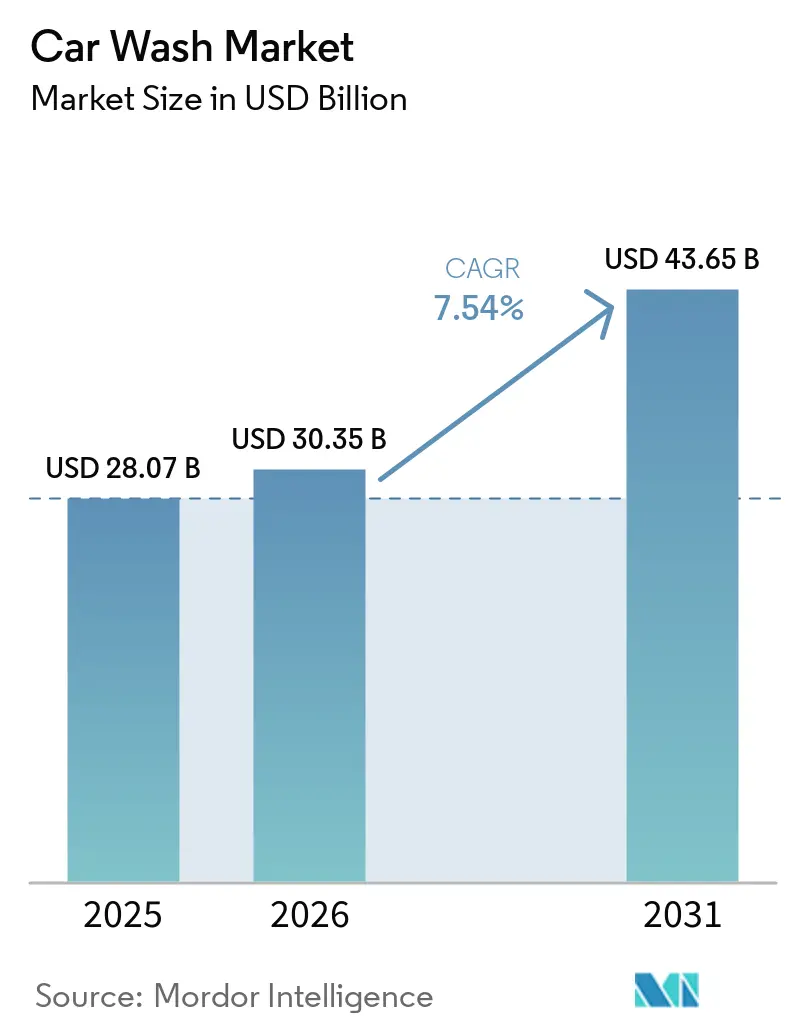
The car wash market size was USD 28.07 billion in 2025, is expected to reach USD 30.35 billion in 2026, and is projected to reach USD 43.65 billion by 2031, growing at a CAGR of 7.54% from 2026 to 2031. The car wash market is moving toward a more stable revenue base as unlimited wash memberships grow faster than one-time washes. That shift is changing how operators value customer acquisition and site economics. The car wash market is also being reshaped by express exterior conveyor investments, enabling operators to process more vehicles with fewer labor touches and to build a model that is easier to scale across multiple locations. Another important shift in the car wash market is the move away from cash, as card, NFC, and app-based payments reduce friction at the point of sale and provide actionable customer data for pricing, retention, and upselling. North America remains the largest regional center of demand, while Asia-Pacific is expanding faster as vehicle ownership rises and operators in China and India move more directly into automated formats instead of repeating the long-format transition seen elsewhere. At the same time, the car wash market is becoming less forgiving for smaller operators because land costs, construction expenses, water-use rules, and staffing pressure increasingly favor chains with stronger balance sheets and denser site networks.
Key Report Takeaways
- By type, Automatic Tunnel led with a 48.12% share in 2025, while Express Exterior recorded the fastest projected growth at an 8.27% CAGR through 2031.
- By mode of payment, Cashless held 63.23% share in 2025 and also posted the highest forecast CAGR at 11.84% through 2031.
- By service model, Single-Service Wash accounted for 55.78% share in 2025, while Subscription-Based Unlimited is projected to grow fastest at a 10.42% CAGR through 2031.
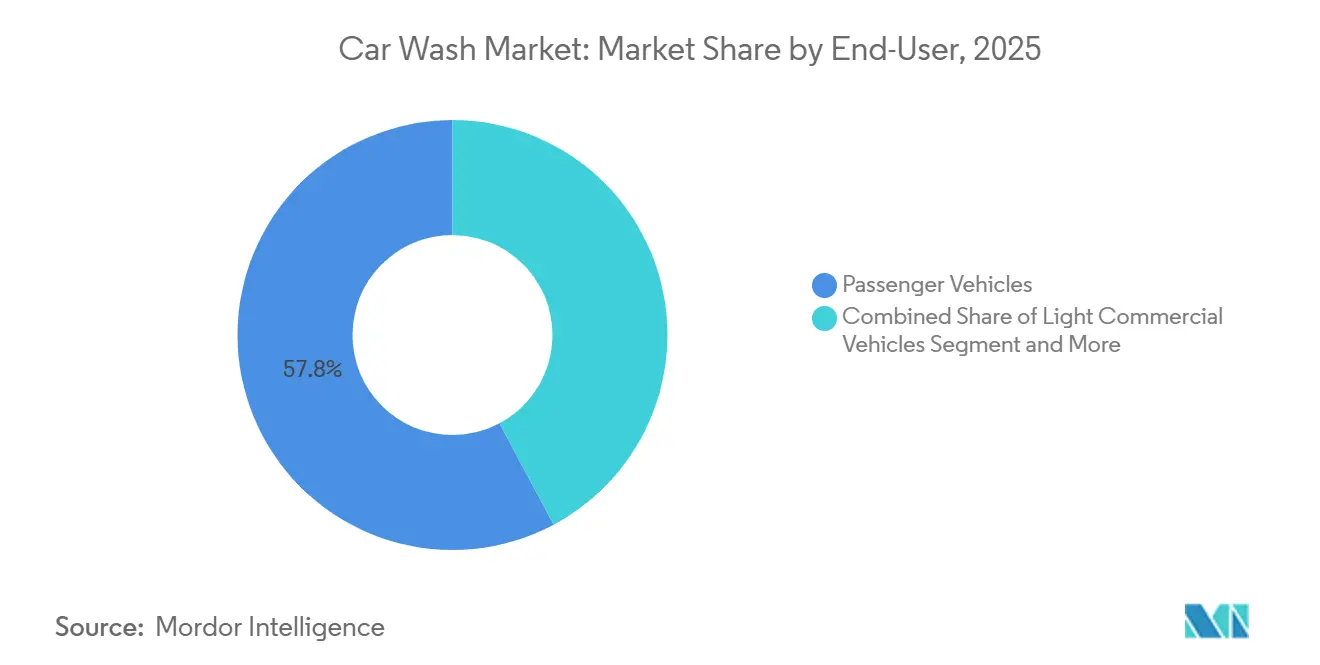
- By end-user, Passenger Vehicles held 57.84% share in 2025, while Light Commercial Vehicles are expected to expand at an 8.21% CAGR through 2031.
- By ownership, Independent Operators led with 67.14% share in 2025, while Franchised and Chain Operators are projected to grow fastest at a 9.42% CAGR through 2031.
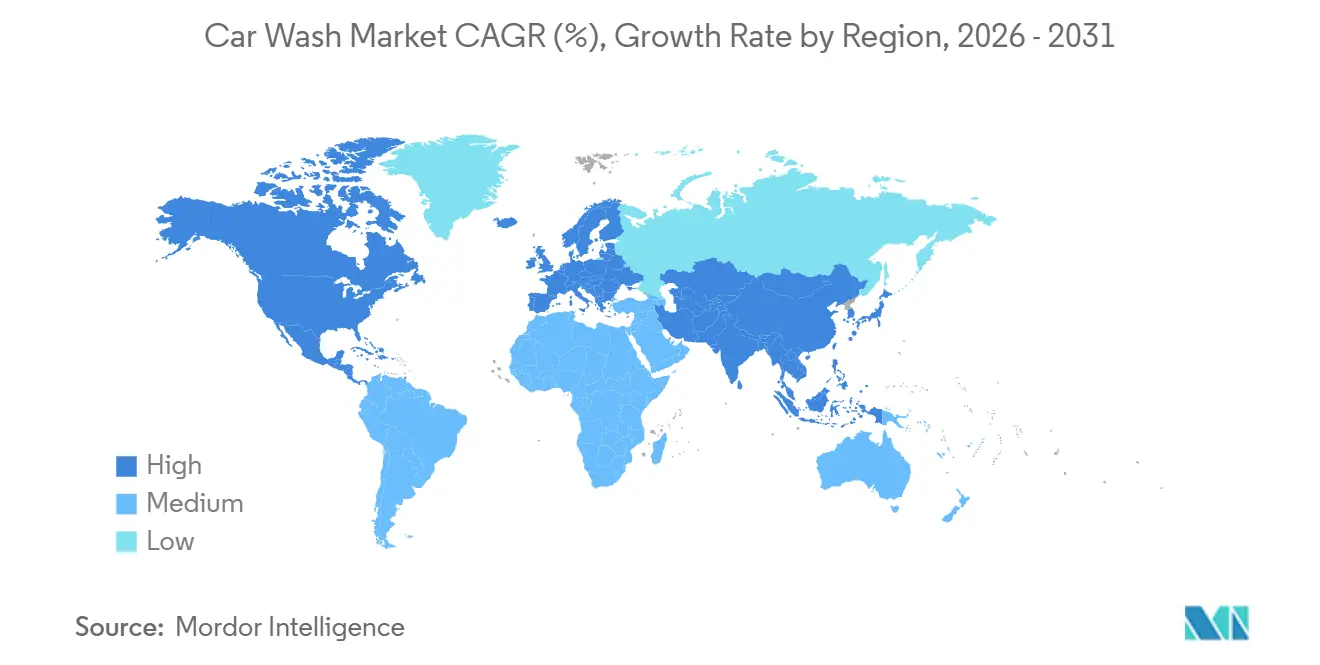
- By geography, North America accounted for 40.76% share in 2025, while Asia-Pacific is forecast to expand at an 8.43% CAGR through 2031.
Note: Market size and forecast figures in this report are generated using Mordor Intelligence’s proprietary estimation framework, updated with the latest available data and insights as of January 2026.
Market Trends and Insights
Drivers Impact Analysis of Car Wash Market*
| Driver | (~) % Impact on CAGR Forecast | Geographic Relevance | Impact Timeline |
|---|---|---|---|
| Subscription-Based Unlimited Wash | +2.3% | North America, Europe, Asia-Pacific | Short term (≤ 2 years) |
| Express-Exterior Conveyor Formats | +1.5% | North America, Europe, Australia, South Korea | Medium term (2-4 years) |
| Fleet and Ride-Hailing Vehicle Growth | +1.0% | Global, concentrated in Asia-Pacific, North America, and MEA urban corridors | Medium term (2-4 years) |
| Cashless and In-App Payments | +0.8% | Global, accelerated in Europe, Australia, and East Asia | Short term (≤ 2 years) |
| Water-Recycling and Eco-Compliance | +0.7% | North America and Western Europe | Long term (≥ 4 years) |
| AI-Driven Pricing and Upsell Kiosks | +0.6% | North America, Western Europe, and Australia | Medium term (2-4 years) |
| Source: Mordor Intelligence | |||
Growth of Subscription-Based Unlimited Wash Programs
Operators transitioning from episodic ticket sales to membership-based models are turning unpredictable demand into a steady cash flow in the car wash market. Rinsed reported consistent growth in membership revenue, even as walk-in sales experienced a decline. Once customers embraced routine washing, churn rates stabilized at a low level, significantly increasing their lifetime value. Mister Car Wash revealed that club members accounted for a substantial portion of total sales, highlighting the potential dominance of subscriptions in established revenue streams [1]“Annual Report 2025,” Mister Car Wash, Inc., Investor Relations, ir.mistercarwash.com. Furthermore, unlimited plans act as a buffer against weather fluctuations, ensuring consistent revenue even during typically slow winter months, and bolstering the company's capacity for technology-related debt upgrades.
Expansion of Express-Exterior Conveyor Formats
Cashless transactions have grown significantly in the car wash market, driven by advancements such as License Plate Recognition (LPR) and Near Field Communication (NFC). These technologies have simplified entry processes, removed the need for kiosks, and enhanced operational efficiency. GO Car Wash has implemented high-accuracy LPR technology, enabling seamless, contactless customer experiences [2]“Lyft Reports Record Q4 and Full-Year 2025 Results,” Lyft, Lyft Investor Relations, lyft.com. Daiwa House Parking’s D-Wash system utilizes artificial intelligence for plate recognition, enabling instant payment settlements, and aims to expand its presence across multiple locations in Japan. The adoption of cashless systems has proven to reduce theft, minimize cash-handling labor, and enable dynamic pricing strategies that enhance revenue potential by increasing the average ticket size.
Rising Fleet and Ride-Hailing Vehicle Counts
Express tunnels process vehicles quickly, typically within a few minutes, and generate higher revenue per square foot compared to full-service facilities in the car wash market. Quick Quack has expanded into new regions, demonstrating its ability to replicate its business model effectively across diverse locations. Spotless Brands has also opened several express locations, highlighting the growing interest among private equity firms in operational models focused on high throughput. The reduced need for a large workforce in these operations helps alleviate concerns about employee turnover. Meanwhile, wages for attendants in the United States remain competitive, despite the convenience retail sector facing significant challenges, including high employee attrition rates.
Shift to Cashless and In-App Payments
Fleet demand shields utilization from seasonal fluctuations in the car wash market. Amazon has deployed a significant number of electric vans in India and committed substantial investments to expand its zero-emission fleet in Europe, thereby broadening its commercial reach. In Japan, the leasing fleet has experienced steady growth, with maintenance-inclusive contracts directing business to preferred wash providers. The growing adoption of electric vehicles (EVs) in commercial fleets is further increasing demand for specialized and frequent vehicle cleaning services. Operators that allocate dedicated fleet lanes or provide off-peak access can generate revenue from guaranteed trips while maintaining their retail capacity.
Restraints Impact Analysis of Car Wash Market*
| Restraint | (~) % Impact on CAGR Forecast | Geographic Relevance | Impact Timeline |
|---|---|---|---|
| Soaring Land and Construction Costs | -2.0% | North America and Western Europe | Long term (≥ 4 years) |
| Staff in Labor-Tight Markets | -1.2% | Global, most acute in North America and Western Europe | Short term (≤ 2 years) |
| Water-Use Restrictions and Drought Fees | -0.9% | Southwestern United States, Mediterranean Europe, and Australia | Medium term (2-4 years) |
| Opposition to 24/7 Operations | -0.3% | Dense urban markets in North America and Europe | Medium term (2-4 years) |
| Source: Mordor Intelligence | |||
Soaring Land and Construction Costs
New sites in the car wash market are grappling with heightened capital requirements and often struggle to achieve stable membership density. For instance, a recent conveyor project in the United States required significant investment, with site work and electrical expenses accounting for a substantial portion. In major Western metro areas, construction costs have risen considerably, necessitating a significantly higher wash count to break even. This financial strain isn't felt equally across the board: while large chains can weather a prolonged ramp-up period, undercapitalized independents often struggle. Furthermore, as development costs climb, existing sites with strong traffic and prime land positions see their value surge, making them prime targets for acquisition. Rather than curbing consolidation, these rising costs often bolster it, as acquiring an existing site proves more economical than embarking on new development in sought-after areas.
High Staff Turnover in Labor-Tight Markets
Labor turnover poses a significant challenge to the car wash market, particularly in formats reliant on human interaction for prep work and high-touch services. An industry survey revealed that many operators struggled with employee recruitment, with some deeming it a significant challenge. The same survey highlighted that average hourly wages in the full-service segment have been rising in recent years—this wage increase, coupled with inconsistent labor scheduling, pressures site-level profitability. Beyond inflating payroll costs, staffing instability in the car wash market can undermine sales conversations, which are crucial for membership conversions and upgrades. Even with stable traffic, sites that falter in front-line execution risk losing recurring revenue. This underscores the importance of labor quality, elevating it from a mere operational concern to a pivotal commercial issue. Consequently, the car wash market increasingly favors formats and operators that minimize manual touchpoints.
*Our forecasts treat driver/restraint impacts as directional, not additive. The impact forecasts reflect baseline growth, mix effects, and variable interactions.
Car Wash Market Segment Analysis
By Type:
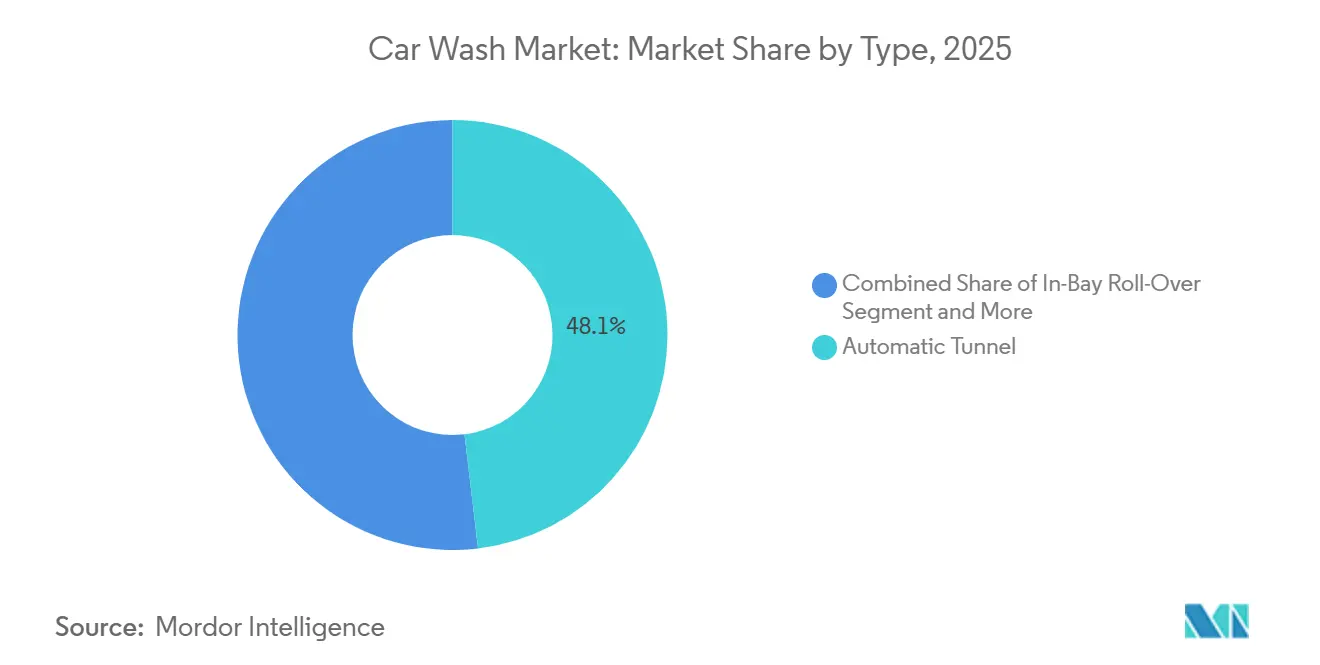
Automatic Tunnels Dominate While Express Formats AccelerateAutomatic Tunnel held 48.12% of the car wash market share in 2025, keeping it well ahead of other categories because the format supports high throughput and scalable membership economics. Within that same grouping, Express Exterior is projected to grow at an 8.27% CAGR through 2031, indicating where capital is moving within the broader car wash market. That combination matters because leading operators increasingly prefer layouts that support high vehicle counts while minimizing service interruptions and labor-dependent steps. Automatic tunnel sites also align better with recurring membership models, since frequent users can be processed quickly, reducing long queue times during peak periods. In practical terms, the format aligns the revenue and operating models more closely than most alternatives.
In-Bay Roll-Over remains relevant at fuel stations and convenience-led locations, especially where the site footprint is tight, and a full tunnel layout is not feasible. Self-Service Bay also remains present in cost-sensitive trade areas. It continues to serve a useful role for operators seeking a lower-entry format or a complementary offer on the same parcel. The 2025 Exterior Conveyor Survey showed that a notable share of express-exterior operators in the United States also operated coin-operated self-service bays on-site, highlighting a hybrid approach rather than a simple one-format market. Mobile and Hand Wash remain smaller in the car wash market. Yet, they retain demand in premium detailing and fleet-oriented niches where convenience and location flexibility carry more weight than throughput. Even so, the direction of the car wash market remains clear, as the best-funded operators are concentrating their investment in automated tunnel systems that can support repeat traffic at scale.



By Mode of Payment:
Cashless Dominance Opens Data MoatsCashless (Card and NFC) accounted for 63.23% of the car wash market in 2025 and is forecast to grow at an 11.84% CAGR through 2031, a strong sign that digital payments still have room to expand. In the car wash market, that pattern is notable because the leading payment option is also the fastest-growing one, which usually points to a structural shift rather than a temporary upgrade cycle. Mature regions such as North America and Australia already process much of their volume electronically. At the same time, many self-service locations in parts of Europe, South America, and Asia still retain a stronger cash mix. That split means the payment transition is moving at different speeds, yet the direction is broadly consistent across the car wash market. App-based subscription billing is also becoming more distinct from basic card acceptance, because it supports household plans, multi-vehicle enrollment, and automated recurring charges.
Cash still serves an important role in certain rural and lower-infrastructure markets, and it remains relevant where customers use self-service bays more frequently than conveyor formats. Even so, the operational advantage of digital systems is widening because cashless payments support license plate recognition, targeted offers, faster member entry, and cleaner audit trails. The Australian Car Wash Association’s payment review points to the same trend, with more than 80% of in-person transactions now conducted via card or mobile wallet channels. UIC and WashCard Systems also partnered in April 2025 to deploy EMV, NFC, and QR payment capabilities for U.S. car wash operators, which shows that enabling infrastructure is becoming more standardized [4]“UIC and WashCard Partner to Deliver Cashless Payment Solutions,” UIC Payments Inc., uicpaymentsinc.com . As more operators adopt these systems, the car wash market should become harder for cash-based competitors to navigate, as the data and automation gap widens over time.
By Service Model:
Subscription Disrupts a Single-Service MajoritySingle-Service Wash accounted for 55.78% of the car wash market in 2025, indicating that one-time transactions still represent the largest share of customer behavior today. Subscription-Based Unlimited, however, is projected to grow at a 10.42% CAGR through 2031, making it the most important growth engine within the service model split. The car wash market is therefore balancing two realities at once: a large installed base of pay-per-wash customers and a faster-growing stream of recurring membership revenue. That contrast explains why operators continue to market aggressively at the lane, because each retail visitor can still become a higher-value subscription customer. It also explains why chains invest in pricing ladders, lane signage, staff incentives, and app flows that push customers toward monthly plans instead of one-time upgrades.
The performance gap between mature and immature membership sites is already visible in the supplied data. Rinsed reported that locations with more than 4,000 active monthly members reached a 15.6% conversion rate in Q4 2025, while sites with fewer than 2,000 members converted at under 3%. Full-Service, which combines washing and detailing, still holds value in the car wash market because automated tunnels cannot fully replace interior cleaning and deeper appearance work. At the same time, operators are adding detailing credits, preferred access, and other premium benefits to unlimited plans so they can move subscribers into higher-value tiers rather than compete only on entry-level price. That migration strategy gives the car wash market another growth lever, because same-store revenue can rise even if customer counts change more slowly than before.
By End-User:
Passenger Vehicles Anchored by Fleet MomentumPassenger Vehicles held a 57.84% share in 2025, keeping consumer demand at the center of the car wash market and reflecting the importance of membership-based programs among household vehicle owners. Light Commercial Vehicles are expected to grow at an 8.21% CAGR through 2031, making them the fastest-growing end-user group in the current forecast. The reason is straightforward because vans, ride-hailing cars, and last-mile delivery vehicles return for cleaning more often than most privately used vehicles. In the car wash market, that higher frequency creates an attractive opening for operators that can package usage into account-based plans rather than depend only on individual retail visits. It also makes fleet demand more visible in site planning, pricing, and lane design.
Tidal Wave Auto Spa already offers dedicated fleet plans for businesses with 5 or more vehicles, indicating that operators are formalizing commercial demand rather than serving it solely through retail lanes. Medium and Heavy Commercial Vehicles remain a smaller part of the mix because they often use specialized truck-wash facilities rather than consumer-facing express tunnels. Still, the growth case for Light Commercial Vehicles in the car wash market appears durable, as e-commerce and on-demand mobility continue to expand vehicle miles traveled in urban and suburban corridors. IMO Car Wash also introduced Business Quick Pay for fleet operators, giving multi-vehicle customers a simpler way to manage usage and payment. As more operators separate commercial accounts from household memberships, the car wash market could develop a more distinct B2B layer with steadier volume and longer contract cycles.
By Ownership:
Independent Scale Erodes as Chains ExpandIndependent Operators held a 67.14% share in 2025, confirming that the car wash market still retains a fragmented ownership base despite ongoing consolidation. Franchised and Chain Operators, however, are projected to grow at a 9.42% CAGR through 2031, indicating where structural momentum lies. This gap reflects more than branding, because larger groups can fund new sites, support digital payment systems, spend consistently on marketing, and wait longer for membership density to build at new locations. In the car wash industry, those advantages compound as networks become denser and customers gain access to shared memberships across several nearby sites. The result is that scale is becoming a stronger competitive variable than it was during the earlier, more locally oriented phase of the market.
Independents still have defensible positions in some areas, especially where they own legacy real estate outright or where local customer loyalty remains strong enough to resist chain conversion. Yet those advantages are narrowing as larger operators improve neighborhood marketing, strengthen app-based retention, and match local offers with broader service convenience. The car wash market is therefore not moving toward the disappearance of independents, but it is making survival harder for owners who lack capital and system discipline. The growth of chain operators also aligns with the broader shift toward subscriptions, cashless transactions, and automated formats, since these elements are easier to standardize across a multi-site platform than across isolated properties. Over the next few years, ownership share in the car wash market is likely to keep shifting gradually, even if independents remain numerically common.
Geography Analysis
North America Car Wash Market
North America accounted for 40.76% of the car wash market share in 2025, keeping it well ahead of every other region and underscoring the depth of its established express and membership ecosystem. The United States continues to drive most of that regional revenue through a large installed base of franchise- and chain-operated tunnel sites, a strong convenience orientation, and high consumer familiarity with unlimited-wash plans. Canada adds support through co-branded convenience and wash formats and through early expansion by U.S.-linked franchise systems, which helps extend the regional operating model beyond one country. Water regulation is becoming an increasingly important operating condition in this region, with Cambridge, Massachusetts, placing drought-related water restrictions in effect during 2025 and the Town of Dillon, Colorado, imposing higher-level restrictions in early 2026. California’s recycling requirement for newer conveyor and in-bay systems adds another layer of compliance, raising the capital threshold for entrants and favoring operators who already have the funding to build closed-loop systems.
APAC and Europe Car Wash Market
Asia-Pacific is forecast to grow at an 8.43% CAGR through 2031, making it the fastest-growing regional bloc in the car wash market. China and India are central to that expansion because vehicle ownership is increasing, urban density is high, and professional washing is gaining ground over informal manual cleaning. One notable feature of the car wash market in this region is that many operators are moving more directly toward automated tunnels and digital payment acceptance without spending as long in the self-service stage that shaped earlier market development elsewhere. Europe remains an important region with a more mature facility base and a stronger regulatory overlay around wastewater handling, biodegradable chemistry, and product restrictions. Those rules can slow expansion in the short term, yet they also raise the operating standard in ways that support better-capitalized operators and more formalized site networks.
MEA and South America Car Wash Market
South America, the Middle East, and Africa remain smaller today, though all add meaningful long-run headroom for the car wash market. In South America, demand is centered in large urban areas where rising vehicle ownership and denser traffic patterns support more organized washing formats. In the Middle East and Africa, the pull is especially visible in the UAE and Saudi Arabia, where high vehicle density and water-scarce conditions make professional washing more practical than at-home alternatives. These regional patterns do not yet rival those of North America in absolute scale. However, they show that the car wash market still has room to expand in places where formal site networks and modern payment systems remain underpenetrated.
Mordor Intelligence provides coverage of the car wash market across other key regional markets, including Europe, North America, Middle East, and Asia Pacific, each with their regulatory frameworks and demand patterns.

Competitive Landscape
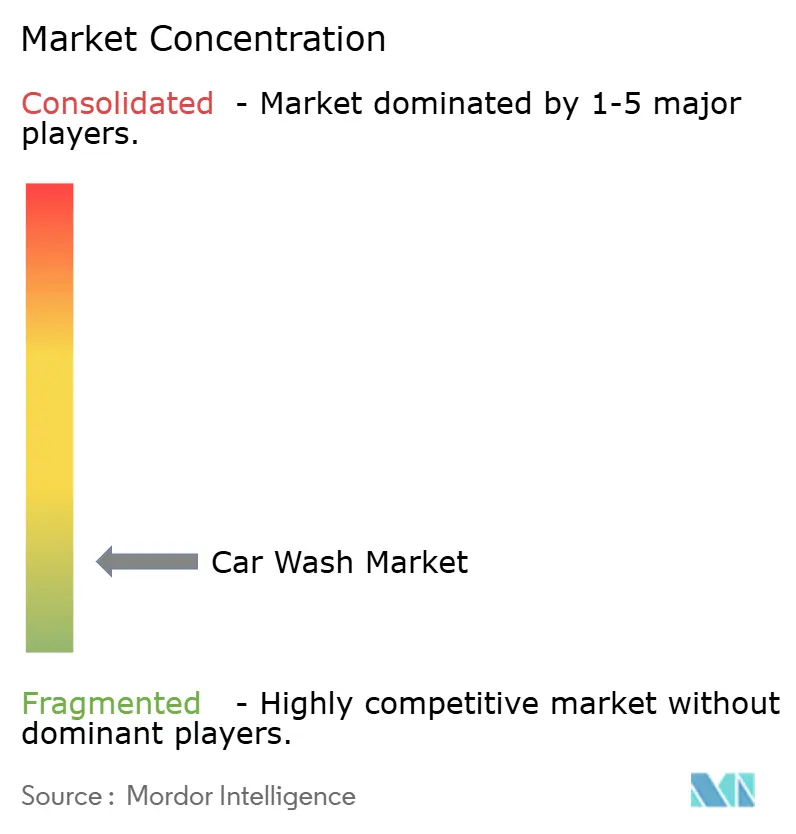
The car wash market is moving from broad fragmentation toward tiered consolidation, where a smaller number of well-funded platforms compete against a long tail of independent operators with local strengths. That shift is visible in strategy as much as in ownership, as larger groups focus on network density, repeat-membership revenue, payment automation, and a standardized customer experience. A major example came in 2026, when Leonard Green & Partners agreed to take Mister Car Wash private at a USD 3.1 billion enterprise value, representing a 29% premium to the 90-day volume-weighted average share price. The message from that deal is clear: the car wash market is increasingly valued for recurring revenue durability and platform scalability rather than wash volume alone.
Large operators are increasingly leveraging balance-sheet tools. In 2025, Mister Car Wash executed several sale-leaseback transactions, demonstrating the trend of recycling real estate to fuel further expansion. The car wash market is witnessing heightened competition, especially in technology. AI-driven kiosks, advanced point-of-sale systems, and proprietary chemistry are emerging as key differentiators. Mister Car Wash's filings highlighted patents related to its Titanium 360° wash technology and Unity Chemistry, with protections lasting until 2040. Such strategic moves indicate that industry leaders are seeking process advantages, making it challenging for smaller players to replicate using standard tools. Furthermore, these developments emphasize that competition in the car wash market has evolved beyond mere location and pricing, with systems, data, and technical consistency now playing pivotal roles in performance.
Portfolio reshaping is another sign of a more focused competitive structure. Driven Brands announced the divestiture of its international car wash business in December 2025, and the supplied draft also ties that broader repositioning to the April 2025 sale of its United States business. Take 5 Car Wash portfolio to Whistle Express and the February 2026 sale of IMO Car Wash to Franchise Equity Partners. In the car wash market, this reinforces a pattern in which specialized operators and dedicated investors appear more willing than diversified owners to continue deploying capital behind subscription-led wash platforms. Independent owners still matter, especially where they control prime legacy sites or maintain strong local trust. Yet, the cost structure of the car wash market increasingly rewards scale, dense clustering, and disciplined operating systems. Competition, therefore, remains active, but it is becoming less so even as access to capital and digital capabilities play a larger role in who expands and who exits.
Car Wash Industry Leaders
Mister Car Wash
Splash Car Wash
Driven Brands, Inc.
Zips Car Wash, LLC
Quick Quack Car Wash
- *Disclaimer: Major Players sorted in no particular order
Car Wash Market Companies Covered in this Report
- Mister Car Wash
- Whistle Express Car Wash
- Driven Brands, Inc.
- Zips Car Wash, LLC
- Quick Quack Car Wash
- Splash Car Wash
- Autobell Car Wash
- Super Star Car Wash
- True Blue Car Wash
- Hoffman Car Wash
- Tommy's Express Car Wash
- Circle K Car Wash
- Petro-Canada SuperWash
- Spotless Brands
- Club Car Wash
- Car Spa Inc.

Recent Industry Developments in Car Wash Market
- May 2026: GenrRev unveiled its patented cloud-based point-of-sale (POS) operational intelligence platform, tailored specifically for car wash operators. This platform aims to streamline hardware complexities and boost operational flow.
- April 2026: With the debut of The Roux Car Wash, The Roux broadened its operational horizons. This new venture promises a fully automated car wash experience, catering not just to vehicles but also to the local community.
- March 2026: Amavi, a European investment firm, acquired Belgian operator De Singel, comprising 6 tunnel car washes and 5 self-service bays, to launch a new Benelux car wash consolidation platform, signaling that PE-led roll-up strategies are actively migrating from North America to fragmented European markets.
- December 2025: Clearwater Express has taken over all 53 locations of BlueWave Express in Texas from Whistle Express. This strategic move significantly boosts Clearwater's presence and density in the Texas market.


Car Wash Market Report Scope and Research Methodology
Market Definition and Coverage
Our study defines the global car wash market as the yearly revenue earned by professional fixed-site and mobile operators that clean passenger and light-duty vehicles through tunnel, roll-over, in-bay, and self-service formats, including single-visit tickets and membership fees.
Scope exclusion: Heavy truck washes, detailing-only boutiques, chemicals, and equipment sales fall outside this assessment.
Segments Covered in This Report
- By Type
- Automatic Tunnel
- In-Bay Roll-Over
- Self-Service Bay
- Express Exterior
- Mobile / Hand Wash
- By Mode of Payment
- Cash
- Cashless (Card / NFC)
- Subscription / Membership App
- By Service Model
- Single-Service Wash
- Full-Service (Wash + Detailing)
- Subscription-Based Unlimited
- By End-User
- Passenger Vehicles
- Light Commercial Vehicles
- Medium and Heavy Commercial Vehicles
- By Ownership
- Independent Operators
- Franchised / Chain Operators
- By Geography
- North America
- United States
- Canada
- Rest of North America
- South America
- Brazil
- Argentina
- Rest of South America
- Europe
- Germany
- United Kingdom
- France
- Italy
- Spain
- Russia
- Rest of Europe
- Asia-Pacific
- China
- India
- Japan
- South Korea
- Australia
- Rest of Asia-Pacific
- Middle East and Africa
- United Arab Emirates
- Saudi Arabia
- Turkey
- South Africa
- Egypt
- Nigeria
- Rest of Middle East and Africa
- North America
Data Sources, Market Sizing, and Validation
Primary Research
We complemented desk work with interviews of chain executives, single-site owners, equipment distributors, and water-recycling technology vendors across North America, Europe, and Asia Pacific. These conversations let Mordor analysts validate ticket prices, membership uptake, outlet throughput, and regulatory friction, closing gaps that secondary data could not address.
Desk Research
We began with a broad scan of freely available data, then filtered what matters. Public sources such as the International Carwash Association wash counts, U.S. Bureau of Labor Statistics service revenues, Eurostat vehicle parc, and environmental agency water-use filings helped set the commercial context. Trade publications like Auto Laundry News and regional transport ministries' car registrations sharpened geography splits, while D&B Hoovers and Dow Jones Factiva supplied operator financials that grounded pricing and outlet economics. This list is illustrative, and many other open records were reviewed for cross-checks.
Market-Sizing & Forecasting
We built a top-down model starting with registered vehicle stock by country, applied average annual washes per vehicle and prevailing ticket prices, then adjusted for professional wash penetration. Outlet roll-ups and sampled average selling price times volume checks provided a bottom-up sense check before figures were locked. Key variables tracked include vehicle parc growth, subscription membership share, new express-tunnel openings, water tariffs, consumer disposable income, and weather normalization factors. A multivariate regression, calibrated with historic wash revenues and the six drivers above, projects values through 2030.
Data Validation & Update Cycle
Our outputs pass three layers of scrutiny: variance screens versus trade statistics, peer review within the analyst team, and a final senior sign-off. Models refresh each year, with interim updates triggered when material events such as a large chain bankruptcy or a sudden tariff shift occur and alter demand assumptions.
How Mordor Intelligence's Car Wash Market Size Compares to Other Published Estimates
We recognize that published estimates often diverge because companies draw the borders of the market in their own way.
Key gap drivers include wider service bundles in competitor scopes, reliance on unverified consumer spending surveys, slower refresh cadences, and differing currency conversion dates.
Benchmark comparison
| Market Size | Anonymized source | Primary gap driver |
|---|---|---|
| USD 28.22 B | Mordor Intelligence | |
| USD 36.29 B | Global Consultancy A | Bundles detailing products and accessory retail, minimal primary validation |
| USD 35.19 B | Industry Association B | Adds heavy-vehicle washes, biennial updates rely on spending surveys |
The simple takeaway is that Mordor's focused scope, live primary checks, and yearly refresh give decision-makers a balanced, transparent baseline they can trust.


Key Questions Answered in the Report
How large is the car wash market by 2031?
The car wash market is forecast to reach USD 43.65 billion by 2031, rising from USD 30.35 billion in 2026 at a 7.54% CAGR.
Which payment method is expanding fastest in car wash operations?
Cashless (Card and NFC) leads the segment with 63.23% share in 2025 and is also the fastest-growing payment mode with an 11.84% CAGR through 2031.
Which region leads global demand for car wash services?
North America held the largest share at 40.76% in 2025 because it has the most mature subscription ecosystem and a dense base of express tunnel sites.
Why are subscription plans becoming so important for operators?
Memberships create steadier recurring revenue, support better site economics, and improve customer lifetime value compared with one-time wash transactions.
Page last updated on:




