
Europe Quinoa Seeds Market Analysis by Mordor Intelligence
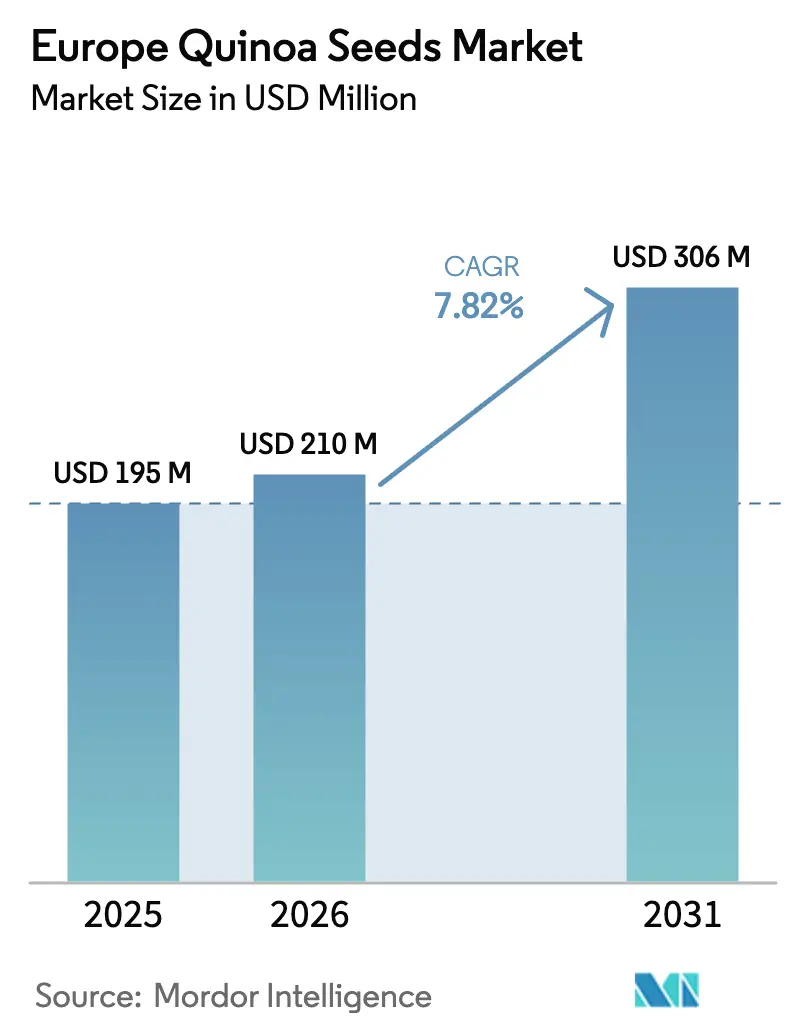
The Europe quinoa seed market size was valued at USD 195 million in 2025 and is estimated to grow from USD 210 million in 2026 to reach USD 306 million by 2031, at a CAGR of 7.82% during the forecast period (2026-2031). Structural diversification away from wheat and barley, policy incentives for alternative proteins, and the rapid uptake of gluten-free diets are shifting acreage toward quinoa across core-producing zones in France, Germany, and the United Kingdom. Price premiums for certified organic grain, averaging 35–45%, continue to outweigh higher input and de-saponization costs, supporting farmer margins even when South American imports pressure conventional grades. Ready-meal manufacturers have elevated demand by integrating quinoa into chilled and frozen lines sold through discount retailers, while aquaculture feed trials in Spain and Norway reveal non-food industrial potential that could unlock incremental volumes. The Europe quinoa seed market is also benefiting from the Common Agricultural Policy’s eco-scheme payments, which reward crop rotation diversity and partially offset growers’ learning-curve risks.
Key Report Takeaways
By Geography, France captured 29.4% of the Europe quinoa seeds market share in 2025, while Germany is advancing at an 11.7% CAGR to 2031.
Note: Market size and forecast figures in this report are generated using Mordor Intelligence’s proprietary estimation framework, updated with the latest available data and insights as of January 2026.
Europe Quinoa Seeds Market Trends and Insights
Drivers Impact Analysis*
| Driver | (~) % Impact on CAGR Forecast | Geographic Relevance | Impact Timeline |
|---|---|---|---|
| Rising consumer demand for plant-based proteins | +1.8% | France, Germany, Netherlands, and United Kingdom | Medium term (2–4 years) |
| Growth in organic and gluten-free product sectors | +1.5% | Germany, France, United Kingdom, and Scandinavia | Medium term (2–4 years) |
| Government incentives for crop diversification | +1.2% | France, Germany, Spain, and Italy | Short term (≤ 2 years) |
| Expanding use in ready-meal manufacturing | +1.0% | Germany, United Kingdom, and Netherlands | Medium term (2–4 years) |
| Aquaculture feed integration of quinoa | +0.7% | Spain, Norway, and Scotland | Long term (≥ 4 years) |
| Heat-tolerant cultivars enabling southern Europe farming | +0.6% | Spain, Italy, and Southern France | Long term (≥ 4 years) |
| Source: Mordor Intelligence | |||
Rising Consumer Demand for Plant-Based Proteins
Flexitarian diets are shifting protein intake toward plant sources as urban millennials and Generation Z seek low-carbon food choices. Quinoa’s complete amino acid profile positions it as an attractive meat substitute in meal kits and quick-service food chains, especially in Germany, where plant-based protein consumption rose 18% in 2025, and quinoa captured 9% of that category [1]. Institutional buyers reinforce volume stability. France’s school-lunch mandate requiring 50% plant-based proteins created a predictable domestic offtake. Suppliers that secure multi-year contracts with foodservice distributors can lock in premiums while South American cargoes continue to clear on volatile spot markets.
Growth in Organic and Gluten-Free Product Sectors
Organic quinoa commands 35–45% premiums over conventional grades, prompting acreage expansion in Germany as certified production continues to rise [2]. European Union gluten-free sales reached EUR 3.8 billion (USD 4.1 billion) in 2025, advancing 12% annually as diagnoses of celiac disease and non-celiac gluten sensitivity rise [3]. Quinoa’s gluten-free status enables processors to avoid cross-contamination risks common to oats and wheat, and harmonized labeling under Regulation 828/2014 simplifies compliance across member states.
Government Incentives for Crop Diversification
The 2023–2027 Common Agricultural Policy earmarked EUR 387 billion (USD 418 billion) for eco-schemes that reward farmers adopting rotations with pseudocereals such as quinoa. France’s Ecophyto III program disburses EUR 150 (USD 162) per hectare for quinoa in low-input zones, while Spain funds seed subsidies through regional agencies. These incentives reduce Europe’s 14 million-metric-ton protein deficit and confer first-mover advantages on growers who master quinoa agronomy early.
Expanding Use in Ready-Meal Manufacturing
European ready-meal revenue reached EUR 28 billion (USD 30 billion) in 2025, and processors now value quinoa for rapid cook times and freeze-thaw stability. German firms such as Frosta and Apetito added quinoa bowls to chilled ranges sold through Aldi and Lidl, while United Kingdom producer Bakkavor lifted quinoa salad output 30% by relying on British Quinoa Company’s local harvests. Local sourcing not only compresses lead times but also shields processors from freight spikes such as those seen during the 2024 El Niño shipping crunch.
Restraints Impact Analysis*
| Restraint | (~) % Impact on CAGR Forecast | Geographic Relevance | Impact Timeline |
|---|---|---|---|
| Limited agronomic know-how among farmers | -1.1% | France, Germany, Spain, and Italy | Short term (≤ 2 years) |
| Competition from low-priced South American imports | -0.9% | Netherlands, Germany, and United Kingdom | Medium term (2–4 years) |
| Stringent European Union pesticide-residue regulations | -0.6% | All member states | Medium term (2–4 years) |
| Saponin allergen concerns in infant foods | -0.4% | Germany, France, and Netherlands | Long term (≥ 4 years) |
| Source: Mordor Intelligence | |||
Limited Agronomic Know-How Among Farmers
Quinoa remained under 5,000 hectares in Europe during 2025, compared with 180,000 hectares in Peru and Bolivia. Photoperiod sensitivity requires precise planting windows, and Wageningen University trials showed yields decline 30–40% when sowing drifts two weeks from optimal dates. High-saponin varieties deter birds but require mechanical de-saponization, adding USD 216–324 per metric ton in processing costs, eroding returns. Limited extension capacity is slowing the diffusion of best practices, constraining acreage gains.
Stringent European Union Pesticide-Residue Regulations
The European Union policy will tighten maximum residue limits for chlorpyrifos and glyphosate in 2025. Compliance testing is expected to add USD 35–50 per metric ton to costs, posing a significant burden for small growers who lack the scale to distribute laboratory expenses. This increase in compliance costs may lead to reduced competitiveness for smaller players, potentially forcing some out of the market. Although the policy aims to protect consumer health by ensuring safer agricultural products, it inadvertently creates a higher financial barrier for new entrants. In contrast, larger, integrated firms with in-house quality laboratories are better positioned to absorb these costs, further consolidating their market advantage.
*Our forecasts treat driver/restraint impacts as directional, not additive. The impact forecasts reflect baseline growth, mix effects, and variable interactions.
Geography Analysis
France dominates with 29.4% of the European quinoa seed market in 2025, with its maritime climate, subsidies under the Common Agricultural Policy (CAP), and cooperative de-saponization capabilities. Agricolor Quinoa's network consolidates smallholder production, reduces processing costs, and supplies grain to Carrefour's national distribution network. Imports are projected to grow significantly through 2031, indicating a persistent supply gap that Andean exporters and emerging European producers are anticipated to compete to address.
Germany’s consumption value is advancing at an 11.7% CAGR through 2031, reflecting the country’s dual role as a high-growth producer and a central logistics hub in Europe. The Europe quinoa seed market size in Germany is expanding quickly as organic premiums sustain farmers' incomes, and federal funding of USD 54 million over four years for protein crops accelerates research on photoperiod-insensitive varieties, re-exports of organic flakes and flour position German processors as regional price setters, especially toward Scandinavia.
The Netherlands remains the re-export gateway, but its arbitrage model faces two pressures include retailers demanding direct traceability and Andean exporters forging direct contracts with large chains. The United Kingdom, Spain, and Italy are cultivating regional niches. Andalusia’s quinoa cluster supports 30 pilot farms, while Emilia-Romagna trials quinoa in rotations with tomatoes and vegetables. Remaining European regions depend on imports, with climate risk and limited extension support delaying local scale-up.
Regulatory Landscape
Quinoa traded in Europe falls under the EU general food framework (Regulation (EC) 178/2002) and food information rules (Regulation (EU) 1169/2011), with gluten-free communication supported by harmonized labeling provisions such as Regulation (EU) 828/2014 cited in the report context. The report characterizes quinoa as not treated as a novel food in the EU, which lowers pre-market authorization friction for mainstream grain and ingredient use, although buyers still require HACCP-aligned controls and documented traceability to manage recalls and retailer audits.
For cross-border supply, EU plant-health entry conditions apply to non-EU consignments, including phytosanitary certification under Regulation (EU) 2019/2072, alongside enforcement of pesticide maximum residue limits (MRLs) across member states. This regulatory stack ties back to the report's residue-testing cost burden and raises the bar for both organic and conventional import lots, shaping procurement toward suppliers that can evidence compliant agronomy, lab testing, and chain-of-custody documentation.
Value Chain Analysis
The European quinoa seeds value chain begins with breeding and seed supply, increasingly supported by public research programs and collaborative trials, before moving into farm production across emerging European clusters (France, Germany, United Kingdom, Spain, and smaller pilots elsewhere). After harvest, cleaning, de-saponization, sorting, and packaging follow, with specialized post-harvest processing (particularly saponin removal and high-precision cleaning) remaining more established in South America. As a result, many European users keep sourcing Andean grain even as local cultivation expands.
Downstream, quinoa supplies retail grains and private label, alongside higher-spec ingredient channels (flakes, flour, isolates) used by ready-meal producers and plant-based formulators. Logistics hubs and re-export nodes, notably the Netherlands and Germany in the report context, aggregate import volumes, support quality assurance and repacking, and distribute to retailers and food manufacturers. Ongoing R&D and scale-up efforts, including the EU-funded QUINNOVA dry fractionation pathway and regional agronomy initiatives (for example, ILVO-led work in Flanders and German collaborative breeding projects), aim at higher-value outputs and better fit-for-Europe varieties, tightening the linkage between upstream genetics, processing capability, and B2B demand for standardized functional ingredients.
Competitive Landscape
The competition in the European quinoa seed market is moderate and fragmented. South American exporters, including Andean Naturals, lead bulk commodity segments, leveraging scale and favorable exchange rates. European contract growers such as British Quinoa Company and Quinoa Marchfeld meet niche organic demand where consumers pay for transparent provenance. Vertically integrated processors, including Quinola and Ekibio, manage genetics, farming, processing, and retail packaging, insulating margins from import price swings.
Technology investment differentiates leaders. British Quinoa Company’s satellite-guided variable-rate seeding lifted yields 12% by matching plant density to soil moisture maps. Naturkost Übelhör installed optical sorters and nitrogen flushing in 2025, extending shelf life to 24 months and supporting exports to cold-chain-limited regions. European Union Intellectual Property Office (EUIPO) patent filings for heat tolerance and protein enhancement rose to 14 in 2025, signaling a trend toward defensible genetics.
Non-traditional entrants drive demand growth as Spanish aquaculture company Avramar is testing quinoa meal as a substitute for fishmeal, aiming to explore sustainable and cost-effective alternatives in aquaculture feed. Similarly, Dutch plant-based meat start-up Redefine Meat is utilizing quinoa protein isolate to enhance the texture of its products, addressing consumer demand for improved plant-based meat alternatives. Suppliers capable of providing ingredient-grade specifications can tap into higher-margin B2B channels, enabling them to diversify their revenue streams beyond traditional retail grain sales and cater to the evolving needs of innovative industries.
Market Opportunities and Future Outlook
A core opportunity in Europe is shifting part of import reliance toward locally adapted varieties and processing that meet retailer and manufacturer requirements around traceability, residues, and consistency. Public and institutional programs already visible in the market, including CAP eco-scheme support for crop diversification (2023-2027) and national or regional protein-crop funding and trials referenced in the report context, provide a structured on-ramp for acreage expansion and agronomic learning. This matters where extension gaps and photoperiod sensitivity still constrain yields.
Value uplift opportunities also concentrate in ingredient-grade processing and localized supply models that shorten lead times for ready-meal and plant-based manufacturers. Market pull is supported by branded and private-label moves toward regional sourcing and organic positioning, alongside R&D and scale-up activity around quinoa fractionation (for protein and starch) aligned to gluten-free formulations and plant protein inputs. At the same time, the regulatory burden on residues and organic compliance creates space for suppliers that can document low-residue production and offer verified chain-of-custody, supporting procurement shifts toward audited European-origin programs and integrated processors with in-house QA and cleaning/de-saponization capabilities.
Recent Industry Developments
- July 2026: Jumbo Supermarkten transitioned its own-brand quinoa to a 100% organic, locally grown Dutch supply under the Plant Protein Forward programme with local farmers. This strengthens retailer-controlled traceability and gives domestic growers a clearer route-to-market for differentiated quinoa, while challenging import-led private label supply models in the Netherlands.
- September 2025: Research initiatives such as Germany's Quinoa for Future Diversified Farming Systems (Q4F) project advanced efforts to develop quinoa varieties suited to European climates. This supports higher-performing domestic seed pipelines and directly targets the agronomic constraints that keep European production below the scale of Andean supply.
- September 2024: Sofiproteol and ESFIN Gestion partnered to fund a new industrial facility for the Pays de Loire Agricultural Cooperative (CAPL) in Longué-Jumelles, France, to process quinoa and other legumes under the Perles d'Anjou brand. Added local processing capacity helps reduce post-harvest bottlenecks (cleaning and preparation for food use) and supports more stable offtake for French growers supplying national retail and food manufacturing channels.
Research Methodology Framework and Report Scope
Market Definition and Coverage
For this study, the market is defined as the value and volume of quinoa seeds traded and consumed within Europe, counted at the product level in USD and metric tons, and mapped through production, imports, exports, and price movements.
Scope exclusions: We exclude downstream packaged quinoa foods and ready-to-eat products, along with retail markups and in-store marketing margins, because they do not reflect the quinoa seed market value.
Segmentation Overview
- By Geography
- France
- Production Analysis (Area Harvested, Yield, and Production Volume)
- Consumption Analysis (Consumption Value and Volume)
- Import Market Analysis (Import Value, Volume, and Key Supplying Markets)
- Export Market Analysis (Export Value, Volume, and Key Destination Markets)
- Wholesale Price Trend Analysis and Forecast
- Regulatory Framework
- List of Key Players
- Logistics and Infrastructure
- Seasonality Analysis
- Germany
- Production Analysis (Area Harvested, Yield, and Production Volume)
- Consumption Analysis (Consumption Value and Volume)
- Import Market Analysis (Import Value, Volume, and Key Supplying Markets)
- Export Market Analysis (Export Value, Volume, and Key Destination Markets)
- Wholesale Price Trend Analysis and Forecast
- Regulatory Framework
- List of Key Players
- Logistics and Infrastructure
- Seasonality Analysis
- United Kingdom
- Production Analysis (Area Harvested, Yield, and Production Volume)
- Consumption Analysis (Consumption Value and Volume)
- Import Market Analysis (Import Value, Volume, and Key Supplying Markets)
- Export Market Analysis (Export Value, Volume, and Key Destination Markets)
- Wholesale Price Trend Analysis and Forecast
- Regulatory Framework
- List of Key Players
- Logistics and Infrastructure
- Seasonality Analysis
- Spain
- Production Analysis (Area Harvested, Yield, and Production Volume)
- Consumption Analysis (Consumption Value and Volume)
- Import Market Analysis (Import Value, Volume, and Key Supplying Markets)
- Export Market Analysis (Export Value, Volume, and Key Destination Markets)
- Wholesale Price Trend Analysis and Forecast
- Regulatory Framework
- List of Key Players
- Logistics and Infrastructure
- Seasonality Analysis
- Italy
- Production Analysis (Area Harvested, Yield, and Production Volume)
- Consumption Analysis (Consumption Value and Volume)
- Import Market Analysis (Import Value, Volume, and Key Supplying Markets)
- Export Market Analysis (Export Value, Volume, and Key Destination Markets)
- Wholesale Price Trend Analysis and Forecast
- Regulatory Framework
- List of Key Players
- Logistics and Infrastructure
- Seasonality Analysis
- France
Data Sources, Market Sizing, and Validation
Desk Research
Desk research was used to build a reliable starting dataset for Europe, especially around area under cultivation, yields, trade flows, and reference price series that can be repeated each year. We leaned on public sources such as Eurostat agriculture and trade tables, FAOSTAT crop statistics, UN Comtrade mirror trade checks, and customs tariff code guidance published by the European Commission.
To keep assumptions grounded, we also reviewed agronomy literature on quinoa cultivation in Europe, national agriculture ministry releases, and trade association updates related to grains and specialty crops. Company annual reports and investor presentations were used to understand processing and sourcing patterns, and a paid subscription focused on shipment-level trade and company financial intelligence was used selectively to cross-check outlier importers and unusual price points. These examples are not exhaustive, and many other public sources were also consulted to collect data, validate it, and clarify open questions.
Primary Interviews and Surveys
Primary work focused on conversations and short surveys with farmers and grower groups, importers and distributors, processors, and buyers supplying food and ingredient channels across key European countries. Since quinoa seed availability and prices change by harvest and by trade season, we used expert inputs to confirm conversion factors, typical contract timing, and what part of the value chain is being priced.
Feedback was then used to fill gaps in public datasets, stress-test assumptions, and confirm whether the observed trade trends lined up with on-the-ground demand signals and supply constraints in Europe.
Distribution of primary research fieldwork respondents
| Company type | Respondent position |
|---|---|
| Top tier: 39% | CXOs: 15% |
| Mid tier: 43% | Functional/Unit leaders: 26% |
| Smaller Players: 18% | Managers: 59% |
Market-Sizing & Forecasting
Sizing was reconstructed using a top-down approach where production, imports, and exports were used to build an apparent consumption pool, which was then valued using a blended wholesale price series for quinoa seeds in Europe. When the main demand pool was formed, checks were added using selective bottom-up approximations such as sampled importer volumes, processor procurement ranges, and price-quantity validation from trade and channel discussions.
Key inputs in the model include harvested area and yield trends, import volume shifts by major entry countries, export movements from re-export hubs, wholesale price direction by season, and the share of supply sourced locally versus imported. These signals helped separate one-off price spikes from demand changes and flag years where supply tightness drove value growth without similar volume growth.
For forecasting, scenario analysis was used because production expansion, weather outcomes, and sourcing strategies can shift quickly, and then expert consensus was applied to the variable paths. Where bottom-up signals were incomplete for smaller countries, gaps were handled through proportional allocation based on verified trade shares and consumption proxies, followed by a final adjustment after interview checks.
Data Validation & Update Cycle
Outputs were validated through triangulation across trade statistics, production indicators, and price series, and then compared against independent signals such as reported procurement behavior and observed seasonality. If a country-level value moved too sharply versus its import volumes or versus price behavior, the assumptions were rechecked and, when needed, interview follow-ups were triggered.
Before sign-off, the model goes through multi-step internal reviews that focus on unit consistency, currency timing, and the logic linking volume and value. Reports are refreshed annually, and interim updates are added when material events occur, such as major harvest disruptions, policy changes affecting trade, or sustained price swings. A final pre-delivery pass is completed so the published view reflects the latest available data cut.
Mordor Intelligence's Europe Quinoa Seeds Market Estimate Compared With Other Published Estimates
It is normal to see different published market values for quinoa in Europe, even when the titles look similar, because the scope can shift between farm-gate seeds, wholesale grain, and retail-packed food products. Differences also come from how trade is netted, how prices are averaged across the year, and whether the estimate leans on volume-led logic or a price-first approach.
Some sources take a broader quinoa view that mixes in consumer-level pricing or includes the wider quinoa market beyond seeds. In Mordor Intelligence, the count is limited to quinoa seeds at the product level in Europe, valued through production and trade balances and tied back to wholesale price signals instead of retail margins.
Benchmark comparison
| Source | Market Size | Gaps in Research Methodology |
|---|---|---|
| Mordor Intelligence | USD 195.00 M (2025) | |
| Industry Data Publisher A | USD 75.00 M (2024) | Uses a quinoa market value concept in nominal wholesale prices for a single year, and it can exclude parts of the Europe seed flow if re-exports and cross-border redistribution are not fully netted in apparent consumption. |
| Regional Research House B | USD 142.80 M (2026) | Positions the market closer to a consumer and ingredient demand view, with end uses and channels such as supermarkets and online retail, which shifts pricing closer to downstream values and changes how seeds for cultivation and bulk trade are counted. |
Taken together, the spread is mainly explained by what price point is used and how the Europe flow is assembled, not by a single data source being right or wrong. By tying value to a repeatable volume build and a transparent wholesale price path, the study stays traceable to clear variables that can be rechecked as new trade and harvest data comes in.
Key Questions Answered in the Report
How big is the Europe Quinoa Seed Market?
The Europe quinoa seed market is projected to reach USD 210 million in 2026 and USD 306 million by 2031.
What is the current Europe Quinoa Seed Market size?
In 2025, the Europe quinoa seed market is estimated at USD 195 million
How fast is demand for quinoa growing in Europe?
Consumption value across Europe is advancing at an 11.7% CAGR in Germany and high single-digit rates elsewhere, driven by flexitarian diets and institutional foodservice mandates.
What makes European quinoa more expensive than South American grain?
Smaller farm scale, higher labor costs, stringent residue testing, and de-saponization expenses lift European production costs 20–30% above Andean imports.