
Bulletproof Vest Market Size and Share
Market Overview
| Study Period | 2020 - 2031 |
|---|---|
| Market Size (2026) | USD 1.82 Billion |
| Market Size (2031) | USD 2.15 Billion |
| Growth Rate (2026 - 2031) | 3.35 % |
| Fastest Growing Market | Asia-Pacific |
| Largest Market | North America |
| Market Concentration | Medium |
Major Players *Disclaimer: Major Players sorted in no particular order Image © Mordor Intelligence. Reuse requires attribution under CC BY 4.0. | |
Bulletproof Vest Market Analysis by Mordor Intelligence
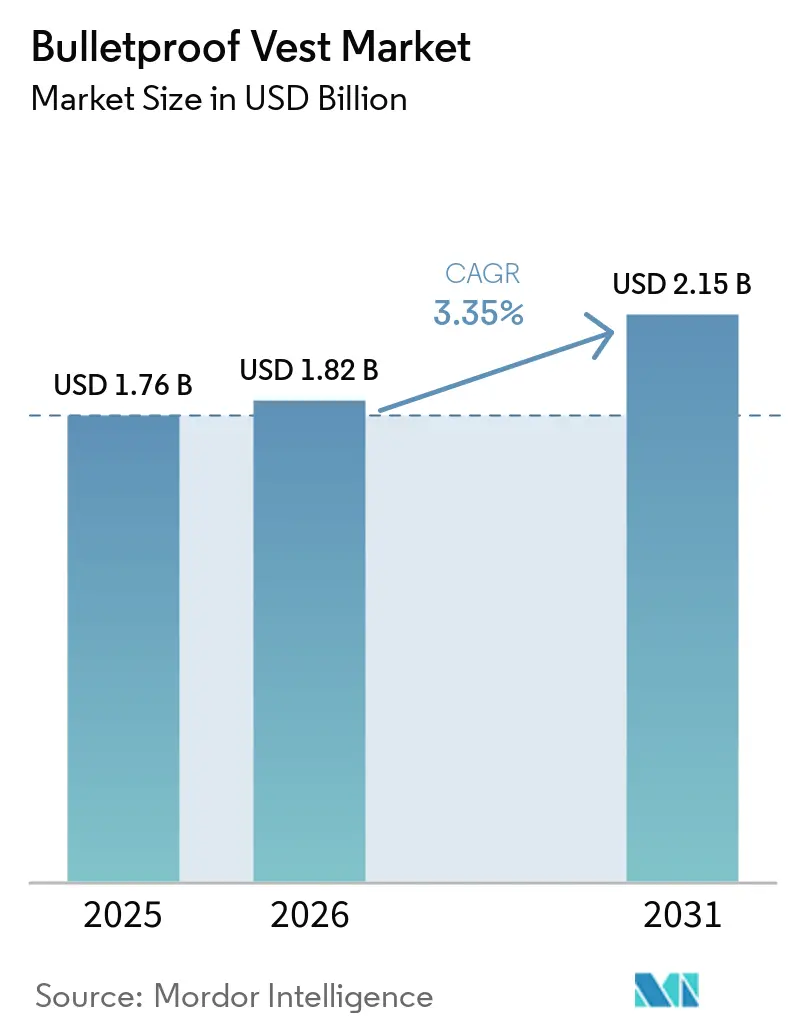
The bulletproof vest market size was valued at USD 1.76 billion in 2025 and estimated to grow from USD 1.82 billion in 2026 to reach USD 2.15 billion by 2031, at a CAGR of 3.35% during the forecast period (2026-2031).[1] Growth hinged on defense modernization in Europe and Asia-Pacific, rapid adoption of lightweight soft armor by law enforcement agencies, material innovations that balanced protection with mobility, and tighter certification standards that raised replacement demand. Rising executive protection spending, particularly in North America and Western Europe, broadened the customer base beyond traditional military buyers. Meanwhile, the Ukraine conflict reshaped European procurement priorities, prompting local manufacturers to scale capacity and accelerating the adoption of Level IV plates for multi-hit scenarios. Ongoing raw-material price swings and counterfeit equipment scandals tempered near-term growth yet spurred demand for authenticated, NIJ-certified gear.
Key Report Takeaways
- By product type, hard vests led with 82.95% revenue share in 2025; soft armor is projected to expand at a 3.72% CAGR to 2031.
- By material, aramid retained 53.10% of the bulletproof vest market share in 2025, while UHMWPE is forecast to grow fastest at 3.95% CAGR through 2031.
- By protection level, Level IIIA held 46.10% of the bulletproof vest market in 2025, whereas Level IV is expected to advance at a 3.86% CAGR until 2031.
- By end user, the military segment accounted for 72.10% share of the bulletproof vest market in 2025; private security exhibits the highest projected CAGR at 3.75% through 2031.
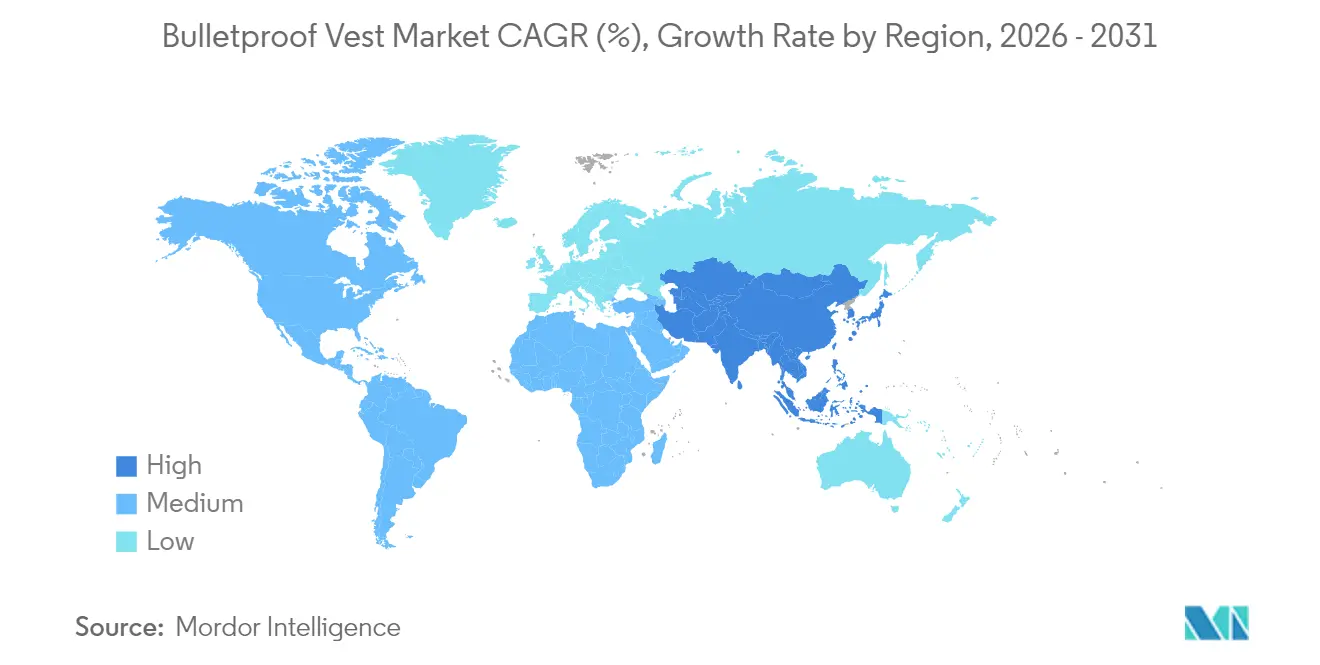
- By geography, North America dominated with a 42.00% share in 2025, while Asia-Pacific is set to record the strongest 3.76% CAGR to 2031.
Note: Market size and forecast figures in this report are generated using Mordor Intelligence’s proprietary estimation framework, updated with the latest available data and insights as of 2026.
Market Trends and Insights
Drivers Impact Analysis of Bulletproof Vest Market*
| Driver | (~)% Impact on CAGR Forecast | Geographic Relevance | Impact Timeline |
|---|---|---|---|
| Escalating defense modernization programs | +0.8% | Global, with concentration in Europe, Asia-Pacific | Medium term (2-4 years) |
| Rising procurement of lightweight soft armor by law enforcement | +0.6% | North America and EU, expanding to Asia-Pacific | Short term (≤ 2 years) |
| Growing demand for female-fit ballistic vests | +0.4% | Global, led by North America and Europe | Medium term (2-4 years) |
| Adoption of multi-hit ceramic-UHMWPE hybrid plates | +0.5% | Global, military-focused markets | Long term (≥ 4 years) |
| Intensifying geopolitical conflicts and territorial disputes | +0.7% | Europe, Asia-Pacific, Middle East | Short term (≤ 2 years) |
| Expansion of private security and VIP protection industry | +0.3% | North America, Europe, emerging markets | Medium term (2-4 years) |
| Source: Mordor Intelligence | |||
Escalating Defense Modernization Programs
European, Asian, and North American armies pursued large-scale re-capitalization programs prioritizing survivability, driving orders for next-generation plates and carriers.[2] France adopted the modular G3P system with boron-carbide inserts and real-time damage sensors, while Germany delivered 100,000 MOBAST vests to its troops, underscoring demand for scalable, technology-enabled solutions. Canada’s USD 19.7 million contract for 3,000 advanced sets further exemplified the modernization wave. These programs emphasized modularity, integration with soldier-worn sensors, and ergonomic adjustments for diverse body types, including female personnel, indicating a systemic shift toward user-centric armor design. Long-run funding commitments sheltered suppliers from short-term budget volatility.
Rising Procurement of Lightweight Soft Armor by Law Enforcement
Police departments in the United States and Europe increased orders for soft vests that cut officer fatigue without sacrificing NIJ compliance. DuPont’s Kevlar EXO and Dyneema’s SB301 reduced weight by up to 30% compared with prior fabrics, widening daily-wear adoption. Updated NIJ Standard 0101.07 introduced gender-specific fit testing that aligned procurement specifications with a more diverse workforce. Department of Justice field trials found negligible core-temperature increases among 504 officers wearing modern armor, dispelling heat-stress concerns and strengthening compliance rates. These factors collectively lifted replacement cycles and spurred backlog orders across municipal agencies.
Growing Demand for Female-Fit Ballistic Vests
Women constituted roughly 15% of the law-enforcement workforce in 2025, prompting dedicated vest designs with contoured panels, variable cup sizes, and moisture-wicking liners that trimmed bulk and improved ballistic coverage. The technology helps in delivering the most advanced ballistic protection that is required by the military, law enforcement, and global security officers while increasing flexibility and comfort. MKU’s COV-F-IA covert model showcased anti-fungal fabrics and SK1 protection within a form-fitted profile, highlighting rising technical sophistication in this niche. Point Blank’s Python II Female vest added electroshock shielding, illustrating a single garment's ballistic and less-lethal protection convergence. Research into 3D warp-interlock fabrics provided repeatable dome-forming methods that maintained ballistic integrity while achieving female-specific ergonomics. NIJ certification frameworks mirrored these advances, mandating separate testing protocols that reinforced product differentiation.
Adoption of Multi-Hit Ceramic-UHMWPE Hybrid Plates
Armies that faced armor-piercing rounds in Ukraine and other conflicts turned to ceramic-UHMWPE hybrids for improved multi-hit endurance at lower mass than legacy steel designs. SiC/Ti6Al4V/UHMWPE trilayers resisted 12.7 mm threats while shaving 35% off weight, enhancing soldier mobility. Atmospheric-plasma surface treatment tightened bonding at the ceramic-polymer interface, yielding statistically significant upticks in V50 values without adding material. Russia’s boron-carbide iterations delivered BR-5 protection in plates weighing just 2,400 g, underscoring the performance headroom opened by local material science programs. These breakthroughs pushed competitors to accelerate hybrid-plate roadmaps and secure long-term fiber supply contracts.
Restraints Impact Analysis of Bulletproof Vest Market*
| Restraint | (~)% Impact on CAGR Forecast | Geographic Relevance | Impact Timeline |
|---|---|---|---|
| Volatile aramid and UHMWPE raw material prices | -0.5% | Global, manufacturing-concentrated regions | Short term (≤ 2 years) |
| Stringent export licensing for ballistic products | -0.3% | Global, US-EU export corridors | Medium term (2-4 years) |
| Heat-stress and back-face deformation concerns in tropical climates | -0.2% | Tropical regions, military deployments | Long term (≥ 4 years) |
| Proliferation of counterfeit/uncertified body-armor products | -0.4% | Global, emerging market focus | Medium term (2-4 years) |
| Source: Mordor Intelligence | |||
Volatile Aramid and UHMWPE Raw Material Prices
Aramid and UHMWPE costs swung sharply with petrochemical inputs and capacity additions, compressing margins for armor assemblers that lacked long-term supply pacts. DuPont’s USD 768 million goodwill impairment in Q1 2025 highlighted profitability headwinds inside legacy aramid lines.[3] Chinese UHMWPE makers undercut Western rivals on price, forcing brand-name suppliers to justify premiums through tighter quality control and PFAS-free chemistries. Research confirmed that resin-parameter variance directly affected fiber modulus, elevating scrap risk and raising processing costs during quality re-work. The resulting cost pass-through squeezed procurement budgets and elongated purchasing cycles
Proliferation of Counterfeit/Uncertified Body-Armor Products
Federal investigations revealed criminal networks that re-labeled low-grade plates from China as NIJ-certified US products, eroding buyer trust and triggering costly recalls. One Washington-state operator shipped more than USD 1 million of substandard gear to military and police clients before sentencing in March 2024. The confusion between “certified” and “compliant” labels amplified procurement risk for smaller agencies that lacked dedicated testing budgets. High-profile investigations into mislabeled imports pressured distributors to adopt blockchain-based provenance tools and sharpen vetting of upstream suppliers. The reputational fallout persuaded end users to favor established brands with transparent quality-assurance records.
*Our forecasts treat driver/restraint impacts as directional, not additive. The impact forecasts reflect baseline growth, mix effects, and variable interactions.
Bulletproof Vest Market Segment Analysis
By Product Type:
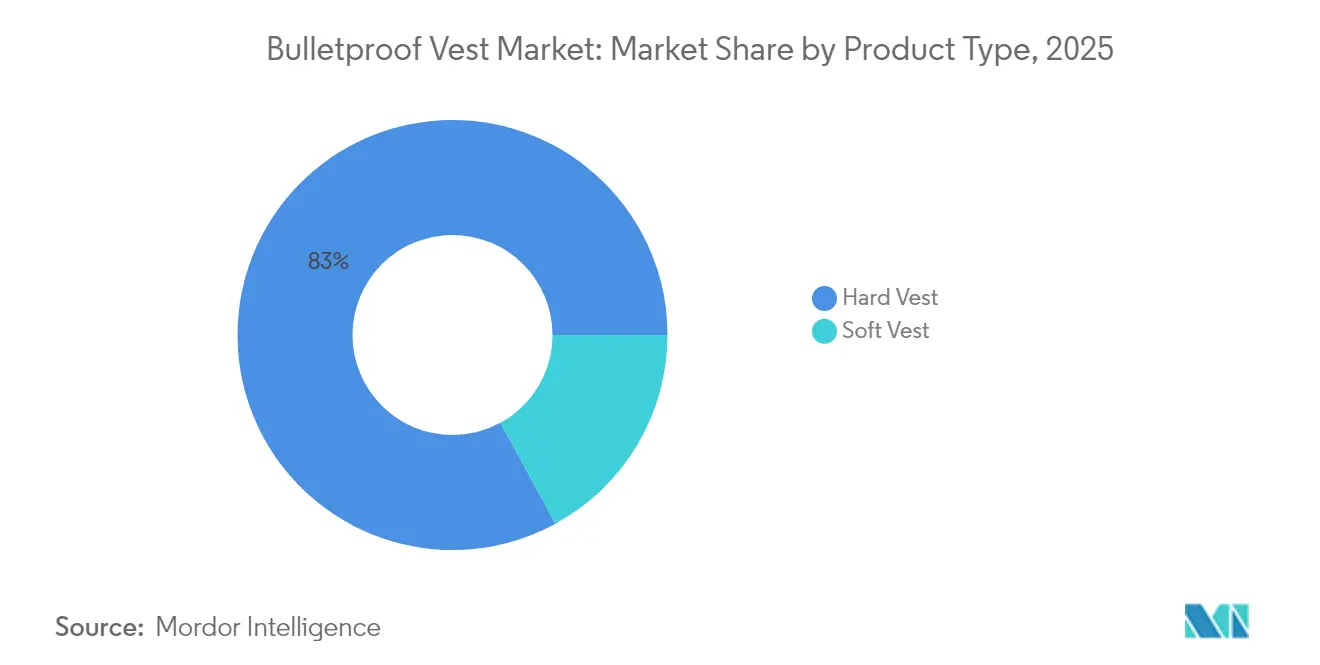
Hard Vest Dominance Reflects Threat EvolutionHard configurations captured 82.95% of 2025 sales, confirming operational priorities that favored armored plate carriers able to withstand rifle fire. The bulletproof vest market size for hard vests was expected to increase by 3.28% CAGR to 2031, fueled by battlefield reports emphasizing multi-hit survivability against armor-piercing rounds. Military buyers demanded modular carriers that integrated communications routing, trauma packs, and identification panels, compressing legacy soft-armor share.
Material advances trimmed weight penalties, allowing infantry to add side plates or deltoid protection without breaching load thresholds. Soft vests remained essential for undercover police and VIP details that required concealment, yet their unit share contracted as weight savings in hard plates narrowed the mobility gap. 3D-knit fabrics and spacer meshes improved thermal regulation inside soft carriers, hinting at future crossover products that merge plate pockets with concealable textiles.

By Material:
UHMWPE Gains Ground Against Aramid LegacyAramid preserved 53.10% of 2025 revenues, but UHMWPE climbed fastest at a 3.95% CAGR on the strength of higher specific energy absorption and buoyancy for maritime missions. PPTA/UHMWPE laminates outperformed single-fiber layups, demonstrating that hybrid stacks supplied optimal back-face deformation control during NIJ RF1 trials. Dyneema’s PFAS-free grades attracted buyers in Europe, where chemical-safety rules tightened.
Price volatility remained a drag on UHMWPE adoption because refinery outages and freight instability jolted feedstock costs. Still, suppliers secured long-term offtake agreements with plate assemblers, locking in volume discounts and shielding programs from spot-market spikes. Research into chainmail-like 2D polymers signaled the next leap, promising 47-fold stiffness gains and weights below contemporary UHMWPE sheets.
By Protection Level:
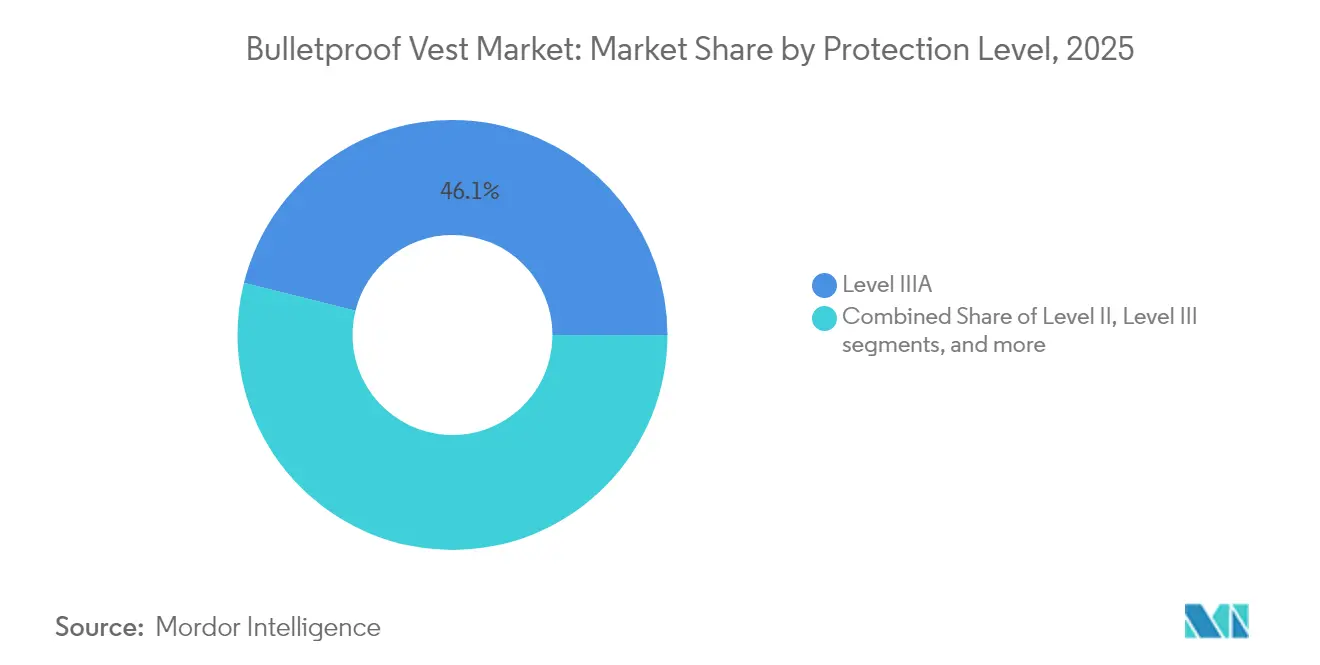
Level IV Acceleration Reflects Threat EscalationLevel IIIA kept a 46.10% sales share in 2025 as the baseline for police patrols. Level IV plates were positioned to expand 3.86% annually as conflict zones normalized the presence of armor-piercing ammunition. NIJ Standard 0123.00 introduced refined rifle-threat definitions that guided agency upgrades from Level III to RF2, nudging demand toward ceramic-composite inserts.
Hybrid silicone-ceramic plates increased V50 thresholds while maintaining shoulder mobility, appealing to special-forces units that required agility in urban terrain. Hardcore Defense validated plate survivability with 30-round endurance tests per threat caliber, exceeding NIJ minimums and inflating customer expectations for empirical data. This proof-based purchasing environment enabled vendors to publish multi-hit curves rather than single-shot pass/fail certificates.
By End User:
Military Dominance Amid Private Security GrowthMilitary procurement represented 72.10% of 2025 demand and was projected to grow 2.95% annually as governments replenished war-stock inventories and fielded updated soldier-system ensembles. The bulletproof vest market share held by armed forces mirrored elevated budgets in East Asia, where total outlays reached USD 411 billion in 2024. Law-enforcement consumption climbed steadily, buoyed by the US Bulletproof Vest Partnership that financed 1.4 million vests since 1999.
Private security emerged as the quickest-growing niche after high-profile CEO targeting spurred corporate spending on bodyguards, lifting allied-universal deployments past 17,000 specialists. Luxury brands and critical infrastructure operators adopted covert plate carriers to mitigate terrorism and civil unrest threats. Military recalls of non-conforming armor in the UK underscored the need for traceability, prompting agencies to negotiate performance-bond clauses that penalized suppliers for latent defects.
Geography Analysis
North America Bulletproof Vest Market
North America retained 42.00% of global sales in 2025 as sustained federal grants and proximity to major prime contractors anchored purchase volumes. Point Blank and Safariland exploited vertical integration to compress lead times. At the same time, US reshoring initiatives heightened site-security spending across new defense-industrial facilities, and some faced 75-point differences in security risk scores within a single metro area. Canada’s 2025 contract award confirmed a regional pipeline of modular plate carriers with delivery slated for 2026.
APAC Bulletproof Vest Market
Asia-Pacific charted a 3.76% CAGR to 2031, propelled by 6.2% year-on-year growth in East-Asian defense budgets and indigenous production scale-ups in India, China, and South Korea. MKU’s Kavro Doma 360 helmet order illustrated the region’s preference for localized supply chains that met fast-track delivery targets for frontline units. Chinese UHMWPE exporters drove price competition, enhancing affordability for emerging Southeast-Asian buyers who balanced capability with budget caps.
Europe Bulletproof Vest Market
Europe underwent structural realignment after the Ukraine war sparked ammunition and armor shortages, prompting EU funding worth EUR 500 million to boost defense manufacturing, including body armor fabrication lines. Germany’s 100,000-unit MOBAST delivery and France’s roll-out of the G3P vest indicated continental commitment to home-grown solutions that met NATO STANAG specifications. Bulgaria’s new 150,000 m² plant broadened European supplier diversity and signaled investor confidence in long-run volume. Ongoing recalls in the United Kingdom highlighted compliance gaps that encouraged agencies to centralize testing at NATO-accredited labs.
Regulatory Landscape
Ballistic vests are governed by test and procurement standards that determine eligibility for public tenders and grant reimbursement. In the United States, National Institute of Justice (NIJ) Standard 0101.07 continues to guide performance verification, with Addendum 3 dated December 1, 2025 clarifying procedures and aligning test-method language with NIJ Standard 0123.00. During the transition, the NIJ 0101.06 Compliant Products List remains accepted for procurement and Bulletproof Vest Partnership reimbursement through at least calendar year 2027, leaving agencies and suppliers to operate under two standard baselines in parallel.
Defense procurement also adds domestic-origin and use-policy constraints. The Berry Amendment (10 U.S.C. 2533a) and DFARS 225.7002 require US Department of Defense body-armor purchases to meet 100% domestic sourcing for fibers, yarns, and end-item manufacturing, which affects supplier qualification and material selection. In Europe, procurement frameworks are being updated as well. The UK Ministry of Defence moved personal hard-armor procurement onto a multi-year framework using the Competitive Flexible Procedure under the Procurement Regulations 2024, while the US Marine Corps MARADMIN 237/25 restricts wear and purchase to issued and approved items, limiting privately purchased commercial off-the-shelf armor in service use.
Value Chain Analysis
The value chain runs from upstream fiber and resin production (para-aramids and UHMWPE), through conversion into woven fabrics and unidirectional composite laminates and ceramic strike-face manufacturing, to final integration by armor OEMs that cut, stack, press, and assemble panels into carriers and plate systems. Upstream supply is concentrated among a small set of global producers (for example, DuPont and Teijin in aramids, and UHMWPE suppliers such as DSM/Avient and Honeywell), so allocation, lead times, and specification lock-in matter for vest assemblers supporting large government call-offs.
Midstream and downstream economics are shaped by certification throughput and trade friction. The NIJ 0101.07 transition, including lab capacity and testing backlogs, affects how quickly new models can be listed for procurement. In parallel, clustered buying cycles, such as grant-funded law-enforcement purchases, can create short-term bottlenecks across laminates, sewing capacity, and trauma pack kitting. Tariff volatility in 2025-2026, including Section 122 and IEEPA-related measures cited by industry sources, increased landed costs for some ballistic-critical inputs. That has pushed manufacturers toward dual-sourcing of fibers (switching between aramid brands or UHMWPE grades), selective vertical integration (weaving or ceramics), and regionalized production footprints, including North America hubs, to reduce exposure to cross-border cost shocks.
Competitive Landscape
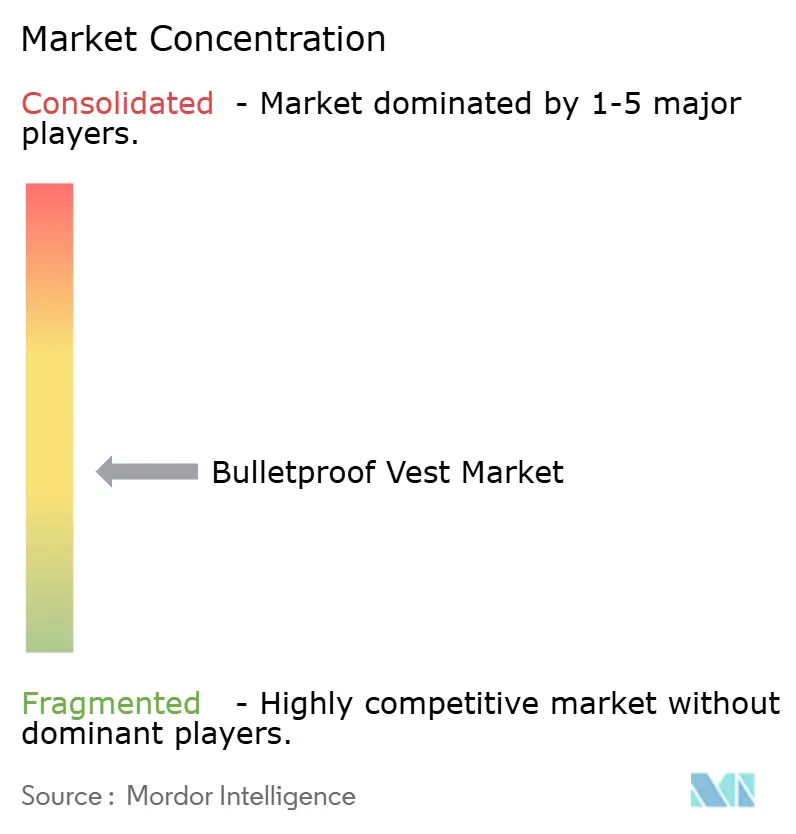
The bulletproof vest market featured moderate fragmentation in 2025: the top players are leaving space for regional specialists and material-science newcomers. Point Blank, Safariland, and Honeywell International capitalized on integrated supply chains spanning fibers, plates, and finished carriers, reducing cycle times and offering tailored kitting options for agency tenders. Cadre Holdings, parent to Safariland, posted record USD 568 million 2024 sales and guided USD 572-601 million for 2025, underscoring sustained demand across duty-gear categories.
Material vendors influenced price and technology pathways; DuPont’s strategic review of Kevlar and Nomex brought speculation about vertical integration by downstream armor manufacturers seeking supply security. Dyneema’s PFAS-free launches are differentiated in sustainability, positioning the brand for European contracts subject to REACH regulations. Start-ups explored mechanically-interlocked 2D polymers with chainmail-like properties that promised step-change performance, attracting venture capital keen on dual-use applications in aerospace and sports.
Quality-assurance scandals reshaped competitive perceptions; firms implicated in counterfeit investigations lost procurement eligibility, transferring orders to compliant rivals. Vendors responded by embedding NFC tags and QR-coded tamper seals that enabled field verification using mobile apps, enhancing traceability in defense logistics pipelines. The resulting digital audit trails emerged as differentiators during multi-year framework tenders.
Bulletproof Vest Industry Leaders
-
Point Blank Enterprises, Inc.
-
Safariland, LLC
-
Central Lake Armor Express, Inc.
-
DuPont de Nemours, Inc.
-
Honeywell International Inc.
- *Disclaimer: Major Players sorted in no particular order
Bulletproof Vest Market Companies Covered in this Report
- Point Blank Enterprises, Inc.
- Safariland, LLC
- Central Lake Armor Express, Inc.
- MKU Limited
- EnGarde B.V.
- ELMON S.A.
- U.S. Armor Corporation
- DuPont de Nemours, Inc.
- Honeywell International Inc.
- Hardshell Ltd.
- Indian Armour Systems Pvt. Ltd.
- ARGUN s.r.o.
- Seyntex N.V.
- MARS Armor
- Zhejiang Hua An Safety Equipment Co. Ltd.
- Survival Armor
- GARED s.r.o.
Market Opportunities and Future Outlook
The NIJ 0101.07 transition is creating a defined replacement and re-qualification runway for manufacturers that can deliver listed products while meeting the standard's conditioning requirements and updated rifle-threat definitions, including the RF2 category referenced in industry technical coverage. It also raises the value of verifiable provenance and compliance, supporting demand for established suppliers with NIJ-listed offerings and traceability practices following prior counterfeit and mislabeling cases.
Material and manufacturing localization programs are also widening partnership and capacity opportunities beyond traditional vest assemblers. In India, DRDO-linked armor programs have pulled ceramics and composite suppliers deeper into defense supply chains; Carborundum Universal Limited (CUMI) publicly positioned its advanced ceramics portfolio across NIJ, BIS, and STANAG 4569 standards (January 2026) and was later named as an armor solutions partner for the DRDO-developed Vikram VT21 platform (July 2026). This points to broader pull-through for ballistic ceramics and hybrid ceramic-UHMWPE stacks used in hard-armor systems. At the same time, multi-year contracting structures, including UK Ministry of Defence frameworks and large US IDIQ vehicles, keep purchasing oriented toward suppliers that can sustain audited quality systems, comply with domestic-origin requirements where mandated (for example, Berry Amendment constraints in US defense), and execute rapid call-offs as operational needs fluctuate.
Recent Industry Developments in Bulletproof Vest Market
- June 2026: Cadre Holdings announced that its subsidiary Safariland was selected as the ballistic panel provider supporting Predictive Ballistics LLC's Overt Armor Kit (OAK) under a five-year, USD 61 million IDIQ contract awarded by the FBI. The award strengthens Safariland's positioning in long-duration US federal law-enforcement supply programs where NIJ-listed performance and scalable production are decisive. It also signals continued procurement preference for integrated providers that can support standardized kits across multiple agency orders.
- May 2025: The US Department of Defense announced that Central Lake Armor Express received a firm-fixed-price, IDIQ award with a maximum value of USD 148.9 million for modular scalable vests and components via DLA Troop Support. The size and structure of the award underscores how IDIQ vehicles concentrate demand into fewer qualified producers and can lock in material planning for aramid and UHMWPE inputs over multiple ordering periods. It also raises competitive pressure on smaller assemblers that lack the capacity and compliance infrastructure needed for sustained federal call-offs.
- April 2024: DRDO's Defence Materials and Stores Research and Development Establishment (DMSRDE) in Kanpur reported development and successful testing of an ultra-light bulletproof jacket offering protection against threat level 6, including testing against 7.62 x 54 R API ammunition. The milestone highlights ongoing national R&D efforts to reduce weight while meeting higher rifle-threat profiles, reinforcing the shift toward advanced composites and optimized vest architectures. Such programs also support domestic qualification pathways that can translate into procurement tenders for locally produced protective equipment.
Bulletproof Vest Market Report Scope and Research Methodology
Market Definition and Coverage
For this study, the bulletproof vest market covers the sale value of wearable ballistic vests designed to protect the torso, across military, law enforcement, and civilian users, and across major regions. The sizing is done in USD value terms for the defined period.
Scope exclusions: The scope excludes ballistic helmets, riot shields, standalone hard plates sold without vests, and vehicle armor kits.
Segments Covered in This Report
- By Product Type
- Soft Vest
- Hard Vest
- By Material
- Aramid Fibers
- UHMWPE Fibers
- Ceramic and Composite Inserts
- Steel and Other Materials
- By Protection Level
- Level II
- Level IIIA
- Level III
- Level IV
- By End User
- Military
- Civilian and Law Enforcement
- By Geography
- North America
- United States
- Canada
- Mexico
- Europe
- United Kingdom
- Germany
- France
- Italy
- Spain
- Russia
- Rest of Europe
- Asia-Pacific
- China
- India
- Japan
- South Korea
- Australia
- Rest of Asia-Pacific
- South America
- Brazil
- Argentina
- Rest of South America
- Middle East and Africa
- Middle East
- Saudi Arabia
- United Arab Emirates
- Turkey
- Rest of Middle East
- Africa
- South Africa
- Rest of Africa
- Middle East
- North America
Data Sources, Market Sizing, and Validation
Desk Research
Desk research was used to map the demand drivers and the procurement cycle that typically shapes vest replacement and new purchases. We reviewed public defense and safety procurement portals, customs and trade statistics (where relevant to aramid and UHMWPE supply), and technical standards documentation such as NIJ guidance that influences what is purchased and when it gets replaced.
To keep assumptions grounded, we also used sources such as government budget documents, parliamentary or congressional hearing notes, law enforcement annual reports, and trade association updates on protective equipment. Company annual reports, investor presentations, and reputable press were then used to cross-check product mix changes and capacity moves, with selective use of paid databases for company financials and patent activity to validate innovation and pricing direction. These desk research sources are illustrative and not exhaustive, and many other public references were used for data collection, validation, and clarification.
Primary Interviews and Surveys
Primary work focused on interviews and short surveys with armor buyers, program managers, distributors, materials specialists, and product leadership roles. The goal was to confirm what is actually being ordered and replaced, and what drives switching between soft and hard configurations. Coverage was balanced across the main regions so that tender timing, currency effects, and protection level preferences could be sanity checked, and then used to tune the model inputs.
Distribution of primary research fieldwork respondents
| Company type | Respondent position | Region |
|---|---|---|
| Top tier: 33% | CXOs: 17% | APAC: 41% |
| Mid tier: 49% | Functional/Unit leaders: 26% | EMEA: 34% |
| Smaller Players: 18% | Managers: 57% | Americas: 25% |
Market-Sizing & Forecasting
The core sizing logic uses a top-down build where defense and public safety spending signals, tender calendars, and replacement cycles are translated into an addressable demand pool, and then applied to vest adoption and mix by protection level. The totals are corroborated with selective bottom-up checks, such as sampled contract award values, distributor channel checks, and ASP-by-type multiplied by estimated unit volumes, which are then adjusted when gaps appear.
Key inputs we track include the split between soft and hard vests, the mix by common protection levels (for example, Level II and Level IIIA patterns for routine policing versus higher level needs in certain deployments), raw material cost direction for aramid and UHMWPE, and the share of purchases coming from program tenders versus commercial channels. Forecasting is done using scenario analysis supported by trend smoothing, where procurement timing, modernization cycles, and pricing progression assumptions are stress tested with primary feedback before the final outlook is locked.
Data Validation & Update Cycle
Model outputs are triangulated against independent signals such as procurement award patterns, reported shipment activity in public announcements, and budget allocation shifts. We then review results for outliers at the region and end-user level. When a variance is large, the assumptions are rechecked, and if needed, respondents are re-contacted to confirm whether the change is due to timing, product mix, or price movement.
Before sign-off, the estimates pass through multi-step internal review so that scope boundaries, conversion logic, and growth drivers stay consistent across sections. The report is refreshed annually, with interim updates for material events, and a final pre-delivery check is completed so clients receive the latest updated view.
Mordor Intelligence's Bulletproof Vest Market Estimate Compared With Other Published Estimates
Published market values for bulletproof vests can vary even when the topic sounds similar, because the year used, the included protection products, and the way pricing is handled are not always aligned. Differences also come from how procurement timing is treated, since large contracts can shift value between years even when unit demand stays steady.
In our model, the refresh cadence and currency timing are kept consistent with the latest procurement and materials signals, and ASP logic is revalidated against current mix changes before the final number is published. This is a key reason the bulletproof vest market value on Mordor Intelligence can land below or above other public figures.
Benchmark comparison
| Source | Market Size | Gaps in Research Methodology |
|---|---|---|
| Mordor Intelligence | USD 1.82 B (2026) | |
| Industry Publisher A | USD 1.84 B (2025) | Uses a different base year and product boundary that explicitly includes hard armor plates as a product line, which can pull more value into the counted scope when plate demand spikes in tender years. |
| Industry Publisher B | USD 2.10 B (2024) | Anchors the estimate to an earlier base year and applies a broader price progression path, which can lift the headline value when inflation and currency conversion are not aligned to the same timing window. |
The spread in the table is mainly explained by base-year selection and how adjacent items like plates and price progression are treated inside the scope. By keeping the inputs tied to observable procurement timing, protection-level mix, and repeatable pricing checks, the estimate stays traceable and practical for planning.
Key Questions Answered in the Report
What is the current value of the bulletproof vest market?
It stood at USD 1.82 billion in 2026 and is projected to reach USD 2.15 billion by 2031, witnessing a 3.35% CAGR.
Which segment dominates the bulletproof vest market?
Hard vests dominated with 82.95% revenue share in 2025 due to military preference for multi-hit rifle protection.
Who are the key players in Bulletproof Vest Market?
Central Lake Armor Express, Inc., Safariland, LLC, Honeywell International Inc., Dupont De Nemours Inc. and Point Blank Enterprises, Inc. are the major companies operating in the bulletproof vest market.
Why is UHMWPE gaining popularity over aramid?
UHMWPE offers higher energy absorption at lower weight and is expanding at a 3.95% CAGR through 2031.
Which region is growing the fastest?
Asia-Pacific is forecast to grow at 3.76% CAGR as defense modernization accelerates across East Asia and South Asia.
How are counterfeit vests affecting the market?
Fraudulent products have triggered recalls, legal actions and stricter authentication requirements, slightly dampening CAGR growth by an estimated 0.4%.
What impact will new NIJ standards have on procurement?
Updated NIJ 0101.07 and NIJ 0123.00 add gender-specific fit and refined rifle-threat levels, leading agencies to upgrade inventories sooner than planned to remain compliant.