
Breast Pumps And Nursing Accessories Market Size and Share
Market Overview
| Study Period | 2019 - 2030 |
|---|---|
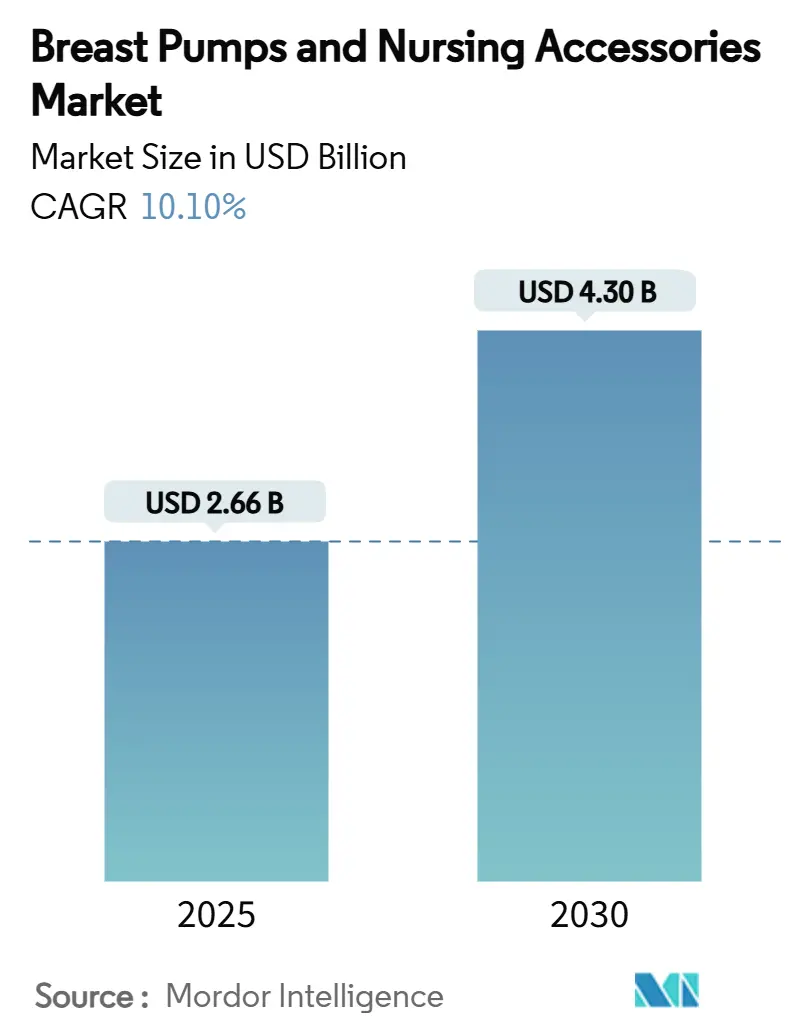
| Market Size (2025) | USD 2.66 Billion |
| Market Size (2030) | USD 4.30 Billion |
| Growth Rate (2025 - 2030) | 10.10 % |
| Fastest Growing Market | Asia Pacific |
| Largest Market | North America |
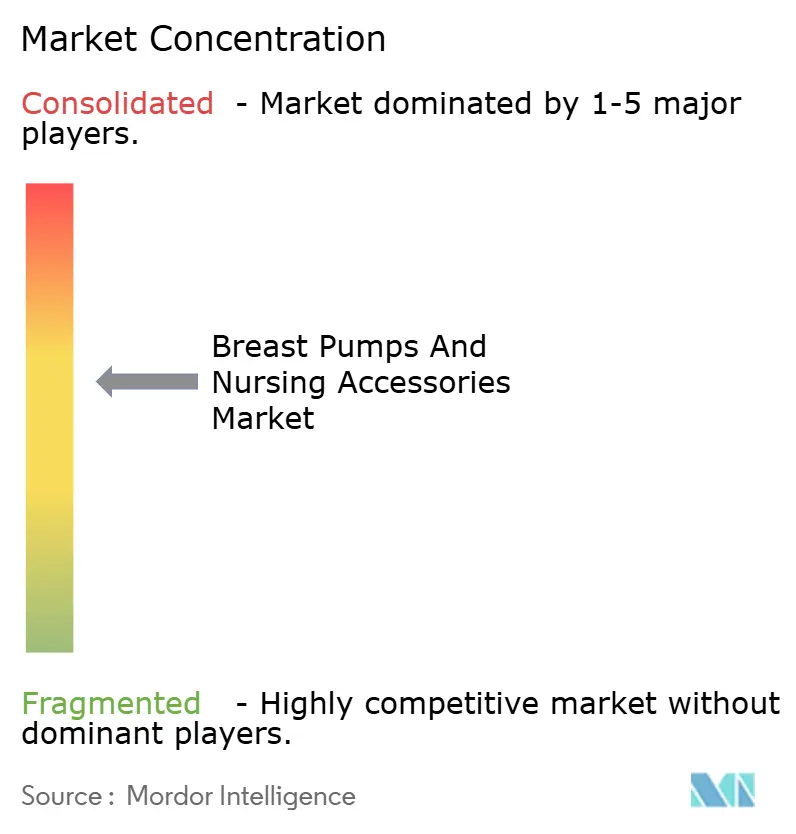
| Market Concentration | Medium |
Major Players *Disclaimer: Major Players sorted in no particular order Image © Mordor Intelligence. Reuse requires attribution under CC BY 4.0. | |
Breast Pumps And Nursing Accessories Market Analysis by Mordor Intelligence
The breast pumps and nursing accessories market size stood at USD 2.66 billion in 2025 and is forecast to reach USD 4.30 billion by 2030, expanding to a 10.1% CAGR. Growing female workforce participation, mandatory insurance reimbursement for breast pumps, and rapid advances in wearable smart-pump design are the primary engines behind this expansion. Firms differentiate through sensor-rich, app-controlled devices that convert pumping into a data-guided maternal-health routine. National laws that oblige employers to provide dedicated lactation spaces add a structural layer of demand, while nearshoring and 3-D printing initiatives are mitigating component shortages. Together, these forces signal a shift from viewing breastfeeding as a private choice toward treating it as a public-health infrastructure need.
Key Report Takeaways
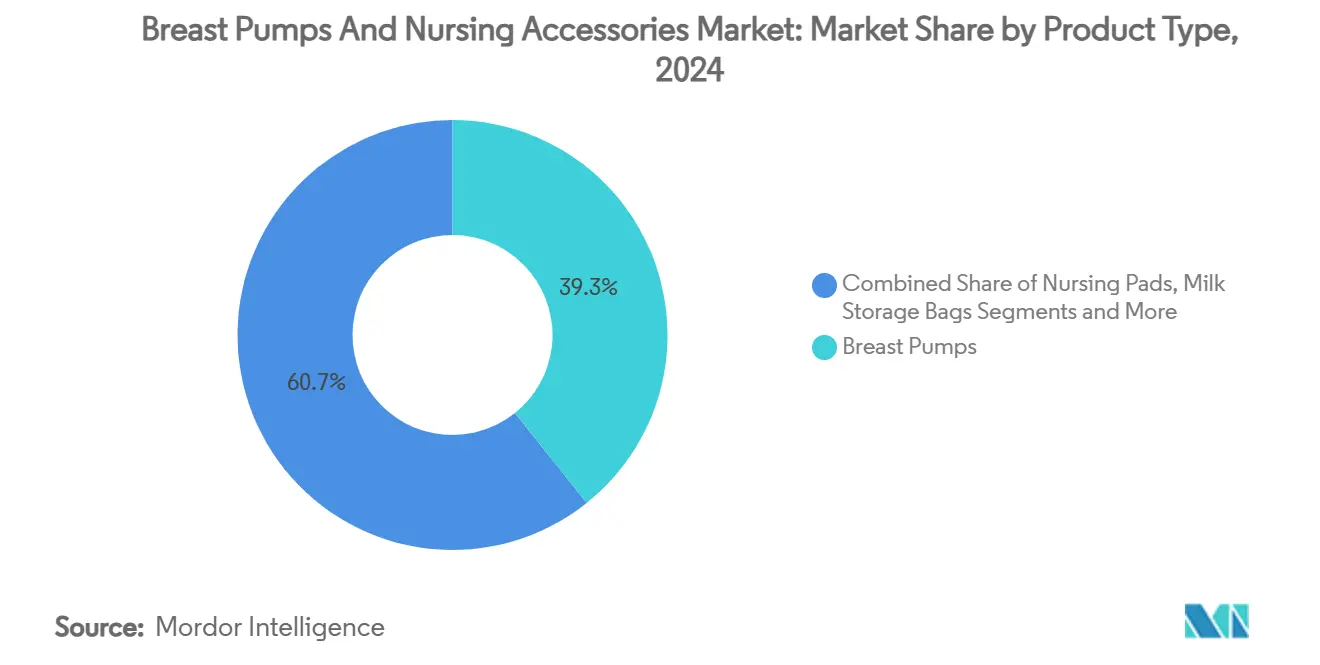
- By product type, breast pumps led with 39.3% of breast pumps and nursing accessories market share in 2024, while wearable smart pumps are projected to grow at a 14.5% CAGR through 2030.
- By technology, electric pumps accounted for 20.8% share of the breast pumps and nursing accessories market size in 2024, and wearable smart electric pumps are advancing at a 14.5% CAGR to 2030.
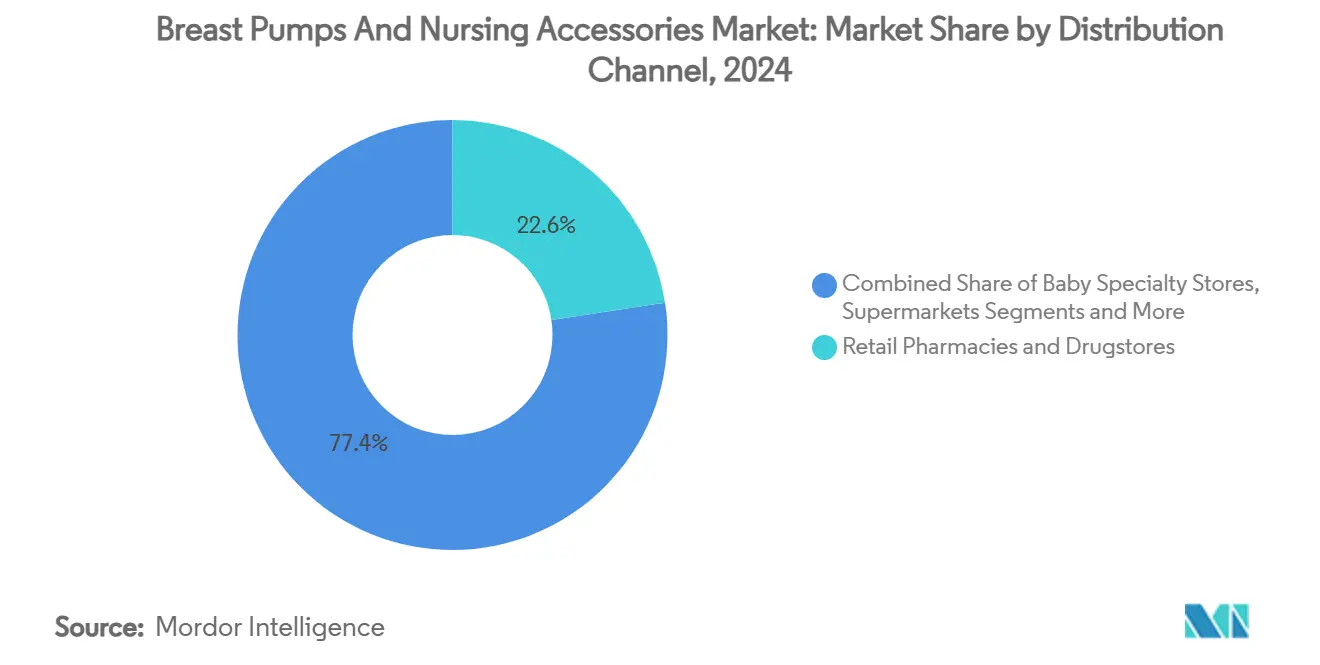
- By distribution channel, retail pharmacies and drug stores held a 22.6% share in 2024; online/e-commerce is rising at a 12.0% CAGR through 2030.
- By end user, the personal/homecare segment captured a 33.2% share in 2024 and will expand at an 11.5% CAGR to 2030.
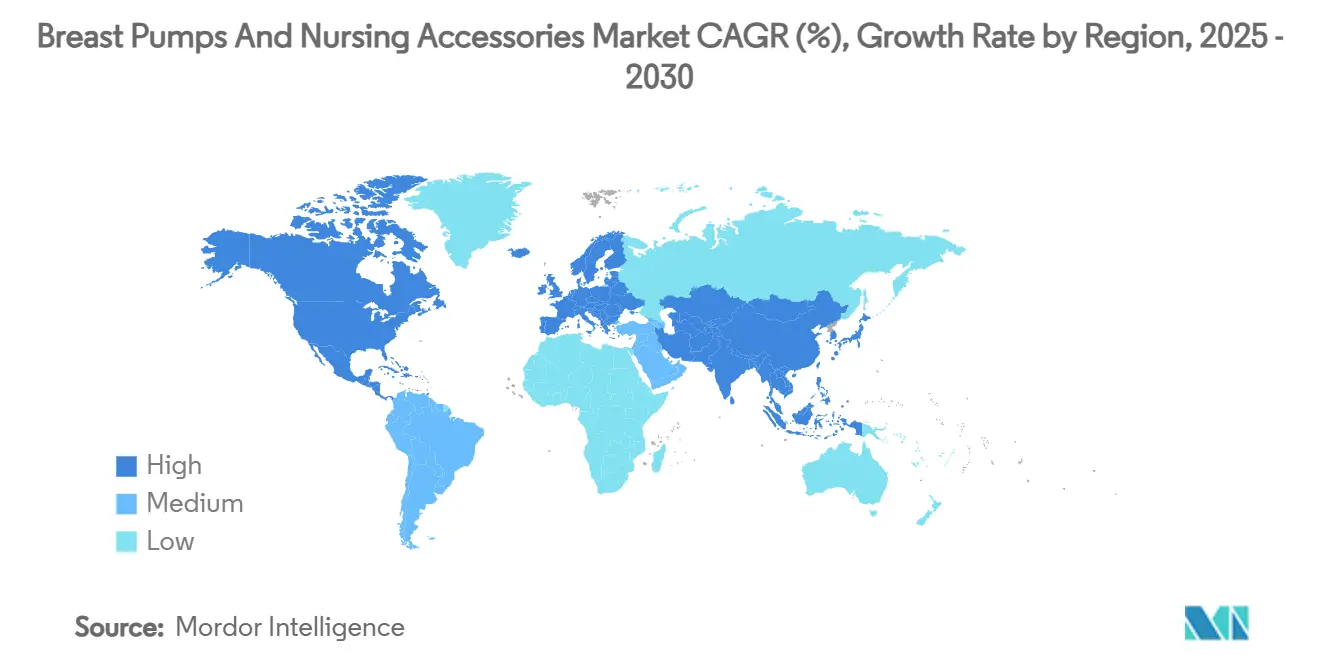
- By region, North America dominated with a 26.3% revenue share in 2024; Asia-Pacific is the fastest-growing region, with a 9.8% CAGR to 2030.
Note: Market size and forecast figures in this report are generated using Mordor Intelligence’s proprietary estimation framework, updated with the latest available data and insights as of January 2026.
Market Trends and Insights
Drivers Impact Analysis of Breast Pumps And Nursing Accessories Market*
| Driver | (~) % Impact on CAGR Forecast | Geographic Relevance | Impact Timeline |
|---|---|---|---|
| Rising Female Workforce Participation & Insurance Coverage For Breast Pumps | +2.10% | Global, with strongest impact in North America & Europe | Medium term (2-4 years) |
| Technological Advances in Wearable & Smart Pumps With App-Integration | +2.80% | Global, led by North America & Asia Pacific | Short term (≤ 2 years) |
| Increasing Awareness Of Exclusive-Breastfeeding Benefits Via Public Health Campaigns | +1.40% | Global, with emerging market focus | Long term (≥ 4 years) |
| Employer Mandates For Workplace Lactation Rooms In Major Economies | +1.90% | North America, Europe, select Asia Pacific markets | Medium term (2-4 years) |
| Demand For Eco-Friendly, BPA-Free Accessories Driven By Chemical-Safety Regulation | +0.80% | Global, with premium market concentration | Long term (≥ 4 years) |
| IoT-Enabled Lactation Analytics Services Offering Personalised Guidance | +1.20% | North America, Europe, urban Asia Pacific | Short term (≤ 2 years) |
| Source: Mordor Intelligence | |||
Rising Female Workforce Participation and Insurance Coverage for Breast Pumps
Insurance mandates that classify breast pumps as essential medical devices have removed cost barriers and anchored a predictable demand floor. After the Affordable Care Act expanded pump reimbursement, United States patent filings for lactation devices climbed markedly, showing how payer policy accelerates innovation.[1] Similar coverage rules in Europe are lowering out-of-pocket costs for premium wearable models and are most attractive to professional women who value productivity gains from hands-free devices.
Technological Advances in Wearable and Smart Pumps with App Integration
Wearable pumps integrate bioimpedance sensors that deliver real-time milk-flow data, turning extraction into an evidence-based activity. A Northwestern University prototype demonstrated accurate, continuous milk-volume tracking that removes the uncertainty that often prompts early weaning. Companion smartphone apps employ AI chatbots that raise breastfeeding self-efficacy, with clinical studies showing higher rates of exclusive breastfeeding when mothers use interactive guidance tools.
Increasing Awareness of Exclusive Breastfeeding Benefits
Public-health outreach now highlights maternal health gains such as lower cardiovascular risk alongside infant nutrition advantages, broadening appeal. World Breastfeeding Week 2025’s theme explicitly calls for sustained systemic support, prompting hospitals and community organizations to add milk-expression education to messaging campaigns. Singapore’s multi-pronged approach—media outreach, workplace programs, and milk-donation banks has lengthened breastfeeding duration, illustrating how integrated campaigns translate into higher pump utilization.[2]
Employer Mandates for Workplace Lactation Rooms
The PUMP Act extended legal protection to roughly 9 million additional U.S. employees, obliging companies to offer time and space for milk expression. New York State raised the standard further by requiring up to 30 minutes of paid lactation time starting June 2024.[3]Comparable rules appear in Europe and parts of Asia, stimulating a discrete B2B market for hospital-grade multi-user pumps and modular lactation pods.
Restraints Impact Analysis of Breast Pumps And Nursing Accessories Market*
| Restraint | (~) % Impact on CAGR Forecast | Geographic Relevance | Impact Timeline |
|---|---|---|---|
| High Upfront Cost & Limited Reimbursement In Emerging Markets | -1.80% | Asia Pacific, Latin America, Middle East & Africa | Medium term (2-4 years) |
| Social Stigma & Cultural Barriers To Public Pumping | -1.20% | Asia Pacific, Middle East & Africa, select European markets | Long term (≥ 4 years) |
| Supply-Chain Vulnerability Of Medical-Grade Silicone & Micro-Motors | -1.50% | Global, with manufacturing concentration in Asia Pacific | Short term (≤ 2 years) |
| Counterfeit/Low-Quality Accessories On E-Commerce Platforms Eroding Brand Trust | -0.90% | Global, with highest impact in unregulated online markets | Medium term (2-4 years) |
| Source: Mordor Intelligence | |||
High Upfront Cost and Limited Reimbursement in Emerging Markets
Premium wearable pumps retail between USD 300–600, a level that exceeds average monthly incomes in many emerging economies. Survey data from urban China show strong willingness to breastfeed if financial support exists, yet only partial reimbursement is available. Manufacturers face a margin squeeze because medical-device supply chains now consume up to 20% of revenue, limiting their ability to lower prices without eroding profitability.
Social Stigma and Cultural Barriers to Public Pumping
In parts of Asia, mothers report embarrassment when expressing milk in public spaces despite high awareness of breastfeeding benefits. Similar discomfort is observed among first-time mothers in Middle Eastern workplaces. Social norms, therefore, dampen the adoption of wearable pumps, whose value proposition depends on discreet use in communal environments. Education programs that combine cultural sensitivity with practical demonstrations show the greatest success in mitigating stigma.
*Our forecasts treat driver/restraint impacts as directional, not additive. The impact forecasts reflect baseline growth, mix effects, and variable interactions.
Breast Pumps And Nursing Accessories Market Segment Analysis
By Product Type:
Breast Pumps Dominate Despite Wearable InnovationBreast pumps held 39.3% of the breast pumps and nursing accessories market share in 2024, underscoring their role as the system’s anchor. The breast pumps and nursing accessories market size for wearable smart pumps is projected to climb to 14.5% CAGR by 2030 as consumers gravitate toward hands-free convenience. Nursing pads remain staple add-ons, while milk-storage bags benefit from higher pumping frequency among working mothers.
Traditional manufacturers are retrofitting core models with smart modules to match wearable advantages. Medela’s hospital-grade line now offers in-bra shells that pair with a mobile dashboard, blending performance with discretion. Complementary accessories increasingly use BPA-free plastics to comply with chemical-safety directives in Europe and North America.

By Technology:
Electric Pumps Lead While Wearable Smart Electric SurgesElectric pumps represented 20.8% of the breast pumps and nursing accessories market share in 2024 because insurance plans prefer proven, hospital-grade designs. At the same time, the breast pumps and nursing accessories market size for wearable smart electric pumps is expanding at a 14.5% CAGR through 2030. Manual pumps still serve occasional users, whereas portable battery units occupy a middle ground for women transitioning to fully wearable systems.
Bioimpedance sensors embedded in next-generation wearables deliver continuous milk-volume data, opening a path to predictive lactation analytics. A university study validated these sensors against gold-standard gravimetric measurements, confirming clinical-grade accuracy. This capability positions smart electric pumps as premium tools within a broader connected-care ecosystem.
By Distribution Channel:
Retail Pharmacies Anchor Sales While E-commerce DisruptsRetail pharmacies controlled 22.6% of 2024 revenue because health-insurance reimbursements are easiest to redeem in that setting. Online platforms, however, are growing at 12.0% CAGR as parents seek wider assortments and discreet delivery. Hospital pharmacies remain vital for dispensing multi-user pumps, and baby specialty stores differentiate through personalized fitting sessions.
The e-commerce boom has a darker side: counterfeit pumps lacking medical-grade plastics have surfaced on large marketplaces, exposing users to safety risks. To preserve trust, manufacturers now place serialization tags on packaging and encourage direct-to-consumer sales. Major platforms have responded by tightening seller verification and delisting non-compliant listings.
By End User:
Personal/Homecare Dominates Across Share and GrowthThe personal/homecare segment captured 33.2% of 2024 revenue and is forecast to rise at an 11.5% CAGR as employers formalize lactation policies that favor at-work pumping with personal devices. Hospitals and maternity wards keep demanding high-throughput, sterilizable systems, while lactation consultants deploy loaner pumps for trial before purchase.
Telelactation services are reinforcing home-based pumping. A RAND Corporation trial found that 70.6% of mothers who received virtual lactation support were breastfeeding at 24 weeks, compared with 66.8% in the control group. Integration of virtual coaching with smart-pump dashboards accelerates skill acquisition and prolongs lactation duration.
Geography Analysis
North America Breast Pumps and Nursing Accessories Market
North America commanded 26.3% of 2024 revenue, supported by longstanding insurance mandates and the 2025 PUMP Act expansion that added millions of covered employees. Paid lactation breaks in states such as New York further institutionalize demand and nudge employers to invest in superior pumping rooms and hospital-grade devices. Wearable pumps resonate with time-pressed professionals who value silent operation and data feedback.
APAC Breast Pumps and Nursing Accessories Market
Asia-Pacific is the fastest-growing region at a 9.8% CAGR through 2030 despite persistent cultural headwinds. Surveyed Chinese mothers rated the need for systematic breastfeeding guarantees at 4.42 out of 5, signaling openness to change when supportive policies are present. In Thailand, factory audits revealed that while breastfeeding corners exist, a lack of official milk-expression breaks forces women to squeeze sessions into meal periods, demonstrating a gap technology can help close.
EMEA and South America Breast Pumps and Nursing Accessories Market
Europe maintains steady momentum under harmonized maternity-leave laws and chemical-safety regulations that favor premium, BPA-free materials. Middle East & Africa and South America offer untapped potential but face affordability constraints and slower cultural normalization. Telehealth lactation support shows promise for bridging geographical barriers, as confirmed by pilot programs that improved breastfeeding persistence in rural areas.
Competitive Landscape
Industry structure is moderately fragmented. The 2025 acquisition of Elvie assets by Willow united two pioneers in wearable, all-in-bra pumps and eliminated a costly patent dispute, enabling deeper investment in R&D and marketing. Medela retains leadership by leveraging hospital relationships and expanding into smart accessories such as app-synced milk-storage trackers.
Supply-chain resilience differentiates winners. Silicone-seal shortages in 2024-2025 spurred leading firms to nearshore component production and adopt 3-D-printed molds that slash tooling lead times. Firms that secured local capacity restored inventory faster and defended shelf space.
Digital-health convergence opens white-space opportunities. UC San Diego researchers trained an AI model that identifies nipple trauma from phone images with clinician-level accuracy, setting the stage for self-directed triage tools that integrate with pump apps. Companies able to package hardware, software, and tele-lactation services are positioned to command premium pricing and longer customer lifecycles.
Breast Pumps And Nursing Accessories Industry Leaders
-
Medela AG
-
Pigeon Corporation
-
Koninklijke Philips N.V.
-
Ameda Inc.
-
Willow Innovations Inc.
- *Disclaimer: Major Players sorted in no particular order
Breast Pumps And Nursing Accessories Market Companies Covered in this Report
- Medela
- Pigeon Corp / Lansinoh Laboratories
- Koninklijke Philips N.V. (Philips Avent)
- Ameda Inc.
- Willow Innovations Inc.
- Elvie (Chiaro Technology)
- Spectra (Uzinmedicare)
- Motif Medical
- Ardo Medical
- Hygeia Health
- Tommee Tippee (Mayborn Group)
- Evenflo Feeding Inc.
- Nuk (MAPA GmbH)
- Chicco (Artsana Group)
- Haakaa
- Nanobébé
- MAM Baby
- Dr Brown’s (Handi-Craft)
- Perrigo Company
- Cimilre
- Freemie (Dao Health)
- BabyBuddha Products
- Baby K’Tan
Recent Industry Developments in Breast Pumps And Nursing Accessories Market
- March 2025: Willow Innovations announced the completion of its acquisition of key Elvie assets, creating a consolidated wearable-pump portfolio and settling all outstanding patent litigation.
- March 2025: LactaLogics secured USD 92 million to expand its human-milk processing facility in Florida, aiming to launch room-temperature donor-milk products.
- October 2024: Willow received FDA clearance for its Generation 3 pump featuring improved suction algorithms and upgraded app connectivity.
- June 2024: New York State began enforcing a paid lactation-break mandate, requiring employers to provide up to 30 minutes of paid time for milk expression.
Global Breast Pumps And Nursing Accessories Market Report Scope
| Breast Pumps |
| Nursing Pads |
| Milk Storage Bags & Bottles |
| Nipple-Care Products |
| Breastfeeding Apparel & Wearables |
| Other Accessories |
| Manual |
| Battery-powered Electric |
| Plug-in Electric |
| Wearable Smart Electric |
| Hospital Pharmacies |
| Retail Pharmacies & Drugstores |
| Baby Specialty Stores |
| Super/Hyper-markets |
| Online/E-commerce |
| Personal / Homecare |
| Hospitals & Maternity Wards |
| Lactation Consultant Clinics |
| North America | United States |
| Canada | |
| Mexico | |
| Europe | Germany |
| United Kingdom | |
| France | |
| Italy | |
| Spain | |
| Rest of Europe | |
| Asia Pacific | China |
| Japan | |
| India | |
| South Korea | |
| Australia | |
| Rest of Asia Pacific | |
| Middle East & Africa | GCC |
| South Africa | |
| Rest of Middle East & Africa | |
| South America | Brazil |
| Argentina | |
| Rest of South America |
| By Product Type | Breast Pumps | |
| Nursing Pads | ||
| Milk Storage Bags & Bottles | ||
| Nipple-Care Products | ||
| Breastfeeding Apparel & Wearables | ||
| Other Accessories | ||
| By Technology | Manual | |
| Battery-powered Electric | ||
| Plug-in Electric | ||
| Wearable Smart Electric | ||
| By Distribution Channel | Hospital Pharmacies | |
| Retail Pharmacies & Drugstores | ||
| Baby Specialty Stores | ||
| Super/Hyper-markets | ||
| Online/E-commerce | ||
| By End-User | Personal / Homecare | |
| Hospitals & Maternity Wards | ||
| Lactation Consultant Clinics | ||
| By Geography | North America | United States |
| Canada | ||
| Mexico | ||
| Europe | Germany | |
| United Kingdom | ||
| France | ||
| Italy | ||
| Spain | ||
| Rest of Europe | ||
| Asia Pacific | China | |
| Japan | ||
| India | ||
| South Korea | ||
| Australia | ||
| Rest of Asia Pacific | ||
| Middle East & Africa | GCC | |
| South Africa | ||
| Rest of Middle East & Africa | ||
| South America | Brazil | |
| Argentina | ||
| Rest of South America | ||
Key Questions Answered in the Report
What is the 2025 value of the breast pumps and nursing accessories market?
The market recorded USD 2.66 billion in 2025.
How fast is the market expected to grow?
It is projected to expand at a 10.10% CAGR, reaching USD 4.30 billion by 2030.
Which product segment is growing the quickest?
Wearable smart pumps are forecast to grow at 14.5% CAGR through 2030.
Why is Asia-Pacific the fastest-growing region?
Rising female workforce participation, improving workplace policies, and growing acceptance of pumping technology support a 9.8% CAGR.
How do workplace laws influence demand?
Statutes such as the U.S. PUMP Act and New York’s paid lactation-break requirement compel employers to invest in pumps and lactation rooms, boosting sales.
What is the main challenge in emerging markets?
High upfront device costs and limited insurance reimbursement constrain adoption despite strong interest.